X (Twitter) API Pricing: Complete Guide for 2026
X API pricing in 2026: the April rate card, why follows and likes were cut from self-serve, the $0.20 URL tax, and webhook billing most guides miss.
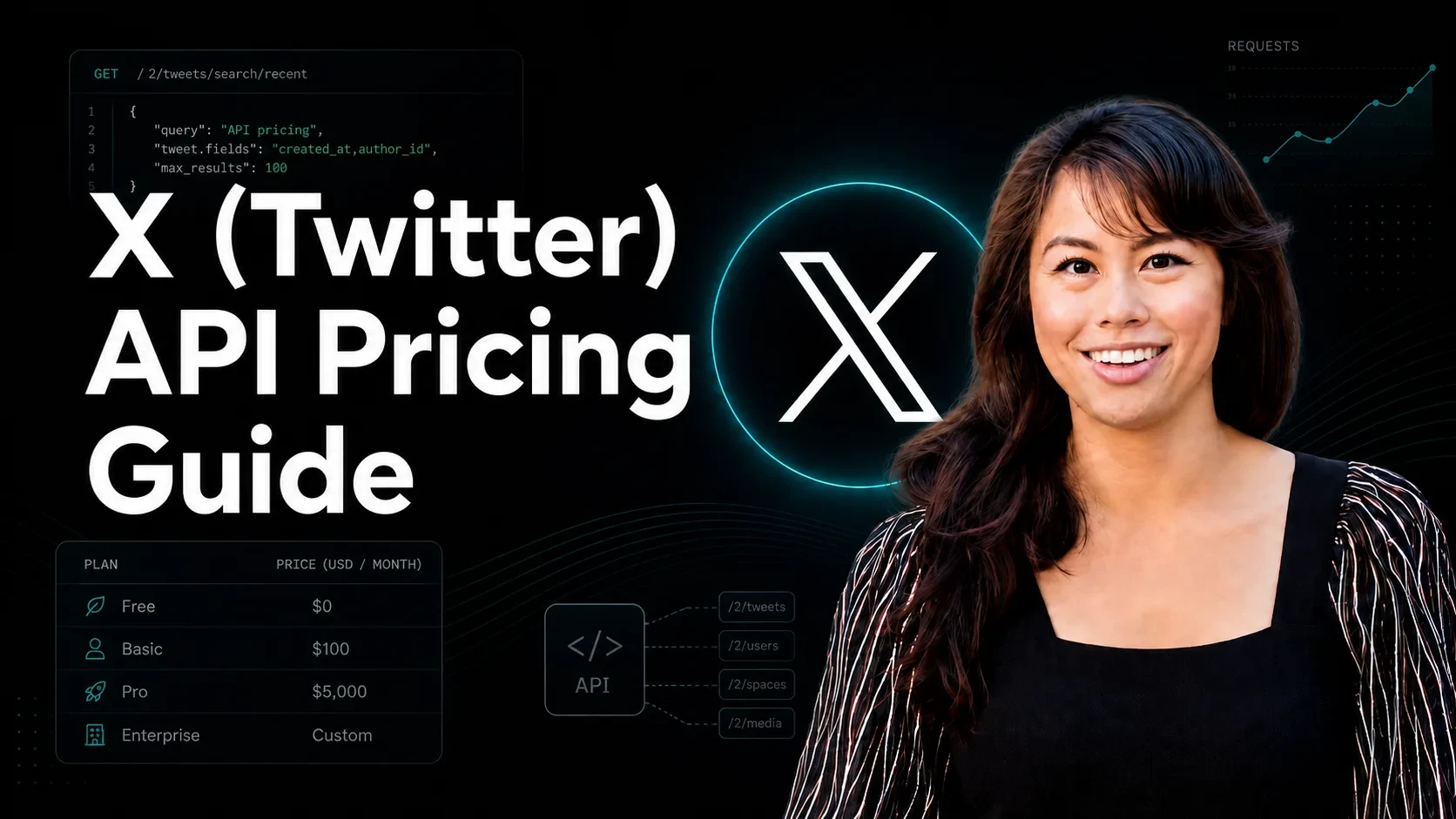
If you’re trying to figure out X (Twitter) API pricing in 2026, the short version is this: there is no real free tier anymore, the default for new developers is pay-per-use, and the rules changed again in April. The math gets ugly fast if you’re posting at any kind of volume.
How much does the X (Twitter) API cost in 2026? New developers default to pay-per-use: $0 base plus per-call charges, capped at 3 million post reads per month. Both flat tiers are on their way out: legacy Basic ($200/mo) subscribers were force-migrated to pay-per-use after June 1, 2026, and X announced on August 14, 2026 that legacy Pro ($5,000/mo) is deprecated too, with every remaining Pro subscriber migrating automatically after September 1, 2026 at their own cutover date. There is no meaningful free tier left, no flat self-serve tier to fall back on, and the per-call math climbs fast at real posting volume. If you only need to publish and schedule to X, a wrapper like Blotato skips the pay-per-use meter, and its MCP server lets Claude Code and other AI agents post to X without touching the API directly.
I’ve watched a few founder friends get burned trying to build directly on the X API this year. So I want to lay out exactly what it costs in 2026, walk through real-world dollar amounts at different usage levels, and be honest about when it makes sense to skip the X API entirely and use a wrapper like Blotato instead.
This is the no-fluff version. If you want the official policy doc, X has one. If you want to know what you’ll actually pay, keep reading.
X API Pricing at a Glance (2026)
| Tier | Monthly cost | Best for | Key limit |
|---|---|---|---|
| Pay-per-use | $0 base + per-call charges | New developers, low-volume use | 3 million post reads/month |
| Basic (legacy) | $200/mo | Retired | Subscribers migrated to pay-per-use after June 1, 2026 |
| Pro (legacy) | $5,000/mo | Deprecated | Subscribers auto-migrate to pay-per-use at their cutover date after September 1, 2026 |
| Enterprise | $42,000+/mo | Heavy data buyers | Custom terms |
Pay-per-use is the only path for anyone signing up today, and the only destination for legacy Basic and Pro accounts as well. Both flat tiers have been deprecated, with each remaining Pro subscription ending automatically at its cutover date after September 1, 2026. Enterprise is a sales conversation, not a self-serve product.
Six Things Developers Actually Build on the X API
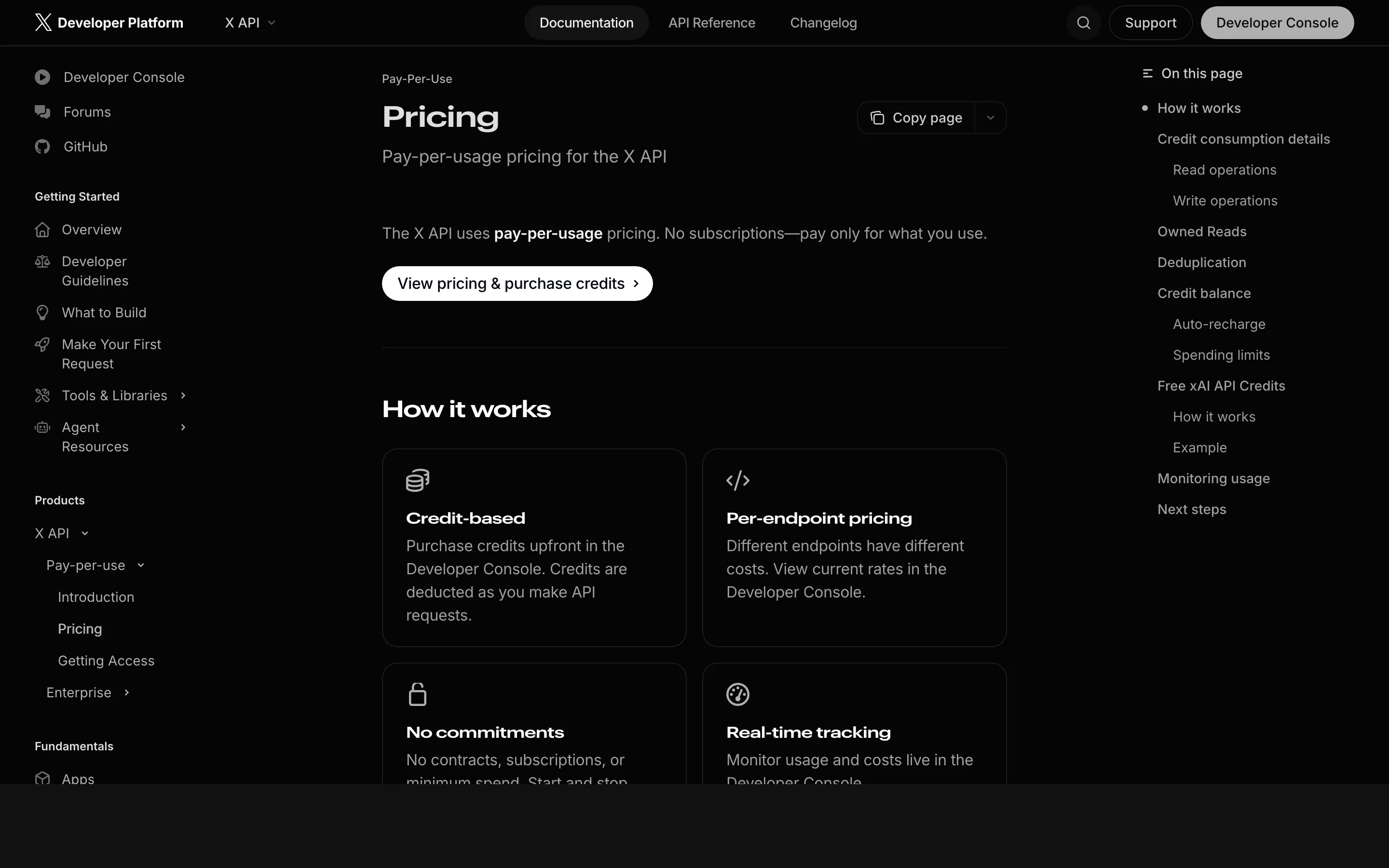
Budget first, because on X the meter starts before anything else does. There is no free tier to prototype in and no subscription to sit behind. You load credits at console.x.com, create an app inside a project, and successful calls draw the balance down. Owned reads are $0.001 per resource, a plain post is $0.015, and a post carrying a URL is $0.200, which makes a link cost more than 13 times a plain one. For a workflow that publishes links at volume, that single ratio moves the bill more than the base rate ever will.
What the credits buy is the v2 REST surface: Posts, users, Spaces, direct messages, lists, and trends. Six build patterns account for most of it. Publishing and scheduling. Reading data you already own, the cheapest line on the card. Searching the public conversation, where the 3 million monthly post-read cap starts to matter. Managing lists and users. Pulling Spaces metadata. Receiving webhook events instead of polling for mentions and DMs.
Engagement automation is the pattern to check before you design around it. Follows, likes and quote-posts through API writes changed on April 20, 2026, and the rate card no longer prices them as their own line item. The next section covers exactly what moved and what it means for an automation you already have running.
Onboarding for the core API is light. X asks you to describe your intended use and reviews that description for policy compliance, with AI and bot use cases drawing extra scrutiny, but there is no partner application or screencast of the kind Meta and LinkedIn require. The Account Activity webhook surface is the exception: it has its own application step in the portal, so budget for that if event delivery is part of your design.
What Changed in 2026 (Updated August 2026)
The headline shift: X retired the old flat-fee model for new developers. Instead of paying a monthly fee for a bucket of calls, you now load credits into the developer console and get charged per API request. New developers can no longer sign up for the old $200 Basic or $5,000 Pro plans, and X announced on August 14, 2026 that existing Pro subscribers cannot stay on one either.
The most recent rate change landed on April 20, 2026, and X announced it in a developer forum post rather than a press release, which is why so many pricing guides still quote the pre-April numbers.
Here’s how the current rate card breaks down for the things most people build:
- “Owned reads” (your own posts, bookmarks, followers, lists) are $0.001 per resource. That’s the cheapest line item, and it’s a win for most publishing use cases.
- Standard writes (creating a text or media post without a URL) are $0.015 per request.
- Posts containing a URL are $0.20 per request. That’s more than 13x the price of a plain-text post, and it lands on anyone auto-posting links.
Interaction actions went the other way, and this is the change most guides still get wrong. As of April 20, 2026, following, liking, and quote-posting via API writes were removed from all self-serve tiers entirely. Every guide quoting a price for them is quoting a line item that no longer exists. That covers POST /2/users/{id}/following (and unfollow), POST /2/users/{id}/likes (and unlike), and quote-posting via the quote_tweet_id parameter on POST /2/tweets.
If you built an engagement workflow that auto-follows or auto-likes on pay-per-use, it does not have a new price. It has no path on self-serve at all. Check your error logs before you check your invoice.
One more line item worth knowing: summoned replies stayed at $0.01, so a reply triggered by a mention is not hit by the $0.20 URL tax the way an ordinary link post is.
Net effect: light publishers reading their own data win big. Anyone posting links at volume pays a real premium. Anyone automating engagement is off the self-serve menu.
Pay-Per-Use, in Plain English
Every API call costs something. Here’s the cheat sheet:
| Operation | Price |
|---|---|
| Read your own post (owned read) | $0.001 per resource |
| Read a third-party post | $0.005 per resource |
| Read a user, following, followers, trends | $0.010 per resource |
| Create a text or media post (no URL) | $0.015 per request |
| Create a post containing a URL | $0.20 per request |
| Send a DM | $0.015 per request |
| User management actions (block, mute) | $0.015 per request |
| Delete a post | $0.010 per request |
| Create a summoned reply | $0.010 per request |
| Follow, like, quote-post | Removed from self-serve tiers (April 20, 2026) |
A few things to keep in mind:
The 24-hour deduplication rule is your friend, but do not budget on it. If you fetch the same post or user profile more than once within a UTC day, you’re only charged for the first request, and the window resets at midnight UTC. This protects you when a webhook re-fires or a polling job double-runs. The caveat is in X’s own docs: deduplication is a “soft guarantee.” It works in the vast majority of cases, but edge cases like service outages can result in resources not being deduplicated. Treat it as a discount you usually get, not a line you can forecast against.
Per-resource pricing means batched requests still cost real money. A single API call that returns 100 posts isn’t $0.005. It’s $0.005 multiplied by 100. This is the line item that catches almost everyone off guard.
The URL-post tax is the headline gotcha. A standard post is $0.015. A post containing any URL is $0.20. If you’re auto-publishing newsletter links, blog posts, YouTube videos, affiliate URLs, or anything with https:// in the body, every post is more than 13x more expensive than a plain-text post. Run the math before you ship a workflow that does this at volume.
Webhooks are billed too, and half of them are free. This is the part almost nobody budgets for. Events delivered through the X Activity API bill per event delivered, deduplicated in the same 24-hour UTC window as everything else. The useful pattern is that inbound events cost money and your own outbound actions do not:
| Webhook event | Cost per event |
|---|---|
post.create | $0.005 |
follow.follow / follow.unfollow | $0.010 |
dm.received | $0.010 |
chat.received | $0.010 |
profile.update.* | $0.005 |
news.new | $0.005 |
spaces.start / spaces.end | $0.005 |
post.delete | Not billed |
dm.sent, dm.read, dm.indicate_typing | Not billed |
chat.sent, chat.conversation_join | Not billed |
If you subscribe to a busy account’s activity firehose, dm.received and follow.follow at $0.010 each are the line items that quietly add up.
For the full, current rate card (including the finer read tiers), X publishes every line item on its official API pricing page.
Rate limits are separate from cost. Even on pay-per-use, you’ll hit per-endpoint rate limits (15-minute and 24-hour windows), documented on X’s rate limits page. Spending more credits doesn’t lift them. You’ll see HTTP 429s before you ever hit your cap, which is the single most common surprise for teams who budgeted for cost but not for throughput.
The 3 Million Post Reads Cap
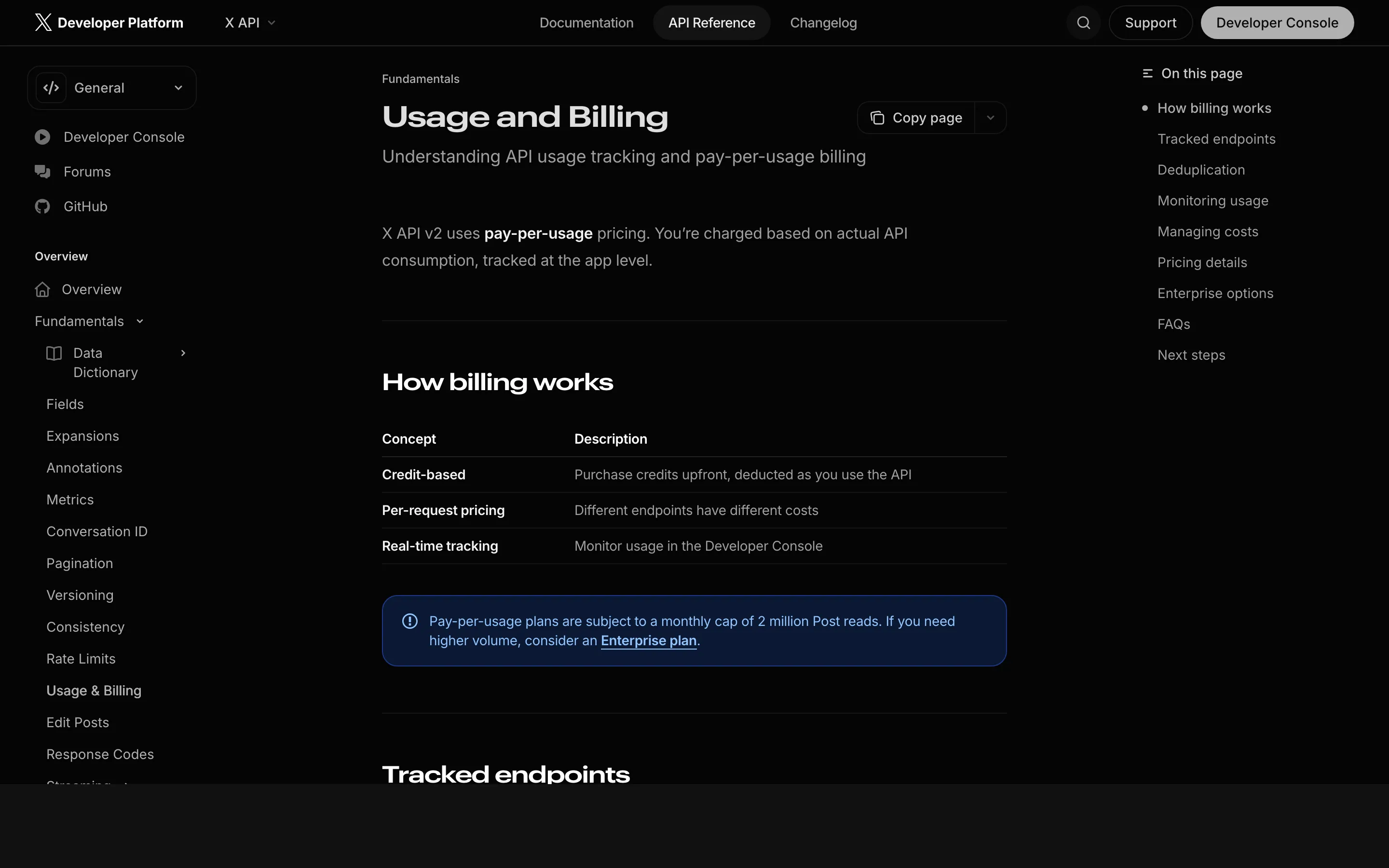
Pay-per-use isn’t unlimited. There’s a hard ceiling of 3 million post reads per month. Above that, X requires you to move to Enterprise.
Enterprise isn’t a checkout-page upgrade. It’s a sales call, a use-case review, and custom pricing (X lists it as “contact sales,” and reported figures put the entry point around $42,000 per month). Plan around the 3M cap as a real constraint, not a soft suggestion. If your usage is anywhere close to it, build the alternative path before you hit the wall.
The xAI Credit Kickback (Read This Before You Spend)
X runs a credit-back program tied to cumulative pay-per-use spend. The more you spend, the higher the percentage that comes back as xAI API credits:
| Cumulative spend | xAI credit kickback |
|---|---|
| $0 to $199 | 0% |
| $200 to $499 | 10% |
| $500 to $999 | 15% |
| $1,000+ | 20% |
The credits are usable on xAI’s API, not the X API itself. Useful if you’re already building Grok-powered features. Less useful if you weren’t planning to. Don’t let the kickback talk you into spending more than you would have otherwise. Credits now flow the other way too: Grok Bot’s X connector, shipped August 29, provisions an X developer account and seeds paid users with free X API credits, though the connector’s shipped capabilities are all reads, so publishing still needs its own route.
Real-World Cost Examples
This is where the abstract numbers get concrete. Three personas, with the math. If none of them match your setup, you can run the same math against your own posting volume and see where you land.
The Indie SaaS Publisher
You’re a one-person SaaS founder posting 10 updates a day to your company X account. You also pull your own engagement metrics once an hour to power a small dashboard.
- 300 writes/month at $0.015 = $4.50
- 720 owned reads/month at $0.001 = $0.72
- Total: about $5/month
Pay-per-use is genuinely cheap at this scale. If your usage looks like this, the API is fine.
The Agency Posting for 20 Clients (with Links)
You’re a small agency publishing roughly 5 posts per client per day across 20 client accounts. Half of those posts contain a link (a blog post, a product page, a tracking URL).
- 1,500 plain writes/month at $0.015 = $22.50
- 1,500 URL-containing writes/month at $0.20 = $300
- Weekly engagement pulls: 4,000 owned reads at $0.001 = $4
- Total: about $325/month
The URL tax flips the economics. A workflow that’s mostly link-posting on behalf of clients is no longer a $50 line item. On top of that, you still have to build OAuth, retry logic, queueing, and an approval UI. This is the bracket where most agencies tap out and use a publishing tool that abstracts the whole thing.
The Brand Monitor
You want to track every mention of your brand name across X. Roughly 10,000 mentions a month, plus you pull author profiles and follower counts on each.
- 10,000 post reads at $0.005 = $50
- 10,000 user reads at $0.010 = $100
- Total: $150/month, before any historical backfill
This is where pay-per-use starts to bite. Add competitor monitoring on top, or any kind of historical research, and you’ll see the bill climb fast. If your job is reading X data at volume, the math often points toward a third-party data provider like TwitterAPI.io instead of the official API. Price it against your own read volume before committing either way, because the crossover point moves with how much of your usage qualifies for owned-read pricing.
Already on Legacy Basic or Pro?
Legacy Basic is gone. On May 21, 2026, X announced that its legacy Basic plans, monthly and annual alike, were being deprecated and that every Basic subscriber would be automatically migrated to pay-per-use. That migration began after June 1, 2026, at the end of each subscriber’s billing cycle, and X described it as final and irreversible once completed. If you were on Basic monthly, X charged your card $200 and loaded it as spendable API credit rather than as a fee. Annual subscribers had the remaining prorated value of the year granted as credits instead, with no fresh charge at cutover. Migrated accounts then default to auto-recharge, buying another $200 of credit whenever the balance drops below $10, and to a $400 spend cap per billing cycle. You can change the recharge amount, the trigger threshold, and the cap in the developer portal.
Pro is now settled too, and this is the change most guides have not caught up to. On August 14, 2026, X announced that legacy Pro plans, monthly and annual alike, are being deprecated and that all Pro subscribers will be automatically migrated to pay-per-use. In X’s words: “After September 1, 2026, your current Pro subscription will end on your cutover date (the end of your current billing cycle), and you will be moved to PPU. No action is required, the migration is automatic.”
The mechanics differ by billing period. Pro monthly subscribers get a $5,000 initial credit charged to their card via Stripe, then default to auto-recharge at $5,000 whenever the balance falls below $250, with a $10,000 spend cap per billing cycle. Pro annual subscribers get the remaining prorated value of the annual fee granted as credits with no fresh charge at cutover, those credits expire after the equivalent number of prorated months, and prorated credits do not trigger auto-recharge. All of it is adjustable in the developer portal, and the auto-recharge default is the setting to check first if a $5,000 top-up landing automatically would be a problem.
If you are on Pro today, the practical read is that a predictable $5,000 line item becomes a usage-driven one on your next cutover date. Model your actual call volume against the pay-per-use rate card before that date rather than after, because the $10,000 cycle cap is twice what you were paying and it is a ceiling, not a budget.
Here is what both tiers included, with one caveat: X has pulled the legacy tiers from its public pricing page, so the allowances below are their last published figures rather than a current rate card. Confirm your own limits in the developer console before you plan against them.
- Basic (formerly $200/mo, now retired): 50,000 posts/month at the app level (3,000 per individual user), 15,000 reads/month, 2 app IDs.
- Pro (formerly $5,000/mo, deprecated August 14, 2026): 300,000 posts/month, 1,000,000 reads/month, 3 app IDs, filtered stream and full-archive search included.
If you were on either tier, this is no longer a planning exercise: work out what your actual monthly call volume costs at $0.015 per plain post and $0.20 per post with a URL, because that is what you are being billed on now, or will be within a billing cycle. For most low-to-mid volume publishers, pay-per-use lands cheaper than Basic did. For data-heavy users who were on Pro, the flat tier often won on price, and losing it is the whole problem. Run Pro’s old allowance through the new rate card and the gap is stark: 300,000 plain posts at $0.015 is $4,500, and 1,000,000 third-party post reads at $0.005 is another $5,000. That is $9,500 a month for usage that used to cost $5,000, and it sits just under the $10,000 default spend cap. If your Pro usage was anywhere near those ceilings, budget for roughly double and raise the cap deliberately rather than discovering it mid-cycle.
What the Hypefury Exit Tells You About This Rate Card
Rate cards are abstract until somebody with real volume walks away from one. In 2026, Hypefury dropped X entirely, and I could not find a blog post, changelog entry, or announcement of any kind explaining it. The clearest first-party statement I found is a line in its own pricing FAQ, which today reads: “Does Hypefury still support 𝕏/Twitter? Nope! Hypefury no longer supports 𝕏 :(” Its homepage now lists Bluesky, Threads, LinkedIn, Instagram, and TikTok, with X absent from the channel list.
Hypefury has never given a reason, so treat any specific explanation as inference rather than fact. What is on the record is the cost pressure. Back in October 2024, co-founder Yannick Veys posted that from November 1 that year, X would charge Hypefury $1 per connected account per month, across what he said were more than 120,000 connected accounts. Run that arithmetic and it is $120,000 a month, north of $1.4 million a year, before a single post is published, and it landed before the pay-per-use rates on this page existed.
Why this belongs in a pricing guide: a vendor absorbing X’s costs on your behalf is making a bet that the rates stay survivable, and that bet is revocable without notice. If you are budgeting a build against the numbers above, the honest planning assumption is that the meter is one announcement away from moving again, and that the tools sitting between you and it can exit the platform faster than you can rebuild.
Worth being precise about the scale of this, because the story invites overstatement: this is one exit, not an exodus. I checked 17 schedulers for the full support-status breakdown and Hypefury is the only one that has dropped X in 2026. Every other tool I looked at still publishes to it today. If you were running on Hypefury and need somewhere to land, I compared the best Hypefury alternatives that still publish to X on exactly this question of what each one’s bill does when X changes terms again.
The Honest Pitch: Skip the X API and Use Blotato
I’d be a bad founder if I didn’t tell you the trade-off. Building directly on the X API in 2026 means you sign up for:
- Per-resource billing on every call
- A 3M post-reads ceiling that forces an Enterprise conversation if you grow
- OAuth 2.0 token management (and the refresh logic that comes with it)
- Compliance review for any AI-related use case
- Your own retry, rate-limit, and queue layer
- Building this all over again for every other platform you want to publish to
If your goal is to publish content to X (and to other platforms), most of that work is wasted motion. Blotato handles it for you - so do six other tools I tested - and gives you one API to publish across X, Instagram, LinkedIn, TikTok, YouTube, Threads, Facebook, Pinterest, and Bluesky. For the wider view across every platform’s developer terms, see my social media APIs developer guide, and if Instagram is next on your list, the Instagram API pricing breakdown covers the same math on Meta’s side. Meta’s other endpoint has its own quirks worth reading before you build, which I break down in the Facebook API pricing guide, and if you’re weighing the newer networks, the cost of building on Threads is a shorter story than most people expect.
What you can publish through Blotato:
- Text posts, images, videos, and threads to X
- The same payloads to 8 other platforms in the same call
- Scheduled or immediate publishing
- AI-generated content via the same endpoint
A minimal example of posting to X via Blotato:
The thread payload and the media rules are on the X posting API page.
curl -X POST https://backend.blotato.com/v2/posts \
  -H "blotato-api-key: YOUR_API_KEY" \
  -H "Content-Type: application/json" \
  -d '{
    "post": {
      "accountId": "YOUR_X_ACCOUNT_ID",
      "target": { "targetType": "twitter" },
      "content": { "text": "Posted via the Blotato API." }
    }
  }'
One call, one auth header, no rate-limit logic on your side. If you want to cross-post the same content to LinkedIn, you change the targetType and reuse the same code path.
The MCP angle matters too. Blotato runs an MCP server at https://mcp.blotato.com/mcp, which means Claude (or any MCP-compatible agent) can publish to your social accounts directly. If you’re building AI-driven content workflows, this is the shortest path from “agent decides to post” to “post is live.” Threads and status polling are exposed as their own calls rather than flags on the post call, which the X MCP reference lays out.
Worth calling out: there’s no URL-post tax on Blotato. A post containing a link costs the same as a plain-text post on every platform Blotato supports.
Blotato’s API is included on every paid plan, starting at $29/month for Starter. One thing to plan for if you are coming here as a developer: the API is not part of the 7-day dashboard trial. Blotato’s API quickstart docs are explicit that generating your first API key activates the paid Starter subscription immediately. If you are evaluating this as an X API replacement, budget for the subscription rather than expecting to test the API for free.
Sabrina’s Take
The X API in 2026 is a developer product, not a publisher product. If you’re building search, analytics, or research tools, you live with the per-call math and probably look at third-party providers above a certain volume. If you just want to post to X (and probably to four other platforms while you’re at it), the X API is the wrong layer to build on.
I’m biased, obviously. But I built Blotato because I was tired of stitching five APIs together to ship one piece of content. The pricing changes this year made that bet age well.
If X is the only platform you care about, the math above is the whole story. If you’re weighing platforms side by side, the closest siblings in cost-to-build terms are the LinkedIn API pricing guide, TikTok API pricing, and YouTube API pricing. LinkedIn is the instructive contrast, because there the meter never starts: you cannot buy access at any price until a partner reviewer approves you. If you want the managed options compared head to head instead, the best social media API tools roundup does that. For the visual and open-network side, I’ve run the same numbers on what Pinterest’s API costs and on Bluesky’s developer access, which is the one genuinely free option in this whole roundup.
X (Twitter) API Pricing FAQs
Is there a free X API tier in 2026?
Not in any practical sense. The old free tier is gone for new developers, and pay-per-use requires a credit balance to make calls. Pay-per-use is cheap at very low volume (a few dollars a month for light publishing), but there’s no zero-cost option anymore.
How much does the X API cost per month?
There’s no fixed monthly price on pay-per-use. You pay for what you call: $0.015 per plain post, $0.20 per post with a URL, $0.001 per owned read. A light publisher (a few posts a day) often lands under $10 a month, while an agency posting links for clients can cross $300. Legacy Basic and Pro have both been deprecated, so your monthly cost now tracks your actual usage rather than a flat plan.
How do I get access to the X API?
Sign up at developer.x.com, create an app inside a project, and go through the pay-per-use onboarding. You’ll add a payment method and load credits before you can make calls. Approval is automated for standard use cases. AI and bot use cases trigger an additional review.
Why did the X API get so expensive?
X moved away from the old open-access model in 2023 and has been tightening monetization since. Pay-per-use is the latest version, and on paper it’s friendlier to small developers (a $5/month indie publisher is genuinely supported). The cost pain hits hardest for anyone reading data at volume.
What happens if I hit the 3 million post reads cap?
Your reads stop until the cap resets at the start of the next month, or until you upgrade to Enterprise. Enterprise is a custom contract (X lists it as “contact sales,” with reported entry points around $42,000/month), with selective approval and a multi-week sales process. If you’re approaching the cap, start that conversation early or build a fallback path through a third-party provider.
Can I still auto-follow or auto-like through the X API?
Not on a self-serve plan. As of April 20, 2026, X removed following, liking, and quote-posting via API writes from all self-serve tiers. The endpoints were withdrawn rather than repriced, and the change covers POST /2/users/{id}/following, POST /2/users/{id}/likes, their delete counterparts, and quote-posting via the quote_tweet_id parameter. If you have an existing engagement automation built on pay-per-use, it stopped working rather than getting more expensive.
Does X have an API?
Yes. The current surface is the v2 REST API, documented at docs.x.com, covering Posts, users, Spaces, direct messages, lists, and trends. It is the version to build on today, and most tutorials still showing v1.1 endpoints are out of date. Access is self-serve through console.x.com, but metered rather than free: you buy credits and each call draws them down.
What is the X API used for?
Four patterns cover most builds. Publishing and scheduling posts from your own tooling. Reading data you already own, which is the cheapest line item at $0.001 per resource and the reason most publishing workflows stay affordable. Searching the public conversation for monitoring, research, or brand tracking, which is where the 3 million post read cap starts to matter. And receiving webhook events for mentions and DMs so you can react without polling. Engagement automation used to belong on this list and no longer does on self-serve tiers.
Are X API webhooks billed separately?
Yes. Events delivered through the X Activity API are billed per event delivered, using the same 24-hour UTC deduplication window as other resources. Inbound events cost money: dm.received and follow.follow are $0.010 each, post.create and profile.update.* are $0.005. Your own outbound actions are generally not billed, including dm.sent, dm.read, chat.sent, and post.delete. Teams monitoring busy accounts routinely miss this line item when budgeting.
Can I still get the $200 Basic or $5,000 Pro plan?
No. Both legacy tiers have been deprecated. X migrated Basic subscribers to pay-per-use after June 1, 2026, and announced on August 14, 2026 that legacy Pro plans are being deprecated too, with all Pro subscribers automatically migrated to pay-per-use after September 1, 2026 at the end of their current billing cycle. Pro monthly subscribers are charged a $5,000 initial credit and default to a $10,000 per-cycle spend cap. Pro annual subscribers receive their remaining prorated value as credits instead, with no fresh charge at cutover. No flat self-serve tier survives the migration, so the only paths are pay-per-use and Enterprise.