YouTube API Pricing: Complete Guide for 2026
YouTube API pricing in 2026: the June 2026 search and upload bucket split, the December 2025 quota cut, the 10,000 unit ceiling, and search traps.

YouTube API pricing in 2026 is free, and it got dramatically cheaper to use for video uploads across two separate changes. Google first cut the quota cost of videos.insert from roughly 1,600 units per call to roughly 100 on December 4, 2025, then moved uploads into their own bucket on June 1, 2026. The current quota cost reference puts an upload at 1 unit against a dedicated limit of 100 calls a day. Every “YouTube API guide” that still says one upload eats 1,600 quota units is two revisions out of date, and the practical ceiling is now 100 uploads a day instead of six.
Is the YouTube API free in 2026? Yes. The YouTube Data API has no per-call fee, and you pay in quota units against a default ceiling of 10,000 units per day. Uploads no longer draw on that pool at all: since June 1, 2026 videos.insert bills to its own bucket at 1 unit per call, capped at 100 calls a day. If you only need to publish and schedule videos rather than wire the quota system yourself, a wrapper like Blotato handles it, and its MCP server lets Claude Code and other AI agents post to YouTube without managing quota at all. For the bigger-picture version of the API-versus-MCP decision, start there.
I’ve been shipping on social media APIs for years and YouTube is the platform where most published advice is now stale. The default daily quota is unchanged at 10,000 units, the official quota calculator still shows the new per-method costs, and the revision history page logs the December 4, 2025 cut explicitly. The trade-off is that the expensive operation has shifted: search is now the meter that runs fast, not upload.
This guide covers what the YouTube Data API actually costs in 2026, the December 2025 cut and what it changed, the full quota cost table, the search-heavy workloads that still blow the budget, the quota-extension reality, real cost math for three operator profiles, and when a wrapper like Blotato makes more sense than wiring the YouTube Data API yourself.
YouTube API Pricing at a Glance (2026)
| Access tier | Cost | Best for | Key limit |
|---|---|---|---|
| YouTube Data API v3 (default) | Free | Reading public data, posting to your own channel, automating uploads | 10,000 shared quota units per day, plus separate ~100-call/day buckets for search.list and videos.insert since June 1, 2026 |
| YouTube Data API v3 (extended quota) | Free, application-gated | Production apps that need search or read at scale | Audit and Quota Extension Form, Google review takes a few weeks to multiple months, approval not guaranteed |
| YouTube Reporting API (bulk reports) | Free, requires channel auth | Channels and content owners pulling owned analytics in CSV bulk | Owned-channel data only, scoped to authenticated channel owner |
| Third-party wrappers (RapidAPI, Apify) | Pay-per-call, starting around $0.0005 per request on Apify | Read scraping when you cannot get a quota extension | Unofficial endpoints, scraping ToS risk, no upload support, exact ceiling varies by provider |
| Blotato unified API | Starter $29/mo, Creator $97/mo, Agency $499/mo | Posting YouTube plus eight other platforms from one endpoint | API access on paid plans, generating a key ends the free trial |
YouTube does not charge money for the Data API. Google charges you in quota units, and your real cost is the engineering time to live inside a budget designed for hobby projects. Once you cross 10,000 units a day, you are in the application queue. Start free week of Blotato →
Free 7-day trial · Cancel anytime
What Changed in 2026
The single biggest change is the December 4, 2025 quota update. Google’s official YouTube Data API Revision History records it in one sentence: the quota cost of a video upload moved from approximately 1,600 units to approximately 100 units. That is a 16x reduction on the single most expensive method most publishers were calling.
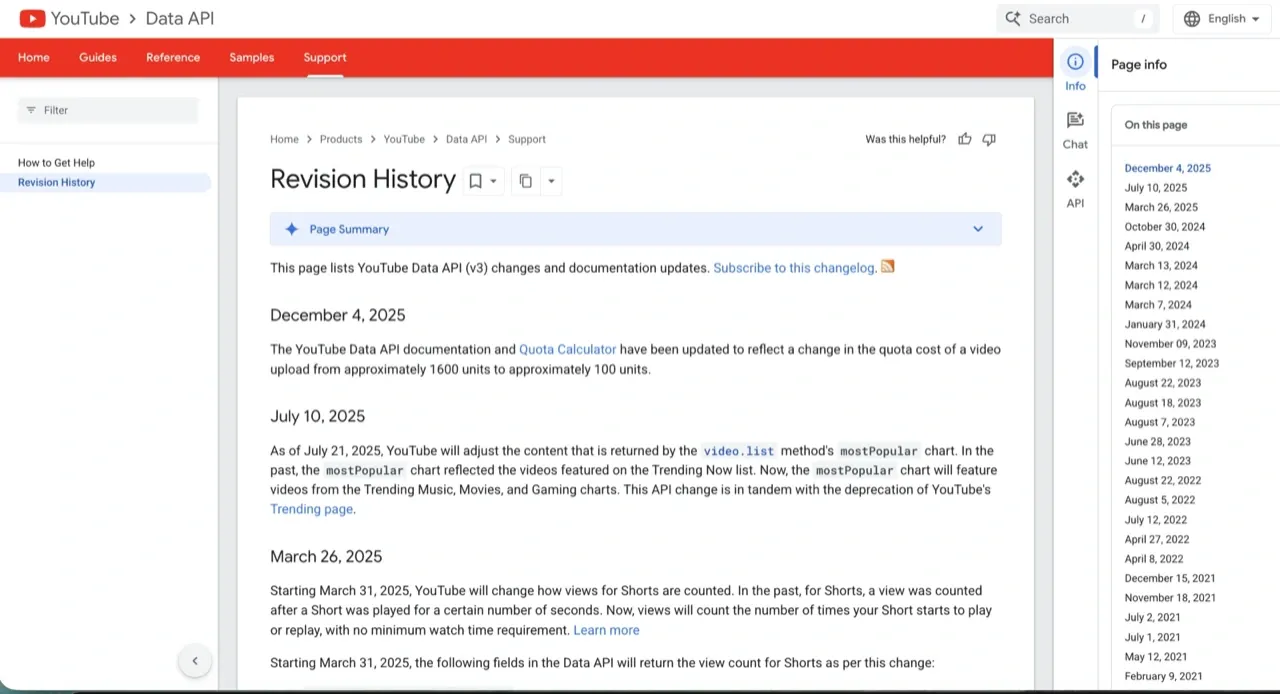
What this actually means in practice:
- The old upload ceiling is gone. Six uploads per project per day was the binding constraint for any automation product before December 2025. Uploads now bill at 1 unit against their own bucket, so the ceiling is 100 uploads a day.
- Search is now the call to watch. Since the June 1, 2026 granular-quota change,
search.listno longer draws 100 units from the shared 10,000-unit pool. It bills to its own dedicated daily bucket, capped at roughly 100 search calls a day. On discovery-heavy workloads that ~100-call ceiling is now the wall you hit first. - The old figure outlived the change. Google’s auto-generated page summary still describes uploads as costing 1,600 points even though every authored part of the page says 1. That is why the six-uploads-a-day number keeps getting republished, and it is a pattern worth understanding before you trust any published number about a platform’s posting limits.
- Quota extensions matter less for publisher tools. Apps that were applying for extensions purely to upload more than six videos a day no longer need to. The extension queue is still real, but the threshold to need it is much higher.
The other 2026 reality is that the quota extension request form is still the only path to more than 10,000 daily units, and developer community reports describe wait times ranging from a few weeks to multiple months. The “free” label survives. The friction is the timeline.
YouTube Data API Pricing, in Plain English
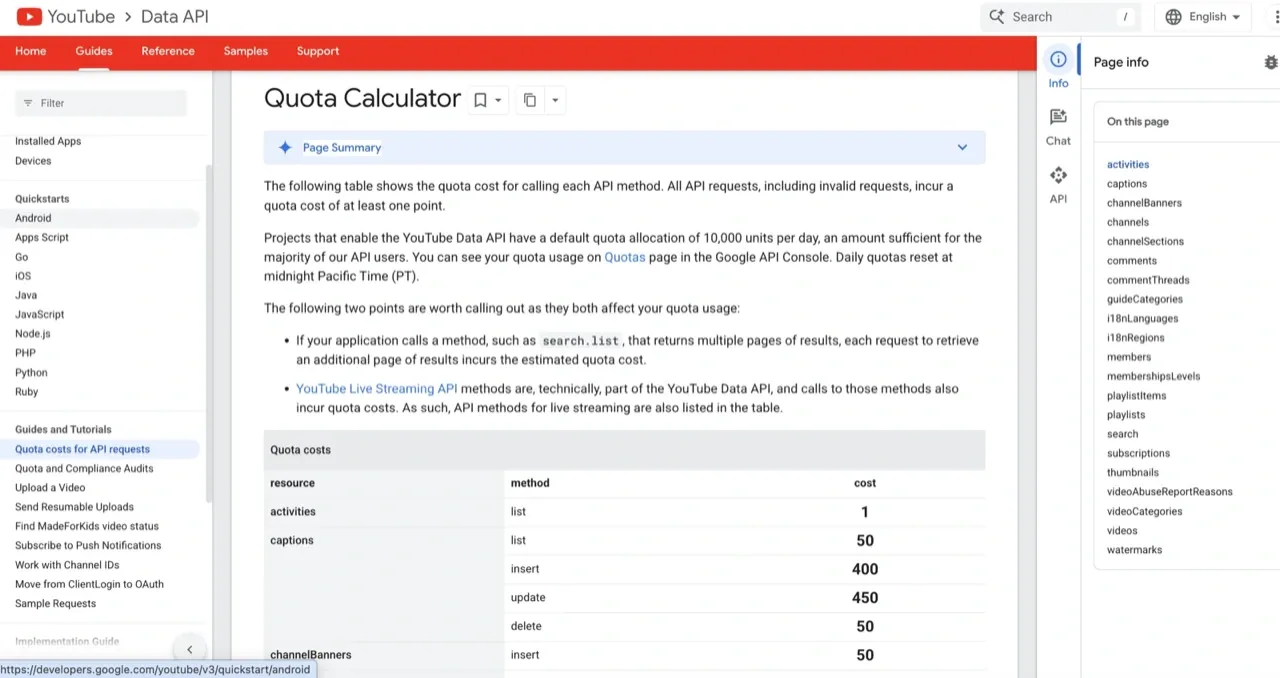
The model is simple to read. Google publishes the exact quota cost for every method in the Quota Calculator docs. Every successful request deducts units from the pool. Failed requests still cost at least one unit. The pool resets at midnight Pacific Time, every day, with no carryover.
Here is the post-December-2025 cost-per-method table you actually need to plan around:
| Operation | Quota cost (units) |
|---|---|
| videos.list (read public video stats) | 1 |
| channels.list (read channel info) | 1 |
| playlistItems.list | 1 |
| activities.list | 1 |
| commentThreads.list | 1 |
| videos.insert (upload a video, post-Dec 2025) | 1 unit per call against its own bucket of 100 calls/day since June 1, 2026, no longer the shared pool |
| search.list (any keyword search) | own bucket (~100 calls/day) since June 1, 2026, no longer the shared pool |
| videos.update / videos.rate / videos.delete | 50 |
| playlists.insert / playlists.update / playlists.delete | 50 |
| captions.insert | 400 |
| captions.update | 450 |
The full table is in the Quota Calculator, but those eleven rows cover roughly 95% of the planning anyone needs. The two things to design around are the search.list ceiling (its own ~100-calls-a-day bucket since June 1, 2026, not a draw on the shared pool) and captions.update at 450 units, which is now the single most expensive method still billed against the shared 10,000-unit pool.
Search Is the New Expensive Operation
Before June 1, 2026, a single search.list call cost 100 units from the shared pool, so a search-heavy tool drained the whole budget fast. As of the June 1, 2026 quota update, search.list and videos.insert each bill to their own separate daily bucket rather than drawing down the shared 10,000-unit pool. Google’s quota cost reference now puts both at 1 unit per call against a default limit of 100 calls a day, so the ceiling that binds is the call count, not the units. So if you are building a YouTube trend dashboard, an influencer-discovery tool, or anything that surfaces “videos like this,” the constraint is no longer units drained: it is the hard ~100-searches-a-day ceiling on that dedicated bucket.
There is a real workaround. videos.list accepts up to 50 video IDs per request and still only costs 1 unit. If you already have video IDs from prior crawls, sitemaps, RSS, or channel uploads playlists, you can pull stats for up to 500,000 videos per day on the free tier. The expensive operation is discovery. Once you have the IDs, reading is cheap.
This is the lever most well-built YouTube products pull: batch reads off a cached ID list, reserve search for when no other path exists.
The Quota Extension Reality
There is no self-serve upgrade. The Audit and Quota Extension Form asks for your project ID, your use case, your expected volume, your business justification, and links to your privacy policy and terms. You submit it. A copy of your submission is emailed back to you, and YouTube’s API Services team replies if and when they review it. The form publishes no response timeline. Whether uploads from unverified API projects are still locked to private is now unclear: YouTube’s revision history says those created after 28 July 2020 are, while its upload reference, as of 8 October 2026, says they are not restricted. Our 2026 social media API report tracks that disagreement alongside the approval steps on ten platforms.
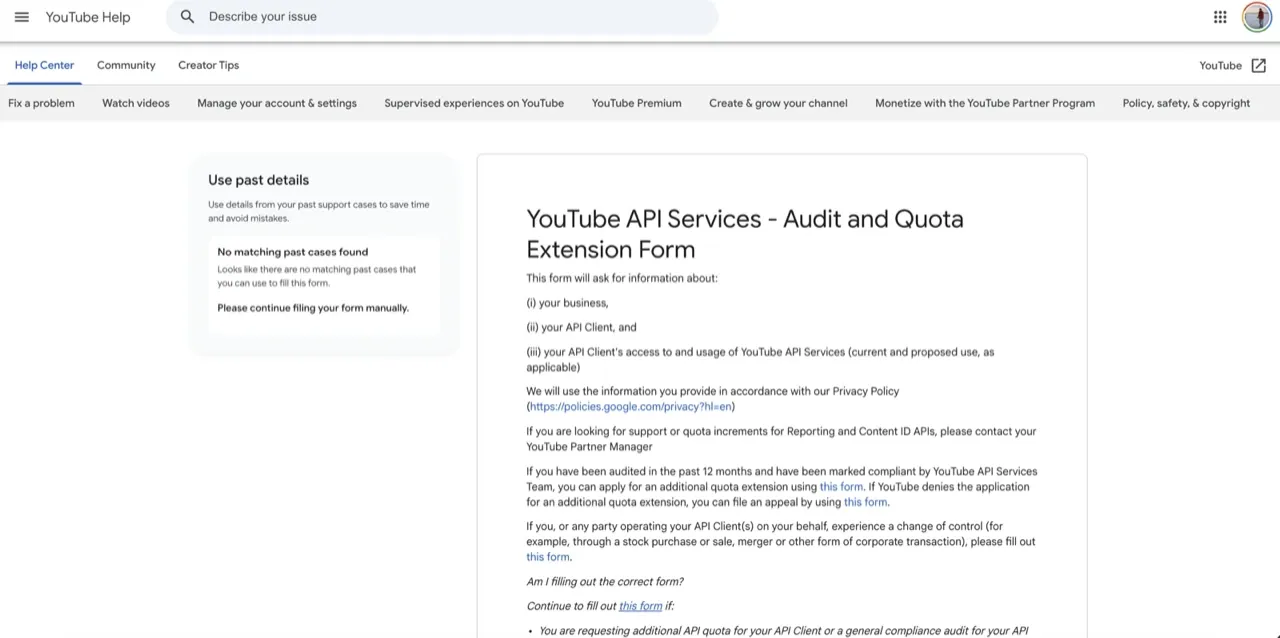
A public Google Community thread documents a five-month delay, and broader developer reports describe wait times ranging from a few weeks to multiple months. Some teams get approved for modest bumps (50,000 or 100,000 units). Others wait and get denied. Developer community write-ups commonly describe similar denial patterns: vague use case, no public privacy policy, automation that resembles scraping, or apps that look like bulk-download tools. The Phyllo and Elfsight guides cover the quota model in more depth. Google does not publish a denial-reason list.
Design your app to live inside 10,000 units for the first month, ship it, then apply for an extension with real usage data attached. That is the workflow that actually gets approved.
Real-World Cost Examples (Post-December 2025)
These are the three operator profiles I see most often. The arithmetic is the answer, and the December 2025 cut changed the answer in every case. If none of the three matches your setup, the cost calculator takes your own upload and read volume and returns the same math.
The Indie YouTube Automation Builder
One creator, automating two scheduled uploads a day, syncing comment notifications, pulling daily stats on 20 videos.
- 2 uploads × 1 unit = 2, billed to the 100-call upload bucket
- 20 videos read in 1 batched videos.list call × 1 unit = 1
- 24 commentThreads.list pulls (one per hour) × 1 unit = 24
- 1 channels.list per day = 1
Total: ~26 units a day against the shared pool, plus 2 of 100 upload calls. This same workload cost 3,226 units a day before the December 2025 cut. Neither ceiling is close to binding.
The Faceless YouTube Agency Posting for 10 Clients
10 client channels, one upload per channel per day, daily analytics pull, weekly comment sweep.
- 10 uploads × 1 unit = 10, billed to the 100-call upload bucket
- 10 channels.list × 1 unit = 10
- 10 playlistItems.list × 1 unit = 10
- 10 commentThreads.list × 1 unit = 10
Total: ~30 units a day against the shared pool, plus 10 of 100 upload calls. This is the workload that was actively impossible on the free tier before December 2025, at 16,030 units a day. Now neither ceiling is close. The math story has shifted from “upload kills you” to “stitching together 9 different platforms for the same agency is the real time sink.”
The Trend Researcher
Tracking 50 keyword queries every morning, pulling stats for the top 50 videos per query, weekly channel-level snapshot.
- 50 search.list calls against the dedicated search bucket (roughly 100 calls/day)
- Up to 2,500 video IDs, fetched in 50 batched videos.list calls × 1 unit = 50 units from the shared pool
- 1 channel snapshot × 1 unit = 1 unit from the shared pool
Total: about 50 of your ~100 daily search calls, plus ~51 units from the 10,000-unit shared pool, if you cache the IDs and batch the reads. Skip caching and re-run search.list for every result, and you blow through the search bucket before lunch. Since the June 1, 2026 update put search on its own bucket, the constraint is no longer “search drains the 10k pool,” it is “you get roughly 100 searches a day, full stop.” The same workload fits comfortably or hits the wall depending entirely on whether the engineer caches IDs after the first discovery pass. Search-heavy workloads are now where the “the YouTube API is too restrictive” complaints come from, not uploads.
Already Built on the YouTube Data API? What’s Worth Knowing
If you are already in production on the YouTube Data API, here is what changed and what didn’t.
The 10,000-unit pool still exists, but as of June 1, 2026 it is no longer the single shared budget for everything. Google split videos.insert and search.list into their own separate daily buckets (each roughly 100 calls a day), so uploads and searches no longer draw down the pool that every other method shares. Both are now governed by that 100-calls-a-day ceiling rather than by unit spend against the shared pool, and Google’s quota reference now prices each at 1 unit per call, down from the roughly 1,600 an upload cost before December 4, 2025. Most write methods are still 50 units. Captions inserts and updates remain the priciest single calls at 400 and 450 units against the shared pool. Google also shipped a videos.batchGetStats read method on June 3, 2026. The Quota Extension form is still the only path to more daily units, and Google has not announced a paid commercial tier for the Data API in 2026.
If your workload depends on heavy search and your extension keeps getting denied, the operational answer is to cache IDs aggressively, batch reads with videos.list, and route discovery through other surfaces (RSS, sitemaps, channel uploads playlists) when you can.
I would be a bad founder if I did not tell you the trade-off honestly. The other instinct is to split work across multiple Google Cloud projects to multiply the quota. Google’s Developer Policies require exactly one (1) API Project per API Client, and that API Project must not be used for any other API Client. YouTube reserves the right to disable or curtail access for violations. Sharding to evade quota is a policy breach, not a gray area. The cleaner path is the extension form, and while you wait, route through a unified API.
The Honest Pitch: Skip the Quota Math and Use Blotato
If your job is “post a video to YouTube every day, and also to Instagram and TikTok and LinkedIn and X while you are at it,” the YouTube Data API is the wrong layer to build on. The December cut helps, but the multi-platform problem doesn’t.
Going direct gets you 9 OAuth flows, 9 quota or rate-limit regimes, 9 token-refresh schedules, and a multi-week wait the first time YouTube decides you need more units. Posting through Blotato’s unified API is a single HTTP request to a single endpoint, with one API key, that fans out to YouTube and eight other platforms. The math is one call, not nine integrations.
One API. Every social platform.
The three required YouTube fields, playlists, and thumbnails are laid out on Blotato’s YouTube upload API page.
curl -X POST https://backend.blotato.com/v2/posts \
  -H "blotato-api-key: YOUR_API_KEY" \
  -H "Content-Type: application/json" \
  -d '{
    "post": {
      "accountId": "YOUR_YOUTUBE_ACCOUNT_ID",
      "target": {
        "targetType": "youtube",
        "title": "My Video Title",
        "privacyStatus": "public",
        "shouldNotifySubscribers": true
      },
      "content": {
        "text": "Posted to YouTube via the Blotato API.",
        "mediaUrls": ["https://your-cdn.example.com/video.mp4"],
        "platform": "youtube"
      }
    }
  }'
The full reference is in Blotato’s API docs. The same request structure works for all nine supported platforms by swapping the targetType, accountId, and the platform-specific fields inside target. There is no per-call charge on top of your plan, and the YouTube quota arithmetic moves from your problem to ours. Start free week →
I cover the full multi-platform breakdown in Social Media APIs in 2026, which compares the friction across every major platform side by side. For the TikTok-specific version of this story, see TikTok API Pricing.
Sabrina’s Take
I am biased, obviously. But I built Blotato because I was tired of treating quota budgets and OAuth refresh schedules as my product. The December 2025 cut to videos.insert made YouTube genuinely usable for indie creators and small agencies on the default quota, which I think is the right call. If you are a solo builder posting two videos a day to one channel, use the YouTube Data API directly. If you are touching more than two or three platforms, the math almost never justifies going direct. You will spend more time arguing with the Quota Extension form than building the thing you wanted to build.
The closest siblings to YouTube on the cost-and-approval axis are the X (Twitter) API pricing guide and the Instagram API pricing guide.
FAQs
Is the YouTube API free in 2026?
Yes. The YouTube Data API v3 has no per-call monetary cost. The constraint is the quota system: 10,000 units per project per day by default, with each method costing between 1 and 450 units. There is no paid commercial tier published by Google for the Data API.
How many uploads can I do per day on the free quota?
Up to 100 uploads per day. videos.insert first dropped from about 1,600 units to about 100 in the December 4, 2025 change, and since the June 1, 2026 update it bills to its own dedicated bucket at 1 unit per call with a default limit of 100 calls a day, so uploads no longer compete with your reads and searches for budget. Before December 2025, the same workload gave you only 6 uploads a day at 1,600 units each, which is why most older guides still quote the lower number.
How do I get more YouTube API quota?
You submit the Audit and Quota Extension Form. Google reviews it, typically over a few weeks to multiple months. Approval is not guaranteed and depends on a clear use case, a public privacy policy, terms of service, and a workload that does not resemble bulk scraping.
What happens when I hit the YouTube API quota?
Subsequent requests return HTTP 403 with a quotaExceeded reason code until the quota resets at midnight Pacific Time. There is no overage charge because there is no charge. Your app simply stops working for the rest of the day.
Can I split work across multiple Google Cloud projects to get more quota?
No. YouTube’s Developer Policies require exactly one (1) API Project per API Client, and that API Project must not be used for any other API Client. YouTube reserves the right to disable or curtail access for violations. The supported path to more quota is the Extension Request form, not sharding.