AI Social Media Trends 2026: What Creators Must Know
AI social media trends 2026: AI runs the whole workflow, no-code automation gives way to MCP, and the authenticity backlash reshapes what wins.
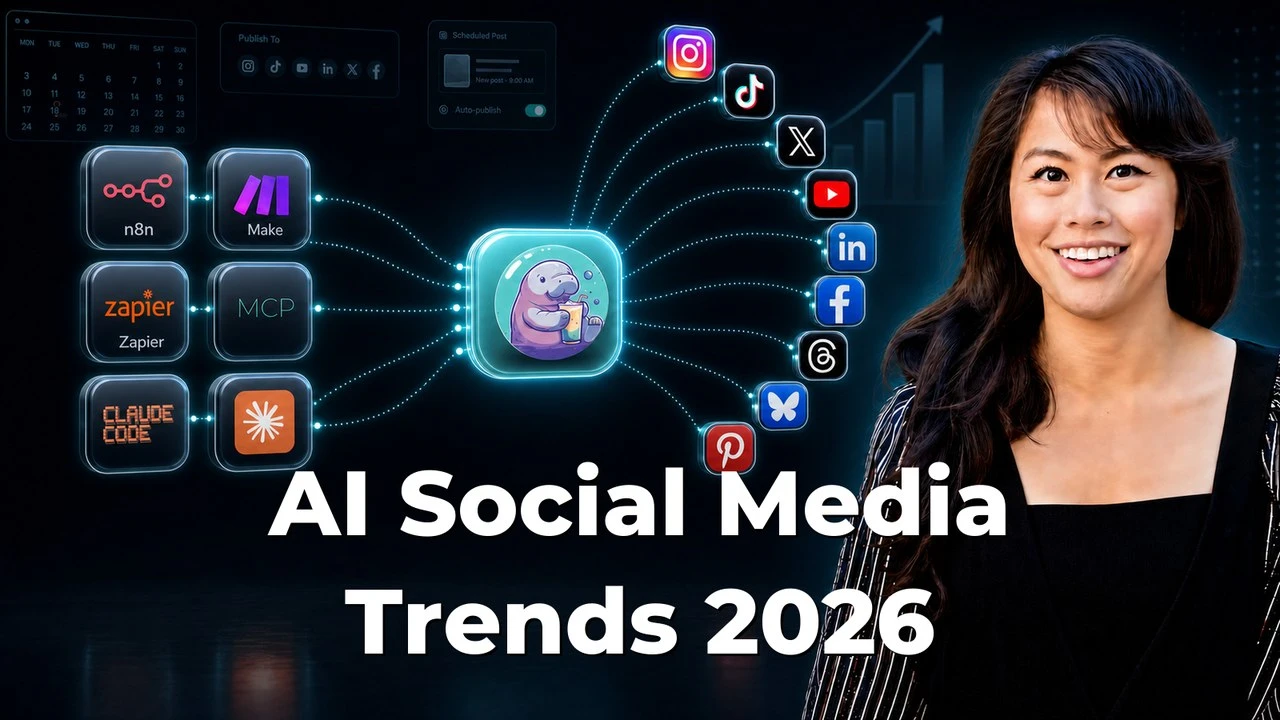
The biggest AI social media shift of 2026 is not video or another caption generator. It is that the automation layer moved from no-code builders like n8n and Zapier to MCP, where you just tell an AI assistant to run your posting for you. That is the one trend in this post you will not find on most “2026 trends” lists, and it is the one I am most sure about.
I run Blotato, so I watch how thousands of creators and solo operators actually discover tools, build content, and publish across platforms every day. Take that with whatever grain of salt feels right. But it means the trends below are not guesses. They are patterns I see in real behavior, backed by public research where the numbers are public.
Here is what actually changed in how people use AI for social media in 2026, and what it means if you are a creator, a solopreneur, or someone building automated content workflows.
If you want to skip ahead and try the workflow behind most of these shifts, you can start a free Blotato trial and connect your accounts in a few minutes. Card required, cancel anytime.
AI Moved From Writing Captions to Running the Workflow
In 2025, AI in social media mostly meant “help me write this caption faster.”
That is still happening. Around 46% of marketers now use AI to write copy, and content creation is the single most common way marketers apply AI at all, per HubSpot’s research.
But the bigger 2026 shift is that AI stopped being a writing assistant and became an operator. People hand AI the whole loop now. Draft, generate the video or carousel, adapt per platform, schedule, publish, read the results, adjust. Media creation is the piece moving fastest: text-to-video and AI image tools got good enough this year that a solo creator can produce a short, a thumbnail, and a carousel without opening a design app. So the “AI writes my caption” story is already dated. The real question in 2026 is how much of the pipeline you are willing to hand off.
That is the trend under all the other trends. The rest of this list is really about what happens once AI runs the workflow instead of just helping with a piece of it.
Video-First Discovery Beat Search
Here is a pattern I see constantly, and the public data backs it up.
People discover tools and creators through video first. YouTube and short-form have become the real search engines for “how do I do this.” How-to content is one of the most-searched categories on YouTube, and a large share of people research products there before they buy, according to Think with Google.
Short-form video is where the attention and the return sit. HubSpot found more marketers name short-form video their highest-ROI content format than any other. The format itself keeps evolving too. Serialized, episodic content, the recurring “part 3 of” format that trains people to come back, is doing in 2026 what one-off viral clips did a few years ago.
The twist most people miss: where you get discovered is often not where you publish most. People find you on YouTube, then live on Instagram, Facebook, and TikTok. The average social media user is now active on 6.75 platforms a month, per DataReportal. Being on one is not a strategy anymore. And increasingly, discovery and the sale happen in the same place, as in-platform shopping on TikTok and Instagram turns a video into a checkout rather than a click out to a website.
This is exactly why cross-posting stopped being optional. If discovery and daily attention live on different platforms, you have to be on both, without doing double the work. That is the whole reason tools like Blotato exist, and it is why we support posting to multiple social networks from one place.
No-Code Automation Gave Way to MCP
This is the trend I am most confident about, because I watch it happen in real time.
In 2025, if you wanted to automate social posting, you reached for a no-code automation platform. You wired up n8n, Make, or Zapier with triggers, modules, and a visual canvas. It worked. A lot of people still run great setups that way, and Blotato has native integrations for n8n and Make precisely because so many builders started there.
In 2026, more of that automation is moving to MCP.
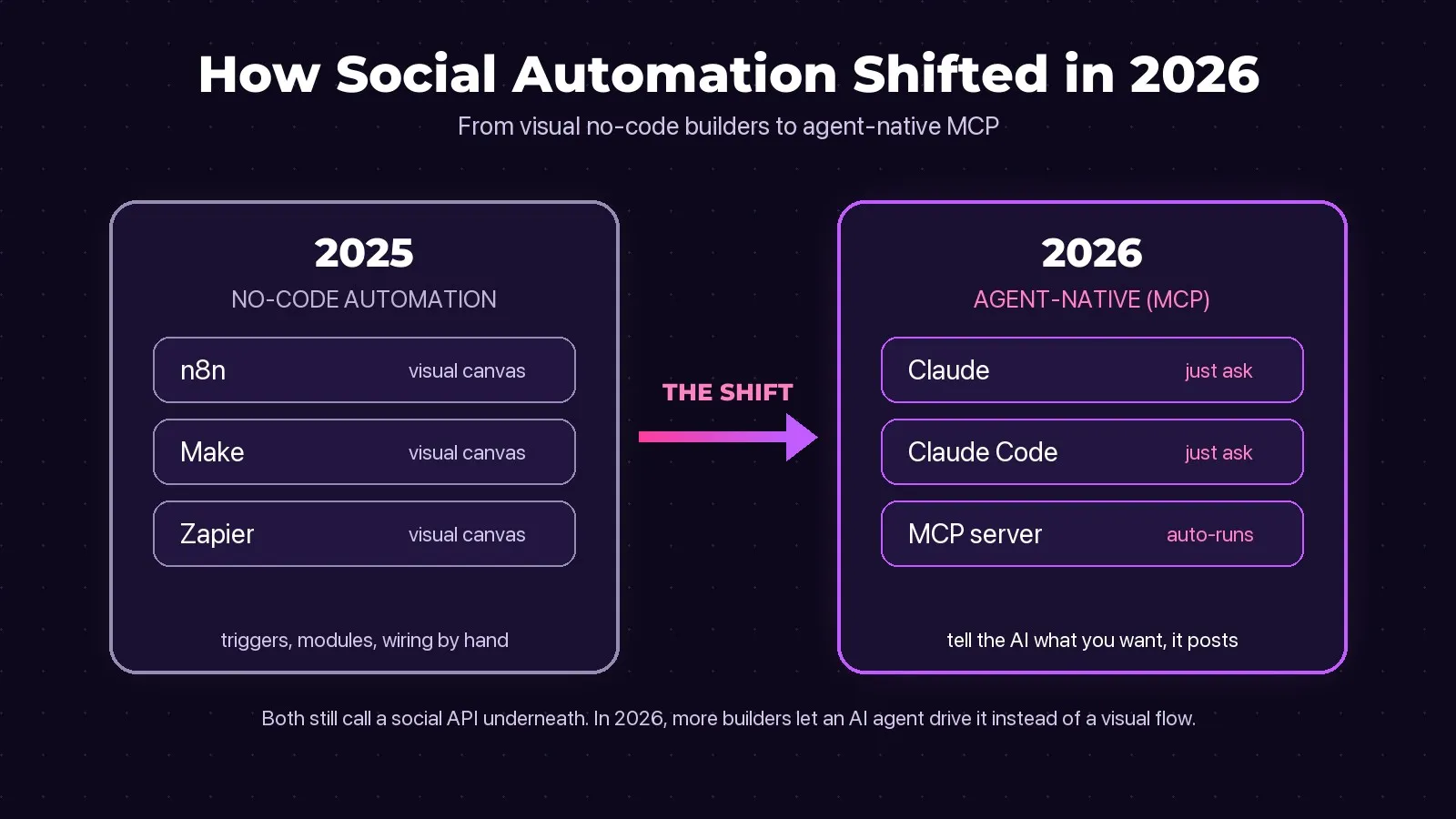
MCP, the Model Context Protocol, lets an AI assistant talk directly to a tool without a visual workflow in the middle. Instead of building a flow, you connect the tool to Claude, Claude Code, or Claude Cowork, and you just ask. “Draft a week of posts from this video and schedule them across my platforms.” The assistant does the rest.
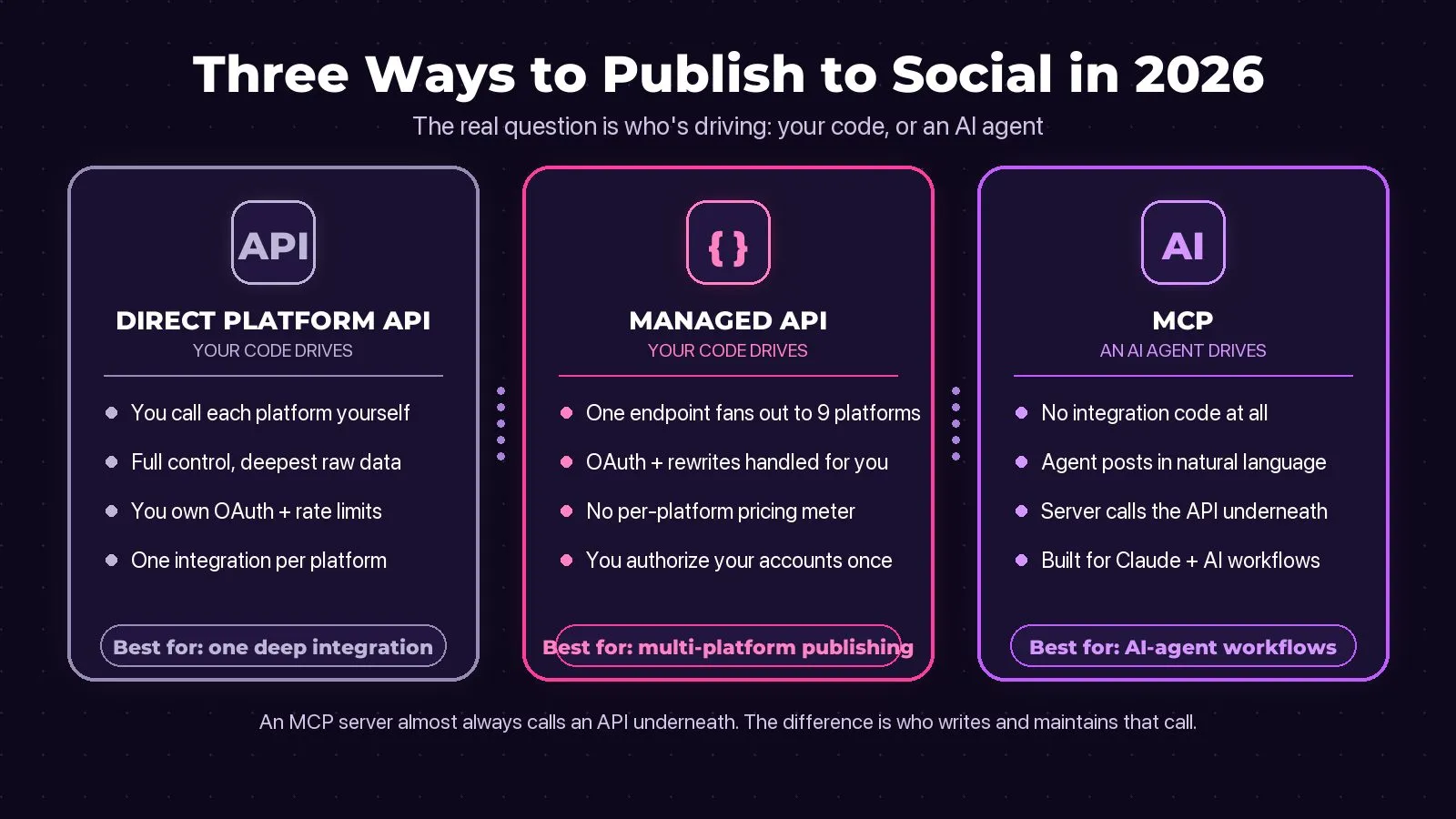
The reason this is happening is not hype. MCP is an open standard introduced by Anthropic that every major AI assistant is now adopting, and tools are shipping dedicated MCP servers to meet it. Blotato runs one at mcp.blotato.com/mcp for exactly this reason. The broader agent data confirms the direction too. Gartner predicts 40% of enterprise apps will include task-specific AI agents by the end of 2026, up from less than 5% in 2025. When AI agents run inside more of your tools, connecting through an agent-native protocol beats maintaining a separate visual workflow.
Here is what I will say plainly: the people building the most hands-off social workflows right now are increasingly doing it through Claude and MCP rather than a no-code canvas. The automation crowd that leaned on visual builders a year ago is drifting toward agent-native setups. That drift is the clearest single change in this space in 2026, and it is why we lead with the MCP server instead of treating it as a footnote.
I want to be honest about the other side of this too. Not every automation trend sticks. Gartner also expects more than 40% of agentic AI projects to be canceled by the end of 2027 when the cost or complexity outweighs the payoff. The lesson is not “MCP everything.” It is that the automation layer for social is genuinely shifting, and it is worth understanding both paths before you commit.
If you want the deeper comparison, we broke down n8n vs Make vs MCP for social media and the difference between a social media API and MCP in their own posts.
One-Person Operations Are Running Like Teams
The creator economy is now worth roughly $252 billion, per Grand View Research, and individual creators hold the largest share of it.
What changed in 2026 is not the size. It is the output per person. A solo operator can now run the workload of a small team, because AI handles the parts that used to require hiring. Drafting, formatting per platform, scheduling, light analysis.
I see people replace an entire social media assistant role with a single AI workflow. That is a real trend, not a pitch, and it is the natural end state of the first shift on this list. When AI runs the workflow, headcount stops being the ceiling on how much you can publish.
The part worth protecting is where you spend the time AI just gave you back. The operators who win are not the ones who publish the most. They are the ones who use the freed-up hours to actually reply to comments and DMs, because community and real conversation are what platforms reward now, not raw volume.
We wrote about how to replace a social media VA with AI if you want the specific setup.
The Authenticity Backlash Got Real
Here is the trend that complicates every other one on this list, and the one most “AI trends” posts skip because it is inconvenient.
As AI content flooded feeds in 2026, audiences pushed back. People got faster at spotting generic AI output, and disclosure started to carry a cost. In one survey, 52% of consumers said they become less engaged with content once they suspect it is AI-generated, and about half could correctly spot AI-written copy in the first place. And it is not just engagement on the line. Nearly a third of consumers say they are less likely to choose a brand that uses AI ads, per Hootsuite’s 2026 social trends research. Visible, careless AI does not just get scrolled past. It can cost you the sale.
I believe this is the most important line to hold in 2026: automate the workflow, never the judgment. AI can draft, resize, schedule, and publish. What it cannot do is decide whether something is true, on-brand, or worth saying at all. The failure mode I watch people fall into is handing AI the voice, not just the labor, and the content flattens into the same beige stuff everyone else is publishing.
So the winning pattern is not “less AI.” Let the assistant handle the ten platform variants, but you still decide what goes out and why. That is also what keeps you citeable, because AI assistants and search engines are getting better at rewarding content with a real perspective and demoting the interchangeable kind.
Social and AI Search Are Eating Google’s Discovery Job
People are searching in new places.
Roughly 40% of Gen Z use TikTok and Instagram for search instead of Google, based on Google’s own data first reported in 2022 and still holding. And AI assistants have become a discovery channel of their own. ChatGPT crossed 800 million weekly users in 2025, and people increasingly ask an assistant to recommend tools the way they used to Google them.
For anyone publishing content, this means two things. Your content needs to be findable inside social platforms, not just on Google. And it needs to be structured clearly enough that an AI assistant can read it and cite it. The old SEO-only playbook is not enough on its own in 2026.
What To Actually Do With All This
You do not need to chase every trend. You need the one workflow that makes the rest manageable.
If I compress everything above into a plan:
- Create for video first, because that is where discovery lives.
- Publish everywhere at once, because attention and buying are spread across platforms.
- Let AI run the loop, not just write the captions, but keep the voice yours.
- Watch the automation layer shift toward MCP, and pick the path that fits how you already work.
That last point matters more than it sounds. The tools you build on now decide how much you can scale later.
That is the workflow Blotato is built for. You connect your accounts, bring your content, and publish across 9 platforms from one place, through the app or through an AI assistant with an MCP server. If you want to see how that looks end to end, start a free trial and try it on your next batch of posts.
The trends will keep moving. The habit that wins in 2026 is simple. Create once, publish everywhere, let AI do the repetitive part, and keep your judgment in the loop.