Social Media API vs MCP: What Developers Need in 2026
Social media API vs MCP in 2026: the difference between calling an endpoint and letting an AI agent drive one, and which path fits your build.
The social media API vs MCP question usually gets framed as a two-way fight. It isn’t. In 2026 there are three ways to publish content to social platforms in code, and the one most developers haven’t clocked yet is the one their AI agent already wants to use.
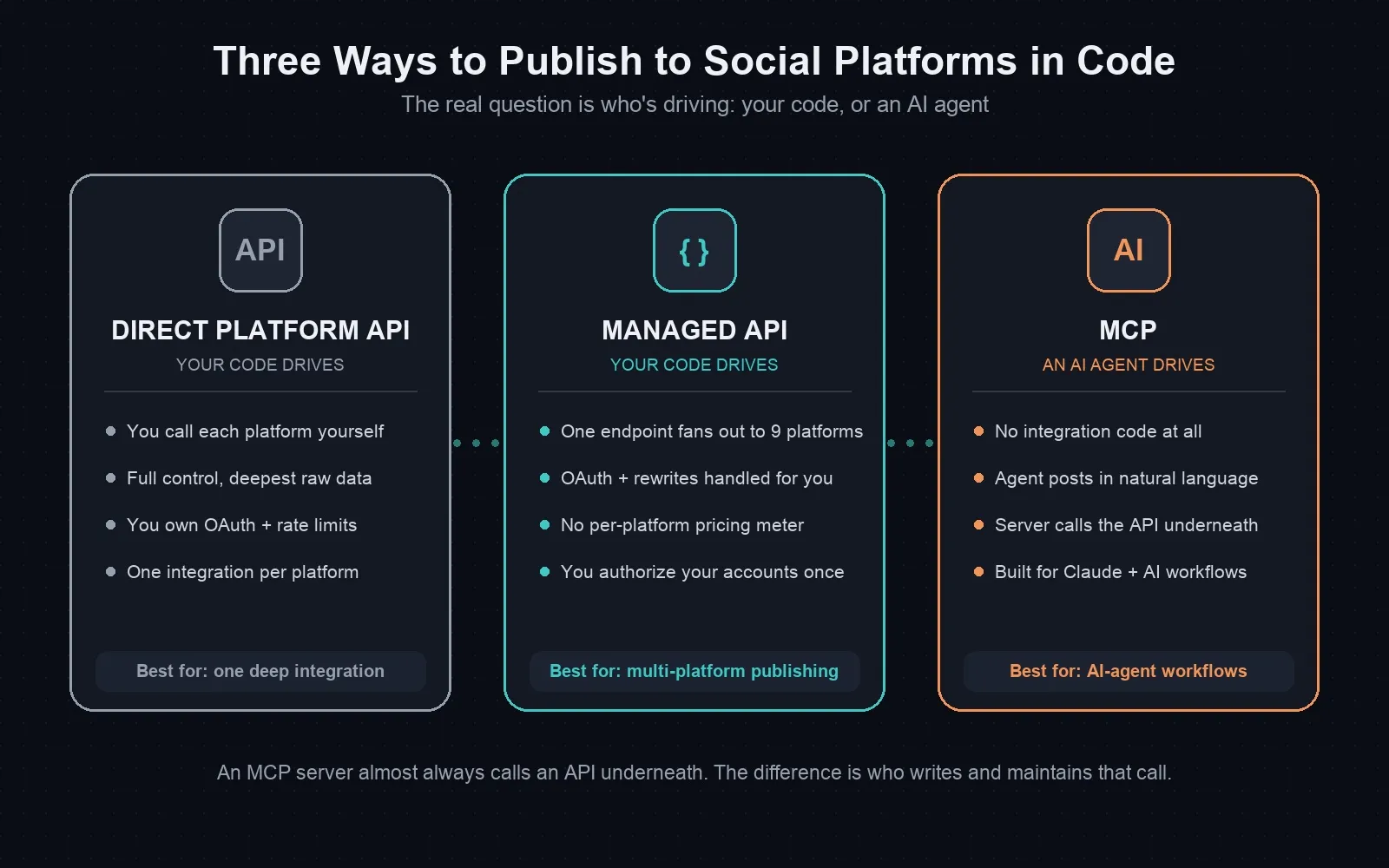
A direct platform API means you call X, Meta, or TikTok yourself. A managed API means you integrate one endpoint that reaches every platform. MCP means you don’t write the integration at all. You point an AI agent like Claude at a server, and it posts by talking to that server in plain language.
That third path is the one worth watching. If you’re building with Claude, Claude Code, or an n8n or Make automation, MCP is the shortest route from “agent decides to post” to “post is live.” So the real question isn’t “which API.” It’s whether you write integration code, hand it to a managed service, or skip the endpoint entirely and let an agent drive. This guide walks all three and tells you which one fits which build.
Social Media API vs MCP: At a Glance
A direct platform API is the better pick if: you need full control over one platform’s raw data, you’re building something that isn’t agent-driven, and you have the engineering time to own OAuth, rate limits, and rewrites.
MCP is the better pick if: you’re building on top of Claude or another AI agent, you want an agent to decide what and when to post, and you’d rather connect a server once than maintain nine integrations. If you haven’t settled on the agent itself yet, we compared the AI agents for social media on which ones can actually publish.
An API and MCP Are Not the Same Layer
Here’s the honest part most comparisons skip: an API and MCP are not the same layer of the stack.
An API is an endpoint you call. Your code sends an HTTP request, the platform sends a response, and you handle everything in between: authentication, retries, rate limits, and the specific shape of every platform’s payload.
MCP is a protocol an AI agent speaks. The Model Context Protocol is an open-source standard for connecting AI applications to external systems. It started at Anthropic and is now stewarded by the Linux Foundation as a vendor-neutral standard, so it isn’t tied to any single AI company. The docs describe it as “a USB-C port for AI applications,” a standardized way for an agent like Claude to reach tools and take actions. An MCP server sits between the agent and the thing it wants to do, and the agent calls it in natural language rather than hand-written HTTP.
So they overlap, but they answer different questions. An API answers “how does my code talk to this platform.” MCP answers “how does my agent take this action.” You can even use both: an MCP server almost always calls an API under the hood. The difference is who writes and maintains that call. With a raw API, it’s you. With MCP, it’s the server author.
What a Direct Social Media API Gets You
Calling a platform’s API directly gives you the most control and the most work. You get every field the platform exposes, in real time, with no middle layer. If you’re building a research tool that reads X at volume, or a product that needs a platform’s raw analytics, this is the layer you want.
The cost shows up in three places.
First, pricing. Platform APIs are not cheap in 2026. X moved to pay-per-use pricing as the default for new developers, charging $0.015 per post created and $0.20 per post that contains a URL. YouTube stays free but boxes you into a 10,000-unit daily quota. Every platform prices differently, and I break down all of them in the social media API pricing guide.
Second, OAuth. Every platform has its own token flow, its own expiry rules, and its own refresh logic. Build for one and you’ve solved one. Build for nine and you’ve built nine token schedules that all break on their own timelines. That token step is one link in the chain an agent has to survive to publish.
Third, rewrites. Platforms deprecate endpoints and bump API versions on their schedule, not yours. Meta, for example, publishes a new Graph API version regularly, and old versions age out. Every version bump is maintenance you didn’t ask for.
If you’re building one deep integration with one platform, going direct is a defensible choice. If you’re publishing to several, the direct path multiplies the pain by the number of platforms.
What a Managed API Gets You
A managed API is the middle path, and it’s the one that gets skipped in a two-way “API vs MCP” framing. Instead of integrating nine platforms, you integrate one endpoint that reaches all of them.
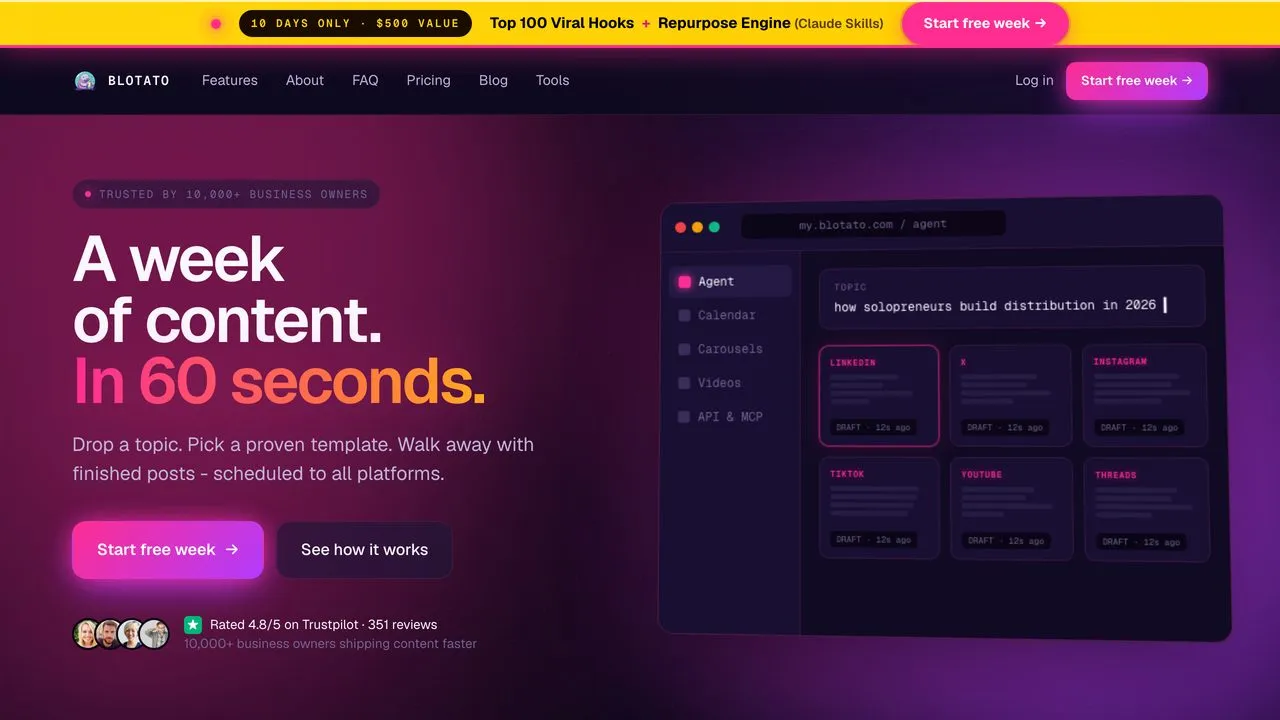
This is what Blotato does. I founded Blotato, so discount my enthusiasm here, but the model is straightforward. One API key and one request shape reach X, Instagram, LinkedIn, TikTok, YouTube, Threads, Facebook, Pinterest, and Bluesky, with one post per account in each call. The OAuth flows, token refreshes, rate limits, and platform rewrites move from your codebase to the service.
curl -X POST https://backend.blotato.com/v2/posts \
  -H "blotato-api-key: YOUR_API_KEY" \
  -H "Content-Type: application/json" \
  -d '{
    "post": {
      "accountId": "YOUR_ACCOUNT_ID",
      "target": { "targetType": "twitter" },
      "content": { "text": "Posted via one managed API." }
    }
  }'
To cross-post the same content to LinkedIn, you send the same request again with your LinkedIn accountId and targetType set to linkedin, through the same code path. There’s no per-platform pricing meter and no URL-post tax. The full reference lives in Blotato’s API docs.
A managed API doesn’t give you a platform’s deepest raw data. If you need every analytics field X exposes, you still go direct. But if your job is “publish content across platforms,” a managed API removes the exact work that makes the direct path expensive.
What MCP Gets You
MCP is the newest of the three, and it’s built for one thing: an AI agent in the loop.
With MCP, you don’t write the posting integration. You connect an MCP server to your agent, and the agent posts by calling the server in natural language. Blotato runs an MCP server at mcp.blotato.com/mcp, which means Claude, Claude Code, or any MCP-compatible client can publish to your social accounts directly. That includes open-source agents, so the same server is what an OpenClaw agent connects to when you want it publishing on your behalf, and the same is true for Hermes Agent, which ships no native skill beyond X. The agent decides “post this now,” and the post goes live, with no HTTP request written by you. Not every server goes that far, so it is worth knowing which ones stop short. The per-platform MCP setup pages list exactly which actions the server exposes on each network, and the AI agents page covers how each client connects, from Claude Code and Cursor to ChatGPT, Gemini CLI, and the newly launched Grok Bot. For OpenAI’s always-on agent, the ChatGPT Dots guide covers what is confirmed so far.
In practice, that looks like this. You add the Blotato MCP server to Claude Code once, which is one command in a session, then you can prompt: “Draft a LinkedIn post about our launch and publish it to my LinkedIn and X.” Claude writes the post, calls the server, and both go live. You never touched the LinkedIn or X API. The same works from Claude Desktop or an n8n or Make workflow, so if you’ve been wiring platform calls by hand inside n8n, the MCP server collapses that into one connection your agent drives.
The trade-off is that MCP assumes you’re working with an agent. If your product has no AI agent driving it, MCP adds a layer you don’t need, and a managed or direct API is the cleaner fit. MCP isn’t a replacement for the API underneath. It’s a way for an agent to reach it without you writing the reach.
The Part Nobody Mentions: You Still Need Platform Access
Whichever path you pick, the platforms still have to let you in, and this is where the three options really separate.
Every platform requires app approval for publishing access. Meta and TikTok both run review processes that can take weeks. Those approvals are yours to get on the direct path, one per platform, before a single post goes out.
A managed API or a managed MCP server absorbs the app-review half of that. The service already holds the approved developer apps on each platform, so you skip the weeks-long review queue. You still connect and authorize your own accounts once through OAuth, which is a few clicks, not a review process. Build your own MCP server on raw APIs, though, and you own the app approvals yourself, plus the server. That’s the nuance the hype misses: MCP relocates the app-review work exactly like a managed API does, and only when the server you use is managed.
The Real Cost Comparison
This is the three-way view of what each path actually costs you to run. The table below is qualitative on purpose, since the dollar figure depends entirely on how much you post; to put a number on the direct-API column, price the DIY route against your own volume. I have since measured the managed-API and MCP columns directly, and what one social media post actually costs in tokens on each path came out closer than the published benchmarks predict.
| Capability | Direct platform API | Managed API (Blotato) | MCP server (managed) |
|---|---|---|---|
| Integration code you write | One per platform | One endpoint | None (agent-driven) |
| OAuth token maintenance | Yours, every platform | Handled | Handled |
| Platform app-review (Meta, TikTok) | Yours, weeks each | Skipped (you just authorize your accounts) | Skipped (you just authorize your accounts) |
| API rewrites on version bumps | Yours, every version | Handled | Handled |
| Agent-native (Claude drives it) | No, you write the calls | Via API calls | Yes, natively |
| Deepest raw platform data | Full access | Publishing-focused | Publishing-focused |
| Best fit | One deep integration | Multi-platform publishing | AI-agent workflows |
The pattern is clear. The direct API wins on raw depth and loses on maintenance. The managed API and MCP both move the maintenance off your plate. The difference between those two is the interface: a managed API is for your code, MCP is for your agent.
One limit this table does not capture is the monthly post cap. Several CLI-first publishing tools meter how many posts you can send, and that ceiling usually shows up after you have wired the thing in, not on the pricing page. I put the developer-facing tools side by side on their caps if that number decides your build.
The two-surface problem is worth checking too, because a vendor’s REST contract and its MCP server do not always expose the same product. I found exactly that split when I compared SocialClaw against Blotato.
Blotato’s API is included on every paid plan, starting at $29/month for Starter, and the same plan covers the API, the managed endpoint, and the MCP server. You pick the interface that fits the build.
When a Direct API Still Wins
- You need one platform’s deepest raw data (full analytics, search, historical reads)
- Your product isn’t agent-driven and never will be
- You’re building a single deep integration, not multi-platform publishing
- You need real-time streaming or endpoints a managed layer doesn’t expose
- You have the engineering time to own OAuth, rate limits, and version rewrites
When MCP Wins
- You’re building on Claude, Claude Code, or another AI agent
- You want the agent to decide what and when to post
- You’d rather connect a server once than maintain nine integrations
- You’re shipping an AI content workflow and want the shortest path to publish
- You want agent-native posting without writing the platform calls yourself
Sabrina’s Final Take
The social media API vs MCP question has a boring, honest answer: it depends on who’s driving. If your code is driving and you need one platform’s raw depth, go direct. If your code is driving and you’re publishing across platforms, a managed API saves you the OAuth-and-rewrites tax. If an AI agent is driving, MCP is the interface that was built for exactly that, and it’s where the best builders I know are spending their time in 2026.
I’m biased, obviously, since I built Blotato. The honest advice holds even if you never touch it: match the interface to who’s making the decision. If you’re still unsure, start with the social media API pricing guide to see what going direct really costs. If you want the managed API or the MCP server to do the heavy lifting, plan on a paid Blotato plan rather than the 7-day trial, because the trial excludes API and MCP access.
FAQs
What is the difference between a social media API and MCP?
A social media API is an endpoint your code calls to talk to a platform. MCP is a protocol an AI agent speaks to take actions through a server. An API answers “how does my code reach this platform.” MCP answers “how does my agent take this action.” An MCP server usually calls an API under the hood, so they’re layers, not rivals.
Does MCP replace the social media API?
No. MCP is an interface for AI agents, not a replacement for the underlying API. An MCP server still calls a platform API to actually publish. MCP changes who writes and maintains that call: with a managed MCP server, the server author owns it instead of you.
Can I use both an API and MCP together?
Yes, and many builders do. You might use a managed API for scheduled publishing from your backend and an MCP server so Claude can post ad-hoc when it decides to. Blotato’s paid plans include the API, the managed endpoint, and the MCP server, so you’re not choosing one interface forever. If the scheduled-publishing half is what you’re weighing, who actually runs the queue on eight scheduling APIs compares them on that specifically.
Is MCP free to use?
The Model Context Protocol itself is an open standard, so the protocol is free. The MCP server you connect to may not be. Blotato’s MCP server is included on its paid plans starting at $29/month, the same plans that include the API. You pay for the service behind the server, not the protocol.
Which is better for an AI agent posting to social media?
MCP, in most cases. If Claude or another agent is deciding what to post and when, MCP is the shortest path from decision to published post, because the agent calls the server in natural language instead of you writing platform HTTP. If your product has no agent driving it, a managed API is the cleaner fit.
Do I still need platform approvals with MCP?
The weeks-long app-review queue, only if you build your own MCP server on raw platform APIs. A managed MCP server already holds the approved developer apps, so you skip that review. You still authorize your own accounts once through OAuth, which is a few clicks. MCP relocates the app-review work, it doesn’t remove your account authorization. That’s the same trade a managed API makes.