Bluesky API Pricing: Full Breakdown for 2026
Bluesky API pricing in 2026: no paid tier, no app review, 5,000 points an hour, OAuth in dev preview, plus wrapper costs and when to skip DIY.
Bluesky API pricing in 2026 is the simplest answer in this whole series: there is no paid tier, no per-call fee, and no Meta-style app review on the official Bluesky AT Protocol API.
Is the Bluesky API free in 2026? Genuinely, with almost no asterisk. There is no developer portal to apply to, no review queue, and no key Bluesky issues you: you create an account and start calling the AT Protocol API. The only real constraint is a points-based rate limit (5,000 points per hour, where a post costs 3), plus the one-time choice between OAuth and the legacy App Password auth. If you would rather not write that auth layer at all, a unified tool like Blotato publishes to Bluesky through its MCP server, so Claude Code and other AI agents post with no OAuth flow of your own.
I’ve been shipping on social media APIs for years, and Bluesky is the platform where the price question stops at the docs. The friction is somewhere else. The official AT Protocol API runs on a points-based rate limit that caps you at about 1,666 record creations per hour per account (posts, likes, follows, and reposts all count), OAuth has been in developer preview since September 25, 2024 and is the recommended path for new builds, and the legacy App Password flow still works but Bluesky has asked developers to stop using it for new projects. One thing the hourly number hides: the daily ceiling of 35,000 points is not 24 times the hourly one, so sustained posting hits the day limit after about seven hours. I put that next to what every other platform caps you at if you are budgeting across several at once.
This guide covers what Bluesky API access actually costs in 2026, the points math behind the rate limits, the OAuth-versus-App-Password decision, what third-party wrappers charge per 1,000 posts, and when going through a wrapper like Blotato makes more sense than wiring AT Protocol auth yourself.
Bluesky API Pricing at a Glance (2026)
| Access path | Cost | Best for | Key friction |
|---|---|---|---|
| Bluesky AT Protocol API (official) | Free, no paid tier published | Posting, reading, building clients on your own account | 5,000 points/hour rate limit, OAuth vs App Password decision, no SLA |
| Public AppView endpoints | Free | Read-only public data (feeds, profiles, search) | Generous limits but no posting |
| RapidAPI BlueSky wrapper | Free Basic tier up to vendor-listed paid tiers (verify live) | Quick prototyping of read flows | Unofficial, vendor-listed prices, verify before subscribing |
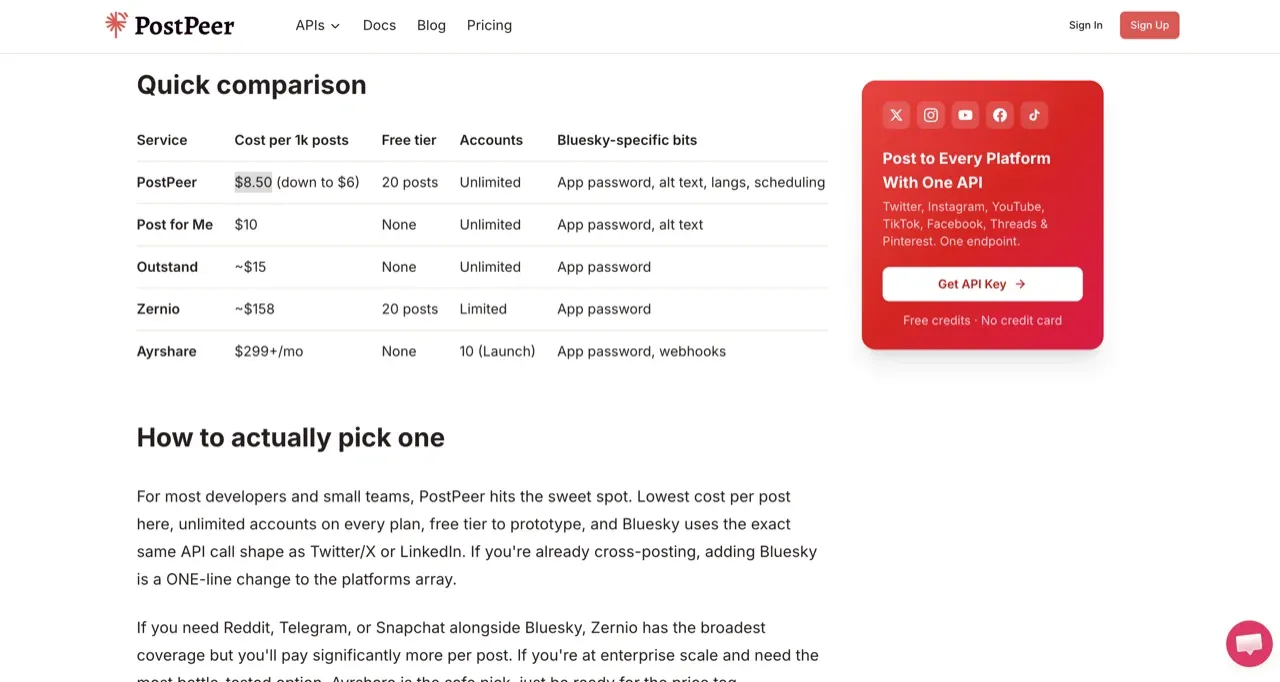
| PostPeer (multi-platform wrapper) | $8.50 per 1,000 posts (drops to $6 on Pro) | Cheapest per-post for Bluesky publishing | ~8 networks supported, free tier limited to 20 posts |
| Zernio multi-platform API | Per-connected-account pricing, derived as roughly $158 per 1,000 posts in PostPeer’s published comparison | Bluesky plus Reddit, Telegram, Snapchat | Account-based rather than post-based pricing, verify on the vendor page |
| Ayrshare | From $149/month (Premium, 1 profile), Launch is $299/month | Enterprise teams needing SLAs | Different pricing unit, monthly subscription vs per-post |
| Blotato unified API | Starter $29/mo, Creator $97/mo, Agency $499/mo | Posting Bluesky plus eight other platforms from one endpoint | API access on paid plans only, generating a key ends the free trial |
Ayrshare’s per-profile model is the one most builders end up pricing around, so if that’s your starting point it’s worth weighing the best Ayrshare alternatives on flat versus per-account cost before you commit.
The honest answer is that Bluesky itself does not charge for API access. The catch is that “free” still costs you the rate-limit math, the auth migration, and the engineering hours to write the OAuth flow when you could be shipping product instead.
For teams that just want to publish to Bluesky and other networks without owning the auth layer, Blotato wraps the whole posting stack behind one endpoint. The dashboard has a 7-day free trial. The Blotato API runs on paid plans starting at $29 per month.
Free 7-day trial · Cancel anytime
No Portal, No Key: How AT Protocol Access Works
Create a Bluesky account. Generate an App Password in settings, or wire an OAuth session. Start calling endpoints. That is the entire access path, and there is genuinely no step missing: no developer portal, no application form, no review queue, no key that Bluesky issues you.
Calls go over XRPC, a plain HTTP convention where every endpoint is a namespaced method. com.atproto.repo.createRecord writes a post, com.atproto.server.createSession logs you in, app.bsky.feed.getAuthorFeed reads a timeline. Records are typed by a schema system called Lexicon, so your post is an app.bsky.feed.post record sitting in a repository you own rather than a row in Bluesky’s database.
Reading is looser still. The public AppView at public.api.bsky.app serves most app.bsky.* GET endpoints, profiles and feeds and post threads included, with no authentication at all. Anything touching private data or writing a record needs a session.
What the missing paperwork does not remove is the engineering. You still route requests to the right PDS for the account, handle token lifecycle, and respect a points budget rather than a request count. The rate limiting in particular behaves unlike anything else in this series, and it is worth seeing an actual response before you write retry logic against it.
What Changed in 2026 for the Bluesky API
Three shifts on the Bluesky developer surface in the past twelve months matter for builders deciding what to ship in 2026.
The first is the OAuth rollout. Bluesky announced OAuth for AT Protocol on September 25, 2024 and explicitly told developers to “stop using the legacy App Password system for new projects.” OAuth has been deployed on the bsky.social PDS and the official TypeScript SDK, and remained in developer preview through 2025. In June 2025, Bluesky shipped the first granular auth scope, transition:email, for reading the account email, with broader auth-scope work still wrapping up in protocol design. If you are starting a project in 2026, OAuth is the path. App Passwords still work for personal scripts and accounts you own.
The second is the rate-limit posture. The points-based limits have held at 5,000 points per hour and 35,000 points per day per account for a couple of years now, but the official rate-limits page is now the canonical reference and the AppView endpoints at api.bsky.app and public.api.bsky.app are documented as having “generous rate-limits” with an explicit “contact us” path if you actually hit them. The practical effect is that read-heavy clients have more headroom than write-heavy bots.
The third is the network. Bluesky grew from roughly 10 million users in September 2024 to more than 40 million by October 2025, with the federation surface (third-party PDS instances, custom feeds, third-party AppViews) maturing alongside it. The API contract is stable, the SDKs are public, and the platform is now a first-class publishing destination, not a side experiment.
Bluesky API Pricing, in Plain English
The Bluesky AT Protocol API has no published paid tier and no per-call fee. The official Bluesky API docs point developers at three host categories, all free:
https://bsky.socialfor the Bluesky-hosted PDS, where authenticated calls (createSession, createRecord, deleteRecord) live for accounts on the default hosting service.https://api.bsky.appandhttps://public.api.bsky.appfor the AppView, where reads of feeds, profiles, and public data live.https://bsky.networkfor the Relay (firehose), which streams the public network’s events.
Authenticated reads and writes route through the user’s PDS. Public reads can hit the AppView directly, with “additional caching” per the official API hosts directory. None of these hosts charge by request, by month, or by quota.
The first cost line in the post is therefore zero dollars. The next sections cover what does cost you: rate limits, auth choice, and the operational tax of running on AT Protocol versus wrapping it.
The Points System: How Bluesky Charges Without Charging
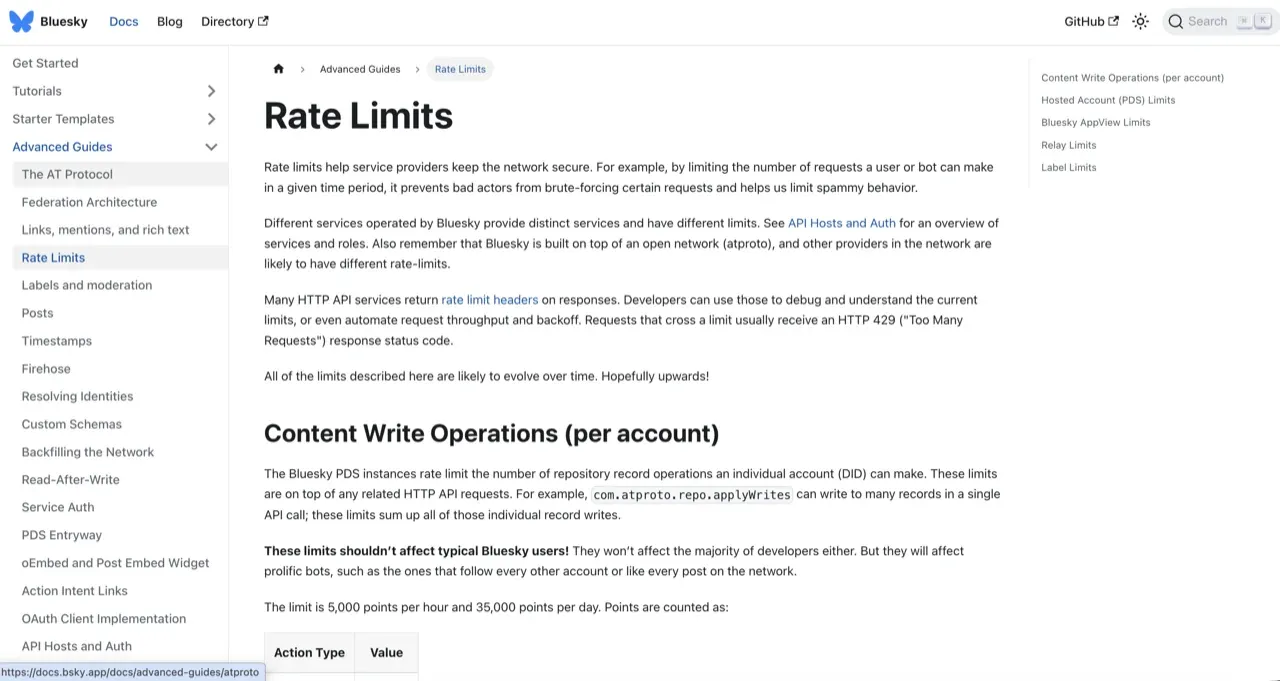
Bluesky meters write actions on a points system instead of a dollar bill. Every record write costs points, and your account has a points budget per hour and per day.
| Action | Points | What it means |
|---|---|---|
| Create a record (post, like, follow, repost) | 3 | Adds a new entry to your repository |
| Update a record (edit profile, edit feed generator) | 2 | Modifies an existing record |
| Delete a record | 1 | Removes a record |
| Account limit, per hour | 5,000 | About 1,666 creates, 2,500 updates, or 5,000 deletes |
| Account limit, per day | 35,000 | About 11,666 creates, 17,500 updates, or 35,000 deletes |
On top of the account limits, the Bluesky-hosted PDS enforces an IP-level limit of 3,000 requests per 5 minutes across all routes, plus per-endpoint caps: 10 handle updates per 5 minutes (50 per day), 30 createSession calls per 5 minutes (300 per day), 100 createAccount calls per 5 minutes per IP, and 50 resetPassword and deleteAccount calls per 5 minutes per IP. The numbers are on Bluesky’s rate limits doc, which is the source you should treat as canonical.
A few things to keep in mind:
The per-hour limit is the one most builders hit first. If your bot does anything more than text posting (auto-likes, auto-follows, repost loops, mass deletion of old content), every action counts at 3 or 1 points and the hour budget burns down fast. Bluesky’s developer guidelines also count automated or bulk likes, follows and replies that notify someone as spam, so the points budget is not the only limit on a bot.
Bursts trigger 429s, not bans. Requests that cross a limit receive an HTTP 429 “Too Many Requests” response status code per the official docs. Back off, retry on a longer window, and you are fine.
Federation changes the math. “Bluesky is built on top of an open network (atproto), and other providers in the network are likely to have different rate-limits,” per the Bluesky docs. If you run your own self-hosted PDS, you control the rate limits for accounts on it. If you build against someone else’s PDS, their numbers apply.
Blob uploads cap at 50 MB. Media uploads top out at 52,428,800 bytes per file, which is also worth knowing before you wire a video pipeline.
”Rate Limit Exceeded” on Bluesky: What the Response Actually Says
If you are here because something returned rate limit exceeded, this is the shape of it. I triggered a real one against bsky.social on September 10, 2026 by repeatedly calling com.atproto.server.createSession, and the wire response was this:
HTTP/2 429
ratelimit-limit: 10
ratelimit-remaining: 0
ratelimit-reset: 1789150040
ratelimit-policy: 10;w=86400

{"error":"RateLimitExceeded","message":"Rate Limit Exceeded"}
Four things in there are worth knowing before you write your retry logic.
The error name is RateLimitExceeded and it arrives in the body, not just the status line. AT Protocol’s XRPC convention returns every error as a JSON object with an error field holding a type name and an optional human-readable message. Branch on error === "RateLimitExceeded" rather than parsing the message string, which is display text and not a stable contract.
The reset time lives in a header, and it is an absolute timestamp. ratelimit-reset is Unix epoch seconds, so the wait is ratelimit-reset - now() rather than a duration you can sleep on directly. ratelimit-policy decodes as limit;w=window-in-seconds, so 10;w=86400 describes ten requests against an 86,400-second window.
No Retry-After header came back on this response. The XRPC spec allows one on a 429, so do not assume it is never present, but do not build your only back-off path on it either. A client that waits solely on Retry-After had nothing to read here. Treat ratelimit-reset as the reliable signal and keep exponential back-off underneath it.
Do not assume the headers are on every response. Repeated probes of the public AppView returned 200 with no ratelimit-* headers at all, while the bsky.social auth endpoint sent the full set. The XRPC spec does not require these headers, so treat them as a signal to read when present rather than a contract, and make sure a limiter treats a missing budget as unknown rather than as zero.
One caveat on the published numbers. Bluesky’s rate-limits page documents createSession at 30 per 5 minutes, and the live response above advertised a policy of 10 per 86,400 seconds on that same endpoint. That gap may be an endpoint-specific, IP-specific or abuse-mitigation limit layered on top rather than a documentation error, and I would not claim which without more probes. Either way the practical rule holds: read ratelimit-policy off your own traffic instead of hard-coding a number from the docs.
If the limit you are hitting is the points budget rather than an endpoint cap, the fix is different: that is the 5,000-per-hour ceiling described above, and it is paced by spreading writes rather than by waiting out a single window.
App Passwords vs OAuth: The Auth Decision
The other “cost” of the Bluesky API in 2026 is the auth migration. There are two production paths, and the right one depends on whether you are building for yourself or for users.
App Passwords are the legacy path. You generate a separate password in your Bluesky settings (so your real password is not exposed), pass it to com.atproto.server.createSession along with your handle, and you get short-lived access plus refresh tokens. App Passwords are still functional in 2026 and remain the simplest pattern for personal scripts and bots on accounts you own. They cost zero dollars and zero calendar time to set up.
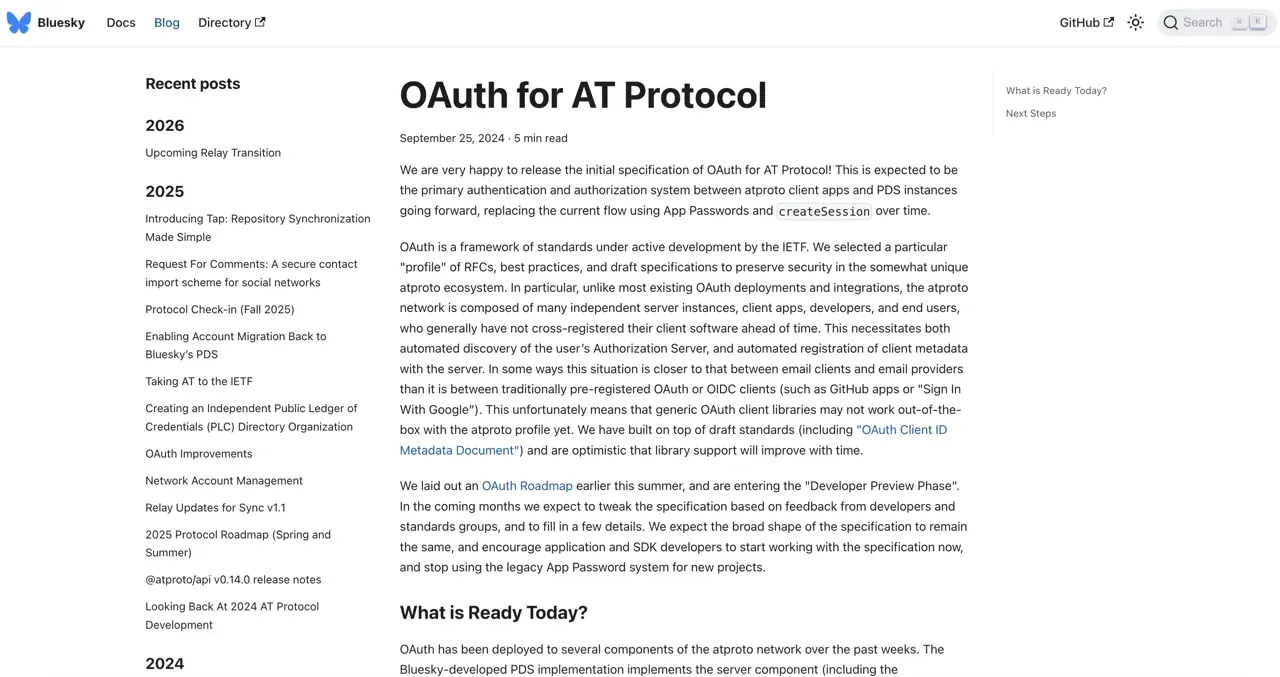
OAuth is the modern path. Bluesky announced OAuth for AT Protocol on September 25, 2024 with the explicit note: “encourage application and SDK developers to start working with the specification now, and stop using the legacy App Password system for new projects.” OAuth supports public clients (browser and mobile apps with no server-side secret) and confidential clients (server-side apps), and as of June 2025 includes granular auth scopes for limiting what your app can do. The Bluesky OAuth client implementation guide walks through the flow.
The trade-off is that OAuth requires more setup. You host a client-metadata.json file at a public URL, handle PAR (pushed authorization requests) and DPoP (demonstrating proof-of-possession), build the callback handler, and refresh tokens correctly. The official @atproto/api TypeScript SDK handles most of the plumbing, but it is still meaningfully more work than three lines of createSession.
In practice: if you are building a public product that onboards users in 2026, build OAuth. If you are scripting against your own account, App Passwords are still fine.
Real-World Access Examples
Three usage profiles. Each one shows what “free” looks like when you add up the auth work, the rate-limit budget, and any wrapper fees.
The Indie SaaS Publisher
A solo founder posting 10 to 20 times a day to a single Bluesky account, with the occasional repost on top.
- Bluesky API monthly cost: $0
- Auth path: App Password, 10 minutes to wire with the official
@atproto/apiSDK - Rate-limit headroom: 20 posts a day plus 100 likes lands at roughly 360 points, deep inside the 35,000-per-day budget
- Total: $0/month, about 2 hours of setup
The Agency Posting for 30 Clients
You run a content agency that posts on behalf of 30 different Bluesky accounts.
- Bluesky API monthly cost: $0
- Auth path: OAuth, per Bluesky’s recommendation for new projects, plus a
client-metadata.jsonhosted at a public URL and a callback handler - 30 separate token-refresh jobs to maintain, no Meta-style app review, no business verification
- Total: $0/month, roughly 1 to 2 weeks of OAuth engineering and ongoing token maintenance
The Brand Monitor or Researcher
You are tracking public Bluesky conversation for clients at firehose volume.
- Public AppView calls to
public.api.bsky.app: $0 within the “generous” but undefined rate limits, with a contact path if you actually need more - Firehose subscription to
bsky.network: $0, with per-PDS Relay limits of 50 events per second, 2,600 per hour, and 21,000 per day on the source side - Total: $0/month, with the caveat that the open firehose is the same surface AI training crawlers have been documented using to scrape Bluesky’s public posts at scale
The Wrapper Tax: When Paid APIs Beat Free
The Bluesky API is free. That is not the same as “the cheapest way to ship a Bluesky integration.” A few third-party wrappers price themselves against the engineering hours, not against Bluesky, and they are the only place real Bluesky API pricing actually lives.
| Wrapper | Free tier | Cheapest paid tier | Per-1k posts (effective) | Networks | Notable |
|---|---|---|---|---|---|
| PostPeer | 20 posts | Credit packs (e.g. $9 / 500 posts) | $8.50, drops to $6 on Pro | ~8 | Cheapest per-post for Bluesky publishing |
| RapidAPI BlueSky API | Free Basic tier | Vendor-listed paid tiers (verify live) | Not priced per-post | 1 (Bluesky only) | Read-skewed, unofficial wrapper |
| Zernio | Free (first 2 accounts) | $6 per account (3-10 accts) | Not priced per-post | 15 inc. Reddit, Telegram, Snapchat | Per-account model, not per-post |
| Ayrshare | None | $149/mo Premium (1 profile) | Not priced per-post | Multi-platform | Enterprise option with SLA, Launch tier is $299/mo |
Per-1k rates assume the cheapest paid tier and are the only comparable unit across vendors that price differently. The Zernio number is PostPeer’s derived comparison rather than Zernio’s own pricing model. Verify each vendor’s live pricing page before subscribing.
If you are posting only to Bluesky and you have engineering time, going direct to AT Protocol is free and the math is hard to beat at low volume. If you are posting to Bluesky plus four other networks, every wrapper saves you the OAuth-flow-per-platform tax, and the math flips fast.
Already Using App Passwords? Here Is What Migrating to OAuth Costs
If you shipped on Bluesky during the App Password era and you are deciding whether to migrate, the calendar cost is real but contained.
You need a client-metadata.json file at a stable public URL (Bluesky uses this as the OAuth client ID, per the official OAuth client guide), a callback endpoint that handles the OAuth response, refresh-token handling for long sessions, and the DPoP-signed request flow the SDK abstracts. The official TypeScript and Node.js OAuth examples on GitHub cut the work substantially. Plan for one to two weeks of engineering for an existing single-account integration, longer for multi-account products.
The upside is that OAuth is the path Bluesky is asking new projects to use, and the granular scope work shipped in mid-2025 means you can ask for read-only access (or transition:email, or write-only) without taking full account control. App Passwords cannot do that.
The Honest Pitch: Skip the Bluesky API and Use Blotato
Founder disclosure first: I run Blotato, so this section is a pitch by definition. Treat it as one.
The real cost of Bluesky integration is not the API itself. It is the auth flow, the rate-limit handling, the per-platform OAuth file per network you want to publish to, and the token-refresh job that runs forever once you have users. For a Bluesky-only personal bot, doing it yourself is the right call. The moment you add a second network on top, the auth code does not cleanly compose and the engineering hours start to dominate the bill. And if you don’t want to write any code at all, Claude can publish to Bluesky from a plain prompt through the same Blotato connection.
One API. Every social platform.
Blotato’s unified API turns Bluesky publishing (and eight other platforms) into a single HTTP request:
The full envelope, with threads and the media URL rule, is on the Bluesky posting API page.
curl -X POST https://backend.blotato.com/v2/posts \
  -H "blotato-api-key: YOUR_API_KEY" \
  -H "Content-Type: application/json" \
  -d '{
    "post": {
      "accountId": "YOUR_BLUESKY_ACCOUNT_ID",
      "target": { "targetType": "bluesky" },
      "content": {
        "text": "Posted to Bluesky via the Blotato API.",
        "mediaUrls": [],
        "platform": "bluesky"
      }
    }
  }'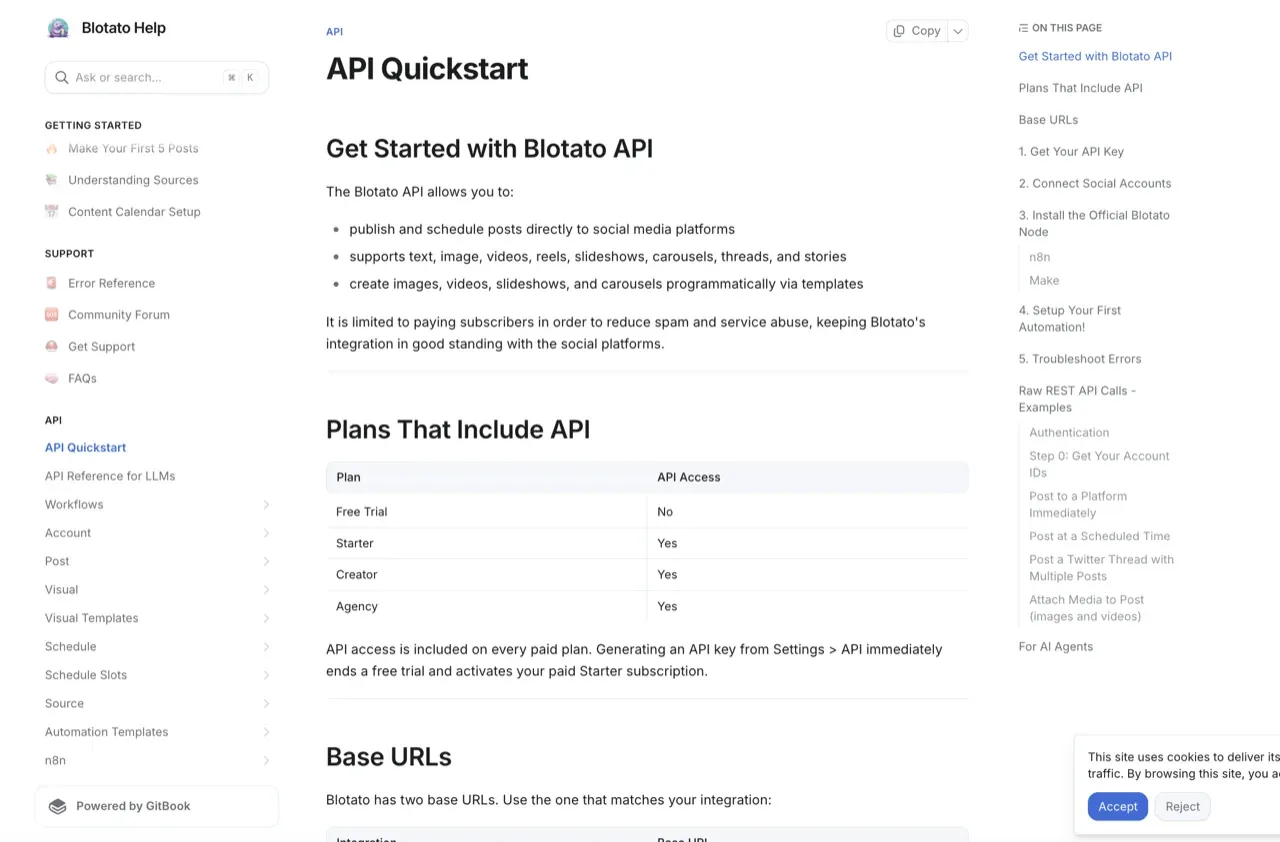
That is the minimal Bluesky payload. The same envelope works for the other eight platforms in the API enum (X, Instagram, LinkedIn, TikTok, YouTube, Threads, Facebook, Pinterest), with platform-specific target fields. The Blotato API quickstart guide covers the full schema, including Bluesky-specific options.
The API is included on every paid plan, with no per-post charges layered on top. The pricing page puts it directly: “No per-post fees, no seat fees, no hidden tax on your soul.”
Blotato plans:
- Starter ($29/month): 1,250 AI credits, 20 connected accounts
- Creator ($97/month)
- Agency ($499/month)
Start a free week of Blotato →
If you are also evaluating direct integrations for the other big platforms, the broader Social Media APIs developer guide covers every platform side by side, and Pinterest API Pricing is the closest sibling: another free API where the real cost is approval and rate-limit rules, not dollars.
Sabrina’s Take
I’m biased, obviously. Of the nine APIs we ship against at Blotato, Bluesky is the one I would recommend to a developer who only ever wants to post to one platform. The docs are clean, the auth flow is reasonable, and the rate-limit page is the only one in this series that actually answers the question in the title without a footnote.
Going direct breaks the moment you also need X’s pay-per-use API, Threads, or LinkedIn, because every platform’s OAuth surface is a different shape. That is the gap a wrapper closes. If you are a solo dev posting only to your own Bluesky account, save the $29. If you are shipping anything multi-platform, the day you stop maintaining four separate auth flows is the day this stops being a math question. The API cost calculator is the quickest way to find which side of that line you sit on.
FAQs
Is the Bluesky API free in 2026?
Yes. The official Bluesky API pricing is zero dollars: no paid tier, no per-call fee, no per-platform quota for the AT Protocol API. Authentication is free, posting is free, reading the public firehose is free. The costs that exist are rate-limit math (5,000 points per hour per account) and the engineering time to wire OAuth or App Password auth.
How do I get access to the Bluesky API?
You don’t apply. Create a Bluesky account, generate an App Password in settings (or set up OAuth, per Bluesky’s September 2024 recommendation), and call the official endpoints. There is no developer portal, no review process, and no API key issued by Bluesky directly.
What are the Bluesky API rate limits in 2026?
Writes are budgeted in points (3 create, 2 update, 1 delete) up to 5,000 per hour and 35,000 per day per account. The Bluesky-hosted PDS adds a 3,000-requests-per-5-minutes IP cap. AppView reads have generous undefined limits with a contact path. Full details on the official rate-limits page.
Should I use App Passwords or OAuth for a new Bluesky integration?
Bluesky’s official guidance is to use OAuth for new projects and stop using App Passwords. OAuth has been in developer preview since September 2024, shipped its first granular auth scope (transition:email) in June 2025, and is handled by the official TypeScript SDK. App Passwords still work for personal scripts on accounts you own.
Does Bluesky have an API?
Yes, and it is open by default. Bluesky is built on the AT Protocol, so the same XRPC endpoints its own apps call are available to you: com.atproto.repo.createRecord to post, app.bsky.feed.getAuthorFeed to read a timeline, and the rest of the app.bsky.* and com.atproto.* namespaces. Most public reads work with no authentication through public.api.bsky.app. Anything private, and every write, needs a session on an account you control.
What does the Bluesky API return when I hit a rate limit?
An HTTP 429 with {"error":"RateLimitExceeded","message":"Rate Limit Exceeded"} in the body. On the bsky.social auth endpoint I probed, it also carried ratelimit-limit, ratelimit-remaining, ratelimit-reset and ratelimit-policy headers, though the XRPC spec does not require them so do not count on them everywhere. ratelimit-reset is a Unix timestamp rather than a duration, and no Retry-After came back on the response I captured, so compute the back-off from ratelimit-reset instead of relying on a client that only watches for Retry-After.
Do I need to self-host a PDS to use the Bluesky API?
No. Most developers run their app against the Bluesky-hosted PDS at bsky.social and never touch a self-hosted instance. Self-hosting a PDS becomes relevant when you want full control over the rate limits applied to accounts on it, or when you are building a competing client on AT Protocol with its own user base. The PDS self-hosting guide covers the Docker setup.