Open-Source vs Managed Social Media API: The Real Cost
This article explains the differences between open-source and managed social media APIs, and how to choose based on cost, maintenance, and scale.
The open-source vs managed social media API question sounds like a budget decision. It isn’t. It’s a decision about who rewrites the code the next time Instagram changes its rules. The same question shows up inside managed tools too, since some hand X back to you as your own developer app rather than brokering it, which I covered in the best Postproxy alternatives.
Self-hosting an open-source posting tool looks free on day one. You spin up a Docker container, connect a few accounts, and post. The bill comes later, and it’s paid in your weekends, not your credit card.
I’ve built content systems on both sides of this line. Here’s the honest tradeoff, where each one genuinely wins, and how to pick without learning the hard way.
One thing shapes the whole decision now: if you’re building with an AI agent, most of the best developers I know skip the raw SDK layer entirely and point Claude at a managed API over MCP to publish. The same holds for self-hosted agents, which is the route I walk through for OpenClaw and for getting a Hermes agent past its X-only limit. If you have not picked an agent yet, this comparison of 12 AI agents for social media sorts them by which ones can publish unattended. That option barely exists on the self-hosted side, and it changes the math. More on that below.
Open-Source vs Managed Social Media API: At a Glance
Open-source self-hosting is the better pick if: you post to a small, stable set of platforms, you have a hard data-privacy requirement, or you already run an engineering team that would maintain OAuth infrastructure anyway.
A managed social media API is the better pick if: you need the approval-gated platforms (Instagram, TikTok, LinkedIn, YouTube), you don’t want to own token-refresh jobs across nine platforms, and your time is worth more than the subscription.
If you already know you’re in the second camp, you can start on a Blotato plan and skip the plumbing entirely. The API is included on every paid plan rather than sold separately, though it sits outside the 7-day trial, so Starter at $29/mo is where the plumbing stops being your problem. If you’re not sure yet, keep reading, because the real cost of self-hosting is the part that never shows up in a pricing table.
Are These Even the Same Thing?
Not really, and pretending they are is how people pick wrong.
An open-source tool like Postiz or Mixpost is software you run on your own server. You get the source code, you host it, and you own the whole stack: the OAuth flows, the token storage, the posting queue, and every future fix.
A managed social media API is a service. You send a request, it posts to the platform, and someone else handles the plumbing underneath. Blotato, Ayrshare, and Zernio sit here.
The real split comes down to one question: who maintains the integration when a platform breaks it? With open-source, that’s you. With managed, that’s someone else’s job.
What Open-Source Self-Hosting Gets You
The open-source pitch is genuinely strong, and I don’t want to talk you out of it if it fits.
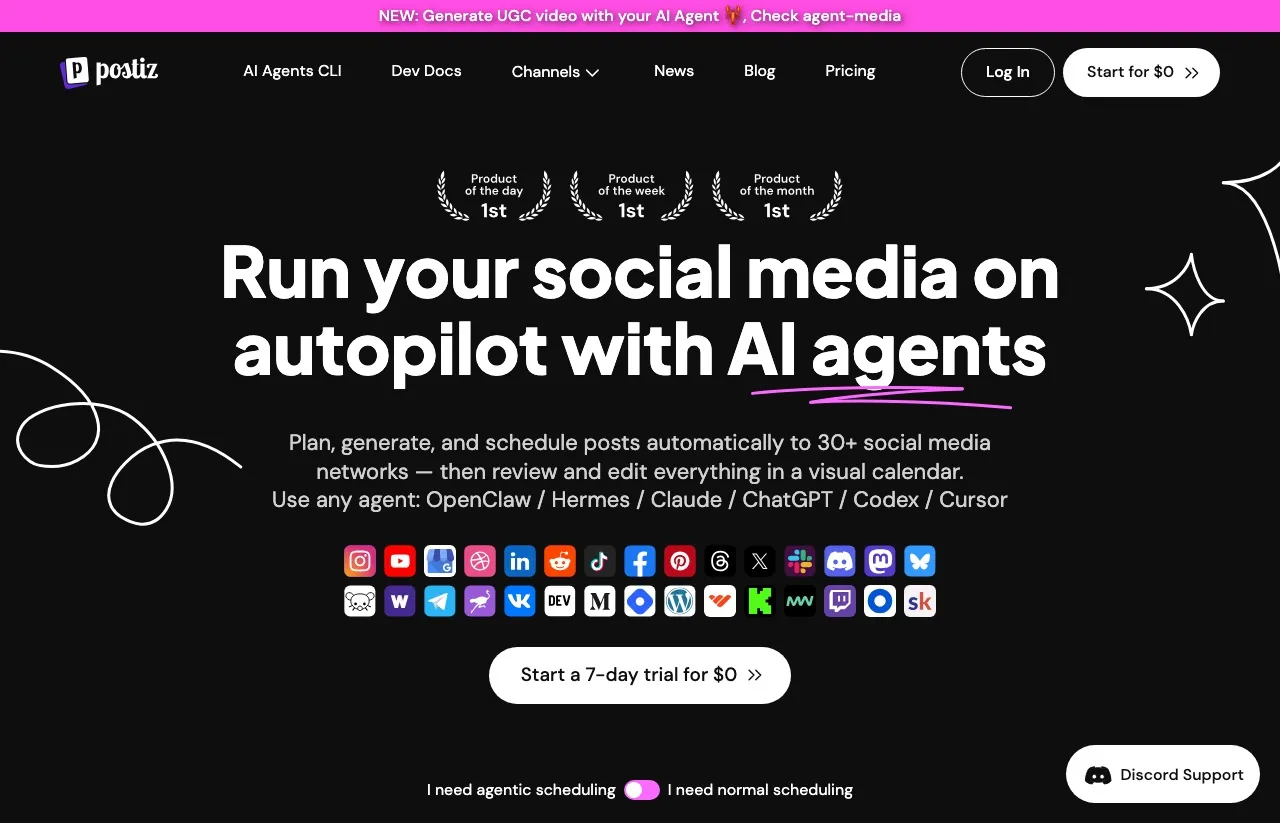
Postiz is the most capable of the bunch. It’s fully open-source, self-hosts through Docker, and its homepage advertises 30+ platform connections including X, Bluesky, Mastodon, Reddit, and Discord. It has more than 33,000 GitHub stars, so it’s a real project with a real community, not a weekend experiment. If it’s the specific tool you’re weighing, I ran the numbers on it in Blotato vs Postiz.
Mixpost takes a privacy-first angle. It’s a self-hosted Laravel app, and its whole reason to exist is that your data never leaves your server. That matters for health-tech, fintech, or anyone with compliance rules that make third-party tools a non-starter.
The honest catch with Mixpost: the free Lite edition only covers Facebook Pages, X, and Mastodon. To add Instagram, LinkedIn, TikTok, YouTube, Pinterest, Threads, and Bluesky, you need the Pro license, which is a $299 one-time payment. Still cheaper than years of subscriptions if you run at volume, but “open-source and free” quietly becomes “$299 for the platforms you actually wanted.”
Here’s what self-hosting really buys you:
- No recurring subscription. You pay for hosting, not per-account SaaS fees.
- Full data control. Nothing routes through a vendor you have to trust.
- Unlimited users and accounts. No per-seat or per-profile meter.
- The source code. You can fork it, patch it, and bend it to your workflow.
If you post to a narrow set of stable platforms and you have someone who can babysit a server, this is a legitimately good deal.
What a Managed Social Media API Gets You
Now the other side, and here I am not neutral. The managed API this section describes is Blotato, which I started, so check each claim below against its public docs rather than taking my word for it.
A managed API’s entire value is that it absorbs the maintenance you’d otherwise own. Blotato posts to nine platforms: X, Instagram, LinkedIn, TikTok, YouTube, Threads, Facebook, Pinterest, and Bluesky. It ships a REST API, native n8n and Make.com nodes, and an MCP server at mcp.blotato.com/mcp so an AI agent on Claude can post directly.
That MCP angle is where a lot of the best developers have landed lately. They aren’t wiring up raw platform SDKs anymore. They point Claude at a social media API over MCP and let the agent handle publishing. If open-source-vs-managed isn’t quite your fork, the other one worth reading is how to decide between a direct API, a managed API, and MCP.
To be fair, MCP is not managed-only anymore. Postiz and TryPost both ship their own MCP servers you can self-host, so an agent can post through them too. The difference is what sits behind the MCP call. With a self-hosted server, you still own the expiring tokens, the platform approvals, and the rewrites underneath it. With a managed API, the MCP call is the whole job, because the plumbing below it is someone else’s problem.
The thing you’re really buying is approvals you don’t have to chase. A managed provider has already passed TikTok’s content-posting audit and Meta’s App Review. When you self-host, those approvals are on you, and they take weeks.
The Part Nobody Puts in the Sales Copy: OAuth
This is where self-hosting quietly gets expensive, and it never shows up in a pricing comparison.
Every connected account runs on OAuth tokens. Tokens expire. Users revoke access. Platforms change their scopes. When you self-host, you own all of that, forever.
The expiry rules alone are a part-time job:
- Facebook and Instagram: long-lived tokens last about 60 days and only refresh when the user opens your app. Go idle for 60 days and the user has to log in again.
- LinkedIn: the access token lasts 60 days and cannot be extended. The refresh token runs 12 months, then the member re-authorizes from scratch.
- TikTok and X: both use OAuth 2.0 with refresh-token rotation, so you’re writing rotation logic and handling silent failures.
Now multiply that by nine platforms, each with its own quirks, error states, and reconnection flow. You’re not building a posting tool. You’re building and maintaining a token-management system that happens to post.
And tokens are only the login half. Actually publishing works differently on every platform. Instagram uses a two-step container flow: you create a media container, then publish it, capped at 100 API posts per account per day. YouTube uses resumable uploads metered by a 10,000-unit daily quota, not a simple rate limit. TikTok’s Content Posting API needs the right publish scope and forces drafts to private until you pass its audit. There’s no shared standard, so self-hosting means learning and maintaining each mechanism separately.
A managed API runs all of that for you. When a token needs refreshing or a platform changes its upload flow, you never hear about it.
The Real Cost: Platforms Change, You Rewrite
Token plumbing is the steady tax. The breaking changes are the surprise bills, and they’re the strongest reason self-hosting costs more than it looks.
Platforms rewrite their APIs on their schedule, not yours. A few that actually happened:
- Instagram’s Basic Display API shut down completely on December 4, 2024. Every endpoint stopped working, tokens quit refreshing, and there was no grace period. Anyone self-hosting on it had to migrate to the Graph API and convert accounts to Business or Creator, overnight.
- Twitter killed free API access in February 2023 with about a week’s notice, deprecated v1.1, and moved everyone to paid v2. Reporting: TechCrunch.
- Meta’s Graph API deprecates every version within roughly two years. It’s on v25.0 now, released February 2026, while v18.0 expired in January 2026. Even with no dramatic breakage, you’re on a permanent upgrade treadmill.
When you self-host, every one of those events is your emergency. You get the deprecation email, you drop what you’re doing, and you rewrite the integration before your posting stops. With a managed API, the provider eats that work and your posts keep going out.
Put a number on it. Integration-infrastructure vendor Merge estimates a single API integration takes roughly 150 hours to build and around 300 hours to maintain. Do the math on that: maintenance runs about twice the build, so most of the real cost lands after you ship, not during. Those are general API figures, not social-specific, so treat them as directional. But the direction is the whole point: across nine platforms with expiring tokens and a version treadmill, plan on this being real recurring engineering time, not a one-time project you finish.
The Pricing Math (And Where “Free” Stops Being Free)
Let’s put real numbers on it. Going direct to platform APIs is the true DIY path underneath any open-source tool, so its costs are the ones that bite. The cost calculator for the platform APIs puts the per-post fees and the maintenance hours side by side if you want to price your own setup while you read.
X made pay-per-use the default for new developers on February 6, 2026. The rate card is public, and one line should stop every creator cold:
- Create a post: $0.015 each.
- Create a post with a link: $0.200 each.
- Read a post: $0.005 each.
That link-post fee is roughly 13 times the plain-post fee. If you post to X with a URL a few dozen times a day, self-hosting the X integration means paying that fee yourself, per post, on top of the server and the maintenance.
The other platforms are “free” in a way that also isn’t. Meta’s Instagram Graph API charges nothing, but publishing on behalf of accounts you don’t own requires Advanced Access, App Review, and Business Verification, commonly a 4-to-6-week process. TikTok’s Content Posting API is free but forces every post to private until you pass a separate audit.
Now the managed side, verified live today:
| Capability | Self-host open-source | Blotato Starter ($29/mo) |
|---|---|---|
| Recurring software fee | $0 (or $299 one-time for Mixpost Pro) | $29/mo flat |
| Server + database hosting | Yours to run and pay | Included |
| OAuth token maintenance | Yours, all nine platforms | Handled |
| Platform approvals (Meta, TikTok) | Yours, 4-6 weeks | Already passed |
| API rewrites on deprecation | Yours, every version | Handled |
| Social accounts | Unlimited | 20 |
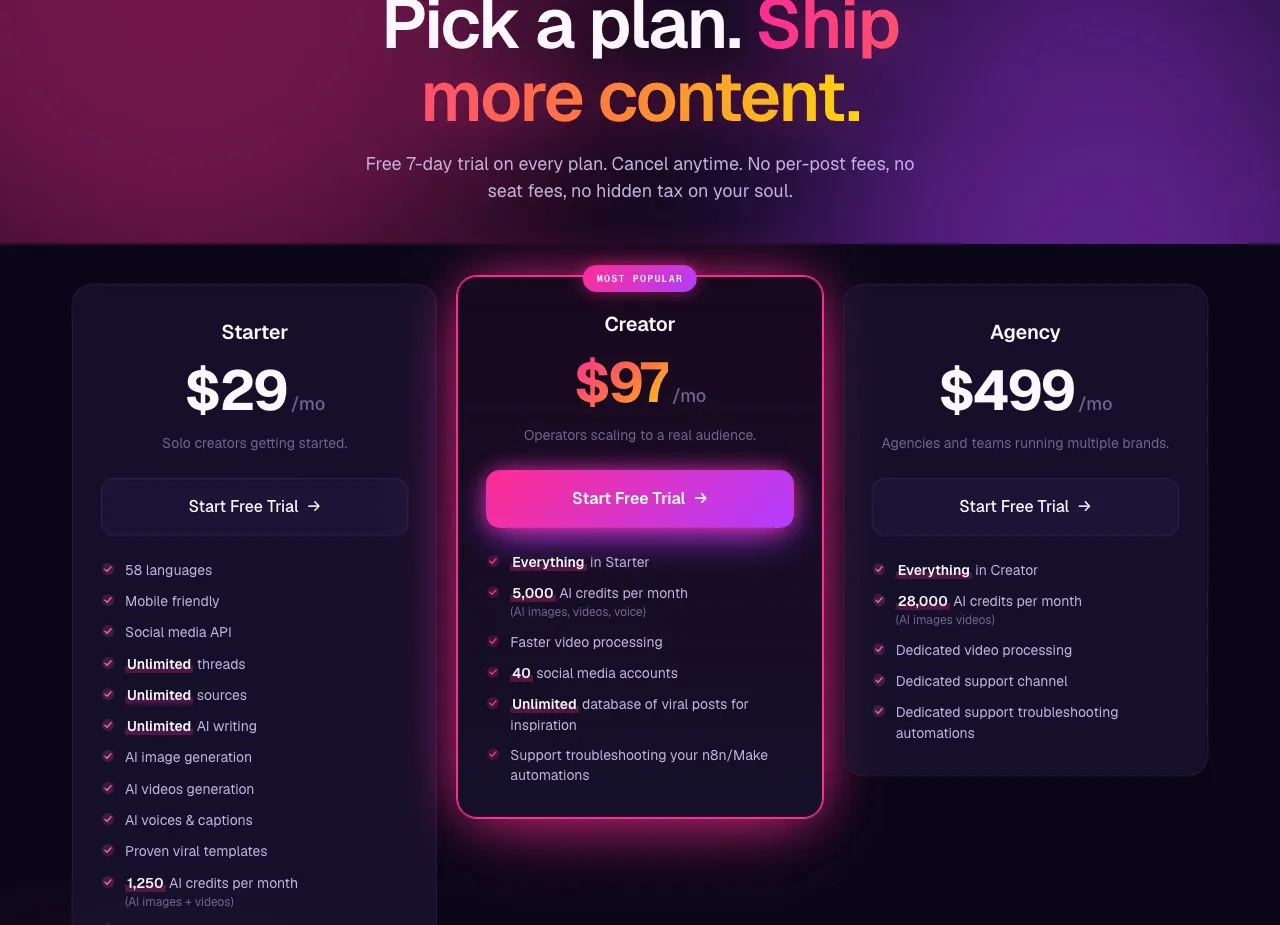
The managed number is $29/mo flat. The self-host number is $0 plus your hosting bill plus every hour you spend on tokens, approvals, and rewrites. On a per-week-of-your-time basis, the flat fee wins for most people the moment you count more than one platform. Blotato runs a 7-day trial on every plan, card required, cancel anytime. What the trial does not cover is the API. Generating a key ends the trial on the spot and starts Starter, so the API path begins at $29/mo.
There’s a clean way to decide. Ask whether social posting is your core product or just infrastructure under it. If the API itself is what you sell, building can be worth the control. If posting is a feature that supports your real product, buy it. The tipping point in practice is around three platforms: each direct integration is commonly a two-to-six-week project once you count app setup, OAuth, and platform review, so three of them is most of a quarter gone before you publish a single post.
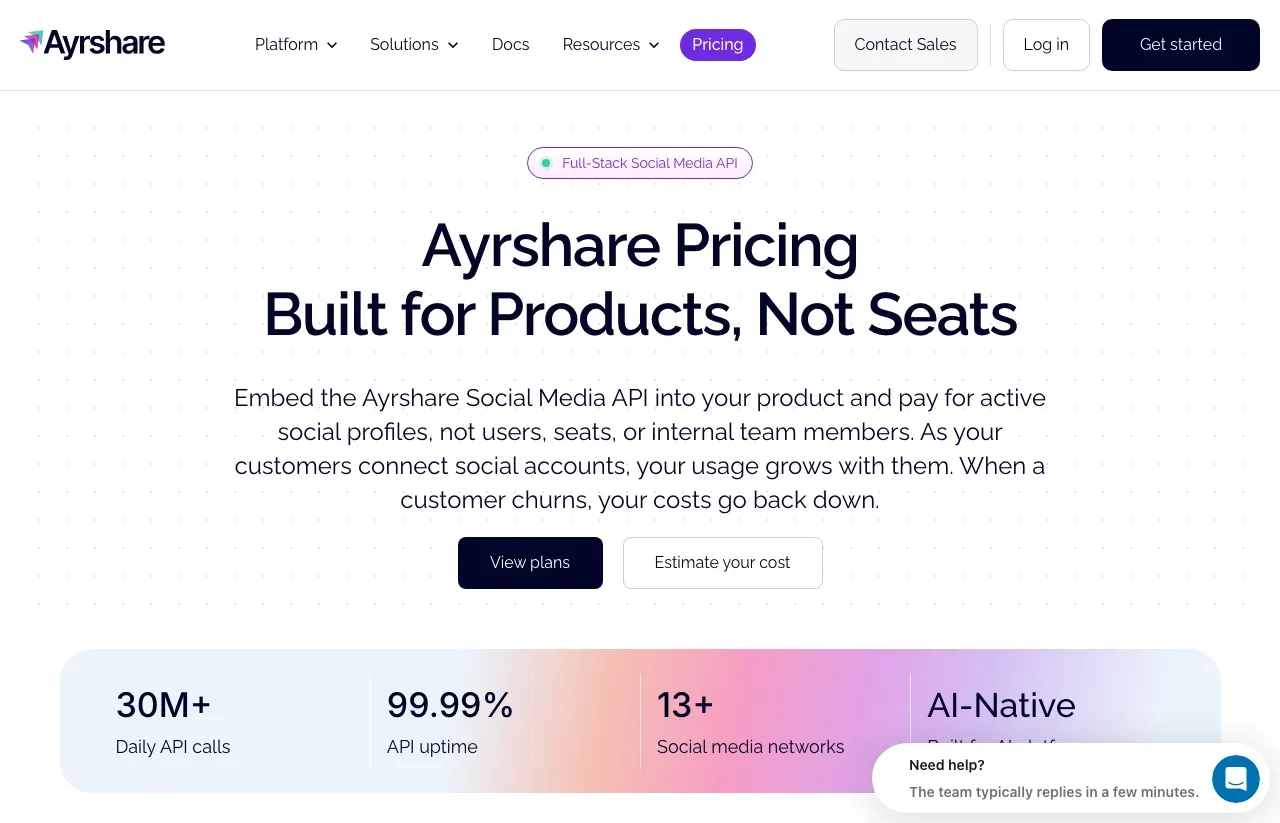
For comparison, the API-first managed players price higher. Ayrshare’s entry Premium plan is $149/mo for a single profile, billed per profile as you scale, which is a different model aimed at developers embedding social posting into their own product. My Ayrshare pricing guide works through what a profile actually counts as, since that definition decides the bill. If that per-profile math doesn’t fit your budget, there are flatter-priced Ayrshare alternatives worth comparing. If you’re weighing the managed options against each other, the best social media API tools roundup breaks down where each one fits.
A few honest caveats, because the managed side isn’t always right:
- If you only post to Bluesky, Mastodon, and X without links, a self-hosted Postiz is close to free and barely breaks. The maintenance tax is smallest on the platforms that change least.
- If data can’t leave your infrastructure, no managed API clears the bar. Self-host Mixpost and be done. If you are weighing the upkeep against a hosted plan, we ran that comparison in the best Mixpost alternatives.
- If the API is your product, you may want to own the integration for control, and the build cost is justified.
When Self-Hosting Genuinely Wins
Use an open-source self-hosted tool if:
- You post to a narrow, stable set of platforms that rarely change their API.
- Data privacy or residency is a hard, non-negotiable requirement.
- You run high enough volume that a one-time license beats years of subscription.
- You already have engineers who maintain OAuth infrastructure.
- You want to fork the code and customize the workflow deeply.
When a Managed API Wins
Use a managed social media API if:
- You need Instagram, TikTok, LinkedIn, or YouTube and don’t want to chase approvals.
- You’d rather not own token-refresh jobs across nine platforms.
- You want an AI agent on Claude to publish through MCP without an integration layer.
- Your time is worth more than a flat monthly fee.
- You want to ship this week instead of in six weeks.
Sabrina’s Final Take
Self-hosting isn’t the cheap option. It’s the option where you pay in engineering time instead of dollars, and that trade only makes sense when your platforms are stable and your team already owns the infrastructure.
For most creators and small teams, the honest answer is that a flat monthly fee buys back the weekends you’d spend on token plumbing and API rewrites. The maintenance is invisible until it’s a 2am emergency, and then it’s the only thing that matters.
My advice: if you post to two or three stable platforms and love running servers, try Postiz self-hosted. If you need the hard platforms or you just want your content out the door, start on a Blotato plan and skip the plumbing entirely.
FAQs
Is an open-source social media API actually free?
The software is free to download, but self-hosting isn’t. You pay for server and database hosting, and you pay in engineering time for OAuth maintenance, platform approvals, and rewrites when an API deprecates. Some tools like Mixpost also gate the popular platforms behind a paid license, so “free” usually means “free plus your infrastructure and your hours.”
What are the best open-source social media scheduling tools?
Postiz and Mixpost are the two most established, and we put them head to head on licensing and what each one calls free. Postiz is fully open-source, self-hosts via Docker, advertises 30+ platform connections, and ships its own MCP server - it’s also the one open-source tool that made my X posting comparison. It is the one people most often leave for operational reasons rather than price, and where they go when they do is a different list from this one. Mixpost is privacy-first and self-hosted, with a free Lite edition covering Facebook, X, and Mastodon and a paid Pro license for the rest. TryPost is a newer open-source option that also offers native MCP. All three are real, actively maintained projects.
How many platforms do I need before buying beats building?
A useful rule: if social posting is your core product, building direct integrations can be worth it. If it’s just infrastructure that supports your product, buy. In practice, once you need three or more platforms, or you need to ship in under a few months, the build-and-maintain cost usually outruns a managed subscription. Instagram, TikTok, and LinkedIn alone each carry their own approval process and publishing quirks, so the count adds up fast.
Why is maintaining a social media integration so hard?
Every platform runs on OAuth tokens that expire and must be refreshed, and each has different rules: Instagram tokens last about 60 days, LinkedIn’s can’t be extended past 60 days, and others rotate silently. Platforms also rewrite their APIs on their own schedule, forcing you to rebuild your integration or watch posting stop. The policy side moves the same way, and X’s rule that OAuth authorization is not by itself consent to act on a user’s account is the one that catches multi-tenant builders out, which I cover in the platform automation rules.
How much does the X API cost to post directly?
As of February 6, 2026, X uses pay-per-use pricing. Creating a post costs $0.015, but a post that contains a link costs $0.200, roughly 13 times more. Reading a post costs $0.005. If you self-host your X integration, those per-post fees are yours to pay on top of hosting and maintenance.
Does a managed API handle platform approvals for me?
Yes. Managed providers like Blotato have already passed TikTok’s content-posting audit and Meta’s App Review, so you skip the 4-to-6-week approval process for Instagram and the separate audit for TikTok. Self-hosting means securing every one of those approvals yourself before you can post publicly.
Which is better for an AI agent posting workflow?
For most agent builders, a managed API with MCP support wins here, unless you already run the token and approval layer yourself. Instead of your agent calling raw platform SDKs and handling tokens, it calls one managed endpoint that reaches every platform, one post to one account on one platform per call. Blotato exposes an MCP server so a Claude agent can publish to any of its nine platforms directly, which is far simpler than self-hosting the integration layer under an agent. The simplicity shows up in the run log rather than the bill: measured against an agent writing its own REST calls, the MCP path cost about the same per publish but took the same eight turns every run, while the hand-written path ranged from four to nine as it retried on payload shape.