Blotato vs MeetEdgar: Who Runs Your Social Media Automation?
Blotato vs MeetEdgar: social media automation that reposts your library on a weekly schedule, or one API key your AI agent uses to post and reply.

Blotato vs MeetEdgar starts at nearly the same price, with MeetEdgar’s Eddie plan at $29.99 a month and Blotato’s Starter at $29, but the two automate different things. MeetEdgar keeps a library of your posts and reposts it on a weekly category schedule, so a rule decides what goes out next. Blotato, an app I built, hands that decision to your AI agent through one key, then lets the same agent work the Instagram and Facebook comments and DMs that come back.
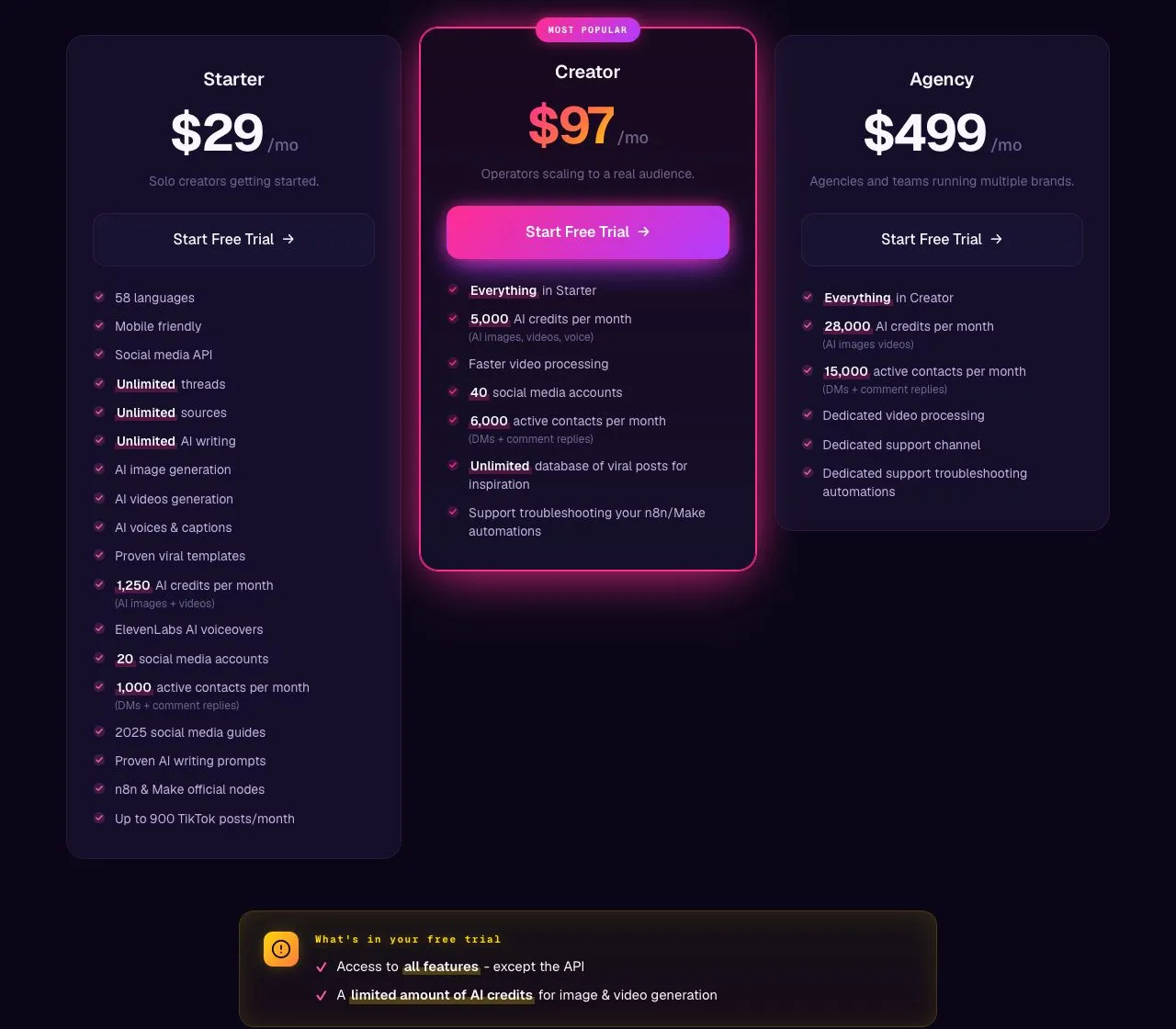
MeetEdgar is the better buy if you run more than 20 accounts, need separate logins for a team, or want a recycling loop that keeps running between check-ins. If your agent needs a social media layer, Blotato’s three plans start at $29 a month, though the 7-day trial leaves out API access.
Blotato vs MeetEdgar: The Short Answer by Setup
Most readers can settle this matchup on two questions: what does the automation for you, and how many accounts you run. Find your row.
| If this is you | Better fit | The deciding fact |
|---|---|---|
| You have a deep library of evergreen posts and want it reposting with nobody in the loop | MeetEdgar | Weekly category slots pull from the library and recycle when a category runs out |
| An AI agent like Claude or ChatGPT, or an n8n or Make workflow, already runs part of your social media work | Blotato | One hosted API and MCP key covers publishing on 9 platforms, plus comments, DMs and DM automation on Instagram and Facebook |
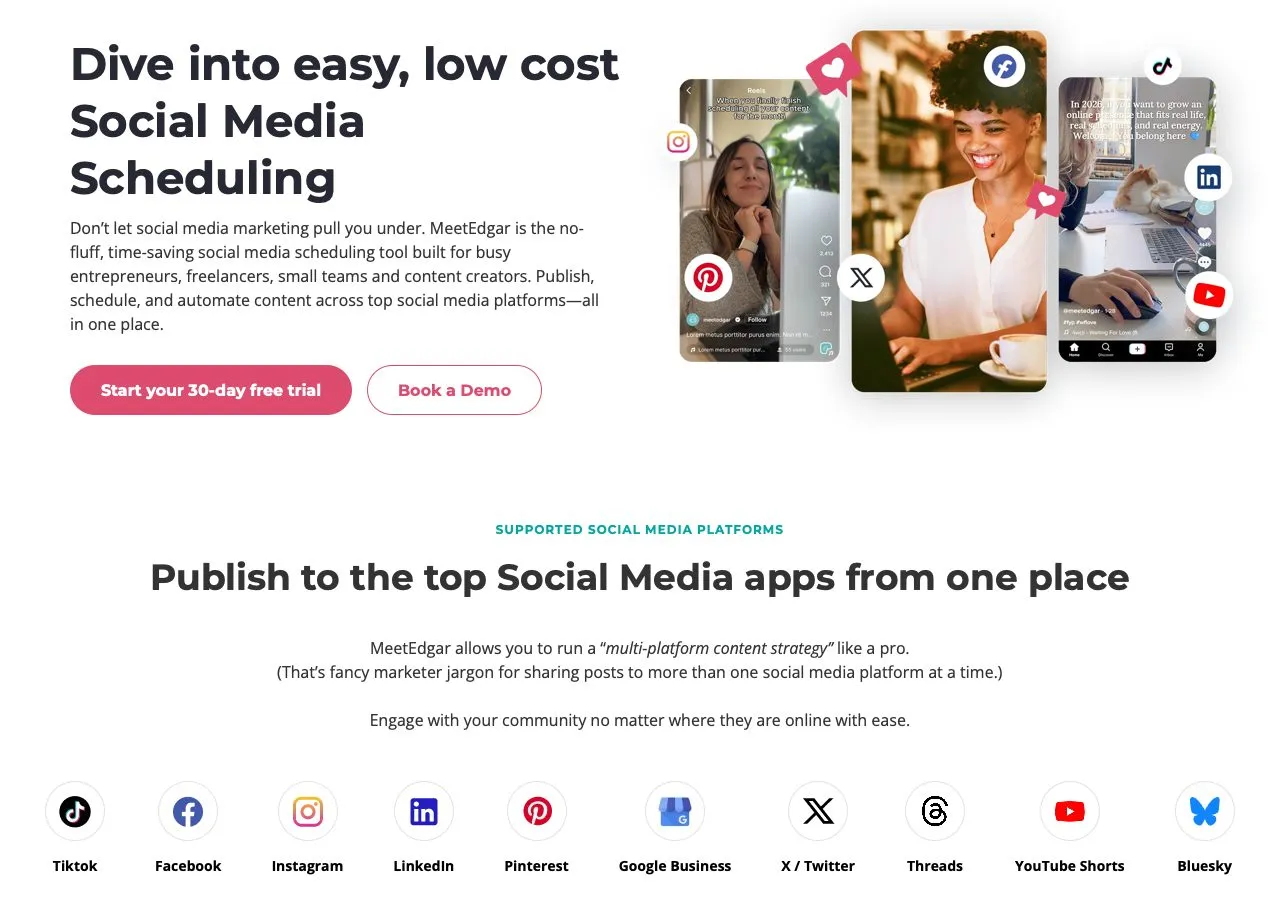
| You run 6 to 20 accounts | Blotato | $29 flat, against $34.98 to $49.99 on MeetEdgar |
| You run 21 or more accounts | MeetEdgar | Edgar holds 25 accounts for $49.99, and Blotato’s next plan is $97 |
| Several people need their own logins | MeetEdgar | 20 team members on every plan, while Blotato has one user per Blotato account |
When the rows disagree, the team row usually wins, since a missing login is hard to work around. After that, pick the kind of automation you want before you pick on price.
A Weekly Rule or an Agent You Direct
In category terms, Blotato is agent infrastructure for social media marketing, while MeetEdgar is an evergreen-library scheduler. MeetEdgar’s job is keeping your feeds active from posts you already wrote. Blotato’s job is giving an agent one key for publishing and scheduling on 9 platforms, analytics on 8, and comments, DMs and DM automation on Instagram and Facebook. The AI writing, images and video are one part of that surface, not the category.
| MeetEdgar | Blotato | |
|---|---|---|
| What it is | An evergreen-library scheduler | Agent infrastructure for social media marketing |
| What picks the next post | Weekly category slots pull from your library | Your agent, or you in the web app |
| Programmatic surface | One Zapier action, “Add Content” | REST API, hosted MCP server, native n8n and Make nodes |
| Engagement | Comments and DMs on Facebook and Instagram, Edgar plan only | Comments and DMs on every paid plan, plus DM automation on paid plans, all on Instagram and Facebook |
| What the bill tracks | A plan, plus each account past 5 (Eddie) or 25 (Edgar) | A plan tier holding 20, 40 or 100 accounts |
How MeetEdgar’s Library Chooses What Goes Out
MeetEdgar is built for entrepreneurs and small teams who wrote good posts once and want them working for years. Laura Roeder founded it to run her own small business’s social media, and SureSwift Capital acquired it in a deal that closed in the winter of 2021.
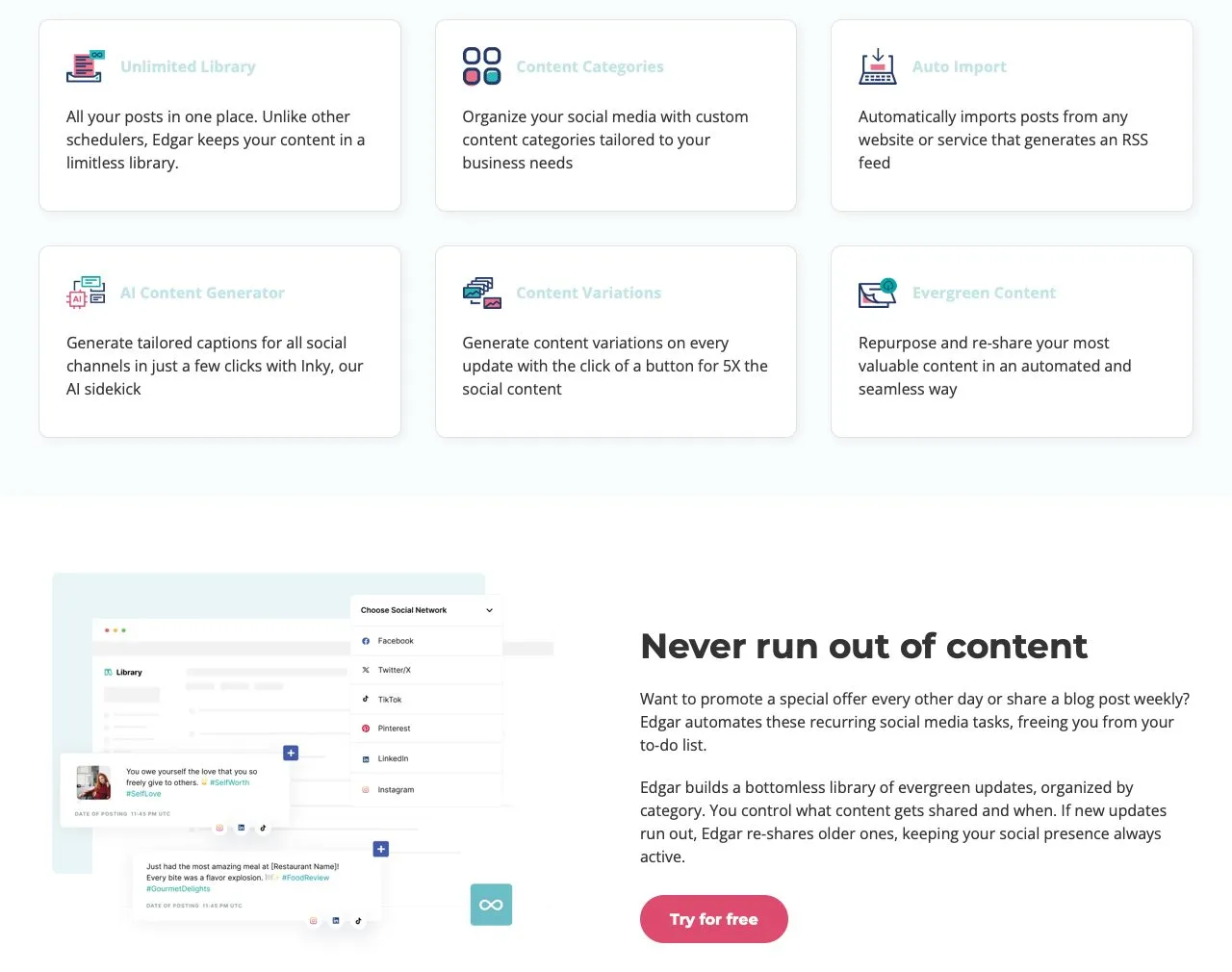
The mechanic is simple, and it works. You sort posts into categories, then set weekly time slots, each tied to a category. Edgar fills each slot from its category, newest first by default, and once every post in a category has gone out, it starts recycling.
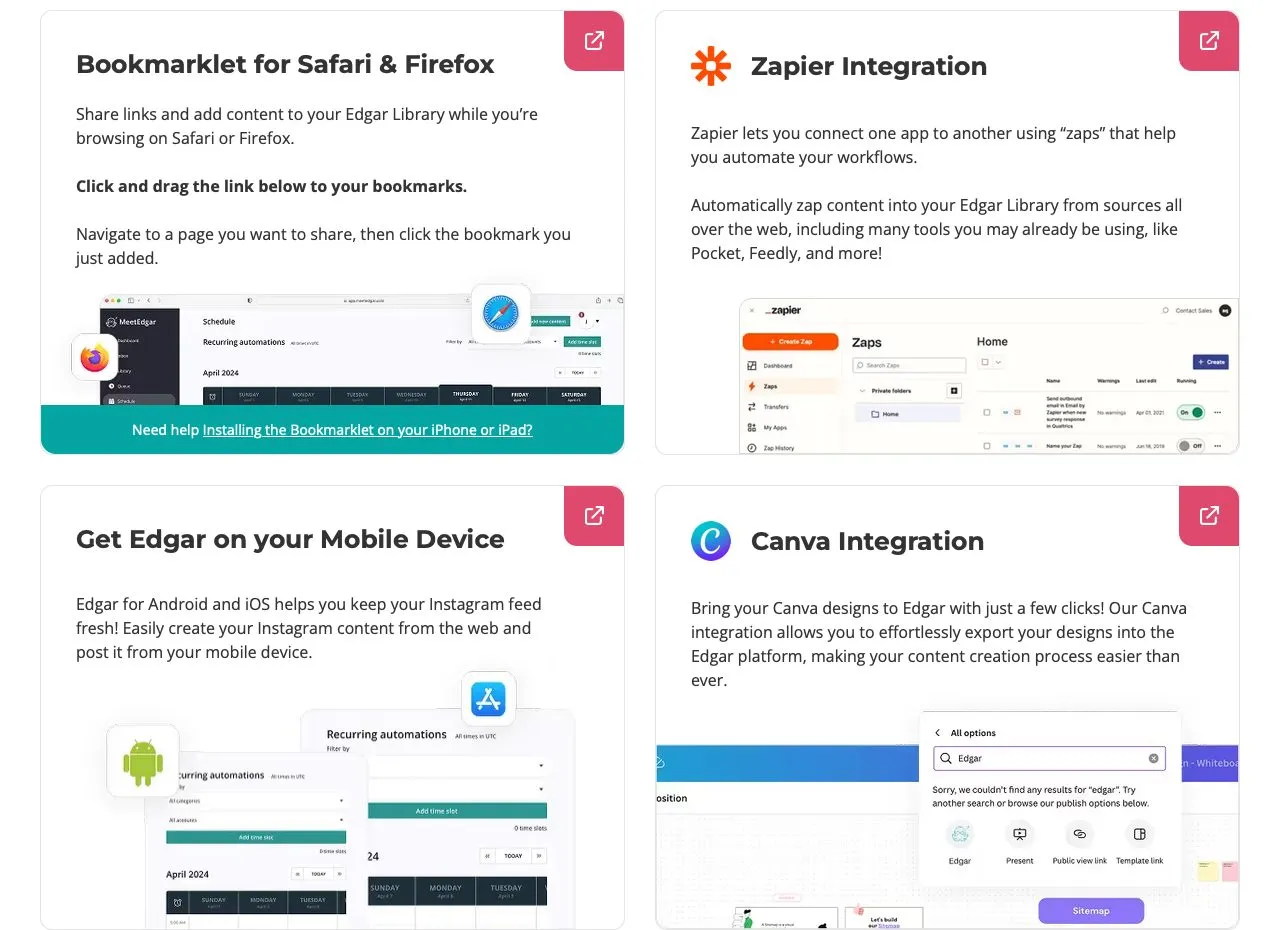
Nothing is deleted after it publishes, so every post stays available to reuse. New posts can arrive by RSS, which Edgar checks once a day, or straight from Canva. You can set a post to expire on a date, mark it Use Once so it retires after a single run, and add as many text variations as you like so a repeat reads fresh.
One limit matters if X is a big channel for you. X lets each variation publish only once, so after the last variation goes out, MeetEdgar’s variations guide says the post is marked “Expired for X” in your library. The loop keeps running everywhere else.
A few platform rules are worth checking before you load a library. TikTok connects personal accounts only, and Instagram Reels need a Creator or Business account. Edgar can’t add music to a Reel either, so any music has to be in the video before you upload it.
On Trustpilot, MeetEdgar sits at 3.2 out of 5, and Trustpilot itself notes the company hasn’t invited reviews recently, so the sample may not be representative. One Reddit user who went looking for a replacement was warmer about the core idea, and wrote that they “really liked MeetEdgar’s evergreen post recycling”.
What Blotato Gives Your Agent Instead
Blotato has no library that reposts on its own, and I’d rather say that before anything else. Its weekly slots supply posting times, and the calendar docs state plainly that slots “do not publish content on their own or select a post’s destination.” Something has to choose each post. In the setup Blotato is built for, that something is an AI agent.
The agent connects through the hosted MCP server at mcp.blotato.com/mcp or the REST API, and builders on n8n or Make get native nodes. One key reaches 9 platforms, one post per account per call, and a publish call can drop a post into the next open slot with useNextFreeSlot. The same key reads per-post analytics on 8 of those 9 platforms, with LinkedIn the gap.
MeetEdgar automates the order your posts run in. With Blotato, the agent makes each pick, and it can check your analytics or a new blog post before it does.
If you want Edgar’s loop rebuilt on top of that, I walked through the steps in my MeetEdgar alternatives guide, so I won’t repeat them here.

Blotato vs MeetEdgar, Row by Row
| Category | MeetEdgar | Blotato |
|---|---|---|
| Publishing destinations | 10 on its homepage, including Google Business Profile and YouTube Shorts (its pricing FAQ lists 9, without YouTube) | 9 platforms, scheduled or immediate |
| How posts get chosen | Weekly category slots pull from the library, then recycle | You or your agent choose, and slots supply times only |
| Pricing model | Plan plus per-account add-ons ($4.99 on Eddie, $2.99 on Edgar) | Flat plan tiers |
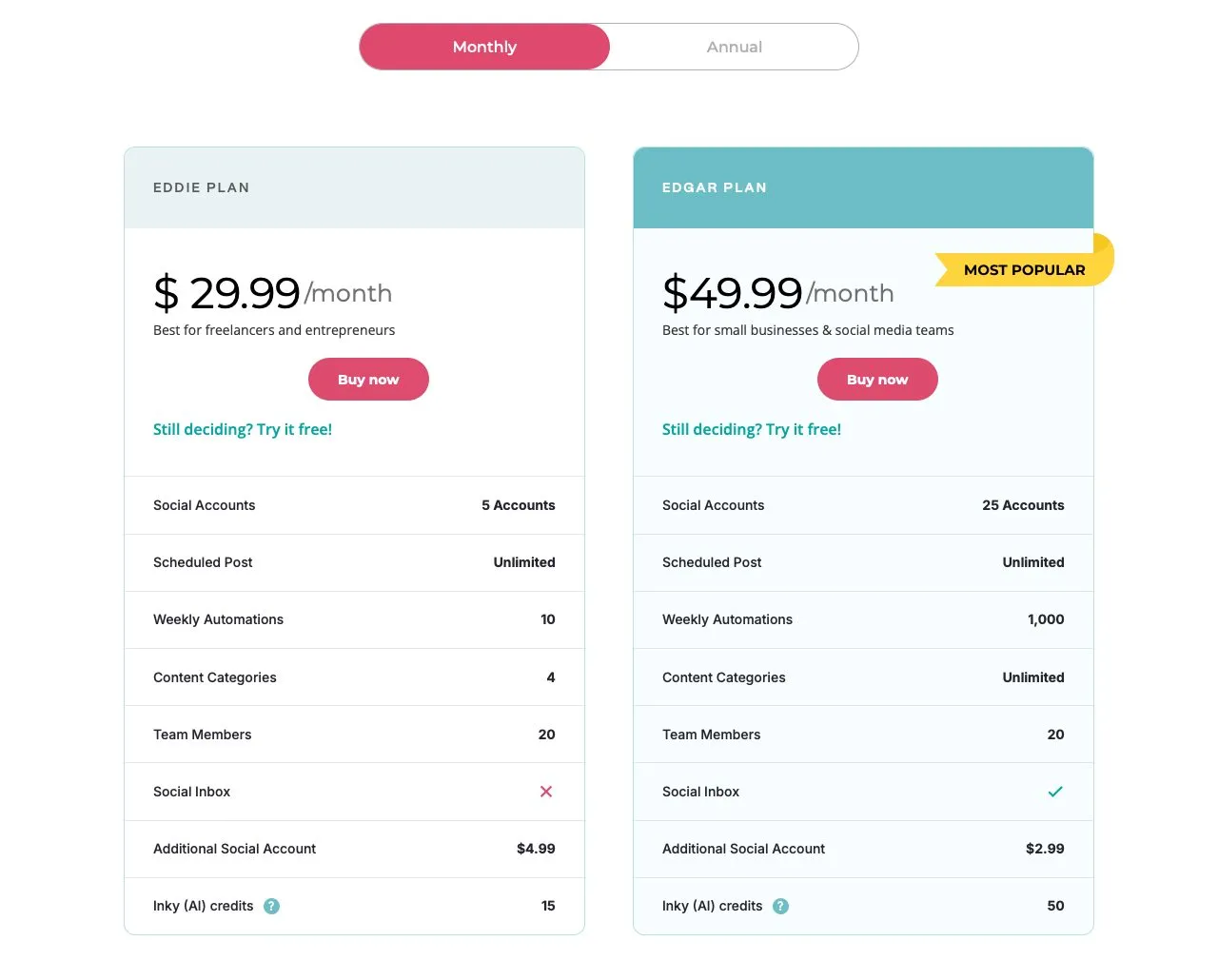
| Entry plan | Eddie, $29.99/mo: 5 accounts, 10 weekly automations, 4 categories | Starter, $29/mo: 20 accounts |
| Scheduled posts | Unlimited on every plan | 200 queued on Starter, 1,000 on Creator, 3,000 on Agency |
| Team members | 20 on every plan | 1 user per Blotato account |
| Public API or MCP server | None found, and the settings API key is for Zapier | REST API and hosted MCP server on paid plans |
| n8n, Make, Zapier | Zapier, one action (“Add Content”) | Native n8n and Make nodes |
| Comments and DMs | Facebook and Instagram, Edgar plan, posts Edgar published | Instagram and Facebook, every paid plan |
| DM automation | Not listed on its pricing or feature pages | Keyword-triggered, Instagram and Facebook, reply-only |
| Analytics | Content sent, link clicks, impressions, plus a Sunday email report | Per-post metrics on 8 of 9 platforms (LinkedIn not yet) |
| Free trial | 30 days | 7 days, web app only (no API) |
| AI writing | Inky writes captions and hashtags (15 or 50 credits a month) | Included |
| AI images and video | Not listed | Included, uses AI credits |
Three rows carry most of the weight. How posts get chosen is the core difference, the API and integration rows decide how much an agent can do in each tool, and the team-members row settles it for any business with more than one person posting.
What MeetEdgar Does Better
The loop runs itself. Load the library once and Edgar keeps posting for months without a prompt, a workflow or an agent. If you want your social media handled with the least ongoing effort, that is the product, and Blotato does not replicate it out of the box.
It costs less past 20 accounts. Edgar holds 25 accounts for $49.99 a month, and extra accounts cost $2.99 each. Blotato’s Starter stops at 20, so account 21 moves you to Creator at $97.
Twenty team members are included. Every MeetEdgar plan includes them at no extra cost. Blotato supports one user per Blotato account today, so a team shares a login.
It publishes to Google Business Profile. That matters for any local business, and it is a destination Blotato does not reach at any tier. On YouTube, MeetEdgar publishes Shorts, while Blotato publishes long videos as well as Shorts.
The trial is a month long. MeetEdgar gives 30 days with every feature, which is enough time to watch the loop run for a few weeks. Blotato’s trial is 7 days.
Where the Agent Path Pulls Ahead
An agent can do more than add posts. MeetEdgar’s main automation hook is Zapier, and its Zapier app lists one action, “Add Content,” which drops a post into the library. Zapier’s own MCP can call that action, so an agent can feed Edgar, but it can’t read your analytics, reply to a comment or change a schedule through it. I also found no public API, no developer docs and no MCP endpoint on MeetEdgar’s own domains.
The inbox comes with the entry plan, and so does DM automation. MeetEdgar’s Social Inbox covers Facebook and Instagram on the Edgar plan, and its help article says it collects comments and DMs from posts Edgar published. Blotato’s inbox covers the same two networks on every paid plan, and an Instagram post published elsewhere shows up once it gets a new comment. On top of that, Blotato runs keyword-triggered DM automation on Instagram and Facebook, reply-only, and Starter includes 1,000 active contacts a month across DMs and comment replies.
Neither inbox is perfect. MeetEdgar’s help article says its inbox has no search or filtering yet and can’t delete a comment. Blotato’s keeps comments and messages for up to 45 days and doesn’t import older Instagram comments or DMs from before you connected.
Twenty accounts at the entry price. Starter covers 20 social accounts, four times Eddie’s 5. Anyone running several of their own brands across several networks hits Eddie’s limit fast.
Analytics an agent can act on. Blotato returns per-post metrics through the API on 8 platforms, so an agent can weigh the numbers when it picks what to post next. MeetEdgar’s analytics live in its dashboard and a weekly email, which suits a person reading them, not an agent.
Where the Monthly Bill Crosses Over
All prices below are month-to-month. Both vendors take about 17% off for annual billing.
| Plan | Monthly price | Accounts included | Extra accounts |
|---|---|---|---|
| MeetEdgar Eddie | $29.99 | 5 | $4.99 each |
| MeetEdgar Edgar | $49.99 | 25 | $2.99 each |
| Blotato Starter | $29 | 20 | Move to Creator |
| Blotato Creator | $97 | 40 | Move to Agency |
| Blotato Agency | $499 | 100 | Top plan |
Here is the cheapest setup on each side at the account counts people actually run.
| Accounts | Cheapest MeetEdgar setup | Blotato | Cheaper |
|---|---|---|---|
| 1 to 5 | Eddie, $29.99 | Starter, $29 | Blotato, by $0.99 |
| 6 to 9 | Eddie plus add-ons, $34.98 to $49.95 | Starter, $29 | Blotato, by $5.98 to $20.95 |
| 10 to 20 | Edgar, $49.99 | Starter, $29 | Blotato, by $20.99 |
| 21 to 25 | Edgar, $49.99 | Creator, $97 | MeetEdgar, by $47.01 |
| 40 | Edgar plus 15 accounts, $94.84 | Creator, $97 | MeetEdgar, by $2.16 |
On standard plans up to 100 accounts, the cheaper tool changes hands once, at 21 accounts. From there through 40, MeetEdgar costs less at every count, and past 40 the gap gets wide because Blotato’s next plan is Agency at $499. Above 100 accounts, Blotato quotes custom plans.
At the entry price, the two plans buy very different things.
| At the entry price | MeetEdgar Eddie ($29.99/mo) | Blotato Starter ($29/mo) |
|---|---|---|
| Social accounts | 5 | 20 |
| Automatic library recycling | Yes, 10 weekly automations across 4 categories | No |
| Team members | 20 | 1 |
| Comments and DMs inbox | Not on Eddie | Instagram and Facebook |
| DM automation | Not listed | Instagram and Facebook, reply-only |
| REST API and hosted MCP | Not found | Included (not on the trial) |
| n8n and Make | Not listed (Zapier only) | Native nodes for both |
| AI | 15 Inky credits for captions and hashtags | AI writing, plus 1,250 credits for images and video |
At almost the same price, Eddie buys the loop and the team logins, while Starter buys four times the accounts plus the inbox and agent surface Eddie doesn’t sell.
Where this math misleads you. Past 20 accounts, MeetEdgar is the cheaper tool at every count I checked, so if all you need at that size is publishing, Blotato’s pricing tiers will cost you more. MeetEdgar includes unlimited scheduled posts, while Blotato’s Starter holds 200 queued posts, so a reader who loads six months ahead will fill Starter’s queue first. And none of these tables count logins: if three people each need their own, MeetEdgar includes them and Blotato gives your team one shared account.
Three Readers, Three Different Answers
The library owner. You have years of posts that still hold up, and you want them going out on a schedule while you work on other things. If you don’t need an agent or an inbox, MeetEdgar is built for you. Pick Edgar over Eddie once 4 categories or 5 accounts feels tight.
The builder. Your agent already drafts posts, reads results or answers DMs, and you want one key behind all of it. Blotato fits if its 9 platforms cover yours and your comments and DMs happen on Instagram or Facebook.
The small team. Three people post for one brand across more than 20 accounts. MeetEdgar wins on both counts that matter to you, the logins and the price past 20.
Trust the Loop or Trust the Agent
If nothing in your setup runs on an agent today and your library is deep, start with MeetEdgar’s 30-day trial and let the loop prove itself. If you want to see the scheduler and inbox first, try a 7-day Blotato trial in the web app, which covers every feature except the API. One catch if the API or MCP server is why you came: generating an API key ends the trial and starts the paid Starter plan, so budget for Starter from day one.
Blotato vs MeetEdgar FAQs
Is Blotato cheaper than MeetEdgar?
It depends on your account count. From 1 to 20 accounts, Blotato’s $29 Starter costs less than MeetEdgar, by $0.99 at 5 accounts and $20.99 from 10 to 20. From 21 to 100 accounts, MeetEdgar is cheaper, since Edgar holds 25 accounts for $49.99 a month and Blotato’s next plan is $97.
Does MeetEdgar have an API or MCP server?
I couldn’t find either, and I found no developer docs on its site. The API key in its settings exists for its Zapier integration, which offers one action that adds content to your library, and I found no native n8n or Make app. Blotato ships a REST API, a hosted MCP server and official n8n and Make nodes on paid plans, though not during the free trial.
Can MeetEdgar answer DMs or run DM automation?
MeetEdgar’s Social Inbox lets you reply to Facebook and Instagram comments and DMs by hand, on the Edgar plan, for posts Edgar published. I found no DM automation on its pricing or feature pages. Blotato covers the same two networks on every paid plan and adds keyword-triggered DM automation, reply-only, with no cold outreach.
Can Blotato recycle evergreen posts like MeetEdgar?
Not on its own. Blotato’s weekly slots supply posting times, but they don’t choose or repost content. An AI agent connected through the API or MCP server can re-queue past posts into open slots, which is the loop my MeetEdgar alternatives guide walks through. If you want reposting with no agent involved, MeetEdgar’s library does it built in.
Does MeetEdgar post to more social platforms than Blotato?
MeetEdgar, by one. Its homepage lists 10 destinations, including Google Business Profile and YouTube Shorts, though its pricing FAQ lists 9 and leaves YouTube out. Blotato publishes to 9 platforms, including long YouTube videos as well as Shorts, but not Google Business Profile.
Can a team share one account on Blotato or MeetEdgar?
MeetEdgar includes 20 team members on every plan at no extra cost, so each person gets a login. Blotato supports one user per Blotato account today, so a team shares a login. If several people post for one brand, that difference matters more than the monthly price.