Grok Bot's X Connector Reads Social Media but Can't Post
Grok Bot's new X connector reads your timeline, mentions, and search. It does not publish, and social media posting still needs a separate layer.
On August 29, xAI shipped an X connector for Grok Bot. It is easy to read that as X now handled natively, with publishing left to solve everywhere else. That is not what shipped. Read the announcement’s own capability list and every capability in it is a read.
Here is xAI’s description of what a Bot can do once you connect the account: “search posts, read your timeline, check mentions, or pull together what’s happening on X.” There is no publish, no post, no schedule, and no draft in that sentence, and the announcement does not claim one anywhere else either.
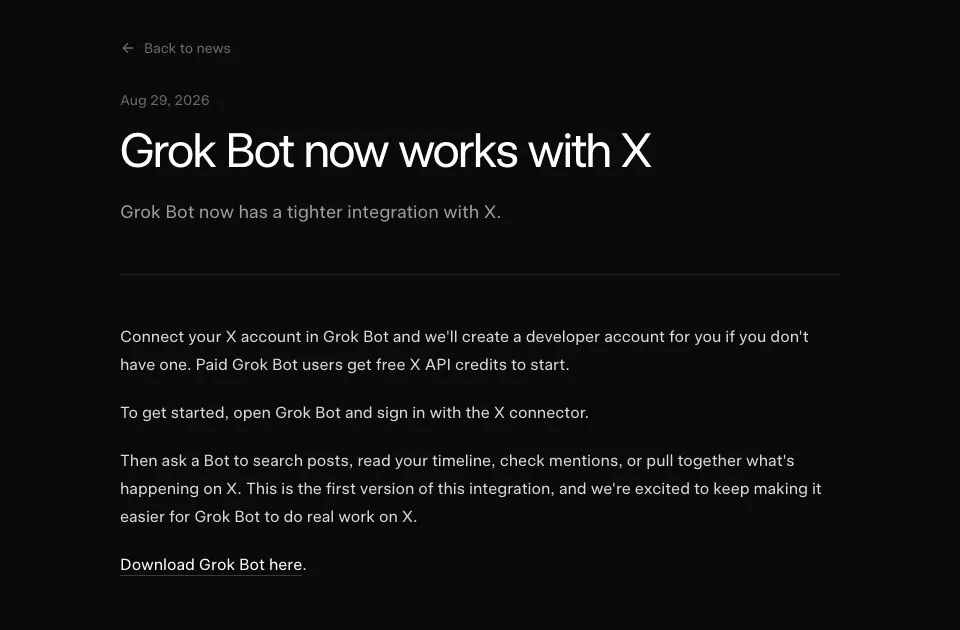
The whole announcement fits in the screenshot above. The connector is real and useful, it just points the other direction: X became an input to your agent, not an output. To be clear, a Bot can still post to X today, just through a connected publishing layer rather than this connector. If your Bot’s job is to notice things on X and act on them, this closes a genuine gap. If its job is to publish, nothing changed on August 29, including for X itself. The tool layer is where X publishing did shift this year: Hypefury walked away from X, and I compared the X schedulers still standing after that exit.
The Read Half Is Genuinely New
A Bot can now search posts, pull your timeline, and check mentions without you wiring up X API access yourself: xAI creates the developer account during connector sign-in, and paid Grok Bot users get free X API credits to start. That removes the usual week-one stall, since X API pricing defaults new developers to pay-per-use with no real free tier, and read volume is what makes that meter climb fastest.
The honest read is that this is a listening feature: monitoring mentions, watching a competitor, pulling what a thread actually said, summarizing a feed into something you can act on. All real work, all inbound.
Here is a detail xAI’s own materials make easy to miss: the connector does not appear in the documentation. The built-in connector list names seven connectors, Gmail and Google Calendar through Salesforce, with X not among them, and searching the docs’ own llms.txt index on August 31 turns up no X connector entry either. The announcement is the only primary source, so the capability list quoted above is everything xAI has published. Anything beyond it, posting included, is something xAI has not claimed, and I would not build against a capability the vendor has not claimed.
Why the Publishing Half Is Still Missing
An agent wired up with this connector alone has no published way to post to X, and the distinction matters because a connector that handles one direction reads as if it handles both. Publishing needs a user token carrying write scope, media upload handling, and per-platform payload rules: the X API’s post-creation endpoint requires exactly that kind of authorization, and nothing xAI has published says the connector requests it.
That gap is what a publishing layer covers, and Blotato is the one I work on. I helped build it, so weigh that how you like, but the shape is simple: connect the accounts once, and one hosted MCP endpoint gives an agent publishing and scheduling across nine platforms, X included. Grok Bot connects to it like any custom MCP server, and the Grok Bot setup guide has the exact config.
There is one route to posting that needs no layer at all, and it is worth naming so you can decline it deliberately: a Bot’s cloud computer can drive x.com in a browser the way a person would. That works until a UI change, a login prompt, or a bot check breaks it silently at whatever hour your job runs. Browser automation is the pattern real platform APIs exist to replace, and an account you care about is the wrong place to run it.
The distinction I would hold onto: the X connector decides what your agent knows. A publishing layer decides what your agent can do. Wiring the first one does not get you the second, and that is as true for X today as it is for the other eight platforms.
The two halves compose into something neither does alone, and that loop is the real reason to care about this launch. The connector is the Bot’s eyes on X, the publishing layer is its hands: pull your mentions and what competitors shipped overnight, draft a take, then publish through blotato_create_post or queue it with useNextFreeSlot. A read connector plus a write-capable layer is the skeleton of a standing workflow. Either half alone leaves the job half done. I have since run that full loop myself, with a 4-Bot Grok Bot marketing team that took an Instagram carousel from brief to scheduled post.
What Running a Grok Bot Social Media Stack Actually Costs
Grok Bot is not sold on its own. It is bundled, and as of today the two entry points are Cursor Pro at $20 a month or SuperGrok at $30 a month, both listing Grok Bot access on their own pricing pages; higher tiers on either side raise usage limits rather than unlocking a different product. Usage is metered separately from your Grok and Cursor plans. One caution: xAI’s August 26 expansion post says all SuperGrok and Cursor Pro plans are in, while its own Grok Bot FAQ still lists only the higher tiers, so check what your account actually shows before buying on the strength of the cheaper one.
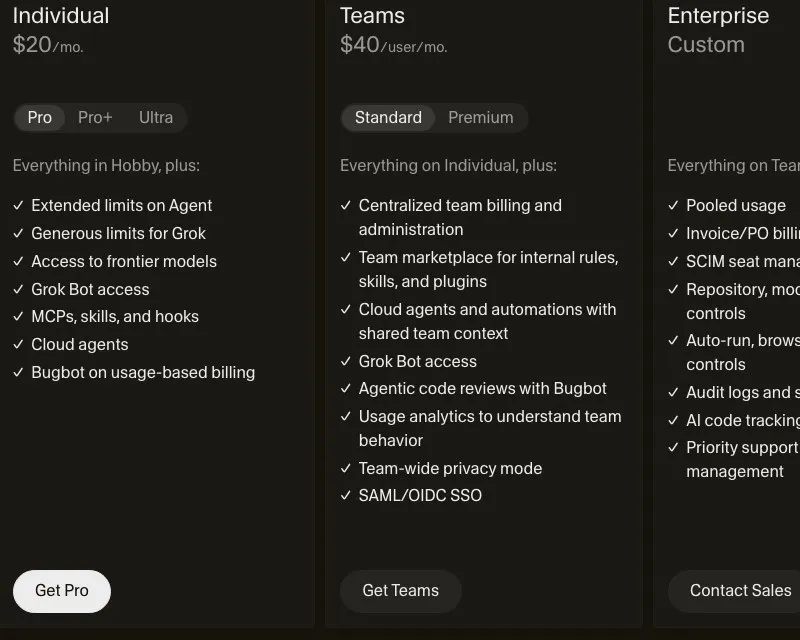
Add a publishing layer and the arithmetic is short. Blotato Starter is $29 a month flat for 20 connected accounts, so the subscriptions run roughly $49 to $59 a month depending on which side you enter from, before any Grok Bot on-demand usage. The flat part is what matters at volume: the publishing bill does not move when the Bot goes from three posts a week to thirty a day, though connecting more than 20 accounts moves you up a tier.
One thing to plan for rather than discover: Blotato’s API and MCP access are not part of the 7-day trial. Generating an API key ends the trial and starts the paid Starter plan, so if you are wiring an agent, budget for the subscription from day one instead of expecting to test it free.
Who Grok Bot Suits, and Who Should Skip It
It fits if you already pay for Cursor or SuperGrok, since Grok Bot is included rather than an extra line item, and if you want work to continue with your laptop shut, since Bots run on a persistent cloud computer. Be accurate about the shape though: xAI’s FAQ answers “Do my Bots share one computer?” with a flat yes, the computer is assigned per user rather than per Bot, and the docs explicitly warn against treating separate Bots as a security boundary.
Skip it if your MCP server is self-hosted on a private network. Grok Bot’s tool calls run from Cursor’s backend rather than your machine, and xAI’s connector docs are blunt that Grok “will reject” a server URL on localhost or a private address. A hosted endpoint works; a local one needs a tunnel, and this is a common reason a config that looks correct never connects.
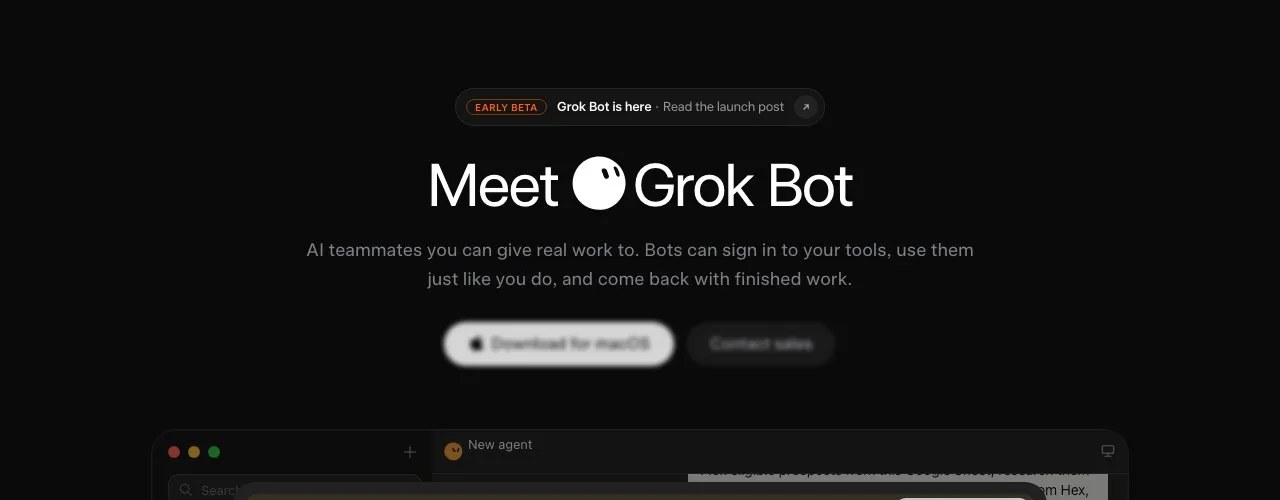
Also weigh that Grok Bot launched in beta on August 11, under three weeks of production history, and xAI’s own product page still wears an early beta label. For a monitoring Bot that is fine. For the thing that publishes to a client’s accounts, I would want the publishing layer to be the boring, older component in the stack.
Grok Bot X Connector FAQs
Can Grok Bot post to X with the new connector?
Not through the connector itself: the announcement lists its capabilities as searching posts, reading your timeline, checking mentions, and pulling together what is happening on X, and publishing is not among them or claimed anywhere else. A Grok Bot can still post to X, it just does it through a connected publishing layer holding write access to the account, such as Blotato’s MCP server.
What does the Grok Bot X connector actually do?
It gives a Bot read access to X: search, your timeline, and your mentions. xAI creates an X developer account for you during setup, and paid Grok Bot users get free X API credits to start. It covers X only, and no other social platform.
How do I connect Grok Bot to social media for posting?
Add a social media MCP server as a custom connector, using a name, the server URL, and a header for your key. Pointing it at mcp.blotato.com/mcp gives the Bot publishing and scheduling across nine platforms. The server must be reachable over the public internet, because the connection runs from Cursor’s backend.
How much does Grok Bot cost?
Grok Bot is not sold standalone. It is included with Cursor Pro at $20 a month and SuperGrok at $30 a month, with higher tiers raising usage limits rather than changing the product, and its usage is metered separately from your Grok and Cursor plans.
Does a Bot need to be running for a scheduled post to go out?
No, and this is worth separating. Grok Bot’s cloud computer means the Bot is not tied to your laptop, and scheduling runs on the publishing layer anyway: a queued post publishes at its scheduled time whether the Bot, your terminal, or your machine is on.
Where This Leaves a Publishing Stack
The X connector is a good addition pointed in one direction: it makes a Bot better informed about X and removes the developer-account friction that stops most people before they start. What it does not change is publishing. An agent that reads X still needs somewhere to send a post, exactly as it did for the other eight platforms before August 29. Build the reading half on the connector, build the half that ships content on a publishing layer, and know which one you are buying before you write the prompt.