How Krista Recker Runs Three Social Media Brands on 13 Hours a Month
A real estate agent and mom of two published 277 posts across three brands in 31 days on about 26 minutes a day. She sent us the data herself.

Krista Recker sells real estate outside Boston, has two young daughters, and runs three social media brands on the side. Nobody asked her for any of this, but she pulled 31 days of her own Blotato workspace data, built it into a three-page report, and emailed it over with a note that ended: “Thank you for giving me time back in my day so I can hang with my kiddos.”
That is the part worth sitting with. She was busy enough that the time mattered, and happy enough about getting it back that she spent some of it writing this up for us.
Here is what those 31 days held: 277 posts across three brands, published on all 31 days, against roughly 13.3 hours a month of her own hands-on time. That is about 26 minutes a day of reviewing, approving and fixing, and it is the number her thank-you note was really about.
The operational finding underneath it is the part any solo operator can copy. By her own effort estimates, one brand was 18% of her posts and about 34% of her workload, while another was 41% of her posts and only 24% of the work. The expensive brand was not the busy one. It was the one publishing carousels, because effort tracks format, not post count.
Fair warning that this is a Blotato customer’s account of using Blotato, published on Blotato’s blog. The counts below come straight from her workspace; anything about hours is her own estimate and labeled where it appears.
Who Is Krista Recker
Krista is a REALTOR with Moor Realty Group outside Boston. Before real estate she spent nearly 15 years in medical device sales. She is not an engineer, describes herself as “not a tech person, just curious,” spent six months rebuilding her business around AI with “no tech degree,” and now teaches other small business owners the same setups at itskristarecker.com.
Hold that profile while you read the numbers below: three brands, no content team, no technical background, and a full-time job selling houses. This is not someone with spare hours to donate to a posting schedule, which is exactly why the workload math is worth reading.
How Krista Recker Publishes 277 Posts a Month
Here is what her workspace looked like over the window she pulled, July 6 to August 5, 2026, which is 31 days inclusive.
| Metric | Count |
|---|---|
| Posts published | 277 |
| Posts per day | 8.9 |
| Accounts connected | 9 |
| Posts queued at time of pull | 126 |
| Days with at least one post | 31 of 31 |
The design load is the part that surprised me. 101 of her 102 Instagram posts were carousels of four to seven slides each, which is roughly 512 individual slides, plus 12 LinkedIn image documents on top. Call it somewhere north of 500 designed images in a single month, by one person who is not a designer.
The cadence is the part most accounts cannot hold. She posted every single one of the 31 days. Her busiest day was July 30 with 16 posts, her quietest was July 13 with 3, and there were no gaps at all.
If you want to run at this kind of volume without hand-scheduling every post, that is the whole job a publishing layer does. Krista runs hers through the web app, which starts with a 7-day Blotato trial that takes a card and converts to a paid plan unless you cancel, so treat it as a plan you can cancel anytime rather than a free look. If you have never opened the app, this beginner guide to Blotato walks the same screens she uses.
The System: Three Brands, Two Rhythms, One Workspace
The detail I find most useful for other operators is that Krista is not running one brand. She is running three through a single workspace: It’s Krista Recker at 114 posts, Krista Recker Properties at 113, and Agentry Studio at 50. By platform, Threads took 122 posts, Instagram 102, LinkedIn 49, and Facebook and X together 4.
Line up each brand’s share of posts against its share of the work and the mismatch is obvious.
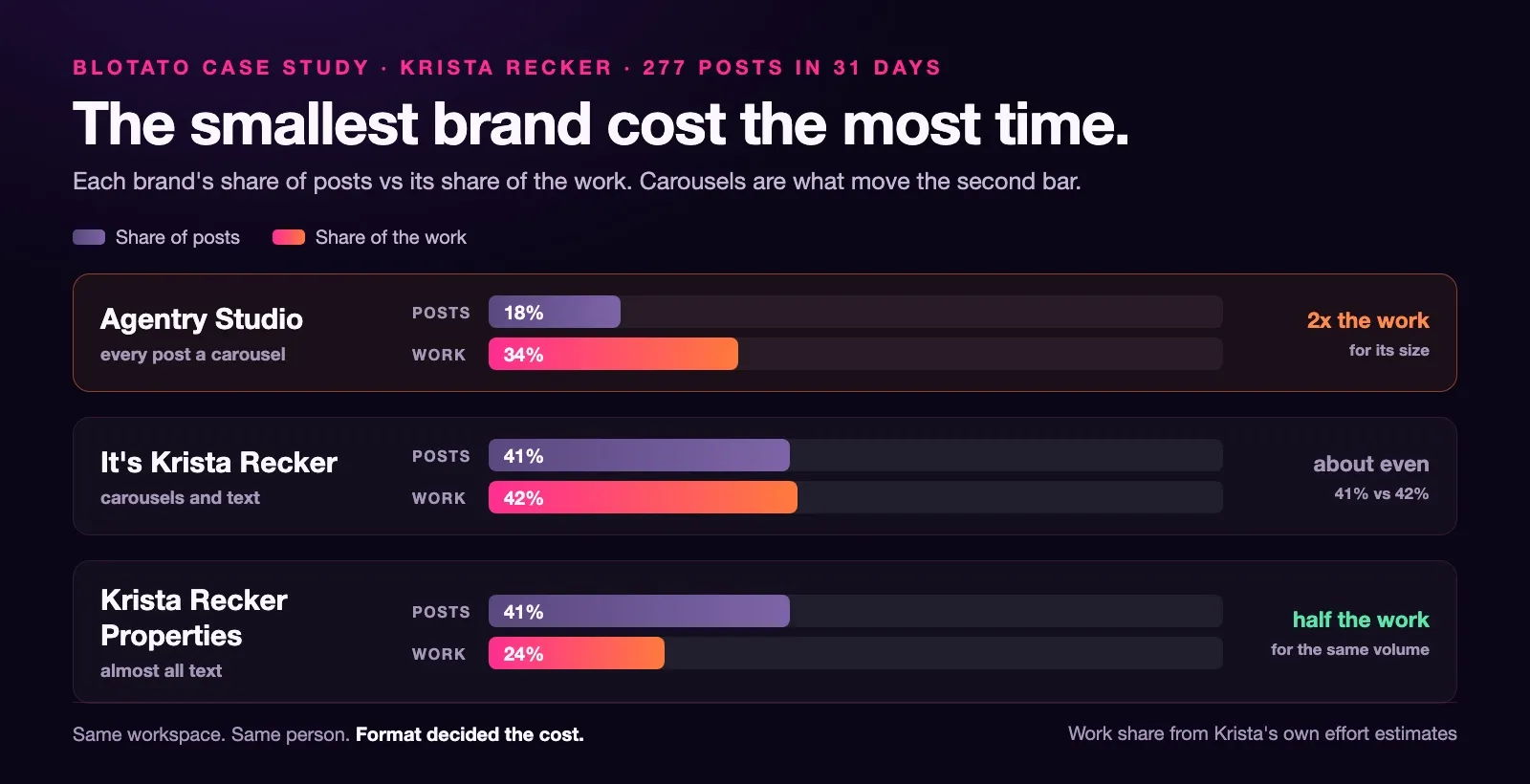
That Threads number is not what I would have predicted. She posts to Threads as a text channel, which costs her almost nothing per post, and it became her highest-volume platform without ever being the one she talks about. Instagram takes a third of the posts and nearly all of the design work.
The Two Rhythms That Keep the Calendar Full
At the time of the pull she had 126 posts already written and scheduled. Those 126 split into two completely different working rhythms, and this is the part I would steal.
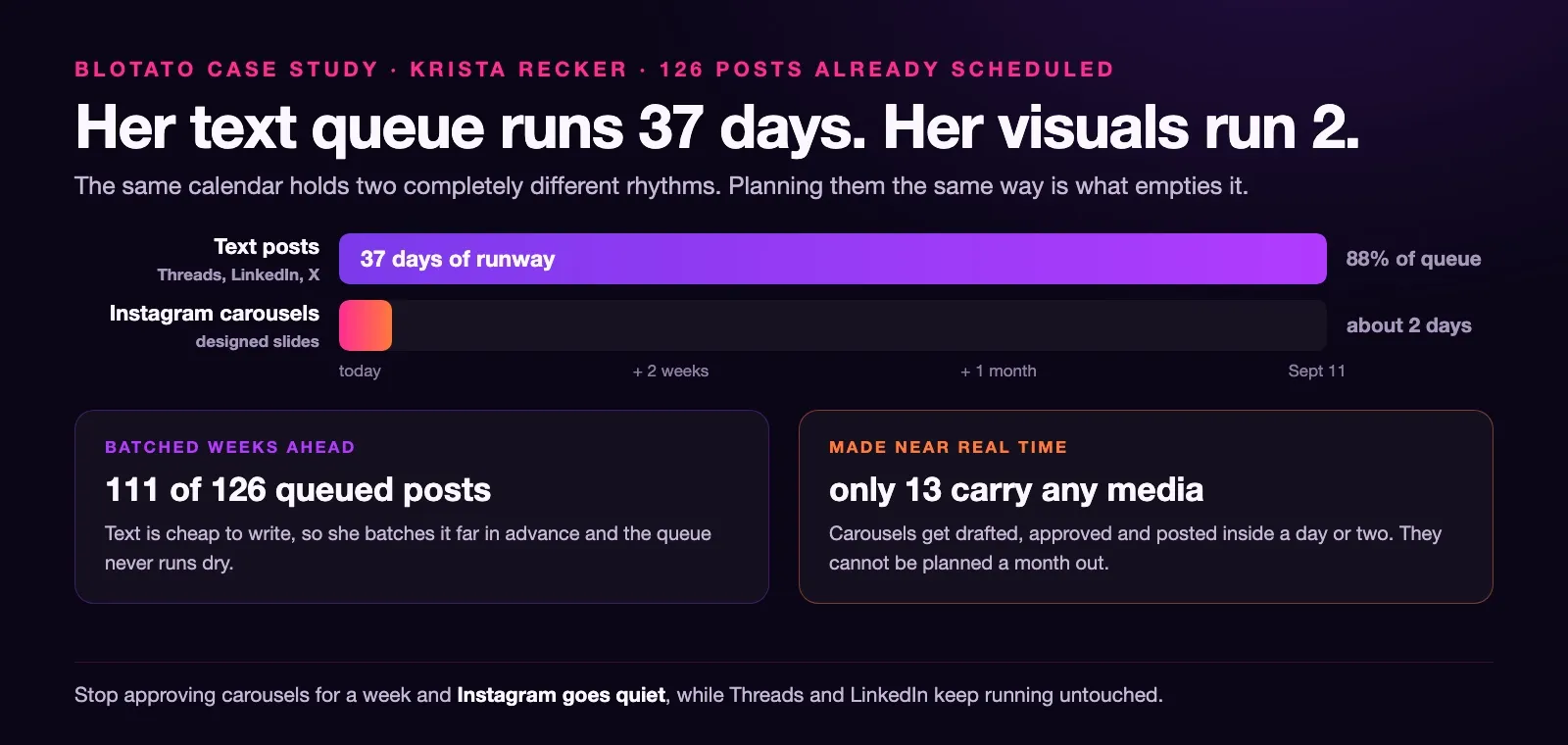
The asymmetry is the whole point. Text is cheap to produce, so it batches weeks ahead and the queue never runs dry. Carousels are expensive, so they get drafted, approved and posted inside a day or two and can never be planned a month out. Only 13 of the 126 queued posts carried any media at all.
So the 37 days is her text runway, not her Instagram runway. Her own summary of it is blunt: the queue runs 37 days on text and about 2 on visuals, so a week without carousel approvals means no Instagram.
What Failed, and Why It Is Worth Reading
Her delivery rate was 95.9%: of 270 posts attempted, 259 published and 11 failed. The other 7 of her 277 were still queued when she pulled the report.
Every single one of the 11 failures came from one account. Agentry Studio on Instagram, clustered between July 18 and July 22, all returning the same message: “We restrict certain activity to protect our community.” Her two established Instagram accounts, pushing the same volume through the same pipe in the same window, had a perfect record.
Agentry Studio was her newest account, and it went from a standing start to roughly 1.6 posts a day. That message is Instagram’s generic integrity notice and Meta does not publish the thresholds behind it, so nobody outside Meta can name the rule that was hit. The reasonable read is that account age and ramp speed were the difference rather than the publishing method, which also means a different scheduler would likely have produced the same result. Her own conclusion was to slow that account to one post a day at staggered times for two weeks, then build back up.
The Results
Krista priced out what those 277 posts would have cost to build by hand, broken out by post type.
| Post type | Qty | Her estimate each | Total |
|---|---|---|---|
| Instagram carousel, 4 to 7 slides | 101 | 50 min | 84.2 hr |
| Threads post | 122 | 8 min | 16.3 hr |
| LinkedIn post, text only | 37 | 18 min | 11.1 hr |
| LinkedIn image document, 5 slides | 12 | 45 min | 9.0 hr |
| Instagram single image | 1 | 20 min | 0.3 hr |
| Facebook and X | 4 | 7 min | 0.5 hr |
| Total | 277 | 121.3 hr |
Against that, she estimated her actual hands-on time at 13.3 hours a month: about 5.2 hours reviewing and approving the daily carousel, 4.4 hours approving the text batches, 2.2 hours feeding it ideas and corrections, and 1.5 hours checking the queue and fixing what failed.
Her stated difference is 108 hours a month. Treat that as her model, not as a measurement. The 277 posts are counted and the 13.3 hours are her own honest accounting, but the 121 hours is a priced hypothetical of work she did not actually do by hand. If you think a carousel takes 25 minutes rather than 50, the gap halves.
Notice what that table does to the brand split from earlier. All 50 of Agentry Studio’s posts are carousels at 50 minutes each, which is why the smallest brand by volume is the most expensive one by hours. Format, not volume, is what ate her week.
Why This Works for Solo Creators and Small Teams
Four things, in the order I would act on them.
Split your calendar into batchable and timely instead of planning both the same way, because her text posts sat 37 days deep in the queue while her carousels ran about 12 posts deep, and only 13 of 126 queued posts carried any media at all. Treating those two as one pipeline is how a content schedule quietly goes empty in week three.
Budget your time against format rather than post count, because in Krista’s data one brand at 18% of the volume consumed roughly 34% of the estimated work purely by publishing carousels, while a brand at 41% of the volume consumed 24% by publishing mostly text. If your hours feel wrong relative to your output, look at what you are making before you look at how much.
New accounts need a slower ramp than feels necessary, because all 11 failures in her 277-post month came from her newest account inside a single five-day window while two older accounts published comparable volume with a perfect record. If a platform decides to restrict a young account, the tool sending the posts is not the variable you can adjust.
Last, go look at what you have connected. Two of Krista’s nine connected accounts, an Instagram and a TikTok, published nothing at all during the window. Separately, her Facebook page and LinkedIn company page destinations had never published anything, with three posts queued for each and pending their first send. An idle connection is not free: it is a channel you are counting on that has never actually been tested, and first posts are exactly where authentication problems surface.
If you are running multiple brands and want the whole publishing layer behind one login rather than a scheduler per platform, that is what every Blotato plan is built around.
Krista Recker Case Study FAQs
Why did only one of her accounts fail?
All 11 failures in the window came from her newest Instagram account, which went from zero to about 1.6 posts a day and returned “We restrict certain activity to protect our community” over a five-day stretch. That is Instagram’s generic integrity message rather than a stated rate limit, so the threshold is not public. Her two established Instagram accounts posted comparable volume in the same window with a perfect record, which points at account age and ramp speed rather than the publishing method.
Does Blotato actually save 108 hours a month?
That figure is Krista’s own estimate, not a measured result. The 121 hours is what she priced those 277 posts at if built by hand, work she never actually did, so adjust her per-post assumptions and the gap moves with them. The sturdier number is the 13.3 hours a month she says she actually spends.
Do you need to be technical to run this?
No. Krista describes herself as “not a tech person” and everything in this report came out of the web app. Blotato does have an API and an MCP server for anyone wiring it into an AI agent, but that is a separate path and nothing in her setup needed it. One thing to know if you are going the API route: the 7-day trial excludes the API, and generating an API key ends the trial and starts the paid Starter plan, so plan on subscribing rather than trialing it.
Sabrina’s Final Take
The 277 is not really the interesting part of this report. The interesting part is that it includes an 11-post failure cluster and a time estimate its own author flagged as arguable. A case study that ships its worst week alongside its best number is worth more than a cleaner one, because you can actually check the reasoning.
For anyone running solo, the thing to copy is the split between batchable text and timely visuals. That one distinction is what held a 31-day streak across three brands with no content team behind it, and it costs nothing to adopt. The rhythm matters more than the tooling, which is the same conclusion Sandy Lee reached building five income streams with no tech background and Brooke Wright reached scaling to six figures. Find the format that is eating your week, build the boring version of the fix, and hand off the part that never needed you.
What I keep coming back to is why this report exists at all. Krista did not build it because a posting tool impressed her. She built it because the hours it gave back were worth enough that she spent some of them writing it up. 277 posts is the headline; 26 minutes a day is the thing she actually wanted to talk about. Thanks, Krista, for sending it over, and for including the parts that did not work.