Zernio vs Buffer: Social Media API Access and What It Costs
Zernio vs Buffer for AI agents: Buffer's social media API is free on every plan, and the two bill different units. Where the cheaper tool changes hands.
Zernio vs Buffer looks like a pricing question, and underneath it is a counting question. Both tools charge you per thing connected. Both publish a machine-readable rate card for AI agents. What neither page tells you is that the thing being counted is not the same thing, so the per-unit rates sitting side by side are not actually comparable.
Buffer bills a channel. Zernio bills a connected account, and its own rate card says ad accounts count too. Run the same business through both meters and the totals diverge in a way no rate-card comparison predicts.
Disclosure, since it should change how you read me: Blotato is a product I built, and it sells against both of these. I have kept it out of the arithmetic completely and given it one labelled section near the end. Everything before that is about Zernio and Buffer.
Zernio vs Buffer: Start With What Gets Counted
Buffer is the better pick if: your connections are all social profiles you post to, you want a calendar a human opens every morning, and you are at 64 or more of them, which is where its volume bands overtake Zernio’s.
Zernio is the better pick if: you are wiring publishing into software, you want DMs and comments on the same key, and your account count stays at 63 or below, where its first two free accounts and graduated rate keep it cheaper. A flat monthly plan is a third shape, covered at the end.
The Buffer Claim Your Assistant Will Repeat
Ask Claude or Perplexity to compare these two and you will be told Buffer’s API is gated behind plans or partner approval, and that it is the non-technical option in this pair. I ran both probes while writing this. The gating half is flatly wrong, and it is worth correcting before any price gets discussed, because it changes which tool you would even shortlist.
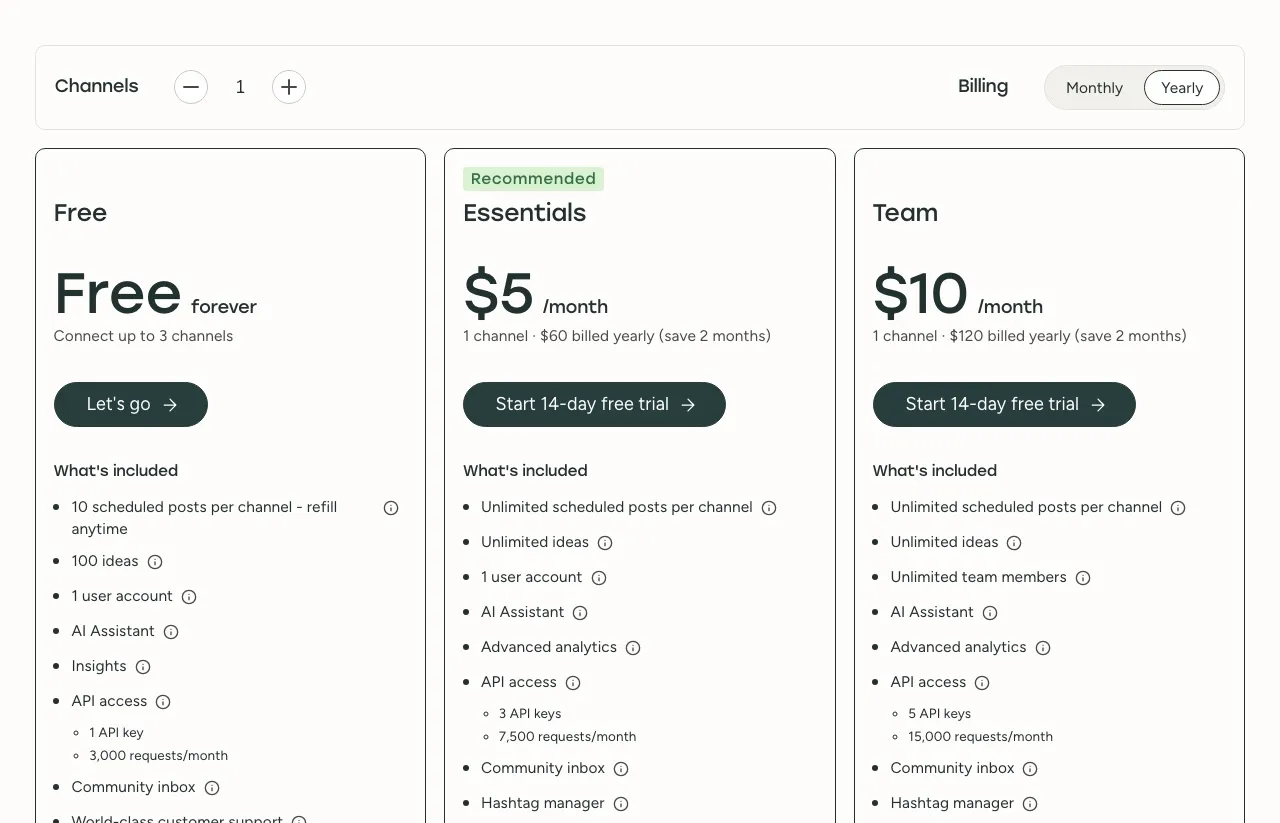
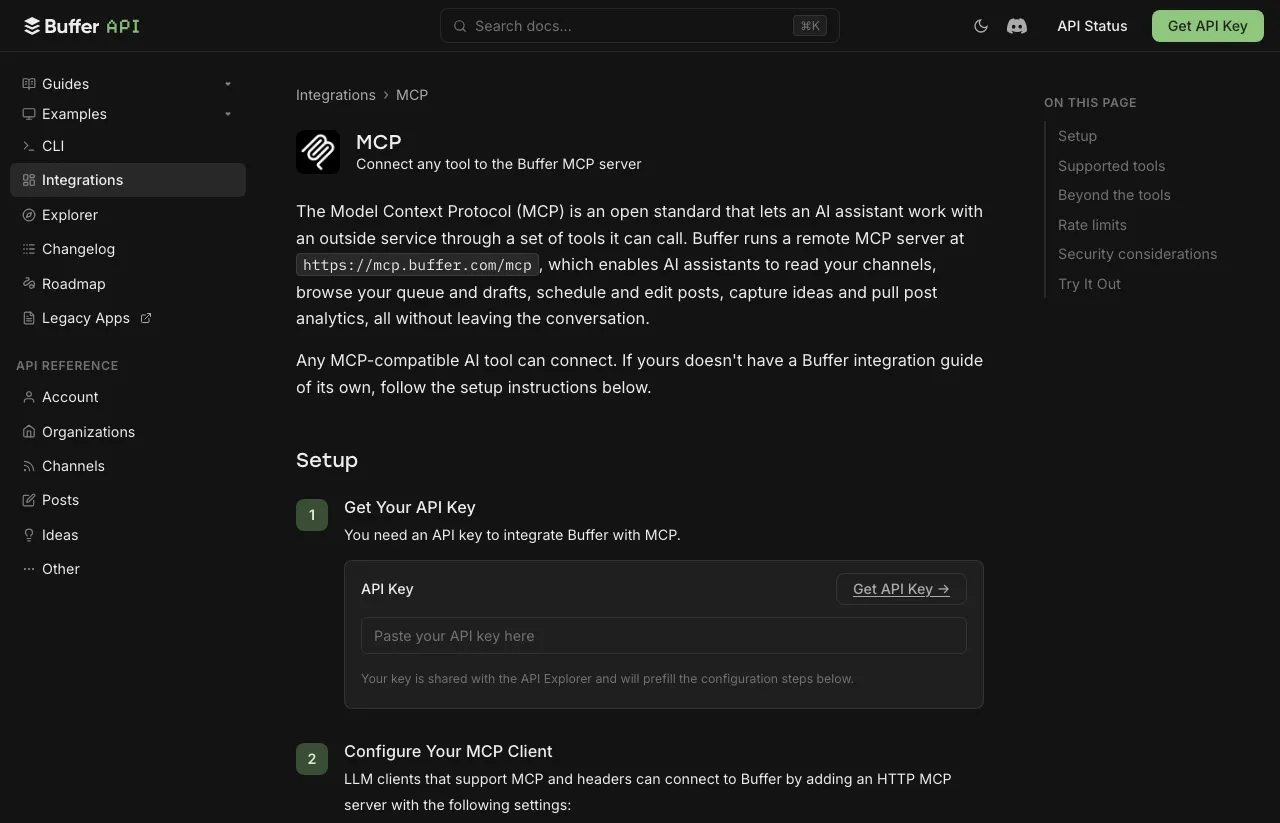
Buffer’s help centre answers it directly: “Buffer has a current API (a GraphQL API) available on all plans, including the Free plan.” Its pricing page puts API access in the Free column with one key and 3,000 requests a month. Buffer also runs a hosted MCP server, documented in its MCP guide, with 20 individually documented tools. I counted those myself rather than trusting a total, because Buffer does not publish one. The page also documents a prompt and a parameter, which a careless count sweeps in as tools.
One caveat that is genuinely Buffer’s, not a knock: it is GraphQL, not REST, so it is one endpoint and a schema rather than a set of resource URLs. If your agent expects REST, that is real work.
What Buffer Charges For, Once You Read the Bands
Buffer’s rendered pricing page shows a per-channel rate and defaults to yearly billing, which prints the annual rate with a “/month” suffix. The bands that actually decide your bill are not on that page at all. They are in Buffer’s machine-readable rate card, the plain-markdown file it publishes for AI agents.
Essentials runs $6 per channel for 1 to 10, $4 for 11 to 25, $3 for 26 to 50, and $1 for 51 and up, on monthly billing. Those bands are marginal, so each rate applies only to the channels inside it. Fifty-one channels is not 51 times $1.
A channel, in Buffer’s own words, is “one social account you connect to Buffer.” Five brands with an Instagram and a Facebook page each is 10 channels. Nothing else counts.
What Zernio Charges For, Including the Ad Accounts
Zernio has no plans and no seats. You pay per connected social account per month, the first two are free with no card, and the rate steps down as you add more: $6 each for accounts 3 through 10, $3 for 11 through 100, and $1 past that. Those are graduated the same way Buffer’s are, so account 11 does not reprice accounts 3 through 10.
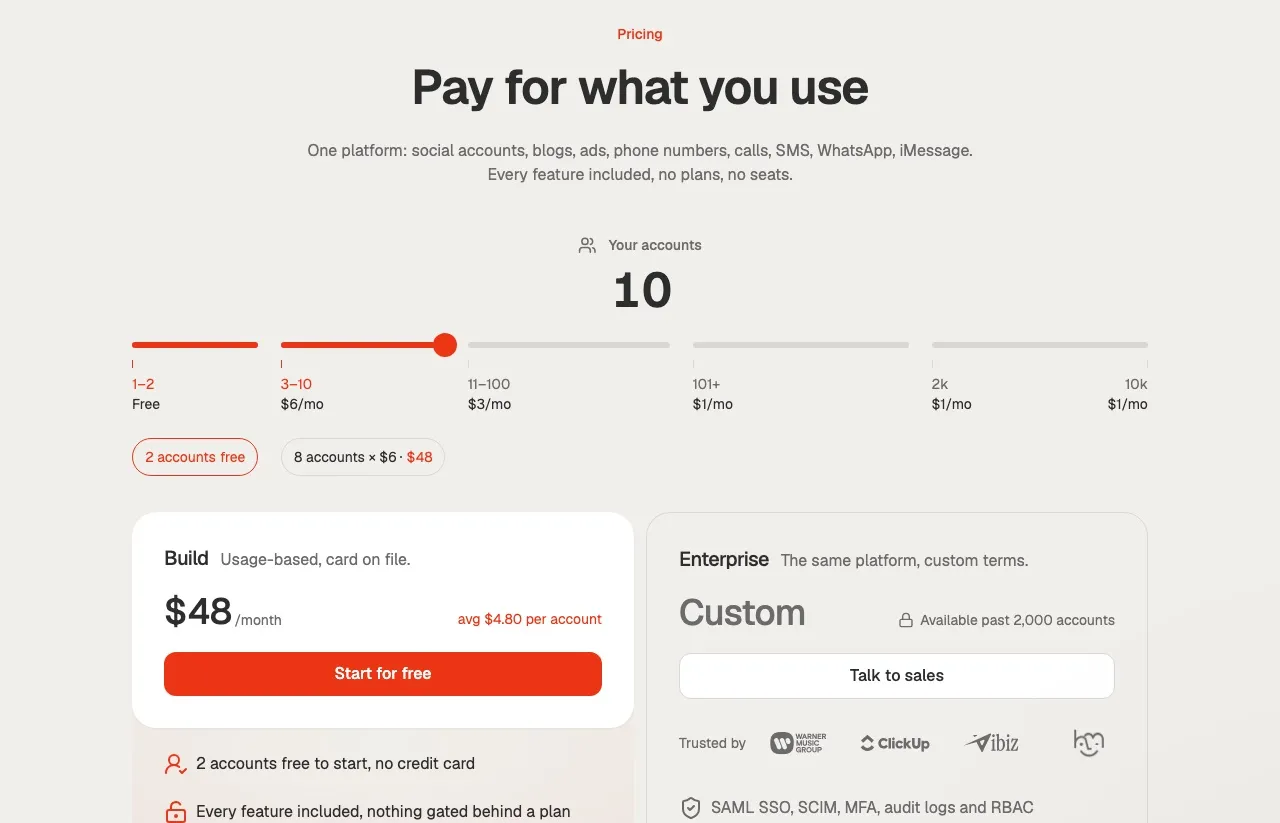
Here is the line that breaks a naive comparison, quoted from Zernio’s machine-readable rate card exactly: “One connected profile on one platform counts as one account: an Instagram account, a TikTok account, a Facebook Page, a YouTube channel… Ad accounts (Meta Ads, Google Ads…) count too.”
Ad accounts are billable connections. Buffer has no equivalent concept, because it does not touch ads. A business running Meta Ads and Google Ads alongside its organic profiles therefore carries two billable units on Zernio that do not exist on Buffer’s meter at all.
That is not a hidden fee. It is disclosed on the rate card, and Zernio’s ads coverage is a real feature others do not sell. It does mean your two “per account” numbers count different populations before you ever compare them.
One Workload, Priced on Both Meters
The comparison only gets concrete when you put one business through both cards. Take one, monthly billing, no annual discount on either side. Buffer publishes worked examples at 1, 3, 5, 10, 25 and 50 channels and Zernio at 10, 20, 100 and 1,000 accounts. Every one of those reproduces exactly from the bands below, so the counts neither vendor publishes are computed the same way.
| Connections | Zernio | Buffer Essentials | Cheaper |
|---|---|---|---|
| 2 | $0 | $12 | Zernio |
| 5 | $18 | $30 | Zernio |
| 10 | $48 | $60 | Zernio |
| 25 | $93 | $120 | Zernio |
| 50 | $168 | $195 | Zernio |
| 64 | $210 | $209 | Buffer |
| 100 | $318 | $245 | Buffer |
The lead changes hands exactly once, at 64 connections. Below that Zernio is cheaper at every count, helped by two free accounts Buffer does not offer on a paid tier. Above it Buffer’s $1 band pulls away and never gives the lead back.
Two things that table is not telling you. It assumes your connection counts are equal on both sides, which the ad-account rule above can break. And it is monthly on both sides, while Buffer’s yearly billing takes roughly two months off and Zernio has no annual discount to offer, which moves the crossover in Buffer’s favour.
Work a real case through it. Say you run six brands, each with Instagram, Facebook, TikTok and LinkedIn, and you also manage a Meta Ads account and a Google Ads account for two of them. On Buffer that is 24 channels, because ads are not something it touches, and 24 channels on Essentials is $116 a month. On Zernio it is 28 accounts, because the four ad accounts bill like any other connection, and 28 accounts is $102.
Zernio still wins that comparison, but notice what happened to the gap. On equal counts at 24 connections Zernio would be $90 against $116, a $26 difference. Adding the ad accounts closed nearly half of it while adding nothing to the Buffer side of the ledger. Push the ad accounts up to a dozen and the ordering changes outright.
That is the whole argument for pricing your own list rather than the vendor’s example. Neither rate card is misleading you. They are just counting different things, and the only way to see it is to write down your own connections and run them through both.
The Tier That Costs More to Buy Less
Buffer’s rate card has an oddity worth knowing before you pick a tier, and I have not seen it written down anywhere. Team is the upgrade, at $12 per channel against Essentials at $6. But the two tiers charge identically in the middle bands, $4 from 11 to 25 channels and $3 from 26 to 50. Then at 51 and up Essentials drops to $1 while Team only drops to $2.
So the premium tier is twice the marginal rate exactly where volume buyers live. At 100 channels Essentials is $245 and Team is $355. You are paying that $110 for unlimited team members, access levels and approval workflows, which is a fair thing to sell. Just buy it for the seats, not expecting the bigger plan to bring a better rate.
What Each One Hands an AI Agent
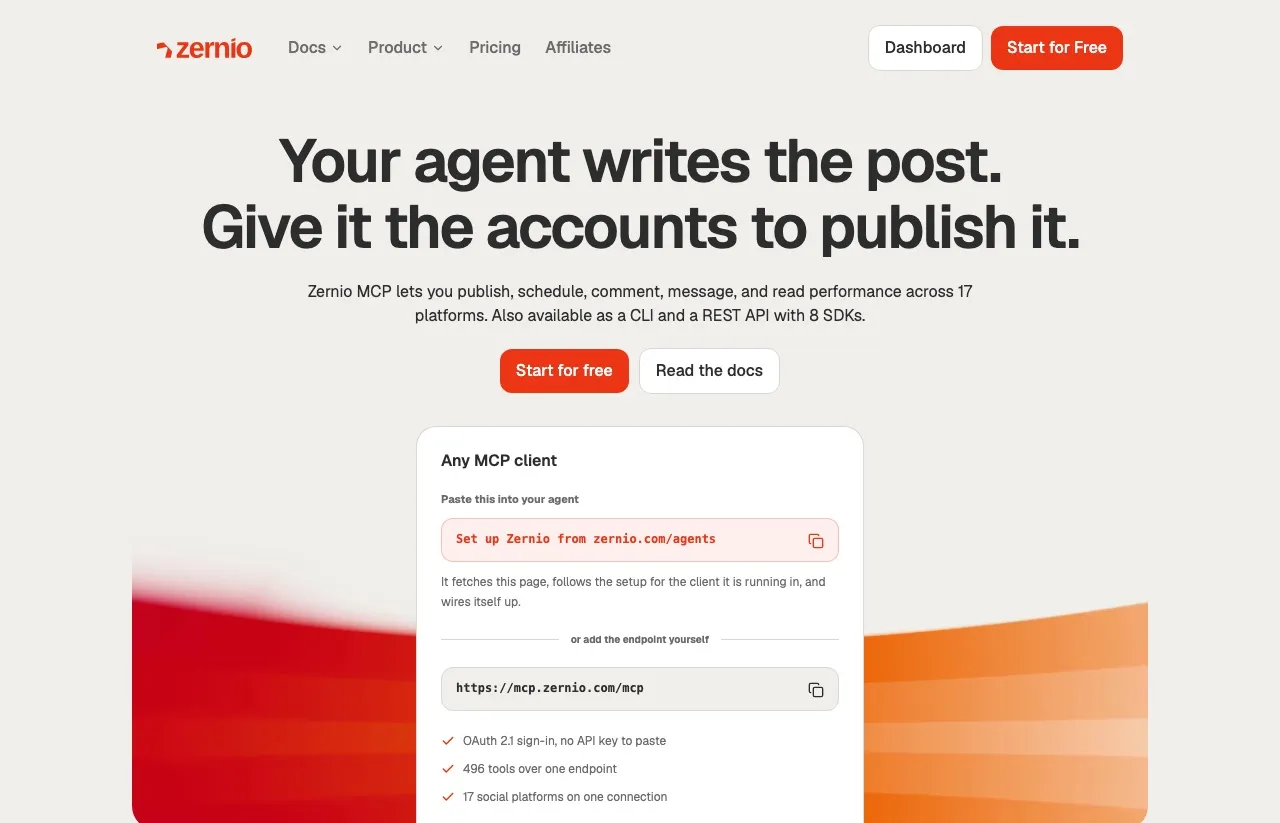
Both ship a hosted MCP server. I probed both endpoints while writing this and both answered with an auth challenge rather than a 404, so both are live and gated. That says the door exists, not how well the rooms behind it are furnished.
| Zernio | Buffer | |
|---|---|---|
| API shape | REST | GraphQL, single endpoint |
| Hosted MCP | Yes, mcp.zernio.com/mcp | Yes, mcp.buffer.com/mcp |
| MCP tools | 496, about 50 visible by default | 20 documented |
| API on the free tier | Yes, first 2 accounts | Yes, 1 key, 3,000 requests a month |
| DMs | 9 platforms | No |
| Comments | 9 platforms | Community inbox in the app, no comment tools in MCP |
| Ads | 8 ad networks, billed per ad account | No |
The tool counts are not the story people make of them. Zernio’s 496 is a deliberate design: its agents page says “Zernio exposes 496 tools; about 50 are visible by default and the rest are found on demand,” so an agent searches a catalogue rather than reading a list. Buffer’s 20 cover a scheduler’s jobs and then hand you execute_query and execute_mutation to reach the rest of the GraphQL API. Neither number tells you whether the operation you need exists.
If your agent has to answer people, that is where these two separate. Zernio replies to DMs and comments. Buffer’s MCP publishes, reads posts and pulls metrics, and documents no comment or inbox tools. Its GraphQL API reference lists no comment query or mutation either, so that work stays in the app.
Buffer’s rate limits are worth reading before you build against it, because they tier with the plan rather than sitting flat. Its API limits page publishes 100 requests per 15 minutes on every tier, then 250 calls a day on Free and Essentials against 500 on Team, and a 30-day ceiling of 3,000, 7,500 or 15,000 by plan. A 15-minute ceiling that does not move with the plan is the one to design around, since a backfill or a bulk reschedule hits it before the monthly number matters.
Where the Published Pages Disagree
Both vendors contradict themselves in ways worth knowing before you quote either at a colleague.
Zernio’s platform count depends which page you land on. Its agents page and its social media API page both say 17 platforms and name all 17. Its documentation says 16, in six places.
Its docs navigation is no help either, listing far more destination pages than any of those totals, because it counts ad networks, Shopify, WordPress and phone numbers alongside the social networks. Two marketing surfaces say 17 and the docs say 16, live on the same day. Take the count from whichever page covers the platform you actually need, and confirm that platform is on it.
Buffer’s contradiction is smaller and more expensive. Its plans say “unlimited scheduled posts per channel,” and its own FAQ defines the limit: “Unlimited scheduling is subject to our fair use policy, which caps usage to 5000 posts per channel. We describe this as ‘unlimited’ because no one has ever exceeded this cap.” That is honest, and it is still a number where the card says there is none.
On reviews, as of September 2026, Buffer sits at 3.6 on Trustpilot and Zernio at 4.8. Read those with the age gap in mind. Buffer has been collecting complaints since 2010 and Zernio is new enough that its reviewers are mostly early adopters who chose it deliberately. G2 blocks automated reads on both, so I am not quoting a score I could not open myself.
Pick Buffer When the Calendar Is the Product
- A person opens the tool daily and wants a queue, a calendar and a mobile app.
- You are at 64 channels or more, where its bands take over, assuming no ad accounts on the other side of the comparison.
- You want a free tier that never expires for up to 3 channels.
- Team seats, access levels and approval workflows matter more than the marginal rate.
- Your integration is publishing and reporting, and GraphQL is not an obstacle.
Pick Zernio When the Bill Is a Line of Code
- Publishing lives inside your own product or agent, not in a dashboard someone opens.
- You need DMs and comments on the same key as publishing, and your platforms are on its lists.
- You run ads and want them on one API, accepting that ad accounts bill as accounts.
- You are at 63 accounts or fewer, which is where its graduated rate stops beating Buffer’s.
- Its rate card’s promise of every feature on every account, with no plan gating, matches how you want to buy.
Where Blotato Sits on These Two Meters
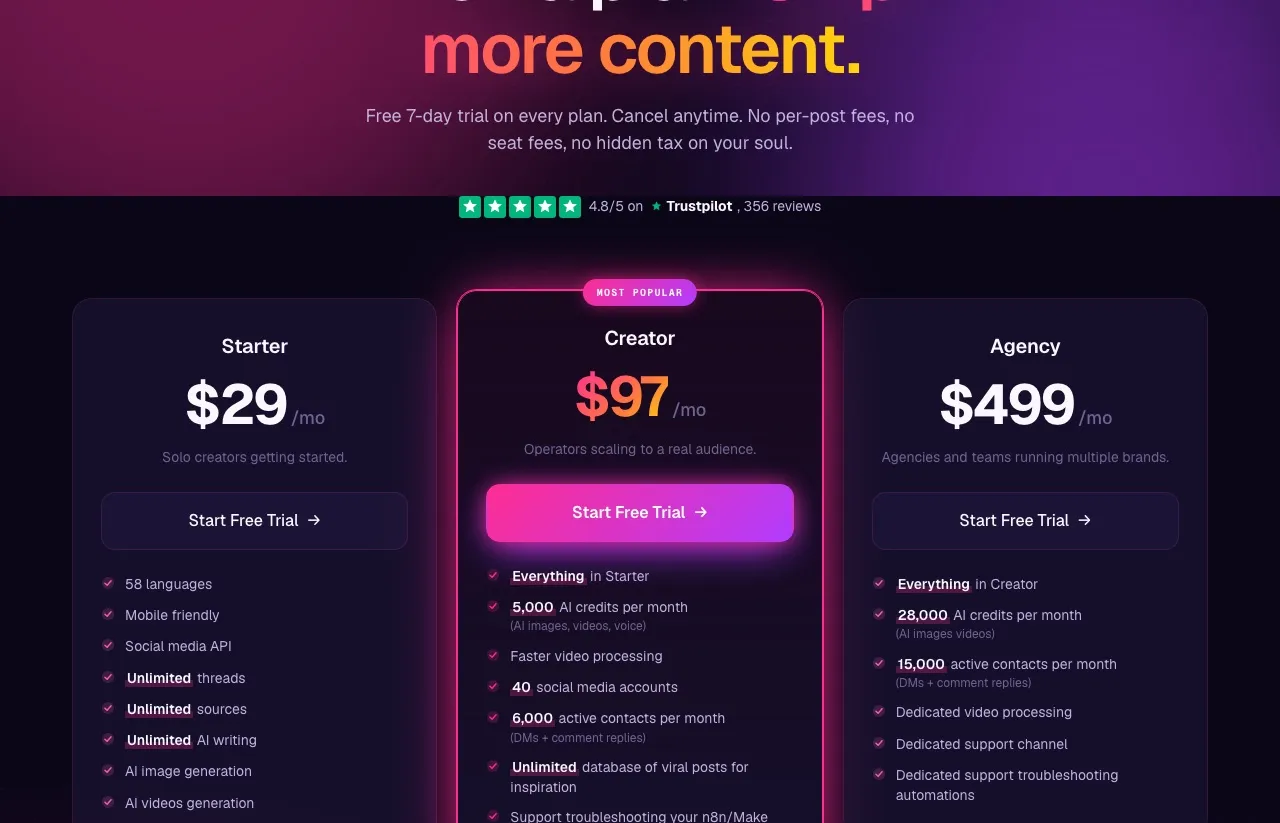
Blotato is the flat-rate shape rather than a third per-unit meter, which is the honest way to describe the difference. Starter is $29 a month for up to 20 connected accounts, so the bill does not move as you add the nineteenth. At 20 connections that is $29 against Zernio’s $78 and Buffer Essentials’ $100 on monthly billing.
That arithmetic only means something to you if your accounts fit what we actually cover, and often they will not. We publish to 9 platforms, so a list with Discord, Slack, Telegram or iMessage on it is a list we cannot serve at any price.
The limit that catches people out on our side is not reach, it is the queue. Starter holds 200 scheduled posts at a time, which sounds generous until you batch a quarter of content across twenty accounts and hit the ceiling mid-upload. That is 1,000 on Creator and 3,000 on Agency. We also sell no ads surface at all, so the ad accounts that bill on Zernio’s meter have nowhere to go on ours.
Where we do compete is the agent surface: 36 named MCP tools on mcp.blotato.com/mcp, documented rate limits of 30 writes and 60 reads a minute, and the same key covering publishing, analytics, comments and DM automation. One caveat for anyone reading this to evaluate the API: our 7-day trial excludes it, and generating a key ends the trial and starts the paid plan. Plan on subscribing rather than trialling it.
Count Your Own Accounts First
Zernio vs Buffer is not a question a rate card answers, and I would not pick either from one. Write down every connection you need, mark which are social profiles and which are ad accounts, and price that list on both meters. That is the step where the two numbers stop being comparable and start being your bill.
Then check the tool you prefer actually reaches your platforms, since Zernio’s own pages disagree about how many it covers and Buffer stops at publishing and reporting. If the list is small and includes an inbox, Zernio. If it is large and lives in a calendar, Buffer.
Zernio vs Buffer FAQs
Is Zernio cheaper than Buffer?
Through 63 connections, yes. Zernio’s first two accounts are free and its graduated rate keeps it under Buffer Essentials at every count up to the crossover: $48 against $60 at 10 accounts, $93 against $120 at 25. From 64 Buffer’s $1 band takes over and the gap widens, reaching $245 against $318 at 100. Both figures assume monthly billing and equal connection counts on each side.
Does Buffer have an API?
Yes, on every plan including Free. Buffer’s help centre states it covers all plans, and the Free tier includes one API key and 3,000 requests a month. It is a GraphQL API rather than REST, so you send queries to a single endpoint rather than hitting resource URLs. Buffer also runs a hosted MCP server with 20 documented tools, so assistants telling you the API is gated are wrong.
How many platforms does Zernio support?
Its own pages disagree. The agents and social media API pages say 17 and name them, while the documentation says 16. Its docs navigation lists more destinations still, but only by counting ad networks, Shopify, WordPress and phone numbers alongside social networks. Check the specific platform you need is listed rather than relying on any headline count.
Do ad accounts count toward Zernio’s bill?
Yes. Zernio’s rate card states that ad accounts such as Meta Ads and Google Ads count as connected accounts, billing at the same graduated rate as a social profile. Buffer has no equivalent, since it does not manage ads. If you run ads, add those accounts to your Zernio count before comparing the two meters.
Is Buffer’s Team plan cheaper per channel at volume?
No, and it is the opposite above 50 channels. Team and Essentials charge the same $4 and $3 rates from 11 to 50 channels, then Essentials drops to $1 at 51 and up while Team only drops to $2. At 100 channels that is $245 against $355. Buy Team for unlimited seats, access levels and approvals, not for a better rate.
Which one handles comments and DMs?
Zernio is the only one of the two an agent can reply through, and its rate card scopes that to nine platforms for DMs and nine for comments, with TikTok on neither list. Buffer has a community inbox inside its app, but its MCP server documents no comment or inbox tools, and its GraphQL API reference lists no comment query or mutation either, so replies stay in the app. If replying programmatically is the job, check your platforms against Zernio’s two lists before assuming it covers them.