Blotato vs Mixpost: Hosted Social Media MCP or Your Own?
Blotato vs Mixpost for social media agents: one gives your agent a hosted MCP endpoint, the other a server you install, license and run yourself.
Blotato vs Mixpost is usually framed as a money question, and one DNS lookup shows why that framing hides the actual decision. mcp.blotato.com resolves to a running MCP server. mcp.mixpost.app does not resolve at all, because Mixpost ships MCP inside the software you host rather than as an endpoint anyone can point an agent at.
Both tools genuinely ship an MCP server, and both can take a request from an agent and put a post on a social network. They are still not substitutes, because with one your agent talks to a server that already exists, and with the other it talks to a server that does not exist until you build it, license it and keep it alive. Everything else follows from that.
Blotato vs Mixpost: At a Glance
Mixpost is the better pick if you can name which of these applies to you: your data cannot leave your own infrastructure, you write Laravel and will modify the source, or you are white labeling for clients and need a license permitting it. If none of the three fits, the one-time price is buying you an install to maintain rather than a better tool.
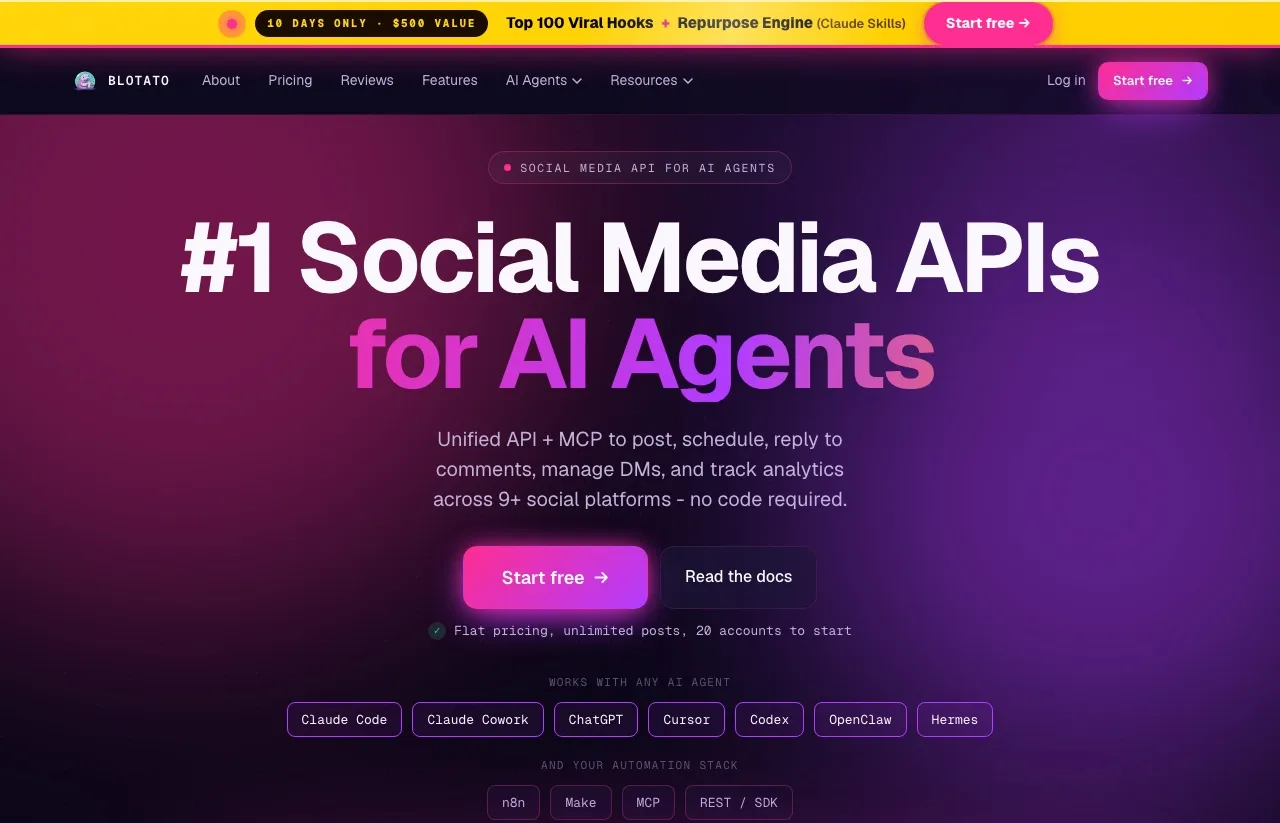
Blotato is the better pick if none of those three describes you and what you want is an agent publishing this afternoon without operating a server to get there. One key reaches publishing on 9 platforms, comments and DMs on Instagram and Facebook, and analytics on eight, all from a hosted endpoint. Pricing is flat at $29 a month on Starter, with the API on paid plans.
One Is Software, One Is a Service
Mixpost gives you a codebase and a license. Your server, your database, your queue worker, your upgrade schedule, your data. Nothing about your posting depends on a vendor staying in business, which is a genuinely strong position to be in.
Blotato gives you a URL and a key. There is no codebase to receive, which is a real limitation if you needed one, and no server for you to keep running, which is the point.
So the honest question is not which tool is better. It is whether you want to own a system or rent an endpoint, and both answers are defensible.
Time to First Agent Call
This is the number I would want if I were choosing, and neither pricing page shows it.
With Blotato, your agent connects to mcp.blotato.com/mcp, which is already running. Claude Code, Claude Desktop, Cowork and Claude.ai web authenticate over OAuth. ChatGPT, Cursor, Codex, Antigravity and Replit Agent use a blotato-api-key header. Generate a key, point the client at the URL, and the agent can list your accounts. The work is configuration.
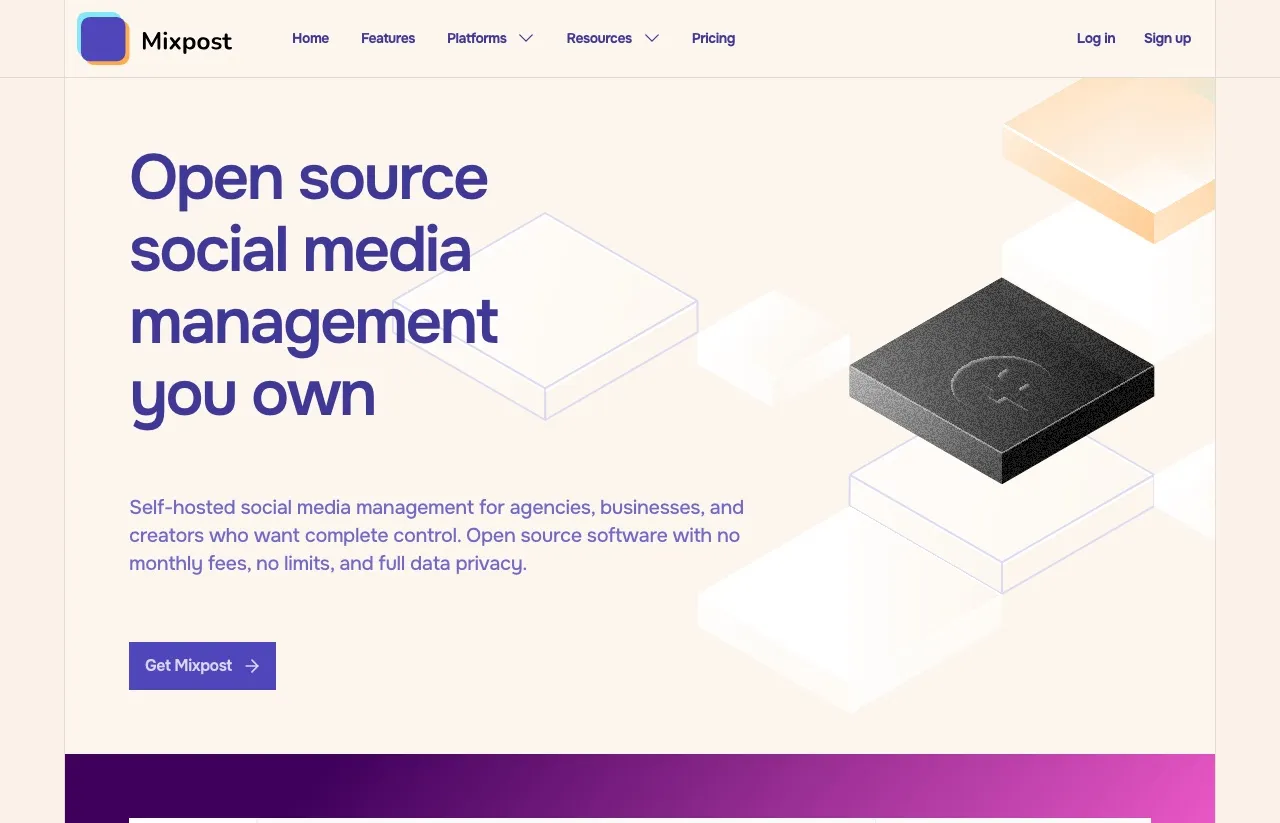
With Mixpost, there is no endpoint until you make one. Your agent connects to https://your-domain.com/mixpost/mcp, and every part of that URL is something you provision first: a server, a domain, and an install.
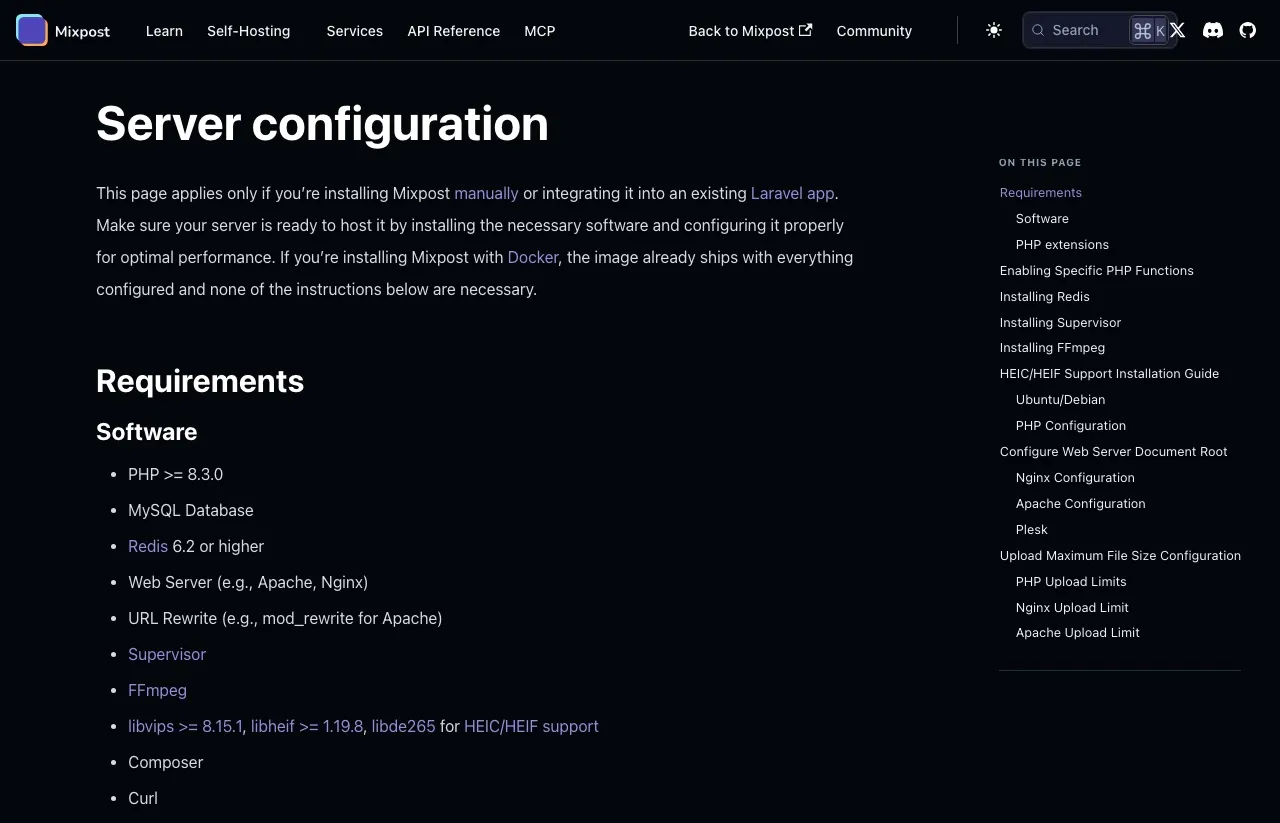
The docs are clear that Docker carries most of this, and I want to quote them properly rather than make it sound worse than it is:
This page applies only if you’re installing Mixpost manually or integrating it into an existing Laravel app. Make sure your server is ready to host it by installing the necessary software and configuring it properly for optimal performance. If you’re installing Mixpost with Docker, the image already ships with everything configured and none of the instructions below are necessary.
That caveat is fair and it matters. Take the Docker path and you skip the dependency list. Take the manual or existing-Laravel path and the server requirements are PHP 8.3+, MySQL, Redis 6.2+, a web server, Supervisor for the queue worker, FFmpeg, Composer, cron and a list of PHP extensions, plus enabling pcntl_signal and pcntl_alarm, which many hosts disable by default.
One constraint applies either way: Mixpost must live on a primary domain or subdomain, and a subdirectory install is explicitly unsupported.
Who Operates the MCP Server
The DNS result from the intro is not an oversight. Because Mixpost ships MCP inside the self-hosted product, the MCP server in a Mixpost setup is a server you run, and when it stops, your agent’s tools disappear and the person who notices is you.
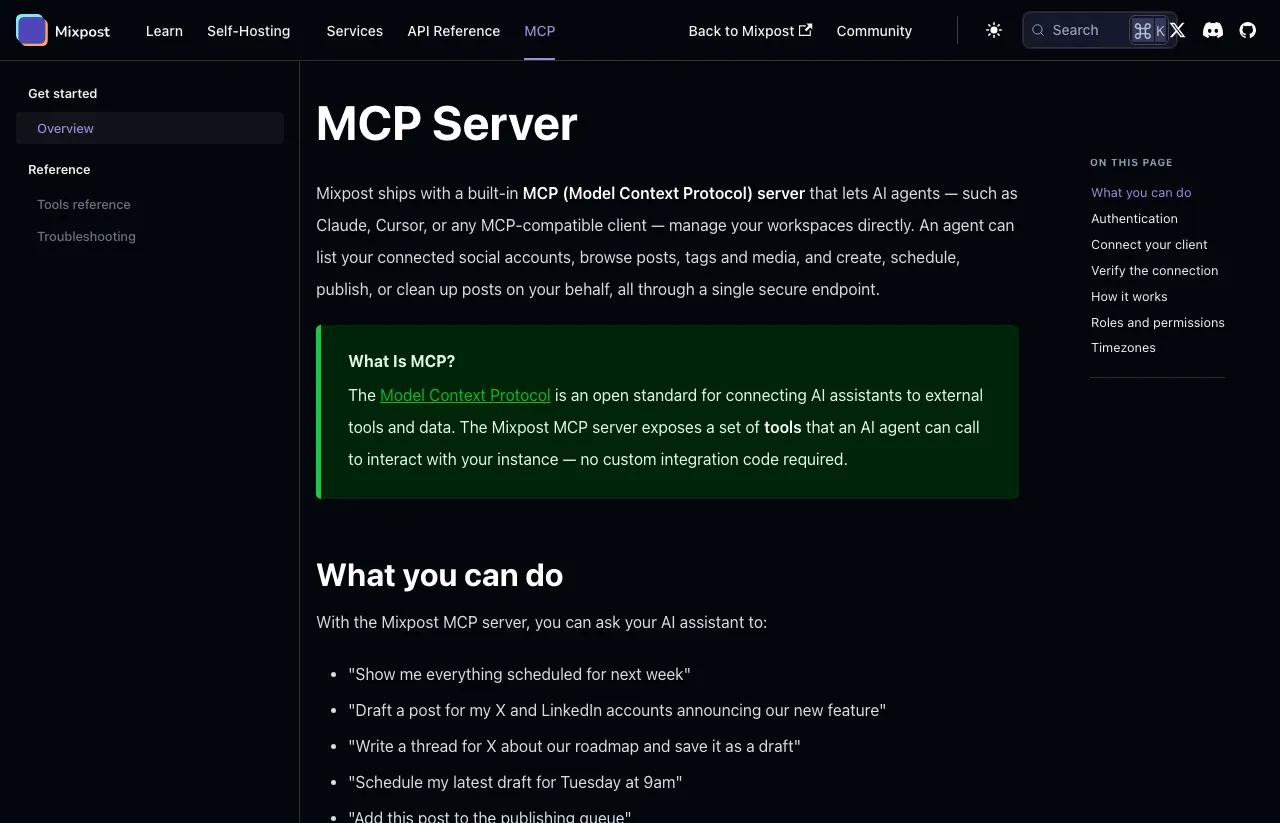
Mixpost’s MCP is real and well documented. It serves over streamable HTTP at a single endpoint on your install, authenticates with a bearer token, documents Claude Code, Claude Desktop, Cursor and Hermes as clients, and exposes 24 tools covering workspaces, accounts, posts, scheduling, tags and media. Roles are enforced, so a Viewer token reads and a Member token writes. That is a considered implementation, not a checkbox.
Two limits are worth knowing before you plan around it. MCP sits behind the $299 Pro license, so the free edition does not have it, and the tool surface is publishing and content management only, with no analytics or inbox tools exposed.
Blotato’s MCP server exposes 35 tools and reaches further into the account: publishing and scheduling, comments, conversations and DMs, DM automations, analytics, media and Pinterest boards. Same protocol, wider surface, nothing for you to operate.
The Mixpost Buyer, and What the License Actually Covers
Mixpost is built by Inovector for agencies, privacy-sensitive businesses and Laravel developers. The public Lite edition has been on GitHub since 2022 and carries about 3,500 stars, which is real traction for a tool in this category.
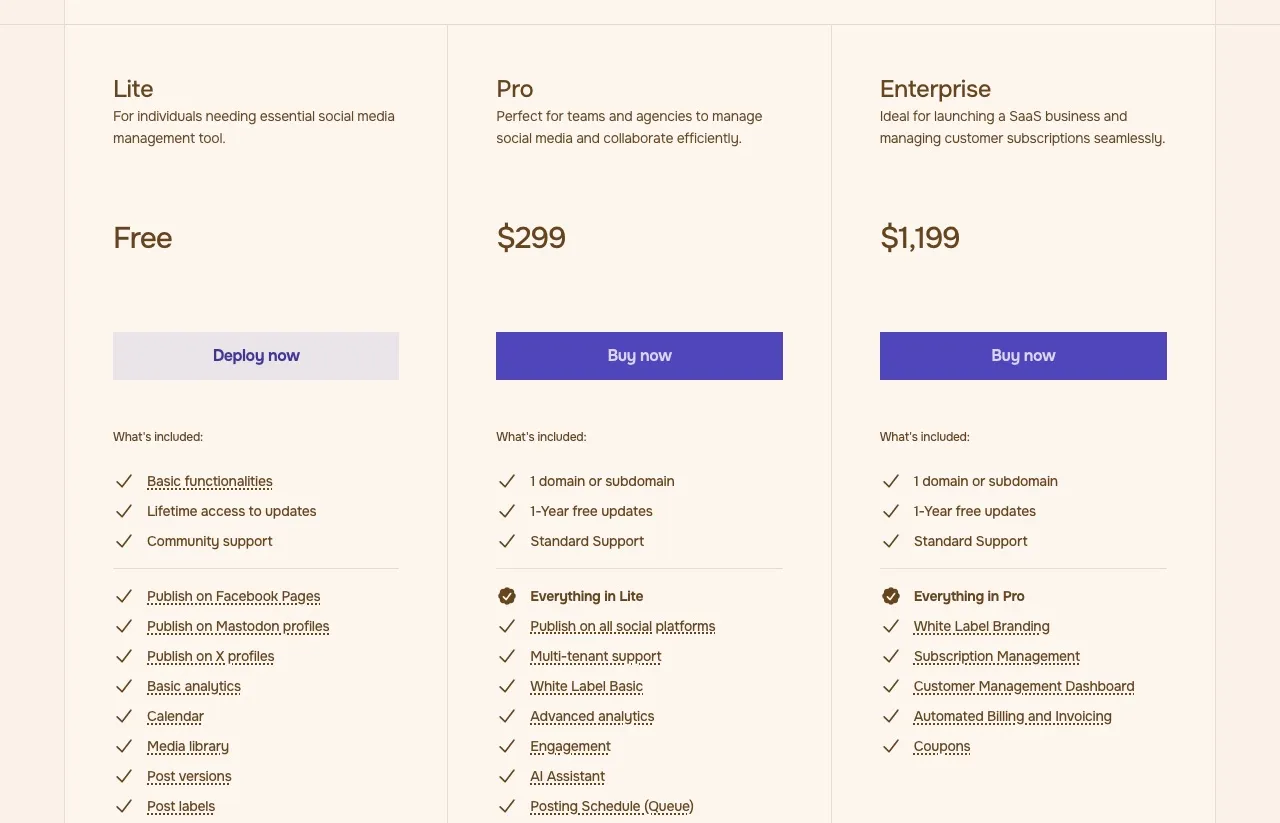
Three editions, all self-hosted, all one-time payments. Lite is free and MIT-licensed. Pro is $299 and unlocks the full platform list, the API, MCP, the AI assistant, engagement, approval flows and white labeling. Enterprise is $1,199 and adds subscription management and billing so you can run a SaaS on top, which Pro explicitly does not permit.
The one-time framing is accurate with one qualifier the pricing page states plainly: every purchase includes a perpetual fallback license, so the software keeps working forever, but updates run for one year and continue only if you renew. Each license covers one domain or subdomain.
Three things I would want to know before buying. Lite publishes to exactly three destinations, Facebook Pages, X and Mastodon, so if you came for a free self-hosted tool that posts to Instagram, it will not do it. Mixpost’s own pages disagree on the Pro platform count, the pricing FAQ listing eleven while the homepage and Pro card show Pixelfed for twelve. And Pro’s Engagement inbox is documented per service rather than as one list, with real conditions attached, so read the page for your platform first: LinkedIn comments and mentions arrive only for Pages connected under the Community Management API, and personal LinkedIn accounts do not support it at all.
Mixpost has almost no presence on the major B2B review platforms, so judge it on its docs, its GitHub activity and a test install rather than on sentiment. On activity: the open-source Lite repository’s most recent public release is 2.6.0 in March 2026, though Pro ships separately from that repo, so the gap is not evidence about Pro.
What Blotato Covers, and Where It Stops
Blotato is an app I built, so weigh my read on it accordingly. What I can do is be specific enough that you can check every claim.
It is built for people wiring social publishing into an agent or an automation who do not want to become the operator of that infrastructure. The API and the MCP server are the product, and the web app sits on the same surface.
One key reaches publishing and scheduling on 9 platforms: X, Instagram, Facebook, TikTok, LinkedIn, Pinterest, Bluesky, Threads and YouTube. Beyond publishing the coverage narrows, and I would rather you hear the shape from me than find it later. Comments, conversations and DM automations run on Instagram and Facebook only. Analytics covers eight networks, every platform except LinkedIn, which returns no metrics yet. DM automations are also reply-only by design: an automation answers people who comment or message first, and there is no cold outreach.
Blotato vs Mixpost: Side by Side
| Category | Mixpost | Blotato |
|---|---|---|
| Deployment | Self-hosted, you run it | Hosted |
| Pricing model | One-time license per domain | Flat monthly |
| Free edition | Yes, Lite (3 destinations) | No (7-day trial, cancel anytime) |
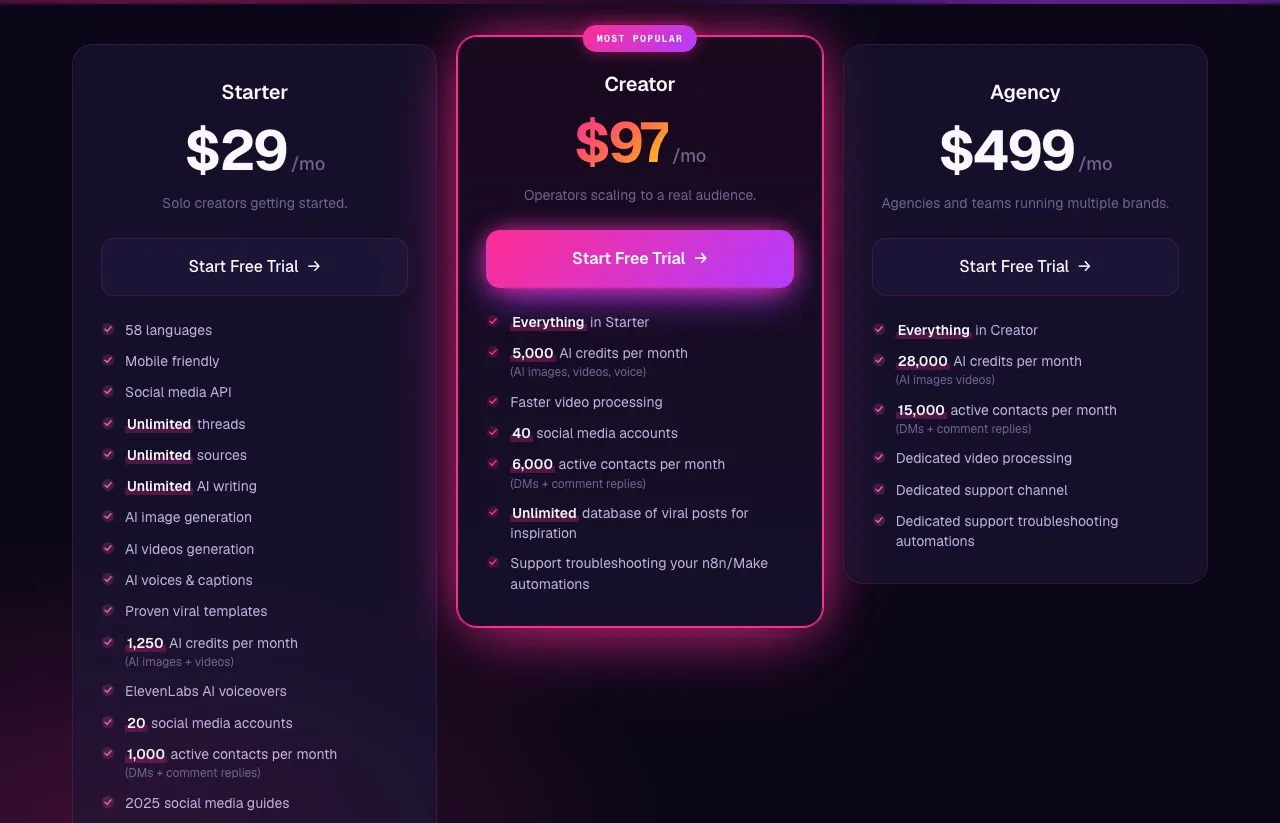
| Entry paid price | $299 one-time (Pro) | $29/mo (Starter, 20 accounts) |
| Publishing platforms | 3 on Lite, 11 to 12 on Pro | 9 |
| Hosted MCP endpoint | No, runs on your install | Yes, mcp.blotato.com/mcp |
| MCP tools | 24 (Pro only) | 35 |
| MCP scope | Publishing and content management | Publishing, comments, DMs, analytics |
| REST API | Pro only | Paid plans |
| Analytics | Basic on Lite, advanced on Pro | 8 platforms |
| Comments / inbox | Pro, incl. Threads and LinkedIn Pages | Instagram and Facebook |
| DM automation | Not offered | Instagram and Facebook, reply-only |
| Source code access | Yes, MIT on Lite | No |
| Updates | 1 year, then renew | Continuous |
Two rows carry most of the decision. Mixpost gives you source code and self-hosting, which Blotato does not offer at any price. Blotato gives you a hosted endpoint and a wider engagement surface, which Mixpost does not offer at any price. Neither gap closes with a sprint, because both are consequences of the delivery model.
Five Things Self-Hosting Gets You
You own it outright. No vendor can change your terms, raise your price, or shut down and take your posting with it. Where that risk is unacceptable, this is decisive on its own and no hosted tool matches it.
Your data stays on your infrastructure. A residency or privacy requirement that forbids content passing through a third party is the single most common legitimate reason to self-host, and a self-hosted install clears a bar no managed API clears.
MIT licensing on the free edition. No copyleft, no network clause. If you are building something commercial on top of the Lite codebase, that is a materially different legal position than a copyleft license.
One payment ages well. $299 once against $29 a month passes in about ten months, so if you already have someone maintaining servers and your platform set is stable enough that the install can sit untouched for years, the arithmetic works in Mixpost’s favor and I am not going to pretend otherwise.
You can read and change the code. If your team writes Laravel, a codebase you can modify is worth something that never appears in a comparison table. Custom workflows that no vendor would build for you become a pull request against your own install.
One more worth stating plainly rather than leaving in a table row: Mixpost’s Engagement inbox reaches more networks than ours does. Its docs cover Threads replies and mentions, and LinkedIn Page comments through the Community Management API, alongside Facebook and Instagram. Blotato’s comments and DMs stop at Instagram and Facebook. If pulling replies from LinkedIn or Threads into one inbox is the job, that is a real gap on our side and Pro’s Engagement inbox covers it.
Four Things You Stop Owning
Nothing to operate. No server, no queue worker, no Redis, no upgrade window, no domain to provision before the first call. The endpoint is running now and staying up is our job.
A wider surface behind one key. Publishing, comments, DMs, DM automations and analytics come from the same key. Assembling that yourself means a self-hosted publisher plus separate solutions for the rest, which is several integrations and several approval processes rather than one.
Platform approvals are already done. Meta’s Advanced Access and App Review and TikTok’s content posting audit are commonly weeks of process each, and self-hosting any tool means going through them as your own developer app. That work never appears on a rate card.
The bill does not move with volume. Flat monthly, no per-post fee, which matters when an agent runs unattended and you would rather not price each call.
What Each One Costs to Keep Running
The sticker prices are $299 once against $29 a month, and I worked the full three-year math in Mixpost vs Postiz rather than rebuild it here. What that math cannot show is the part that decides most builds: a self-hosted install carries a server bill and an operator, and the operator is you. Platform APIs change, OAuth tokens expire, queue workers die quietly, dependencies need patching. None of it is hard. All of it is unscheduled and arrives on the platform’s timetable rather than yours.
So this table covers only the costs the rate cards leave out.
| Cost the sticker price hides | Mixpost Pro ($299 once) | Blotato Starter ($29/mo) |
|---|---|---|
| Server and database | Yours to run and pay | Included |
| Platform approvals (Meta, TikTok) | Yours, weeks each | Already passed |
| OAuth token maintenance | Yours, every platform | Handled |
| Upgrades after year one | Renew to keep receiving them | Continuous |
| Who restores service on an outage | You | Us |
The one-line version: a self-hosted install costs less in dollars and more in hours, and which of those you have more of is genuinely the deciding question.
Four honest caveats, because the hosted side is not always right.
If the only destinations you need are Facebook Pages, X and Mastodon, then Blotato’s wider platform list is capacity you would be paying for and never touching, and a free Lite install covers you.
If data residency is a hard requirement, no hosted API clears the bar and the comparison ends there.
Reselling a white-labeled social tool under your own brand is a licensing question before it is a product one, and Blotato does not sell a license that permits it at any tier, so an agency building a resold product should be pricing the $1,199 Enterprise edition against running the infrastructure that comes with it.
Check your destination list before anything else, because Blotato does not publish to Mastodon, Discord or Google Business Profile at any tier, and if one of those is where your audience actually is then no amount of hosted convenience makes up for not reaching them.
Mixpost Suits Data You Cannot Let Leave
- Your data cannot leave infrastructure you control.
- You want to own the software outright with no recurring vendor relationship.
- Your team writes Laravel and will actually modify the code.
- You are white labeling or reselling and need a license that permits it.
- Facebook Pages, X and Mastodon are enough, in which case Lite is free.
Blotato Suits Anyone Who Won’t Run a Queue Worker
- You want an agent publishing today rather than after a deployment.
- You would rather not run a server, a queue worker and an upgrade schedule.
- You need comments, DMs and analytics from the same key as publishing.
- You do not want to pass Meta and TikTok approvals as your own developer app.
- You are connecting Claude Code, Cowork, ChatGPT or Cursor and want the endpoint to already exist.
How I Would Actually Decide
A sticker price of $299 once against $29 a month only settles the question if your own hours are free, which is the assumption worth checking before you let the cheaper number decide.
My honest read is that self-hosting pays off when you have a reason beyond cost, and there are four good ones: data residency, source access, white labeling, and a Laravel team that will actually use it. If one of those describes you, a self-hosted install is the right call and no hosted endpoint changes that. If none of them does, picking a self-hosted tool purely to avoid $29 a month means buying yourself an operations job, and that job is cheapest to discover before you take it rather than after.
If you want the agent working today and you have no residency or licensing constraint, that is what Blotato is for. One caveat if you are here for the API or MCP specifically: the 7-day trial excludes the API, and generating a key ends the trial and starts the Starter subscription immediately, so plan on subscribing rather than trialing that part.
Blotato vs Mixpost FAQs
Does Mixpost have a hosted MCP server?
No. Mixpost ships MCP inside the self-hosted product, so the server runs on your own install at https://your-domain.com/mixpost/mcp, and mcp.mixpost.app does not resolve. Blotato’s is hosted at mcp.blotato.com/mcp. For an agent builder that is the practical difference: one needs a deployment before the first call, the other does not.
Is Mixpost’s MCP server free?
No. MCP sits behind the $299 one-time Pro license, along with the REST API. The free Lite edition is genuinely free and MIT-licensed, but it covers publishing to Facebook Pages, X and Mastodon through the interface only. Any agent or API access to Mixpost starts at the Pro license plus whatever your server costs to run.
How many MCP tools does each one expose?
Mixpost exposes 24 tools covering workspaces, accounts, posts, scheduling, tags and media, with no analytics or inbox tools in the set. Blotato exposes 35 spanning publishing, scheduling, comments, conversations, DM automations, analytics, media and Pinterest boards. Counts proxy surface area, not quality, so weigh them against what your agent needs to do.
Which supports more social platforms?
Mixpost Pro supports eleven or twelve depending which of its own pages you read, against Blotato’s 9. Mixpost’s free Lite edition supports three. The lists differ in composition too, so the count is less useful than the overlap: Mixpost reaches Mastodon and Google Business Profile, which Blotato does not publish to at any tier.
Can I self-host Blotato?
No. Blotato is hosted only, with no self-hosted or on-premise edition, so there is no path to running it on your own infrastructure. If a data residency or control requirement means content cannot pass through a third party, then a self-hosted tool is the only category that clears that bar and the hosted side of this comparison does not apply to you.
Which is better for an agent posting unattended?
It depends on whether you already run production infrastructure. Blotato is a hosted endpoint, so an unattended agent depends on our uptime rather than yours, and there is no queue worker of yours to die quietly. A self-hosted install gives you full control and full responsibility together, which fits a team that already monitors services and fits badly if what you wanted was publishing rather than a server to look after.