Blotato vs Post Bridge: Which Social Media API for Agents?
Blotato vs Post Bridge: one publishes what you already made, the other makes it too. Where each social media API fits an AI agent build.

Blotato vs Post Bridge usually comes down to one question nobody asks up front: does your agent already have the image and the video, or does it need to make them?
Both run a hosted MCP server, both ship a REST API, and both let an agent publish to nine platforms without you touching a single platform developer portal. On that layer they are closer than most comparisons admit.
The split shows up one step earlier, in what your agent hands the API. Post Bridge assumes the asset exists. Blotato assumes it might not.
Blotato vs Post Bridge: At a Glance
Post Bridge is the better pick if: your agent already produces finished media somewhere else, and you want the cheapest reliable way to push it to a lot of connected accounts. At $99 a month for unlimited accounts, nothing else in this category matches that ceiling.
Blotato is the better pick if: your agent starts from a script or an idea rather than a finished file, and you would rather generate the image or video behind the same key that publishes it. You can see how the tiers break down on the Blotato pricing page.
A Publishing Layer Against a Creation Engine
Not quite, and pretending otherwise would waste your time.
Post Bridge is a publishing layer. It takes media you already have, puts it on a schedule, sends it to your connected accounts, and reports back what happened. It does that job cleanly and it charges very little for it.
Blotato is a creation layer that also publishes. The API that schedules your post is the same API that can generate the image or the faceless video going into it, and the ElevenLabs voiceover on top of that.
If your pipeline already ends with a finished MP4 sitting in object storage, Blotato’s creation surface is something you are paying for and not using.
Agent Builders Shopping on Price per Account
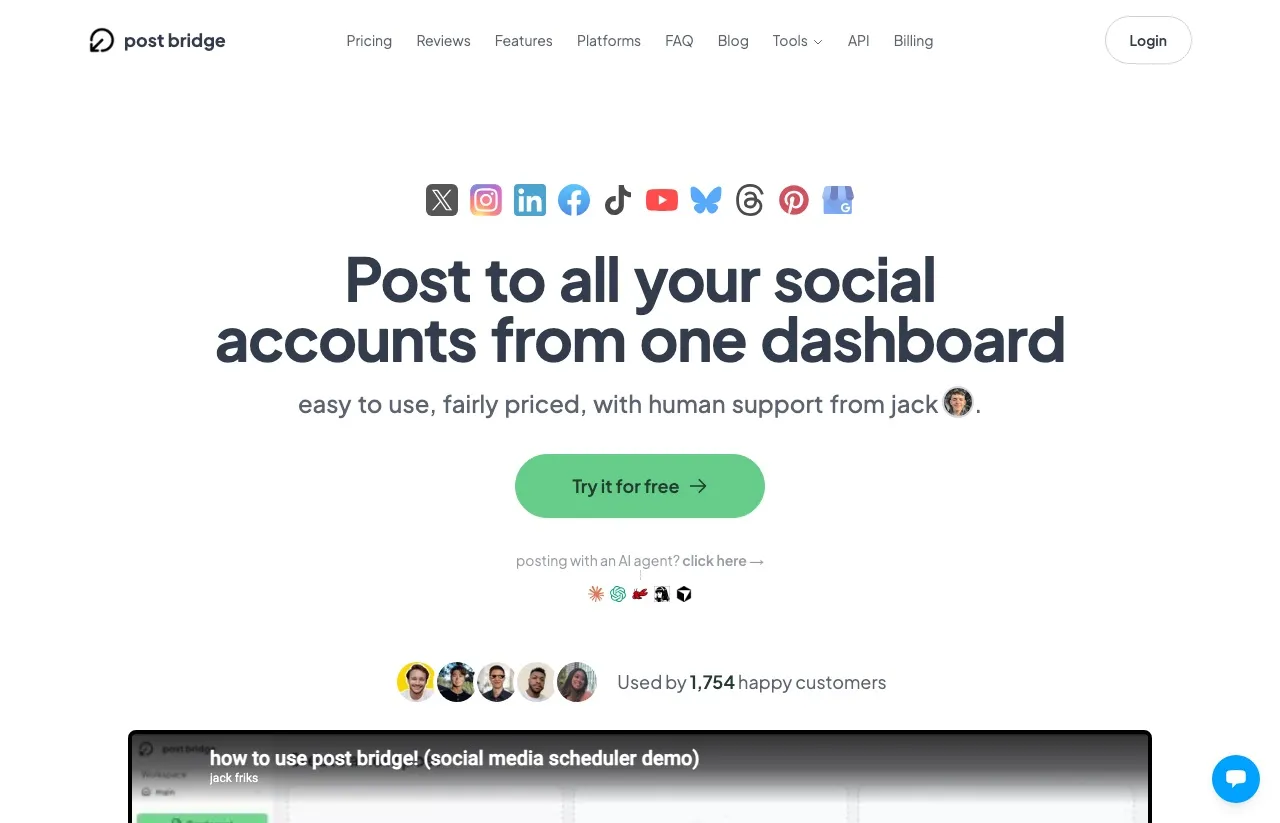
Post Bridge is built for solo operators and small teams who publish a lot and want the bill to stay boring. The homepage pitch is “easy to use, fairly priced, with human support from jack,” and that is an accurate description of the product.
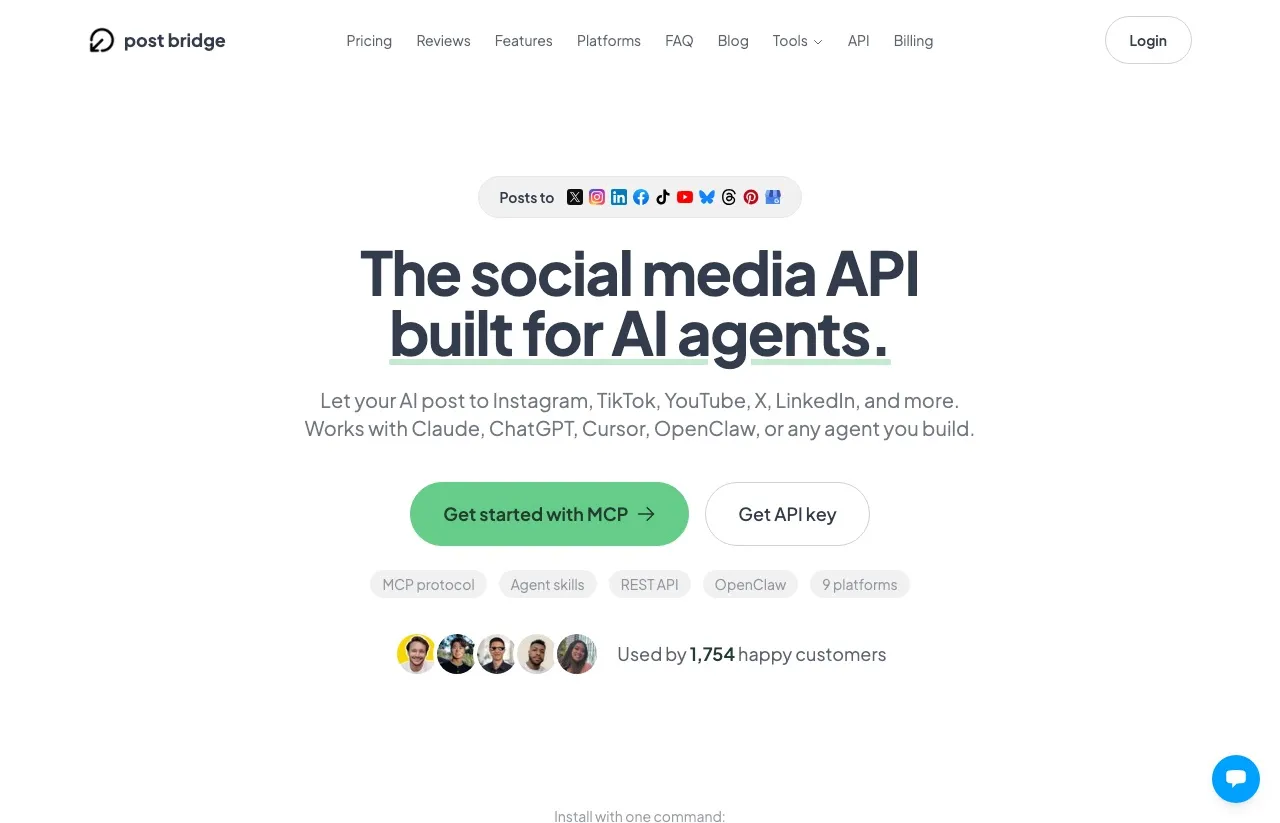
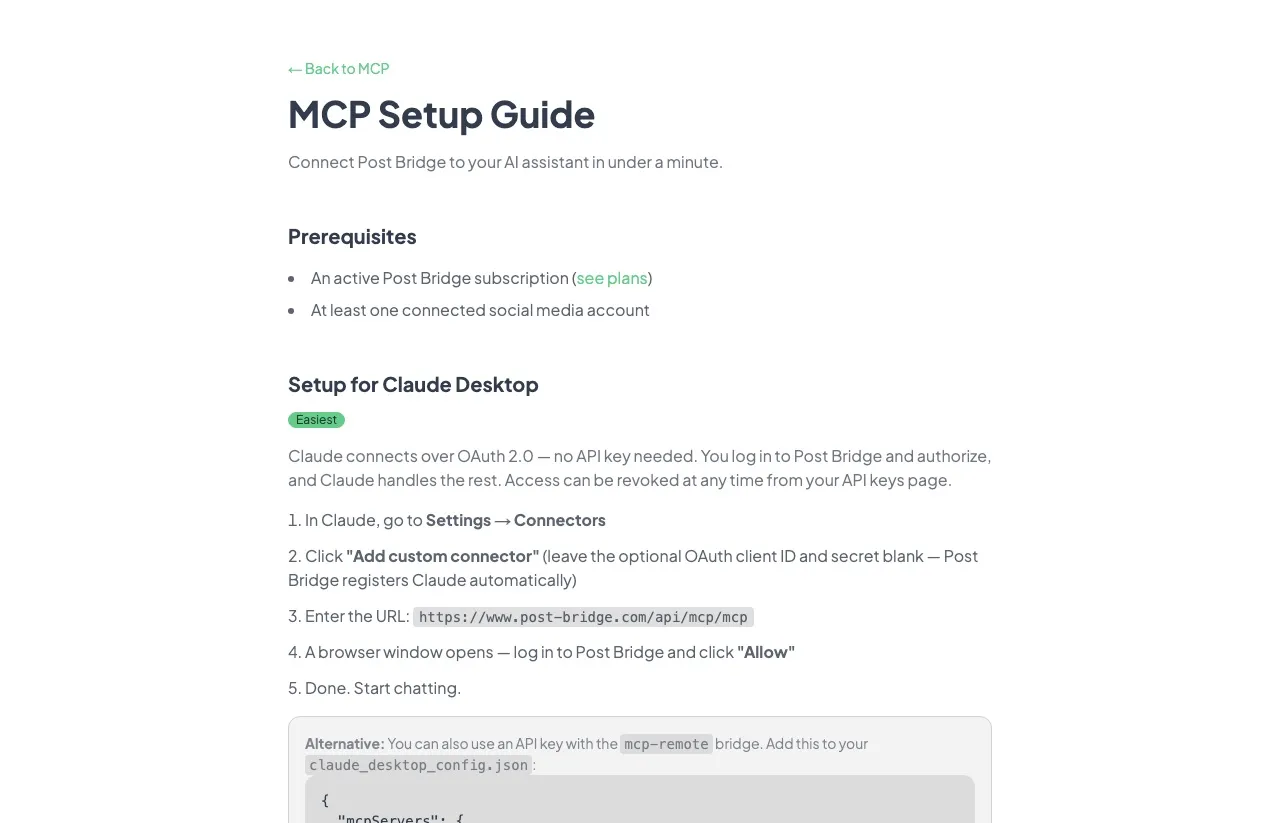
The agent story is real, not a bolt-on. Its agents page leads with “The social media API built for AI agents” and names Claude, ChatGPT, Cursor and OpenClaw directly. It ships a hosted MCP server, a REST API, a CLI you can install with npx postbridge-cli, and an open-source agent skill. Claude Desktop connects over OAuth 2.0 with no API key at all, which is a genuinely nicer first run than pasting a bearer token.
One practical note before you evaluate it. Post Bridge is newer than most tools in this category, so third-party review coverage is still thin. Judge it on its docs and a trial run rather than on aggregate sentiment.
Agent Builders Who Also Need the Content Made
Blotato is an app I built, so take my read on it with whatever grain of salt feels right.
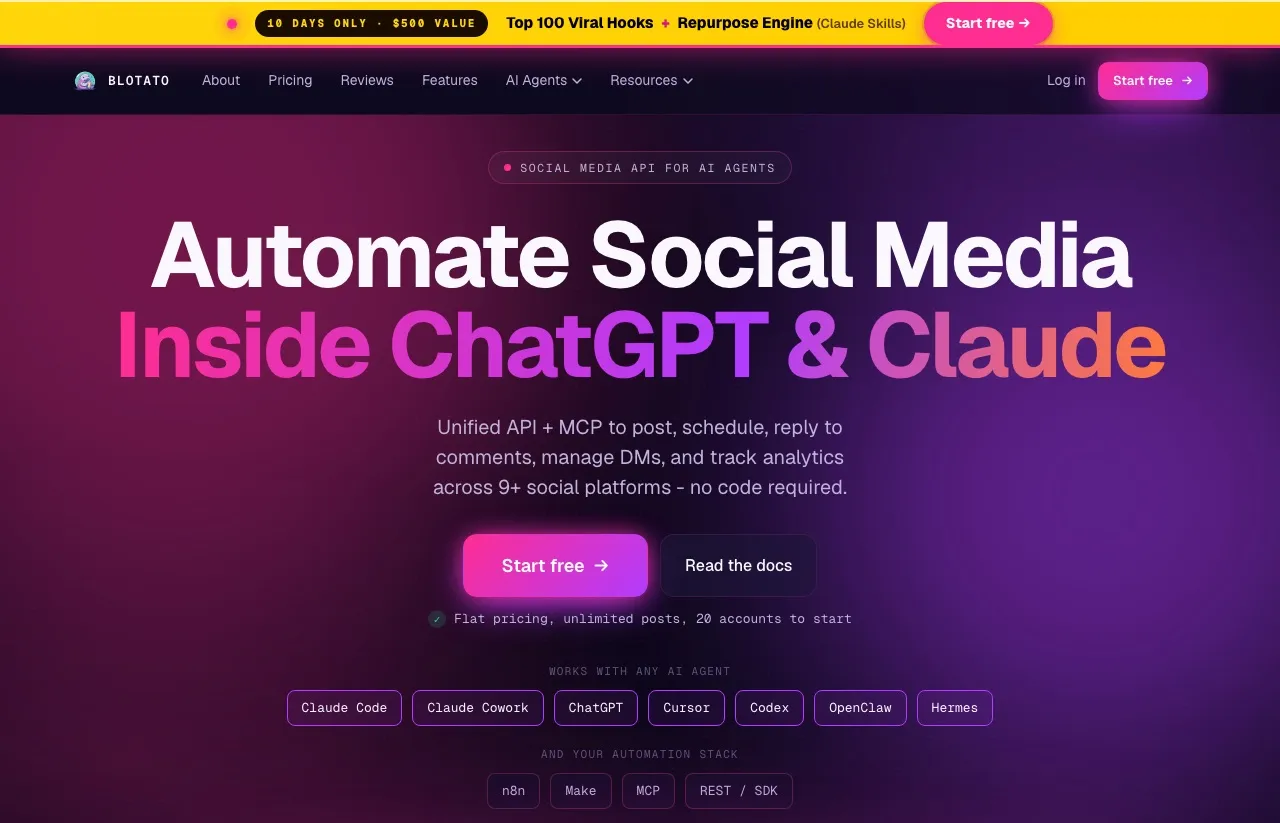
I built it for the case where the agent is doing more than delivery. You hand it a topic, it writes the post, generates the image or the faceless video, and publishes to nine platforms without a second vendor in the chain. Most of my highest-retention users are running it through Claude Code, Claude Desktop or Cowork rather than clicking around the web app.
The publishing call is asynchronous, which matters when you are writing the agent loop. blotato_create_post returns a postSubmissionId, and that is a receipt rather than proof. You poll blotato_get_post_status until it comes back published, which carries the publicUrl, or failed, which carries the errorMessage. One wrinkle worth knowing: the MCP tool reference also documents a scheduled state for posts queued to go out later, while the API reference lists only the first three. If you queue posts ahead, handle scheduled so a loop waiting on published alone does not spin forever.
Post Bridge vs Blotato: Side by Side
| Category | Post Bridge | Blotato |
|---|---|---|
| Pricing model | Flat rate by account count | Flat rate by account count |
| Free plan | No (7-day free trial, cancel anytime) | No (7-day free trial, cancel anytime) |
| Cheapest paid tier | $29/mo (Starter, 5 accounts) | $29/mo (Starter, 20 accounts) |
| Cheapest agent path | $29/mo MCP-only, or $39/mo + $5 API add-on = $44/mo | $29/mo (Starter) |
| Top tier | $99/mo (Pro, unlimited accounts) | $499/mo (Agency, 100 accounts) |
| Platforms | 9 by their headline count, though their own platform list enumerates 10 including Google Business | 9 |
| AI text writing | No | Yes (unlimited generation) |
| AI image generation | No | Yes (built in, uses AI credits) |
| AI video generation | No | Yes (faceless video plus ElevenLabs voiceovers) |
| Public REST API | Yes ($5/mo add-on) | Yes (included on all paid plans) |
| Hosted MCP server | Yes (included on every tier) | Yes |
| n8n / Make.com nodes | Not published | Native nodes for both |
| Analytics | Yes, labelled beta on every tier | Yes, 8 platforms |
| Comments and DMs | No | Instagram and Facebook |
| Trial on paid plans | 7 days | 7 days |
On the MCP row, both say yes, and that separates nothing. Plenty of tools in this category run one now. The row that moves a decision is AI generation, and it only matters if your agent needs it.
An Unlimited Tier With No Equivalent on Our Side
1. The unlimited tier has no equivalent on our side. Post Bridge Pro is $99 a month for unlimited connected accounts. Blotato Agency is $499 a month for 100. If you are running dozens of accounts and publishing finished assets, Post Bridge is dramatically cheaper and I am not going to argue otherwise.
2. MCP-only publishing costs the same as ours, and the REST path costs more. Its pricing page opens at $29 for Starter with MCP access included, which matches Blotato Starter exactly. The $5 REST API add-on is listed on Creator and above but not on Starter, so an agent that needs REST realistically starts at $39 plus $5. Its own agents page disagrees and markets Starter plus the add-on at $34, so the two surfaces do not match.
3. MCP is included at every tier, and the API is the add-on. That is an unusual split and it favors MCP users. A Claude Desktop user on the $29 Starter plan gets the MCP server without paying for REST access they would not call directly.
4. OAuth setup is genuinely easier. Claude connects with no API key: you authorize in the browser and Post Bridge registers the client automatically. Blotato’s MCP setup is competent but a token is a token.
5. It posts to Google Business, and Blotato does not. Its own platform list runs to ten destinations including Google Business, even though the headline count says nine. If you manage local business listings alongside social, that is a destination we cannot cover for you at any tier.
6. Support is a named human. “Human support from Jack” appears across the site, and for a solo operator that is worth more than a ticket queue.
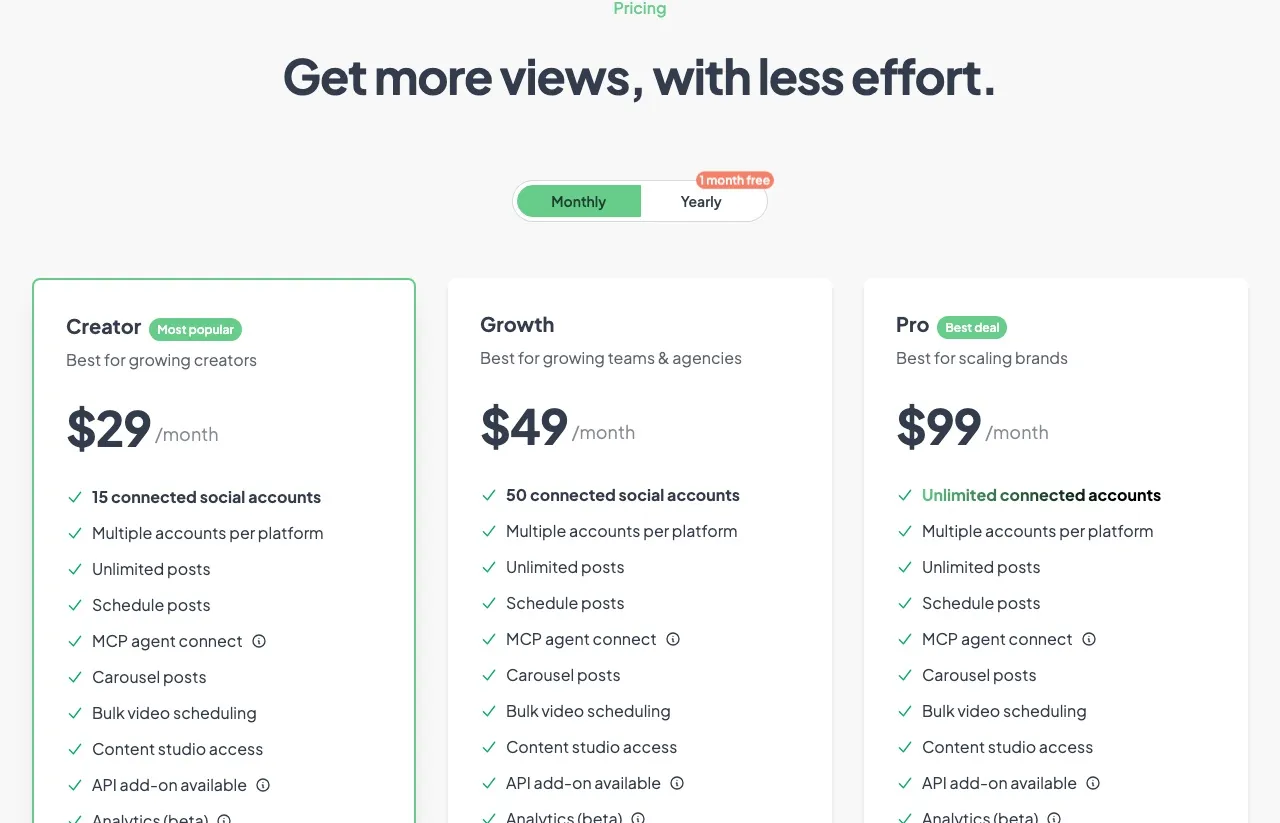
One caveat on that pricing screenshot, and it is their own label rather than my characterization: analytics reads “Analytics (beta)” on the three tiers that carry it, Creator, Growth and Pro, including the $99 plan. Starter does not list analytics at all. If reporting is load-bearing for you, test it during the trial rather than assuming it is finished.
Creation and Publishing Behind a Single Key
1. Against Post Bridge, creation and publishing sit behind one key. Your agent can generate an image, generate a faceless video, add an ElevenLabs voiceover, and publish the result without leaving the same surface. This is the whole comparison between these two tools: Post Bridge’s documented API covers publishing, scheduling, media upload and analytics, with no generation endpoint. If your agent needs to make the asset, it needs a second vendor. Other tools in this category do bundle AI generation, so this is a Post Bridge comparison rather than a claim about the whole market.
2. The agent can read and reply, not just broadcast. Blotato covers comments and DMs on Instagram and Facebook. Post Bridge’s documented surface is 17 endpoints across 13 paths, and it has no inbox, conversation or comment-reply endpoint. Its comment_count field is an analytics number, and its first_comment is a comment you post on your own post at publish time rather than a reply to a person.
3. Native n8n and Make nodes exist. If part of your stack is still no-code, Blotato ships official nodes for n8n and Make. Post Bridge does not publish equivalents.
4. API access is included rather than an add-on. Every paid Blotato plan includes full API access. On Post Bridge the REST API is $5 a month on top of the plan.
Two Live Price Lists and the $499 Gap
| Tier | Post Bridge | Blotato |
|---|---|---|
| Agent entry | $29/mo MCP-only (5 accounts); REST from $39 plus $5 | $29/mo (Starter, 20 accounts) |
| Entry | $29/mo (Starter, 5 accounts) | $29/mo (Starter, 20 accounts) |
| Mid | $59/mo (Growth, 50 accounts) | $97/mo (Creator, 40 accounts) |
| Top | $99/mo (Pro, unlimited accounts) | $499/mo (Agency, 100 accounts) |
| Trial | 7 days, cancel anytime | 7 days, cancel anytime |
Now the comparison that matters, at the tier most people actually start on:
| Capability at the entry tier | Post Bridge Starter ($29/mo) | Blotato Starter ($29/mo) |
|---|---|---|
| Social accounts | 5 | 20 |
| Publishing and scheduling | Yes | Yes |
| Hosted MCP server | Yes | Yes |
| REST API | Add-on not listed on this tier | Included |
| AI text writing | No | Unlimited |
| AI image generation | No | Included (uses credits) |
| AI faceless video | No | Included (uses credits) |
| Comments and DMs | No | Instagram and Facebook |
| Analytics | Not listed on Starter | Yes (8 platforms) |
Same $29 sticker, though the packages differ: that $29 buys 5 connected accounts there and 20 here. If you want REST API access on Post Bridge, the add-on is not offered on Starter, so the comparable figure is $39 plus $5. Either way the difference is not the publishing. It is whether the thing you publish can be made behind the same key. For the full breakdown of both Post Bridge rate cards and what each tier costs at real account counts, see Post Bridge pricing.
Four honest caveats, because this table flatters Blotato and your situation may not:
If you publish assets built elsewhere, every AI row above is dead weight you are paying for. A video team with an existing render pipeline gets nothing from Blotato’s generation surface.
If you run more than 100 accounts, Blotato has no answer at all. Post Bridge Pro is unlimited at $99 and Agency caps at 100 for $499.
If you only want MCP and never plan to call the REST API, Post Bridge’s $29 Starter matches Blotato’s entry price, so the question becomes account count and what else is in the box.
If Google Business is one of your destinations, Post Bridge posts there and Blotato does not, and no amount of AI generation makes up for a channel you cannot publish to.
And if your agent needs to reply to comments on LinkedIn, X or TikTok, neither of these tools covers it. Blotato’s engagement surface is Instagram and Facebook only.
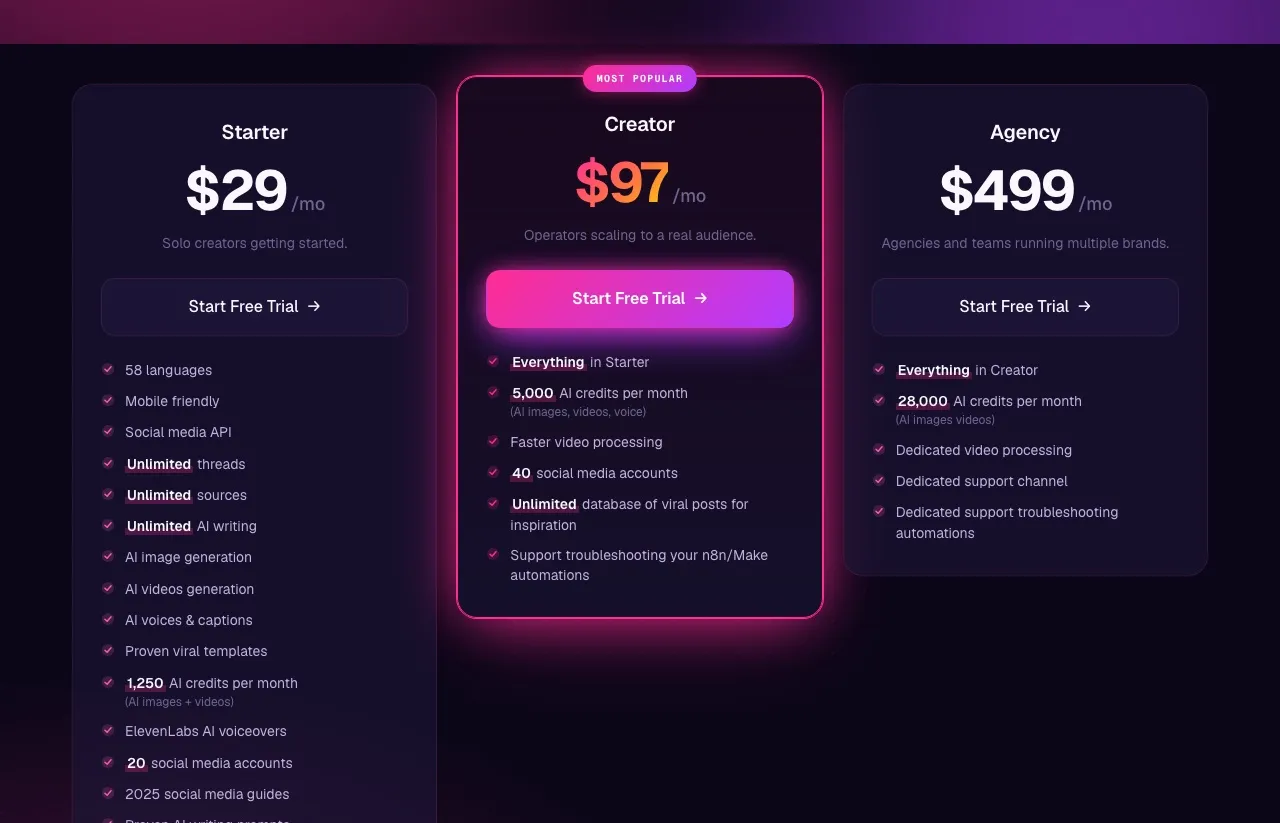
One note on credits, since they only apply to one side of this comparison. Blotato credits are spent on AI image and video generation and nothing else. Publishing, scheduling, API calls and ElevenLabs voiceovers do not consume them, and unused credits roll over month to month. The credit allowance attached to each plan is what decides how much generation you get before you buy more.
Post Bridge Suits Finished Media at Scale
- Your agent publishes finished media it got from somewhere else.
- You are running more accounts than Blotato Agency’s 100.
- You publish to 5 accounts or fewer and want MCP-only publishing without the AI generation.
- You would rather connect Claude over OAuth than manage an API token.
- Your budget ceiling is firm and $99 unlimited is the deciding number.
Does the Asset Exist Yet?
- Your agent starts from an idea or a script rather than a finished file.
- You want image and video generation behind the same key that publishes.
- You need your agent to read and reply to Instagram or Facebook comments and DMs.
- Part of your stack still runs in n8n or Make.
- You want REST API access included rather than billed as an add-on.
Finished Assets? Post Bridge Is the Better Buy.
If your pipeline already ends with a finished asset, Post Bridge is the better buy and the unlimited tier is genuinely hard to argue with. I would rather tell you that than pretend the $499 gap does not exist.
Where I think Blotato earns the money is the case where publishing was never the hard part. Making the thing was. If your agent has to produce the image or the video before it can post, doing that behind two vendors and two bills is worse than doing it behind one.
One caveat if you are an API or MCP reader. The Blotato trial excludes the API, and generating a key immediately ends the trial and starts the paid Starter plan, so plan on starting the subscription rather than trialing it.
Blotato vs Post Bridge FAQs
Can an AI agent generate images with Post Bridge?
No. Post Bridge’s documented API covers posts, scheduling, media upload, social accounts and analytics. Media has to be created somewhere else and uploaded. Blotato generates AI images and faceless videos through the same API that publishes them, which is the main difference between the two tools at the same $29 entry price.
Is Post Bridge cheaper than Blotato?
Usually yes, and at the top tier it is not close. Post Bridge runs $29, $39, $59 and $99, with the $99 Pro tier covering unlimited connected accounts. Blotato runs $29, $97 and $499, with Agency capped at 100 accounts. Post Bridge’s Starter is $29 with MCP included, and its $5 REST API add-on starts on Creator.
Which one should I use with Claude Code?
Both work. Both run hosted MCP servers and both are auth-gated, so “works with Claude” does not separate them. Choose on what your agent hands the API: Post Bridge if it already has the finished media, Blotato if it needs to generate the image or video first.
Does Blotato or Post Bridge handle DMs?
Blotato reads and replies to comments and DMs on Instagram and Facebook only. Post Bridge has no inbox, conversation or comment-reply endpoint in its documented API, so it does not handle either. Neither tool covers DMs on LinkedIn, X or TikTok, so check the platform you actually need before committing.
How many social accounts does each tool support?
Post Bridge gives you 5 accounts at $29, 15 at $39, 50 at $59, and unlimited at $99. Blotato gives you 20 at $29, 40 at $97, and 100 at $499. If account count is your binding constraint rather than content creation, Post Bridge scales further for much less money.
Do Blotato credits get used up by publishing?
No. Blotato credits are spent only on AI image and video generation. Scheduling, publishing, API calls and ElevenLabs voiceovers do not consume credits, and unused credits roll over each month. The free trial grants 60 credits, which is enough to test generation quality but not to run a month of production volume.