Blotato vs SocialClaw: Which Social Media API Meters Your Posts?
Blotato vs SocialClaw: two social media APIs for AI agents, compared on post metering, where the prices cross, and which one reaches an inbox.

Blotato vs SocialClaw comes down to one number neither pricing page puts in the headline: how many posts you are allowed to publish. SocialClaw counts them. Blotato does not.
There is a second thing neither page mentions, and it is worth reading before the prices. SocialClaw’s two developer surfaces do not agree with each other about whether your agent can touch an inbox: its MCP server ships Instagram comment and DM tools, its REST contract has none at all, and I probed both on September 4, 2026 to be sure. That one is settled first because it can end the comparison outright.
None of that means SocialClaw is a thin product. The same probe returned 32 MCP tools covering the whole publishing lifecycle, and its agent story is not a landing page. I built Blotato, so hold what follows to the sources it cites rather than to my say-so.
Blotato vs SocialClaw: At a Glance
SocialClaw is the better pick if your posting volume is predictable and modest, you publish to Discord, Telegram, Reddit or WordPress, and the inbox caveat below does not bite you.
Blotato is the better pick if volume is the thing you cannot predict, or the agent’s job continues after the post goes out, because one key covers publishing on 9 social media platforms, analytics on 8 of them, and the Instagram and Facebook inbox on a flat monthly plan.
The Two SocialClaw Surfaces That Disagree
Start here, because it is the one thing you cannot read off either pricing page.
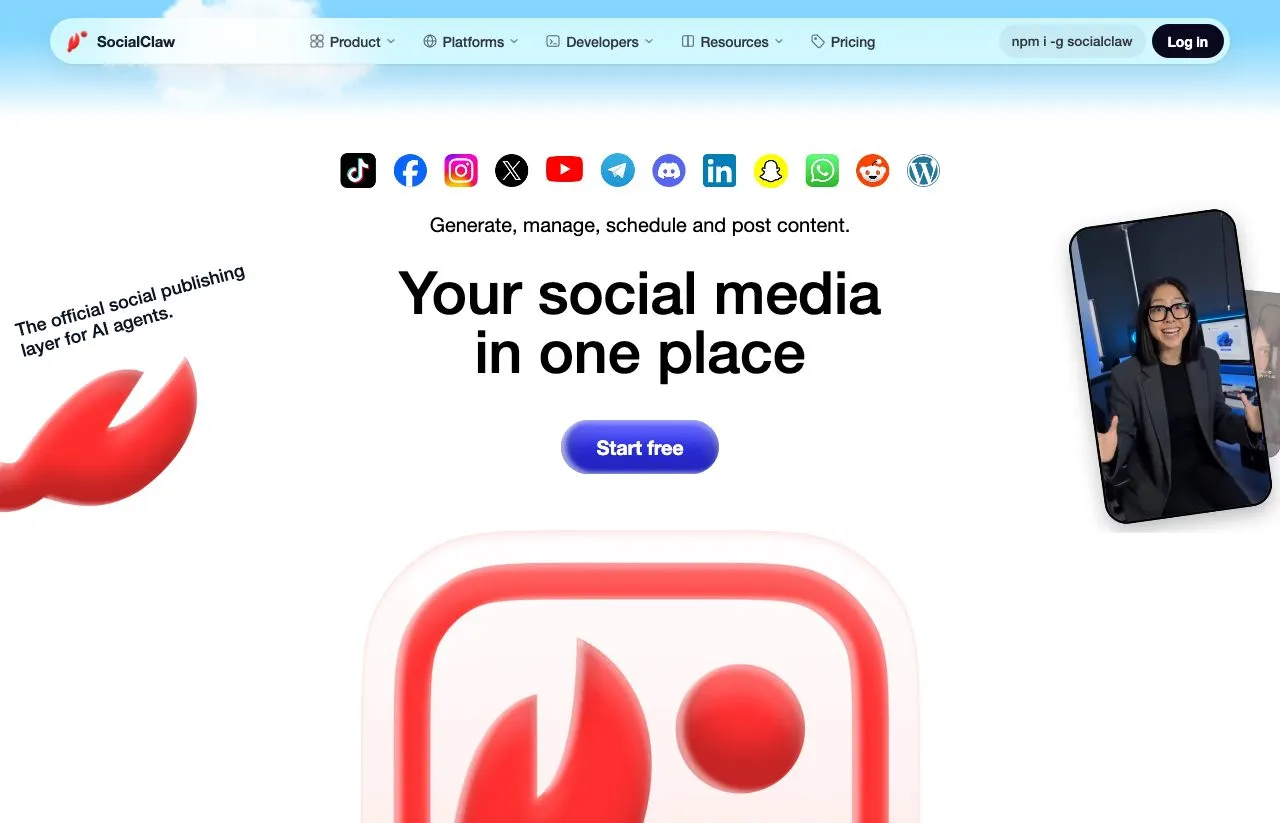
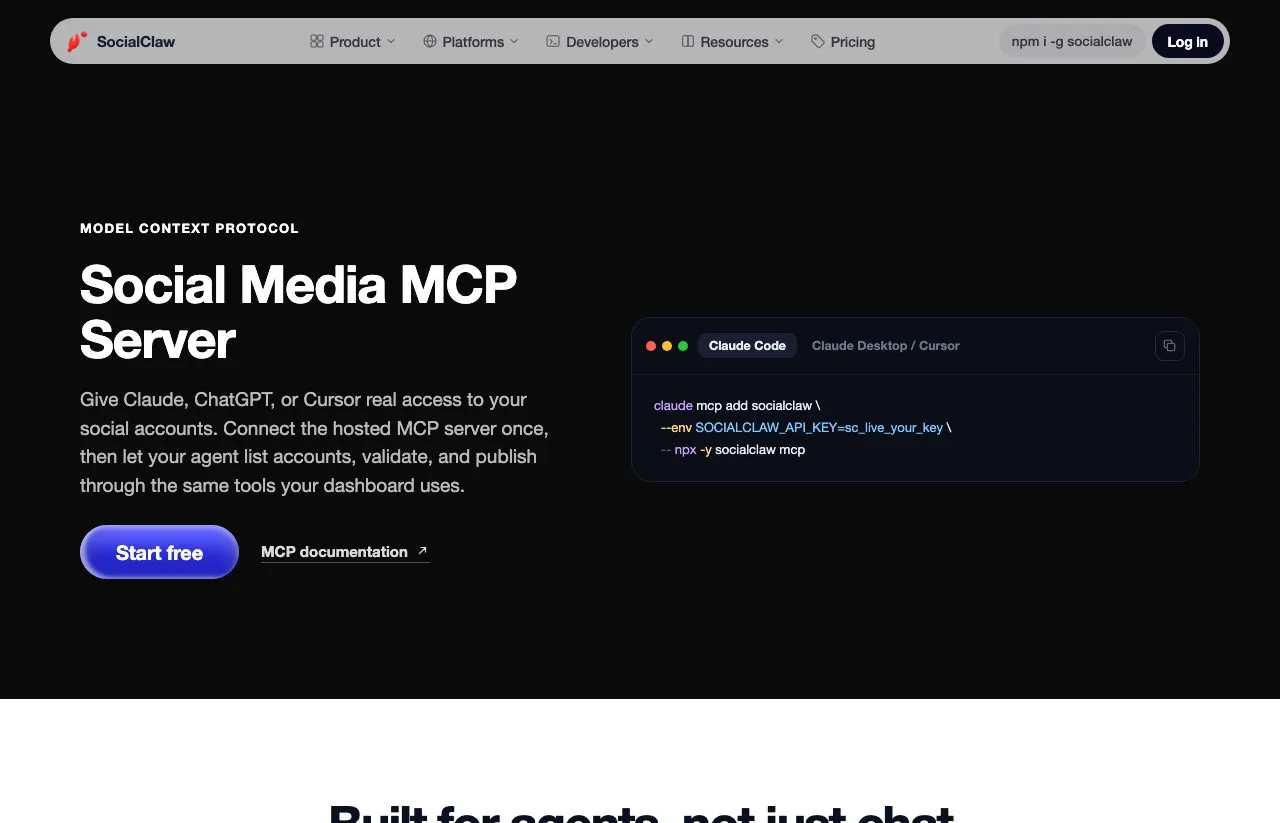
SocialClaw’s REST contract and its MCP server do not expose the same product, so check which one you are building against. Its REST contract has no engagement paths at all, and I pulled its OpenAPI document on September 4, 2026 to confirm that none of its 84 paths match comment, conversation or message. Its MCP server does have them. A live tools/list against its MCP server the same day returned 32 tools including get_instagram_comments, reply_instagram_comment and send_instagram_message.
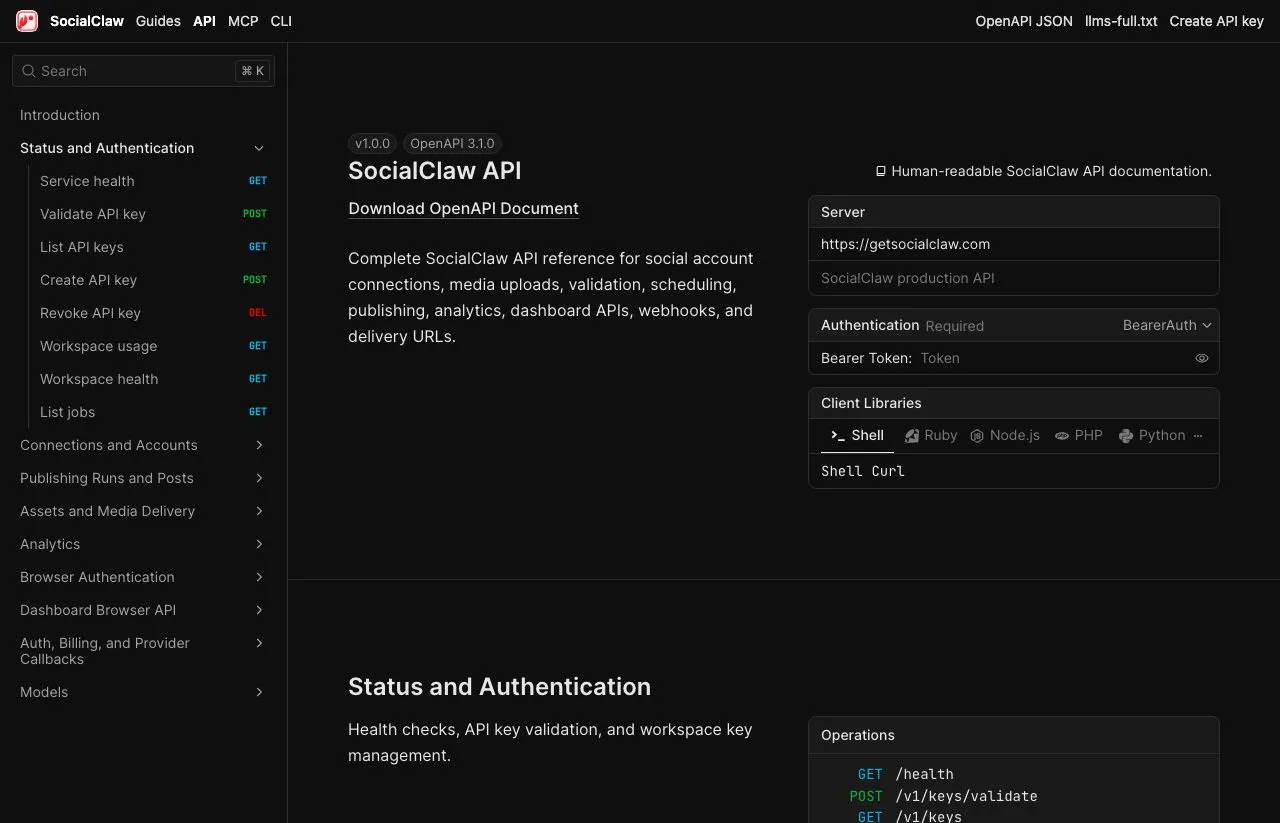
An agent on MCP can therefore work an Instagram inbox while the same agent on REST cannot, and it is Instagram only either way. Analytics pulls native stats for Instagram, TikTok, YouTube, Reddit, X, Pinterest and Snapchat, and the docs say other providers return an unsupported snapshot with the metric fields null.
Blotato’s key also reads and posts comments, and lists and sends direct messages, on Instagram and Facebook. Analytics covers 8 of the 9 platforms, with LinkedIn as the stated exclusion because it returns no metrics yet.
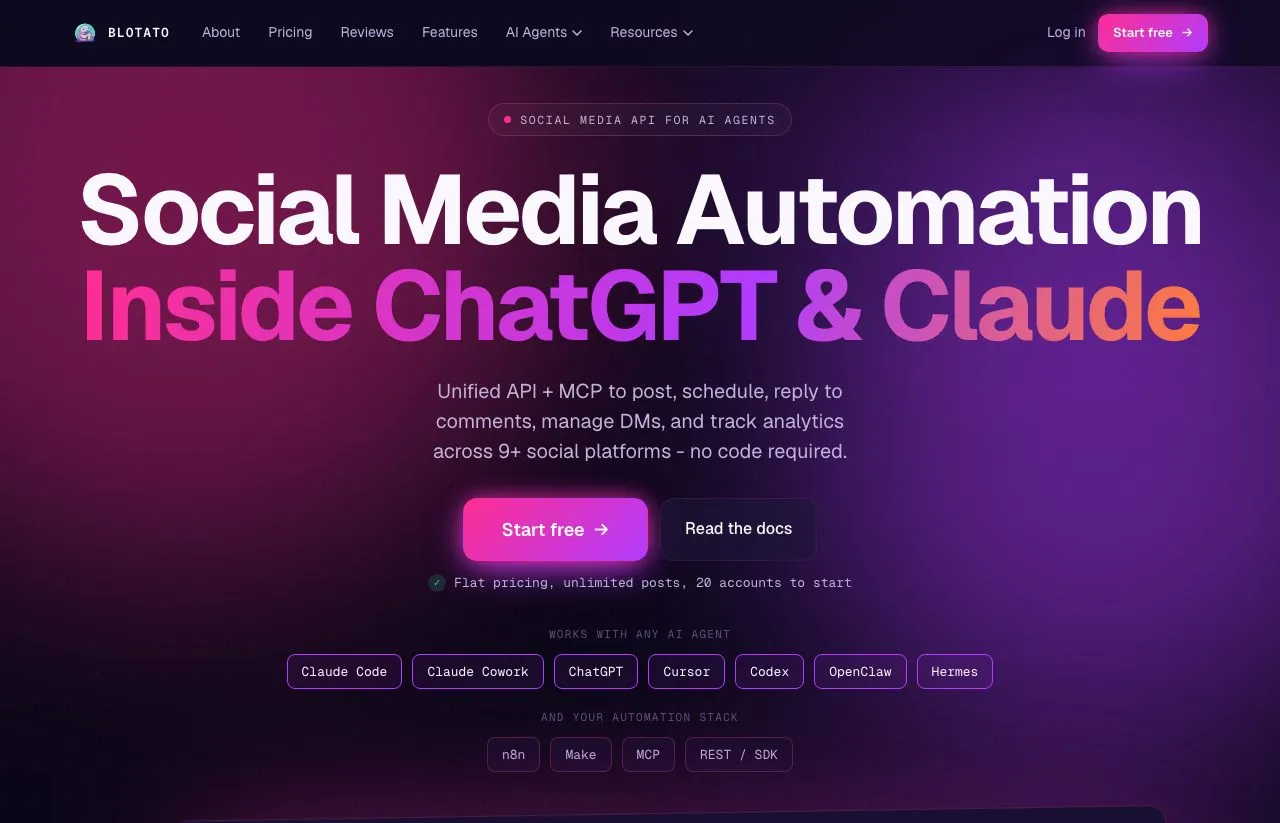
Whether that matters depends on the job. An agent that turns a newsletter into twelve scheduled posts never opens an inbox, and paying for one is waste.
An agent meant to run an account is fine on SocialClaw while that account is on Instagram and connected over MCP. Add a Facebook Page, or build against REST, and the inbox work needs a second vendor. Our guide to social media APIs versus MCP servers covers how that choice plays out beyond these two tools.
One Bill Tracks Your Volume, the Other Ignores It
SocialClaw prices on two axes at once. Starter is $15 a month for 3 connected accounts and 200 posts. Startup is $29 for 6 accounts and 400 posts.
Plus is $67 for 20 accounts and 1,000 posts, and Pro is $99 for 50 accounts and 2,500 posts. Those figures come from the rendered pricing page with the Monthly toggle active.
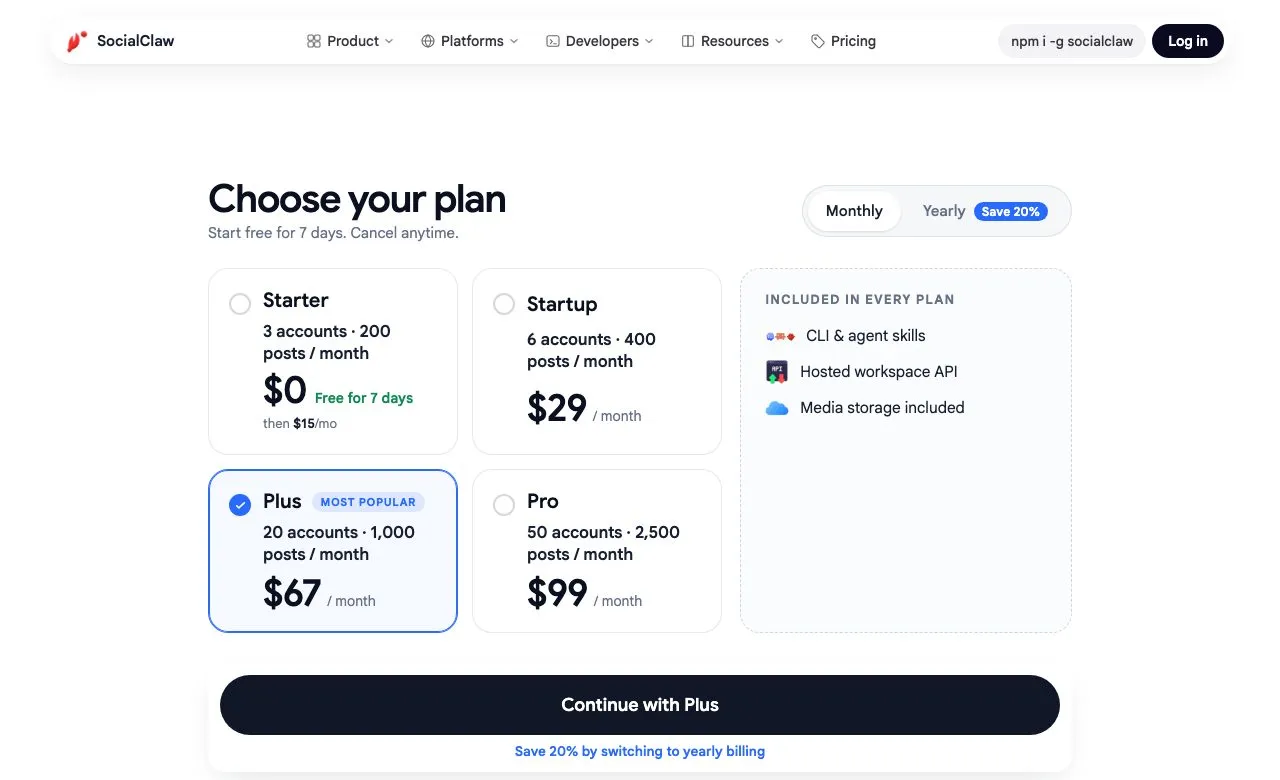
Check the Yearly view yourself before budgeting on it, because the page argues with itself. The banner offers a flat 20% for paying annually. The tiers it renders are $10, $19, $49 and $80, which are discounts of 33, 34, 27 and 19 percent against the monthly prices. Three tiers beat the advertised 20 percent and Pro quietly falls under it, so take the number off the tier you are actually buying rather than off the banner.
Blotato bills on one axis. Starter is $29 a month for 20 connected accounts, Creator $97 for 40, and Agency $499 for 100. The pricing page states it plainly: no per-post fees. Publish 40 posts this month or 4,000, and the invoice is identical.
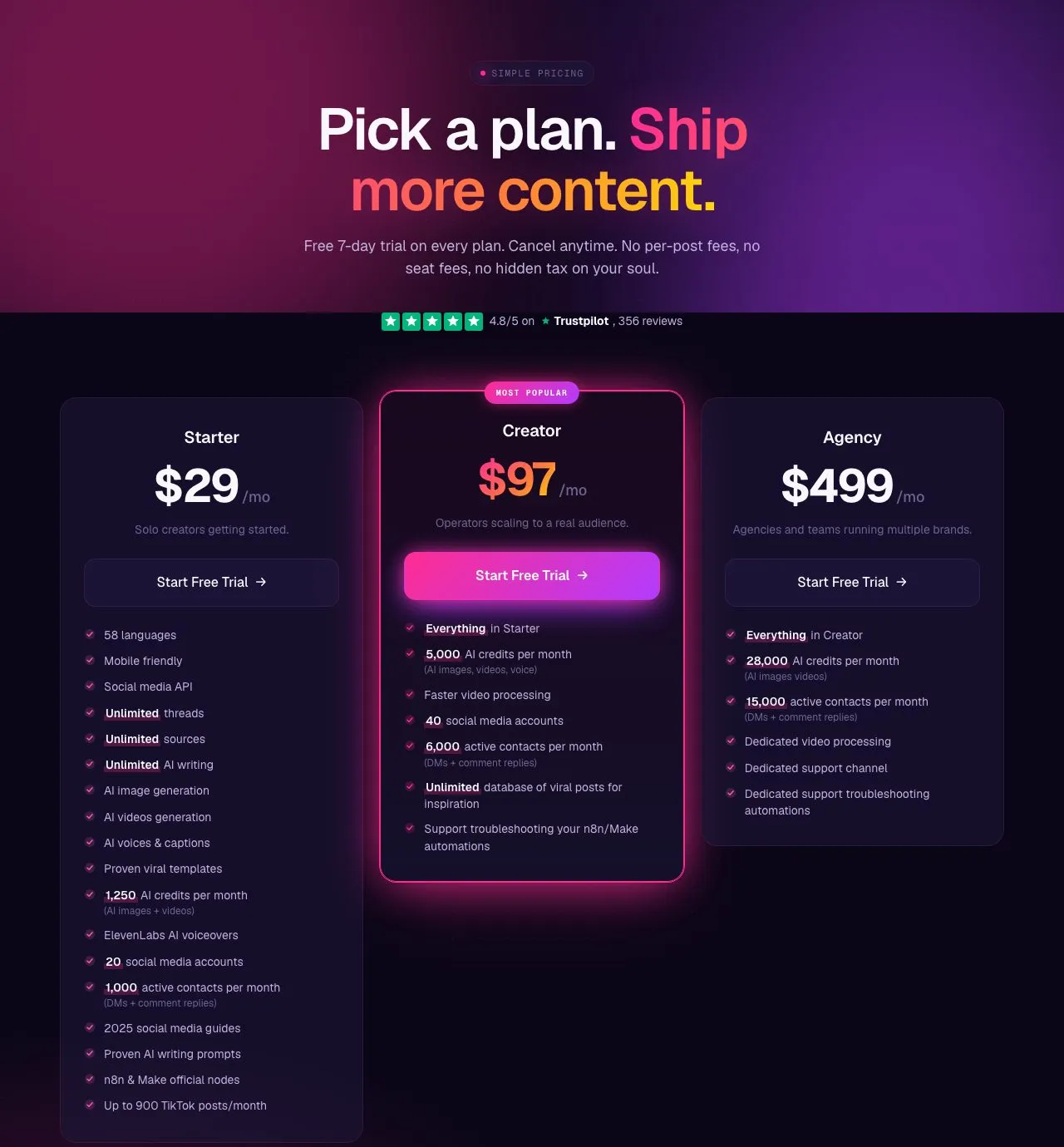
That cuts both ways. A two-axis meter is cheaper when you sit comfortably inside both numbers, and a one-axis meter is cheaper the moment one of them is volatile. Which is why the next number to work out is where the two cross.
Where the Two Meters Cross
Compare at equal account counts rather than equal prices, because that is the number both vendors charge for.
Twenty connected accounts costs $67 on SocialClaw Plus and $29 on Blotato Starter. That is $38 a month, or $456 a year, for the same connection count, and Blotato’s figure carries no post ceiling while SocialClaw’s stops at 1,000.
Below that the picture reverses. Three accounts is $15 on SocialClaw and $29 on Blotato, a little over half our price. Six accounts is $29 against $29, a genuine tie. SocialClaw is the cheaper tool for a small, countable footprint, and pretending otherwise would be easy to disprove with two browser tabs.
The post cap is the part worth arithmetic. Two hundred posts a month is between 6.5 and 6.7 a day depending on the month’s length. Six accounts posting once daily lands between 180 and 186 on the same basis, which clears Starter’s 200 with almost nothing spare. A seventh account puts you at 210 to 217, so the plan breaks on posts before it breaks on connections, and it breaks in the longer months first.
Separately, a pipeline that turns one video into five platform-specific posts five days a week runs about 108 a month. Either shape fits alone. Run both on the same workspace and you are over the cap.
Blotato vs SocialClaw: Side by Side
| SocialClaw | Blotato | |
|---|---|---|
| What is metered | Connected accounts and posts per month | Connected accounts only |
| Entry price (monthly) | $15 (3 accounts, 200 posts) | $29 (20 accounts, no post cap) |
| Cost at 20 accounts | $67 (Plus, 1,000 posts) | $29 (Starter) |
| Top published tier | $99 (50 accounts, 2,500 posts) | $499 (Agency) |
| Publishing destinations | Wider, and adds Discord, Telegram, Reddit and WordPress | 9 platforms |
| Analytics | 7 networks natively, others return null metrics | 8 of 9 platforms, LinkedIn excluded |
| Comments and DMs | Instagram only, and only over MCP | Instagram and Facebook, REST and MCP |
| Hosted MCP server | Yes, no self-hosting | Yes, no self-hosting |
| API on the cheapest plan | Yes, and during the trial | Paid plans only, not in the trial |
How Each One Proves a Post Went Out
Both publish asynchronously, so neither hands your agent certainty for free. They differ in how many steps they make it take.
SocialClaw stages it. An agent calls POST /v1/posts/validate, which the API reference describes as validating a schedule without creating a run, then POST /v1/posts/apply with an idempotencyKey so a retry cannot duplicate it, then reads GET /v1/runs/{runId}/status and GET /v1/posts/{postId}/attempts, with POST /v1/posts/{postId}/retry to requeue a failure. The MCP tool names mirror it: validate_schedule, apply_schedule, run_status.
Blotato collapses the same work. POST /posts returns a postSubmissionId, which is a submission receipt rather than proof, and the agent polls GET /posts/:postSubmissionId until the status is terminal. Fewer calls to wire, same underlying truth at the end.
The honest gap is ours: if you want a dry run before anything is created, our API has no equivalent of that validate call. SocialClaw also exposes GET /v1/me/usage for entitlement consumption, which it needs precisely because it caps posts and we do not.
Either way, an agent that treats a submission receipt as a promise will log a clean success for a post the platform silently rejected. If you are weighing the wider field rather than these two, our roundup of SocialClaw alternatives covers it.
Where SocialClaw Reaches Further
Two places, and both are real.
It publishes to networks we do not touch. Discord, Telegram, Reddit and WordPress are all documented SocialClaw destinations, and none of them are Blotato destinations. Our own API reference states that its list of 9 is exhaustive and that Blotato does not publish outside it, so if your posting includes a Discord webhook or a WordPress blog, this is settled before price enters the conversation.
It also puts the API on every plan, including inside the trial, alongside the CLI and the hosted workspace API. Blotato’s trial explicitly excludes the API, and generating a key ends the trial and starts the Starter subscription, so a builder who wants to write code before paying cannot do that on our side and can on theirs. That is our restriction rather than their feature, and it is the one I would most like to change.
The Two Places Blotato Will Bite You
Ours are less elegant than a quota, because they are not one kind of thing.
The write rate limit is the operational one, and it is the reason “one axis” describes the invoice rather than the throughput. POST /posts accepts 30 requests a minute, and the read endpoints allow 60. This is a real ceiling for the reader this post is written for, because an agent flushing a backlog does not pace itself the way a person would, and a burst that would take a human all afternoon arrives in seconds. Build the pacing into the queue rather than discovering the limit in production.
The entry price is the commercial one. At three connected accounts Blotato costs $29 against SocialClaw’s $15, and no amount of unmetered posting fixes that if three accounts is genuinely all you run. The flat plan is a bet that your account count or your volume will grow. If neither will, you are paying for optionality you do not need.
What $29 Buys on Each Side
The entry tiers are not comparable head-on, because SocialClaw’s cheapest plan is $15 and Blotato’s is $29. Line them up at the same spend instead.
| At roughly $29 a month | SocialClaw Startup ($29) | Blotato Starter ($29) |
|---|---|---|
| Connected accounts | 6 | 20 |
| Posts per month | 400 | No cap |
| REST API and hosted MCP | Included | Included |
| Comments and DMs | Instagram, MCP only | Instagram and Facebook, REST and MCP |
| Analytics | 7 networks | 8 of 9 platforms |
| Publishes to Discord, Telegram, Reddit, WordPress | Yes | No |
At the same $29, Blotato covers 20 accounts to SocialClaw’s 6 and drops the post ceiling. SocialClaw reaches four destinations we do not. Both sides also market in-app AI creation, so I have left it out of the table rather than score it, because neither vendor’s plan cards spell out what you actually get at a given tier.
Pick SocialClaw If
- Your posting runs to a predictable monthly number you are comfortable capping.
- You publish to Discord, Telegram, Reddit or WordPress, which Blotato does not reach.
- You run six or fewer connected accounts, where its entry price is genuinely lower.
- You want to write code against the API before paying for a subscription.
- You want a validate call that dry-runs a schedule before anything is created.
Pick Blotato If
- Your posting volume moves, or you cannot predict it month to month.
- You connect ten or more accounts, where the flat plan pulls ahead.
- Your agent answers comments or DMs, and Facebook is in scope as well as Instagram.
- You want analytics across 8 of the 9 platforms behind the same key.
- You want AI writing, images and video generation behind the same key, on a flat plan where only the generation draws on a credit allowance.
Which One Should Your Agent Use?
Take the disqualifying question first. If your agent needs Facebook DMs, or reaches the inbox over REST rather than MCP, only Blotato does that and the pricing is academic. Same in reverse for Discord and WordPress.
If nothing disqualifies either, it comes down to the meter, and the honest answer is that Blotato is the wrong purchase below six accounts with a post count you can name. You would be paying $29 for headroom you will not use.
The tie-breaker is what breaks first. On SocialClaw it is a quota, which is cheap to plan for once you know the number. On Blotato it is a platform gap, which is not. Pick the failure you would rather have, and if that is us, note the Starter plan excludes the API from its trial, so plan on subscribing rather than trialing.
Blotato vs SocialClaw FAQs
Does SocialClaw limit how many posts I can publish?
Yes. SocialClaw meters posts as well as connected accounts, and the caps are on the pricing page: 200 posts a month on the $15 Starter, 400 on the $29 Startup, 1,000 on the $67 Plus, and 2,500 on the $99 Pro. Blotato does not count posts at all, and its pricing page says so in those words. If your volume is steady, the cap is a non-event. If it spikes, it is the whole story.
Do Blotato and SocialClaw both have an MCP server?
Both do, both are hosted, and neither asks you to self-host, so this is not a difference you can decide on. SocialClaw’s is at getsocialclaw.com/mcp and Blotato’s is at mcp.blotato.com/mcp. Tool counts differ, but a tool count is not a capability list, and the thing worth comparing is what those tools can reach: publishing for both, plus comments, DMs and wider analytics on one of them.
Can my agent reply to comments or DMs through SocialClaw?
Only over MCP, and only on Instagram. A live tools/list against getsocialclaw.com/mcp on September 4, 2026 returned engagement tools including get_instagram_comments, reply_instagram_comment and send_instagram_message, while its REST contract at openapi.json has no comment, conversation or message paths at all. Blotato exposes comments and direct messages on both Instagram and Facebook, through the REST API and MCP alike. If your inbox work is on TikTok or LinkedIn, neither tool reaches it today.
Which is cheaper, Blotato or SocialClaw?
It inverts partway up the range, and you have to check two numbers on SocialClaw’s side rather than one. At three accounts SocialClaw is $15 against Blotato’s $29. At six they are both $29. At twenty, SocialClaw is $67 against Blotato’s $29, a $456 difference over a year for the same connection count. Then check your monthly post volume against that tier’s cap, because a plan that looks cheaper on accounts can still be the wrong tier on posts.
How does each one tell my agent a post actually went out?
Both make the agent check, in different shapes. SocialClaw stages it: validate the schedule, apply it to create a run, then read run status and per-post attempts, with a retry endpoint for failures. Blotato returns a postSubmissionId from POST /posts and expects the agent to poll GET /posts/:postSubmissionId until the status is terminal. Neither one treats the accepted request as proof, and an agent that does will misreport on either tool.
Can I test either API before paying?
On SocialClaw, yes. The hosted workspace API, the CLI and the agent skills are listed as included in every plan, and the Starter plan opens with a 7-day free trial. On Blotato the trial covers all features except the API, and generating an API key ends the trial and starts the Starter subscription, so plan on subscribing rather than trialing if the API is what you came for.