Blotato vs Typefully: Which Social Media API Reaches Further?
Blotato vs Typefully compared on social media platform reach, API and MCP surface, analytics coverage, and which one an agent-run posting workflow needs.
Blotato vs Typefully looks like a feature fight and is really a question about who is holding the keyboard. Typefully is built for a person writing. Blotato is built for an agent working.
Both ship a real API. Both ship a hosted MCP server. I probed Typefully’s on September 1, 2026 and it answered exactly the way a healthy server should, so nothing here depends on pretending its agent story is weak.
It is not weak. It is pointed somewhere else.
Blotato vs Typefully: At a Glance
Typefully is the better pick if the writing itself is the hard part and your publishing lives on X plus a few text networks, because its composer and thread preview are genuinely better than ours at that job and $99 for a year is cheap for a tool you open every morning.
Blotato is the better pick if an agent is doing the posting rather than a person, and the work touches video destinations or needs reporting afterward, because one key covers publishing on 9 social media platforms and analytics on 8 of them from a flat monthly plan rather than a bill that grows with each set of accounts you add.
The Fork: Who Is Doing the Typing
Most comparisons in this category argue about feature counts. This one has a cleaner split, and once you see it the rest of the post is just arithmetic.
Typefully is a desk. You sit at it. You draft a thread, you watch the preview render the way a reader will actually see it, you move it into the queue. Every good decision in that product assumes a human is present and cares about the sentence.
Blotato is infrastructure. There is a web app, but the API and MCP surface does not assume a person is watching. An agent authenticates, lists accounts, pushes a post, reads back what happened, and does that at three in the morning without a composer ever being opened. Blotato is an app I built, so weigh my read on it accordingly, and hold the rest of this post to the sources it cites rather than to my say-so.
Neither of those is a better idea in the abstract. They stop being interchangeable the moment you know which one describes your week.
What Typefully’s Composer Does Better Than Ours
Typefully’s editor is better than Blotato’s at drafting for X. The thread preview is accurate rather than approximate, the interface stays quiet while you write, and the whole flow is shaped around getting a good post out of a person. Blotato is not trying to win that comparison and I would not claim it does.
Their pricing page describes the product as being for individual writers and creators serious about their content, and after years of them sharpening that one surface, the description reads as accurate rather than as marketing. Third-party review coverage is thin on both sides here, so judge either tool on its docs and a real trial run rather than on aggregate sentiment.
Both Ship a Real MCP Server, So That Is Not the Difference
Plenty of comparison pages will tell you Typefully has no agent story. That is wrong today, and it is worth settling before anything else.
Typefully runs a hosted MCP server. A JSON-RPC initialize against it returns a 401 with an OAuth challenge, which is what a live server does, and a nonsense subdomain on the same domain returns nothing at all, so that response is real rather than a wildcard artifact.
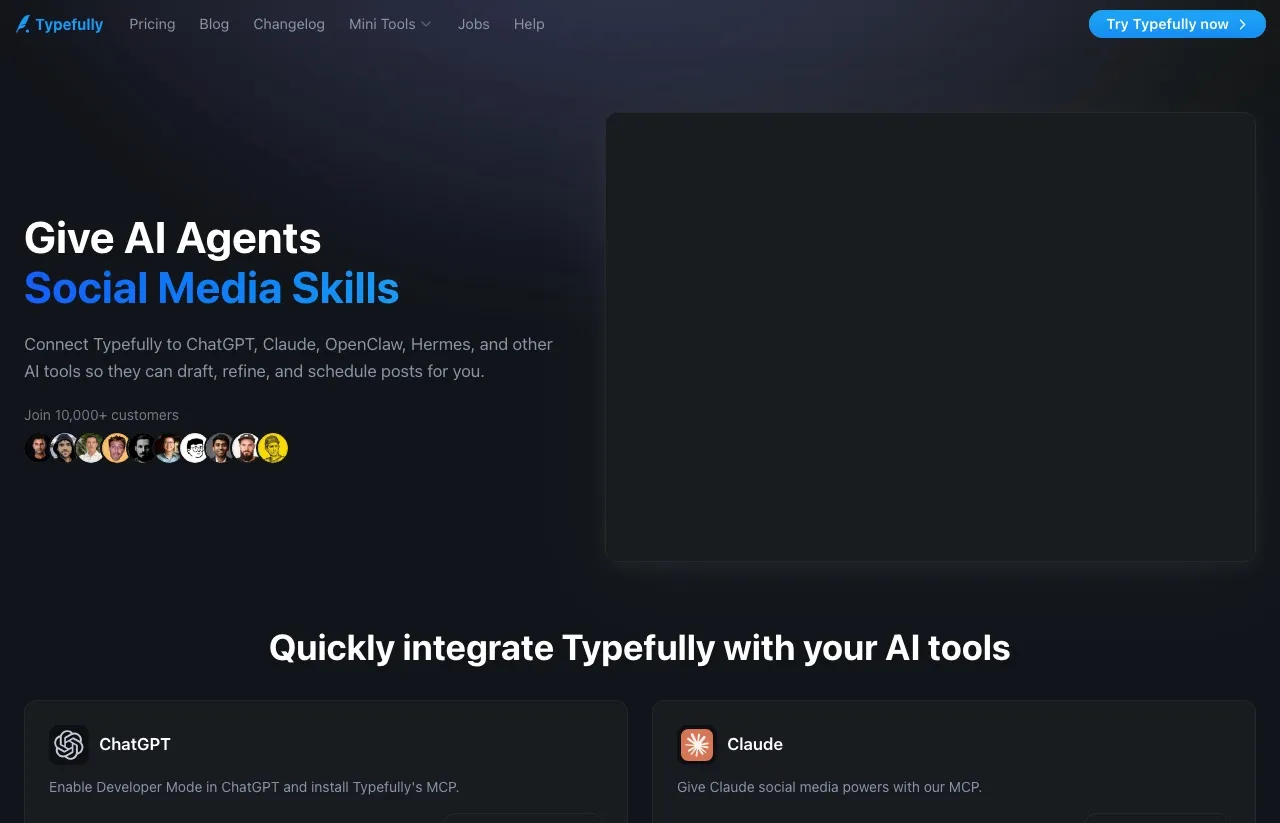
Its AI agents page names ChatGPT, Claude, Notion, Codex, Claude Code, Cursor, OpenClaw and Hermes, offers OAuth or a bearer token, and points at an open-source agent-skills repository published under MIT. “Agents, API, MCP” sits on their Free plan card.
That is a considered implementation, not a checkbox. So MCP presence decides nothing here, and any post telling you otherwise has not run the probe. Most serious tools in this category now run one, which is why I judge them on what each server can actually publish rather than on whether it exists. Connecting an agent and reading data is cheaper on their side than ours, because their Free plan allows it and our trial excludes the API, though publishing through their API returns a 402 until you are on a paid plan, so the free part stops exactly where the useful part starts.
What differs is what the key reaches once the agent is connected, and how far the vendor intends you to take it.
Typefully vs Blotato: Side by Side
| Category | Typefully | Blotato |
|---|---|---|
| Pricing model | Per social set | Flat rate per plan |
| Free plan | Yes, 1 social set, 10 posts a month | No, 7-day trial, cancel anytime |
| Cheapest paid tier | $99 a year, annual billing only | $29/mo flat, 20 accounts |
| Publishing platforms | 5 on the pricing table | 9 |
| Video destinations | No TikTok or YouTube | TikTok and YouTube included |
| Public REST API | Yes, v2 with an OpenAPI spec | Yes, on paid plans |
| Hosted MCP server | Yes, OAuth or bearer token | Yes, OAuth or API key header |
| Documented MCP tool count | Not published | 35 |
| Documented agent clients | 8 named | 18 named |
| Analytics | X only, per their own API spec | 8 of 9 platforms |
| Comments on published posts | Not in the API | Instagram and Facebook |
| DMs and inbox | Not in the API | Instagram and Facebook |
| AI image and video generation | No | Yes, uses credits |
| n8n / Make.com nodes | Not published | Native nodes for both |
| Monthly publishing cap | 10 free, 1,000 Creator, 1,500 Business | No per-post fee, but per-platform daily caps apply |
Two rows carry most of the decision. The platform row decides whether your content can even land, and the analytics row decides whether anything comes back.
Where the Agent Surface Actually Diverges
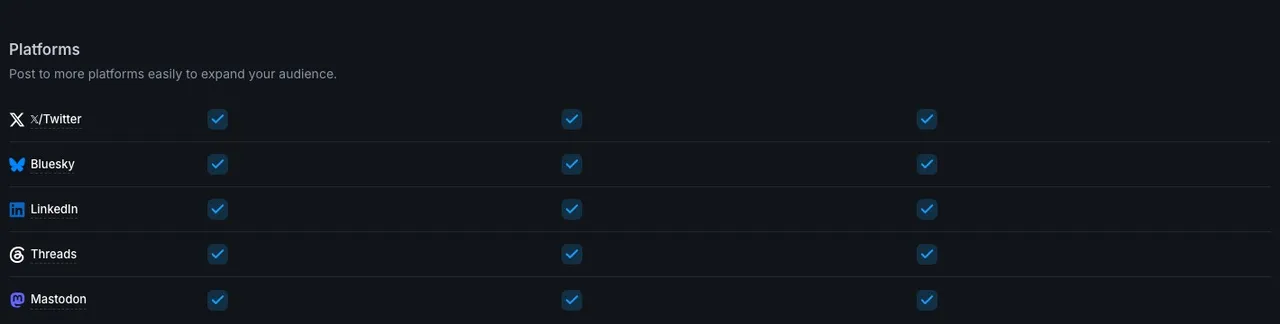
Typefully’s own agent documentation says an agent can “schedule or publish content across X, LinkedIn, Threads, Bluesky, and Mastodon.” Their help center adds Substack Notes. Their pricing comparison table lists exactly five platform rows and neither TikTok nor YouTube appears on any of them.
Blotato’s API reference states its publish list and then closes the door on ambiguity: “This list is exhaustive for the Blotato web app, API, MCP, and Cowork. Blotato does not publish to platforms outside this list.” Nine platforms, video included.
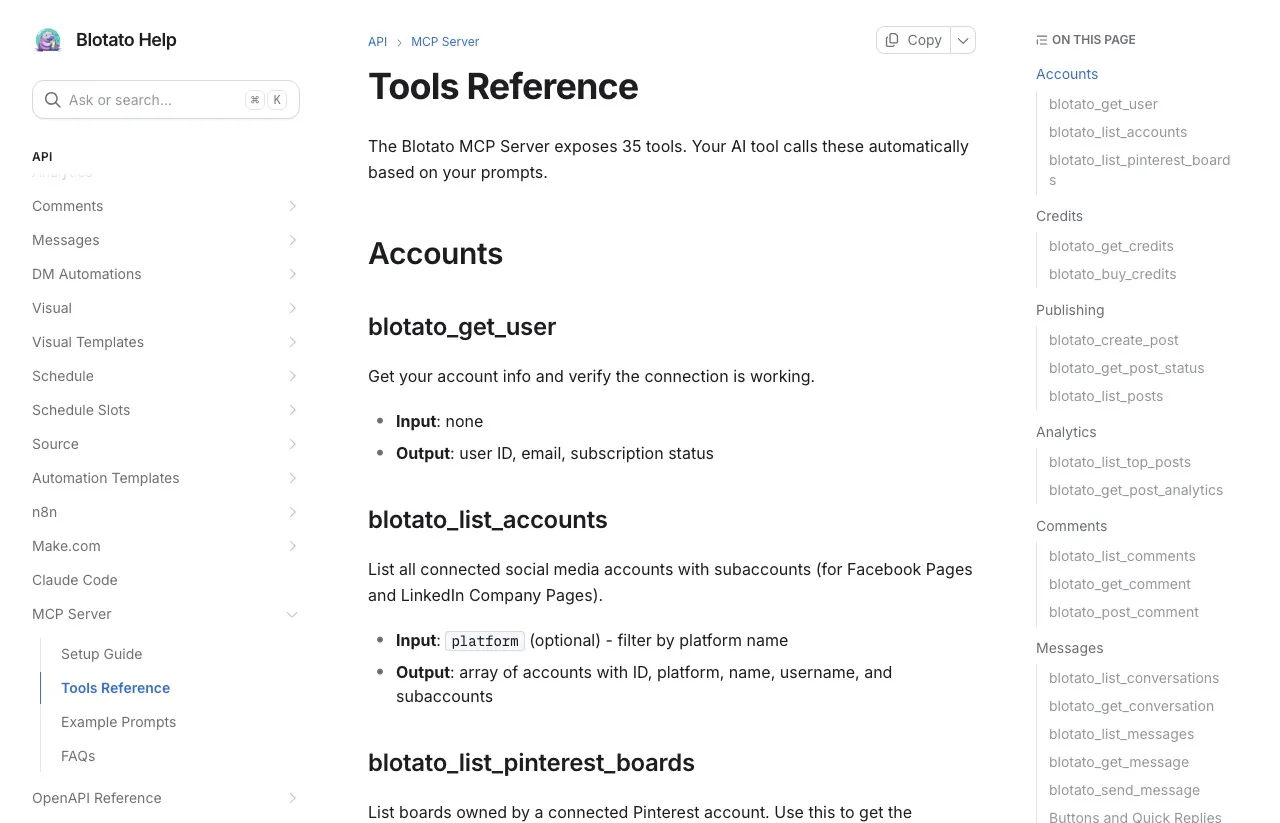
The tool surface is the second gap, and it is the one an agent builder feels first. Blotato’s MCP documentation names every one of them: 35 tools called things like blotato_list_accounts, blotato_create_post, blotato_get_post_analytics and blotato_send_message, covering publishing, analytics, comments, messages, automations and media. Typefully’s MCP server card publishes no tool count at all, so there is no equivalent number to put beside it and I am not going to invent one.
If your agent’s job is drafting text and putting it on X, none of these gaps will ever reach you. If its job is moving one recording out to YouTube and TikTok as well as X, then the constraint is the destination list rather than the code, and the cleanest way to find out is to write down where this month’s content has to land before you compare anything else.
What Each Key Reaches After the Post Goes Out
Publishing is the easy half, and both tools do it. The half that decides whether you need a second vendor is what happens next, and that is where the two products separate.
Typefully’s v2 API is 18 paths and 26 operations, and I read the spec rather than guessing. It covers drafts, the queue, media upload, tags and analytics. Its analytics endpoints carry a note from Typefully’s own documentation: “Currently, only x is supported.” Their pricing table agrees, filing analytics under a heading that reads X Analytics.
The API’s comment endpoints are draft comments, meaning teammates leaving notes on an unpublished draft. They are a collaboration feature and a good one. They are not comment moderation on a live post, and there are no inbox or DM endpoints in the spec at all.
Blotato reads back further. Analytics covers 8 of the 9 publishing platforms, with one stated exclusion in the docs: “LinkedIn returns no metrics yet.” Reading and answering comments and DMs works on Instagram and Facebook, along with keyword-triggered DM automation on those same two networks.
So the honest shape is this. On X, Typefully reports and Blotato reports. On the other eight platforms, Typefully’s API has nothing to report with, and if you need LinkedIn numbers neither of us can hand them to you today.
Typefully Tells You Where Its API Stops
The most useful sentence in this whole comparison is not mine. It sits at the top of Typefully’s API documentation, and it is the vendor drawing its own boundary: if you plan to build an app on X “that is not just for you or your company to use,” you will need the X API with higher rate limits, because Typefully’s API “is meant to create personal automations and workflows.”
Read that as scope rather than as a flaw. Typefully is telling you exactly what their API is for, which is more than most vendors do, and for a personal or in-house automation it is a completely fine answer. It is a different answer if you are putting a product on top of it for other people, and knowing that before you build is worth more than any feature row in the table above.
Two Pricing Shapes: Per Social Set and Per Account
These plans are not priced on the same unit, which is why a straight price comparison misleads in both directions.
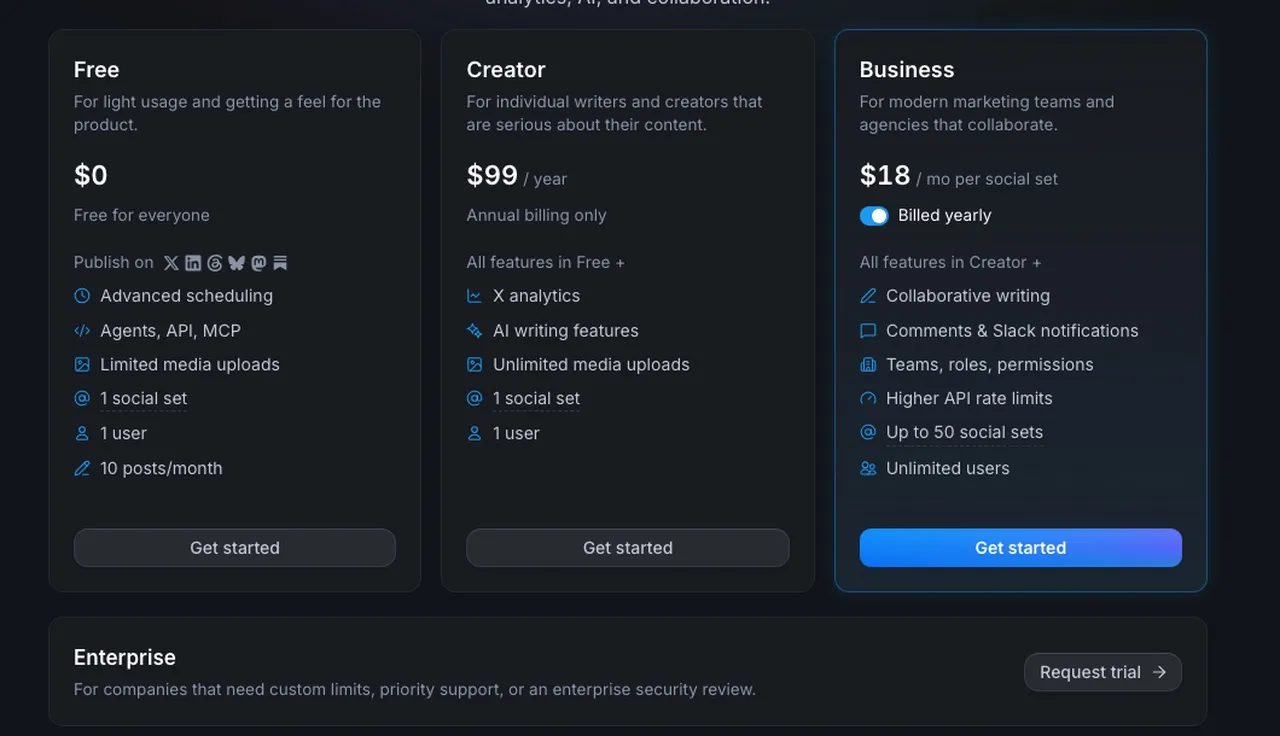
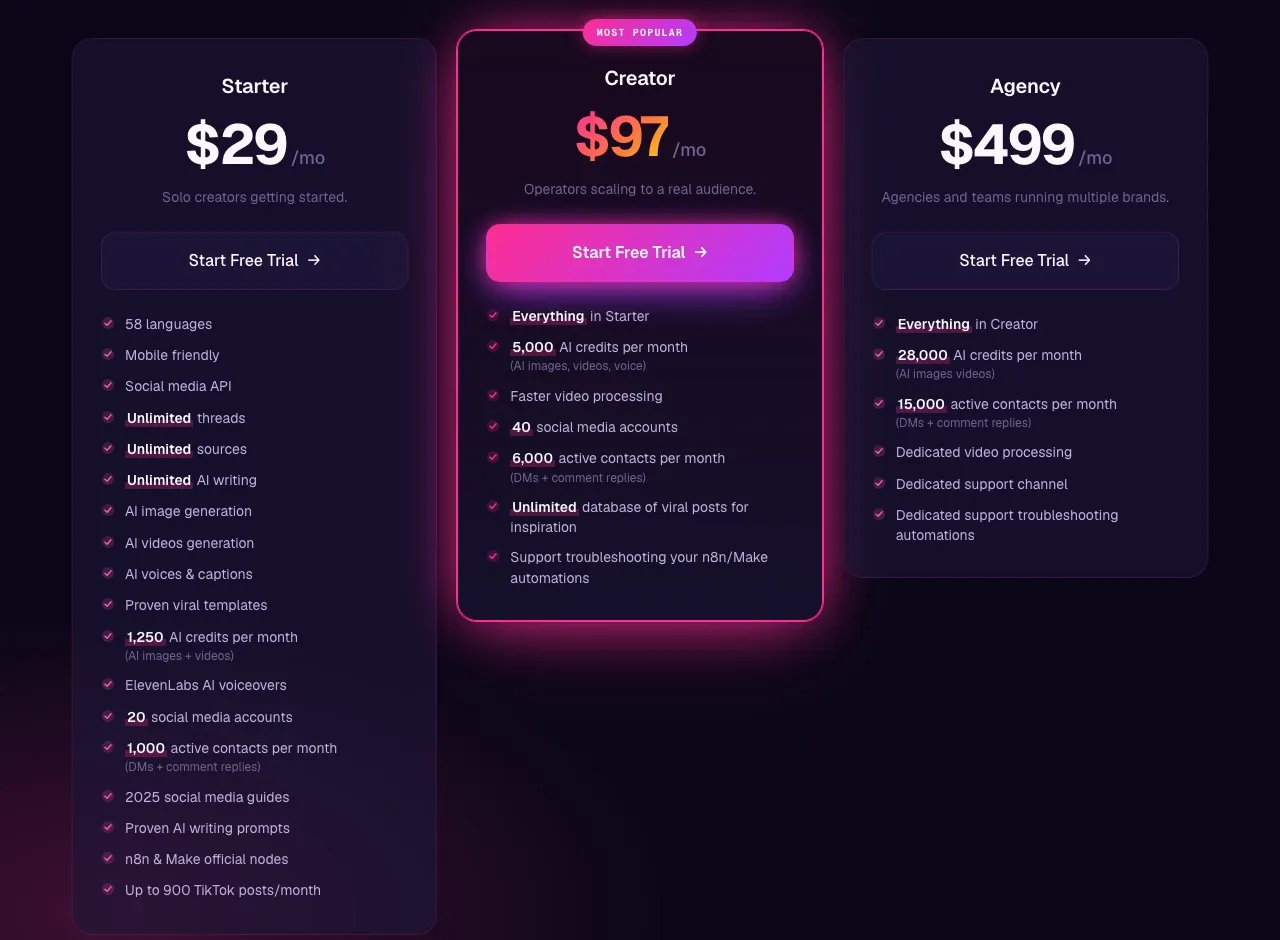
| Plan | Typefully | Blotato |
|---|---|---|
| Free | $0, 1 social set, 10 posts a month | No free plan |
| Entry paid | Creator, $99 a year, annual billing only, 1 social set, 1 user | Starter, $29/mo, 20 accounts, 1,250 AI credits |
| Mid | Business, $18/mo per social set billed yearly, up to 50 sets | Creator, $97/mo, 40 accounts, 5,000 credits |
| Top | Enterprise, custom | Agency, $499/mo, 100 accounts, 28,000 credits |
| Trial | Free plan instead of a trial | 7 days, cancel anytime |
One warning before you plan a budget around any figure you find for Typefully. Their prices render in the browser rather than in the page source, so scrapers and AI answers routinely report tiers that do not exist, and two of Typefully’s own 2024 blog posts still advertise a $12.50 Starter plan and a 14-day trial that are not on the current card. I read the figures above off the rendered page today. Check it yourself rather than trusting a quote, mine included.
A social set is a bundle of connected accounts, so Typefully’s Creator plan at $99 a year is genuinely inexpensive for one writer running one set. Nothing in Blotato’s lineup competes with that on price for that shape of work.
The unit changes what happens next. Typefully’s Business tier is $18 a month per social set billed yearly, so the bill rises with each set you add. Blotato’s Starter is one flat $29 covering 20 connected accounts, so the second account and the twentieth cost the same.
Run three or four sets and the two lines cross. Run one, and Typefully is cheaper and it is not close.
Here is the entry-tier comparison on capability rather than price.
| Capability at the entry tier | Typefully Creator ($99/yr) | Blotato Starter ($29/mo) |
|---|---|---|
| Social media platforms | 5 | 9 |
| TikTok and YouTube publishing | No | Yes |
| Connected accounts | 1 social set, 1 user | 20 |
| REST API and hosted MCP | Yes | Yes |
| Documented MCP tools | Not published | 35 |
| Analytics reach | X only | 8 platforms |
| Comments and DMs on live posts | No | Instagram and Facebook |
| AI image and faceless video | No | Included, uses credits |
| Publishing cap | 1,000 posts a month | No per-post fee, daily platform caps apply |
Blotato’s Starter adds video publishing, engagement and generation that Typefully does not sell at any tier. Typefully’s Creator costs about a quarter as much per year. Both are true, and which one matters is decided by who is doing the typing.
Where Blotato Costs You More
Four places where the honest answer is that we are the worse buy.
We add our own posting caps on top of each platform’s, and they are stricter than the platform’s own. On Starter you can publish to 3 unique TikTok accounts in any 24-hour window, 10 posts each, no matter how many TikTok accounts you have connected. That ceiling is the one most likely to surprise an agent builder mid-run, and it lifts on Creator.
Starter also holds 200 queued scheduled posts and will not accept anything dated more than 9 months out. An agent that batches a year of evergreen content in one pass hits both ceilings at once, and the fix is a higher tier rather than a setting.
Our 7-day trial excludes the API. Generating a key ends the trial and starts the paid Starter subscription immediately, so if you are here to evaluate the agent surface, plan on starting the subscription rather than trialing it. Typefully’s Free plan has no equivalent trap, though its API returns a 402 reading “Upgrade your plan to create drafts from this account” when an unpaid account tries to write, so reading is free there and publishing is not.
And if you only ever write threads for one X account, everything Blotato adds is surface area you are paying for and will not open.
Stay With Typefully If
- Writing is the hard part of your week and the composer is what you are actually buying
- Your publishing lives on X, LinkedIn, Threads, Bluesky or Mastodon and stays there
- You run one social set, where $99 a year is hard to beat for a tool you open every day
- Your agent’s job is drafting and scheduling text rather than moving video
- Team review on drafts matters more to you than reporting after publishing
Move to Blotato If
- An agent posts unattended and you need it to read back what happened
- The work includes TikTok or YouTube, which the desk does not reach at any price
- You want analytics on more than X, or Instagram and Facebook comments and DMs behind the same key
- You are running more than a couple of account sets and want the bill to stop tracking that number
- You want images and faceless video generated in the same place they get published
Who Should Actually Switch, and Who Should Not
Most people reading a Blotato vs Typefully comparison do not have a Typefully problem. They have a scope change. The tool was right when the work was writing, and the work stopped being only writing.
If your work is still only writing, stay where you are. A better composer is worth more than a wider API you will not call, and paying $29 a month for reach you never use is a worse decision than paying $99 a year for a desk you open daily.
If the work has grown past writing, check your destination list before you check the price. Video is the usual trigger and reporting is the second, and both are settled in a minute against either vendor’s own docs. I have written up the wider field of Typefully alternatives separately if you would rather weigh more than two options, and if X itself is the worry, which schedulers still publish to X covers where every major tool now stands.
The part I would defend to anyone, including against my own product, is the fork itself: buy the desk if a person is typing, buy the infrastructure if an agent is.
Blotato vs Typefully FAQs
Can an AI agent post to TikTok or YouTube through Typefully?
No. Typefully’s agent documentation lists X, LinkedIn, Threads, Bluesky and Mastodon, and its help center adds Substack Notes. TikTok and YouTube are not destinations it publishes to, so an agent connected to Typefully cannot reach them regardless of plan. Blotato publishes to 9 platforms including both, which is the usual reason someone runs this comparison in the first place.
Does Typefully report analytics for LinkedIn or Threads?
Not through its API. Typefully’s own OpenAPI spec says of both analytics endpoints, “Currently, only x is supported,” and its pricing table files the feature under X Analytics on the Creator and Business plans. Blotato collects analytics on 8 of its 9 platforms, with LinkedIn as the stated exclusion because it returns no metrics yet.
Is Typefully cheaper than Blotato?
Typefully is cheaper only while you stay at one social set, where Creator is $99 a year against Blotato Starter at $29 a month. The comparison inverts as accounts multiply, because Typefully’s Business tier charges $18 a month per social set while Blotato’s Starter covers 20 connected accounts for one flat fee. Count your accounts before you read the two prices as comparable.
Which one connects to more AI agent clients?
Blotato documents 18 clients with per-client setup, including Claude Code, ChatGPT, Cursor, Codex, Copilot, Gemini CLI and OpenClaw. Typefully’s agents page names eight and splits them, steering chat apps to its MCP server and coding agents to its agent skill instead. Both connect over OAuth, and both work fine with Claude.
Can I reply to comments or DMs from either tool’s API?
Only from Blotato, and only on Instagram and Facebook. Typefully’s API does have comment endpoints, but they are notes teammates leave on unpublished drafts rather than replies to the public, and its spec contains no inbox or messaging paths. If answering the audience is part of the job, check that row before you choose.
Do I need a paid plan to use either API?
Effectively yes on both, in different ways. Typefully lists Agents, API and MCP on its Free card, but the API returns a 402 saying to upgrade your plan when an unpaid account tries to create a draft, so reading works free and writing does not. Blotato includes the API on every paid plan and excludes it from the trial, and generating a key ends that trial and starts billing.