Blotato's Social Media API Now Reads and Answers Comments and DMs
Blotato's social media API now reads and answers Instagram and Facebook comments and DMs, so the key that publishes also handles the conversation.

Publishing was only ever half the job.
Blotato now has comments and messaging endpoints in the API. Your agent can read the comments on your posts, reply to them, pull your Instagram and Facebook DM conversations, and send messages back. Same key you already publish with.
The permissions are the part worth pausing on, because they are the part that is slow to get. Meta gates comment access and message access behind separate permissions, and an app that wants to use them on other businesses’ accounts needs Advanced Access, which means going through App Review.
The do-it-yourself version of this release is: register a Meta app, request the comment and message permissions with a justification for each, wait out the review, then handle token refresh and scopes yourself. After all that you still have to bolt the result onto whatever separate vendor you pay to publish, and pay both.
Blotato’s integration already carries those permissions, so you skip that path entirely.
I built Blotato and I use it every day, so weigh that however you like. What I keep hearing from people running Blotato inside Claude is that their agent could ship content all week, then go silent the moment somebody replied. That was the gap.
If you want the full surface behind one key, Blotato plans start at $29 a month, and API access begins with a paid plan rather than the trial.
What the Comments API Does
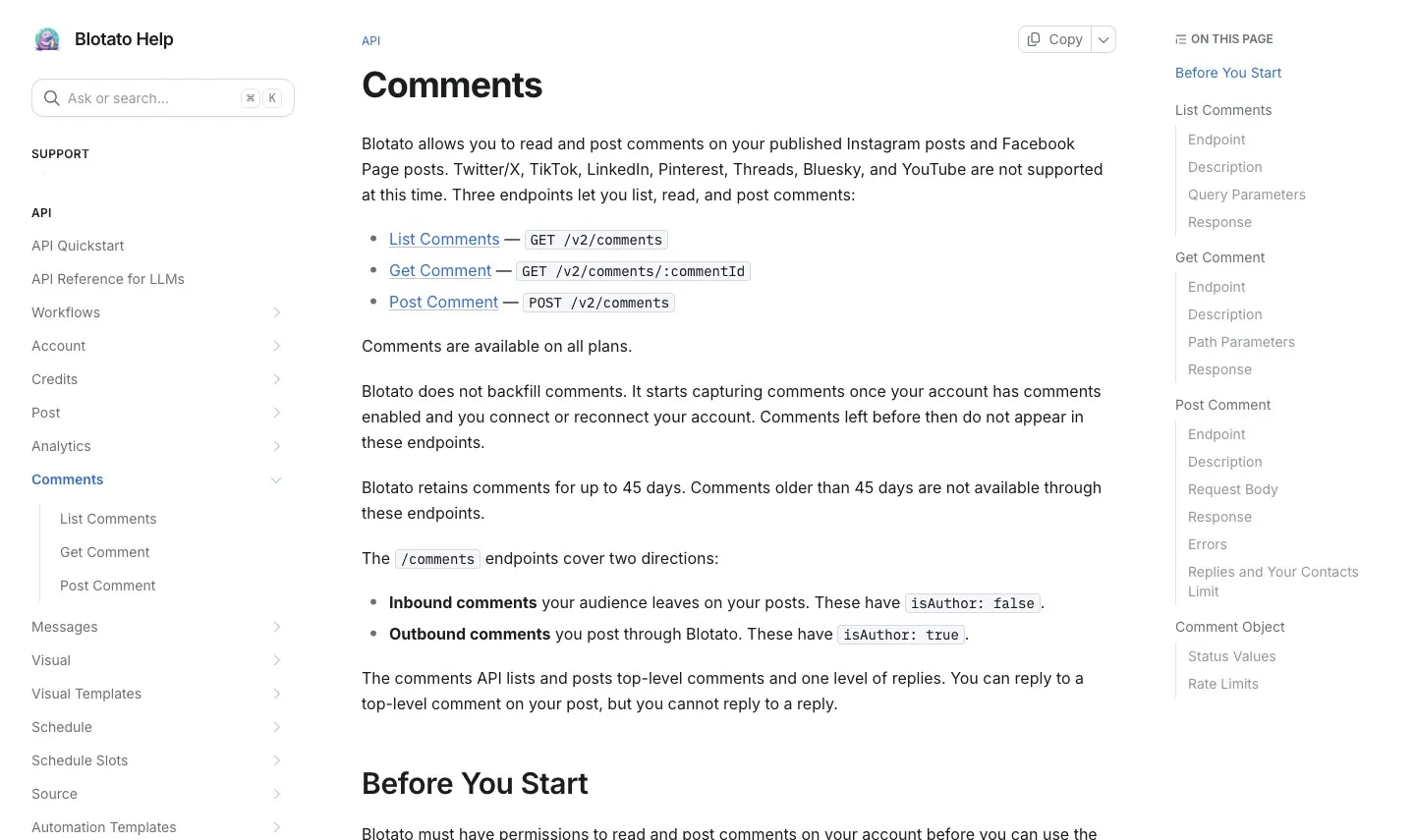
Three endpoints cover the comment loop on your published Instagram posts and Facebook Page posts: list comments (filtered by post, account, platform, or date range), get a single comment, and post one, either top-level or as a reply when you pass a parentCommentId.
Comments come back tagged by authorship, so an agent can tell its own replies apart from real inbound activity. You can reply to a comment on your post, but not to a reply. Comments are available on all plans.
What the Messaging API Does
Five endpoints cover direct messages on your Instagram account and Facebook Page: list conversations, get a conversation, list messages, get a message, and send a message. Sending is async, so you poll until it reaches sent or failed.
You can send a reply inside an existing conversation, or a private reply to a comment.
This is a reply surface, not a cold-outreach surface. You send to a recipientId that came from an existing conversation, never to an arbitrary user.
Which Platforms Are Supported
Comments and messaging cover Instagram and Facebook first, because those are the two where the permissions are in place.
X, TikTok, LinkedIn, Pinterest, Threads, Bluesky, and YouTube are not supported for comments or DMs yet, and that boundary is set by the platforms rather than by us. Publishing still covers all nine platforms exactly as before, and analytics covers eight of the nine.
If you connected your Instagram or Facebook account before this shipped, you need to reconnect it. The old connection does not carry the comment and message permissions, and that is the most common reason these endpoints come back empty.
Why This Matters for an AI Agent
The largest share of our new API signups now arrives through MCP, and most of those are people running Blotato inside Claude. This release was built for them.
Pull your top-performing posts from the past week, read the comments on them, and let Claude tell you what people actually asked about. Then decide next week’s content from real audience questions instead of a guess.
The messaging side does the same for your inbox. Scrape the past week of conversations, find everyone who asked about a specific product or hit the same objection, and follow up with each of them.
Reading and classifying every thread used to be the expensive part, because it took a human. That is the work a language model does well.
Both surfaces are live as MCP tools too, so if you run Blotato through Claude you get blotato_list_comments, blotato_post_comment, blotato_list_conversations, blotato_send_message and the rest without touching an HTTP client. The MCP server now exposes 35 tools.
Publishing was never the hard part of social media. Listening was.
“An agent that posts is a tool. An agent that posts, reads the replies, and answers them is running the account. That is the whole reason we put comments and DMs behind the same key that publishes.”
Sabrina Ramonov, founder of Blotato
Limits Worth Knowing Before You Build
A few things I would rather you hear now than discover at 3am.
Blotato does not backfill. Capturing starts when you connect or reconnect the account, so anything earlier will not appear. Retention is 45 days for both comments and messages, so if you need longer history, store it on your side as you pull it.
The messaging windows come from Meta, not from us. You reply within 24 hours of someone’s last message, or within 7 days for a private reply to a comment. Send outside an allowed window and the message lands in failed status. Sending to a new person also counts toward your plan’s monthly active-contacts limit.
And to be clear about what is not in this release: keyword-triggered DM automation, the ManyChat style “comment this word and I will send you the link” flow. These endpoints are the foundation that kind of flow runs on. It has since shipped as DM automations on August 6, so you no longer have to build it yourself on top of them. If you are still weighing vendors, here is how it compares to the dedicated DM tools.
Where to Find It
The endpoints are live now in the Blotato API. Point your agent at the LLM-optimized reference and it can read the spec itself.
Reconnect your Instagram and Facebook accounts first so the permissions are in place. Then let your agent start reading.