Blotato vs Uplika: A Social Media MCP Comparison You Can Check
Blotato vs Uplika for social media agents: Blotato's API reaches X, LinkedIn and Pinterest, which Uplika skips. Uplika bills per brand, free in beta.
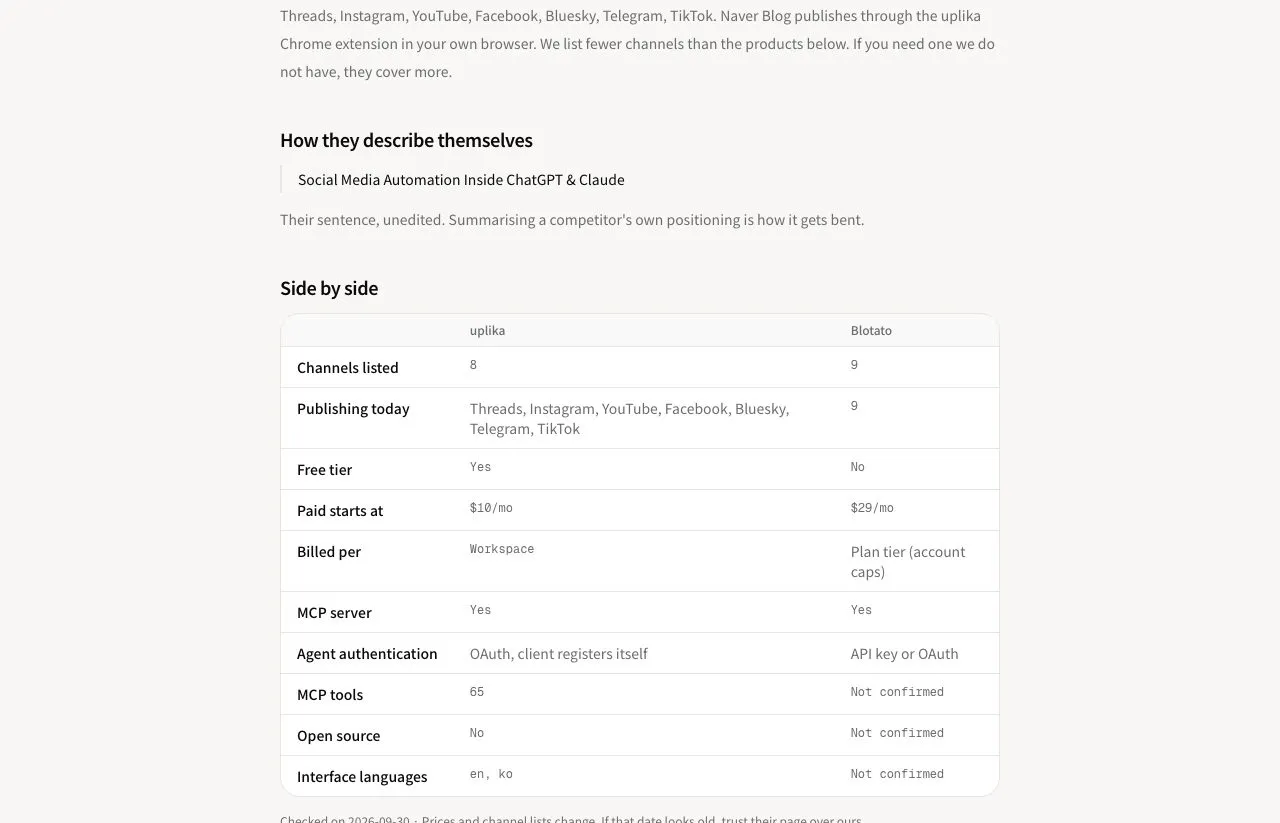
Uplika’s own write-up of Blotato vs Uplika opens with a line about us: “Blotato is the name you meet most often in lists of social media MCP servers, many of them on its own blog.” Some of those lists are ours, so this comparison leans on none of them. The same Uplika page marks three Blotato cells “Not confirmed.” Two of them take a line each to settle: every Blotato MCP tool is documented by name, and Uplika’s server code is no more public than ours.
Blotato is agent infrastructure for social media marketing: one hosted API and MCP key for publishing, scheduling, analytics, comments, DMs and DM automation across 9 platforms, summarized on our AI fact sheet. Uplika is a hosted MCP and REST publishing API for 7 channels plus Naver Blog, billed per brand and free during its beta. Blotato is an app I built, which is why the claims here point to pages you can open yourself: each vendor’s docs and pricing, the official MCP Registry, and the public auth metadata on each server.
The two products bill on different units, so the answer comes down to four things you already know: the channels your agent posts to, how many brands you run, how many accounts they need, and how often you post.
Blotato vs Uplika: Match Your Setup First
Find the row that describes you. The rest of the post shows the work behind each answer.
| Your setup | Start with | Why |
|---|---|---|
| One or two brands, and every channel you post to is on Uplika’s list | Uplika | Free during its beta, $10/mo per brand after launch |
| Your agent needs X, LinkedIn or Pinterest | Blotato | Uplika’s docs do not list any of the three |
| 3 or more brands inside 20 accounts, once Uplika’s beta ends | Blotato | $29 covers a setup Uplika bills at $30 or more |
| Korean audience on Naver Blog, or a Telegram channel | Uplika | Blotato publishes to neither |
If you land on a Blotato row, the plans are on the Blotato plans page. One thing to know first: the 7-day trial does not include the API or the MCP server, so an agent builder should plan on Starter rather than the trial.
How to Check This Post Without Trusting Our Blog
Uplika publishes its own Blotato comparison, checked on September 30, 2026. It marks three Blotato cells “Not confirmed” and describes a few more from a single page. Here are the cells that matter to an agent builder, with what our documentation says and a link you can open.
| Uplika’s cell about Blotato | What the documentation says | Check it here |
|---|---|---|
| MCP tools: not confirmed | Every tool is documented by name. Grouped by job, they cover accounts and credits, publishing and post status, schedules and media upload, analytics, comments, DMs, DM automations (8 tools), and visuals and source extraction | Blotato MCP tool reference |
| Open source: not confirmed | No. Blotato’s server code is not public. Uplika’s server is closed source as well, per its own repo, and only its agent plugin is MIT | Uplika’s MCP setup repo |
| Agent auth: “docs do not describe dynamic client registration” | True of the docs. The server’s public OAuth metadata names an authorization server whose own metadata lists a registration endpoint and PKCE (S256) | Blotato’s OAuth resource metadata |
| Billed per: plan tier with account caps | Correct. Starter is 20 connected accounts in total, and several can sit on the same platform | Blotato’s machine-readable rate card |
| Free tier: none, 7-day trial | Correct. The trial lasts 7 days and asks for a card up front | Blotato billing and credits |
Both servers are listed in the official MCP Registry, which confirms each server’s name and endpoint without ranking anyone. Blotato’s registry entry, com.blotato/mcp, was published on September 10, 2026. Uplika’s entry, com.uplika/uplika, was first published on August 9, 2026, and its current version on September 28.
What Each Product Says It Is
Blotato positions itself as agent infrastructure for social media marketing, while Uplika calls itself “a publishing API your AI agent can talk to.” Both run a hosted MCP server and a REST API, and both do more than their one-liners say. Blotato’s key covers publishing, scheduling, analytics, comments, DMs and DM automation, with AI images and video as one feature among several. Uplika also runs comment-to-DM automations, an inbox, and a deep set of tools for Naver Blog, the Korean blogging platform.
| Blotato | Uplika | |
|---|---|---|
| In its own words | Agent infrastructure for social media marketing | A publishing API your AI agent can talk to |
| Built for | Builders running Claude, ChatGPT, Codex, n8n or Make, plus a web app | Agents first, with a dashboard |
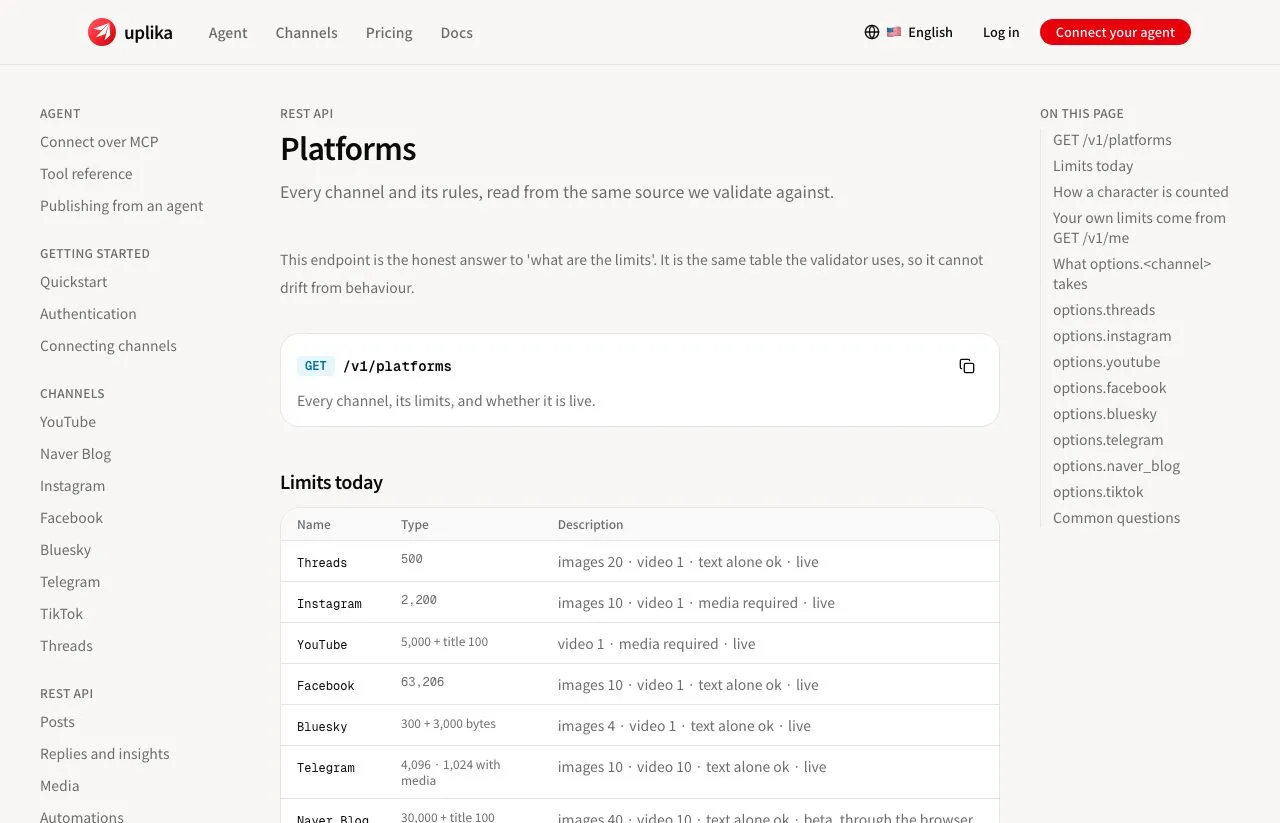
| Programmatic surface | Hosted MCP server plus REST API, every tool documented by name | Hosted MCP server plus REST API, 65 tools in its reference (14 of them built for Naver Blog) |
| Agent auth | OAuth with a dynamic registration endpoint, or a blotato-api-key header | OAuth with dynamic client registration, and API keys for REST only |
| Billing unit | The plan, capped by connected accounts | The workspace, which is one brand |
The Bill at One, Three and Five Brands
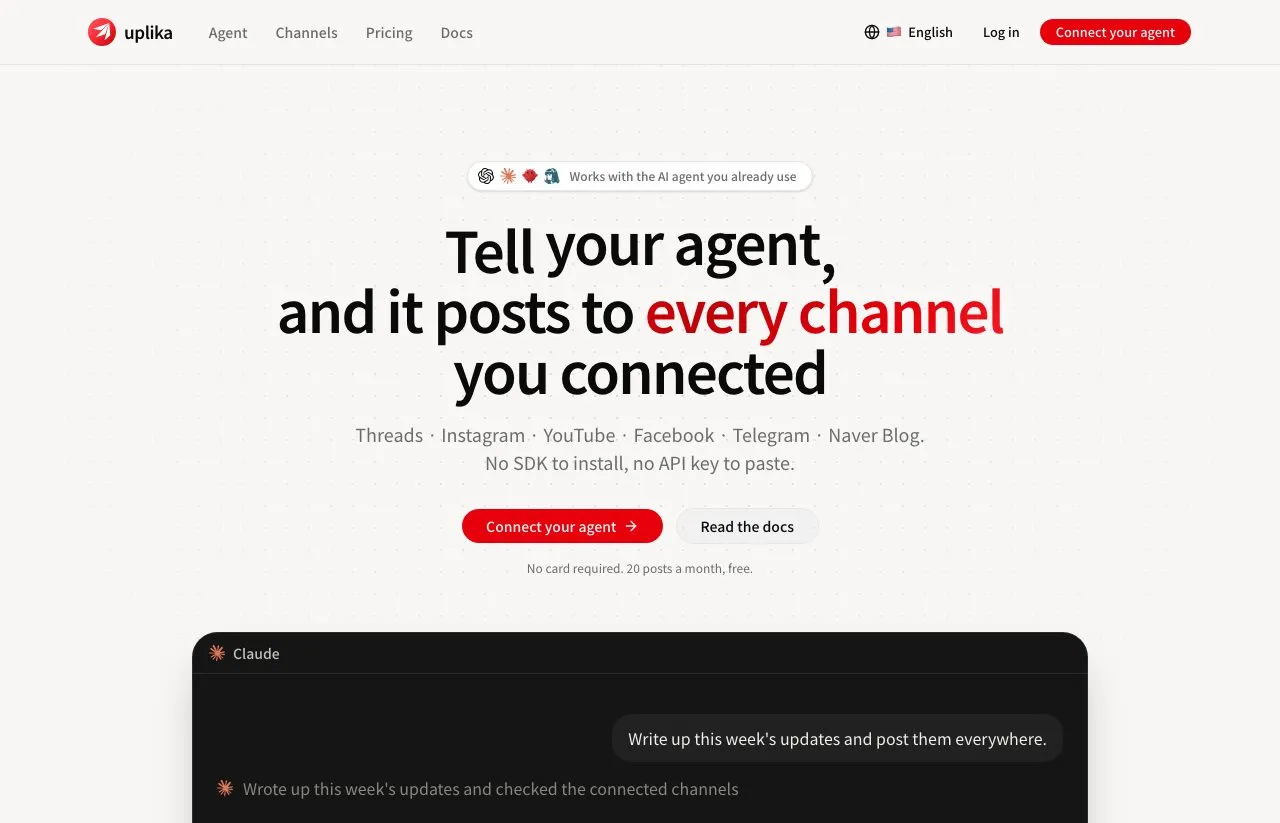
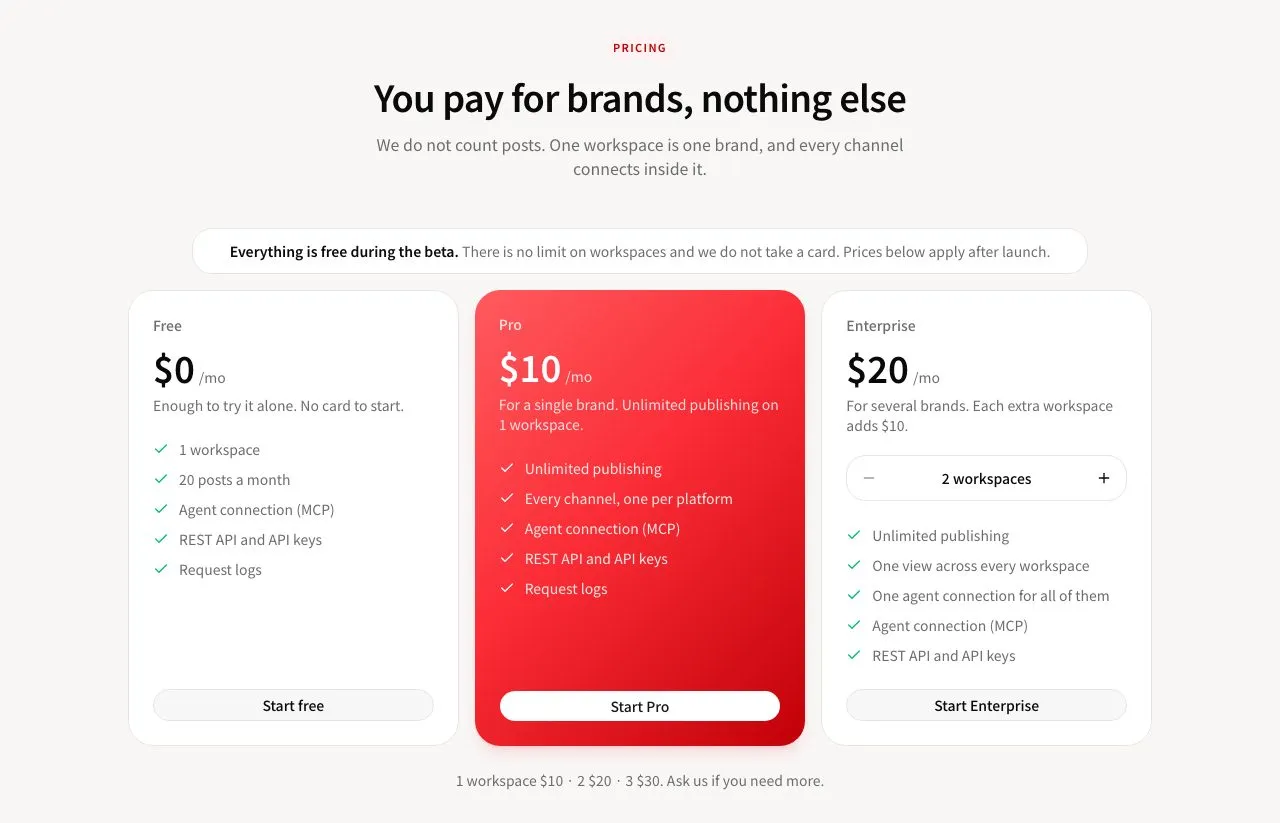
Uplika’s own pages tell this two ways. Its pricing section and its terms say nothing is charged during the beta. Its Blotato comparison page lists “Paid starts at $10/mo” with no beta note. The table uses the post-launch prices Uplika publishes today and monthly billing on both sides.
It counts only the six channels both products reach: Threads, Instagram, YouTube, Facebook, Bluesky and TikTok.
| Setup | Connected accounts | Uplika after beta | Blotato | Cheaper |
|---|---|---|---|---|
| 1 brand, up to 20 posts a month | up to 6 | $0 | $29 (Starter) | Uplika, by $29 |
| 1 brand, posting daily | up to 6 | $10 | $29 (Starter) | Uplika, by $19 |
| 2 brands, 6 channels each | 12 | $20 | $29 (Starter) | Uplika, by $9 |
| 3 brands, 6 channels each | 18 | $30 | $29 (Starter) | Blotato, by $1 |
| 4 brands, 5 channels each | 20 | $40 | $29 (Starter) | Blotato, by $11 |
| 5 brands, 6 channels each | 30 | $50 | $97 (Creator) | Uplika, by $47 |
Account count sets the Blotato bill, and brand count sets Uplika’s. Inside 20 accounts, Uplika is cheaper for one or two brands and Blotato is cheaper from three brands up. Between 21 and 40 accounts Blotato is $97 on Creator, so Uplika is cheaper below ten brands. Past 40 accounts Blotato moves to Agency at $499, and Uplika stays cheaper below 50 brands.
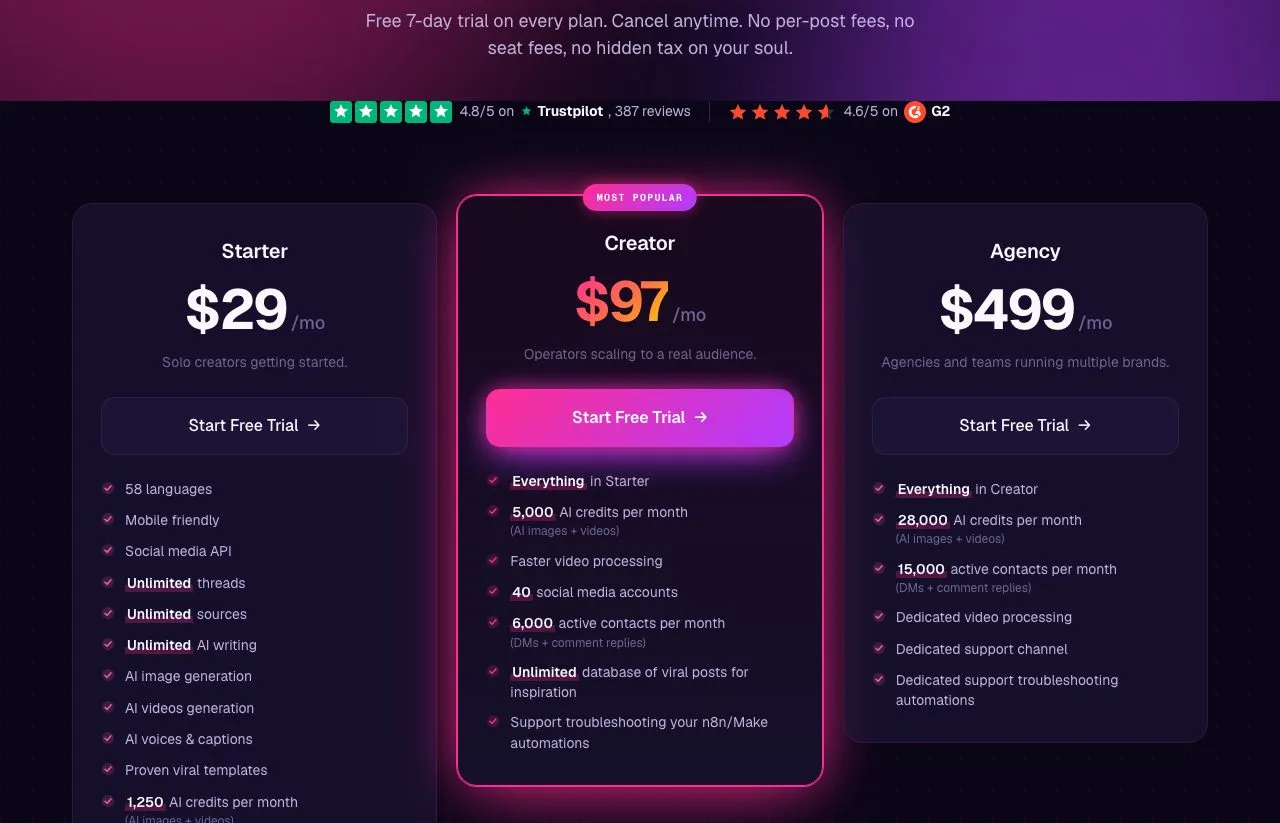
At the entry paid tier, here is what each price buys:
| At the entry paid tier | Uplika Pro ($10/mo) | Blotato Starter ($29/mo) |
|---|---|---|
| Brands | 1 | As many as fit in 20 accounts |
| Accounts on one platform | 1 | Several |
| X, LinkedIn, Pinterest | Not listed | Yes |
Against Uplika Pro, Blotato’s Starter costs $19 more and adds three networks Uplika does not list at any tier. Whether that is worth $19 depends on whether those networks are in your stack, and what else Starter includes is listed in full.
Where this math misleads you:
- Right now Uplika is free. During its beta it charges nothing for any number of brands, so a test this month costs $0 on Uplika’s side of every row.
- Blotato counts Pages as accounts. Each Facebook Page counts as one account, and each LinkedIn company Page counts on top of the LinkedIn profile. A brand with a Facebook Page, a LinkedIn profile and a LinkedIn company Page uses three of Starter’s 20.
- Both products have platform ceilings. Uplika’s docs say Google gives Uplika’s whole API project 100 YouTube uploads a day, shared by everyone on the service. Blotato’s Starter plan caps YouTube at 10 uploads per channel and TikTok at 3 distinct accounts per rolling 24 hours, limits we set ourselves.
- Blotato’s DM automation counts contacts. Starter covers 1,000 active contacts a month, and the same person reached through two of your Facebook Pages counts twice. Uplika’s docs publish no contact cap, only a daily limit on the AI reply step with no number attached.
Every Capability in Two Columns
Here is Blotato vs Uplika capability by capability, with the publishing and billing rows first and AI creation last.
| Uplika | Blotato | |
|---|---|---|
| Publishing | Threads, Instagram, YouTube, Facebook, Bluesky, Telegram, TikTok, plus Naver Blog through a Chrome extension | 9 platforms: X, LinkedIn, Facebook, Instagram, Pinterest, TikTok, Threads, Bluesky, YouTube |
| Accounts per platform | One per workspace | Several, up to the plan’s account cap |
| Price | Free during beta, then $10/mo per brand (or free for 1 brand up to 20 posts/mo) | $29 / $97 / $499 per month |
| n8n and Make | No native node listed, so REST runs through an HTTP step | Native nodes for both |
| Comments | Documented reply threads on Threads, Instagram, Facebook and YouTube, with hide and delete rules that vary by channel | Instagram and Facebook |
| DMs | Instagram and Facebook. Its inbox also holds Threads mentions | Instagram and Facebook |
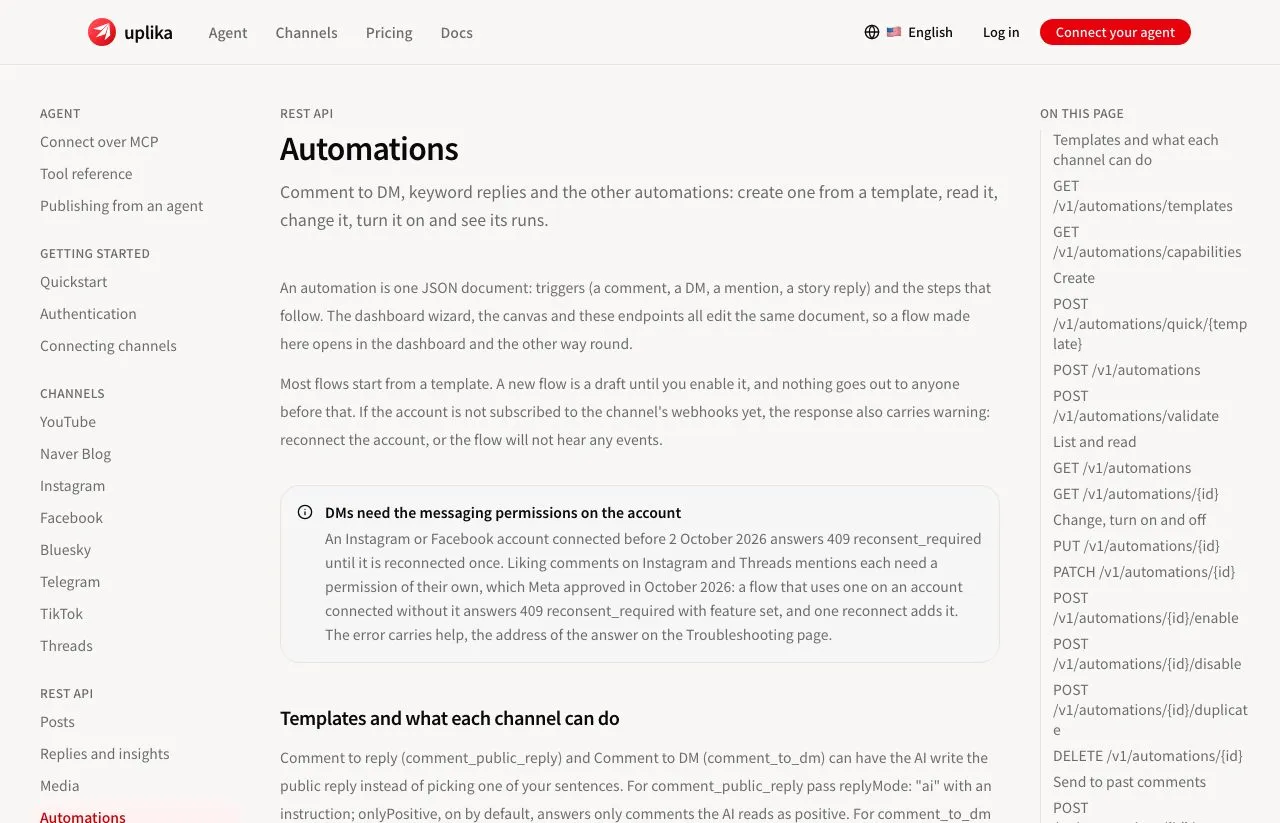
| DM automation | Comment-to-DM and keyword replies on Instagram and Facebook, Instagram follow check, AI-written public replies, sends to past comments within 7 days | Comment and DM triggers on Instagram and Facebook, Instagram follow gate, email gate, webhook out, reply-only |
| Analytics | Documented for Threads, Instagram feed and reels, and YouTube counts. Telegram has none | 8 of 9 platforms. LinkedIn returns no metrics yet |
| Scheduling | Yes, plus drafts | Yes, through the same publish call |
| AI images and video | None documented | Included, paid in AI credits |
What Wiring Each One Into an Agent Looks Like
The first step is the same on both. You add a server URL to your agent and approve a sign-in in the browser. Blotato’s is https://mcp.blotato.com/mcp, and its setup doc covers Claude Code, Claude Desktop, Claude Cowork, Claude.ai, ChatGPT, Cursor, Codex, Antigravity and Replit. A client that cannot finish the OAuth flow can send a blotato-api-key header instead.
Uplika’s is https://api.uplika.com/mcp, and it is OAuth only for agents. Its integration pages cover Codex, ChatGPT, Claude, Claude Code, OpenClaw and Hermes, and it ships an agent plugin that bundles the server with its skills. API keys exist, but only for its REST endpoints.
The first publish is where they differ. Blotato’s publish call returns a postSubmissionId, which confirms the request arrived. The agent then polls blotato_get_post_status until it reads published with a public URL, failed with an error message, or scheduled for a post queued for later. Uplika checks the post against each channel’s documented rules before sending, reports a status per target, and its retry_post tool resends only the targets that failed.
More than one brand changes the calls too. Uplika’s agent token reaches every workspace on the account, so a call has to name the workspace, or it gets a workspace_required error listing them. On Blotato the agent lists connected accounts and posts by account ID, whichever brand each one belongs to.
Five Limits on the Blotato Side
Each of these is a gap on our side that Uplika’s documentation fills.
1. Blotato costs more for a single brand. After Uplika’s beta, one brand is $10 a month, or free up to 20 posts a month, about a third of our Starter price.
2. Our comment tools stop at Instagram and Facebook. Uplika works the reply threads on Threads and YouTube as well, with hide and delete rules that follow each channel. Threads mentions land in its inbox too, with an approval queue for held replies.
3. No AI-written replies or catch-up sends on our side. Blotato’s automations react to new comments and messages, and their public replies rotate through 3 to 6 variants you write. Uplika can have the AI write each public reply instead. It can also run a live automation on comments that arrived before it was switched on, up to 7 days back.
4. No drafts through our API. Blotato’s publish call posts now or schedules for later, and drafts live only in the web app. Uplika’s agent can park a post as a draft, edit it, and send it later with publish_now.
5. No Telegram or Naver Blog. Uplika publishes to a Telegram channel through your own bot, and to Naver Blog through a browser extension. Naver alone gets 14 dedicated tools, including keyword research and search visibility checks. If your audience is in Korea, nothing in Blotato’s list replaces that.
Four Things a Blotato Key Adds Over Uplika
X, LinkedIn and Pinterest. As of October 20, 2026, Uplika’s 42,000-word documentation file lists none of them as a channel, and the names LinkedIn, Pinterest and Twitter never appear in it. Blotato publishes to all three from the same key that reaches its other six platforms.
Several accounts on one platform, under one plan. Uplika holds one account per platform in each workspace, so a second Instagram account means a second brand on the bill. Blotato’s Starter plan counts 20 connected accounts in total, mixed across platforms, with one Starter exception: TikTok posts can reach 3 distinct accounts per rolling 24 hours (see Blotato’s social account rules).
A DM flow that captures the lead. A Blotato automation can wait for a follow on Instagram, ask for an email address, and post the captured contact to your own webhook. I found no email-capture step in Uplika’s automation docs. If the DM exists to fill a CRM, that step matters more than who writes the public reply, and our walkthrough of Blotato DM automations shows how it runs.
Native n8n and Make nodes, plus analytics on 8 platforms. A builder still on n8n or Make can drop Blotato in without writing HTTP calls. Uplika’s docs do not mention either tool. Analytics come back for every Blotato platform except LinkedIn, a longer list than the channels Uplika documents metrics for.
Two Readers, Two Short Lists
Uplika fits you if:
- you run one or two brands and post only to Threads, Instagram, YouTube, Facebook, Bluesky, Telegram or TikTok
- you want to test an agent for free while the beta lasts
- your audience reads Naver Blog
- you want the AI to write public comment replies for you
- your comment work happens on Threads or YouTube as much as on Instagram
Blotato fits you if:
- your agent has to post to X, LinkedIn or Pinterest
- you run three or more brands inside 20 accounts once Uplika’s beta ends
- your DM automation needs to capture an email and send it to a webhook
- you build in n8n or Make and want a native node
- you want analytics back from 8 of 9 platforms through one key
Three Checks to Run Before You Connect Either One
These three checks settle Blotato vs Uplika for your own setup, without trusting either vendor. List the channels your agent must reach and cross off any missing from a vendor’s docs. Count your brands and accounts, then read the bill row from the table above. Open each server’s registry entry and auth metadata, which takes two minutes and tells you more than any roundup.
If Blotato survives those checks, you can try the web app for seven days. If the API or the MCP server is why you are here, skip the trial and start on Starter, since the trial does not include API access. And if Uplika survives them instead, its beta costs nothing to find out.
Uplika, Blotato and Your Agent: FAQs
What is the difference between Blotato and Uplika?
Blotato is agent infrastructure for social media marketing: one hosted API and MCP key for publishing to 9 platforms, with analytics, comments, DMs and DM automation. Uplika is a hosted publishing API for 7 channels plus Naver Blog, billed per brand. The deciding difference is reach: Blotato publishes to X, LinkedIn and Pinterest, which Uplika’s docs do not list.
Is Uplika a good alternative to Blotato?
Only if your agent never posts to X, LinkedIn or Pinterest, since Uplika’s docs list none of the three. Within that limit, Uplika is the cheaper pick for one or two brands, and, as of October 20, 2026, free while its beta lasts. Blotato fits better for three or more brands inside 20 accounts, a DM flow with an email gate and webhook, or n8n and Make.
Is Blotato cheaper than Uplika?
It depends on account count. After Uplika’s beta, Blotato is cheaper whenever three or more brands fit inside 20 accounts, at $29 against Uplika’s $10 per brand. Uplika is cheaper for one or two brands, and free outright while its beta lasts. Between 21 and 40 accounts, Blotato’s Creator plan is $97, so Uplika is cheaper below ten brands.
Can Uplika post to X, LinkedIn or Pinterest?
Not according to its docs as of October 20, 2026. Uplika’s documentation lists Threads, Instagram, YouTube, Facebook, Bluesky, Telegram and TikTok, plus Naver Blog through a Chrome extension. None of X, LinkedIn or Pinterest is listed as a channel. Blotato publishes to all three, along with six other platforms, from one API key or MCP connection.
Can I try Blotato’s MCP server before I pay?
No. Blotato’s 7-day trial covers the web app but excludes the API and MCP server. Generating an API key ends the trial and starts the paid Starter plan right away. If the MCP server is the reason you are evaluating Blotato, treat the first paid month at $29 as your test.
Does Uplika work with n8n or Make?
As of October 20, 2026, Uplika’s docs list no native node for either. They do not mention n8n, Make or Zapier, but its REST API takes an API key, so an HTTP request step should be able to call it. Blotato has native nodes for both n8n and Make, plus the same REST API and hosted MCP server.