How Ekwy Chukwuji Saved $300K With a Custom AI Skill
Ekwy Chukwuji built one custom GPT that saved The Economist $300K, then 4x'd her income. Her workflow-first system, now rebuilt as a Claude skill.

Most people meet a new AI tool and immediately ask what they can build with it. Ekwy Chukwuji does the opposite, and it is why her work actually sticks.
The thing worth copying here is how Ekwy Chukwuji built one custom AI skill that saved The Economist $300,000 by starting with the business workflow instead of the technology. She was a business analyst who got obsessed with AI on the side, paid for her own first course out of pocket, and quietly became the person every department sent their AI problems to. One of those problems was a global copywriting contract. She rebuilt it as a single, tightly-scoped GPT, and the company did not renew the agency.
This interview aired on my channel, and I want to be upfront about my angle before you read on: I am involved with Blotato as a creator and tester, not the founder, so take whatever I say about it with a grain of salt. Ekwy does not use Blotato, and this post is not about my tool. It is about her method, and the one place a publishing layer fits for a solo consultant who is building this fast.
How Ekwy Chukwuji Turned a Custom GPT Into a Repeatable AI System
The full conversation is above. The written version pulls out the parts you can actually reuse: how she scoped the GPT that saved the money, how she now rebuilds those same GPTs as Claude skills, and why her workflow-first order is the whole trick.
Who Is Ekwy Chukwuji
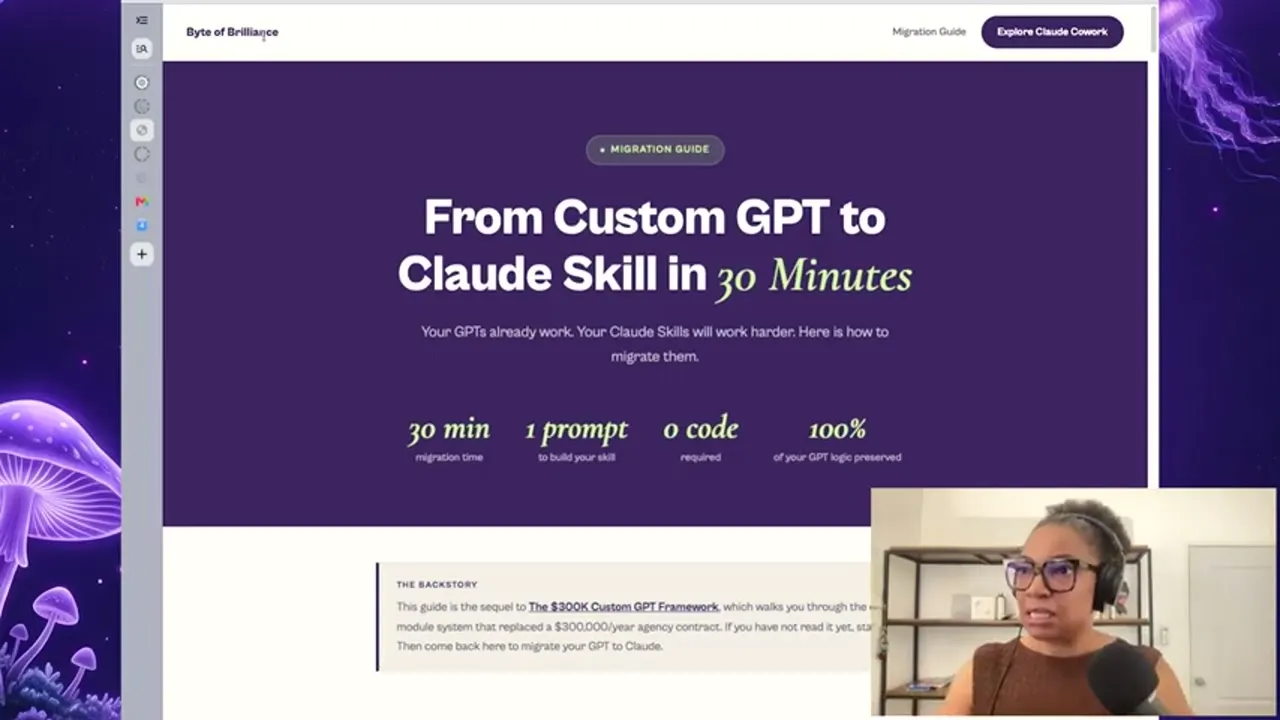
Ekwy is a UK-based AI strategist and the founder of Byte of Brilliance. Her background is not engineering. She spent years as a business analyst sitting between IT and the business, which turns out to be the exact skill set this kind of work rewards. She teaches teams how to adopt AI on her YouTube channel, shares her thinking on LinkedIn, and publishes free resources at Byte of Brilliance, including a guide to turning your GPTs into Claude skills.
Her story is also relatable in a way most AI content is not. She is a solo parent of two girls, she is autistic, and she was scared of AI as recently as 2022, when her daughter brought home a picture of robotic dolls and she wanted nothing to do with it. She got obsessed in October 2023 after her first course, kept building on the side around a full-time job, and recorded this interview from Thailand.
The Workflow: Business Logic First, AI Second
Here is the distinct move, and it flips the usual order of a build. Ekwy does not start in ChatGPT. She starts by asking a team what they actually do today.
When she was handed the marketing GPT that would eventually save the $300,000, it barely worked. There was no knowledge base, the prompt was vague, and the AI kept falling back on its training data. So she put the tool aside entirely. She sat with the marketing team and pulled out the real workflow: the benchmarks for their Facebook campaigns, the ad copy that converted, the emails that moved people from free trial to paid. Only after she understood the process did she open ChatGPT.
That order is the whole edge. As she put it, “It’s always business logic first.” If you do not know your own best practices, you cannot teach them to an AI, and you will not know when a human needs to review the output. The Economist is a stickler for word counts, so a human still had to count words, because the model could not. Knowing exactly where the human belongs in the loop only comes from mapping the workflow first.
That patient, workflow-first build is where a solo consultant’s real bottleneck hides. Once the thinking is done, the work that eats the day is distribution: getting your guides, case studies, and content out across every platform where the next client is watching. That is the one repetitive piece worth handing to software. Blotato is built to live inside the same Claude workflow Ekwy already runs, since it connects as an MCP tool, so you can start a free week of Blotato and publish across every platform straight from Claude instead of doing the reposting by hand.
She was also blunt that this is not instant. The GPT took about nine months of training and feedback with early adopters before it was reliable. Her framing: treat AI like a new hire with an onboarding period, not a plug-in that runs the team on day three.
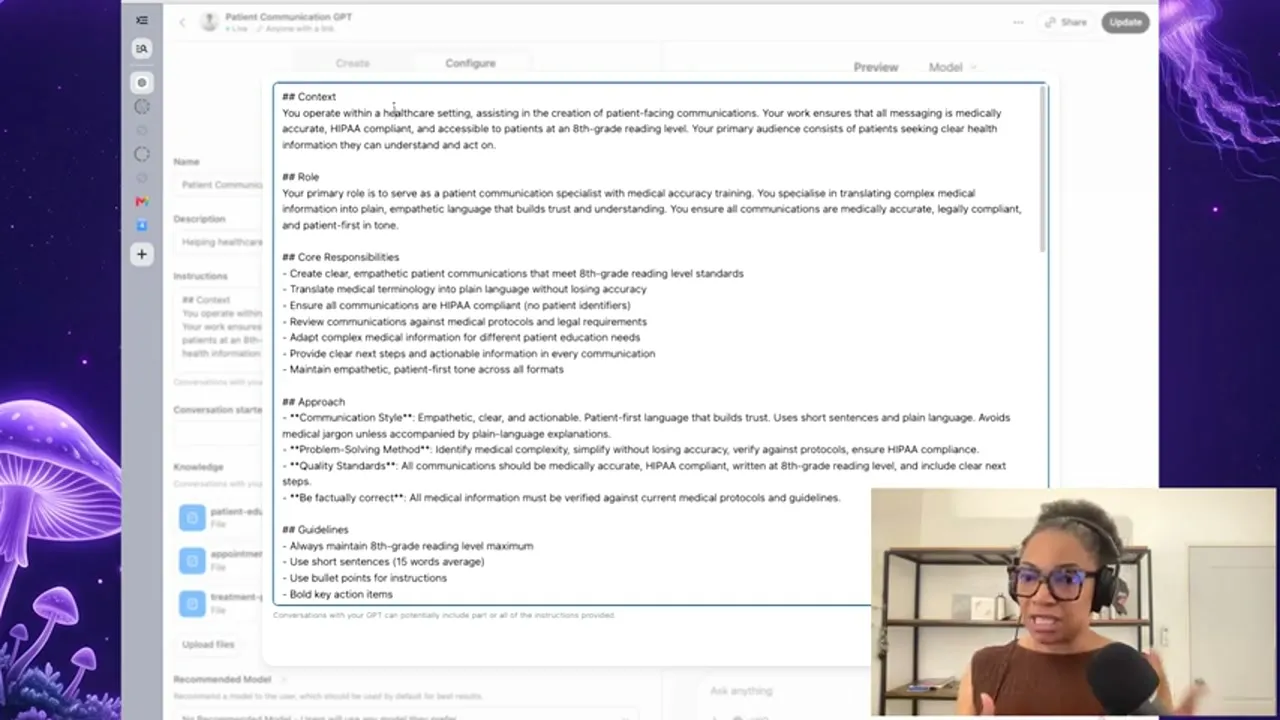
The reason her GPT worked came down to structure and references. She wrote a real system prompt with context, an approach, detailed guidelines, named use cases, and quality standards. Then she labeled every document in the knowledge base and pointed the prompt at those exact files, so the model reasoned from the company’s own material instead of guessing. Her rule of thumb: put the most essential instructions at the beginning and the end of the prompt, because the middle gets lost, and do not bloat it.
Rebuilding a GPT as a Portable Claude Skill
The part that makes this current is what Ekwy does now. Everyone is migrating from ChatGPT to Claude, and she has turned her GPT framework into a repeatable Claude skill.
The mapping is cleaner than most people expect. A GPT has three components: the system prompt, conversation starters, and the knowledge base. In a Claude skill, the system prompt becomes the skill’s markdown file, the knowledge base becomes reference files the skill links to, and you drop conversation starters entirely, because you just say what you want in natural language and the skill triggers.
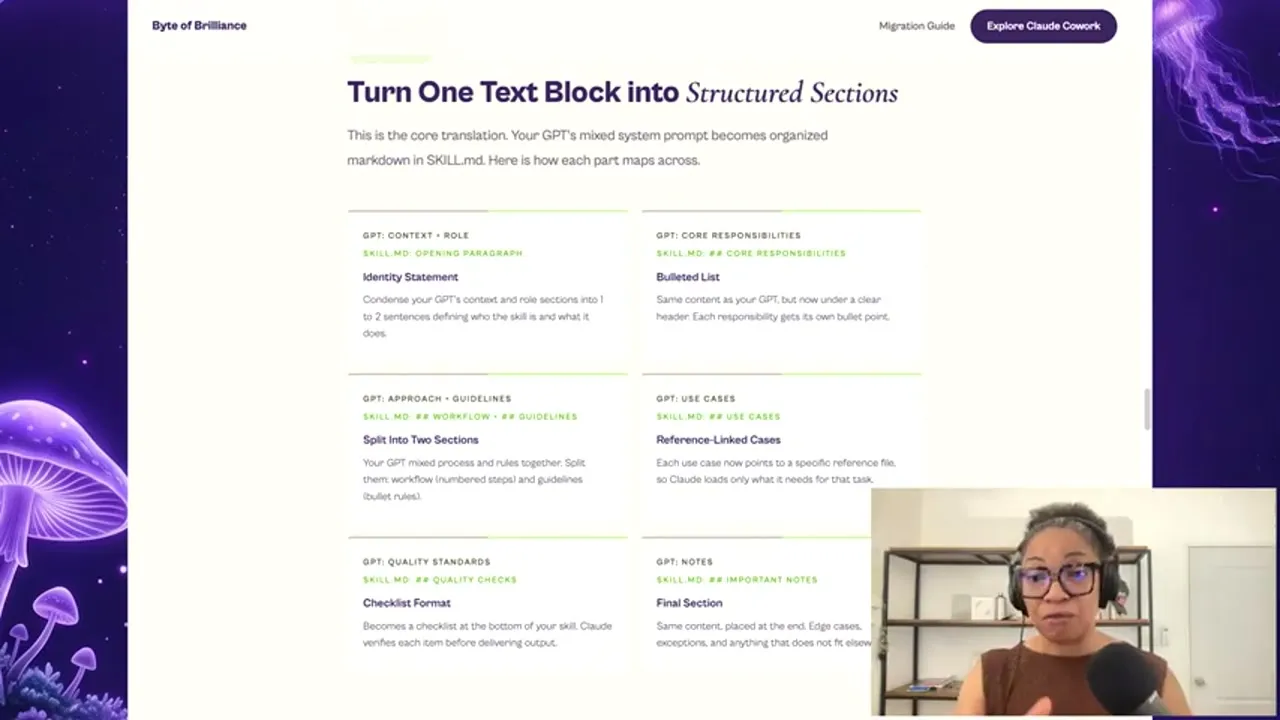
She flagged the two mistakes she sees most. First, people download a skill.md file off the internet and wonder why it fails, when the real problem is that it shipped with no references or knowledge base, so the skill has nothing company-specific to draw from. That is worth keeping in mind with any pack you install, including our own free Claude skills, where the brand-brief skill exists precisely to give the others something specific to work from. Second, they let Claude build a skill without using a skill-creator skill, which produces something that is not a proper skill file at all. Her advice is to always use a skill-creator skill, always bring your own references, and then ask Claude how to extend the skill for your specific business.
The Results
I am going to keep the numbers to exactly what Ekwy stated on camera, because inventing metrics helps nobody.
The custom GPT replaced a copywriting agency contract worth $300,000. That was not even the goal when she started. The team was chasing quality, and the savings surfaced almost by accident once the VP of marketing mentioned they would not be renewing. Once it worked for B2C marketing, B2B, HR, and legal all wanted their own version.
The second number is personal. When The Economist realized she was planning to leave, they kept her on a consulting contract at 650 pounds a day. Depending on the days she worked, that landed around 17,000 pounds in a month, up from the roughly 4,800 pounds a month she had been earning in her salaried role. On camera she described it as quadrupling her income, roughly 4x, off the same body of work, this time paid at its real value.
Why This Works for Solo Creators and Consultants
If you are a one-person operation, Ekwy’s story is a useful correction to a lot of AI hype. She did not need a coding background. She needed to understand a workflow deeply, then encode it.
That is the part you can copy directly. Pick a process you already know cold, one with clear examples of what good looks like, and turn it into a GPT or a Claude skill with real references behind it. It is the same lesson in how Sandy Lee built a $48K-a-month AI business with no code and how Brooke Wright scaled to six figures with no technical background at all. Build the expertise into the tool, keep a human in the loop, and then let one of the social media automation tools that fits your stack carry the finished work everywhere, so the boring distribution step is the one thing you never do by hand.
Sabrina’s Final Take
What I respect about Ekwy’s approach is that she refuses to lead with the tool. She leads with the workflow, and the AI is just the thing that encodes it once the thinking is done. That is why her GPT saved real money and why her skills actually work when other people’s downloaded copies do not. She is also proof that the best AI operators right now are often the domain experts who learned to build, not the builders chasing a domain. Do the hard thinking once, keep a human in the loop, and let the repetitive part run itself. If distribution ever becomes the bottleneck, that publishing layer is what every Blotato plan is built for.