How Marcin Teodoru Gets Paid Twice for Reels He Already Posted
He reposts short-form he already published to Facebook, where it earns a second time. How the move works, and the gate standing in front of it.
Marcin Teodoru posted a screenshot to his Instagram story with a claim I want to take apart rather than repeat. Reposting short-form content to Facebook pages is, in his words, “literally free money. Zero effort, fully automated with Blotato MCP.”
The screenshot under it shows a Meta analytics panel: 3M views and $2.1K in earnings over 28 days. He was not pitching anything. He tagged me to say thanks.
Blotato is an app I built. I founded the company, so take my read on it with whatever grain of salt feels right. His screenshots are his own, and the parts of his setup I cannot see from a screenshot, I say so rather than filling in.
Reposting Short-Form to Facebook Pages Is the Step Most Creators Skip
Almost every creator workflow I see treats distribution as a reach problem. Make the thing, push it everywhere, hope the algorithm picks it up. Facebook gets skipped in that push, on the assumption that nobody under 40 is there and a page with no followers cannot do anything for you.
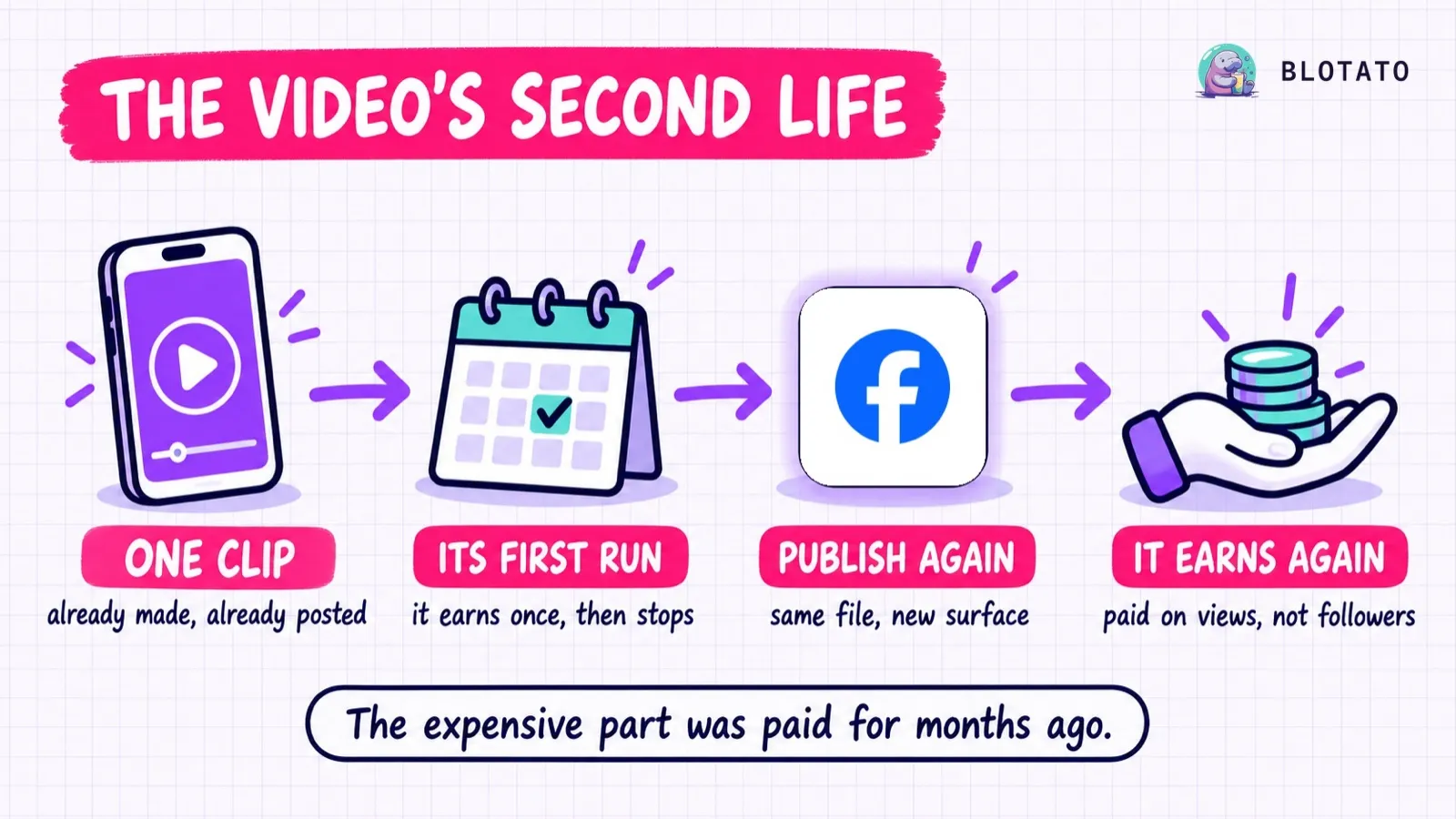
Marcin’s setup inverts that. The content is already made, and it already ran on TikTok or Instagram. Sending it to a Facebook page afterward costs him nothing he has not already spent, and Facebook pays on how content performs rather than on how many followers the page has.
The Number That Actually Matters Here
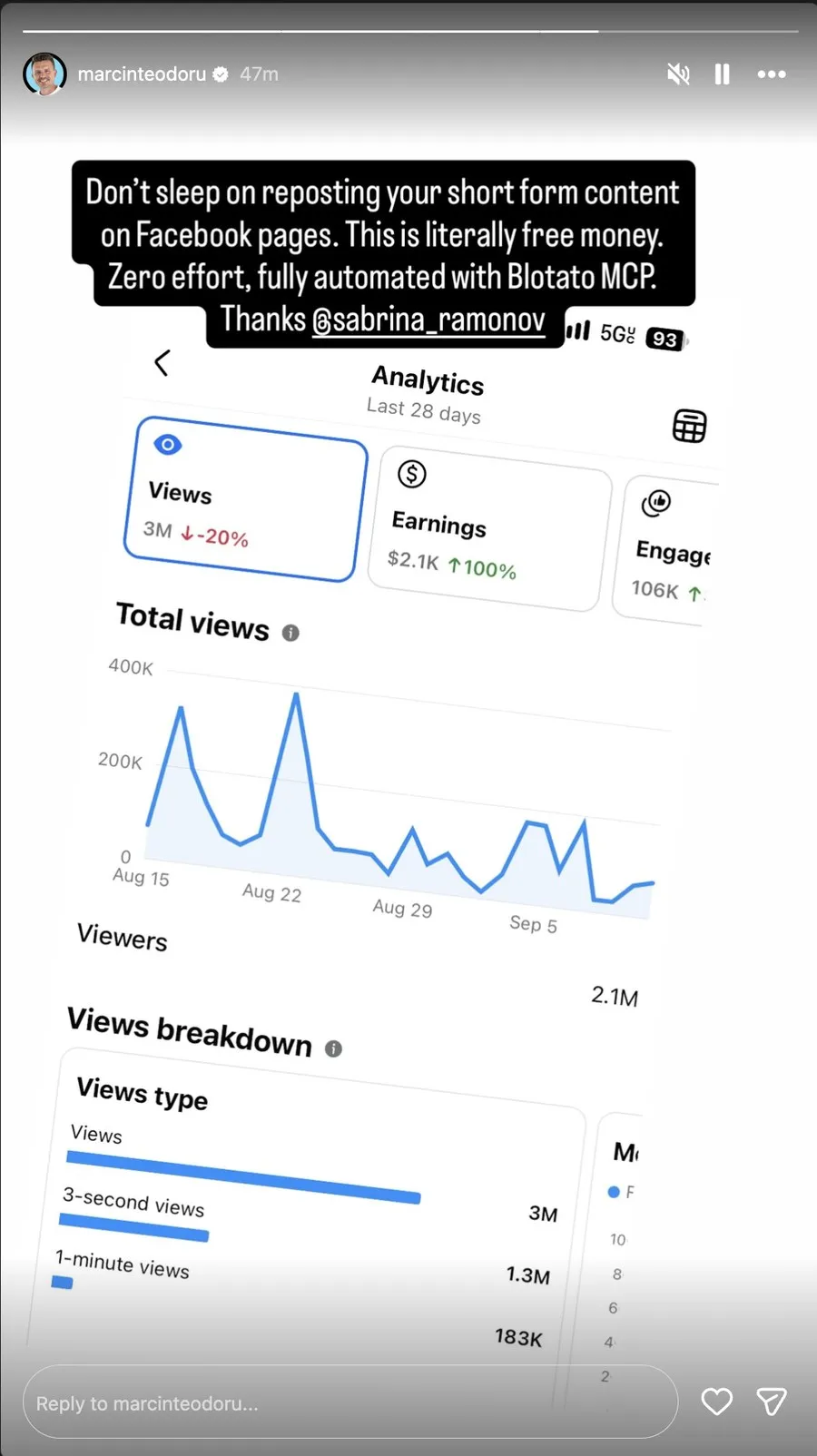
That window runs from roughly August 15 to September 12. Read the two arrows together. Views went down by a fifth while earnings doubled, so whatever moved the money that month, it was not more reach. Meta pays on qualified views rather than raw ones, and there is a second possible reason I get to further down. Either way the takeaway holds: earnings here do not follow view count, so do not plan around a view target.
He also sent a screen of his payout history, which he confirmed is his account. I am not publishing it or adding it up, because the crop carries no platform name, date range, or headers, so I cannot tell you what it covers. One detail in it is worth passing on. Some rows read “Paid” and others read “Not payable.” A number on a dashboard is not money until it clears, which is worth knowing before you plan around anyone’s screenshot, including this one.
If your own back catalog is sitting unused, this is a cheap thing to test, and our pricing is one page. Read one caveat first though. The MCP route Marcin uses runs on the API, and the API is not part of the free trial. Generating an API key ends the trial and starts the paid plan, so if you are copying his setup specifically, plan on starting a subscription rather than trialing it.
Who Is Marcin Teodoru
Marcin runs Marcin AI, where he teaches non-technical people to build software with AI. He says he came out of filmmaking and spent more than a decade building online businesses.
His audience is mostly on TikTok, around 500K followers when I checked in September 2026, with YouTube in the low forty thousands and Instagram at 48.6K. He also runs a paid Skool community, AI Builders. His content is fast-turnaround commentary on new model releases plus build-along tutorials, exactly the kind of catalog that piles up fast and then sits unused.
Worth being straight about one thing: Marcin does not publicly teach social media automation. His lane is app building, and the tools he names on his own site are Lovable, Base44 and Rork. The Blotato part came from his own story, not from anything he sells.
What “Fully Automated” Does and Does Not Mean
Marcin said “fully automated with Blotato MCP.” He did not walk through his setup, so I am not going to invent the steps.
What I can verify is our side. Blotato’s MCP server exposes 35 tools to whatever assistant he has connected, so it can publish a reel to a connected Facebook page inside the conversation he is already working in, without him opening an app. What triggers it for him I do not know, and “fully automated” is doing a lot of work in that sentence. In most setups I have seen there is still a person deciding which clip goes.
One real constraint worth knowing before you copy this, and it is ours rather than Facebook’s: we cap publishing at 25 posts per Page per 24 hours, which is stricter than what Facebook itself allows. Each Page carries its own independent limit. Facebook separately recommends staying under five a day for organic reach. So this scales across pages, not by hammering one.
The Small Page, and Why It Might Not Be the Story
Marcin’s Facebook following is 1.7K, his smallest platform by a wide margin against roughly half a million on TikTok. He said “pages” plural, so I cannot pin the full $2.1K to one page, and Facebook recommends content to people who do not follow you, so the viewers were probably mostly strangers. What I can say is that he did not build a Facebook audience first and monetize it after, because there is not much of one to build on.
That inverts the usual advice. Before you take it too far, here is what complicates it.
In March 2026 Meta launched Creator Fast Track, which pays creators who already have at least 100,000 followers on Instagram, TikTok or YouTube $1,000 a month guaranteed for posting eligible reels to Facebook, rising to $3,000 a month above a million. It hands them immediate access to Facebook Content Monetization, skipping the invite-only queue, and for the first three months the pay is guaranteed rather than earned on performance.
Marcin has around half a million followers on TikTok, so he clears that bar comfortably. I do not know whether he is in the program, and I have not asked him. But I am not going to publish a story about a small page earning money without telling you that a program exists which pays established creators to post to Facebook regardless of how the posts do. If he is in it, the money is following his TikTok audience into Facebook, not appearing out of a 1.7K-follower page. That would also explain earnings doubling while views fell, better than my qualified-views guess does.
What survives either way is the useful part: he is getting paid for videos he had already made and already published somewhere else.
What This Does Not Tell You
Meta’s rules matter here, and they are the reason this works for Marcin specifically. Meta requires that monetized posts be original or meaningfully transformed, and it flags unoriginal or copyrighted reposts. Marcin is reposting content he made, which is squarely fine. If you read “reposting short-form content” as permission to run other people’s videos through a page, that is the thing Meta actively polices, and it is not what this post is describing.
Facebook Content Monetization is invite-only unless you come in through Fast Track. For most readers that is the real gate in front of copying this, and it has nothing to do with which tool you publish with.
A 28-day window is not a run rate. Earnings doubled while views fell in this particular window. One month is not a trend, and payout rates move.
I do not have the prior period in dollars. The panel says earnings doubled, but not from what, so I cannot tell you what this workflow itself is worth.
Facebook Monetization FAQs
Does Creator Fast Track boost your reach, or only your pay?
Both. Meta’s announcement says creators in the program receive “increased reach on eligible reels” alongside the guaranteed pay. That matters when you are reading anyone’s Facebook numbers, because a creator in the program is being handed distribution as well as money, so their view counts are not a clean read on how the content would perform on its own.
Who is Creator Fast Track actually aimed at?
Meta describes it as being for “established creators who are new to or rediscovering Facebook,” and says it exists because creators who built followings elsewhere told Meta that starting fresh on Facebook felt daunting. So it is explicitly a poaching program aimed at TikTok, Instagram and YouTube audiences, not a reward for creators who grew on Facebook.
What happens to your earnings when the guaranteed pay ends?
The guarantee runs three months. After that, Meta says creators keep their access to Facebook Content Monetization and “continue earning from their eligible content,” which puts them back on performance-based payouts. Anyone planning around a Fast Track number should assume the floor disappears at month four.
Do Blotato’s posting limits come from Facebook or from us?
Both, and the stricter one wins, which in this case is ours. The limit worth planning around separately is the one nobody documents on a pricing page: a brand new account needs a manual warm-up period before you connect it to any automation, ours included, or you risk being flagged as a bot rather than throttled.
Sabrina’s Final Take
What I like about this one is how unglamorous it is. No new content, no growth hack. A back catalog that already exists, a second surface that will pay for it, and a publishing step small enough that it stopped being a decision. The reason it reads to him as “free money” is that the expensive part, making the videos, was paid for months ago.
The part I would copy is the reframe, not the tooling. Most people have a folder of short-form that ran once and then stopped existing. Marcin treats that folder as inventory. Getting it onto a paying surface still takes eligibility, rights you actually hold, and possibly a following you built somewhere else, so it is not literally free. It is just much cheaper than making something new, and almost nobody bothers. Start there before you build anything more complicated, and the pricing is on one page.