MCP vs REST API: One Social Media Post, Measured Both Ways
MCP vs REST API for social media posting, measured from Claude Code: the tokens, turns and dollars each path costs, and which one stayed predictable.

The MCP vs REST API question is usually argued about cost. On a real social media publishing job the cost came out within 4%, and the interesting number was somewhere else entirely: across five runs each, the MCP path’s input tokens varied by 321 and the REST path’s by 289,497.
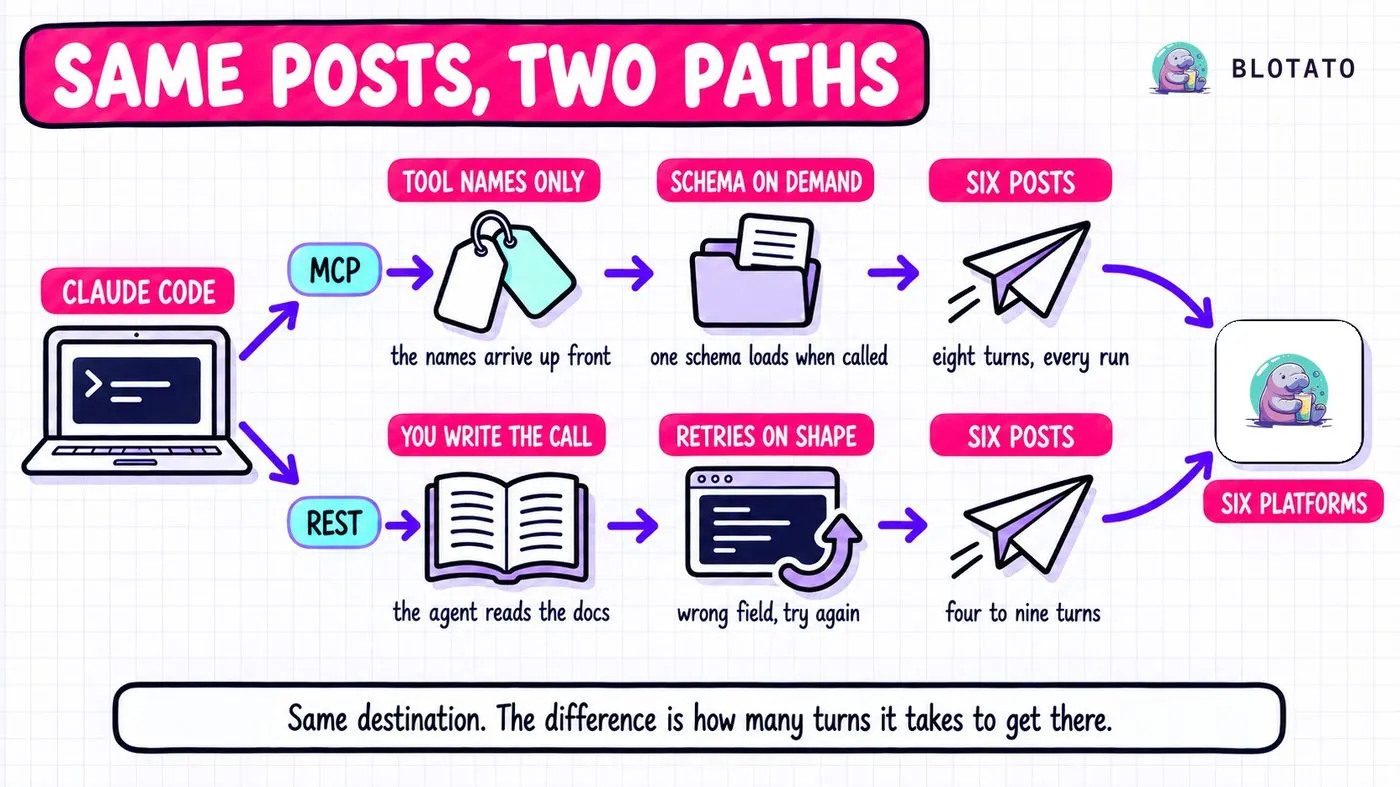
Ryan Doser ran the same job fifteen times from Claude Code on his own connected accounts: five runs over Blotato’s hosted MCP server, five with the agent writing raw curl calls to the REST API, and five from a plain script with no model in the loop. Every run scheduled the same six platform posts. Medians were $0.1020 over MCP and $0.0981 over REST, four tenths of a cent apart.
That is not the answer the ecosystem is selling. The most cited benchmark in this space, Scalekit’s MCP vs CLI comparison, found MCP burning 4 to 32 times more tokens than the equivalent CLI call. I expected to reproduce some version of that and write the honest bad news.
Two things came back instead. The token gap had mostly closed, for a reason that has nothing to do with Blotato and everything to do with the client. And the gap that did show up was about reliability rather than price, which is the half of this argument that actually belongs to the server you point at.
Does MCP Increase Token Usage?
On this job, no, and the run-to-run spread turned out to matter more than either total. MCP’s input tokens moved by 321 across five runs against REST’s 289,497. On the totals themselves MCP used 22% fewer input tokens and landed within 4% on dollars.
| Path | Input tokens (median) | Input-token range | Output tokens (median) | Cost (median) | Turns | Wall time (median) |
|---|---|---|---|---|---|---|
| Blotato MCP server | 143,031 | 143,025 to 143,346 | 2,348 | $0.1020 | 8 every run | 19s |
| REST via Bash + curl | 182,782 | 137,229 to 426,726 | 2,873 | $0.0981 | 4 to 9 | 26s |
| Plain script, no model | 0 | 0 | 0 | $0.0000 | 0 | 1.7s |
Read the spread column before the cost column. The MCP path varied by 321 tokens across five runs. The REST path varied by 289,497.
Be precise about where that second number comes from, because it is the one a skeptic should push on. Four of the five REST runs sat between 137,229 and 183,099 tokens. The fifth hit 426,726. So the spread is one bad draw out of five, not a smooth distribution, and five runs is nowhere near enough to characterise a tail. Worth volunteering the other half too: REST’s best run came in at 137,229 tokens, below MCP’s median. On a good night the REST path is cheaper on tokens as well. That is the honest reading, and the spread is still the number worth budgeting against, because an unattended job is priced by its worst nights and this one produced a worst night in five attempts. The MCP arm never produced one.
The third row is the one nobody puts in these comparisons. A plain Python script making the same six HTTP calls costs $0 in model usage, finishes in 1.7 seconds, and held within three tenths of a second across five runs. Every dollar in the first two rows is what you are paying for a model to be in the loop at all. If your posting job is fully determined, no model needs to be there, and no protocol argument will get you below the floor a for loop already occupies.
If you want to reproduce this, note first that neither path is reachable on the trial: the 7-day trial excludes API access, and generating a key ends the trial and starts the paid Starter subscription. Plan on starting the subscription rather than trialing it.
Why the 4-32x Result Did Not Reproduce
Scalekit’s benchmark is sound and I am not disputing it. It measures something this run no longer contains. Worth adding the half of their result that gets quoted less often: their MCP arm succeeded on 18 of 25 runs against 25 of 25 for the CLI, with every failure a TCP timeout reaching GitHub’s server. Their reliability finding runs opposite to mine, and the difference is a hosted server’s uptime rather than the protocol.
Their MCP arm connected to GitHub’s Copilot MCP server, which exposes 43 tools, and in their words “every time the agent makes a tool call, the entire schema for all 43 tools is part of the conversation context.” Their simplest task cost 1,365 tokens on the CLI and 44,026 over MCP. That gap is almost entirely tool schemas the agent never used.
Claude Code 2.1.267 does not work that way anymore, and the run checked directly rather than assuming. To be clear about whose win this is: deferred tool loading is an Anthropic client feature, not a Blotato one. Any 35-tool server on this client gets the same treatment, and a competitor’s server would too.
Connecting Blotato’s MCP server to a headless run adds 635 tokens of context. All 35 tool names are present and callable. The parameter schemas are not. Asked to recite the required parameters of blotato_create_post without calling anything, the model replied SCHEMA_NOT_LOADED. The schemas load on use, not on connect.
Here is what deferral is saving. Pulled straight off mcp.blotato.com/mcp over JSON-RPC, the full tool list is 35 tools and 64,627 bytes of JSON, and injecting it into a real Claude Code run as context costs 24,200 tokens. Measured three times: 24,194, 24,200 and 24,205.
So the choice on this server is 635 tokens or 24,200 tokens for the same 35 tools, a 38x difference, and the client makes that choice for you. The 635-token version carries the names. The 24,200-token version carries the names and every parameter schema, so roughly 23,600 tokens of that is schema you are holding whether or not the agent calls anything. Scalekit measured a client that loaded everything. This run measured one that defers. Opposite conclusions, and schema-loading policy is what moved between them. Nothing in the MCP specification requires a client to load every schema up front, which is why two clients speaking the same protocol can differ this much on the same 35 tools.
This is the same mechanism Speakeasy documented when it cut token usage by up to 160x with dynamic toolsets, reporting that “schemas often represent 60-80% of token usage in static toolsets.” On Blotato’s server that ratio is higher still. That ratio is why deferral wins so decisively here, and why the answer to “does MCP cost more” now depends on your client version more than your server.
What I Actually Measured
Same image, same six accounts, same scheduled time, three paths, five runs each. The caption text was identical apart from a run tag, for a reason covered below.
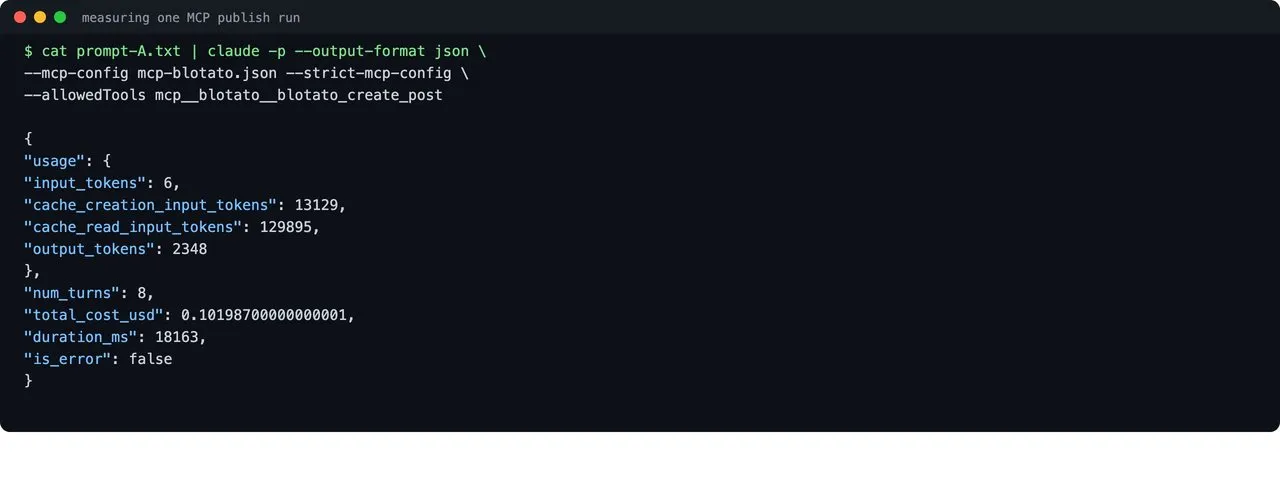
Every run went through claude -p --output-format json on Sonnet, in a fresh session with permissions pre-granted, on 2026-09-10. Dollar figures are whatever Claude Code itself reported in total_cost_usd for that run, so they move with model pricing. The token counts do not. It reports input_tokens, cache_creation_input_tokens, cache_read_input_tokens, output_tokens, num_turns and total_cost_usd per run. Input tokens in the table above are the sum of the three input fields, since cached reads are still tokens the model processes and still appear on the bill at a reduced rate. Anthropic’s token counting documentation covers how those fields relate.
The MCP arm ran with --mcp-config pointing at mcp.blotato.com/mcp and --strict-mcp-config so no other server could leak in, with --allowedTools mcp__blotato__blotato_create_post. The REST arm ran with an empty MCP config and --allowedTools Bash, so the agent had to write the HTTP call itself. Both arms got identical account IDs and platform fields in the prompt, so neither was paying to discover them.
Two things I would do differently, stated plainly because they bound what this measures.
Ryan ran these on his own connected accounts, and his workspace has six platforms connected, not nine. Blotato publishes to nine platforms, but Threads, Bluesky and Pinterest were not connected on the account I had, and the remaining rows belonged to a client. Every post was scheduled far in the future, confirmed to a terminal scheduled status, then deleted. Nothing reached a feed. Six real platforms with six real sets of required fields is a fair test of the fan-out, but it is six, not nine, and a nine-platform run would add 50% more tool calls to both arms.
The second one is a trap worth naming. An early repeat run returned six submission IDs byte-identical to the run before it, against a prompt that was byte-identical too. Nothing new had been scheduled. Every run after that carried a unique tag in the caption so no two prompts could match, which is why the caption is not quite identical across runs. If you benchmark this yourself and your numbers look suspiciously stable, vary something in the prompt before you trust them.
Where the REST Path Loses Its Money
The REST arm’s spread is not random. It is retries, and in every run inspected the retries had the same cause.
Blotato’s POST /v2/posts puts platform-specific fields in target, not in content. TikTok needs privacyLevel and four booleans there. YouTube needs title and privacyStatus. Facebook needs pageId. Put them one level off and the API returns a clean 400 naming the missing property, which is good API design and exactly what tripped the agent.
The first hand-written calls hit it too, before the runs started. Facebook, TikTok and YouTube all returned body.post.target must have required property..., from someone who had read the docs.
On the MCP path that class of error did not occur once. The tool schema is the contract, the agent fills named parameters, and every one of the five runs took exactly 8 turns. On the REST path the agent is authoring JSON against a shape it has to hold in its head, and when it guesses wrong it reads the error, rewrites the body and calls again. Four turns on a good run, nine on a bad one, and the 426,726-token run is one long argument with a payload shape.
That is the trade this run measured. REST gave a marginally cheaper median and a much wider spread. MCP gave a slightly more expensive median and a flat one.
What This Does Not Show
This is one job on one server measured on one day, and it does not generalize as far as the table makes it look.
It does not show that MCP is cheaper in general. It shows that on a 35-tool server, with a client that defers schemas, on a task where the agent already knows every ID it needs, the schema-loading penalty that drives the published benchmarks is not present.
It does not show anything about tool discovery. The prompts named every account ID and every required field, so a run that has to call blotato_list_accounts first would shift the comparison toward MCP.
It measured scheduling, not publish latency, because nothing published. Immediate publishing is asynchronous and would add polling to both arms equally.
And it does not tell you your bill. Counting one platform post as one post, a thousand of them a month works out to roughly $17 of model spend on the MCP path and $16 on the REST path, since each run here published six. Both of those are model costs sitting on top of your Blotato plan, and both of them are $0 if you write the loop yourself.
The Honest Pitch: One Key, Every Platform
The bias disclosure belongs here rather than in the footer: I helped build Blotato. The reason this experiment was cheap to run is the reason I think the product is worth paying for: one credential covers all nine platforms, so a fan-out is six or nine calls against one contract rather than six or nine vendor integrations with their own auth, their own approval queues and their own bills.
One API. Every social platform.
curl -X POST https://backend.blotato.com/v2/posts \
  -H "blotato-api-key: YOUR_API_KEY" \
  -H "Content-Type: application/json" \
  -d '{
    "post": {
      "accountId": "YOUR_ACCOUNT_ID",
      "content": {
        "text": "Posted through one managed API.",
        "mediaUrls": [],
        "platform": "twitter"
      },
      "target": { "targetType": "twitter" }
    }
  }'
accountId is not something you invent. It comes from GET /users/me/accounts, and Facebook and LinkedIn Page IDs come from the subaccounts array on that same response. On the MCP path you never touch any of it, because the agent calls blotato_list_accounts and passes the right ID itself. The full surface is in Blotato’s API reference.
The MCP server lives at mcp.blotato.com/mcp. In Claude Code that is one command, then /mcp and Blotato > Authenticate to complete the OAuth handshake:
claude mcp add \
  --transport http \
  Blotato https://mcp.blotato.com/mcp
Claude Desktop, Cowork and Claude.ai web authenticate the same way. Cursor, Codex, Antigravity and Replit Agent pass a blotato-api-key header instead. Check the per-client setup docs before pasting anything, because the config field names differ by client and a copied config from the wrong one fails silently. On a client that defers schemas, connecting it costs 635 tokens rather than the 24,200 a full load would, which is a property of the client and would hold for any server this size. Point your agent at it once you are on a paid plan, per the trial caveat above.
One limit worth knowing before you plan a volume run: Blotato applies its own anti-spam posting caps that are stricter than several platforms’ own. Instagram is 50 posts per 24 hours where Meta’s own documented limit is 100 in a 24-hour moving period. Facebook is 25 per Page. Pinterest is 10 pins a day. Those are ours, not passed through, and they will bind before any token budget does.
Which Path I Would Actually Pick
If an agent is deciding what to post, use MCP. The schema is the contract, and the contract is what held every run to 8 turns. You are buying a flat tail, not a cheaper median. The cost tie may not survive the next Claude Code release, since it rests on a client behavior Anthropic controls. The turn-count consistency rests on the tool schema, which is the part a server actually owns.
If your code already knows exactly what to send and nothing needs deciding, do not put a model in the path at all. Write the six calls. The script row costs nothing, finishes in under two seconds, and is the correct answer more often than either protocol camp likes to admit.
If you are somewhere in between, which is most people, the useful question is not MCP or REST. It is which of your steps genuinely need a model, and the answer is usually the drafting and almost never the publishing. I wrote up the interface-level version of that argument in social media API vs MCP, and the MCP server comparison covers what each server in the category actually exposes. If your bottleneck is caps rather than cost, the social media API rate limits guide is the more useful page.
MCP vs REST API FAQs
Is MCP just a REST API?
No, and the distinction is about who the caller is. A REST API is an endpoint your code calls with a body you construct. MCP is a protocol an AI agent speaks to a server, and that server almost always calls a REST API underneath. In this experiment both paths hit the same POST /v2/posts endpoint. The difference was whether the model wrote the JSON or filled in a named tool schema.
How is MCP server different from REST API?
An MCP server publishes typed tool definitions the agent can call by name, while a REST API publishes endpoints you send bodies to. That difference showed up as turn count in my runs: the MCP arm took exactly 8 turns every time because the schema constrained the call, while the REST arm ranged from 4 to 9 turns because the agent had to get the payload shape right on its own.
Why use MCP server instead of API?
Predictability and discovery. On a fan-out where the agent already knows every ID, MCP landed within 4% of REST at the median and its input tokens varied by 321 across five runs, against 289,497 for the REST path. If your agent also has to find out what accounts exist, MCP widens its lead, because listing and describing capabilities is what the protocol is for.
How do I reduce MCP token usage?
Check whether your client already defers tool schemas before optimizing anything. Claude Code 2.1.267 loads tool names only, which put Blotato’s 35-tool server at 635 tokens instead of 24,200. If your client loads all schemas eagerly, limit which tools are exposed per session, connect fewer servers at once, or use a server that supports dynamic toolsets.
Does connecting more MCP servers cost more tokens?
On a deferring client, only by the size of the extra name listing, which is small. On a client that loads full schemas, yes, and it compounds, because every connected server’s complete tool definitions sit in context on every call whether the agent uses them or not. That is the scenario the widely cited 4-32x benchmarks measure, so check your client’s behavior before assuming those numbers describe your setup.