Postiz vs Ayrshare: Social Media Calendar or Embedded API?
Postiz vs Ayrshare turns on one question price cannot answer: are the social media accounts yours, or your customers'? That decides it first.
Postiz vs Ayrshare almost always gets compared on price, and price is the part that tells you the least. One brand on five networks runs $29 a month on Postiz and $149 on Ayrshare. Ten client brands run $99 against $299. Postiz is cheaper at every size you are likely to buy.
That gap looks like a verdict. It is closer to a category label.
These two tools are answering different questions. Postiz is a calendar you operate, scoped to your organization, behind one API key. Ayrshare is infrastructure you embed in a product, where the thing you pay for is a customer and your end users connect their own accounts.
Ask which is cheaper and you get a number. Ask who the accounts belong to and the choice usually makes itself.
One conflict to state plainly before I go further: Blotato is a product I built, so it competes with both tools here. It gets one clearly marked section near the end, and you can skip it without losing the answer. Most of this post is about Postiz and Ayrshare.
Postiz vs Ayrshare: Who Owns the Accounts?
Postiz is the better pick if: the social accounts are yours or your employer’s, you want a calendar and an AI copilot in the box, and you would rather pay $29 a month than $149 for a publishing layer you will operate yourself. Self-hosted, the software is free.
Ayrshare is the better pick if: the accounts belong to your customers, each of whom needs to connect their own Instagram and TikTok inside your product without ever seeing your dashboard. That is a different job, and Postiz has no native answer for it at any tier. You can see how a flat hosted plan compares further down.
One API Key, or One Key Per Customer
This is the mechanism, and it is the part most comparisons leave out.
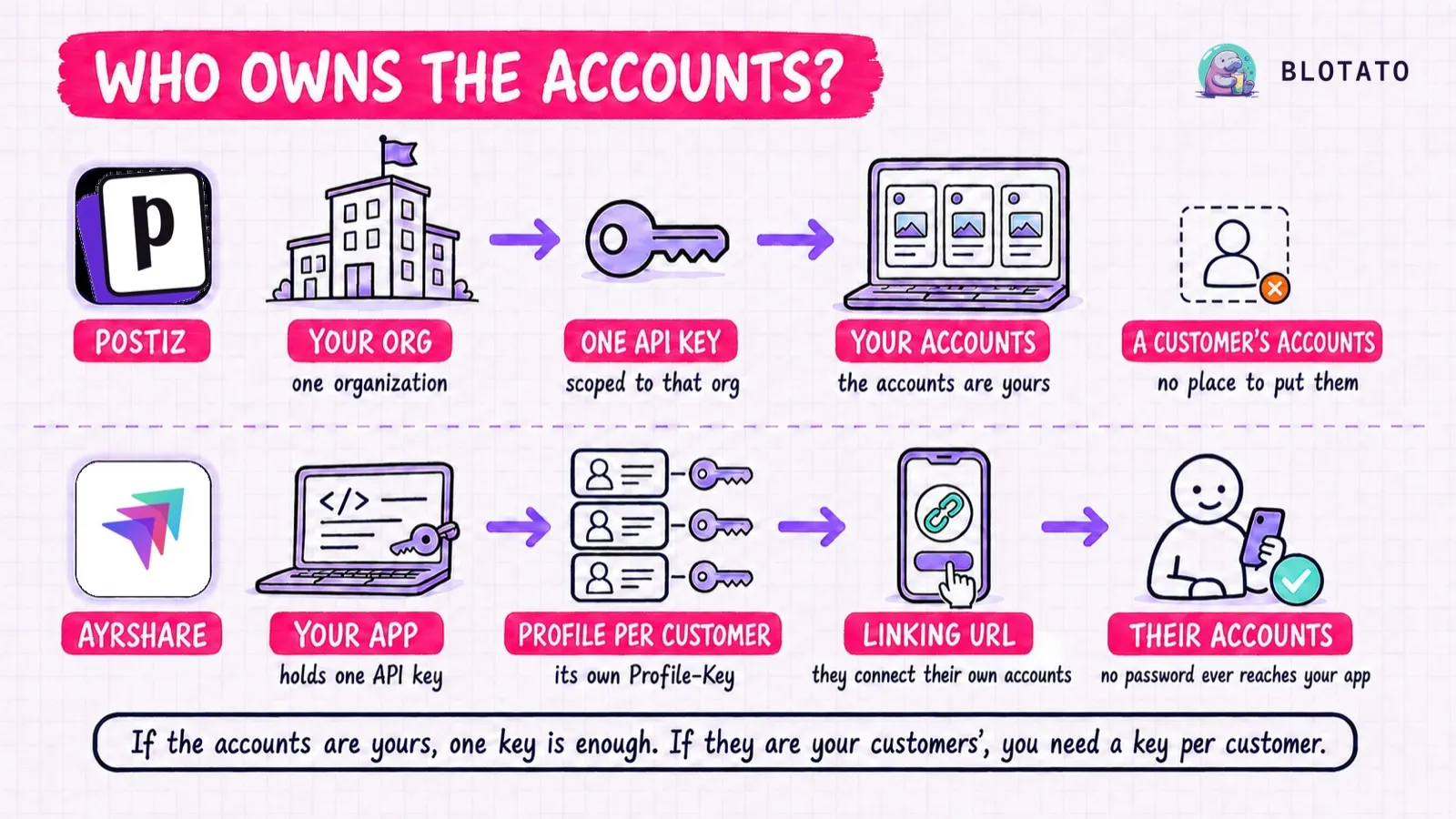
Postiz authenticates with a single API key tied to your organization. Every channel you connect lives under that organization, and the API tells you so when you cross the line: Postiz’s own error table documents a 403 Forbidden for the case where “the API key is valid but doesn’t own the resource (e.g. you tried to delete a post in another organisation).” That is the correct behavior for a tool you run for yourself. It is a wall if you are building for other people.
Ayrshare inverts it. The billing and access unit is the User Profile, one customer or brand, and each profile gets its own Profile-Key. Its docs are explicit that endpoints like /user, /analytics and /delete are called on behalf of a profile “by adding the Profile-Key parameter in the Header.” Your code holds one API key. Each of your customers is a profile underneath it.
The part that makes it embeddable is the linking flow. Ayrshare’s generateJWT endpoint creates a social-linking URL for a specific profile, so your customer clicks a link inside your product, authorizes their own Instagram or TikTok, and lands back in your app. They never see your Ayrshare dashboard. You never touch their password.
The pricing page does not spell out what happens next, and it changes the budget. Every plan bills in social profiles, and Premium includes exactly one, which is your own. But the multi-profile machinery, the User Profile endpoints and the generateJWT linking URL, is gated to the Business tier group, which its profile docs render as Launch, Business and Enterprise. So a single profile costs $149, and the ability to give a second customer their own costs $299 a month.
What Postiz Does Well, and Where It Stops
Postiz is AGPL-3.0 licensed, sits past 35,000 GitHub stars, and has been maintained under the Gitroom org since mid-2023. Self-host it and the software costs nothing forever. Take the cloud and you skip the servers.
Cloud pricing runs $29 a month for 5 channels, $39 for 10, $49 for 30 and $99 for 100. Postiz says annual billing “saves about 20%”, and its plan docs put the yearly totals at $278, $374, $470 and $950. Every tier includes the REST API, webhooks, the AI copilot and analytics, which is unusual: plenty of tools in this category gate the API behind a higher plan.
What you get beyond publishing is a product: a calendar, a picture editor, an AI copilot that writes, metered image generation, and video. That included interface is a real saving over building your own.
Where it stops is engagement, and nothing in the product or the API gives you an inbox. Its MCP documentation is blunt about the agent path: “There is no getComments or replyToComment exposed via MCP. Comment replies must be triggered through the Postiz UI.”
The two features whose names suggest otherwise are something else. “Post comments” on the pricing card means scheduling a follow-up comment on your own post, and the Comments feature is a client-approval box. Neither reads a message from a customer.
Analytics is narrower than the platform count suggests too. Postiz’s analytics documentation states that “Only 10 of the 34 platforms report analytics back to Postiz,” and adds that LinkedIn analytics “are available for Pages, not personal profiles, because that is what LinkedIn’s API exposes.”
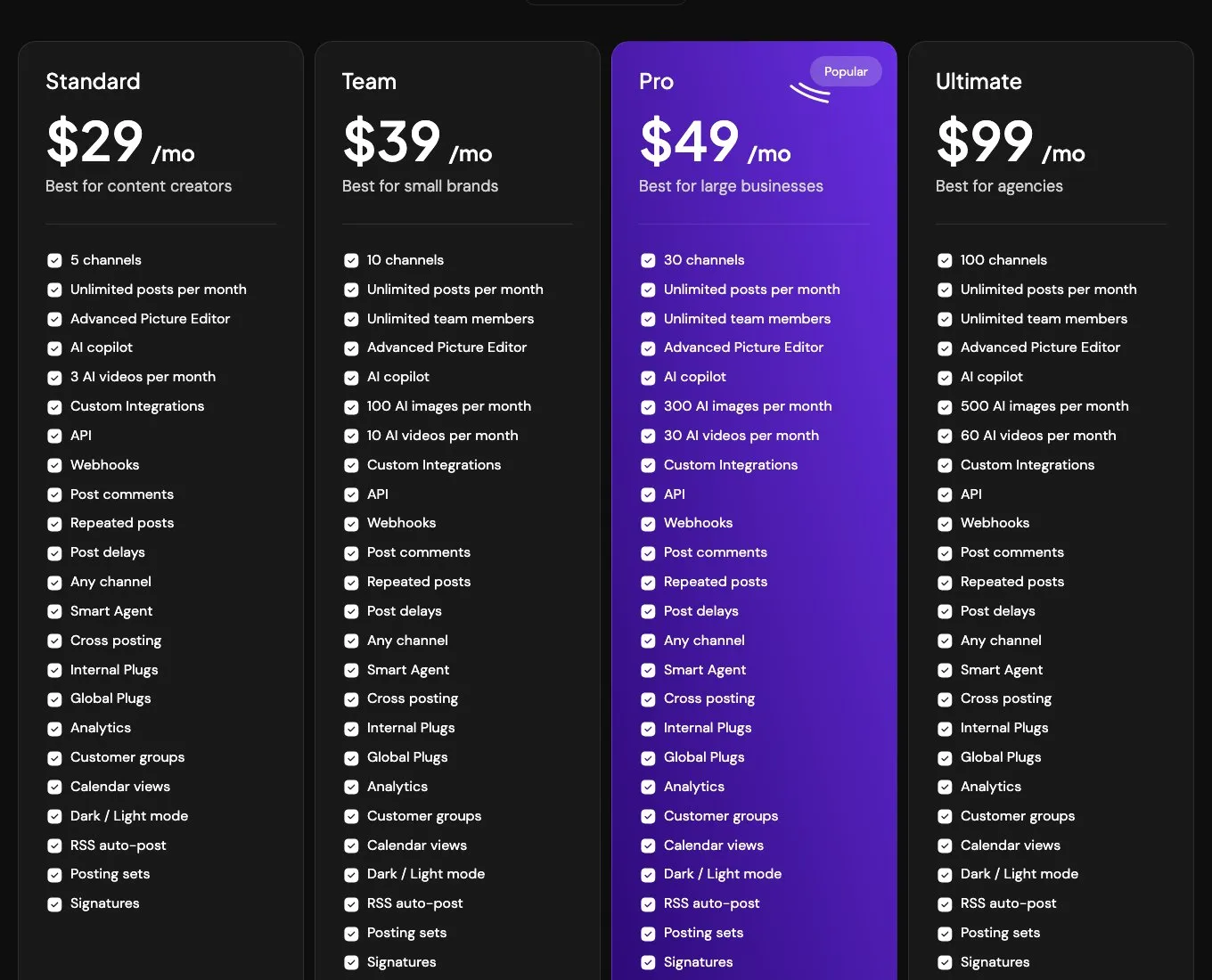
One live oddity to check before you commit to a volume. Every Postiz tier card says “Unlimited posts per month,” including the $29 Standard card. The FAQ further down that same page, answering what each plan includes, says “Standard - $29/mo. 5 channels, 400 posts/month.”
Both are live as I write this. If your volume sits near 400 posts a month, get the number in writing. I go deeper in my tier-by-tier read of what Postiz actually meters.
How Ayrshare Charges for a Customer Instead of a Channel
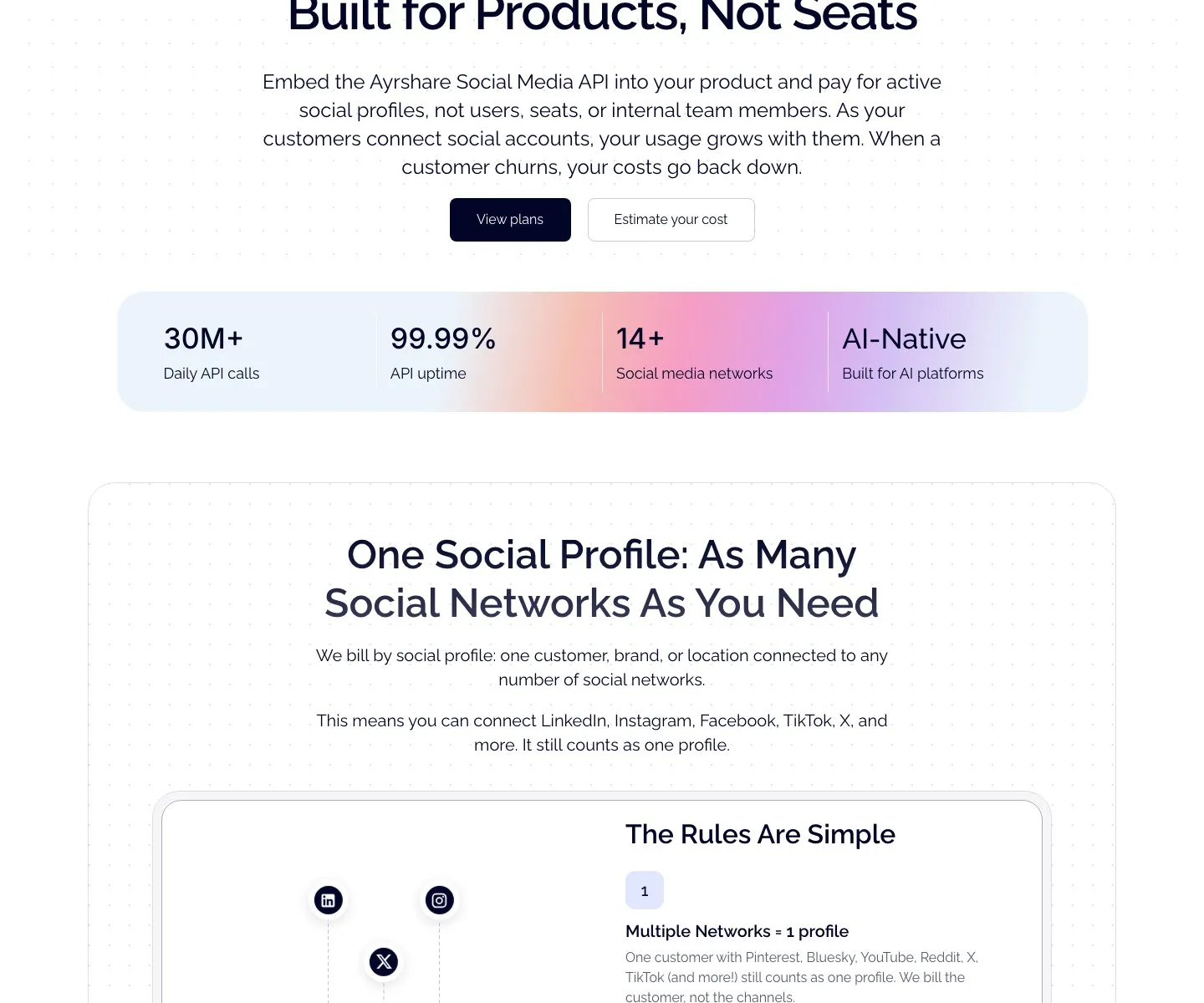
Ayrshare prices per social profile, where a profile is one customer, brand or location connected to any number of networks. Its rate card puts it in five words: “We bill the customer, not the channels.” A client posting to six networks costs the same as a client posting to one.
Premium is $149 a month for a single profile. Launch is $299 for up to ten. Business starts at $599 and includes thirty, with tiered rates above that up to three hundred. Add-ons sit on top: Max Pack at $300 a month, Facebook Boosted Ads at $100.
The trial is worth naming because it is unusual in this category: 28 days on Launch, no credit card, and it includes full Business access plus Max Pack. Premium and Business bill at signup with no trial.
Ayrshare publishes to 13 platforms in its POST /post enum: Bluesky, Facebook, Google Business, Instagram, LinkedIn, Pinterest, Reddit, Snapchat, Telegram, Threads, TikTok, X and YouTube. Its marketing says “14+”, which counts WhatsApp, and WhatsApp is messaging rather than publishing. Its own comparison pages use 13 when they do arithmetic.
On engagement it does the thing Postiz does not. Comments across nine platforms, and DMs on Facebook, Instagram, X and WhatsApp, the last in private beta.
Two things work against it, and both are about the shape of the ladder. If you are scheduling your own accounts, $149 buys you a publishing API and none of the multi-tenancy you are paying for. And profile eleven moves you from $299 to $599, which is a real cliff rather than a gentle curve. The full ladder including the overage bands is worth reading before you model a year.
The Feature Split That Actually Decides This
| Category | Postiz | Ayrshare |
|---|---|---|
| Billing unit | Per channel, tiered | Per social profile (one customer) |
| What a “unit” means | One connected account | One brand on any number of networks |
| Entry price | $0 self-hosted, or $29/mo cloud | $149/mo (1 profile) |
| Multi-tenancy | No, one org per API key | Yes, Profile-Key per customer |
| End-user account linking | No | Yes, generateJWT linking URL |
| Multi-tenancy available from | n/a | $299/mo Launch, not $149 |
| Platforms | Low 30s (32 in its API docs, 34 elsewhere) | 13 in the publish enum |
| Engagement inbox | None | Comments on 9, DMs on 4 |
| Analytics | 10 of 34 platforms | Included per profile |
| AI generation | Text, images, video, metered | No |
| Self-hosting | Yes, AGPL-3.0 | No |
| Free trial | 7 days (cloud) | 28 days on Launch, no card |
Two rows decide most of this, and neither is the price row. Multi-tenancy is a yes or a no, and an inbox is a yes or a no. Everything else is a preference you can live with either way.
The Price Gap, and What the Extra Money Buys
Postiz is cheaper at every comparable size. That is worth stating plainly rather than burying.
Postiz bills per channel and Ayrshare per brand, so any comparison has to fix the number of networks each brand uses. Five is a realistic figure, and that is what these rows assume.
| What you are running | Channels | Postiz | Ayrshare |
|---|---|---|---|
| 1 brand, 5 networks | 5 | $29/mo (Standard) | $149/mo (Premium) |
| 3 brands, 5 networks each | 15 | $49/mo (Pro) | $299/mo (Launch) |
| 10 brands, 5 networks each | 50 | $99/mo (Ultimate) | $299/mo (Launch) |
| 30 brands, 5 networks each | 150 | Above its top plan | $599/mo (Business) |
At one brand it is 5.1x. At ten it is 3x. Then at thirty the comparison stops working, because 150 channels is more than Postiz sells on any published tier, while Ayrshare is still on a standard plan. Run Postiz on your own box and the license column is zero the whole way down, though the server and the maintenance are not.
So what does the 3x to 5x buy? Two things, and if you do not need them you should not pay for them. It buys the profile boundary, which is the difference between your customers’ accounts being separated by your own code and being separated by the vendor. And it buys the engagement half of the loop, which Postiz does not sell at any tier.
There is a third cost that appears in neither column, and multi-tenancy is where it bites hardest. Self-hosting Postiz makes you the registered developer app for every network you touch, and Postiz’s own pricing FAQ is candid that the Meta and YouTube reviews are the slow ones. That is survivable once, for your own accounts. It is a different proposition when each new customer arrives expecting their networks to work on day one and your app review is the thing standing in the way.
When Postiz Is the Obvious Answer
- The accounts belong to you or your employer, and always will.
- You want a calendar and an editor in the box rather than building an interface.
- You need generation and publishing from one subscription.
- You want the source, and you have someone who can run Postgres, Redis and Temporal.
- You publish to somewhere unusual: Mastodon, Discord, Nostr, or a blog target like Dev.to.
When the Cheaper Tool Is the Wrong Tool
This is the reverse of the mistake most comparisons warn about, and it is the more expensive one.
- Your customers connect their own accounts. One API key scoped to one organization has no place to put them.
- You need a customer’s data to leave when the customer leaves. Ayrshare’s model is delete the profile and billing stops. On Postiz, offboarding is your code’s problem.
- Your product needs to read and answer DMs. Postiz has no inbox, and its MCP cannot read or reply to comments.
- You are selling social publishing as a feature of your own software. The linking URL is the piece you would otherwise build and maintain yourself.
If two or more of those are true, the $29 plan is not a cheaper version of Ayrshare. It is a different product, and the gap is work you would be writing yourself.
Where Blotato Fits, and Where It Does Not
Disclosure again, since this is the section where it matters: Blotato is mine.
We sell a hosted API and MCP surface at mcp.blotato.com/mcp, $29 a month flat, 20 connected accounts, 9 publishing platforms. Analytics covers 8 of those 9, LinkedIn being the exclusion, and comments and messaging cover Instagram and Facebook only.
On the question this post is actually about, we lose. Blotato has no customer-profile model. There is no Profile-Key, no sub-profile, and no linking URL your end users click. Accounts connect to your Blotato account, which is the same single-tenant shape Postiz has. If you are building a product where your customers bring their own Instagram, we do not have the primitives for it and you should not pick us for that job.
We compete on the other side of the split. Against Postiz the trade is ownership versus operations: it has no licence fee and no vendor to reprice it, and we are a subscription with a server you never see. Against Ayrshare, for your own accounts, $29 flat for 20 of them is a lower bill than $149 for one profile.
One caveat if you came here to evaluate an API: ours is the one thing the 7-day trial does not cover, and the moment you generate a key the trial converts to a paid Starter subscription. Budget for the subscription rather than the trial. What each plan includes is spelled out on the pricing page.
Ask Who the Accounts Belong To
Every other question here is downstream of that one. If they are yours, Postiz is cheaper, ships more product around the API, and is free if you will run it. If they are your customers’, the price gap stops mattering, because the cheaper tool does not sell the thing you are buying.
The trap is that both products publish social posts, so they demo identically for about ten minutes. The difference shows up on the day your second customer signs up. For a wider field on either side, my rundown of who else bills per customer rather than per channel covers the category, and if Postiz is the one you keep circling, what the alternatives look like once you stop self-hosting runs the full list.
Postiz vs Ayrshare FAQs
Is Postiz cheaper than Ayrshare?
Yes, at every size it covers. One brand on five networks is $29 a month on Postiz against $149 on Ayrshare, and ten brands on five networks each is $99 against $299, though Postiz bills per channel so those figures assume five networks per brand. Self-hosted Postiz is free in license fees at any count. The gap is real, but it compares a single-tenant calendar against multi-tenant infrastructure, so it only holds when the accounts are yours rather than your customers’.
Can Postiz manage social accounts for my customers?
Not in the way a product needs. A Postiz API key is scoped to one organization, and its own docs return a 403 Forbidden when a key touches a resource in another organisation. There is no end-user linking flow, so your customers cannot authorize their own accounts inside your app. Ayrshare is built for that case, using a Profile-Key per customer and a generateJWT linking URL.
Which Ayrshare plan do I need for multiple customer profiles?
Launch at $299 a month or above. Ayrshare’s docs gate the User Profile endpoints and the generateJWT linking URL to the Business tier group, which its own plan component renders as Launch, Business and Enterprise. Premium at $149 includes a single social profile, which is your own, but not the machinery for giving each customer theirs. So the multi-tenancy that is the main reason to choose Ayrshare starts at $299, not at the advertised entry price.
Does Postiz have a social media inbox?
No. Postiz’s MCP documentation states there is no getComments or replyToComment exposed, and that comment replies must be triggered through its UI. The “Post comments” feature on its pricing cards means scheduling a follow-up comment on your own post, and its Comments feature is a client-approval workflow. Ayrshare covers comments on nine platforms and DMs on Facebook, Instagram, X and WhatsApp.
How many platforms does each one support?
Ayrshare publishes to 13, which is what its POST /post enum contains. Its “14+” marketing figure counts WhatsApp, which is messaging rather than publishing. Postiz sits in the low thirties and disagrees with itself on the exact number, listing 32 in its public API documentation and 34 elsewhere. Postiz reaches more destinations, including blogs and communities that are not social networks in the usual sense.
Does either one have a free trial?
Both, on very different terms. Ayrshare gives 28 days on the Launch plan with no credit card, and the trial includes full Business access plus the Max Pack add-on. Postiz gives a 7-day trial on its hosted plans, and separately you can self-host the open-source edition free forever, which is the more common way people evaluate it.