8 Best Postiz Alternatives When You're Done Self-Hosting (2026)
The best Postiz alternatives in 2026, with the rate-limit and MCP claims checked against each vendor's own docs, not repeated from other roundups.

Almost nobody goes looking for Postiz alternatives because $29 a month is too expensive. They go looking on the Saturday they spend fixing a Temporal container instead of posting. Postiz is good software, genuinely open source, and free if you run it yourself. The license is free. The maintenance is the invoice. Blotato is my top pick below for people who have decided to stop paying that invoice in weekends, and I am the founder, so judge that entry on the math rather than my word. If you want the short version, you can compare the plans yourself in about ten minutes.
Before the list, one correction that will save some of you the switch entirely. The “Postiz is capped at 100 requests per hour” line you have read on half the comparison pages in this category is wrong, and I walk through Postiz’s own documentation on it further down. Every MCP endpoint in the table below was probed directly rather than taken from a rival’s page.
Quick Comparison: 8 Best Postiz Alternatives
| Tool | Best For | Starting Price | Hosted MCP server | Key Strength |
|---|---|---|---|---|
| Blotato | Creators who want AI writing, images, and video bundled at one flat price | $29/mo | Yes, mcp.blotato.com/mcp (35 tools) | 20 social accounts, unlimited AI writing, and a hosted MCP server at one flat rate |
| Mixpost | Teams who want to keep self-hosting but own the license outright | $299 one-time | No, ships inside the self-hosted license | Self-hosted with no recurring bill and no AGPL copyleft obligation |
| Publer | Solo operators who want cheap, reliable scheduling without servers | $5 first account, $4 each additional | No | Bulk scheduling and a genuinely free tier, hosted by someone else |
| Buffer | Creators posting to 3 channels who want the simplest possible tool | Free, then $6/channel/mo ($5 annual) | Yes, mcp.buffer.com/mcp | The most reliable publishing engine in the category |
| Metricool | Marketers who need real analytics alongside scheduling | Free, then about $20/mo annual | Yes, ai.metricool.com/mcp | Reporting depth that open-source schedulers do not match |
| SocialPilot | Small agencies managing client accounts on a budget | $30/mo | Yes, mcp.socialpilot.co/mcp | Client approvals and white-label reports |
| Blotato Agency | Agencies who want AI creation across many brands | $499/mo | Yes, same endpoint and tool set | 28,000 AI credits and dedicated support across client accounts |
| Hootsuite | Enterprise teams with a compliance and reporting mandate | About $99/user/mo, billed annually | Yes, four separate servers | Deep reporting and enterprise governance |
Every endpoint in that column was probed directly on 6 August 2026 with a JSON-RPC initialize call. A live server behind authentication answers 401. Publer’s returns 404, and mcp.mixpost.app does not resolve at all, which is the expected result for Mixpost rather than a failure: it ships MCP inside the self-hosted Pro license, so there is no vendor endpoint to point a URL at.
Why People Are Looking for Postiz Alternatives
The reason is almost never price, and any roundup that treats price as the motive has misread the room.
Postiz’s cloud plans start at $29 a month, which is competitive. But the whole draw of Postiz is that you do not have to pay that. You can self-host it under AGPL-3.0 for the cost of a server. I ran that break-even properly, infrastructure and maintenance included, in my Postiz pricing breakdown. So the person searching for alternatives already had the cheap option and is leaving anyway. Something else went wrong.
The public issue tracker tells you what. The most-discussed open issue is a provider connection failure, “Could not add provider,” which sat at 59 comments when I checked on 6 August 2026, from people who could not connect the accounts they installed the tool to reach. There are companion threads for Instagram and LinkedIn OAuth failures on self-hosted installs. The tool’s core job is posting, and for the self-hosters in those threads the connection step is where it stalls.
Then there is the operational weight. Postiz’s own system requirements recommend 4 vCPU and 8 GB of RAM for a team of 20 or fewer, and require PostgreSQL 14 or newer, Redis 6 or newer, and a Temporal stack that has been mandatory since v2.12.0. There is a documented 2 vCPU and 2 GB minimum, but the docs are blunt that it “leaves no headroom” and tell you to plan for 4 GB or more the moment you add teammates, scheduled workflows, or a co-located database. Strict egress firewalls will break OAuth, and every provider gets configured by hand in a .env file.
And there is the risk nobody mentions until it happens to them. In issue #832, now closed, a user reported a retry loop that kept reposting to Instagram, and flagged the risk of the account being treated as a bot and disabled. That is one user’s report, since resolved, not a verdict on the product, and every scheduling tool has bad bugs. But when you host the software, the retry loop is yours to catch at 2am.
None of this makes Postiz bad. It makes it a piece of infrastructure, and some people are done running infrastructure. If you are still weighing that trade rather than shopping, self-hosting versus a managed API is the more useful read.
The Postiz Rate Limit Everyone Gets Wrong
If you have shopped this category at all, you have been told Postiz is “capped at 100 requests per hour.” Several competitor comparison pages lead with it, and one builds its entire pitch around a “720x gap” in throughput. It is the single most repeated technical claim about Postiz, and it is wrong in three ways at once. I am recommending you leave Postiz, so it would be convenient for me to let this one stand. It is still worth correcting.
Here is what Postiz’s own configuration reference says about the API_LIMIT variable, verbatim:
Per-hour limit on the public-API create-post endpoint. Defaults to
90. Postiz Cloud uses100. Channel and post quotas are tiered separately by plan.
Three corrections fall out of that one sentence.
It applies to one endpoint, not the API. The limit governs the create-post endpoint only. Listing integrations, fetching schemas, pulling groups, uploading media: none of those are counted against it. A comparison that presents 100/hour as a ceiling on your whole integration misstates the limit.
On self-hosted it is a config variable, not a cap. The default is 90, and the public API docs state plainly that self-hosters can change it. If you run Postiz yourself, the number that gets quoted at you as a hard limit is a line in your own .env file. That is the opposite of a ceiling.
It does not tier by plan. It is a single global value for the instance. Postiz tiers on channels and monthly posts instead, so paying for Ultimate does not buy you more requests per hour, and nobody’s pricing table should imply it does.
So what is the honest version? On Postiz Cloud the 100/hour create-post limit is real and you cannot change it, which genuinely does rule out high-volume publishing. On self-hosted Postiz it is a default you control. The rate limit is a reason to leave Postiz Cloud. It is not a reason to leave Postiz.
That distinction matters more than it looks, because it tells you which problem you actually have. If your constraint is throughput, self-hosting fixes it for free and everything below is beside the point. If your constraint is that you no longer want to run the server the throughput lives on, keep reading, because that is a different purchase.
If throughput genuinely is the constraint and you want the numbers side by side, our Zernio vs Postiz comparison puts both rate limits in the same table, including what Zernio actually allows per minute at each tier.
Best Postiz Alternatives for 2026
I ranked these for the reader most likely to be here: someone who tried the open-source route and wants their weekends back, without giving up API access or paying enterprise prices.
1. Blotato: Best for creators who want AI creation bundled instead of metered

Blotato bundles AI writing, images, and video with scheduling at a flat rate.
I am the founder of Blotato, so take this entry with that grain of salt. I built it because I was paying for an AI writer, an image tool, a video tool, and a scheduler separately, then gluing them together every time I wanted to post. Blotato folds those into one hosted product: $29 a month flat for 20 social accounts, unlimited AI writing, and credit-based AI image and video generation. There is a REST API on paid plans, official n8n and Make nodes, and a hosted MCP server at mcp.blotato.com/mcp so Claude can post without custom glue code.
Since MCP breadth is the thing this audience actually compares, here is the specific number rather than an adjective. Blotato’s MCP server exposes 35 tools, against Postiz’s 9. The gap is not in publishing, where both are competent. It is that Blotato’s set reaches past publishing into reading comments (blotato_list_comments, blotato_post_comment), inbox and DMs (blotato_list_conversations, blotato_send_message), analytics (blotato_get_post_analytics, blotato_list_top_posts), and schedule management (blotato_list_schedules, blotato_update_schedule). Postiz’s own docs are candid about the boundary: “there’s no getComments or replyToComment exposed via MCP.”
The honest gap: Blotato covers 9 platforms to Postiz’s 30-plus, so if you need Mastodon or Discord, this is not your tool. There is no self-hosted option and no free tier. Two limits worth knowing before you buy on the tool count above: analytics returns metrics for eight of the nine platforms, with LinkedIn the only one that reports nothing, and comments and DMs work on Instagram and Facebook only. And our 7-day trial excludes API access, so if you are here specifically to test the API, plan on starting the subscription rather than trialing it. Generating an API key ends the trial and starts the paid plan.
Pros:
- Flat $29/mo for 20 accounts, no per-channel scaling
- Unlimited AI writing plus bundled image and video generation
- 35 MCP tools covering comments, DMs, and analytics, not just publishing
- No servers, no OAuth configuration, no Temporal stack
Cons:
- 9 platforms, no Mastodon or Discord
- Analytics covers eight platforms, with LinkedIn the only one it does not report on; comments and DMs are Instagram and Facebook only
- No self-hosted or free option
- The 7-day trial excludes the API
Pricing: Starter $29/mo (20 accounts), Creator $97/mo (40 accounts), Agency $499/mo. 7-day trial, cancel anytime.
Ideal for: Creators and small operators who want AI creation and publishing in one place without running infrastructure.
Bottom line: The best pick if the AI is the point and you never want to see a server again.
2. Mixpost: Best for teams who want to self-host without the copyleft strings
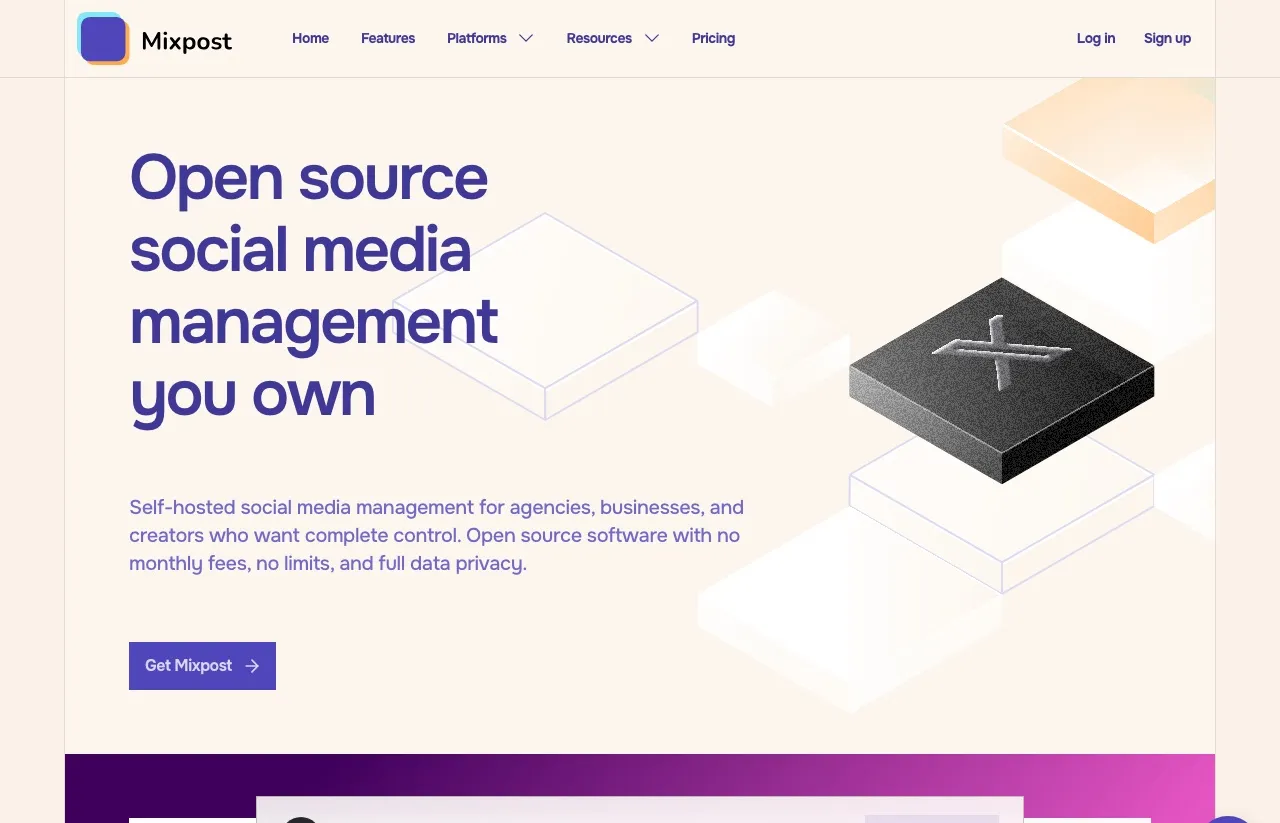
Mixpost is self-hosted like Postiz, but sold as a one-time license.
If Mixpost itself is what you are trying to replace, these are the strongest Mixpost alternatives.
If you are leaving Postiz but not leaving self-hosting, Mixpost is the obvious landing spot. You pay once, not monthly, and you run it on your own server with unlimited social accounts. It is a Laravel application, so the stack is lighter than Postiz’s Temporal setup, and for a lot of teams that alone is the reason to switch.
The other reason is licensing. Postiz is AGPL-3.0, a network copyleft license, which matters if you plan to modify it and offer it as a service. Mixpost’s paid license does not put that obligation on you. If your objection to Postiz is operational rather than philosophical, though, note that you are still the one on call.
Mixpost does ship an MCP server, which is easy to miss because there is no hosted endpoint to point at. It runs inside your own instance, at your domain, and it arrives with the paid Pro license rather than as a separate product. That is consistent with the rest of the deal: you own the thing, including the part your agent talks to.
Pros:
- One-time license, no recurring bill
- Unlimited social accounts on your own server
- Lighter stack than Postiz’s Temporal requirement
- No AGPL copyleft obligation
- Ships an MCP server inside the license
Cons:
- You still own uptime, updates, and OAuth breakage
- The MCP server is yours to host too, so there is no vendor endpoint
- AI features are thin next to a dedicated content tool
- Smaller community than Postiz
Pricing: Lite is free. Pro is $299 one-time with a year of updates, and Enterprise is $1,199 one-time.
Ideal for: Technical teams who want to own the software outright and keep hosting it.
Bottom line: The right move if you like self-hosting and just want a lighter, cleaner license.
3. Publer: Best for solo operators who want cheap hosted scheduling
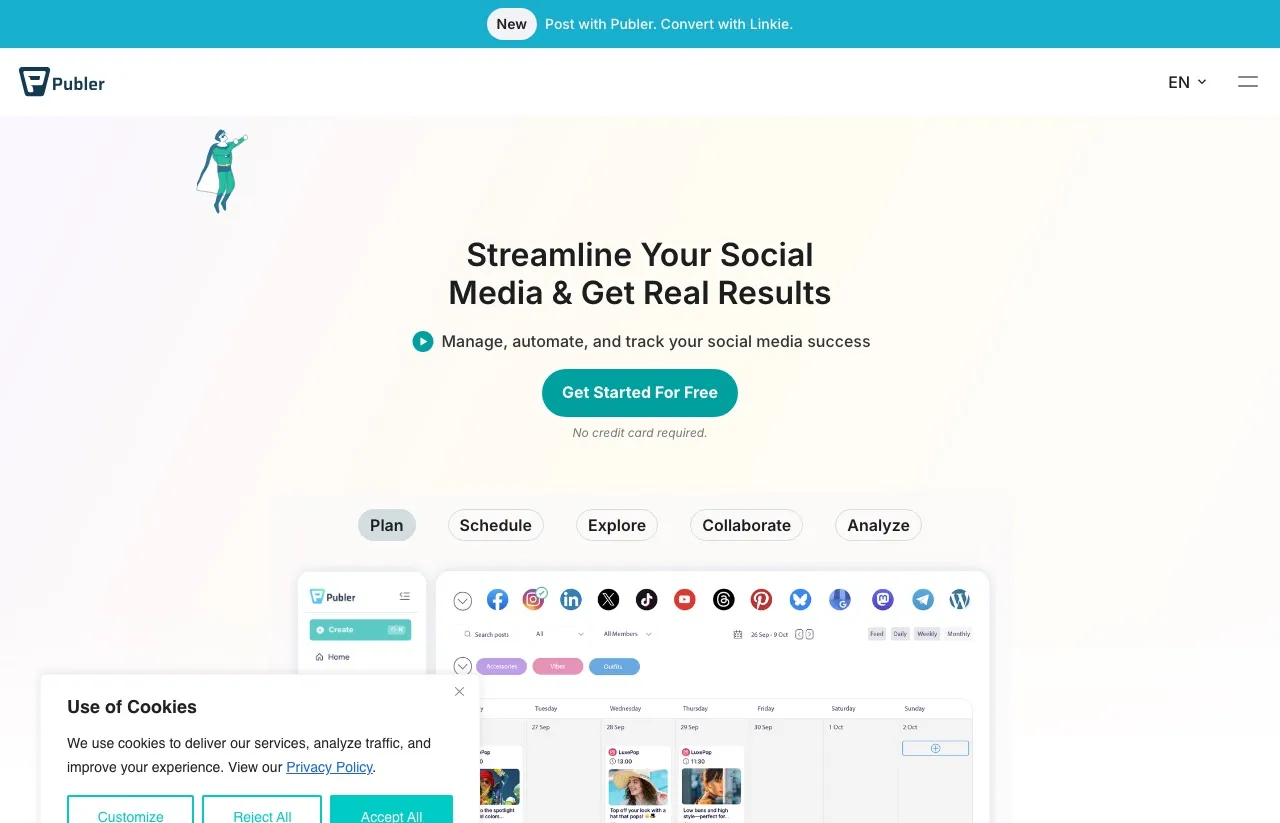
Publer offers hosted scheduling with a free tier and low per-account pricing.
Publer started in 2012 as a side project to help the founder’s brother’s travel agency in Tirana get on Facebook, and it shows in the product: the roadmap is driven by people who actually schedule posts. It is the cheapest credible way to stop self-hosting, with a free tier and paid plans that start at $5 a month.
The catch is the pricing model, and it is worth getting the arithmetic exactly right because most roundups do not. Publer charges $5 for one account and $9 for two on Professional, and from the third account the whole plan bills at $4 each. Business runs $10, then $17, then $7 per account. So eight accounts on Professional is $32 a month, not the $40 a flat “$5 each” reading gives you, and not the $5 a scan of the pricing page suggests. Team members are extra again, at $2 a month on Professional and $3 on Business. Run your real account count before you commit, because the cost per account moves as you add them and every tenth one is free. Our Publer comparison walks the math.
On the agent question, Publer is the most gated option in this lineup. The public API is restricted to Business and Enterprise, and the MCP server exists but is in beta for top ambassadors and Enterprise customers, set up from inside the dashboard rather than at a public endpoint (mcp.publer.com returns a flat 404). If you are on Business today, expect to write the integration against the REST API yourself.
Pros:
- Genuinely free tier to start
- Strong bulk scheduling and post recycling
- Reliable hosted publishing, no servers
Cons:
- Per-account pricing adds up quickly, and seats cost extra on top
- AI features are basic
- No MCP server, and the API is Business-tier and up
Pricing: Free tier available. Professional is $5 for the first social account and $4 for each additional; Business is $10 then $7. Extra team members are $2/mo on Professional and $3/mo on Business.
Ideal for: Solo creators with a handful of accounts who want the cheapest hosted option.
Bottom line: The budget exit from self-hosting, as long as your account count stays small.
4. Buffer: Best for creators who only need three channels

Buffer’s free plan covers three channels with straightforward scheduling.
Buffer is the least exciting recommendation on this list and the one I would still make to a specific reader. It has been publishing posts reliably for over a decade, the interface is clean, and the free plan covers three channels. Nobody ever spent a weekend fixing Buffer.
It is also the narrowest option here. Pricing is per channel, so it scales badly, and the AI Assistant is thin next to a dedicated AI tool. Credit where it is due on the agent question: Buffer does ship an official MCP server at mcp.buffer.com/mcp, so Claude can create scheduled posts and drafts. Per Buffer’s own developer documentation it sits on a beta API built around creating posts, with edits and deletes handled in the dashboard rather than through the API. Coming from Postiz’s nine tools, that will feel thin, and we put the two MCP servers directly against each other in Postiz vs Buffer. Our Buffer alternatives roundup covers the wider field if it is close.
Pros:
- Free plan for three channels
- The most reliable publishing engine in the category
- Ships an official MCP server for scheduling and drafts
Cons:
- Per-channel pricing scales painfully
- Thin AI compared to dedicated tools
- The MCP runs on a create-only beta API
Pricing: Free for 3 channels. Essentials $6/channel/mo ($5 annual), Team $12/channel/mo ($10 annual). Channels past the tenth cost less per channel, dropping to $4 from channel 11 and $3 from channel 26.
Ideal for: Creators posting to a few channels who want zero maintenance and zero surprises.
Bottom line: Boring in the best way, if three channels is genuinely all you need.
5. Metricool: Best for marketers who need analytics, not just publishing
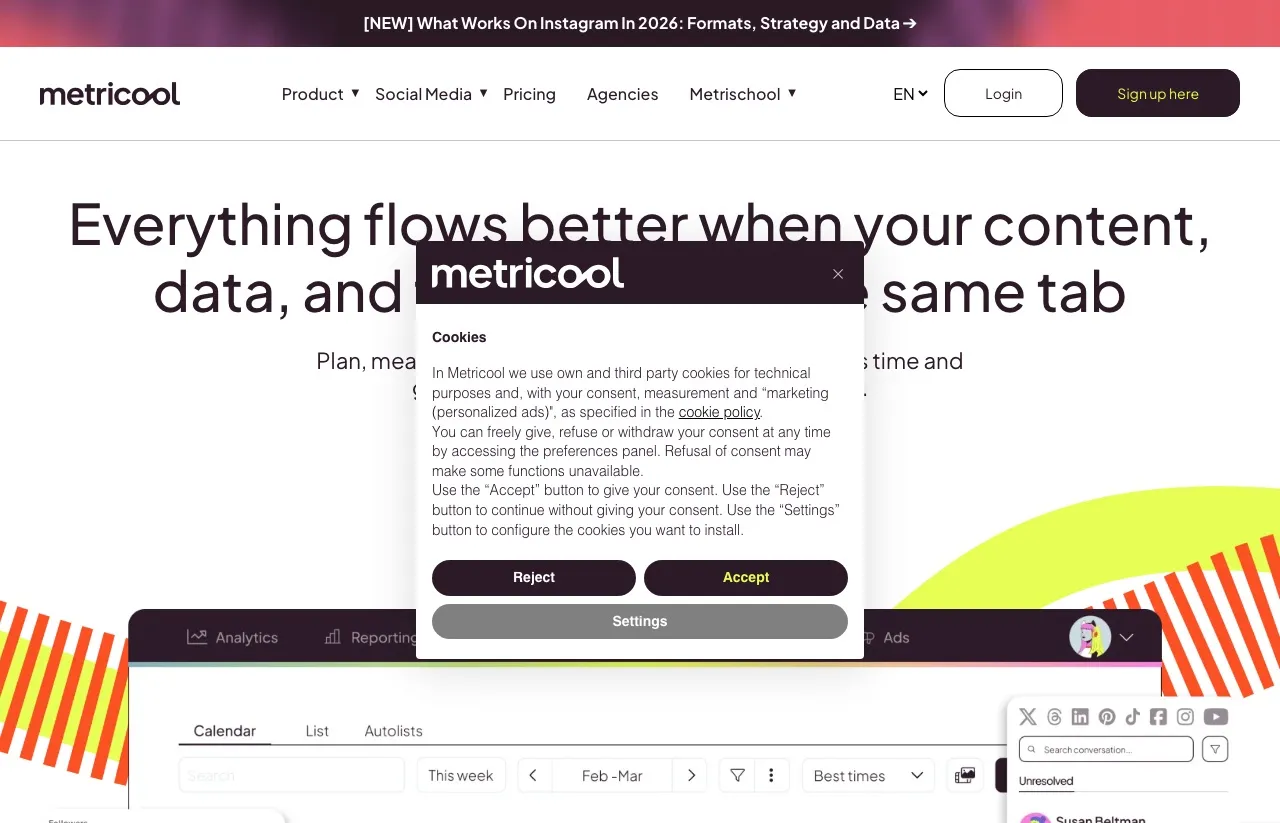
Metricool pairs scheduling with the reporting depth open-source tools tend to skip.
Reporting is where a lightweight scheduler usually runs out of road. Postiz ships analytics and exposes them through its API, which is fine until someone asks you to explain a month of performance in a deck.
Metricool is built for that reader. It handles scheduling competently and reporting genuinely well, and its paid Starter tier tracks up to 100 competitor profiles, which is the kind of thing open-source schedulers do not ship at all. Be precise about which tier you are reading, though: the free plan tracks 5 competitors, not 100, and white-label reporting sits on the Custom contact-sales plan. The AI creation surface is not why you would pick it.
Metricool is also the tool most often described wrongly on the agent question, and its own two surfaces are the reason. Its MCP page says the server, at ai.metricool.com/mcp, “works with any Metricool plan, including the free account,” with your plan’s own limits applying. Its pricing page lists MCP inside a “Metricool API (Zapier, Make, and MCP)” row on the Advanced tier, and shows MCP on the lower tiers marked “limits may apply.” So the free path looks real but the exact boundary is not something I would state as settled from the outside. If MCP access on a free or Starter plan is the reason you are choosing Metricool, confirm it with their support before you commit, rather than trusting either page or this one. I put both of those surfaces side by side, along with each tool’s MCP tool count, in a head-to-head on Postiz and Metricool.
Pros:
- Reporting and competitor analysis well beyond the category norm
- Hosted MCP server, documented as working on any plan
- Free tier to evaluate it
Cons:
- AI creation features are secondary
- White-label reporting is Custom-tier only
- Metricool’s own pages disagree on which tier MCP needs, so verify before buying on it
Pricing: Free plan available. Starter from about $20/mo and Advanced from about $53/mo, both quoted at the annual rate; monthly billing costs more.
Ideal for: Marketers who have to show results to someone else.
Bottom line: Pick it when the reporting matters as much as the posting.
6. SocialPilot: Best for small agencies managing client accounts

SocialPilot focuses on client management and approval workflows for agencies.
SocialPilot exists for the agency reader, and it is a reasonable landing spot if you were self-hosting Postiz to keep client costs down. Client approvals, white-label reports, and account grouping are built in, and the entry price is genuinely low at $20 a month.
Read the seat math before you commit. That $20 entry tier covers 5 accounts and exactly one user. Adding teammates means Standard at $40 a month, which includes 10 accounts and 3 users, with extra users at $5 each and extra accounts at $4. That is gentler than enterprise per-seat pricing, but the entry price is a solo price.
One correction to the version of this post that ran before today, and to most roundups still live: SocialPilot ships a first-party MCP server. It launched in April 2026, and mcp.socialpilot.co/mcp answered my probe with a 401, which is what a live authenticated endpoint does. Saying otherwise sells the tool short. What it does not have is a public developer API, so if your pipeline needs REST rather than an agent, that is the real limitation. The AI is still a caption assistant rather than a creation engine.
Pros:
- Client approval workflows built in
- White-label reporting
- Ships a first-party MCP server
- Low entry price for an agency-focused tool
Cons:
- The $20 Essentials tier is single-user
- AI is a light assistant, not a creation engine
- No public developer API
Pricing: Essentials $30/mo (7 accounts, 1 user). Standard $50/mo (15 accounts, 3 users), extra users $5/mo and extra accounts $4/mo.
Ideal for: Small agencies who need approvals and client reporting without enterprise pricing.
Bottom line: A practical agency exit from self-hosting, if you do not need AI creation.
7. Blotato Agency: Best for agencies who want AI creation across many brands

Blotato’s Agency plan is $499/mo with 28,000 AI credits and dedicated support.
Counting this separately is a stretch and I would rather say so than let it pad the list: it is entry number one on a bigger plan, not a ninth product. It is here because agency readers ask about it specifically, and because the honest answer to that question is mostly a warning. The Agency plan is $499 a month with 28,000 AI credits, dedicated video processing, and a dedicated support channel, and it exists for agencies producing real volume across client brands.
Be clear-eyed on the math, because it is not flattering to us. Agency covers 100 connected social accounts. Postiz Ultimate covers 100 channels for $99 a month, and self-hosted Postiz covers as many as you want for free. That is the same account count for a fifth of the price, and on that number alone Postiz wins outright. Blotato Agency only makes sense if AI creation volume is the bottleneck and you want someone else carrying the operational risk across every client account. If you are buying seats rather than content, buy Postiz.
Pros:
- 28,000 AI credits a month for image and video generation, and they roll over
- Dedicated support channel and video processing
- No infrastructure to run across client accounts
Cons:
- Expensive next to Postiz Ultimate on channel count
- 9 platforms only
- Overkill unless AI volume is genuinely your constraint
Pricing: $499/mo.
Ideal for: Agencies whose bottleneck is producing content, not scheduling it.
Bottom line: Only worth it when AI creation volume, not channel count, is the thing you are buying.
8. Hootsuite: Best for enterprise teams with a compliance mandate

Hootsuite pairs scheduling with the governance and reporting enterprise teams are told to buy.
Hootsuite is last on purpose. If you were self-hosting an open-source tool, an enterprise per-seat contract is the opposite of what you were optimizing for, and I would not insult you by ranking it third.
It earns its place for exactly one reader: the team that has a compliance, approval, or governance requirement from someone above them. Hootsuite’s reporting and governance are real, and its entry Standard tier is $99 per user per month billed annually, so read the monthly rate separately before you budget from that number.
It is also, unexpectedly, the most heavily invested in agents of anything here: Hootsuite runs four separate MCP servers rather than one, split by job. Perch handles content creation, planning, and publishing; Nest covers the social inbox and customer care; Lumen does insights and listening; Parliament runs employee advocacy. Whether that is an advantage or four things to configure depends on how much of the suite you actually bought.
Pros:
- Deep reporting and enterprise governance
- Mature approval workflows
- Four MCP servers across publishing, inbox, listening, and employee advocacy
Cons:
- Per-user pricing is punishing for small teams
- Heavy interface
- Thin AI creation
Pricing: $99/user/mo on the entry Standard tier, billed annually. Verify with Hootsuite directly, since this moves.
Ideal for: Enterprise teams with a governance requirement and a budget to match.
Bottom line: The right answer only when compliance signs the check. Our Hootsuite alternatives guide covers cheaper routes.
How I Chose These Postiz Alternatives
- Does it remove the operational load? The dominant reason people leave Postiz is maintenance, so every pick had to reduce it or make it meaningfully lighter.
- Does it keep the API and agent story alive? Anyone who got Postiz running has already proved they will use an API. A tool with no API or MCP is a downgrade for that reader, and I flagged it where it applies.
- Is the pricing honest at real account counts? Per-account pricing that looks cheap at one profile and expensive at eight gets called out.
- Does it cover the platforms you actually use? Nobody replaces 30-plus destinations with 9 by accident, so I said plainly where coverage drops.
- Would I recommend it to a friend leaving Postiz? If the honest answer was no, it is not on the list.
Pricing here was read off each tool’s own pricing page on 6 August 2026, and prices in this category move, so check the current number before you buy. Postiz’s license, system requirements, MCP tool list, and rate limits come from its GitHub repository and its own docs, quoted directly rather than paraphrased from other comparison pages. The complaints cited come from Postiz’s public issue tracker rather than a review aggregator, which is why I link the issues by number instead of quoting a star rating.
The MCP column is first-party: I sent a JSON-RPC initialize request to each vendor’s advertised endpoint on 6 August 2026 and recorded what came back. A 401 means the server is live and asking for credentials. That check changed two entries in this post: SocialPilot does run an MCP server, and Metricool’s runs at ai.metricool.com/mcp rather than the address most roundups give it.
How to Choose the Right Postiz Alternative
If you want to keep self-hosting but drop the Temporal stack: Mixpost. One license, lighter application, no copyleft obligation.
If AI creation is the actual job: Blotato. Unlimited writing plus bundled image and video at $29 flat, and no server.
If you just want cheap and hosted: Publer, or Buffer if three channels covers you.
If you need reporting for a client or a boss: Metricool, or SocialPilot when approvals matter.
If you are leaving because of the 100/hour rate limit: check which Postiz you are on first. Self-hosted, that number is an environment variable you can raise, and switching tools to fix it would be paying to solve a problem you already own.
If you need Mastodon or Discord: stay on Postiz. Nothing on this list matches its platform coverage, and I would rather tell you that than sell you a downgrade.
If compliance is driving the decision: Hootsuite, and negotiate hard.
Sabrina’s Final Thoughts
Most people leaving Postiz are not leaving a bad product. They are leaving a second job they did not sign up for. That is worth naming plainly, because it means the question is not “what is cheaper than $29,” it is “what is my Saturday worth.”
If the answer is that you enjoy running infrastructure, stay where you are or move to Mixpost and keep the savings. If the answer is that you want to make content and never think about a Redis container again, start a free week and see whether the bundled AI does enough work to justify the switch. If you came from Postiz for the API specifically, skip the trial math and plan on starting the subscription, because the free week does not include API access. If you want the deeper head-to-head, our Blotato vs Postiz comparison runs the same numbers in more detail.
Postiz Alternatives FAQs
What is the best Postiz alternative?
It depends on why you are leaving. If you want AI writing, images, and video bundled with scheduling and no server to run, Blotato at $29 a month flat for 20 accounts is my pick. If you want to keep self-hosting with a lighter stack and a one-time license, Mixpost, and the full Mixpost and Postiz breakdown covers what that license does and does not buy you. If you just want cheap hosted scheduling, Publer.
Is Postiz actually free?
The software is free under AGPL-3.0 if you self-host it. You still pay for infrastructure, and Postiz recommends 4 vCPU and 8 GB of RAM for a small team plus PostgreSQL, Redis, and Temporal. Its hosted plans start at $29 a month. Free means free of license fees, not free of cost or effort.
What is the best open-source Postiz alternative?
Mixpost is the main one people move to. It is self-hosted with a one-time license from $299, runs a lighter Laravel stack than Postiz’s Temporal setup, and does not carry AGPL’s network copyleft obligation. If open source is a principle for you rather than a price preference, it is the closest match.
Why do people leave Postiz?
Rarely price. The common reasons are self-hosting maintenance, provider and OAuth connection failures, thin analytics, and risk aversion after reading old threads about retry loops causing duplicate posts, including one that is now closed. Its public issue tracker documents all of it openly, which is more transparency than most hosted vendors offer.
Do any Postiz alternatives have an MCP server?
Almost all of them, and that is the point: an MCP server is table stakes in this category now, not a differentiator. Probing each vendor’s advertised endpoint on 6 August 2026 returned a live authenticated response from Blotato (mcp.blotato.com/mcp), Postiz (api.postiz.com/mcp), Buffer (mcp.buffer.com/mcp), Metricool (ai.metricool.com/mcp), and SocialPilot (mcp.socialpilot.co/mcp). Hootsuite runs four separate ones. Mixpost ships one inside the self-hosted license with no vendor endpoint, and Publer’s is in beta behind an early-access gate rather than open to every paid plan. The useful question is not whether a tool has an MCP server but how much of the job it can do, which our social media MCP servers guide breaks down tool by tool.
How many MCP tools does Postiz expose?
Nine: integrationList, groupList, integrationSchema, triggerTool, schedulePostTool, generateImageTool, generateVideoOptions, videoFunctionTool, and generateVideoTool. They cover listing accounts, scheduling and publishing posts, and generating images and video. What they do not cover is engagement, and Postiz’s docs say so directly: there is no getComments or replyToComment, so comment replies have to happen in the UI. For comparison, Blotato’s MCP server exposes 35 tools, with the extra surface going to comments, DMs, analytics, and schedule management.
Is Postiz’s API really limited to 100 requests per hour?
Only on Postiz Cloud, and only for one endpoint. Postiz’s configuration reference defines API_LIMIT as the “per-hour limit on the public-API create-post endpoint,” defaulting to 90 with Cloud set to 100. It does not govern listing integrations, fetching schemas, or uploading media, it does not tier by plan, and on a self-hosted install it is an environment variable you can change. Competitor comparisons that present it as a hard cap on the entire API, or build a throughput multiplier out of it, are describing a limit that does not exist as stated.
What is the best free Postiz alternative?
Mixpost Lite and Metricool both have genuinely free tiers, and they answer different questions. Mixpost Lite keeps you self-hosting, which only makes sense if the server was never the problem. Metricool’s free plan is hosted and tracks 5 competitors, though scheduling and data retention are capped, and its MCP server is documented as working on any plan including the free one. Buffer’s free plan covers 3 channels. If free is the requirement because self-hosted Postiz was already free, the honest answer is that leaving costs money, and the question is which cost you would rather pay.
Does Postiz’s AGPL license affect my business?
Only if you modify it and offer it as a network service to others, in which case AGPL-3.0 requires releasing your modifications under the same license. Self-hosting for yourself, your team, or clients whose accounts you manage is fine. Postiz relicensed to AGPL in January 2025, so older articles may say otherwise.