X MCP server for social media publishing
Claude cannot reach X by itself. Connect Blotato's MCP server once and it can publish posts (tweets), threads, image posts, video to X from a plain prompt. One hosted endpoint, no developer app, no copy-paste.
This one publishes. Search "X (Twitter) MCP server" and you get two different kinds of tool: scrapers that read public X data, and publishers that put a post live on your own account. Blotato is the second kind, on X's official API, not browser automation.
https://mcp.blotato.com/mcp Updated August 2026
How do I post to X with an AI agent?
- Connect your X account. Sign in to Blotato and connect X through the normal login flow. Blotato holds the tokens and refreshes them, so this is the last time you think about auth.
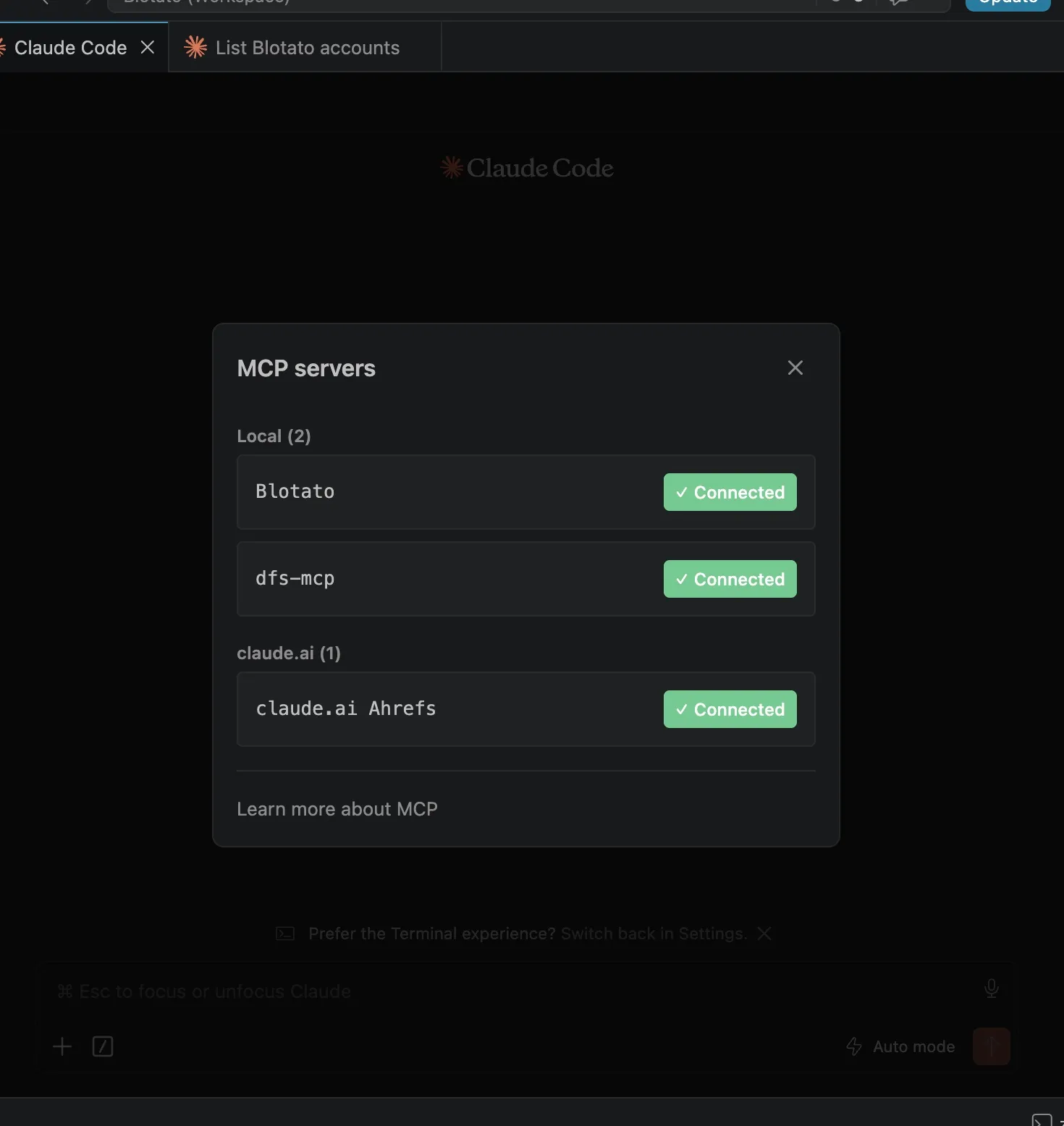
- Add the MCP server to Claude. In Claude, open Customize, then Connectors, then add a
custom connector pointing at
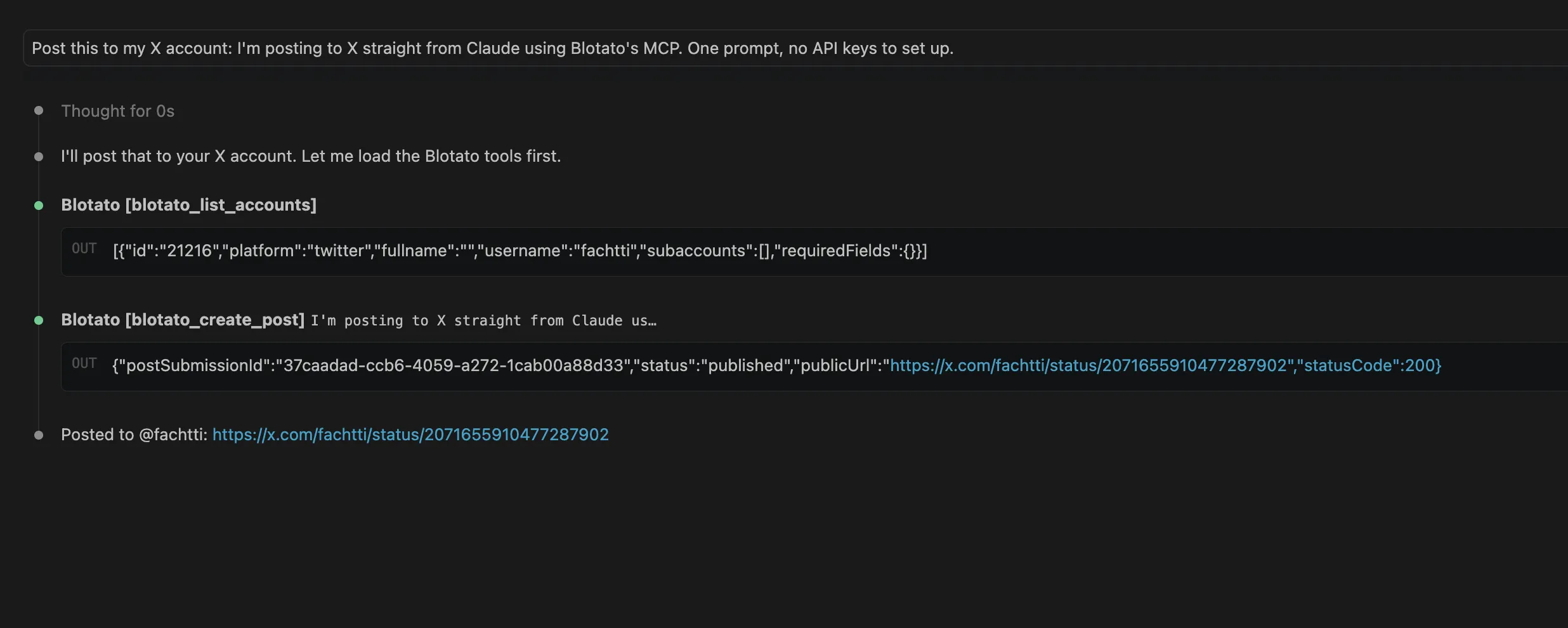
https://mcp.blotato.com/mcp. Claude Code and Cowork take the same URL. - Ask Claude to post. Write it the way you would say it out loud: "Break this article into a 6-tweet thread and publish it to X." Claude calls the publish tool and Blotato puts the post live.
What can your agent do on X through Blotato?
Publish to X
Post posts (tweets), threads, image posts, video directly, with the fields each format requires.
Schedule for later
Queue a X post for a future time and let Blotato publish it on the clock.
Upload or generate media
Hand Claude a local file or a URL, or have it generate the image or video first.
List connected accounts
See which X accounts are connected and pick the right one to post from.
Check post status
Confirm a post actually went live, and read back the error if a platform rejected it.
Read post analytics
Pull performance metrics back off your X posts so an agent can learn from what worked.
On X, Blotato covers publishing and scheduling and analytics. It does not yet cover comments and direct messages on this platform, so if that is what you need, this is the wrong tool and it is better you know now. X moved most engagement and messaging endpoints to paid tiers above the self-serve plans in 2026, so covering them would mean passing that cost through.
Tools your agent can call on X (Twitter)
These are the exact MCP tool names exposed on this platform, so you can reference them directly in a prompt or check them against your client's tool list.
blotato_get_userblotato_list_accountsblotato_create_postblotato_get_post_statusblotato_list_postsblotato_create_presigned_upload_urlblotato_get_scheduleblotato_list_schedulesblotato_update_scheduleblotato_delete_scheduleblotato_list_visual_templatesblotato_create_visualblotato_get_visual_statusblotato_create_sourceblotato_get_source_statusblotato_get_creditsblotato_buy_creditsblotato_get_post_analyticsblotato_list_top_posts
Which AI agents can post to X?
Eight, and they all reach X through the same endpoint. Claude authenticates over OAuth. The rest
take your API key as a blotato-api-key header. Nothing here runs a local server.
| Agent | Connects with |
|---|---|
| Claude Code | OAuth |
| Claude Desktop and Cowork | OAuth |
| Claude.ai on the web | OAuth |
| Cursor | API key header |
| OpenAI Codex | API key header |
| Antigravity and Replit Agent | API key header |
The full setup for each client, including the copy-pasteable config, is on the social media MCP server page. ChatGPT connects as well, through Developer mode over OAuth or with the blotato-api-key header config in Blotato's setup guide.
What does it look like in practice?
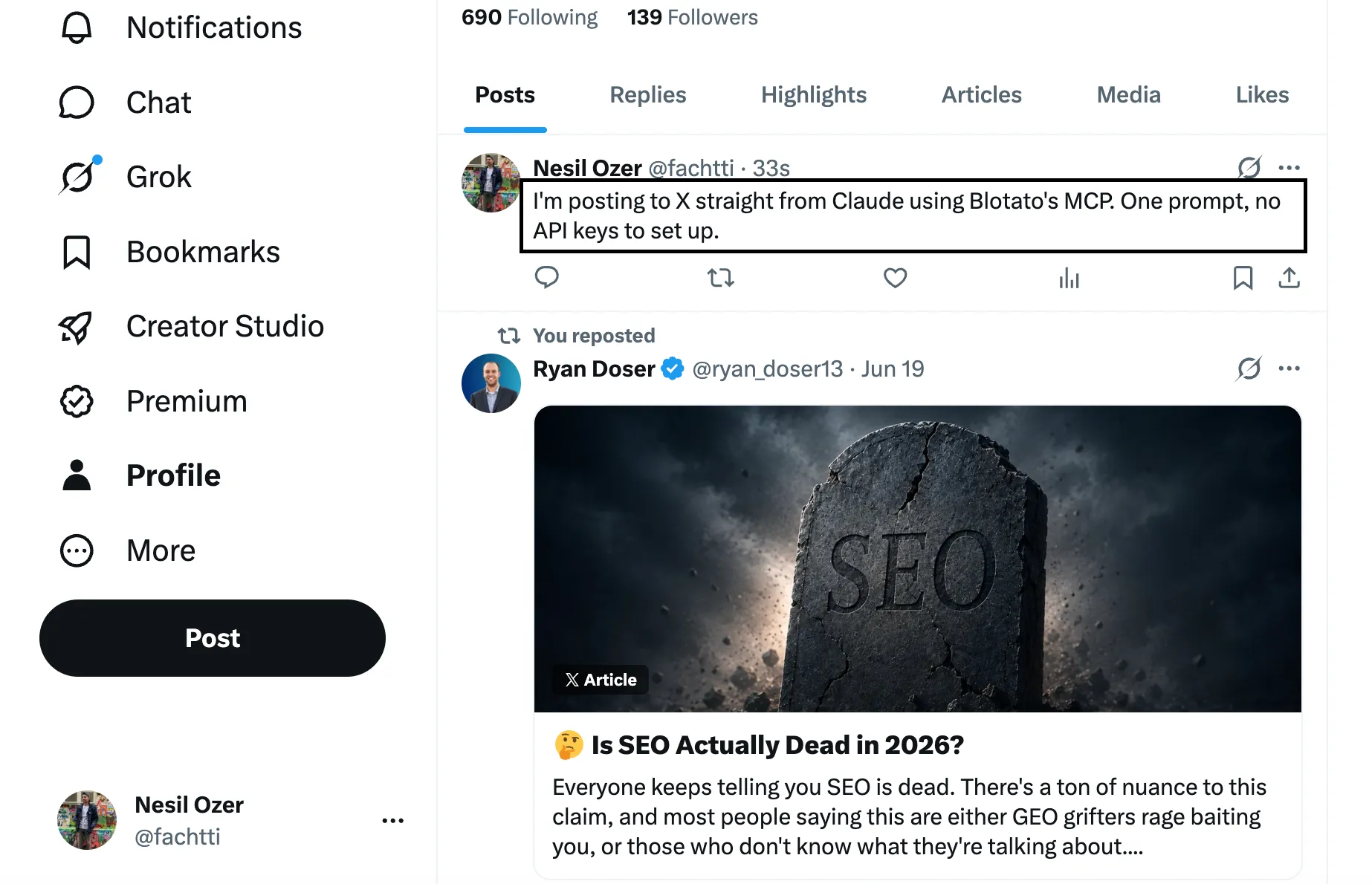
Screenshots from the full X walkthrough, showing the connection and a real published post.
Why not just build it against the Twitter API?
X (still widely called Twitter) moved most write access behind paid API tiers, and the pricing has shifted more than once, so a hand-built integration is exposed to both the bill and the next change to it.
You can absolutely build it yourself, and if X is the only network you will ever post to, that is a reasonable call. The trade shows up at the second platform: every network has its own auth model, its own upload flow, and its own review process, and they change on their own schedules. Blotato is one endpoint across nine of them, at a flat price that does not move when you post more.
If you would rather own that layer yourself, we wrote up the honest tradeoff between open-source and managed posting APIs, and our roundup of social media MCP servers covers the alternatives, including the ones that only draft rather than publish.
Who is already publishing to X this way?
These are Blotato customers describing their own agent and API setups, in their own words.
Between those two socials, I'm posting content to 12 platforms, which means 1 video needs to end up in 6 places when all is said and done. Any social media management tool I used previously that posts it to multiple platforms was always extremely costly, convoluted, and inconsistent. Too much fluff. Blotato keeps it as simple as possible, only showing you the stuff you need to see. Connecting socials was so easy and I was surprised when connecting multiple accounts to 1 social. Didn't skip a beat.
 Nick
NickCEO, Naaackers & NackHabitat, Detroit
I spent a few days in December testing out 7-8 providers of automation interfaces for posting to social media platforms. In the end I chose VistaSocial - 5 times more expensive than the competitors. Now I am switching from Vista Social to Blotato, where I am getting the same functionality at a fraction of the price. I am in the automation business, so the UI look&feel is not very relevant, I am mostly focused on the hooks that you can access from automated flows.
 Mihai M.
Founder, IQBiz.ro, Romania
Twitter MCP server or X MCP server: what is the difference?
There is no difference. Twitter became X in 2023, and the network, the API, and the MCP tooling are the same thing under both names. Most people still search for a Twitter MCP server, and most tools are still listed under both, so if you landed here looking for Twitter, you are in the right place.
What does differ is what each server actually does. Most of the Twitter MCP servers you will find are open-source wrappers around the X API that you clone, host, and supply your own developer credentials to. X also ships its own official MCP server, which connects an AI tool to the X API under your account permissions. Both are real options, and both leave you managing X API access and its per-call pricing yourself.
Blotato is the hosted alternative: it holds the X connection, so you never create a developer account, load API credits, or maintain a server. The tradeoff is honest, though. If you want to read timelines, search tweets, or pull follower data, an open-source Twitter MCP server or the official X one is the better fit. Blotato is built to publish, so a scheduled thread, an image tweet, or a video post is what it does well.
X (Twitter) MCP server FAQs
01 Can Claude post to X?
02 What is an X (Twitter) MCP server?
03 Do I need X API access or a developer app?
04 What kind of X account do I need?
05 Can Claude schedule X posts for later?
06 What else can Blotato's MCP server do on X?
07 Does this X (Twitter) MCP server publish, or only read X data?
08 Is there a Twitter MCP server, or only an X one?
09 Can Claude post a tweet or a thread for me?
10 Do I need an X developer account or API credits?
11 Which AI agents can post to X?
12 Which X MCP server should I use?
13 How much does it cost?
Does the same connection cover other platforms?
X is one target on the same endpoint. Once Claude is connected, it can publish to the rest without any further setup.
 Blotato
 Your AI Agent still can't post to social media.
Point Claude, ChatGPT, n8n, or your own agent at Blotato's MCP and that's fixed: 9 platforms behind one key, flat $29/mo.
Connect your agentFlat pricing. Cancel anytime.