Blotato vs Ocoya: Can Each Social Media API Work Your Inbox?
Blotato vs Ocoya for agent builders: what each social media API and MCP server can reach, whose replies cover more networks, and the price by account.
Blotato vs Ocoya comes down to what your agent can do once a post is live. Both ship a hosted MCP server and a REST API, and both start at $29 a month. Ocoya’s agent tools cover the calendar, its design studio and its workflows, and its inbox stays in the app. Blotato’s agent tools also read and answer Instagram and Facebook comments and DMs, build DM automations and pull post analytics.
Ocoya has written its own comparison of the two tools, and most of it is accurate. Blotato is an app I built, so I am the least neutral person to grade that page. I link Ocoya’s own docs for its load-bearing claims and ours for Blotato’s, so you can check both sides yourself.
Blotato vs Ocoya: The Decision in One Paragraph
If you need separate seats, post approvals and an editable design canvas, Ocoya fits that work better. Its reply workflows also run on Google reviews, Discord and Mastodon, not only Facebook and Instagram. From 41 to 100 accounts, its Agency plan is also the cheaper base price.
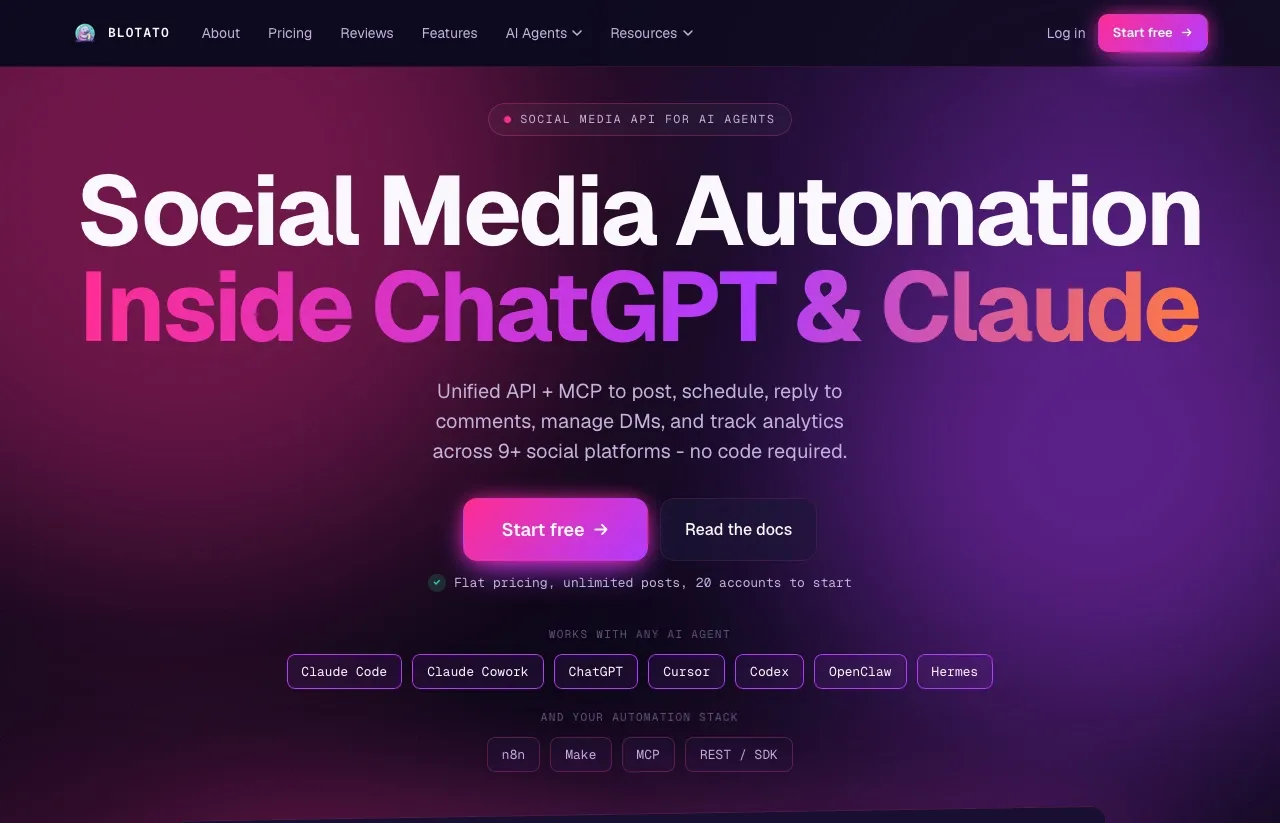
If your agent in Claude, ChatGPT or n8n needs to publish, read results and answer replies itself, Blotato fits better. One key covers publishing on nine platforms, analytics on eight, and the Instagram and Facebook inbox and DM automations, and the Starter plan covers 20 accounts for $29. That holds as long as nine platforms, one login and no LinkedIn analytics are enough for you.
Two Products Behind Two MCP Servers
Ocoya calls itself a marketing copilot. It bundles AI copywriting, a design studio, AI campaigns, a shared inbox, visual workflows, link-in-bio pages and SEO blog articles in one subscription, with email listed as coming soon. Its MCP server lets an assistant drive part of that suite.
Blotato is agent infrastructure for social media marketing. The product is the hosted API and MCP surface itself, with a web app beside it for the same jobs.
| Ocoya | Blotato | |
|---|---|---|
| What it is | An AI marketing suite for teams, with an MCP server and an API | Agent infrastructure for social media, with a web app alongside |
| Built for | Teams and agencies working in the app across many brands | Builders whose agent or automation runs social media |
| Agent surface | 26 MCP tools listed (its overview says 24), OAuth only, plus a REST API | 35 MCP tools, OAuth or an API key, plus a REST API |
| What the agent can touch | Brands, channels, posts, campaigns, Studio designs, workflows | Posts, schedules, comments, DMs, DM automations, analytics, visuals |
| Engagement | Auto-replies on 9 networks, in-app inbox on 3 to 9 depending on which doc you read | Instagram and Facebook comments and DMs, in the app and through the API |
| What the bill tracks | Connected channels, users and monthly credits | Connected accounts, AI credits and active DM contacts |
One detail matters if you run several brands. Ocoya’s MCP consent screen lets you tick which brands an assistant can reach, which is a clean way to scope a client. Its API tokens work the other way, reaching every brand you own or admin, with no way to scope one to a single brand.
Blotato has no brand layer to scope. blotato_list_accounts returns every account connected to your login, so if each client needs to be isolated, each one needs its own Blotato account.
The Team Features Ocoya Ships and We Don’t
Ocoya is the stronger product for a team that works inside an app all day. Here is where it wins, sourced from its own pages.
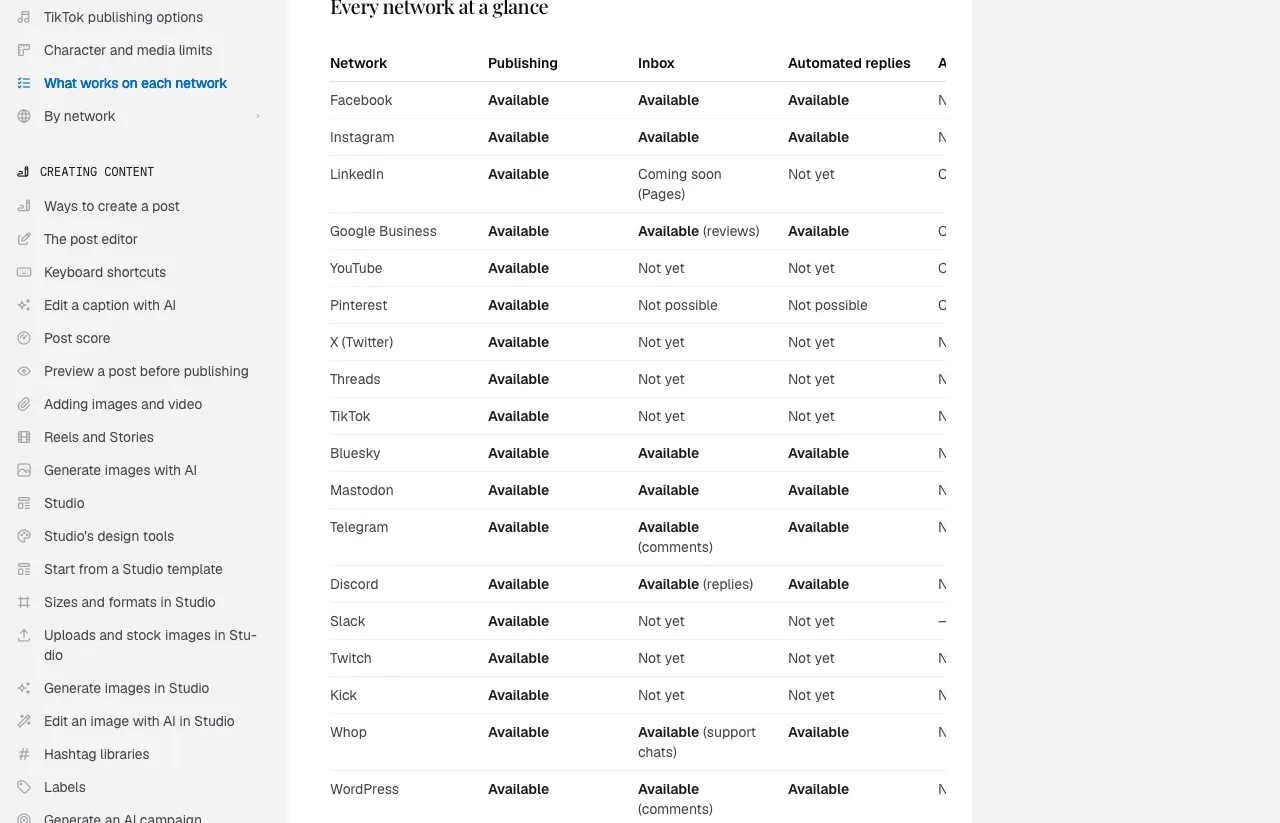
1. It publishes to far more destinations. Ocoya’s network matrix marks 26 publishing destinations as available, including a custom webhook. Beyond the big social networks, that list covers Google Business, Mastodon, Telegram, Discord, Slack, Tumblr, WordPress, DEV.to, Whop, Notion, Airtable, Framer, Wix, Twitch and Kick. Blotato publishes to nine platforms, and none of those extras are on the list.
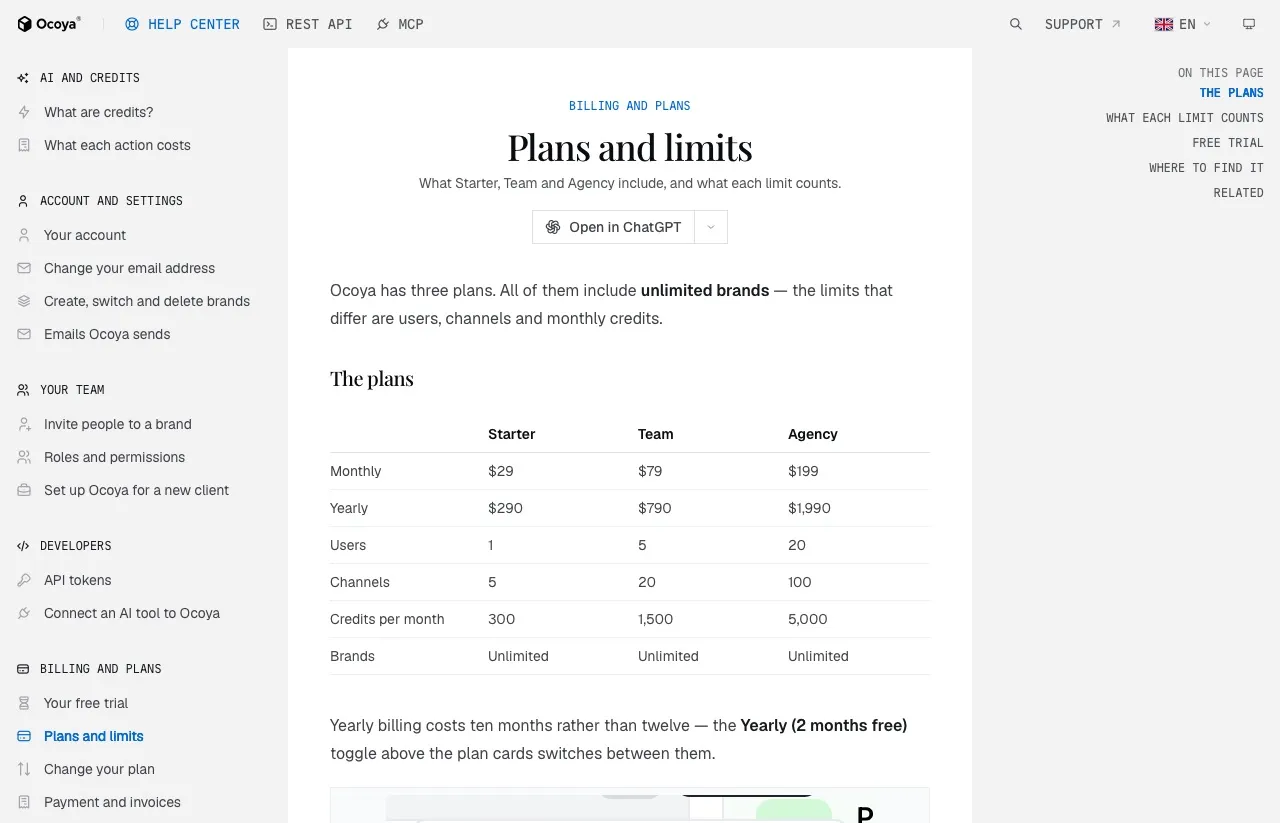
2. It has seats and approvals. Ocoya’s plans give Starter one user, Team five and Agency 20, with unlimited brands on every plan. Its post approvals send a post to chosen reviewers by email. The post cannot publish until someone approves it.
3. It has an editable design canvas, not only generated visuals. Ocoya’s Design Studio is a full editor with templates and a brand kit in the same tab as the calendar. Its AI campaigns turn one prompt into posts, visuals and a schedule. Your agent can also render a saved Studio design with new text through ocoya_render_studio_design, which is a real strength if your posts follow a designed template.
4. Its reply workflows cover more networks. The matrix and its automation doc list automated replies on nine networks. Beyond Facebook and Instagram, they add Google Business reviews, Bluesky, Mastodon, Telegram, Discord, Whop and WordPress.
Workflows can answer a review, reply to a DM or send a DM when someone comments. Its in-app inbox doc names fewer networks, which the corrections table below covers. Blotato’s engagement surface stops at Instagram and Facebook.
5. Its trial includes the agent surface. Ocoya’s free trial doc says an eligible trial gets every feature on the plan you pick. Ours excludes the API and MCP server, so you can test Ocoya’s agent surface before paying and you cannot test ours that way.
What Our Agent Tools Reach That Ocoya’s Don’t
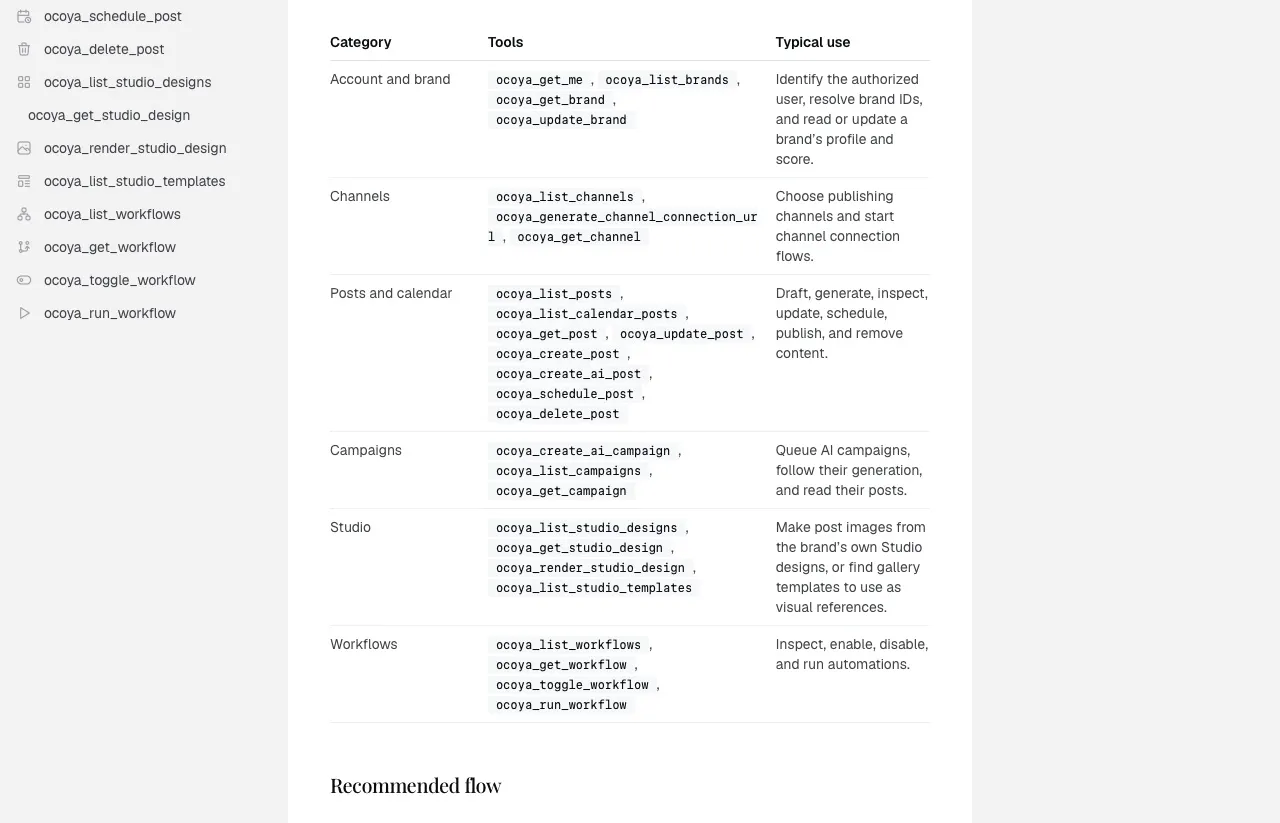
Ocoya’s MCP tool reference groups its tools into six categories: account and brand, channels, posts and calendar, campaigns, Studio and workflows. None of those tools read the inbox, send a reply directly or return analytics, and its REST reference lists no endpoint for them either. That is where Blotato’s 35 tools, listed in our MCP tool reference, keep going.
1. The agent can work the inbox. blotato_list_comments, blotato_post_comment, blotato_list_messages and blotato_send_message let an agent read and answer Instagram and Facebook DMs and comments. The same conversations land in the web app’s inbox on every paid plan, so a person can step in.
2. The agent can build the automation, not only switch it on. Ocoya’s four workflow tools list, inspect, toggle and run workflows that someone built in the app. Blotato has eight automation tools, including blotato_create_automation and blotato_update_automation. An agent can create an Instagram or Facebook comment-to-DM funnel, or point existing ones at a new offer with one update call each.
If that is your main job, here is how it works over the DM automation API.
3. Analytics work today, on eight platforms. blotato_get_post_analytics returns metrics for X, Instagram, Facebook, Threads, Bluesky, TikTok, YouTube and Pinterest. Ocoya’s own comparison page lists its analytics as in private beta and “not yet open to every account.” Its matrix shows no network with analytics available yet.
4. Automation runs don’t spend credits. Our billing doc says credits are only spent on AI image and video generation. DM automations count active contacts instead, 1,000 a month on Starter.
Ocoya’s automation doc says every run costs a credit, even runs a filter stops. Its credit cost table says a run is free and only the AI steps cost, so check which applies to your workflows.
Here is what that looks like in one Claude session. You ask it to publish today’s carousel, then check how yesterday’s post did and answer the DMs it brought in. On Ocoya, the agent can create and schedule the post with ocoya_create_post. The numbers and the replies are not in its tool list.
On Blotato, the agent posts with blotato_create_post, confirms it went live with blotato_get_post_status, reads the numbers with blotato_get_post_analytics, then works the replies with blotato_list_messages and blotato_send_message. That last step only works on Instagram and Facebook, which is the honest scope of the whole engagement surface.
Ocoya vs Blotato, Row by Row
Every Ocoya cell comes from Ocoya’s docs or pricing page, and every Blotato cell from ours, both read on November 11, 2026.
| Capability | Ocoya | Blotato |
|---|---|---|
| Publishing destinations | 26 marked available, plus Snapchat and Webflow coming soon | 9 platforms |
| Pricing model | Plan tiers by channels, users and credits | Plan tiers by accounts, credits and DM contacts |
| Entry plan | Starter, $29 a month: 5 channels, 1 user, 300 credits | Starter, $29 a month: 20 accounts, 1,250 AI credits |
| Free plan | No paid-feature plan (a cancelled trial leaves a free account with no channels or credits) | No |
| Trial | 7 days, card required, full plan | 7 days, card required, no API or MCP |
| Hosted MCP server | Yes, OAuth only, brand-scoped consent | Yes, OAuth or an API key header |
| MCP tools | 26 in the reference (its overview line says 24) | 35 |
| REST API | Yes, owners and admins only, 60 requests a minute per key | Yes, paid plans, limits set per endpoint (30 a minute on POST /posts) |
| Agent reads and answers DMs | No tool in the MCP or REST reference | Yes, Instagram and Facebook |
| Agent creates DM automations | No (workflows can be listed, toggled and run) | Yes, Instagram and Facebook, reply-only |
| In-app inbox | Yes, 9 networks in its matrix, 3 in its inbox doc | Yes, Instagram and Facebook |
| Analytics | Private beta | 8 platforms, LinkedIn not yet |
| n8n and Make | n8n as an MCP client, a Zapier app, Make not listed on its integrations page | n8n node and Make app |
| Seats | 1, 5 or 20 by plan | 1 per account |
| Post approvals | Yes | No |
| Design editor | Yes, Design Studio | No (template visuals from a prompt) |
| AI writing | Yes, 1 credit per action | Yes, unlimited |
| AI images and video | Images at 2 credits each, no AI video | Both, from AI credits |
Checking Ocoya’s Own Comparison Page
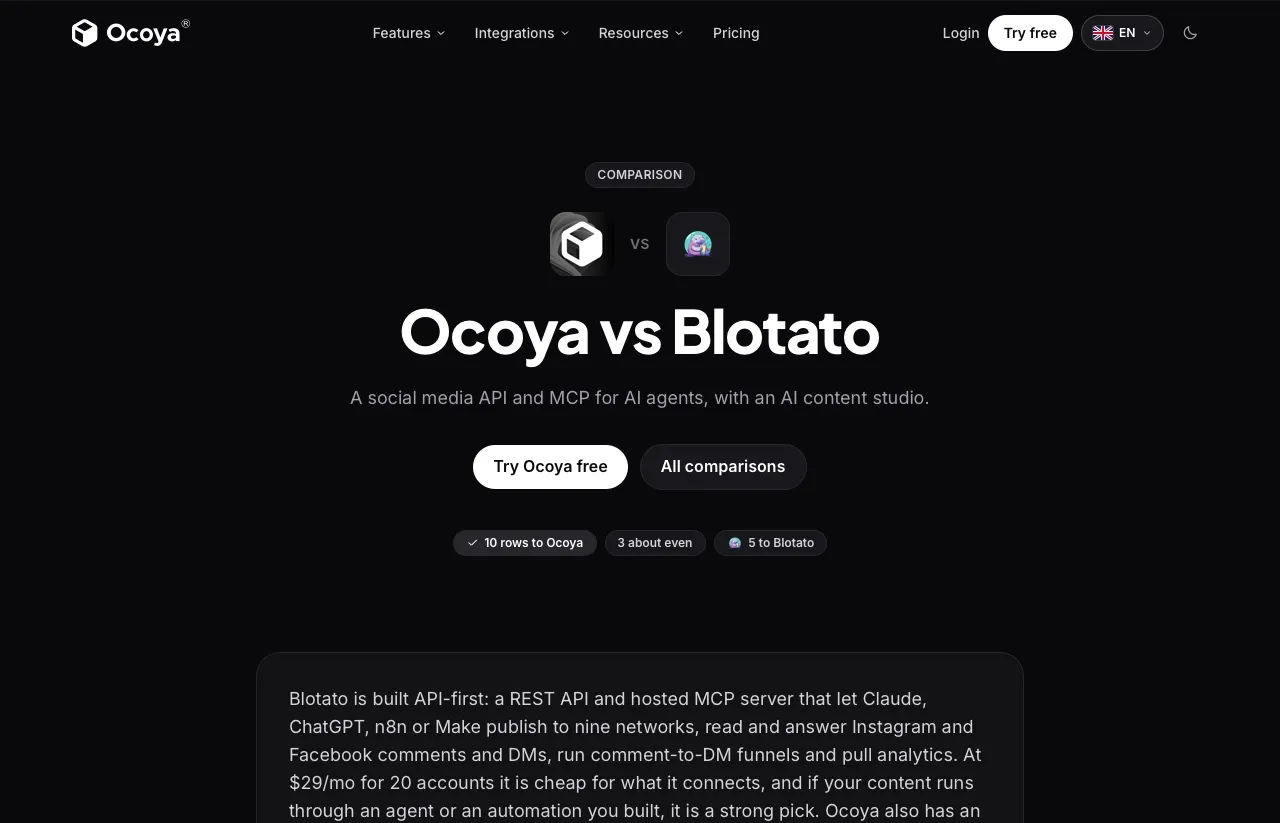
Ocoya publishes a comparison against Blotato and scores it 10 rows to Ocoya, 3 even and 5 to Blotato. It describes our product fairly and says which rows we lead. A few lines read differently against the docs, including two about Ocoya itself.
| What Ocoya’s page says | What the docs add | Check it |
|---|---|---|
| Ocoya: “Unlimited users on every plan” | Ocoya’s plans doc lists 1, 5 and 20 users, and blocks invites past the limit | Ocoya plans and limits |
| Ocoya’s inbox covers 9 networks | Ocoya’s inbox doc says “Inbox supports Facebook, Instagram and Google Business reviews. Other networks are not yet available” | Ocoya Inbox |
| Ocoya: “Email marketing built in” | Ocoya’s own site menu lists Emails as “Coming soon” | Ocoya site menu |
| Blotato’s comments and DMs are “read and answered through the API or MCP” | They are also in the web-app inbox on every paid plan | Blotato Inbox |
| Blotato’s API allows “up to 1,800 requests an hour” | That matches the POST /posts limit of 30 a minute. Other endpoints have their own limits | Blotato limits |
The inbox row is the one to check before you buy, since Ocoya’s matrix and its inbox doc disagree. Connect a test account in the trial and see which networks show up.
The Monthly Bill as Your Account Count Grows
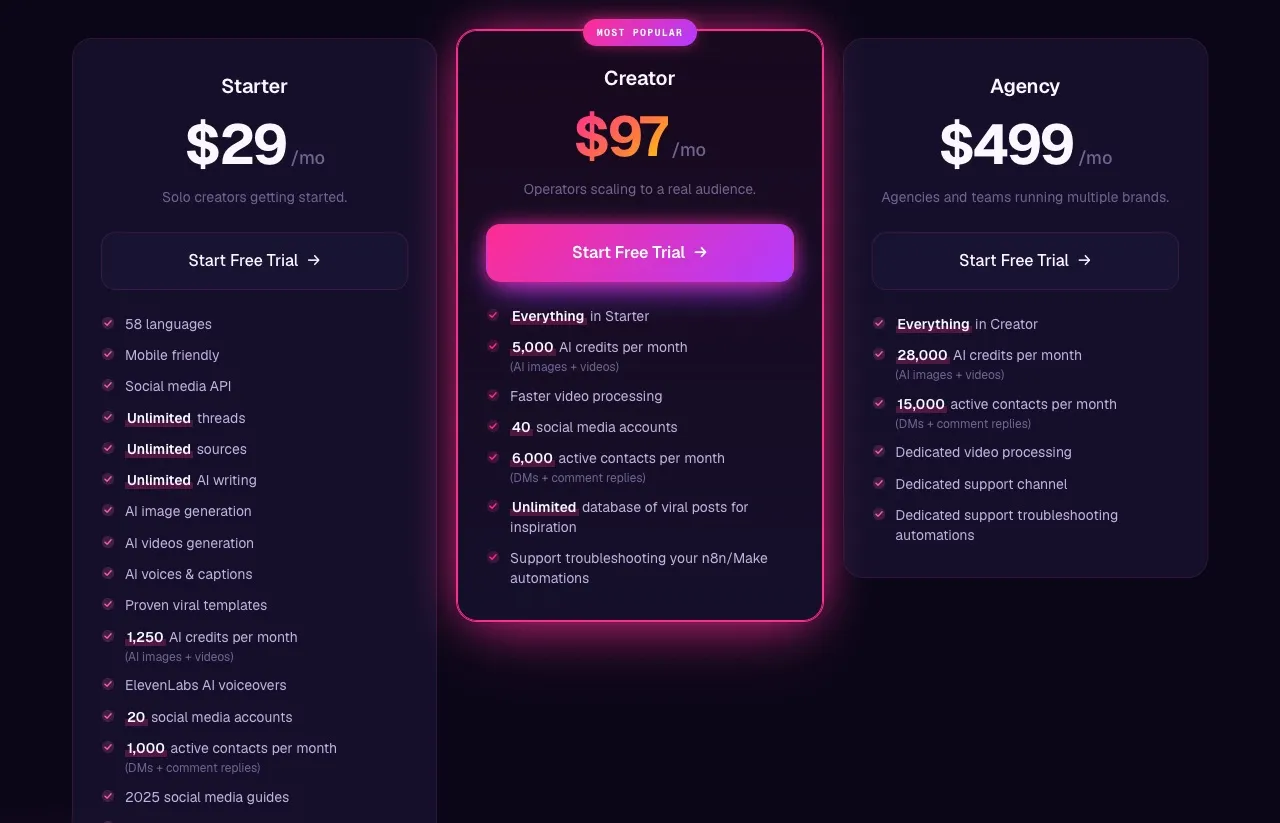
Blotato vs Ocoya pricing works the same way on both sides: plan tiers, so the base subscription depends on how many accounts you connect. The table leaves out add-ons and usage. Ocoya counts a Facebook Page and its linked Instagram account as two channels, and Blotato counts every connected account the same way.
| Accounts you connect | Ocoya, base monthly | Blotato, base monthly |
|---|---|---|
| 1 to 5 | $29 (Starter) | $29 (Starter) |
| 6 to 20 | $79 (Team) | $29 (Starter) |
| 21 to 40 | $199 (Agency) | $97 (Creator) |
| 41 to 100 | $199 (Agency) | $499 (Agency) |
Yearly billing lowers Ocoya’s three plans to $290, $790 and $1,990 a year. Our plan cards list each Blotato tier’s accounts, credits and contacts.
Ocoya’s pricing page also says you can add channels as you grow. I found no per-channel price in its docs, so the table uses plan tiers only. Check Ocoya’s pricing page for that before you plan around it.
At each entry plan, here is what $29 buys.
| At $29 a month | Ocoya Starter | Blotato Starter |
|---|---|---|
| Accounts or channels | 5 | 20 |
| Users | 1 | 1 |
| REST API and hosted MCP | Included, also in the trial | Included, not in the trial |
| Agent tools for comments and DMs | None in the reference | Instagram and Facebook |
| Agent tools that build DM automations | None (toggle and run only) | Yes, reply-only |
| Analytics | Private beta | 8 platforms |
| Design editor and approvals | Included | Not offered |
| AI writing | 300 credits, shared with images | Unlimited |
At 6 to 40 accounts, Blotato costs $50 to $102 a month less and adds agent access to the inbox, automations and analytics. Past 40 accounts, the comparison flips.
Where this math misleads:
- From 41 to 100 accounts, Ocoya’s Agency plan is $300 a month cheaper than ours and adds 20 seats, if your team can live without agent access to the inbox and analytics.
- Ocoya’s credits and ours are not the same unit. Ocoya spends credits on writing and images, and its docs disagree on whether automation runs cost one. Ours go only to AI images and video, so a raw credit count compares nothing.
- If your posts start from saved design templates, Ocoya’s Studio and approvals come with the plan. Blotato generates visuals from a prompt but has no editable canvas, so you would add a design tool.
Limits on Our Side, Before You Commit
These are Blotato’s limits, so you meet them here and not in week two.
- One login per account. Our team access doc says Blotato supports one user per account and that multi-user access has no release date. A teammate signs in with the owner’s email and code, so there are no separate roles or per-person history.
- Our n8n node lags our API. The current node covers posts, media, sources and video templates, with no comment, DM, automation or analytics operations. An n8n build that answers DMs uses the HTTP Request node against our REST API.
- YouTube is capped at 10 posts per channel per rolling 24 hours on Starter, and 25 on Creator and Agency, per our social accounts doc.
- Nine platforms is the whole list. If Discord, Telegram, WordPress or Google Business is on your plan, Blotato cannot post there at any tier.
Match Your Setup to the Tool
| If your setup looks like this | Start with |
|---|---|
| A team that designs and approves posts in the app | Ocoya |
| An agent in Claude or ChatGPT that publishes and answers Instagram and Facebook DMs | Blotato |
| Publishing to Discord, Telegram, WordPress or Google Business | Ocoya |
| 6 to 40 accounts and an agent doing the work | Blotato |
| More than 40 accounts and people doing the work | Ocoya |
| Post analytics read by your agent this month | Blotato |
| SEO blog articles in the same plan as your posts | Ocoya |
Where I Would Start This Week
Settle Blotato vs Ocoya from the jobs, not the logos. If the work needs seats, approvals, an editor or replies beyond Instagram and Facebook, trial Ocoya, connect your real channels and check which inbox networks appear.
Its Trustpilot rating is 1.3 across 228 reviews. Both trials take a card and bill on day seven, so put the date in your calendar whichever one you start. On Ocoya, you cancel in Settings, then Billing, and the trial ends as soon as you do.
If the job is an agent that publishes, reads its results and answers Instagram and Facebook DMs, start on Blotato’s Starter plan and give it one Instagram account to run for a week. Our trial covers the web app but not the API or the MCP server. If the agent is why you are here, plan on the subscription instead of the trial. For the wider field of agent-ready servers, I keep a list of the MCP servers I would trust with a social account.
Blotato vs Ocoya FAQs
Is Blotato cheaper than Ocoya?
On the base subscription, from 6 to 40 connected accounts, yes. At 6 to 20 accounts, Blotato Starter is $29 a month against Ocoya Team at $79. At 21 to 40, Blotato Creator is $97 against Ocoya Agency at $199. Both cost $29 at five accounts or fewer, and from 41 to 100 accounts Ocoya Agency at $199 beats Blotato Agency at $499.
Does Ocoya have an MCP server, and can it answer DMs?
Yes, Ocoya runs a hosted MCP server at mcp.ocoya.com that connects over OAuth, plus a REST API. It cannot answer DMs directly, because the tools in its MCP reference cover brands, channels, posts, campaigns, Studio designs and workflows. Ocoya answers messages in its in-app inbox and through reply workflows built in the app, which an agent can switch on or run. Blotato’s MCP server reads and answers Instagram and Facebook comments and DMs, and builds reply-only DM automations on those two platforms.
Can I use Ocoya with n8n or Make?
Ocoya lists n8n as an MCP client on its homepage, so an n8n agent can connect over MCP, and Zapier lists an Ocoya app. I found no Make integration on Ocoya’s integrations page and no Ocoya page in n8n’s directory. Blotato has an n8n node and a Make app. Our n8n node covers posts, media, sources and video templates, so DM work in n8n runs on the HTTP Request node.
Does the free trial include the API on Ocoya and on Blotato?
Ocoya’s 7-day trial includes everything on the plan you pick, so you can test its API and MCP server. Blotato’s 7-day trial covers the web app only. Generating an API key ends the trial and starts your paid subscription, so an agent builder should plan on paying from day one.
Which tool publishes to more social platforms?
Ocoya. Its network matrix marks 26 destinations as available, including Google Business, Mastodon, Telegram, Discord, WordPress and Notion. Blotato publishes to nine: X, LinkedIn, Facebook, Instagram, Pinterest, TikTok, Threads, Bluesky and YouTube.
Is Ocoya or Blotato better for an agency?
An agency whose staff work in the app is better served by Ocoya, with 20 seats, approvals, unlimited brands and 100 channels for $199 a month. An agency that sells agent-run DM automation on Instagram and Facebook gets the build and edit tools on Blotato. The trade-off is one login per Blotato account, so isolating each client means a separate Blotato account.