Blotato vs PostEverywhere: Which One Fits Your Workflow?
Blotato vs PostEverywhere compared on AI credit limits, account tiers, and native automation support for Claude, n8n, and Make.

Blotato vs PostEverywhere is a comparison between two AI-native scheduling tools built for roughly the same reader, which makes the differences more interesting than a scheduler-versus-creation-tool split. Both bundle AI generation with publishing. Both ship a hosted MCP server for Claude. The gap that actually matters is how each one runs out.
PostEverywhere caps two things at once: your account count and your AI credit pool, and they scale together in fixed tiers. Blotato caps accounts too, but AI text writing has no ceiling at all. If you generate a lot, that difference compounds fast.
There’s a second gap worth naming up front, especially if you build with agents or run automations. PostEverywhere’s MCP server and REST API are genuinely strong, on par with anything in this category. But its own developer docs don’t list a native n8n or Make.com integration node, where Blotato ships both. If your workflow lives inside a no-code automation platform rather than raw API calls, that’s the practical difference you’ll feel first.
Blotato vs PostEverywhere: At a Glance
PostEverywhere is the better pick if: you need Discord or Telegram alongside the mainstream networks, you want native ChatGPT and Codex agent connections in addition to Claude, or your posting volume fits comfortably inside a fixed credit tier and you’d rather have more platforms than more writing headroom.
Blotato is the better pick if: you generate a high volume of AI writing and don’t want a monthly credit count deciding when you stop, or your workflow runs through a no-code automation platform rather than custom API calls. See what the flat-rate plans include.
Yes, and That’s Rare on This Blog
Yes, more than most comparisons on this blog, and that is worth saying plainly before anything else.
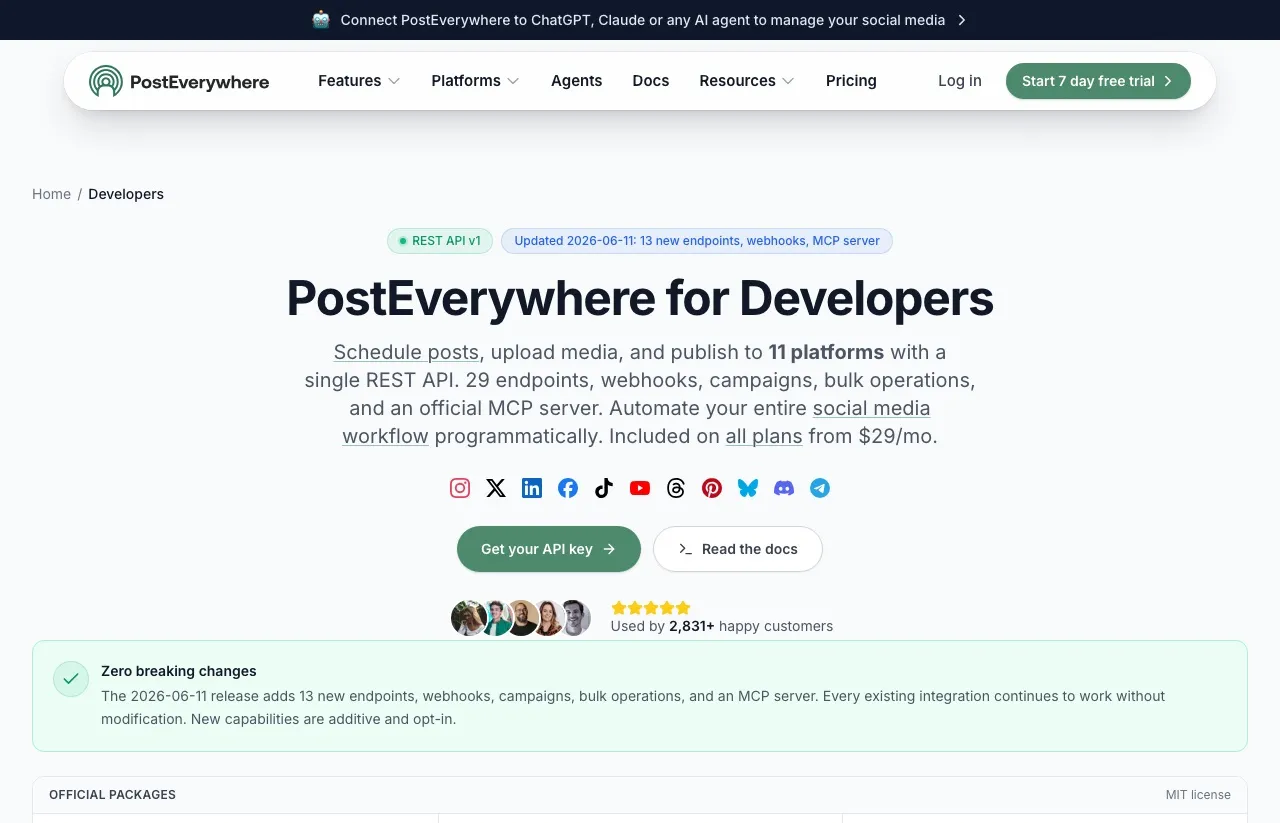
PostEverywhere is an AI content and scheduling platform: an AI Content Studio for captions, images, and video, a visual calendar, and a REST API with a hosted MCP server, all aimed at creators, small businesses, and agencies, plus a real developer and AI-agent audience. It sits in the same category I mapped in this rundown of social media API tools. Blotato is the same basic shape: AI writing, image and video generation, a content calendar, and a hosted MCP server for the same kind of reader.
The two companies even converge on $29 as an entry price. Where they diverge is in what that $29 caps, and how far each one goes to serve the automation-builder crowd specifically.

Early Adopters Testing a Young All-Tiers API
PostEverywhere is a young company. It was incorporated in October 2025, so as of this writing it’s under a year old, and it already covers real ground: 11 platforms including Discord and Telegram alongside the mainstream networks, a REST API with 29 endpoints, a hosted MCP server exposing 33 tools, a Node.js SDK, and a CLI. That MCP server puts it among the social media MCP servers worth knowing about. The homepage leads with connecting Claude, ChatGPT, or Cursor directly to manage your social media, and that AI-agent framing is not an afterthought, it’s the pitch.
The tiering is straightforward and honestly presented: Starter at $29/mo for 10 accounts and 100 AI credits, Growth at $39/mo for 25 accounts and 500 credits, Pro at $79/mo for 40 accounts and 2,000 credits. API, MCP, and CLI access ship on every tier including Starter, which is more generous than tools that gate developer access behind a higher plan.
I couldn’t verify a review score directly. G2 search snippets suggest a 4.8 rating, but I could not confirm that number or a review count on a live fetch, and Capterra’s own page for PostEverywhere states it’s “based on 0 user reviews.” For a company this new, that’s expected rather than alarming, but it means there isn’t yet a deep independent sentiment record to draw on the way there is for an established competitor.
Operators Who Need Writing Without a Credit Meter
Blotato is an app I built, so take this section with whatever grain of salt feels right.
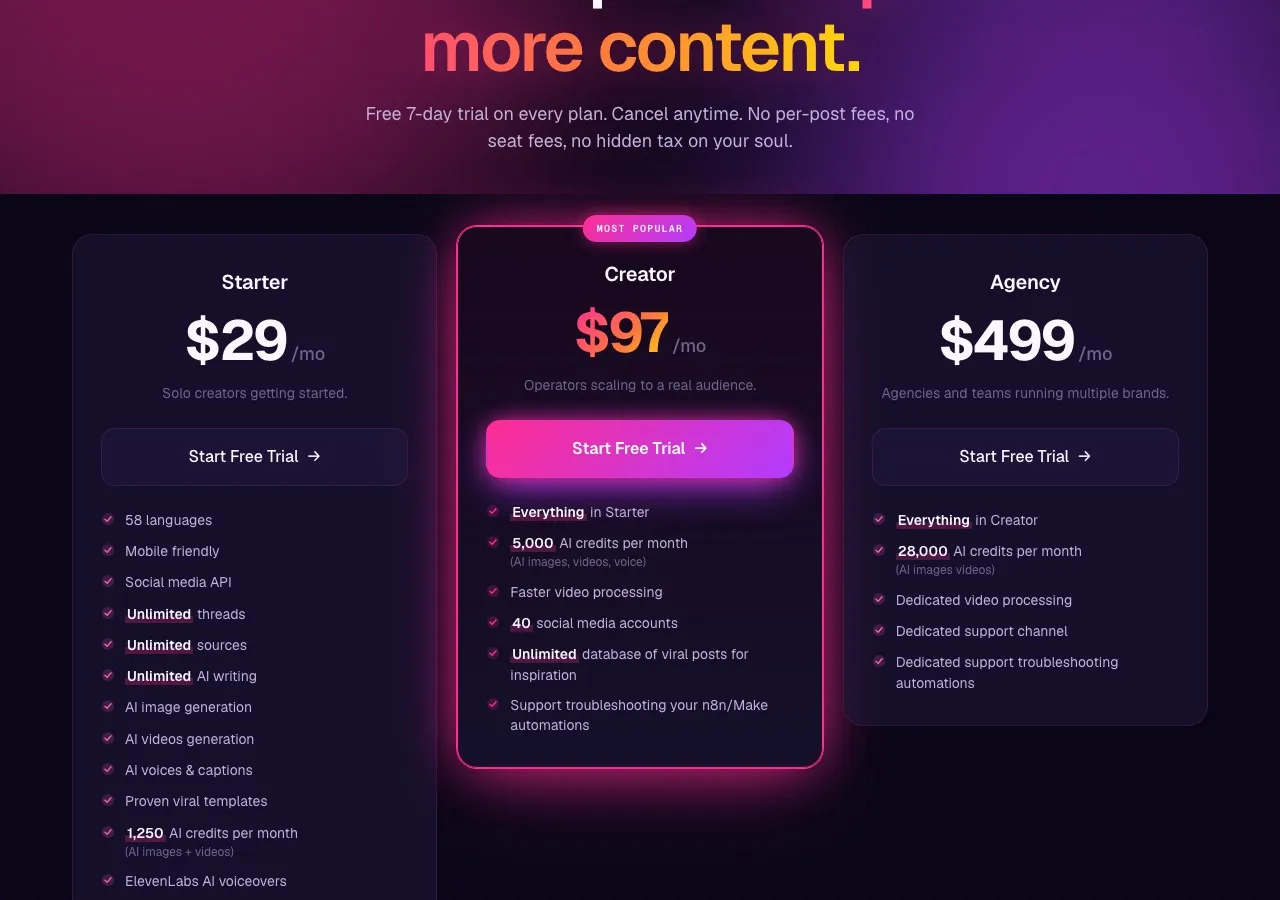
Blotato is built for the person who generates content constantly and doesn’t want a monthly counter running underneath every caption. The Starter plan is $29/mo flat for 20 social accounts with unlimited AI writing, plus credit-based image and video generation (1,250 credits a month) and ElevenLabs voiceovers. There’s a full REST API on paid plans, a hosted MCP server at mcp.blotato.com/mcp that you can point Claude at to post across every platform from Claude Code, and official n8n and Make nodes for anyone building automations rather than calling the API directly.
One honest caveat before you sign up, especially if PostEverywhere’s all-tiers API access is part of what drew you here: Blotato’s 7-day trial covers everything except the API, and generating an API key ends the trial and starts the paid Starter subscription. PostEverywhere’s own documentation states no such exclusion for its trial.

PostEverywhere vs Blotato: Side by Side
| Category | PostEverywhere | Blotato |
|---|---|---|
| Pricing model | Tiered, accounts and AI credits scale together | Flat rate |
| Free plan | No (7-day trial, card required) | No (7-day trial, card required, cancel anytime) |
| Cheapest paid tier | $29/mo (10 accounts, 100 AI credits) | $29/mo flat (Starter, 20 accounts) |
| Platforms | 11 | 9 |
| Messaging apps | Discord, Telegram included | Not offered |
| AI text writing | Metered by credit tier | Unlimited |
| AI image generation | Metered by credit tier | Included (uses AI credits) |
| AI video generation | Metered by credit tier | Included (faceless video plus voiceovers) |
| Public REST API | Yes, all tiers | Yes (paid plans, not the trial) |
| MCP server | Hosted (mcp.posteverywhere.ai) | Hosted (mcp.blotato.com/mcp) |
| Native agent connections | Claude, ChatGPT, Codex, Cursor | Claude-focused |
| n8n / Make nodes | Not listed in developer docs | Native nodes for both |
| CLI | Yes | No |
| Team seats | 1 to 10 depending on tier | Not tiered by seat count |
| Trial | 7 days, card required | 7 days, card required, excludes the API |
The row that decides most cases is the AI credit column. PostEverywhere caps generation by design, tier by tier. Blotato uncaps the writing and only meters the heavier image and video side.
Eleven Channels, Including Discord and Telegram
It reaches more platforms, including messaging apps. 11 channels against Blotato’s 9, and the extra two are Discord and Telegram, both real destinations for community-first creators and both absent from Blotato’s list entirely.
Native agent support is broader. The homepage names Claude, ChatGPT, Codex, and Cursor as first-class integrations. Blotato’s MCP setup is real and well documented, but the marketing and onboarding lean Claude-first rather than naming four agent ecosystems by default.
API and MCP access ship on every tier, including the cheapest one. PostEverywhere doesn’t carve the API out onto a higher tier the way some competitors do. Its documentation doesn’t state whether the 7-day trial itself includes API access before conversion to paid, but once you’re on the Starter plan, the API is simply there, not gated behind Growth or Pro.
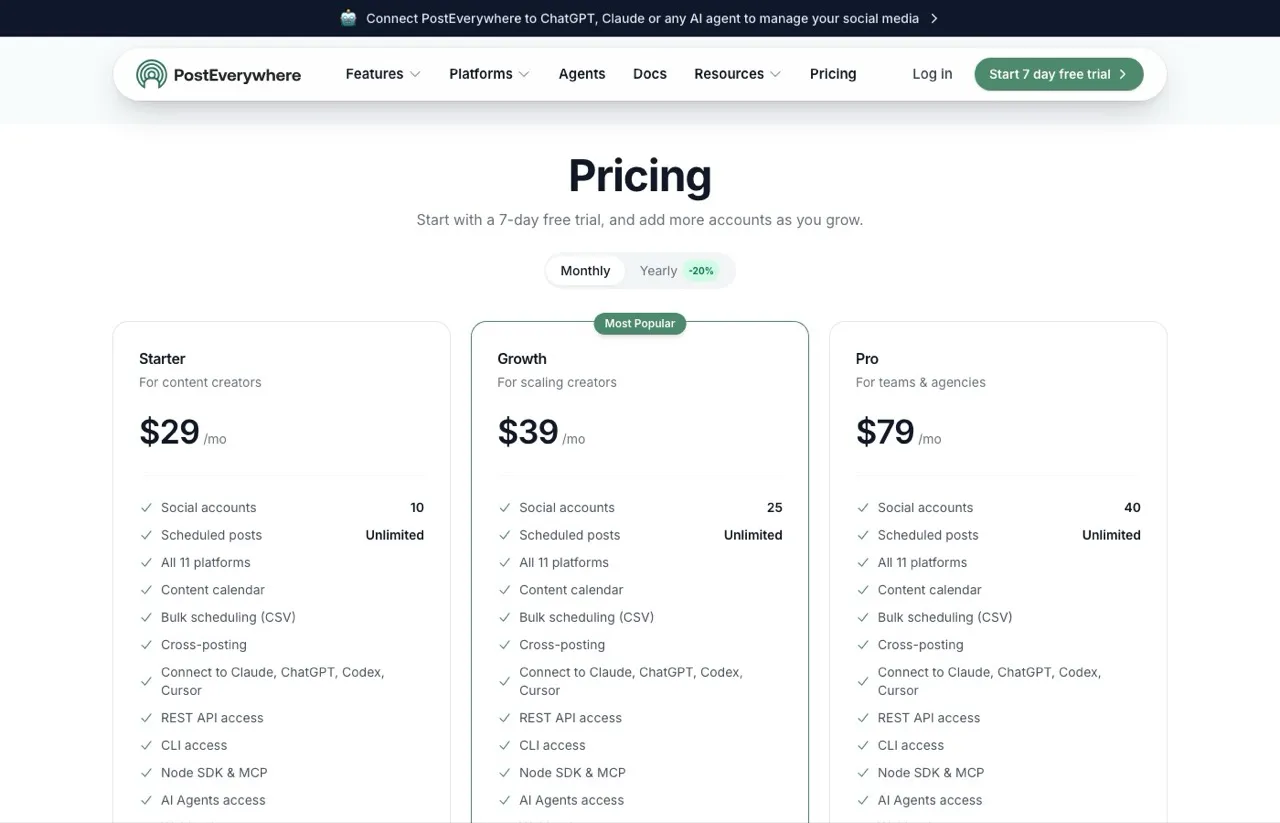
Team and workspace structure is built in from the entry tier. Even Starter includes 1 team member and 1 workspace, scaling to 10 members and 20 workspaces on Pro. Blotato doesn’t structure its plans around named seats or workspaces the same way.
It’s actively adding developer surface. Its developer changelog shows a real API expansion in June 2026, adding webhooks, campaign grouping, and bulk operations, which suggests ongoing investment in the exact developer audience this comparison is written for.
AI Writing With No Ceiling
AI writing has no ceiling, and that’s the one thing to remember from this whole comparison. PostEverywhere’s $29 Starter includes 100 AI credits a month, shared across text, images, and video. Blotato’s $29 Starter includes unlimited AI text generation on top of 20 accounts, twice PostEverywhere’s 10. If you generate a lot and automate through n8n or Make, that pairing, uncapped writing plus a pre-built node instead of a raw endpoint, is the reason to pick Blotato over a genuinely capable, newer competitor.
The automation ecosystem has a finished door, not just an open one. PostEverywhere’s REST API and MCP server are genuinely capable, but connecting them to n8n or Make means building the connection yourself. Blotato ships official nodes for both, so the no-code automation crowd gets a working integration on day one instead of a raw endpoint to wire up.
There’s a track record to check. Blotato has been live longer, with a real body of published comparisons, a visible founder, and enough usage history that its claims can be checked against prior posts and prior pricing pages. PostEverywhere launched within the last year, and its review presence (0 ratings on Capterra as of this writing, an unverifiable G2 figure) reflects that newness honestly rather than hiding it.
No separate credit line for text at all. Beyond the ceiling itself, PostEverywhere’s credit model means every caption you generate draws from the same pool as your images and video. Blotato separates unlimited writing from the metered creative pool, so a heavy-writing, light-image workflow never touches the credit count at all.
Same $29, Different Credit Ceilings
| Plan level | PostEverywhere | Blotato |
|---|---|---|
| Entry | $29/mo, 10 accounts, 100 AI credits | $29/mo, 20 accounts, unlimited AI writing |
| Mid | $39/mo, 25 accounts, 500 AI credits | $97/mo, 40 accounts, 5,000 AI credits |
| Top | $79/mo, 40 accounts, 2,000 AI credits | $499/mo, Agency, 28,000 AI credits |
| Trial | 7 days, card required | 7 days, card required, excludes the API |
Now the entry tier, capability by capability.
| Capability at the entry tier | PostEverywhere Starter ($29/mo) | Blotato Starter ($29/mo) |
|---|---|---|
| Social accounts | 10 | 20 |
| Platforms reachable | 11 | 9 |
| AI text writing | 100 credits/mo shared pool | Unlimited |
| AI image generation | Shared credit pool | Included (uses credits) |
| AI video generation | Shared credit pool | Included (uses credits) |
| REST API | Yes, full access | Yes (paid plans, not the trial) |
| MCP server | Yes | Yes |
| n8n / Make nodes | Not listed | Native nodes for both |
| Team members | 1 | Not seat-limited |
At the same $29, Blotato doubles the accounts and removes the writing ceiling. PostEverywhere answers with more platforms and an API that isn’t gated behind a higher tier. That’s the price-to-value trade in one table.
Now the honest caveats, because the table above hides real situations where PostEverywhere is the better answer.
If Discord or Telegram is where your audience actually is, Blotato has no answer at any price. No pricing tier adds platforms we don’t support.
If you want the API included on your cheapest paid tier without an explicit carve-out, PostEverywhere’s model is simply more accommodating. Blotato’s trial explicitly excludes API access, and PostEverywhere’s documentation makes no such exclusion.
If your posting volume is genuinely light, PostEverywhere’s credit ceiling may never bind. A creator posting a few captions a week across 10 accounts may never brush against 100 monthly credits, in which case Blotato’s unlimited writing is capability you’re paying for without using.
If you need named team seats and workspaces from the entry tier, PostEverywhere structures that in by default. Blotato doesn’t organize its plans around seat counts the same way, so a small team evaluating both should check whether that structure actually matters to how you work.
PostEverywhere Makes Sense for Messaging-App Reach
- You need Discord or Telegram alongside the mainstream platforms
- You want native ChatGPT or Codex agent connections in addition to Claude
- You want the API included on your cheapest paid tier with no explicit trial exclusion
- Your posting and generation volume fits comfortably inside a fixed credit tier
- You want named team seats and workspaces built into the plan structure
A Hundred Credits, and the Month Is Not Over
- You generate a high volume of AI writing and don’t want a credit count deciding when you stop
- You automate through n8n or Make and want a pre-built node instead of raw API calls
- You manage 20 accounts and want that covered at the entry price
- You want faceless video and voiceovers bundled with the same credit pool as your images
- You’d rather compare against an established track record than a company under a year old
Capable for Its Age, Metered Where It Counts
I’m the founder of Blotato, so weigh this accordingly: PostEverywhere is a genuinely capable tool for a company this young, and its all-tiers API access plus four-agent story (Claude, ChatGPT, Codex, Cursor) are real strengths I don’t want to undersell.
The comparison tightens to one real question, and it’s the one I’d actually ask a friend: do you generate constantly, and does your workflow route through n8n or Make rather than custom code? If yes to either, pick Blotato. Uncapped writing plus a finished node beats a fixed credit tier and a raw API every time you’re the one shipping the automation. PostEverywhere earns the pick only in the narrower case, modest volume, a need for Discord or Telegram, or an API that isn’t carved out of the trial.
If neither of us fits, I lined up the wider field in the best PostEverywhere alternatives, including the tools worth a look if self-hosting or the widest platform reach matters more to you.
Run your real posting and generation volume against the tables above. If the unlimited-writing side wins for you, the Starter plan is $29 for 20 accounts. If you’re here mainly for the API, remember it sits outside Blotato’s trial, and PostEverywhere’s own documentation states no equivalent exclusion.
FAQs
Is Blotato cheaper than PostEverywhere?
At the same $29 entry price, Blotato includes 20 accounts and unlimited AI writing against PostEverywhere’s 10 accounts and 100 AI credits. PostEverywhere includes 11 platforms against Blotato’s 9 and reaches Discord and Telegram, which Blotato does not. Which is cheaper depends on whether your bottleneck is accounts, platforms, or AI volume.
Does PostEverywhere have AI video generation?
Yes, alongside AI text and image generation, all drawn from the same shared credit pool that scales by tier (100 credits on Starter up to 2,000 on Pro). Blotato also generates AI video, including faceless video with ElevenLabs voiceovers, using a separate credit pool that doesn’t touch its unlimited AI text writing.
Can I use PostEverywhere or Blotato with n8n or Make?
Blotato ships official nodes for both n8n and Make. PostEverywhere’s developer documentation does not list a native integration node for either platform, though its REST API can be called from a custom HTTP step in both tools.
Does Blotato have a free plan?
No. Blotato runs a 7-day trial on every plan, a card is collected at signup, and you can cancel anytime. The trial excludes API access specifically. PostEverywhere also has no permanent free plan, running its own 7-day trial with a card required, and its documentation states no equivalent API exclusion.
Which tool supports more social platforms?
PostEverywhere, at 11 platforms against Blotato’s 9. The extra two are Discord and Telegram, both outside Blotato’s current platform list. If either is a hard requirement for your audience, PostEverywhere is the better fit regardless of the rest of this comparison.
Is PostEverywhere or Blotato better for agencies?
It depends on what the agency needs most. PostEverywhere’s Pro tier includes 10 team members and 20 workspaces at $79/mo, which is a real answer for structured multi-client teams. Blotato’s Agency plan is $499/mo and leans on a large shared AI credit pool (28,000/mo) and unlimited writing rather than named seats. An agency generating heavy content volume across many client brands should weigh Blotato’s uncapped writing against PostEverywhere’s lower price and built-in team structure.