Blotato vs PostSyncer: Public vs Private Social Media Automation
Blotato vs PostSyncer: PostSyncer moderates social media comments on seven networks, while Blotato's agent tools answer Instagram and Facebook DMs.
Blotato vs PostSyncer splits on two messages: a spam comment under your YouTube video and a “how much?” DM on Instagram. PostSyncer’s agent tools work public comments on the seven networks its inbox page lists. Blotato’s agent tools work comments, DMs and DM automation, but only on Instagram and Facebook. PostSyncer’s API spec and MCP tool reference list no DM tool, and Blotato has no tool to hide or delete a comment.
PostSyncer is a social media scheduler with an AI studio, a comment-moderation inbox, a REST API and its own MCP server. Blotato is agent infrastructure for social media marketing, and its engagement tools stop at Instagram and Facebook. Blotato is an app I built, which makes me the least neutral judge of its inbox, so every PostSyncer claim below links to PostSyncer’s own docs for you to check.
Blotato vs PostSyncer: Match the Reply to the Tool Call
Each row pairs a job you might hand an agent with the tool that does it on each server. The names come from PostSyncer’s MCP tools reference and from Blotato’s own server tool list on October 12, 2026.
| What you ask the agent to do | PostSyncer MCP tool | Blotato MCP tool |
|---|---|---|
| Publish or schedule a post | create-post | blotato_create_post |
| Reply to a comment | create-comment | blotato_post_comment (Instagram, Facebook) |
| Hide a spam comment | hide-comment (where the network supports it) | None |
| Delete a comment | delete-comment | None |
| Turn moderation filters or AI replies on for one post | update-post-comment-moderation | None |
| Auto-reply once a post hits an engagement threshold | update-post-auto-plug | None |
| Add commenters to a CRM list, by keyword or all of them | update-post-contact-collection | None (an email gate can pass captured emails to your webhook) |
| Read and answer a DM | None | blotato_list_messages, blotato_send_message (Instagram, Facebook) |
| Build a comment-to-DM automation | None | blotato_create_automation (Instagram, Facebook, reply-only) |
| Pull analytics for a post | get-analytics-post | blotato_get_post_analytics (8 platforms, not LinkedIn) |
PostSyncer fits better if the jobs you need are comment moderation and public auto-replies, because it suits the reader who works public threads on X, LinkedIn, YouTube, Threads or Bluesky, wants teammates in the same account, or posts to Telegram or Mastodon. Blotato fits better when the conversations you care about happen in Instagram and Facebook DMs and 20 accounts on one $29 Starter plan cover your stack, as long as you can live without Telegram, Mastodon, LinkedIn analytics and comment hiding.
What PostSyncer Does With a Public Comment
PostSyncer publishes to 11 networks, and its llms.txt names them: X, Facebook, Instagram, TikTok, YouTube, Pinterest, Threads, Telegram, LinkedIn, Bluesky and Mastodon. Every plan on its pricing page includes unlimited team members and approval workflows. Its comment moderation page names seven inbox networks: Twitter, Facebook, Instagram, LinkedIn, Threads, Bluesky and YouTube. On TikTok, the same page contradicts itself: its FAQ answers “Yes comming soon!” and then says the moderation tool “supports TikTok along with” those seven.
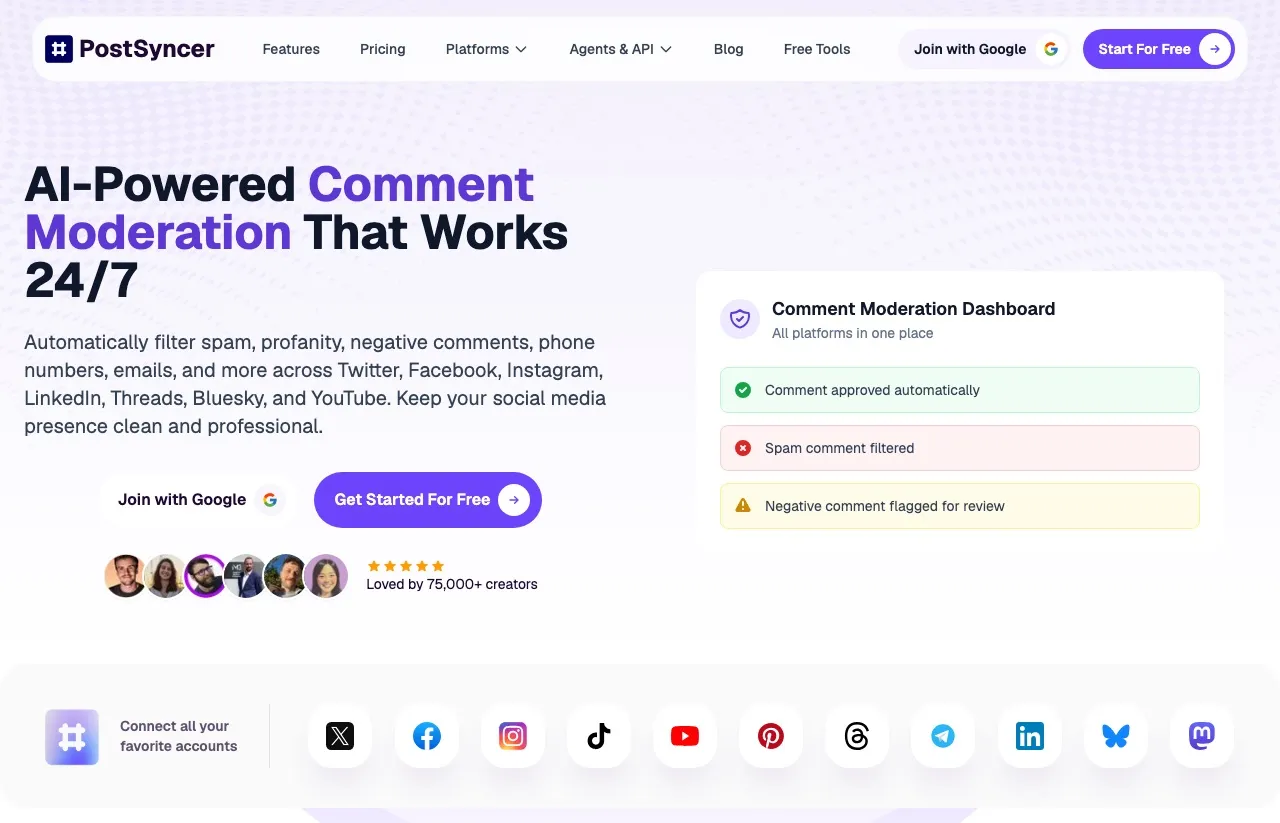
PostSyncer advertises automatic filters for spam, profanity, negative comments, and comments that contain phone numbers or emails. The AI reply page offers a “Manual Review Option,” so you can “review AI responses before sending or enable full automation.” An agent turns moderation filters and AI reply on or off per post through update-post-comment-moderation. Its comment tools then reply to, hide or delete individual comments, with the available actions depending on what each network supports.
What Blotato Does With a Private Message
Our engagement tools cover Instagram and Facebook only. On those two networks, an agent can read comments and reply to them, read DMs, and answer a DM inside the platform’s 24-hour messaging window. The same key builds DM automations, which move a public comment into a private conversation.
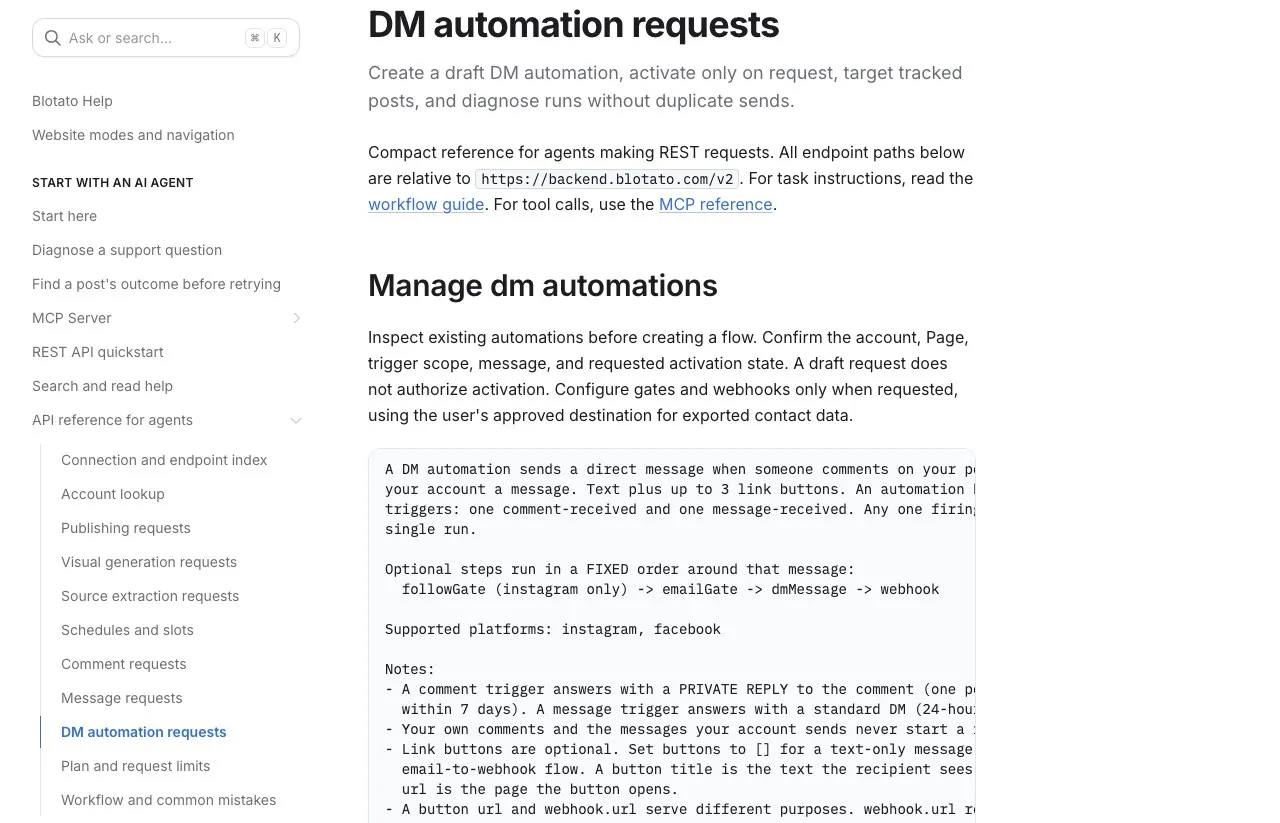
An automation watches for a keyword in a new comment or DM, and the DM automation docs spell out what happens next. A comment trigger answers with a private reply within 7 days, and a message trigger answers with a standard DM inside the 24-hour window. The DM is the required step, and optional steps run around it in a fixed order: a follow gate on Instagram only, an email gate, the DM, then a webhook. There is no cold outreach, so an automation only answers people who contacted you first.
The keyword match is a case-insensitive substring, so “price” also fires on “pricey.” Automated sends count against a monthly active-contacts limit: 1,000 on Starter, 6,000 on Creator and 15,000 on Agency. For the full mechanics, the DM automation API walkthrough covers a build step by step.
Counting the Tools Behind Each Key
PostSyncer’s docs list 46 MCP tools at postsyncer.com/mcp, and its MCP setup guide connects with a Bearer token or OAuth. Fifteen of those tools organize work rather than publish it: labels and campaigns sort posts, and folders sort the media library, five tools each. Seven handle comments, five handle analytics, and the rest cover posts, media, accounts and workspaces.
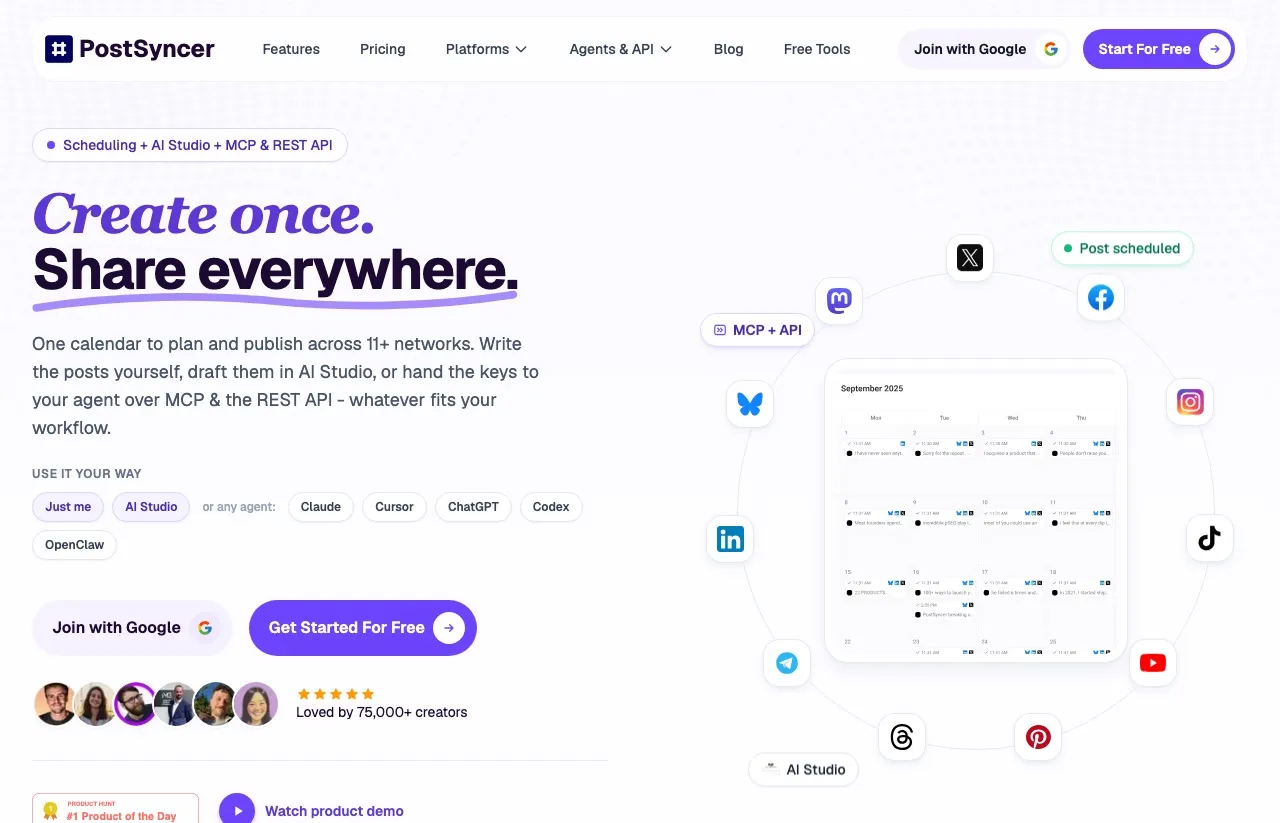
Besides per-post moderation, two more PostSyncer post tools set per-post automation: auto-plug replies automatically once a post crosses engagement thresholds, and contact collection adds commenters to CRM lists, either by keyword rule or all of them to one list. Its REST API v1 publishes 42 operations in an OpenAPI spec.
Blotato’s MCP server returned 35 tools on October 12, 2026, and it takes OAuth, a blotato-api-key header or an Authorization: Bearer key. On Instagram and Facebook, eight of those tools build and monitor DM automations, five read and send DMs, and three handle comments. Blotato has nothing for labels, campaigns or folders. So PostSyncer documents more tools, and most of the gap is organizational.
Guardrails Before You Hand Over the Key
Both servers can change live accounts, so check the safety model before an agent gets a key. PostSyncer’s MCP includes delete-post, delete-account (which disconnects a social account) and hide-comment, and its tools reference warns: “Only use them when the end user clearly asked for that outcome.” Its API keys start with every permission on, and a Bearer-token key can be scoped to resource:action pairs, with the same permission gating the matching MCP tool. Connector (OAuth) authorizations get full access to your workspaces, so that scoping only helps on the token path.
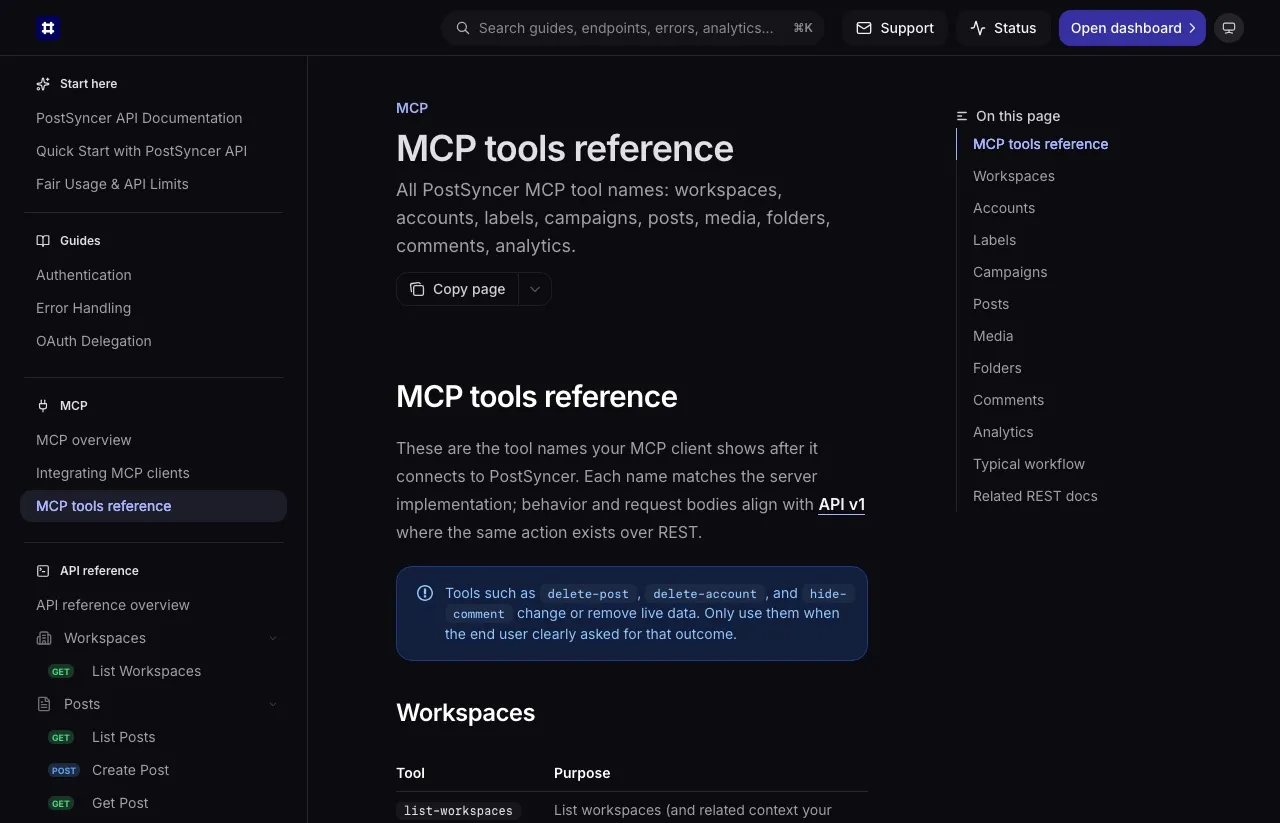
Blotato’s MCP server has no tool to delete a published post or disconnect an account. Its destructive tools delete a scheduled post before it goes out and archive a DM automation. Its limits doc caps publishing at 30 requests a minute and status checks at 60 a minute. PostSyncer’s usage doc names 60 API requests a minute as its only enforced limit, even though its pricing cards list daily posting caps.
The Specs, Line Against Line
| PostSyncer | Blotato | |
|---|---|---|
| What it is | Social media scheduler with an AI studio, comment inbox and MCP server | Agent infrastructure for social media marketing: one API and MCP key |
| Publishing | 11 networks, incl. Telegram and Mastodon | 9 platforms, one account per publish call |
| Billing shape | Plan sets the account cap: 10, 15 or 30 | Plan sets the account cap: 20, 40 or 100 |
| Team members | Unlimited on every plan | One user per account |
| Public API | REST v1, 42 operations, 60 requests a minute across all calls | REST on paid plans, 30 publish and 60 status requests a minute |
| Hosted MCP | 46 documented tools, Bearer token or OAuth | 35 tools in the server’s list on October 12, OAuth, API-key header or Bearer key |
| Comments | Inbox on 7 networks, reply, delete and hide over API and MCP where the network supports it | Instagram and Facebook, read and reply, no hide or delete |
| DMs | Not in its API spec or MCP tools | Instagram and Facebook, reply-only |
| DM automation | Not in its API spec or MCP tools (per-post automation covers public auto-replies and CRM capture) | Yes, keyword-triggered, Instagram and Facebook |
| Analytics | Post, account and workspace metrics | 8 of 9 platforms, LinkedIn not yet |
| n8n / Make | Homepage suggests wiring them to the REST API | Native nodes for both |
| Trial | 7 days, “$0.00 today - cancel anytime” | 7 days, web app only, no API or MCP |
| AI images and video | AI Studio, credits differ between plan cards and pricing FAQ | Included, 1,250 credits on Starter |
Third-party review coverage of PostSyncer is still thin, so judge it on its docs and a trial run rather than on aggregate scores.
Account Counts and the Monthly Bill
In Blotato vs PostSyncer, the cheaper bill depends on how many accounts you connect. Both tables below use monthly prices, read from PostSyncer’s pricing page and Blotato’s plan list on October 12, 2026.
| Accounts you connect | PostSyncer, monthly | Blotato, monthly |
|---|---|---|
| 10 | $29 (Starter) | $29 (Starter) |
| 15 | $49 (Pro) | $29 (Starter) |
| 20 | $49 (Pro Plus) | $29 (Starter) |
| 30 | $49 (Pro Plus, list $99) | $97 (Creator) |
| 40 | No plan listed | $97 (Creator) |
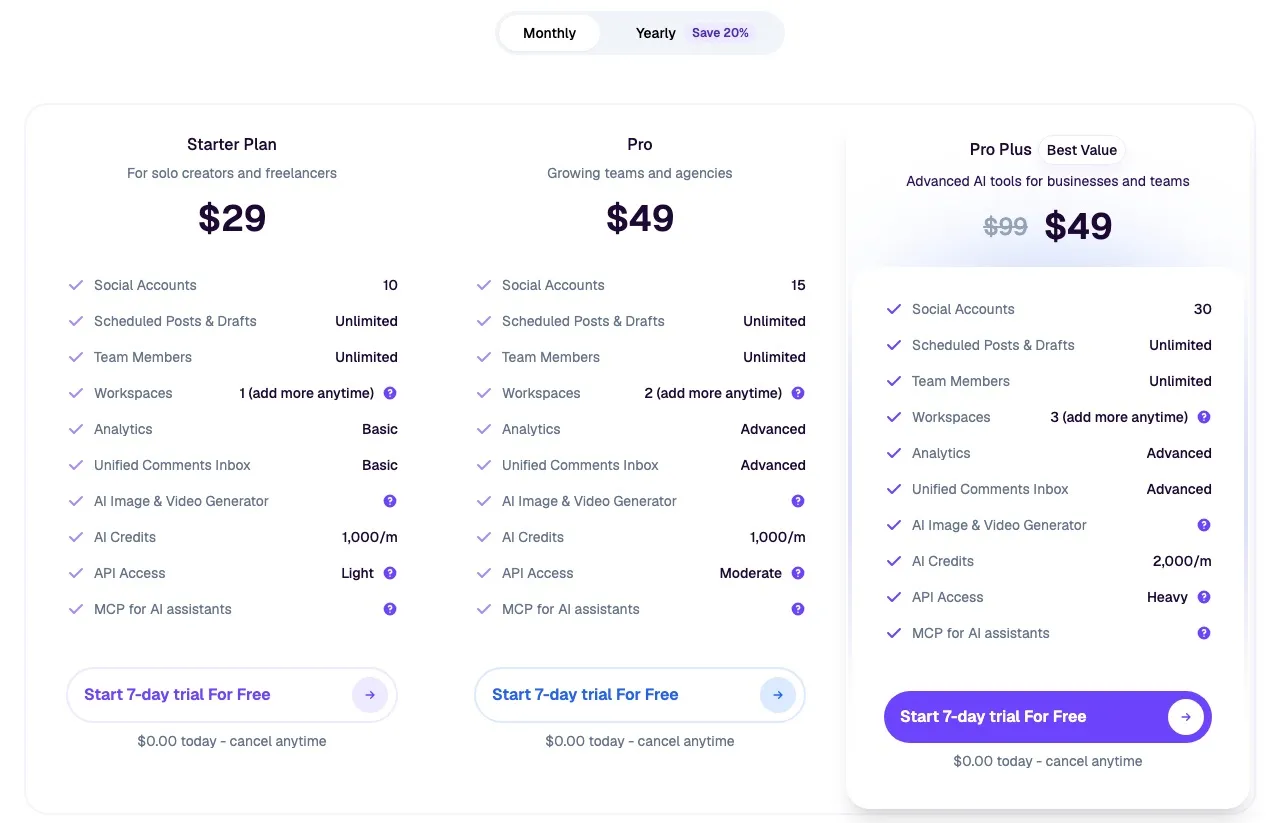
| At the entry tier | PostSyncer Starter ($29/mo) | Blotato Starter ($29/mo) |
|---|---|---|
| Social accounts | 10 | 20 |
| Team members | Unlimited | 1 |
| REST API and MCP | Included, “Light” API tier | Included, not on the trial |
| Comment inbox | Included, “Basic” tier | Instagram and Facebook |
| DMs and DM automation | Not documented | Instagram and Facebook, 1,000 active contacts a month |
| AI credits | 1,000 on the plan card, 200 in the pricing FAQ | 1,250 a month |
The matching sticker price buys different things. PostSyncer’s Starter covers a whole team and its Basic comment inbox, and Blotato’s covers twice the accounts plus Instagram and Facebook DM automation. For a second $29 matchup with 20 accounts on each side, Blotato vs Postqued splits on approvals and DMs instead.
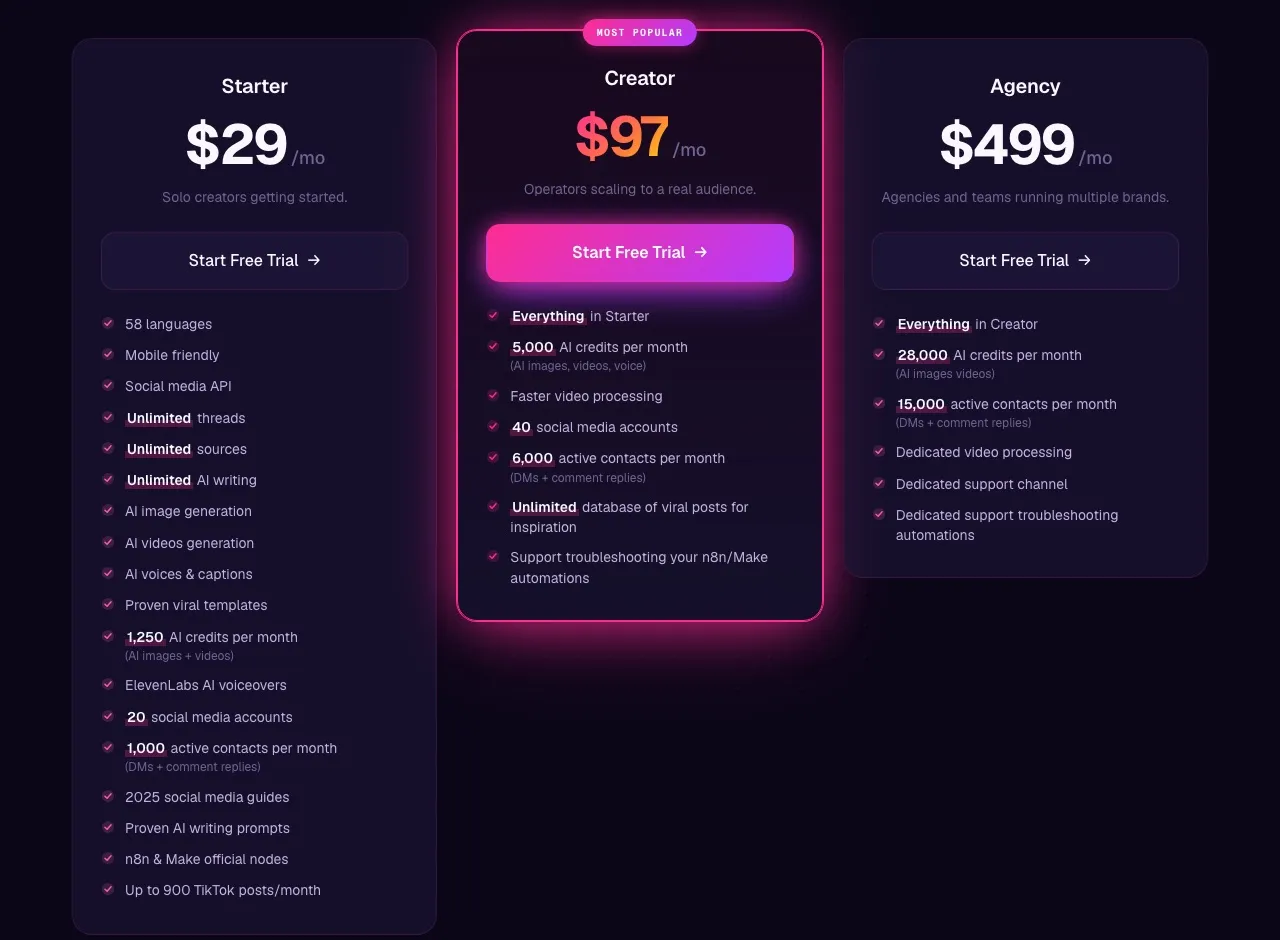
Before trusting either column, check these:
- On October 12, 2026, PostSyncer’s Pro Plus showed $49 a month for 30 accounts against a struck-through $99, cheaper than Blotato’s $97 Creator from 21 to 30 accounts, with no end date given for that price.
- PostSyncer contradicts itself on volume. Its pricing cards give Starter API access a “daily posting limit of 100 posts (10 posts/platform/day),” while its usage and limits doc says “posting is unlimited.” Ask which applies before an agent’s batch schedule depends on it.
- Blotato’s flat price buys one login. A second person can share it, but nobody gets their own login, role or approval step.
Agent builders get no free week here: Blotato’s 7-day trial is web-app only, and creating an API key during it switches the account straight to a paid subscription.
Jobs Blotato Handles Better Than PostSyncer
It answers the private conversation on Instagram and Facebook. When someone asks “how much?” in an Instagram or Facebook DM, Blotato’s agent can read the message and reply inside the 24-hour window, or let a keyword automation answer for it.
One agent session can publish a post and wire a private reply to it. On Instagram and Facebook, a comment automation can target one post by its Blotato post ID, which the agent reads from its published posts. So the same session can publish a post, confirm it went live, and attach a keyword automation that answers commenters by DM. PostSyncer can also wire per-post automation, but its documented options reply in public or file commenters into its CRM.
The entry plan holds twice the accounts. Blotato Starter covers 20 connected accounts for $29 a month, and PostSyncer Starter covers 10 at the same price. Between 11 and 20 accounts, Blotato is the cheaper bill.
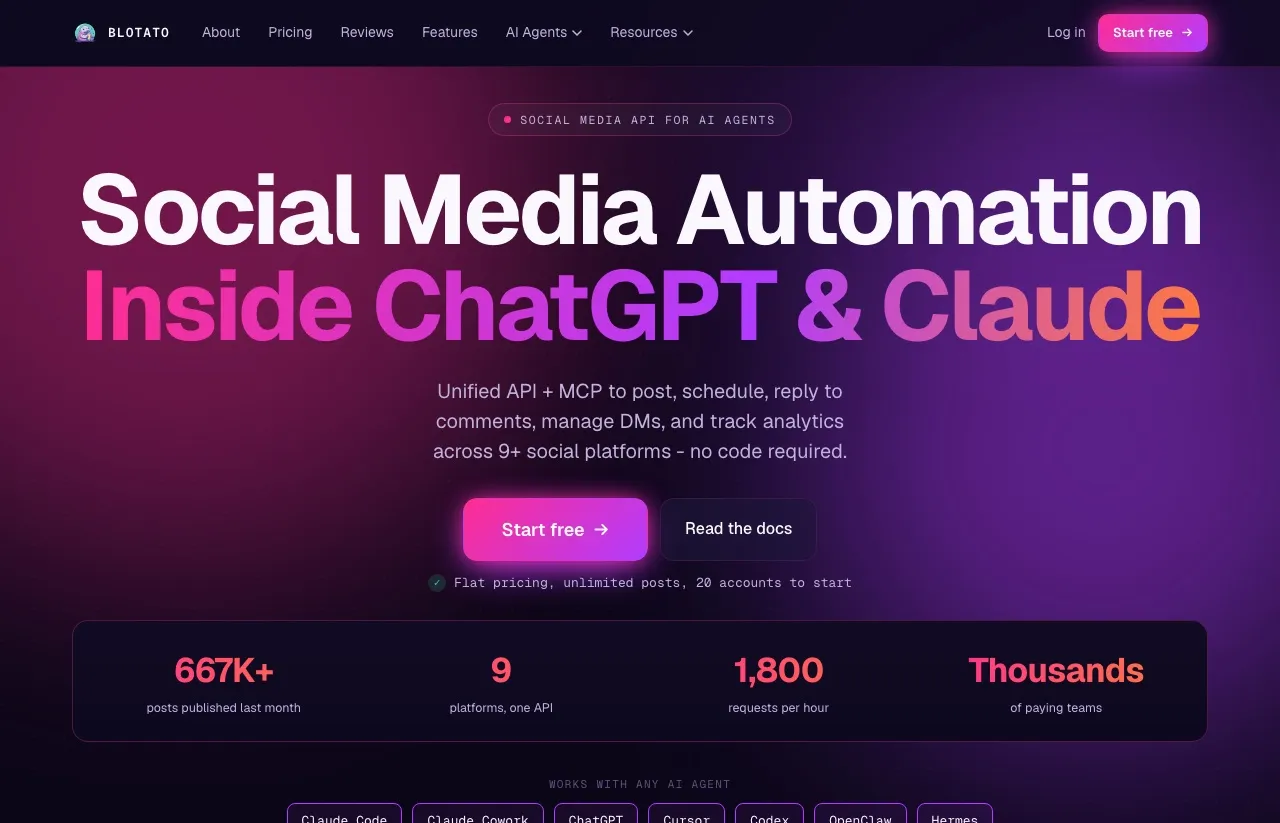
n8n and Make get native nodes. Blotato has an official n8n integration and a Make app, so an existing workflow gets a Blotato step without custom HTTP calls. PostSyncer’s homepage suggests wiring n8n, Make or Zapier to its REST API instead.
Jobs PostSyncer Handles Better
It reaches two networks Blotato cannot. PostSyncer publishes to Telegram and Mastodon on top of the nine networks both tools share. If either one is part of your plan, Blotato is out before price comes up.
It moderates public comments beyond Meta. Its inbox covers X, LinkedIn, YouTube, Threads and Bluesky as well as Instagram and Facebook, and its API and MCP expose reply, hide and delete where each network supports them. Per post, an agent can also switch on auto-plug replies and capture commenters into CRM lists, by keyword or all at once. A brand that protects and works its public threads has more tools here.
A whole team can work inside one account. Every PostSyncer plan includes unlimited team members and approval workflows, so an editor can approve posts before they publish. Blotato allows one user per account, as its team access docs say.
It gives an agent ways to organize a busy calendar. Labels and campaigns let an agent file and find posts as the calendar grows. PostSyncer also ships a CLI for agents and an OAuth delegation flow for apps that connect a user’s social accounts.
What Blotato’s Agent Cannot Reach
These limits apply to the MCP server and the REST API alike. Blotato publishes to 9 platforms, and Telegram and Mastodon are not among them. Analytics cover 8 platforms, and the analytics docs say LinkedIn metrics are not available yet.
The comment tools list, read, post and reply, but Blotato’s API and MCP cannot hide or delete a comment. That cleanup happens in the native Instagram or Facebook app, or in another moderation tool. Our comment-triggered automations answer with a private reply only, and a public reply under the comment means your agent calling blotato_post_comment itself.
Which Reply Your Business Runs On
Public replies across X, LinkedIn, YouTube, Threads and Bluesky are PostSyncer’s ground, since it advertises comment filtering and moderation on every network its inbox covers, with hide and delete where each network allows it. Private replies in Instagram and Facebook DMs are where Blotato earns its place, because its agent answers them and runs reply-only automations, on those two networks only.
Treat this Blotato vs PostSyncer answer as dated October 12, 2026, because both docs sites change fast. A PostSyncer DM tool, or comment hiding and wider engagement on Blotato’s side, would flip part of it. Read both tool lists again before you commit, since a renamed or added tool is the first sign the split has moved.
PostSyncer and Blotato FAQs
Is there a DM endpoint in PostSyncer’s API or MCP server?
Not in its documentation. PostSyncer’s MCP tools and REST API spec cover comments, with no DM or conversation endpoints for Instagram or any other network. Facebook Messenger is the open question: its AI reply page answers “Yes comming soon!” and then says PostSyncer “supports Facebook Messenger through our Facebook integration.” Blotato’s agent can read and send Instagram and Facebook DMs and run reply-only DM automations there, and it covers DMs on no other network.
Does PostSyncer cap how many posts an agent can publish per day?
Its own pages disagree. The pricing cards list a daily API posting limit of 100 posts on Starter, 250 on Pro and 500 on Pro Plus, while the usage and limits doc says posting is unlimited and only enforces 60 API requests per minute. On Blotato, the social accounts docs set per-platform caps, such as 50 posts per Instagram account and 25 per Facebook Page every 24 hours.
Can my agent hide a spam comment through Blotato?
No. Blotato’s comment tools list comments, read one, and post a comment or reply, on Instagram and Facebook only. PostSyncer’s MCP server does include hide-comment and delete-comment. On Blotato, hiding or deleting a comment still happens in the native Instagram or Facebook app.
How does PostSyncer’s MCP server connect to Claude or ChatGPT?
PostSyncer runs a hosted MCP server with 46 documented tools. ChatGPT installs it as an official app, and Claude connects through OAuth as a custom connector. Config-file clients such as Claude Desktop, Claude Code and Cursor use a Bearer token, the same one the REST API uses. Blotato’s server at mcp.blotato.com/mcp takes OAuth, an API-key header or a Bearer key, and ChatGPT adds it as a custom MCP server from its Plugins page.
Does Blotato’s DM automation post a public reply too?
No. On Instagram and Facebook, a comment trigger answers with a private reply only, so nothing appears under the original comment. If you want a public reply as well, your agent posts it with blotato_post_comment and a parent comment ID, as a separate step.