Higgsfield Pricing 2026: What a Credit Buys You
Higgsfield pricing in 2026: what each plan costs at 10, 25, 50, and 100 videos a month, what credits actually buy, and when going direct is cheaper.
Higgsfield pricing looks simple until you try to work out what one video costs. Three tiers, three credit allowances, done. Then you notice the price you are quoted depends on a toggle you did not touch, the credits buy wildly different amounts depending on which model you pick, and whatever you do not spend disappears at the end of the month.
This post breaks down what each plan actually costs per generation at real publishing volumes, what a credit buys across the model range, and the one condition that decides whether Higgsfield is cheap or expensive for you.
Credit where it is due first. Higgsfield is one of the few platforms in this category that publishes its own credit-to-output conversion right on the pricing card, which is more transparency than most of its competitors offer. The numbers below are its own.
Higgsfield Pricing at a Glance
- No free plan. There is a $3 one-time access offer for 40 credits, and a 3-day trial plan attached to connecting over MCP.
- Starter: $19/month, billed monthly or annually. 270 credits.
- Plus: $59/month billed monthly, $47/month billed annually. 1,200 credits.
- Ultra: $129/month billed monthly, $99/month billed annually. 3,000 credits.
- The quirk that matters most: unused credits do not roll over. They reset every month, so your real cost per video is set by how much of the bundle you actually spend.
- The second quirk: Starter cannot reach the full Seedance 2.0 or 2.5 models. It runs the cut-down Fast and Mini variants only, which is a different product rather than a slower version of the same one.
A promotion of 20% to 30% was running when I checked, so the discounted numbers above may not be what you see.
How Higgsfield’s Credit Pricing Actually Works
The billing unit on Higgsfield is the credit, not the video, and that is the whole source of confusion. A credit is worth a different amount of output depending on which model you run, what resolution you ask for, and how long the clip is. Ask for 4K with audio and the same bundle disappears several times faster than it would at 720p.
The second thing to understand is the pricing page itself. It loads on the annual toggle by default and prints the annual rate with a “per month” label next to it, which is why three of the pages ranking for this term quote numbers that do not match the live checkout. Here is what each billing state actually shows.
| Plan | Billed monthly | Billed annually | Credits per month | Seedance access |
|---|---|---|---|---|
| Starter | $19 | $19 | 270 | Fast and Mini only |
| Plus | $59 | $47 | 1,200 | Full line-up |
| Ultra | $129 | $99 | 3,000 | Full line-up |
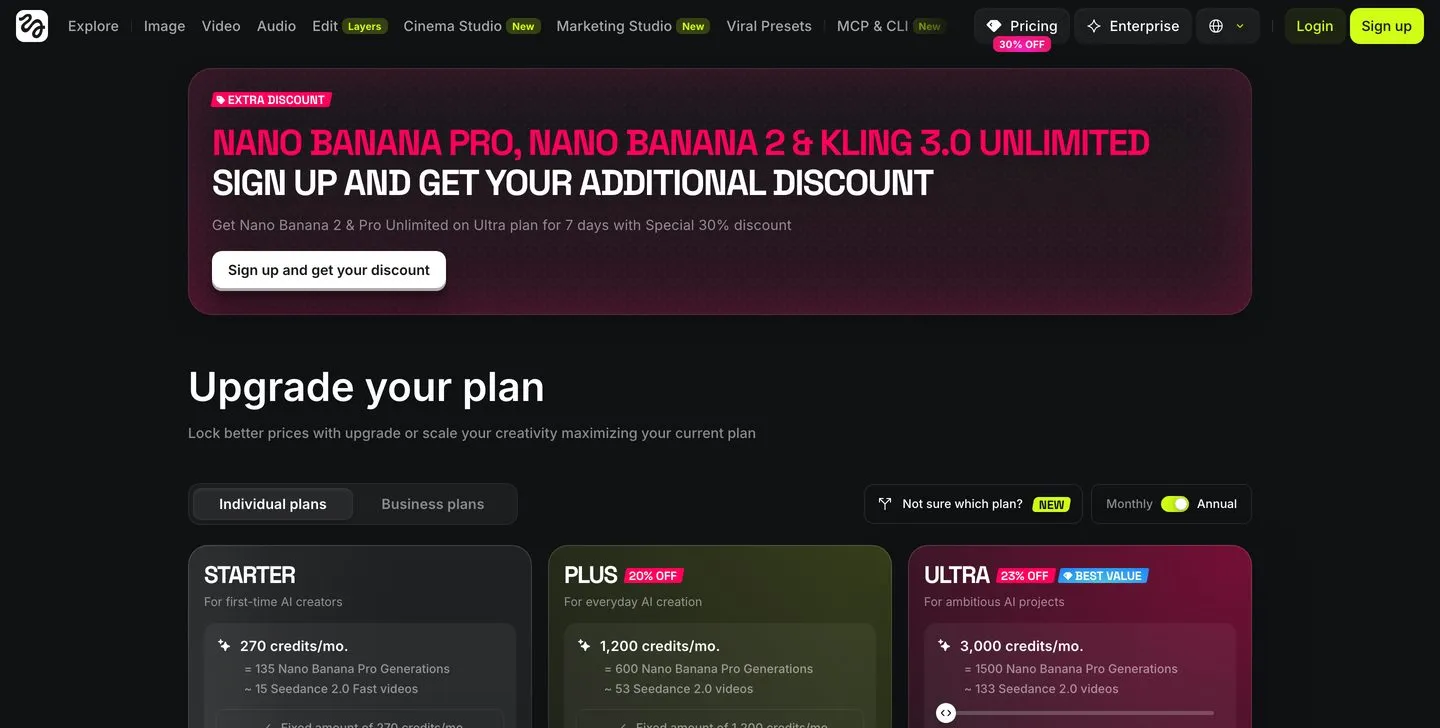
The live pricing page, with the annual toggle selected by default.
What a Credit Actually Buys
This is the part worth internalizing, because it is where the real cost lives.
Higgsfield states its own conversions on each card: 270 credits is about 15 Seedance 2.0 Fast videos, 1,200 credits is about 53 Seedance 2.0 videos, and 3,000 credits is about 133. Those are generations, not keepers. Retries, discarded takes, and variations all spend credits at the same rate, so a realistic working ratio is somewhere below the published one.
Divide the price by the output and the picture changes completely:
| Plan | Stated videos | Cost per video (monthly billing) | Cost per video (annual billing) |
|---|---|---|---|
| Starter | About 15 | $1.27 | $1.27 |
| Plus | About 53 | $1.11 | $0.89 |
| Ultra | About 133 | $0.97 | $0.74 |
Under a dollar per video at the top tier is a genuinely competitive rate. Higgsfield is cheap per video and expensive per month, and those two facts are not in tension. They are the same fact seen from either end of the bundle.
The Real Cost at 10, 25, 50, and 100 Generations a Month
Here is the table the tier comparison above cannot give you. Every figure assumes annual billing and counts generations rather than keepers, so treat each row as a best case that a retry-heavy workflow will not reach.
| Generations per month | Cheapest workable plan | Monthly cost | Real cost per video |
|---|---|---|---|
| 10 | Starter | $19 | $1.90 |
| 25 | Plus | $47 | $1.88 |
| 50 | Plus | $47 | $0.94 |
| 100 | Ultra | $99 | $0.99 |
The 50-generation row is the one to read carefully: it sits at about 94% of the Plus allowance, so that $0.94 is only reachable if almost nothing gets retried or discarded.
Notice what happens at 25 generations a month. You have moved up a tier to reach Seedance 2.0, you are spending roughly half your allowance, and your real cost per video is almost exactly what it was at 10 videos on Starter. The tier upgrade bought you model access, not efficiency.
The same effect shows up inside Starter. Ten videos on a fifteen-video allowance costs $1.90 each. Use all fifteen and it drops to $1.27.
The efficient zones are narrow. Plus at 40 to 53 generations and Ultra at 110 to 133 are where the advertised rates hold, and above those ceilings the plan cannot deliver the volume at all. Both bands assume near-total utilization, so read them as ceilings rather than as recommendations. Sit anywhere below those and you are paying for headroom.
What Higgsfield Credits Do Not Cover
Worth knowing before you assume a plan covers your whole workflow.
- Nothing outside generation. Credits buy images and video. They do not buy distribution, scheduling, or anything downstream of the render.
- No rollover. Higgsfield’s help centre states subscription credits expire at the end of each billing cycle, unlike some competitors where purchased credit packs persist.
- Model access is tier-gated, not just volume-gated. Starter cannot reach Seedance 2.0 or 2.5 at any credit level.
- Higher fidelity costs more credits. 4K and audio-enabled generations draw down the bundle considerably faster than the headline conversion suggests.
When Higgsfield Pricing Makes Sense (and When It Does Not)
When it makes sense:
- You publish on a steady weekly cadence and reliably spend most of a bundle.
- You want breadth of models without wiring up several vendors yourself.
- You are driving generation from an agent and want one subscription rather than a metered balance to monitor.
- You value the editing surface, presets, and one-click apps, which pay-per-generation gives you none of.
When it starts to bite:
- Your output is seasonal, client-driven, or otherwise lumpy. The reset is a straight tax on quiet months.
- You publish fewer than about 20 videos a month, where the real per-video cost roughly doubles the advertised one.
- You mostly need one model rather than the full range, in which case you are paying for a catalog you do not use.
This is a category-fit question rather than a verdict on the product. The pricing is honest. It just assumes a consistency most people do not have.
Higgsfield Pricing vs Other Ways to Buy Video
| Tool | Cheapest paid tier | What you get at entry tier |
|---|---|---|
| Higgsfield Starter | $19/mo | 270 credits, no Seedance 2.0 or 2.5 access |
| Runway Standard | $12/mo annual, $15 monthly | 625 credits, Gen-4 line, credits reset monthly |
| Kling Standard | $8.80/mo standing rate | 660 credits, strong motion model, credits reset |
| KIE.ai | No subscription | Per-second billing on the same Seedance models |
Every row above prices the same job: turning a prompt into a file. None of them price what happens next.
The cost after the render
Once the clip exists it still has to reach an audience, and publishing across nine platforms carries its own bill and its own per-platform approval process. Budget for that separately, whichever generator you pick, because no credit bundle covers it.
One relationship to put on the table before you weigh what follows: Blotato is my company, and it handles that step at $29 a month. It generates nothing, so it is an addition to a Higgsfield stack rather than an alternative to one.
Is Going Direct Cheaper Than a Subscription?
The most common advice in threads about Higgsfield’s cost is to skip the subscription and call the model APIs directly. It is worth testing that against numbers.
KIE.ai resells the same ByteDance Seedance models and bills by the second. Seedance 2.0 at 1080p is $0.51 per second without a video input and $0.31 with one, and Seedance 2.5 at 480p is $0.085.
An eight-second clip therefore runs $4.08, $2.48, or $0.68 depending on which of those you pick. Only the last undercuts the $0.89 a fully spent annual Plus bundle implies, and it does so by dropping to 480p.
So at matched resolution the popular advice inverts the truth. Going direct costs roughly two and a half to four and a half times more per clip on the same annual basis, because a bundle is a wholesale rate and an API call is retail. What it buys instead is a zero in the months you publish nothing. That is the actual trade, and it is a question about your calendar rather than your budget. I ranked the tools on both sides of that fork in my guide to Higgsfield alternatives.
What About the API and MCP?
Higgsfield ships a hosted MCP server at mcp.higgsfield.ai/mcp alongside a CLI, with Claude, Claude Code, ChatGPT, Cursor, OpenClaw, and Hermes listed as clients. I probed the endpoint directly and it returns HTTP 401 unauthorized, which confirms it is live and auth-gated.
There is no separate API rate card. Higgsfield’s documentation states its tools draw on the same credit system as your existing plan, so API cost equals plan cost and every per-video figure above applies unchanged.
For anyone running generation from an agent, that has a consequence worth pricing. Your switching cost is no longer the subscription. It is the connector wiring, the prompts, and the presets built on top of it, and that is a stronger reason to stay than the credits are to leave. It also means the step after generation becomes the open question, since an agent that can render a clip still cannot post it anywhere.
Sabrina’s Take on Higgsfield Pricing
Work out what you paid per shipped video last quarter before you pick a tier. Take the invoice, divide by the number of videos you actually published, and compare that to the $0.74 to $1.27 range above.
Most people discover the subscription was never the problem. They bought capacity for the publishing schedule they intended to keep rather than the one they kept. If your number lands under twenty videos a month, go pay per generation and stop thinking about it. If it lands above that, you were getting a real wholesale rate and switching on price will cost you money.
Then price the step after the render, because that is where the hours quietly go.
Higgsfield Pricing FAQs
How much does Higgsfield cost?
Verified live on August 19, 2026: Starter is $19/month, Plus $59/month, and Ultra $129/month on monthly billing. Billed annually those become $19, $47, and $99 per month. The plans carry 270, 1,200, and 3,000 credits respectively, and a 20% to 30% promotion was active when I checked.
Is Higgsfield AI worth it?
It depends on publishing consistency more than anything else. At full credit utilization Higgsfield works out to between $0.74 and $1.27 per video, which is competitive with calling the model APIs directly. Higgsfield does not state a resolution for that conversion, so treat it as a like-for-like figure only against its own stated output. Spend half your credits and the real cost doubles, because unused credits expire.
How much does the Higgsfield AI API cost?
There is no separate API price. Higgsfield’s MCP server and CLI draw down the same monthly credit allowance your plan includes, so API access costs whatever your tier costs. The endpoint is mcp.higgsfield.ai/mcp, and there is a 3-day trial plan for connecting over MCP.
Is Higgsfield paid or free?
Higgsfield is paid, starting at $19 a month. There is a $3 one-time access offer and a 3-day MCP trial plan, but no permanently free tier for continued generation. Kling does run a free tier with a daily credit allowance, which is the closest thing to free generation at usable quality in this category.
Do unused Higgsfield credits roll over?
No. Credits reset at the start of each billing month, which is the most common complaint in threads about this tool. Anything you do not spend is gone, so your effective cost per video rises every month you publish less than you planned.
Which Higgsfield plan should I choose?
Starter only if you can work within Seedance 2.0 Fast and Mini, since it cannot reach Seedance 2.0 or 2.5 at all. Plus is the sensible default if you land in the 40 to 53 range at full utilization. Ultra earns its price nearer its own 133 ceiling. The expensive place to sit is the middle of a tier you cannot fill, such as 25 videos on Plus, where you pay about $1.88 each for output that costs $0.89 at full utilization.