6 Best PostPulse Alternatives for Reselling Social APIs (2026)
The best PostPulse alternatives in 2026, compared on white-label OAuth, pay-per-publication pricing, and idle-account costs. Tested by Sabrina Ramonov.

Most people comparing PostPulse alternatives are not shopping for a scheduler. They are reselling publishing inside their own product, which means the questions that matter are different: whose name sits on the OAuth consent screen, who passes the platform audits, and what a client account costs in a month when it posts nothing. PostPulse answers that last question better than almost anyone, and I will give it full credit for that below. My top pick overall is still Blotato, and I’m the founder, so take this with whatever grain of salt feels right. The honest condition attached to that pick comes with it: if your users must connect accounts under your brand, Blotato is not that product, and two tools on this list are.
Quick Comparison: 6 Best PostPulse Alternatives
| Tool | Best For | Starting Price | Key Strength |
|---|---|---|---|
| Blotato | Agencies running client social themselves, agent-first | $29/mo | AI writing, image, and video generation behind the same key that publishes |
| Ayrshare | Funded SaaS products embedding posting for isolated end users | $149/mo ($299 for multi-user) | Branded linking page plus comments and DM endpoints across 14 networks |
| Zernio | Builders who want white-label included from account one | Free for 2 accounts, then $6/account/mo | Fully white-label by default, with rates falling to $1/account at scale |
| Post for Me | Teams willing to pass platform reviews for the cheapest bill | $10/mo for 1,000 posts | White-label via your own credentials with unlimited connected accounts |
| Upload-Post | Resellers whose users publish beyond the big nine networks | Free, then $24/mo | 22 destinations including Discord, Mastodon, and WordPress |
| Postiz | Technical teams who want to own the white-label stack | $29/mo hosted, self-hosting free | Open-source core with a no-branding enterprise tier from $200/mo |
Why People Are Looking for PostPulse Alternatives
Start with what PostPulse gets right, because it explains who searches for a replacement. Its white-label plan runs $200/mo plus $1 per active social account, and an account only counts as active in a month where it publishes at least one post. Connected-but-idle accounts are free. For an agency or SaaS with seasonal clients, that is a structural advantage: PostPulse’s own worked example shows 1,000 connected accounts with 300 active costing $500 for the month. Its self-serve tier is the only true usage-based option in the category at $0.20 per publication, with a $5 per account per month subscription as the alternative. Two smaller things deserve credit too: a startup program that waives fees for products still building toward launch, and support answered by the founder himself. Like every hosted vendor here, it also owns the OAuth token upkeep, refresh, and platform app reviews, so none of that lands on your team.
People leave PostPulse for three reasons. The first is platform coverage: PostPulse publishes to nine networks including Telegram, but its own comparison page concedes Ayrshare reaches four more and Zernio six more, so resellers whose users ask for Reddit, WhatsApp, or Google Business Profile hit a wall. The second is the engagement layer. PostPulse is a publishing API, so reading and answering the comments a post earns means wiring a second vendor. The third is upstream of delivery entirely: PostPulse ships the post, but nothing in it writes the caption or renders the video, and for agent builders that is usually the harder half of the pipeline.
There is also a discovery problem worth naming. Searching the brand surfaces review-site listings for an unrelated AI article tool that shares the PostPulse name, so the roundups Google returns compare the wrong product. This list covers the actual publishing API at post-pulse.com.
Best PostPulse Alternatives for 2026
I ranked these on white-label economics: whose brand your users see, who carries the platform audits, and what the bill does when accounts sit idle. Pricing came off each vendor’s live pages this week.
1. Blotato: Best for agencies running client social themselves, agent-first
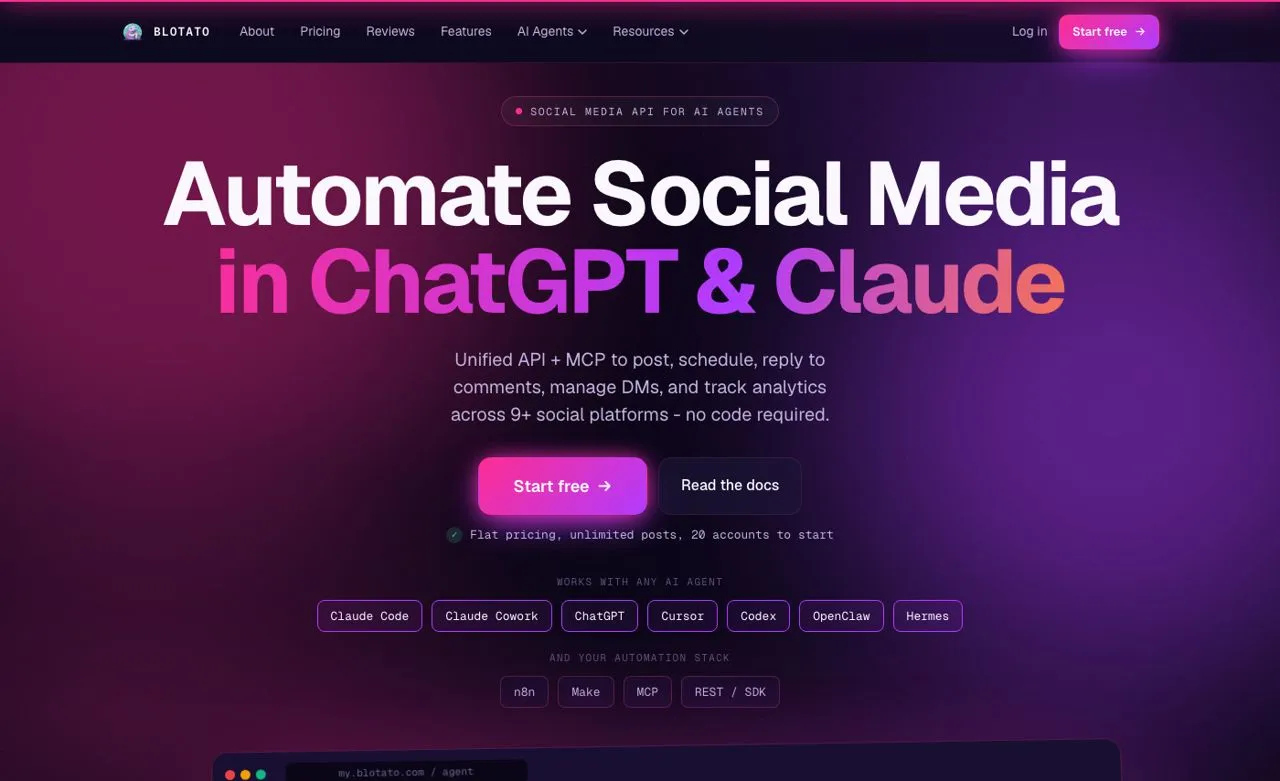
Blotato’s homepage: content generation and publishing to nine platforms behind one API key.
Blotato sits at number one for a specific reader: the agency or builder who operates client social themselves rather than reselling a connect button. Most “white-label” searches are really this workflow. Your team or your agent drafts, schedules, and publishes on the clients’ behalf from one credential, and the client never logs into anything. For that shape, Blotato starts a step earlier than PostPulse does: AI writing is unlimited on every plan, image and faceless video generation are metered by credits, and the result publishes to nine platforms through the same REST API or the hosted MCP endpoint at mcp.blotato.com/mcp.
The one honest disqualifier comes now, stated once: Blotato has no white-label OAuth and no multi-tenant end-user flow. If your product’s users must connect their own accounts under your brand, pick Ayrshare or Zernio below. I will not repeat it after this.
For everyone else, the math is flat where PostPulse’s is metered. Starter is $29/mo for 20 connected accounts with API access included on every paid plan, so a heavy posting month costs the same as a quiet one, and there is no per-publication line item to forecast. Comments and DM endpoints cover Instagram and Facebook, which is two networks more of an engagement surface than PostPulse documents.
Pros:
- AI writing, image, and faceless video generation included, not a second vendor
- Flat pricing that ignores post volume, with 20 accounts on the $29 Starter plan
- Hosted MCP endpoint plus native n8n and Make nodes alongside the REST API
- Comments and DMs on Instagram and Facebook, where PostPulse is publish-only
Cons:
- No white-label OAuth or multi-tenant end-user profiles
- Nine platforms, without PostPulse’s Telegram
- The 7-day trial excludes the API, and generating a key ends the trial and starts paid Starter, so plan on subscribing rather than trialing
Pricing: Starter $29/mo (20 accounts, 1,250 AI credits), Creator $97/mo (40 accounts, 5,000 credits), Agency $499/mo (100 accounts, 28,000 credits).
Ideal for: Agencies and agent builders who run client accounts from their own credential and want the content made and published in one place.
Bottom line: Pick this when you operate the accounts yourself and the blank page, not the OAuth screen, is the actual problem.
2. Ayrshare: Best for funded SaaS products embedding posting for isolated end users
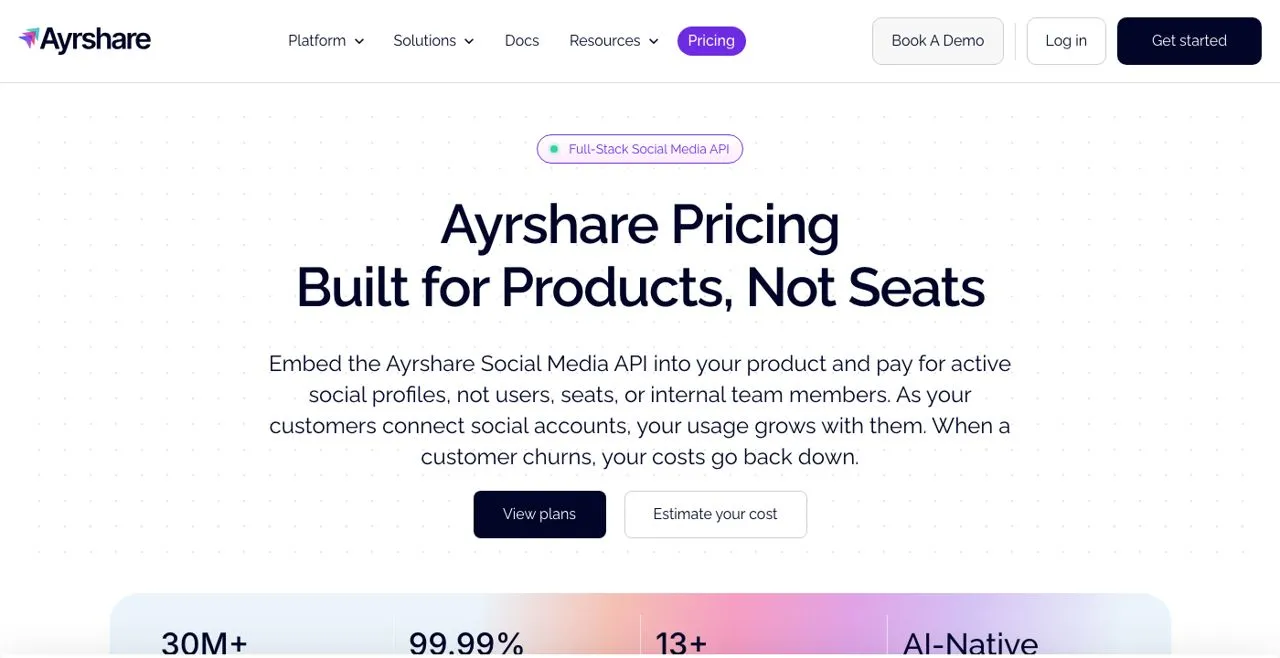
Ayrshare bills per active social profile, with multi-user white-label from the Launch plan.
Ayrshare is the most complete white-label alternative to PostPulse, and the most expensive way to find that out. Multi-tenant user profiles arrive on the Launch plan at $299/mo, where each of your customers gets an isolated profile and connects accounts through a linking page carrying your logo. Around that flow sits the widest endpoint surface in the category: comments, direct messages, and analytics across 14 networks, including the Reddit and Google Business Profile coverage PostPulse lacks.
The trade is the meter. Business runs $599/mo for 30 profiles and then bills per additional profile, so the bill tracks your customer count. A dormant client does not neatly round to zero the way PostPulse’s active-account rule guarantees, and the full cost curve is worth reading before you commit to it.
Pros:
- Branded linking page with per-user token isolation, live since long before MCP made this category crowded
- Comments, DMs, and ads endpoints PostPulse does not document
- Coverage spans 14 networks, more than any hosted rival on this page
- 28-day free trial on Launch
Cons:
- White-label starts at $299/mo, against PostPulse’s $200 plus usage
- Per-profile billing scales with customers signed up, not posts published
- AI features are paid add-ons rather than included
Pricing: Premium $149/mo (single user profile), Launch $299/mo (10 profiles), Business $599/mo (30 profiles, then per-profile rates), Enterprise custom.
Ideal for: SaaS products with revenue that need engagement endpoints and per-customer isolation, not just publishing.
Bottom line: The most complete embedded-posting API on the list, priced for products that already charge their own customers.
3. Zernio: Best for builders who want white-label included from account one
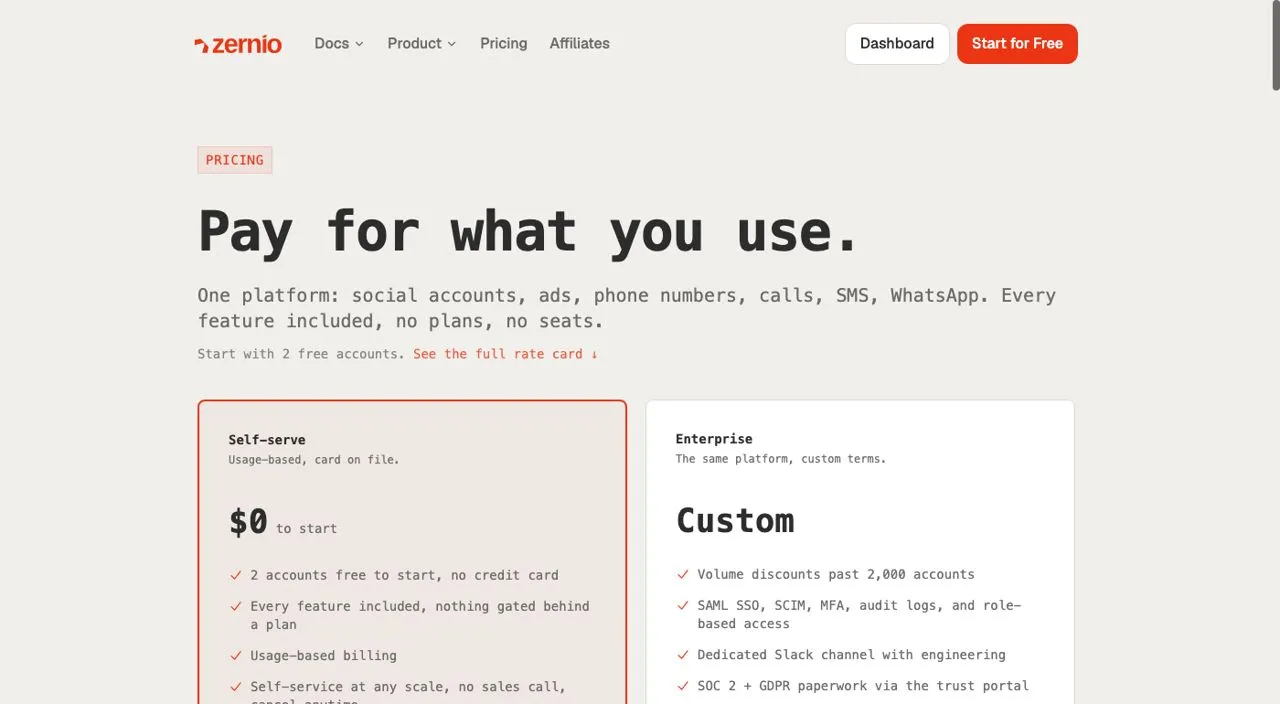
Zernio’s graduated rate card: two accounts free, then per-account pricing that falls with volume.
Zernio treats white-label as the default rather than a tier. End users connect through flows that never show Zernio’s branding, multi-tenant profiles are built in, and the first two connected accounts are free with full API access, so you can prove the branded flow works before paying anything. Coverage runs wider than PostPulse’s nine, reaching WhatsApp, Telegram, and Reddit, plus a unified inbox that closes the engagement gap PostPulse leaves open.
The meter runs the other way from PostPulse’s, and that is the comparison to price out. Zernio bills every connected account monthly, $6 each for accounts three through ten, $3 through one hundred, $1 past that, whether the account posted or not. Its own examples put 100 accounts at $318/mo and 1,000 at $1,218/mo. PostPulse’s white-label plan with the same 1,000 connected but 300 active costs $500. If most of your accounts post most months, Zernio’s falling rates win. If half your book goes quiet between campaigns, the idle-account line decides it.
Pros:
- White-label and multi-tenancy included at every price point, starting free
- Wider network list than PostPulse plus a unified inbox for comments and conversations
- Graduated rates reach $1/account/mo at scale
- Agents connect through the hosted endpoint at
mcp.zernio.com/mcp
Cons:
- Idle connected accounts still bill, the exact cost PostPulse waives
- Usage metering plus add-on rates make the bill harder to forecast
- No flat tier, so costs track account count from day one
Pricing: First 2 accounts free, then $6/account/mo (accounts 3-10), $3 (11-100), $1 (101+).
Ideal for: Builders who want branded OAuth from the first client without a $200 platform fee, and whose accounts post steadily.
Bottom line: The easiest white-label on-ramp in the category, as long as you model what your dormant accounts will cost.
4. Post for Me: Best for teams willing to pass platform reviews for the cheapest bill
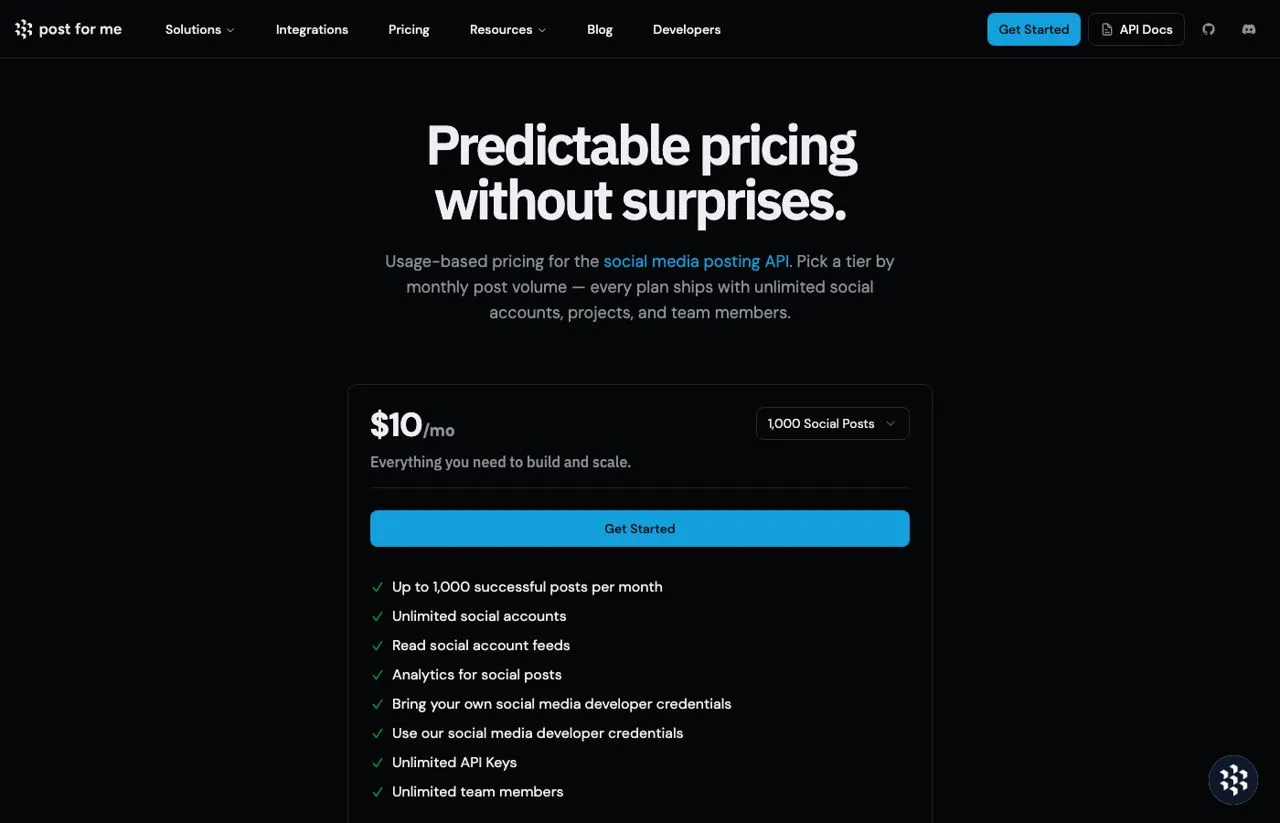
Post for Me charges by successful post, with unlimited connected accounts on every tier.
Post for Me is the price floor of this list at $10/mo for 1,000 successful posts across nine platforms, with unlimited connected accounts on every tier. That means idle accounts cost nothing here too, the same economics PostPulse advertises, reached from the opposite direction: you pay per post delivered instead of per account active. Below roughly 50 publications a month, PostPulse’s $0.20 pay-as-you-go is cheaper. Above that, Post for Me’s flat $10 takes over. Run your own volume through that crossover before picking either.
White-label is where the two part ways. Post for Me’s white-label mode uses your own developer credentials, so your name is on the consent screen at no extra platform fee, but their documentation is plain that your app must pass each network’s approval process itself. PostPulse and Ayrshare carry the audits for you. Post for Me hands them back in exchange for the smallest bill in the category, and the whole server is public on GitHub under AGPL-3.0, which nobody else here matches.
Pros:
- $10/mo for 1,000 posts is the cheapest subscription in the category
- Unlimited connected accounts, so idle clients cost nothing
- White-label with your own credentials at no tier premium
- Entire server open source on GitHub
Cons:
- White-label mode requires you to pass Meta, TikTok, and Google reviews yourself
- Publishing only, with no comments or DM endpoints documented
- No free tier, unlike Zernio and Upload-Post
Pricing: From $10/mo for 1,000 successful posts, scaling by volume to custom enterprise tiers.
Ideal for: Developer teams that can clear platform reviews once and want the lowest possible per-post cost afterward.
Bottom line: The cheapest white-label path here, if you accept that the audit burden PostPulse removes becomes yours again.
5. Upload-Post: Best for resellers whose users publish beyond the big nine networks
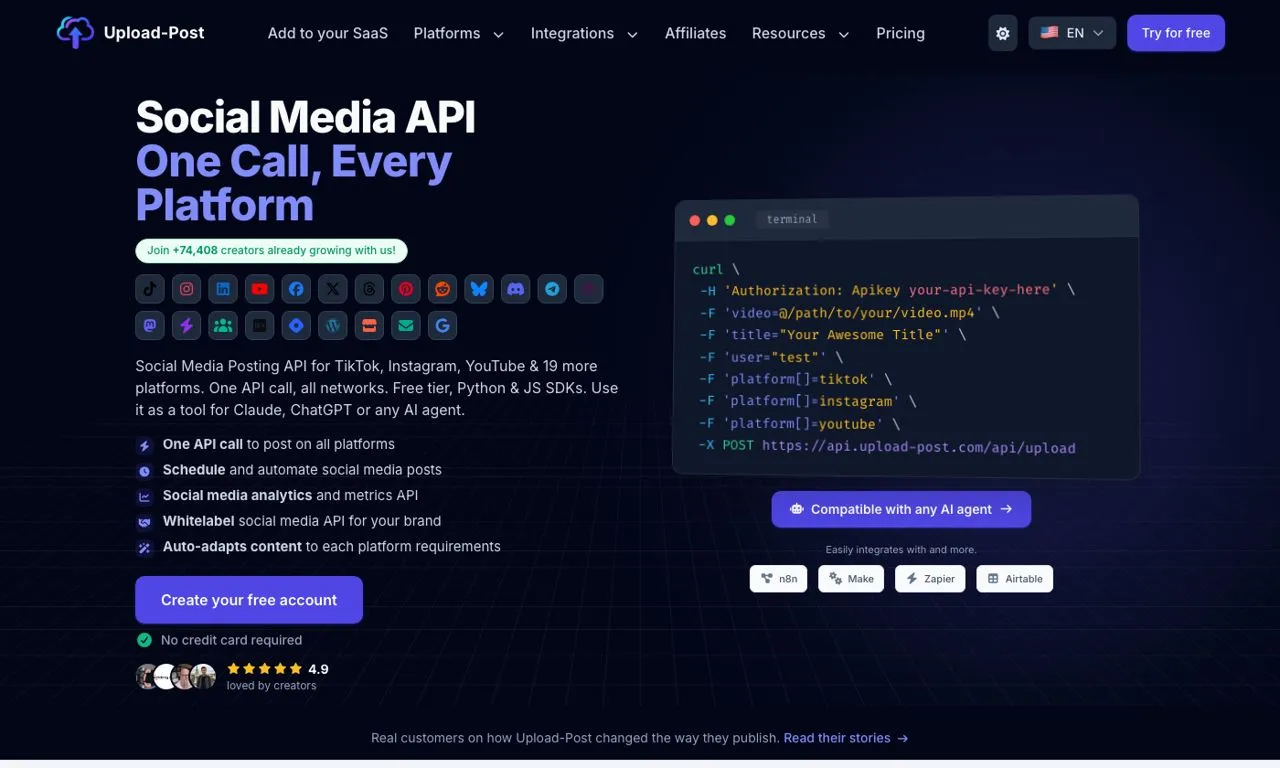
Upload-Post reaches 22 destinations, the widest platform list of any tool on this page.
Upload-Post wins on one axis outright: destinations. It publishes to 22 platforms, and the long tail is what resellers actually get asked for: Discord, Mastodon, Slack, Telegram, WordPress, Dev.to, and Hashnode alongside the mainstream nine. Its pricing page advertises a whitelabel API for SaaS platforms, agencies, and resellers, and its MIT-licensed MCP server spans publishing, scheduling, analytics, comments, and DMs. A free tier with two profiles and ten uploads a month lets you test the pipeline without a card.
The billing unit is the thing to check. Paid tiers meter profiles, not posts or active accounts: $24/mo covers 5 profiles and $50/mo covers 25, with unlimited uploads on every paid plan. A connected-but-quiet profile still occupies a slot you paid for, so the idle math lands between PostPulse’s free-idle model and Zernio’s per-account meter.
Pros:
- 22 destinations, the widest coverage on this list
- Unlimited uploads on every paid tier
- Whitelabel offering plus an open-source MCP server covering comments and DMs
- Genuine free tier for pipeline testing
Cons:
- Profile-capped tiers mean growing resellers climb plans quickly
- Idle profiles consume paid quota rather than dropping to zero
- Free tier excludes TikTok
Pricing: Free (2 profiles, 10 uploads/mo), Basic $24/mo (5 profiles), Professional $50/mo (25), Advanced $147/mo (75), Business $438/mo (225).
Ideal for: Resellers whose users need Discord, Mastodon, or WordPress in the same publish call as Instagram and TikTok.
Bottom line: Buy it for the platform list, and size the profile tier against your real account count first.
6. Postiz: Best for technical teams who want to own the white-label stack
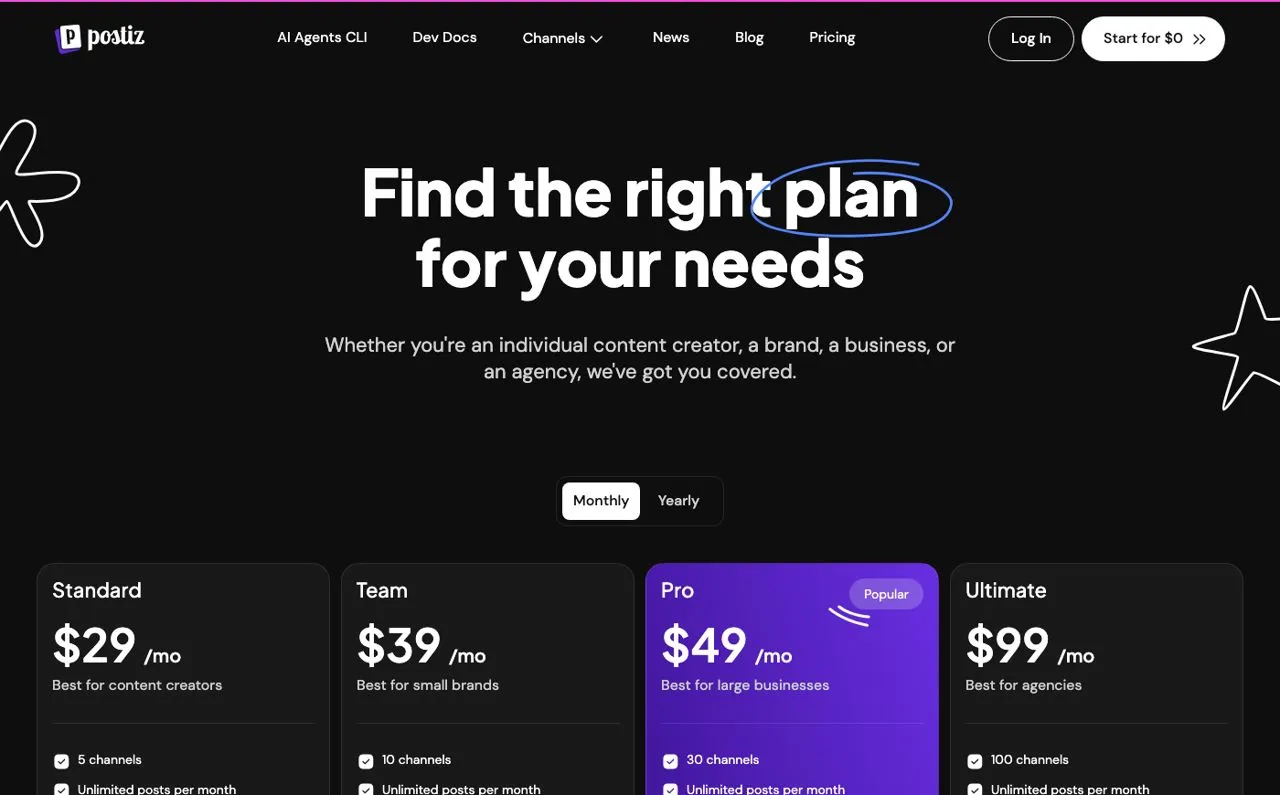
Postiz sells hosted plans by channel count, with a free open-source self-hosted route underneath.
Postiz is the ownership answer. The core is open source under AGPL-3.0, so a team that self-hosts registers its own platform OAuth apps and ends up with end users connecting under the team’s brand at zero license cost, the same trade Post for Me offers, plus the whole scheduling product around it. Hosted plans run $29 to $99/mo by channel count with AI generation quotas that grow by tier (image quotas start on the $39 Team plan), and a separate enterprise track starting at $200/mo sells the no-branding version as a managed service, in Postiz’s own words presenting the scheduling capabilities as your own product.
The gap to price is operational. Self-hosting means owning Postgres, Redis, and a Temporal stack, and the hosted Ultimate plan caps at 100 channels, so a large book of client accounts pushes you either to enterprise pricing or to your own servers. Whether that upkeep beats a managed meter is the open-source-versus-managed question in its purest form.
Pros:
- Open-source core, so the white-label exit is self-hosting rather than a bigger contract
- Hosted plans include AI generation quotas, growing by tier
- Enterprise tier removes Postiz branding entirely from $200/mo
- 7-day trial on hosted plans
Cons:
- Self-hosted white-label means passing platform reviews and running the stack yourself
- Hosted plans cap at 100 channels before the enterprise jump
- Create-post API calls are rate-limited to roughly 100 requests per hour on cloud
Pricing: Standard $29/mo (5 channels), Team $39/mo (10), Pro $49/mo (30), Ultimate $99/mo (100). Self-hosting free. Enterprise white-label from $200/mo.
Ideal for: Teams with real infrastructure experience who want the reseller stack as an asset instead of a subscription.
Bottom line: The only pick here where the white-label layer can end up owned outright, paid for in operations instead of dollars.
How I Chose These PostPulse Alternatives
- White-label reality, not the marketing word. For each tool I checked whose brand appears on the OAuth consent screen, whether multi-tenant end-user profiles exist, and which tier actually includes them.
- The audit question. Who passes Meta, TikTok, and Google app reviews: the vendor (PostPulse, Ayrshare, Zernio) or you (Post for Me, self-hosted Postiz). This single fact moves months of timeline.
- Idle-account economics. PostPulse’s strongest card is that dormant accounts cost nothing, so every entry states plainly what a connected-but-quiet account costs there.
- Billing unit before headline price. Per publication, per active account, per connected account, per profile, per channel, and per license all appear on this one page, and the cheapest model depends entirely on your volume shape.
- Category fit. Everything here is an API-first publishing tool a PostPulse customer could genuinely switch to, not a dashboard with an API bolted on.
Pricing was verified live on each vendor’s own pricing page, white-label claims against their documentation, and the gaps draw on each product’s public docs alongside my own testing.
How to Choose the Right PostPulse Alternative
If you run client accounts yourself and your agent writes the content, the white-label OAuth question does not apply to you, which is exactly the case where Blotato replaces both the posting API and the content stack.
If your users must connect accounts inside your product, Ayrshare and Zernio are the two real answers. Ayrshare for engagement endpoints and per-customer isolation at SaaS budgets, Zernio to start branded and free today.
If the bill matters more than the audit burden, Post for Me’s $10 flat beats everyone once you publish more than about 50 posts a month, and PostPulse’s $0.20 per publication beats it below that line.
If your users publish to Discord, Mastodon, or a blog, Upload-Post’s 22 destinations are the reason it is here.
If you want to own the stack, Postiz self-hosted turns the white-label layer into infrastructure you control, and whether your integration should speak REST or MCP is worth settling before you build against any of these.
Final Recommendation
PostPulse earned its spot in this category with one pricing rule nobody else copies exactly: accounts that do not post do not bill. If your book of accounts is seasonal and publishing is the whole job, staying put is a defensible call, and I would rather say that than pretend otherwise. The people who should actually switch are the ones missing a layer: engagement endpoints, a platform PostPulse does not reach, or the content itself. That last gap is the one I built for. Blotato will not put your brand on an OAuth screen, but it will write, render, and publish the post from one key, and the plans are simple enough to price out in a couple of minutes.
PostPulse Alternatives FAQs
What is the best PostPulse alternative?
The best PostPulse alternative depends on which layer you are missing. For agencies and agent builders who run client accounts themselves, Blotato pairs publishing with unlimited AI writing at $29/mo flat. For SaaS products that need users connecting their own accounts under your brand, Ayrshare from $299/mo is the most complete option and Zernio starts free. For pure cost, Post for Me runs $10/mo for 1,000 posts.
Is there a cheaper alternative to PostPulse’s white-label plan?
Zernio includes white-label OAuth with no platform fee, so two accounts cost nothing and small books stay under PostPulse’s $200/mo baseline. The trade is that Zernio bills every connected account, idle or not, while PostPulse only bills accounts that publish that month. Past a few hundred steadily active accounts, Zernio’s $1 rate and PostPulse’s $1 active-account fee converge.
Who handles platform app reviews with each PostPulse alternative?
PostPulse, Ayrshare, Zernio, and Upload-Post operate their own verified platform apps, so you skip Meta, TikTok, and Google reviews entirely. Post for Me’s white-label mode and self-hosted Postiz use your own developer credentials, which puts your brand on the consent screen but makes each network’s approval process your job.
Does PostPulse have an MCP server?
Yes. PostPulse ships an MCP server alongside its REST API and its n8n and Make nodes, so agents in Claude or Cursor can publish directly. That is table stakes in this category now: Blotato, Zernio, Upload-Post, Postiz, and Post for Me all document MCP servers too, so the deciding factors are the white-label flow, the billing unit, and the tools each server actually exposes rather than MCP itself.
What does an idle social account cost on each alternative?
On PostPulse and Post for Me, nothing: one bills active accounts, the other bills successful posts. On Zernio an idle connected account bills its tier rate of $1 to $6 a month. On Upload-Post and hosted Postiz, an idle account occupies a paid profile or channel slot. On Ayrshare, billing follows active social profiles under your plan’s included count. On Blotato, accounts sit inside a flat plan, so 20 connections cost $29/mo posting or not.