Sprout Social Pricing 2026: What $399 Actually Means
Sprout Social pricing in 2026, with the monthly rates its page hides behind an annual toggle, and the tier where API access finally appears.

Sprout Social pricing has a number that means two different things, and almost every write-up quotes it without saying which one.
Open the pricing page and Advanced reads $399 per seat per month. Open it again and click Professional, and Professional reads $399 per seat per month too. Both are real. The first is the annual rate for the top self-serve tier, the second is the monthly rate for the tier below it, and a $100-per-seat gap sits between them with the same digits on both sides.
That matters more than usual here, because Sprout is the rare tool where the answer to “which plan do I need” has nothing to do with features for most people reading this. If you want programmatic access, exactly one self-serve tier sells it, and it is the expensive one.
Fair warning that I sell against Sprout, so every figure below is one you should confirm on the page itself. All of them came off Sprout’s own pricing page and feature matrix on September 8, 2026.
Sprout Social Pricing in Brief
- Essentials $79 per seat/mo annual, $99 monthly. 5 social profiles.
- Standard $199 annual, $249 monthly. 5 social profiles.
- Professional $299 annual, $399 monthly. Unlimited profiles.
- Advanced $399 annual, $499 monthly. Unlimited profiles, and the only self-serve tier with the Sprout API.
- Enterprise custom, quoted by sales.
- No free plan. 30-day trial, no credit card up front.
- The quirk to know: there is no monthly toggle on the pricing page. Every card shows the annual rate, and monthly costs 25% more.
Every Sprout Social Plan, Both Ways It Can Be Billed
Sprout publishes five tiers on its pricing page. There is no monthly toggle to click, which is the part that trips people up. The cards show annual rates only, permanently, and the monthly column is disclosed further down in a FAQ. So the price you see first is always the one that requires paying twelve months up front.
| Plan | Annual, per seat/mo | Monthly, per seat/mo | Social profiles |
|---|---|---|---|
| Essentials | $79 | $99 | 5 |
| Standard | $199 | $249 | 5 |
| Professional | $299 | $399 | Unlimited |
| Advanced | $399 | $499 | Unlimited |
| Enterprise | Custom | Custom | Unlimited |
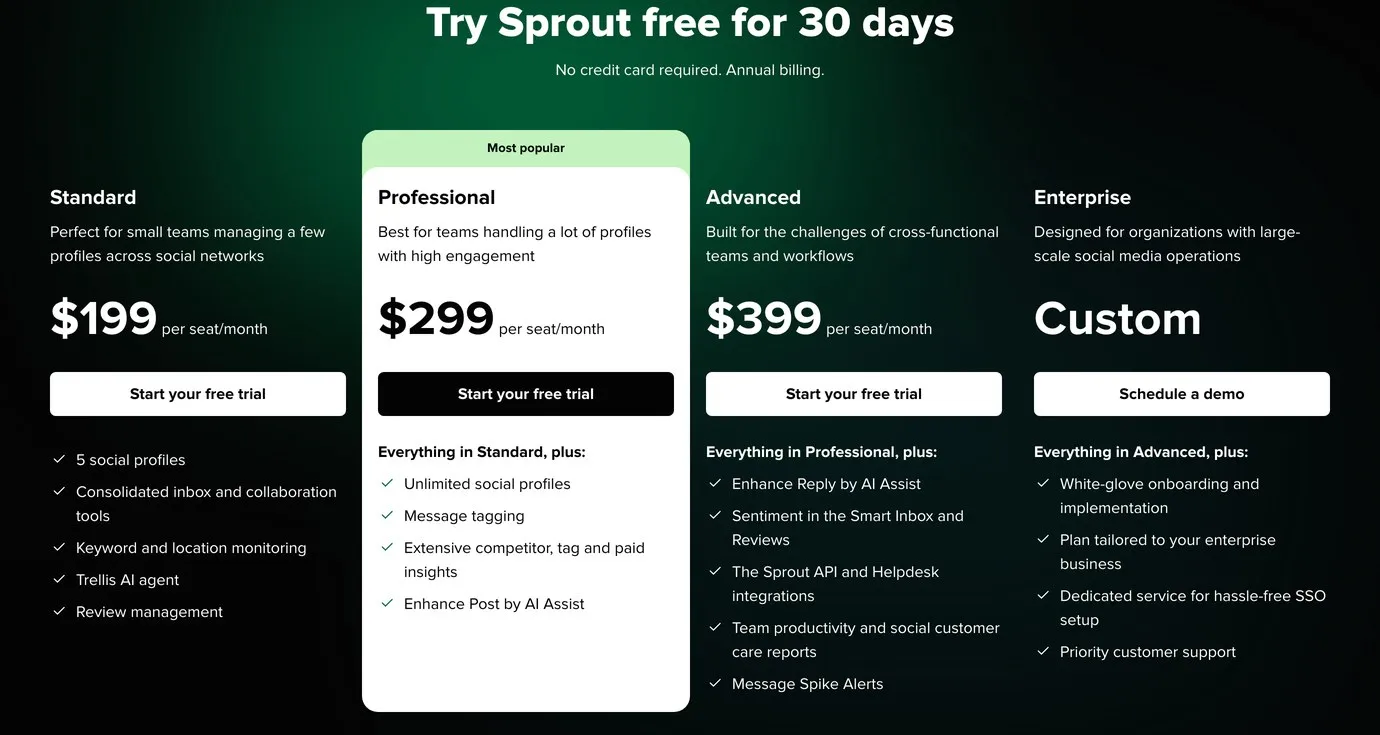
The “Annual billing” note sits above the cards rather than on them, and there is no monthly view to switch to.
Sprout states the monthly column itself, in a FAQ further down the same page: “Essentials: $99 per seat/month, Standard: $249 per seat/month, Professional: $399 per seat/month, Advanced: $499 per seat/month.”
So the honest way to read the headline numbers is that $199, $299 and $399 are what you pay per seat per month if you commit to a year. Month to month, Essentials, Standard and Advanced each cost about 25% more, and Professional costs a third more.
Two practical notes before the math. Essentials is the newest and cheapest way in, and it caps you at 5 social profiles, the same ceiling as Standard. And “unlimited social profiles” starts at Professional, which is the first tier where adding a tenth account costs nothing extra.
Where the Sprout API Actually Sits
This is the section our readers come for, and it has a one-line answer: the Sprout API is an Advanced-tier feature.
It is stated four separate ways on Sprout’s own page. The Advanced plan card lists “The Sprout API and Helpdesk integrations” among what the tier adds. The feature matrix carries a row reading “Automate workflows with integrations (Sprout API)” marked not included for Essentials, Standard and Professional and included for Advanced, and that row appears twice, once under publishing and again under engagement, with identical values both times. And a separate row, “Business intelligence tools integration,” carries a tooltip in Sprout’s own words about using the Sprout API to reach BI tools.
Price that honestly and it is $399 per seat per month on an annual commitment, or $499 per seat per month if you are not ready to sign for a year. A two-person team wiring Sprout into anything pays $9,576 a year at the annual rate before writing a line of code.
Sprout does publish its API documentation openly, so you can read the endpoints before you buy. What you cannot do is call them, because the entitlement rather than the documentation is what Advanced unlocks.
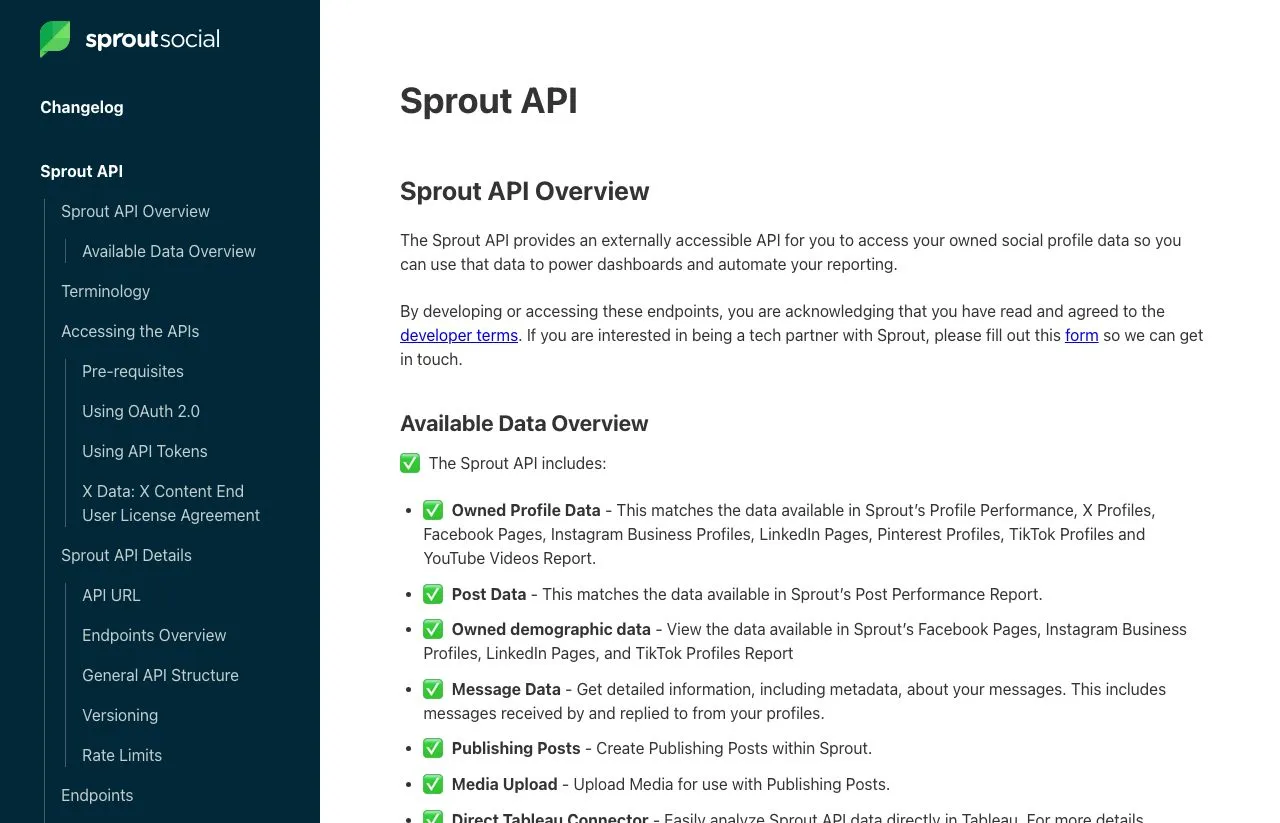
The endpoint reference is public and readable without an account. Calling it is what costs $399 a seat.
Sprout Ships an MCP Server, and Its Pricing Page Never Mentions It
Here is the thing I did not expect to find, and it is worth knowing before you write Sprout off as a pre-agent tool.
Sprout runs a live, hosted MCP server at mcp.sproutsocial.com/mcp. A JSON-RPC handshake against it returns a 401 carrying an OAuth challenge, and both of its discovery documents resolve cleanly, which is how you tell a real deployment from a parked hostname. It even supports dynamic client registration, so an agent can register itself rather than waiting on a manually issued client ID.
What I cannot tell you is what it costs or how far it reaches, because Sprout does not say. There is no MCP row anywhere in the pricing matrix and no MCP marketing page on the site. The one clue is in the challenge header itself, which names its authentication realm SproutAPI, the same entitlement the matrix gates to Advanced. That is an inference from a header rather than a published rate card, and I am not going to dress it up as one, but it is the direction I would plan around.
So treat this as a live endpoint rather than a documented product. Sprout’s own published agent guidance covers a ChatGPT integration scoped to published-post insights, which is a much narrower thing than a general publishing surface, and the gap between what is running and what is documented is the part worth watching.
The Per-Seat Trap, Priced at 1, 3, and 5 Users
Sprout meters seats, not accounts. That inverts how most tools in this category behave, and it is the single biggest driver of your bill.
| Team size | Standard (annual) | Professional (annual) | Advanced (annual) |
|---|---|---|---|
| 1 seat | $2,388/yr | $3,588/yr | $4,788/yr |
| 3 seats | $7,164/yr | $10,764/yr | $14,364/yr |
| 5 seats | $11,940/yr | $17,940/yr | $23,940/yr |
The shape here is worth sitting with. Going from one person to three on Advanced costs you $9,576 a year in additional software, and none of those seats connect a single extra social account, because Professional and above are already unlimited on profiles. You are paying for people, and the capacity was already included one tier below.
That is a defensible model when the deliverable is a report that three people collaborate on, an approval chain, and a shared inbox with sentiment on it. If a client or an executive is receiving what you produce, the per-seat bill is buying a reporting and collaboration layer the cheap tools do not have.
It is a bad model when the deliverable is published posts and the second seat exists only so a contractor can schedule on Thursdays.
What the Sticker Price Leaves Out
Most of Sprout’s add-ons carry no public price at all. Premium Analytics and Listening are each sold separately “to the Standard plan and up,” as is Employee Advocacy, and Professional Services routes to a consultation rather than a number. Influencer Marketing is the odd one out: Sprout states “No Sprout plan required” for it, so it is not gated to a tier at all.
I am not going to estimate them. What I will say is that Listening is the capability people most often assume is included in a $199 seat, and it is not.
One add-on does have a published price. Every seat on every tier includes 100 AI agent credits a month, and Trellis Plus extends that for $28 per user per month annually or $35 monthly. Sprout does not publish what the higher ceiling is, describing it only as extended credits subject to fair use, so budget the seat rather than the credit count.
Nonprofits get a real discount on two tiers if they are a qualifying US 501(c)(3) committing to at least two seats on an annual subscription: Professional at $239 and Advanced at $299 per seat. That is a genuine $60 and $100 a seat off, and it is the one place Sprout’s list price moves without a sales call.
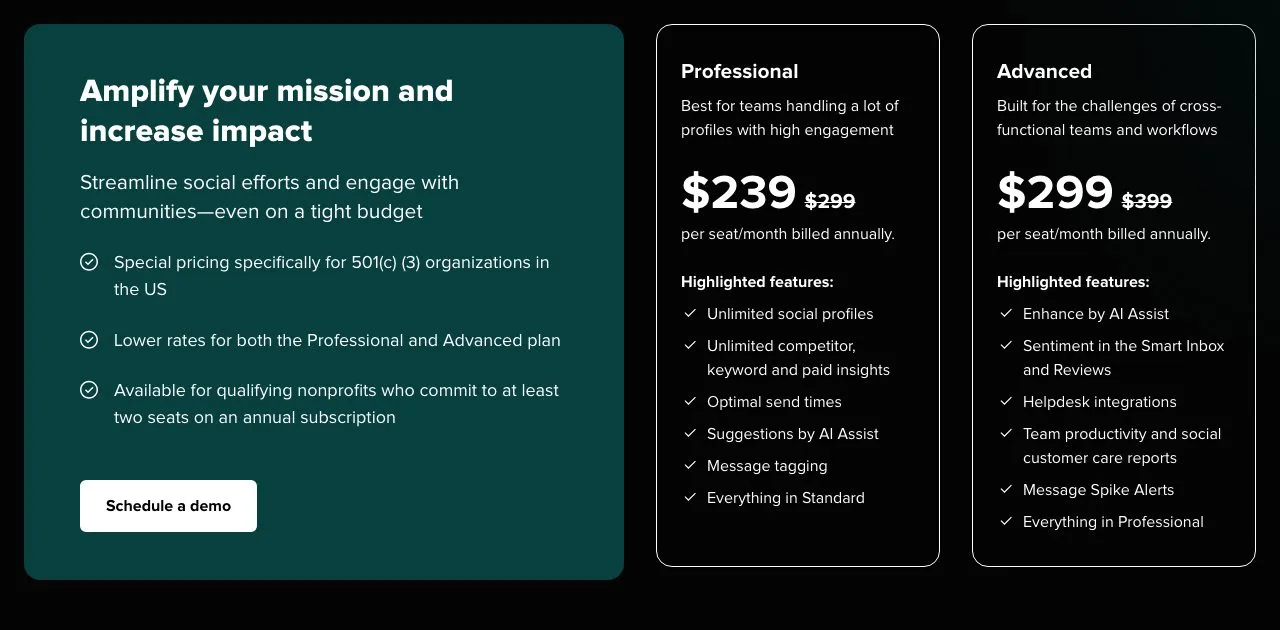
Sprout prints the standard rate beside the discounted one, so the size of the nonprofit discount is easy to check.
How the Bill Compares to Flat-Rate Tools
Different tools meter different things, so a per-seat number and a flat number are not directly comparable until you fix a scenario. Here is one team of three running fifteen social accounts for a year, every row on that vendor’s cheapest annual billing.
| Tool | Billing unit | Annual cost, 3 people / 15 accounts |
|---|---|---|
| Sprout Advanced | Per seat | $14,364 |
| Sprout Standard | Per seat | $7,164 (capped at 5 profiles, so this scenario does not fit) |
| Metricool Advanced | Per brand band | $636 |
| Buffer Essentials | Per channel | $804 |
| Blotato Starter | Flat | $348 |
The Buffer row is worth a footnote, because its rate is tiered rather than flat. The first ten channels bill at the full rate and channels eleven through twenty-five bill lower, so fifteen channels is not fifteen times anything. That is $80 a month on monthly billing and about $67 on annual, which is the figure in the table.
Read that table for shape rather than as a verdict. Sprout is the only row that reaches sentiment analysis, review management and the reporting layer its buyers are actually paying for, and none of the cheaper rows replace those. Metricool and Buffer both publish their full rate cards in machine-readable form, so those two numbers are easy to check against your own account list. Listening is not in that column either, since it is a separately priced add-on on top of the seat. The comparison only tells you something if that reporting layer is not what you need.
That last row is not a neutral one, and you should read it that way: I am a creator and tester on Blotato rather than a bystander, so price it against your own shortlist instead of taking my word for where it lands. What the row says factually is that Blotato is $29 a month flat for 20 social accounts across 9 platforms, with the REST API and a hosted MCP server on that lowest paid plan rather than four tiers up.
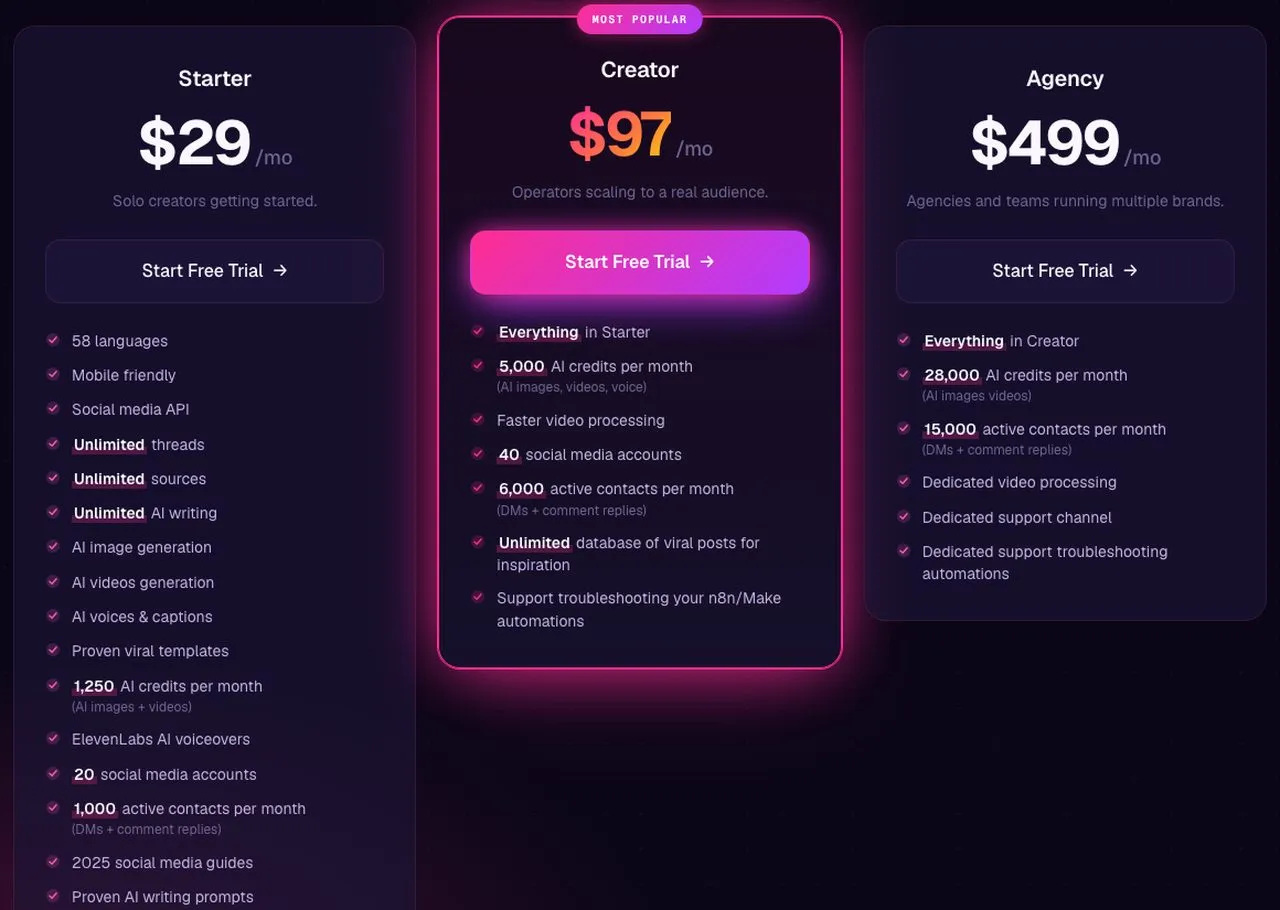
The API sits on the lowest paid Blotato tier, which is the specific line this comparison turns on.
The honest limits, on the axes this particular comparison runs on: Blotato has no social listening, no sentiment analysis, no review management, and no approval workflow. Those four are most of what a Sprout seat actually buys, and we do not sell any of them at any price. If a stakeholder above you reads the output, that gap is the whole decision and $29 does not close it.
Who Should Actually Pay Sprout’s Prices
Pay it if a named person receives your social reporting and judges you on it, if social listening informs decisions above your pay grade, or if approval workflow across a team is a compliance requirement rather than a nicety. That is the buyer Sprout is built for, and for that buyer the seat price is the cost of the reporting layer rather than of the publishing.
Do not pay it if you are one or two people publishing content, if the API is the reason you are here and $499 a seat is the entry price to reach it, or if your reporting need is “did the post do well.” A cheaper Sprout Social alternative covers that last case for a rounding error of the difference.
Think harder if you are an agency. Sprout’s per-seat model and its unlimited-profile tiers can genuinely work out when you have many clients and few staff, which is the opposite of how most agency pricing lands. Run your own seat count before assuming it is too expensive.
The Number I Would Check Before Signing
If you take one thing from this page, make it the billing period. Sprout’s annual and monthly columns are 25% apart, its page defaults to the cheaper one, and the same $399 appears in both columns attached to different tiers. Nearly every third-party Sprout pricing post I read while writing this quotes the annual figures without saying so, which means readers budget 25% light and find out at checkout.
The second thing: if you need the API, the decision is already made for you. There is one self-serve tier that sells it, it is the most expensive one, and no amount of feature comparison changes that. Price the Advanced seat, multiply by your headcount, and decide against that number rather than against $199.
Sprout Social Pricing FAQs
How much does Sprout Social cost per month?
On monthly billing, Sprout Social costs $99 per seat for Essentials, $249 for Standard, $399 for Professional and $499 for Advanced. On annual billing those drop to $79, $199, $299 and $399 per seat per month. Sprout’s pricing page displays the annual rates by default, so the widely quoted $199, $299 and $399 figures all assume a twelve-month commitment.
Which Sprout Social plan includes API access?
Advanced, at $399 per seat per month billed annually or $499 billed monthly. Sprout’s feature matrix marks “Automate workflows with integrations (Sprout API)” as unavailable on Standard and Professional and available on Advanced and Enterprise, and the Advanced plan card lists “The Sprout API and Helpdesk integrations” among what the tier adds. There is no cheaper self-serve route to the API.
Does Sprout Social have an MCP server?
Yes. Sprout runs a hosted MCP server at mcp.sproutsocial.com/mcp, which responds to an unauthenticated request with a 401 and an OAuth challenge, and publishes a valid OAuth discovery document. Sprout does not list MCP anywhere in its pricing matrix, so which plan includes it is not something the company states publicly.
Is Sprout Social free?
No. There is no free tier. Sprout offers a 30-day free trial that does not require a credit card up front, and its FAQ says you pick a plan and enter payment details after the trial ends. Whether the trial includes API access is not documented.
How many social profiles does each Sprout Social plan include?
Essentials and Standard each include 5 social profiles. Professional and Advanced include unlimited profiles, and Enterprise inherits that from Advanced. Sprout’s own tooltip lists what counts, still using its older network names: “Twitter, Instagram, Pinterest, YouTube, Facebook, TikTok, WhatsApp, LinkedIn Company Pages, Google My Business, TripAdvisor, Glassdoor, Yelp, and LinkedIn personal profiles.” It excludes Google Analytics, non-social and messaging integrations, and ad accounts associated with a profile you already connected.
Why is Sprout Social so expensive compared to other schedulers?
Because it is not really a scheduler. Sprout bills per seat rather than per social account, and the seat buys sentiment analysis, review management, approval workflows and a reporting layer built for presenting results to someone else. Social listening is not in that list, because it is a separately priced add-on on Standard and up. Tools that cost a tenth as much are usually selling publishing alone, so the comparison is only unfavorable to Sprout when you do not need the half of the product that costs the money.