AI Agent Social Media Guardrails for Unattended Posting
AI agent social media guardrails for unattended posting: terminal-status polling, idempotency keys, and the calls that return success and publish nothing.
AI agent social media guardrails get discussed as content review, and the failures that actually wake people up are the ones no reviewer can see: posts that never appeared while every API call returned success.
Here is the cleanest example, and it is ours. If your agent polls a Blotato post until it reports published or failed, that loop is correct for a post you publish immediately and it hangs forever on a post you scheduled. A post can come to rest in four different states, our own two documentation surfaces disagree about which ones exist, and the fourth is on neither list. That is our bug to fix in the docs. It is your bug to survive in code today.
Four guardrails cover this whole category of failure. Terminal-status polling, an idempotency key, letting the API report your ceiling, and a named human for the one step that cannot be automated.
AI Agent Social Media Guardrails Start With the Status Enum
There is exactly one state that means keep waiting, and four your loop has to be ready to stop on. Here is the machine, assembled from four Blotato pages rather than one.
| State | What it means | Which of our docs lists it |
|---|---|---|
in-progress | Not terminal, still working | Both the REST and MCP references |
published | Live, carries a publicUrl | Both |
failed | Permanent, carries an errorMessage | Both |
scheduled | Queued for a future time, nothing wrong | MCP reference only |
CANCELED | Schedule removed before it published | Neither status list |
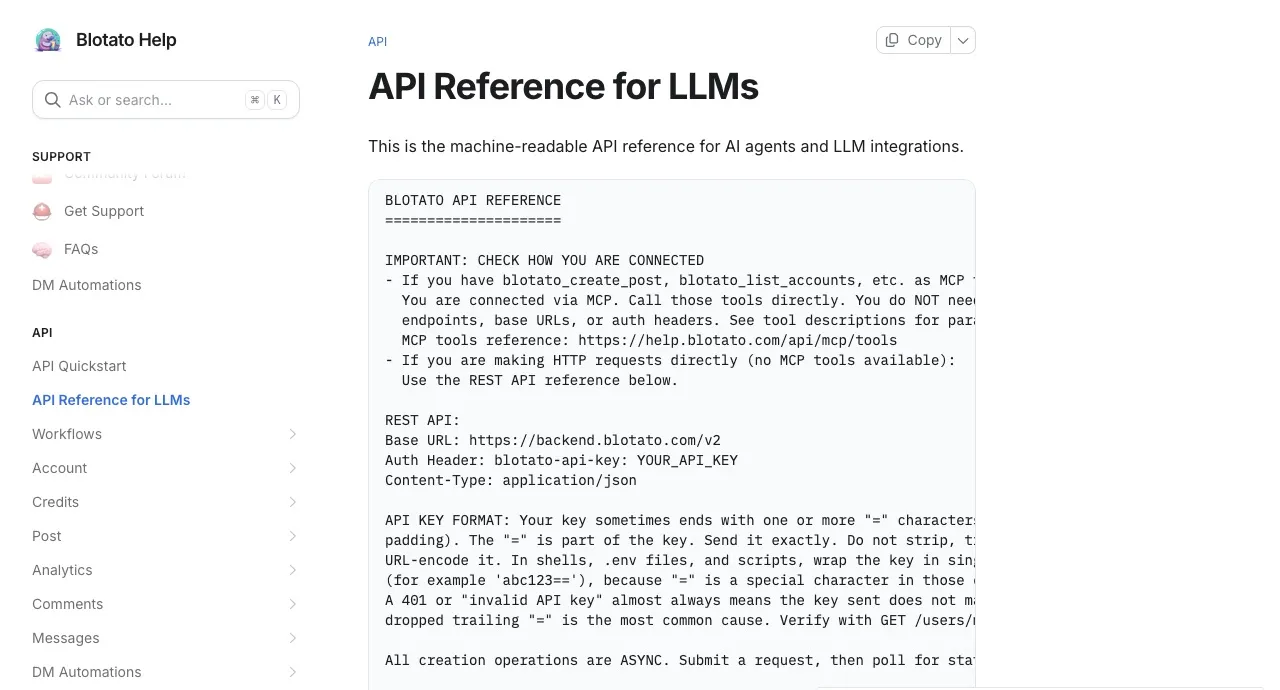
The API reference for LLMs gives the REST status values as in-progress, published, and failed. The MCP tools reference describes the same check as in-progress -> published | scheduled | failed. CANCELED appears in neither, and our docs describe it in two places with two different words: the error reference calls it “a post status, not a publishing error,” while the support FAQs call it “a post status, not a publishing failure.”
The fix is one line of logic. Terminate on any state that is not in-progress, rather than enumerating the states you expect to see. Treat scheduled as a successful outcome with a follow-up rather than a pending one, and bound the loop in wall-clock time regardless. A polling loop with no timeout is not a guardrail, it is a hang with good intentions.
That pattern generalizes past us, which is the real lesson. Any status enum you hardcode is a bet that a vendor will never add a state, and vendors add states. Write the loop against the state you know means “keep waiting,” never against the list of states you know means “stop.”
If you would rather not maintain this for nine platforms, start a free week of Blotato. Worth knowing before you click, since it is why most of you are here: the trial does not include API access, so budget for the Starter plan if you are testing programmatically.
Free 7-day trial · Cancel anytime
Why the Receipt Is Not the Proof
The reason that loop exists at all is that publishing is asynchronous nearly everywhere, including here. POST /posts returns { "postSubmissionId": "uuid" }, which confirms we accepted the job and proves nothing about delivery. An agent that treats the 200 as done will report a clean week that never went out.
I would be a bad founder if I let you find that out in production, so I will also name the version of it that a correct polling loop does not catch. TikTok’s content sharing guidelines state that an unaudited API client “can only post contents in SELF_ONLY viewership.” The call works, the status reaches published, and the post reaches an audience of one.
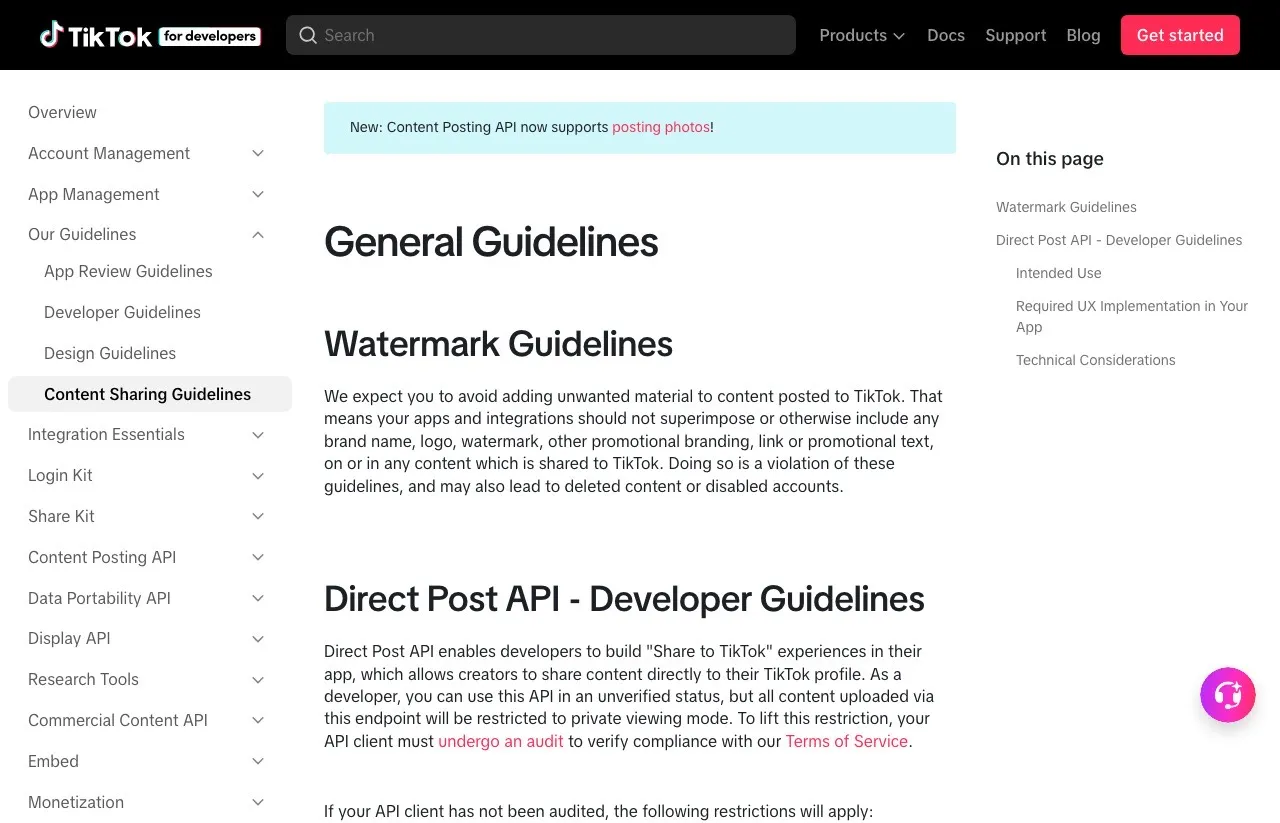
Status polling cannot save you there, because nothing failed. The same shape shows up in any pre-publish step an agent runs unattended, including file cleaning that reports success while changing nothing. Worth knowing before it happens: TikTok’s fix is not retroactive in bulk, since the account owner must change account visibility to public and then change the privacy setting on each piece of content individually. I cover what each platform’s rate limits and caps actually do separately, including that one.
The guardrail for the visibility case is a startup assertion rather than a runtime check. On boot, confirm the visibility level your app is permitted to request, and refuse to run a publishing loop if the answer is private-only.
Idempotency Is Your Job, Not the API’s
Retries are where a good guardrail turns into a bad one.
The naive loop retries on any non-success, which is correct for a network timeout and wrong for almost everything else. A timeout is the dangerous case: the request may have succeeded server-side and died on the way back to you. Retry it blindly and you double-post, publicly, on the customer’s account.
Nothing in the flow solves this for you. The pattern has a name and an IETF specification, which defines an idempotency key as “a unique value generated by the client which the resource uses to recognize subsequent retries of the same request.” The client generates it. That is the part people skip.
So generate a stable key per intended post on your side, before the first attempt, derived from the content and the target account rather than from a clock or a random value. Record the key with the returned submission ID. On any retry, look up the key first and re-poll the existing ID instead of submitting again. The rule that keeps this simple: a retry may only ever repeat a read. If your retry path can reach a write, you have built a double-poster.
The second half is knowing what not to retry at all. Plenty of publishing failures are permanent, and our error reference is blunt about the case worth internalizing: a TikTok post that failed after three retries is “a temporary TikTok-side outage,” where “retrying immediately or reconnecting the account usually will not help,” and the advice is to wait hours rather than loop. Retrying that into a rate limit converts one dead post into a throttled account. Read errorMessage, branch on it, and send anything you do not recognize to a dead-letter queue for a human. It helps to know which strings actually arrive: in one account’s 90-day failure log, eight distinct strings covered every failure and two of them were not in the error reference at all. Default an unfamiliar error to a person rather than to a tighter loop.
Discover Your Ceiling, Do Not Declare It
A hardcoded limit is the same bet as a hardcoded status enum, and it loses the same way.
The specific numbers are worth reading somewhere else, because the tool in the middle usually caps you tighter than the platform does and that surprises people. What belongs here is the mechanism, which is to let the API tell you when you have hit a ceiling instead of trying to predict it.
Treat HTTP 422 as your capacity signal. Plan limits surface as a 422 on synchronous calls like POST /posts, while asynchronous jobs do not raise anything at all and instead transition their records to failed. Those are two different code paths, and they need to stay that way, because only one of them will ever reach your exception handler. An agent that only catches exceptions is blind to every limit it hits asynchronously.
The One Nobody Plans For
Connecting a new social account cannot be done headlessly. This is not a platform quirk you can engineer around, it is the design of the protocol: RFC 6749 specifies that the authorization server “authenticates the resource owner (via the user-agent) and establishes whether the resource owner grants or denies the client’s access request.” A user-agent means a browser, and a resource owner means a person.
This sounds obvious written down and it is routinely missed, because it only surfaces at the worst moment. Everything else in your pipeline scales without you. Then a token expires or a client adds a tenth brand, and the fully autonomous system needs a person to open a browser window. If your runbook does not have a named human and a documented path for that, your agent has a single point of failure wearing a hat.
Plan for it as a scheduled maintenance task rather than an incident. And alert on silence, not only on errors, because a dead token produces no traffic at all. An agent that has published nothing for eighteen hours should page you exactly as loudly as one that threw an exception.
Where ChatGPT Dots’ Approvals Stop
ChatGPT Dots’ approval review covers the decision to submit a post, not anything that happens after submission. Dots are OpenAI’s always-on agents. Before a dot acts on your accounts, an automatic review checks the action against your instructions and rules. OpenAI’s dots controls page puts it plainly: “Asking your dot to draft replies doesn’t give it permission to send them.”
You can tighten that with a custom rule set to “Ask before taking action” for social posts. OpenAI also says a dot tries to follow custom rules and can get them wrong. That is why I would not let a rule replace any check in this post.
Here is the part that involves us. OpenAI has not documented whether a custom MCP plugin like ours reaches a dot at all. If it does, a post the dot queues for a set time publishes then with no second approval step, so every guardrail above still applies.
OpenAI’s plan rules for custom MCP servers in ChatGPT would cap it too. Write actions are in beta on Business, Enterprise, and Edu, and Pro gets read and fetch only. If the plugin does reach a dot, on Pro it would be limited to reading through Blotato, not publishing. What is confirmed so far lives on the ChatGPT Dots setup page.
The Honest Pitch: Debug One State Machine, Not Nine
Every mechanism above is buildable. The question is how many state machines you want to keep in your head.
Going direct, each platform hands you its own status vocabulary, its own error semantics, and its own definition of what a successful call means. The work is not difficult. It is recurring, and it lands on you every time a vendor adds a state without telling you.
One API. Every social platform.
curl -X POST https://backend.blotato.com/v2/posts \
  -H "blotato-api-key: YOUR_API_KEY" \
  -H "Content-Type: application/json" \
  -d '{
    "post": {
      "accountId": "YOUR_ACCOUNT_ID",
      "target": { "targetType": "tiktok" },
      "content": { "text": "Posted via the Blotato API.", "mediaUrls": [], "platform": "tiktok" }
    }
  }'
That accountId is not a value you invent. Call GET /users/me/accounts to list your connected accounts and their IDs. Facebook additionally requires a pageId and LinkedIn optionally takes one, both from GET /users/me/accounts/{accountId}/subaccounts, and Pinterest requires a boardId from GET /social/pinterest/boards. The full endpoint surface is in the API docs.
Blotato runs an MCP server at https://mcp.blotato.com/mcp, exposing 36 tools, which means Claude Code, Claude Desktop, Cowork, or any MCP-compatible agent can publish without your code touching a platform auth flow at all. It also takes the ID lookup off your hands: the agent calls a tool that lists accounts and passes the right ID itself, so a Claude Code subagent shipping a week of content is not threading raw account IDs through your code. You can still point it at the wrong account, so keep the account name in your logs. Nine platforms sit behind one key, and on a given plan the price does not move with your posting volume.
Where we do not help you: our engagement surface is Instagram and Facebook only, so if your guardrails need to cover replies across every platform you connect, that gap is real and you should weigh it. Analytics covers eight of the nine, with LinkedIn returning no metrics yet.
Sabrina’s Take
I am biased, obviously. But I built Blotato because I got tired of discovering the same class of bug on a ninth platform, and the version of that bug I hate most is the one that reports success.
My actual position is narrower than “use guardrails.” It is this: an agent you cannot page at 3am is not automated, it is unsupervised. Those are different products with different risk profiles, and most people shipping the second one believe they shipped the first. The tell is simple. If nothing in your system can wake you up, then the only monitoring you have is a customer noticing.
Build the boring three first, before anything clever. Terminal-status polling, an idempotency key, and an alert on silence. Everything else on this page is a refinement of those.
AI Agent Guardrail FAQs
Why did my agent report success when nothing was published?
Two causes account for nearly all of these. Either you read the submit response instead of polling to a terminal status, or your app is not permitted to request public visibility, which is what happens to an unaudited TikTok client. The second one is worse because it survives a correct polling loop: the post really did publish, at SELF_ONLY.
How do I test guardrails without posting to a live audience?
Publish to a throwaway account you own on one platform, and make your first checks the failure paths rather than the happy path. Kill the network mid-submit to prove your retry does not double-post, submit a deliberately malformed payload to see which branch catches it, and schedule one post to confirm your loop terminates on scheduled. A guardrail that has only ever run against successful calls is untested.
Should my agent retry a failed post?
Usually not. Branch on errorMessage and retry only the errors you have confirmed are transient. The dangerous case is a network timeout rather than an error response, because the write may have landed on the server and died on the way back to you, which is exactly when a naive retry double-posts.
How often will my agent need a human, realistically?
Rarely, but on a schedule you do not control. Token lifetimes are set by each platform rather than by you, so the interruptions arrive unevenly and always as a surprise. Give the task a named owner and treat it as recurring maintenance, because the failure it produces is silence rather than an error, and silence is the one thing an unmonitored agent is worst at reporting.
Do guardrails still matter if a human approves every post?
Yes, and this is the common misread. Content approval happens before submission, so it catches a bad caption and nothing else in this post. Automate with Marc runs exactly that setup, holding his agent at an approval gate before it publishes, and it is still the submission side that needs these checks. A human who approved the copy still cannot tell you the post landed at an audience of one, published twice, or never left the queue.