Blotato vs n8n for Social Media: Build or Buy?
Blotato vs n8n for social media automation: when wiring it yourself in n8n pays off, and when a built tool just gets you posting faster.
Most people framing Blotato vs n8n for social media are asking the wrong question. They treat it like a head-to-head, pick a winner, move on.
It is not really a head-to-head. n8n is a workflow automation platform. Blotato is a tool that creates and publishes social content. One is a workshop full of tools. The other is the finished machine. So the honest question is not “which wins,” it is “do you want to build the machine or buy it?”
I have used both. Here is how I would decide.
Blotato vs n8n at a Glance
n8n is the better pick if: you are technical, you like building, and social posting is one node in a much bigger automation that also touches your CRM, your database, and ten other apps. You want full control and you do not mind maintaining it.
Blotato is the better pick if: you want to draft in your voice and publish to every platform without wiring or babysitting anything. You would rather spend your time making content than maintaining plumbing.
The twist most comparisons miss: you do not have to choose. There is an official Blotato node for n8n, so the real answer for a lot of people is “use both.” More on that below.
A Visual Canvas Is Not a Content Tool
No, and pretending they are is where these comparisons go wrong.
n8n is a general-purpose automation builder. Think of it as a visual canvas where you connect triggers and actions into workflows: a new row in a sheet fires an action, which fires another, which posts something. It can automate almost anything, not just social media. That flexibility is the whole point.
Blotato is built around one starting point: creating and publishing social content. It writes posts in your brand voice, generates images and faceless video, and pushes everything out to your accounts. It is focused on content, not on being a universal connector.
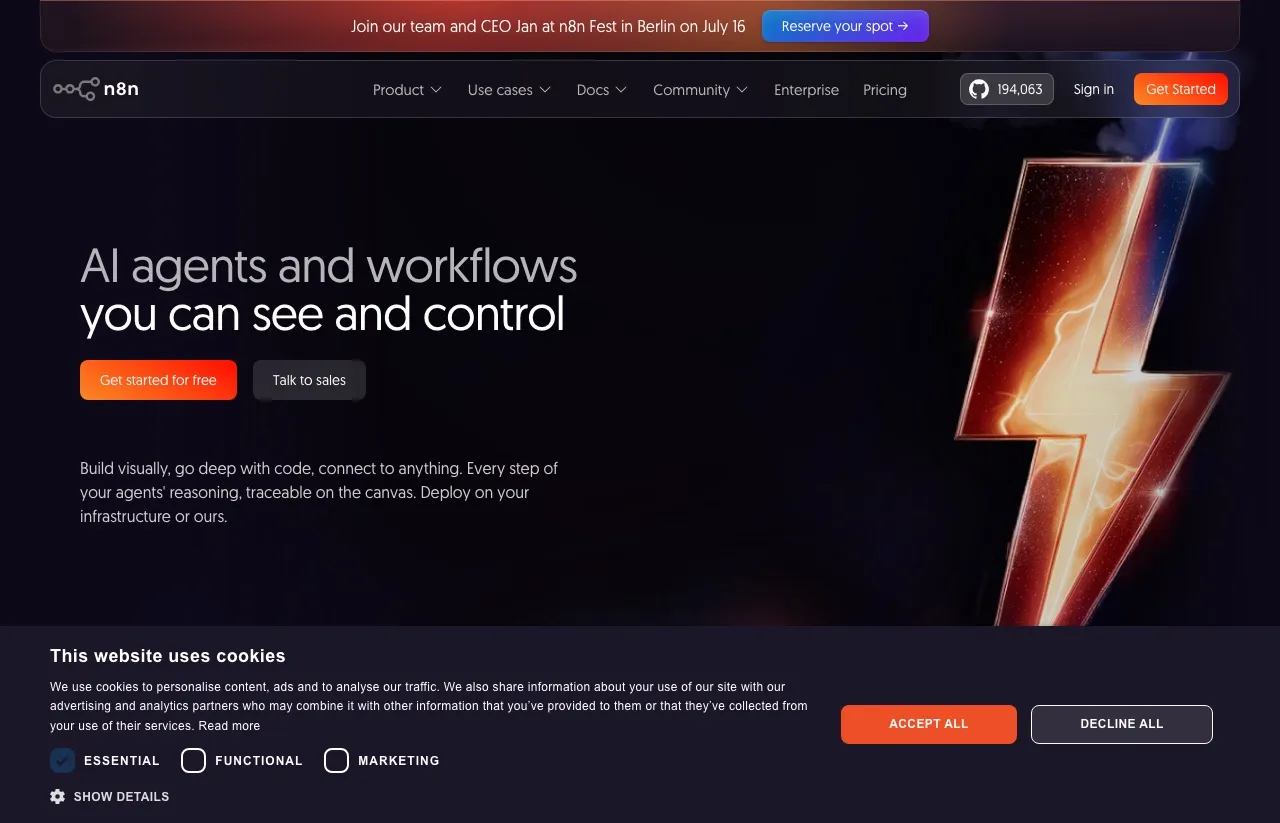
So one is a builder you assemble, and one is a product that already does the job. That difference shapes everything else, including the part nobody likes to talk about: native platform support.
Builders Who Want the Wiring Exposed
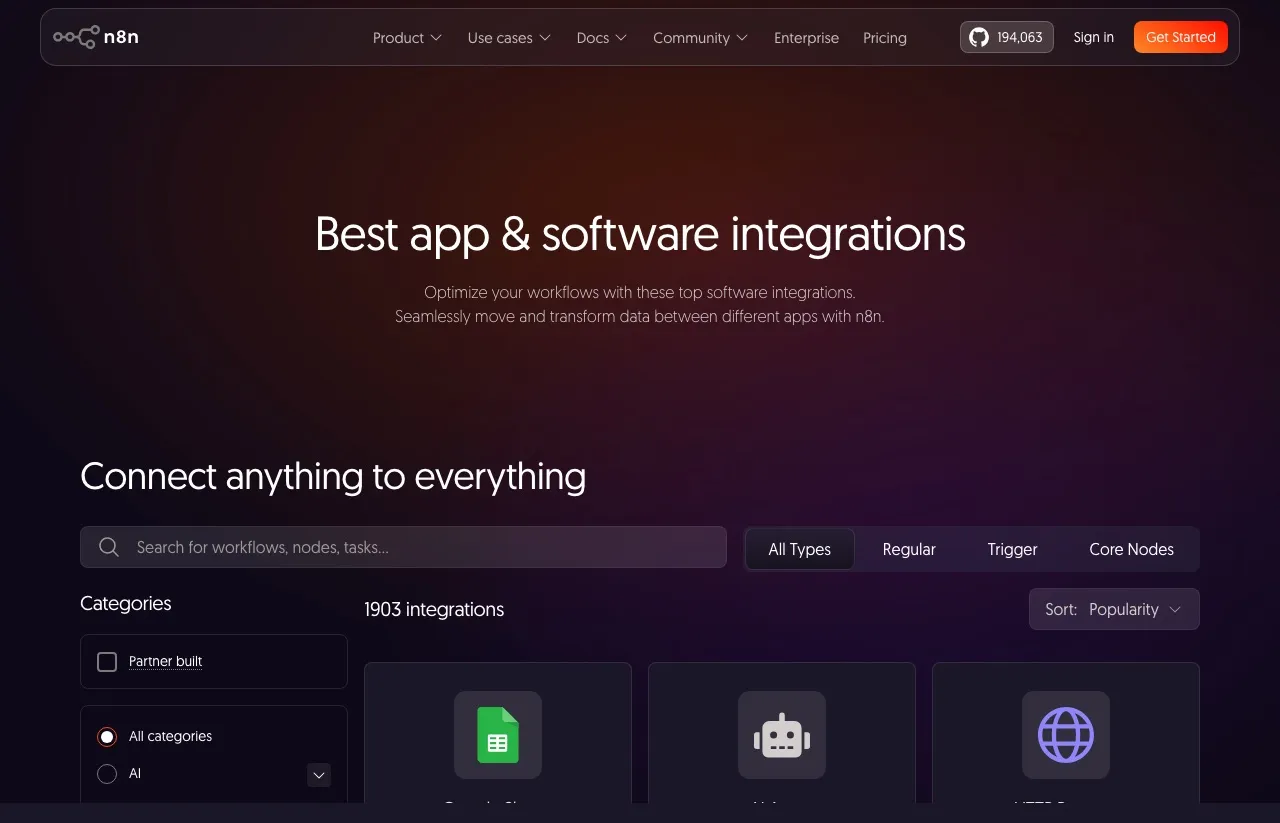
n8n is built for technical people who like building. It is open-source, self-hostable, and node-based, and it was founded in 2019 by Jan Oberhauser in Berlin. You can browse its integration library, wire up genuinely complex logic, and run the whole thing on your own server if you want to.
The people who love n8n really love it. It holds a 4.7 out of 5 on G2, and the praise is consistent: the flexibility is huge, the integration library is deep, and self-hosting can save real money versus per-task tools like Zapier. One reviewer described cutting hundreds of dollars a month off their automation bill with no lost functionality.
The complaints are just as consistent, and they matter for social media specifically. The learning curve is steep. Self-hosting is a maintenance job, not a one-time setup. And the social side has gaps.
Here is the part to be honest about. n8n has native nodes for X, LinkedIn, and the Facebook Graph API. It does not have dedicated native social-posting nodes for Instagram, TikTok, Threads, Pinterest, Bluesky, or YouTube. You can still reach some of those through HTTP requests, the Facebook and Google APIs, or community nodes, but you are building and maintaining that yourself. For a creator who just wants to post everywhere, that is a lot of plumbing.
Builders Who Want the Result, Not the Build
I founded Blotato, so read this as the vendor’s own comparison.
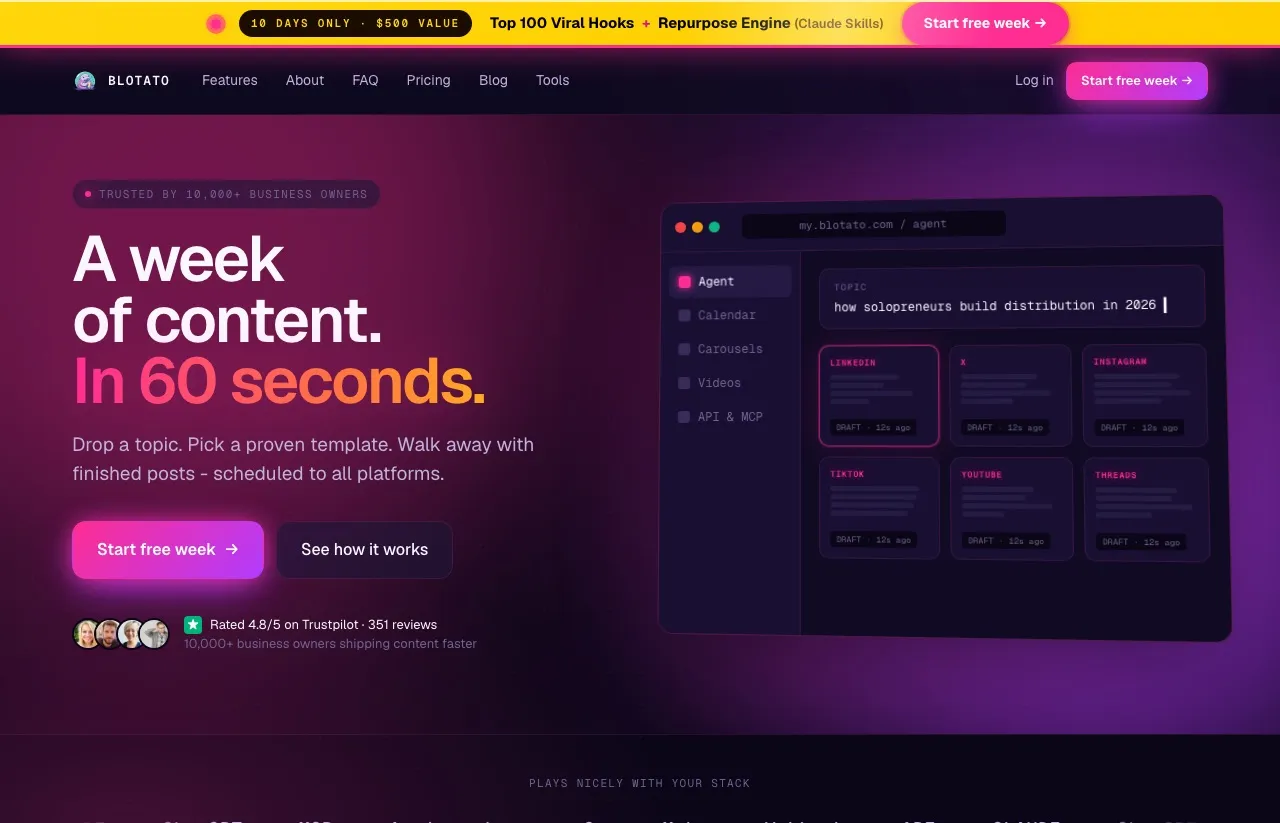
Blotato is built for solo creators, faceless operators, and small teams who want content out the door without becoming part-time automation engineers. You write the post, or you let the AI draft it in your voice, and it publishes to all 9 supported platforms without you wiring a single node. The platforms it covers are the modern set that n8n lacks native nodes for, which is exactly why the two tools end up complementing each other.
Where Blotato stops being just a web app is the API and the integrations, and the MCP server is the part I would lead with. It exposes Blotato to Claude, Claude Code, and Cowork, so my happiest and highest-value customers now run their whole content engine through Claude plus an MCP server instead of building scenarios by hand. They tell Claude what to post and it publishes, no canvas required. There is also a full REST API on paid plans and native nodes for n8n and Make. If that sounds like your setup, the Blotato 7-day trial is the fastest way to see it run end to end.
n8n vs Blotato: Side by Side
| Category | n8n | Blotato |
|---|---|---|
| What it is | General workflow automation builder | Social content creation + publishing tool |
| Pricing model | Per workflow execution | Flat rate |
| Free option | Yes (self-hosted Community edition) | No (7-day trial, cancel anytime) |
| Cheapest paid tier | $20/mo Cloud Starter (billed annually) | $29/mo flat (Starter, 20 accounts) |
| Native social platforms | X, LinkedIn, Facebook | 9 (X, LinkedIn, Facebook, Instagram, TikTok, Threads, Pinterest, Bluesky, YouTube) |
| AI content writing | No (you wire an AI node yourself) | Yes (trained on viral posts) |
| AI image + video | No (build it from other nodes) | Yes (images, faceless video, voiceovers) |
| Setup effort | High (build and maintain workflows) | Low (connect accounts, post) |
| Self-hosting | Yes | No |
| MCP / Claude integration | No native MCP server (build it yourself) | Yes (native MCP server, post from Claude in plain English) |
The table makes the real split obvious. n8n gives you a canvas and raw power. Blotato gives you the finished posting machine. Neither is “better” in a vacuum. It depends on whether you want to build or buy.
Execution-Based Billing and Unlimited Flexibility
n8n earns real wins, and it would be dishonest to skip them.
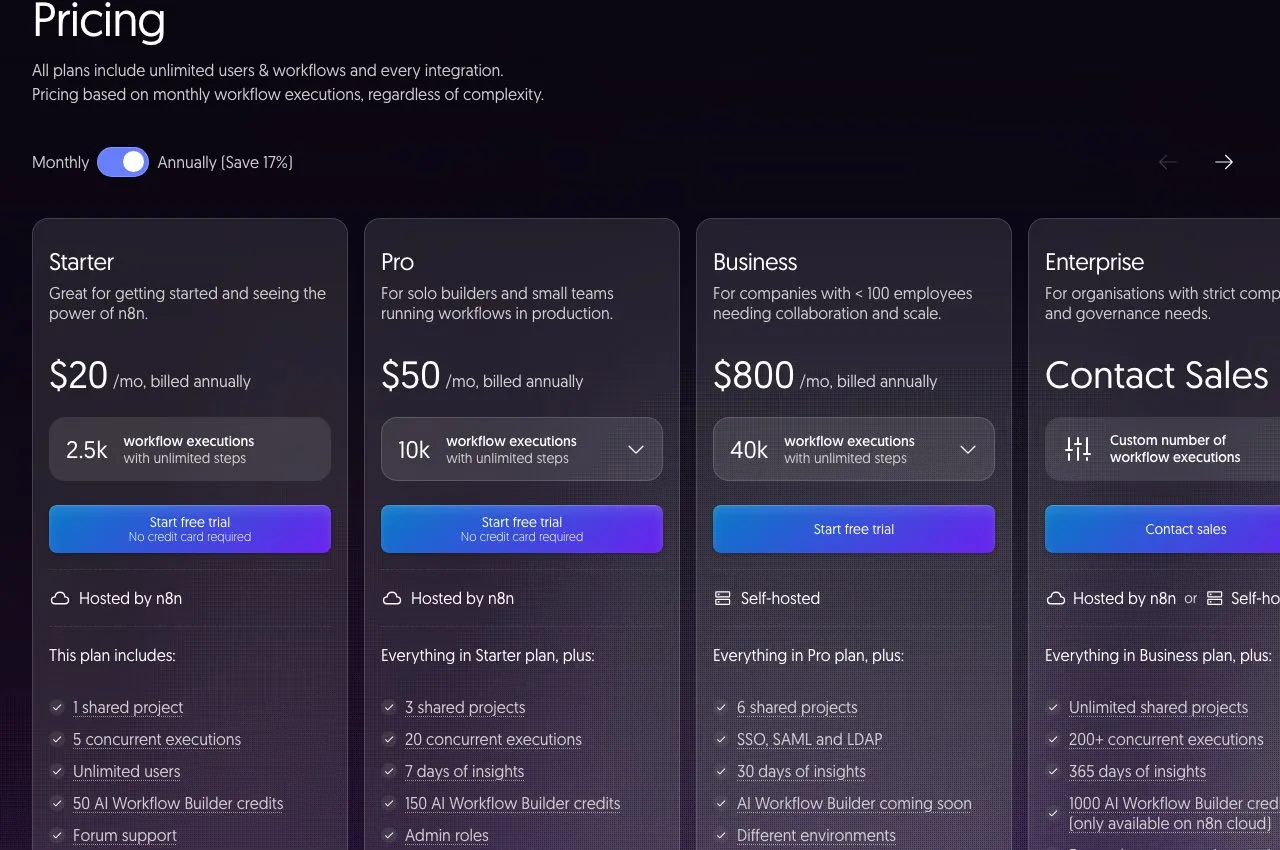
The pricing model is genuinely smart. n8n bills by workflow execution, not per seat and not per step. The page says it plainly: you pay when a workflow runs start to finish, regardless of how many steps are inside it. For a complex automation with twenty nodes, that is a real advantage over tools that meter every action.
It is free if you self-host. The Community edition is open-source. If you have the technical comfort to run it on your own server, you can automate a lot for the cost of the hosting alone. That is a serious draw for engineering-minded users.
The flexibility is unmatched for whole-business automation. Social posting is one node. n8n can also update your CRM, parse a PDF, hit a database, and branch on logic, all in the same workflow. If your social media is part of a bigger system, n8n ties it together in a way no single-purpose social media automation tool can match.
It scales technically. Unlimited users and workflows on every plan, self-hosting, and version control on higher tiers. For a technical team, that ceiling is high.
The catch is that all of this assumes you want to build. Every win above costs you setup time and ongoing maintenance. For some people that is a fair trade. For others it is the whole problem.
Removing Work Rather Than Adding Capability
Blotato’s wins are about removing work, not adding capability.
The MCP server is the biggest advantage, and it is the one n8n cannot match. This is the part I would put first. Blotato runs a native MCP server for Claude, Claude Code, and Cowork. That means you skip the workflow canvas entirely. You tell Claude “write three posts about this and publish them to all my accounts,” and it does, through Blotato, in plain English. There is no trigger to configure, no node to wire, no scenario to debug. n8n has no equivalent. To get anything close in n8n, you would build the AI logic, the prompts, and the posting steps yourself, then maintain that build. With MCP, the agent is the workflow. For content creation plus posting, that is the whole game, and it is why the creators getting the most out of Blotato run their engine through Claude and MCP instead of an automation builder.
It posts natively to platforms n8n cannot reach without custom work. Instagram, TikTok, Threads, Pinterest, Bluesky, and YouTube are built in. In n8n you would be wiring those yourself through HTTP nodes or community integrations, then maintaining them when an API changes. Blotato handles that for you.
The content itself is the product. Blotato writes in your voice, generates images, and produces faceless video with voiceovers. n8n does none of that on its own. You would connect a separate AI node, a separate image tool, and a separate video tool, then glue them together. Blotato ships that as one surface.
Setup is minutes, not a project. Connect your accounts and post. There is no canvas to learn, no server to maintain, no node to debug at midnight. For a creator who wants output, that gap is the entire decision.
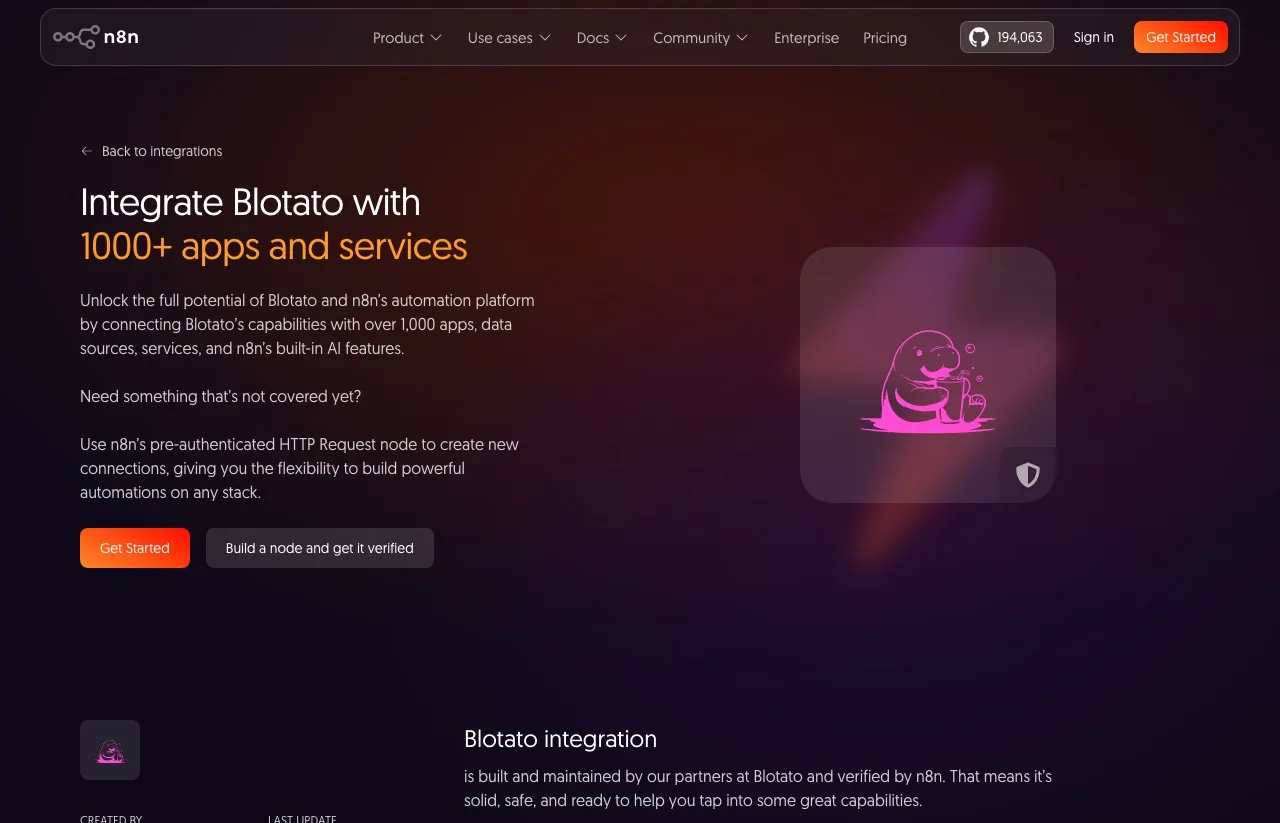
It plugs into n8n when you do want to build. This is the part that makes the “vs” framing collapse. The official Blotato node lets you publish, schedule, and generate content from inside an n8n workflow. So if you are already an n8n builder, you do not have to hand-roll social posting. You drop in the Blotato node and it covers all 9 platforms for you.
Execution Capacity vs a Finished Tool: Not the Same Purchase
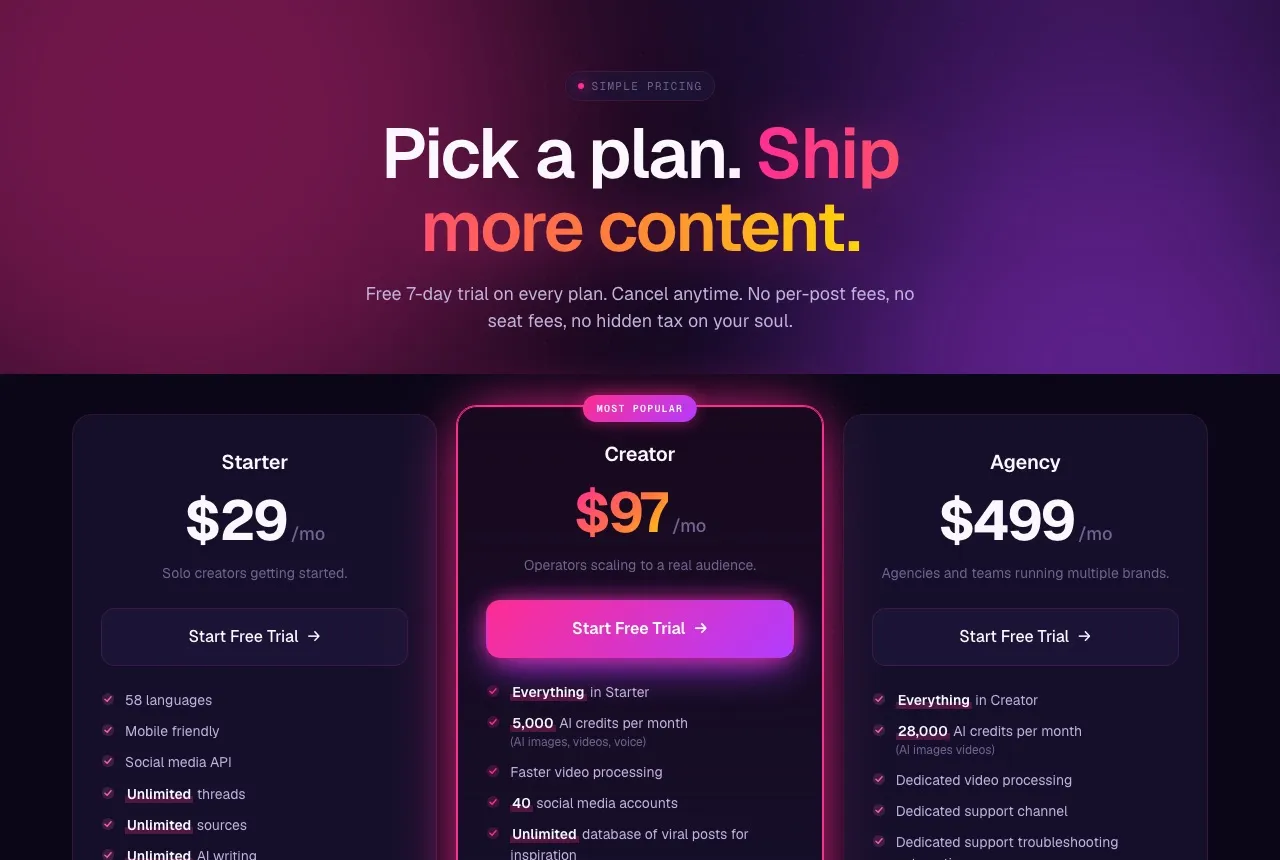
Comparing prices here is tricky because you are not buying the same thing. With n8n you are buying execution capacity for any automation. With Blotato you are buying a finished content-and-publishing tool. Still, the entry numbers are worth laying out.
| Capability at the entry tier | n8n Cloud Starter ($20/mo) | Blotato Starter ($29/mo) |
|---|---|---|
| What you get | 2.5K workflow executions/mo | 20 social accounts, full posting |
| Native social posting | X, LinkedIn, Facebook | 9 platforms |
| AI writing in your voice | Build it yourself | Included |
| AI image generation | Build it yourself | Included (uses credits) |
| AI faceless video | Build it yourself | Included (uses credits) |
| Setup required | High | Low |
The free self-hosted route changes this math, and I want to be fair about it. If you self-host n8n, your software cost can be zero. So three honest caveats:
If you are technical and your social posting is part of a larger automation, n8n’s flexibility and per-execution pricing can be the cheaper, smarter choice. Do not pay for a content tool you would mostly route around.
If you only post to X, LinkedIn, and Facebook, n8n’s native nodes already cover you, and you may not need Blotato’s wider platform support at all.
And if you genuinely enjoy building and maintaining workflows, that time is not a cost to you. It is the part you like. Blotato’s whole value is removing that work, which only matters if you wanted it removed.
Reach for n8n When Social Is One Node of Many
- You are technical and comfortable building and maintaining workflows.
- Social posting is one piece of a larger automation across many apps.
- You want to self-host and keep your software cost near zero.
- You mostly post to X, LinkedIn, and Facebook.
- You value full control over convenience.
Skip n8n If You’d Be Debugging Nodes on a Saturday
- You want content created and published without wiring anything.
- You post to the newer platforms n8n has no native nodes for.
- You want AI writing, images, and video in one tool.
- You would rather make content than maintain plumbing.
- You run your engine through Claude and a social MCP server.
Most People Want What n8n Produces, Not What It Asks
Most creators who think they need n8n for social media actually want the result n8n produces, not the building it asks of them. They overvalue the flexibility because it sounds powerful, then spend their weekends debugging nodes instead of making content.
If you are technical and social posting is part of a bigger system, build it in n8n. That is the right call, and the per-execution pricing rewards it. If you just want to post everywhere without becoming an automation engineer, a built tool gets you there faster.
And if you are already in n8n, the most honest advice is to stop hand-rolling social posting and drop in the Blotato node. You keep your canvas and skip the plumbing. If you want to try the built path on its own, start with the Blotato 7-day trial and see how much of your week posting actually gives back.
FAQs
Is n8n or Blotato better for social media?
It depends on whether you want to build or buy. n8n is better if you are technical and social posting is one part of a larger automation. Blotato is better if you want content created and published across all 9 platforms without wiring anything yourself.
Does n8n support posting to Instagram and TikTok?
Not with dedicated native nodes. n8n has native nodes for X, LinkedIn, and Facebook. For Instagram, TikTok, Threads, Pinterest, Bluesky, and YouTube you would build it through HTTP requests, the Facebook and Google APIs, or the Blotato node, rather than a first-party social-posting node.
Can I use Blotato inside n8n?
Yes. There is an official Blotato node for n8n, built by Blotato and verified by n8n. It lets you publish, schedule, and generate AI content to all 9 platforms from inside an n8n workflow, so you do not have to hand-roll social posting.
Is n8n free?
The self-hosted Community edition is free and open-source. n8n Cloud is paid, starting at $20/mo billed annually for the Starter plan, metered by workflow executions. Blotato does not have a permanent free tier but offers a 7-day trial you can cancel anytime.
Which one is easier for non-technical creators?
Blotato, by a wide margin. You connect your accounts and post, with no canvas to learn and no server to maintain. n8n is powerful but assumes you are comfortable building and maintaining workflows, which is the opposite of what most non-technical creators want.
What is Blotato’s biggest advantage over n8n?
The MCP server. Blotato runs a native MCP server for Claude, Claude Code, and Cowork, so you can create and publish content by telling Claude what you want in plain English, with no workflow to build. n8n has no native MCP equivalent for social posting, so you would build and maintain that logic yourself. For content creation and automated posting, that hands-off agent layer is the clearest reason creators pick Blotato.
Do I have to choose between Blotato and n8n?
No. Many people use both: n8n as the automation backbone and the Blotato node as the social-posting layer inside it. The “vs” framing is misleading, because the two tools are built to work together.