Blotato vs Post for Me: Social Media API or Content Engine?
Blotato vs Post for Me: whose logo sits on your users' OAuth screen, and which social media API fits a product build versus running your own content.
Blotato vs Post for Me usually gets decided on the wrong number. Post for Me is $10 a month, Blotato is $29, and if the two tools did the same job this would be a very short article.
They do not do the same job, and the clearest way to see it has nothing to do with price. It is whose brand your users see when they click connect, and whether anyone needs to write the post before it goes out. Those two questions sort almost every build correctly, so this comparison starts with them rather than with a feature grid.
Blotato vs Post for Me: At a Glance
Post for Me is the better pick if: you are building a product where your own users connect their social accounts, you already have content coming from somewhere, and you want the cheapest reliable delivery layer you can embed. You can see how the two plans compare in a couple of minutes.
Blotato is the better pick if: you are running your own social media presence through an agent, and you want that agent to write the caption, generate the image or video, and publish it without you wiring three vendors together.
Whose Logo Appears on Your Users’ Consent Screen
Start here, because it is the decision that is hardest to reverse later and the one nobody puts in a comparison table.
If your product asks its own users to connect their TikTok or Instagram accounts, somebody’s brand appears in that OAuth consent screen. Post for Me’s cheapest and fastest path, Quickstart, uses Post for Me’s own platform credentials. That is precisely why you can skip the developer review queue at each network and ship this afternoon.
Their documentation states the tradeoff plainly: your users “will see the ‘Post for Me’ brand and logo requesting permission to access their account,” and those connections “will be subject the permissions that our app has been approved for.” You are borrowing someone else’s identity and someone else’s approved scope ceiling.
The documented way out is White Label mode with your own credentials, and it is a legitimate option that many products should take. The cost is stated just as plainly: “your app must go through the approval and verification processes mandated by each specific social network.” That is the review gauntlet the $10 was supposed to spare you, and the white-label API field splits exactly on who carries that burden.
Blotato sits outside this tradeoff rather than solving it, and the reason is worth understanding. You connect accounts under your own Blotato plan and publish to them, so there is no third-party logo and no borrowed scope ceiling. There is also no mechanism for hundreds of your customers to connect their own accounts through you, which is the exact job Post for Me is built for.
Developer Infrastructure or an Operator’s Tool
They are not, and the difference decides most of what follows.
Post for Me sells developer infrastructure, the same category I covered in the social media API roundup. Its homepage promises to ship social media integrations for your product “in hours, not weeks,” and it names the buyers it has in mind: SaaS products, marketing teams, schedulers, games, and AI content generators. The common thread is that you are building something and the content arrives from upstream. Post for Me handles the OAuth, the media transcoding, and the delivery.
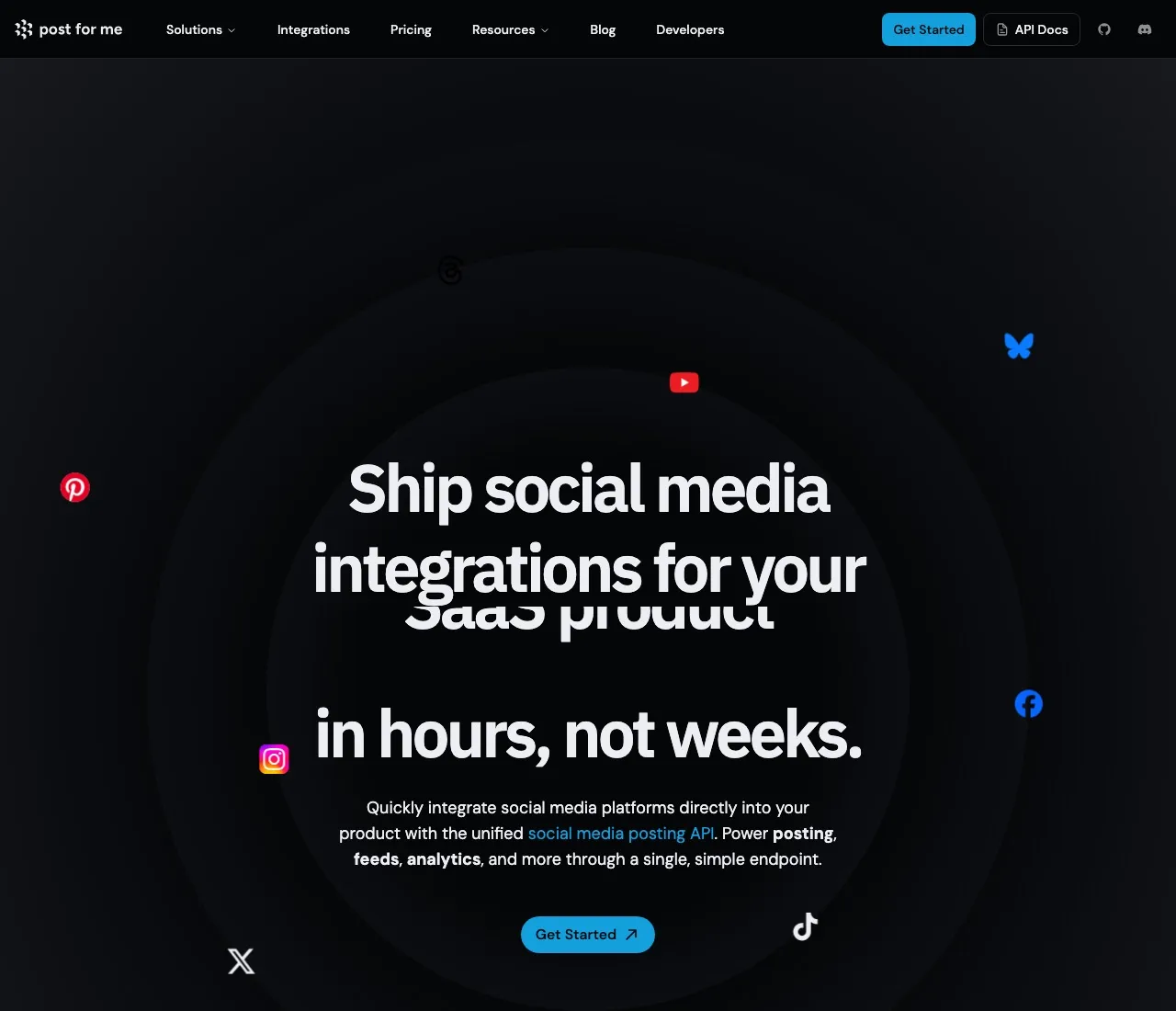
Post for Me’s homepage frames the product as integration infrastructure for developers building their own apps.
Blotato starts a step earlier, at the blank page. The API and MCP surface cover generating the post, generating the image or the faceless video, and then publishing across nine platforms. If you already have finished content, that upstream half is capability you are paying for and not using.
So the honest framing is not cheap versus expensive. It is delivery layer versus content engine, and there are plenty of builds where the $10 tool is the correct answer.
Developers Shipping Publishing Inside Their Own Product
Post for Me is built by Day Moon Development, a two-person team who shipped it as their first product in 2025, and it is aimed squarely at developers embedding social posting into their own software.
The $10/mo entry plan covers 1,000 successful posts with unlimited social accounts, projects, team members, and API keys. That account model is genuinely generous, since most competitors bill per connected profile and a product with many end users would cost far more elsewhere. The pricing page steps up by monthly post volume from 1,000 through 200,000, with enterprise quoting above that.
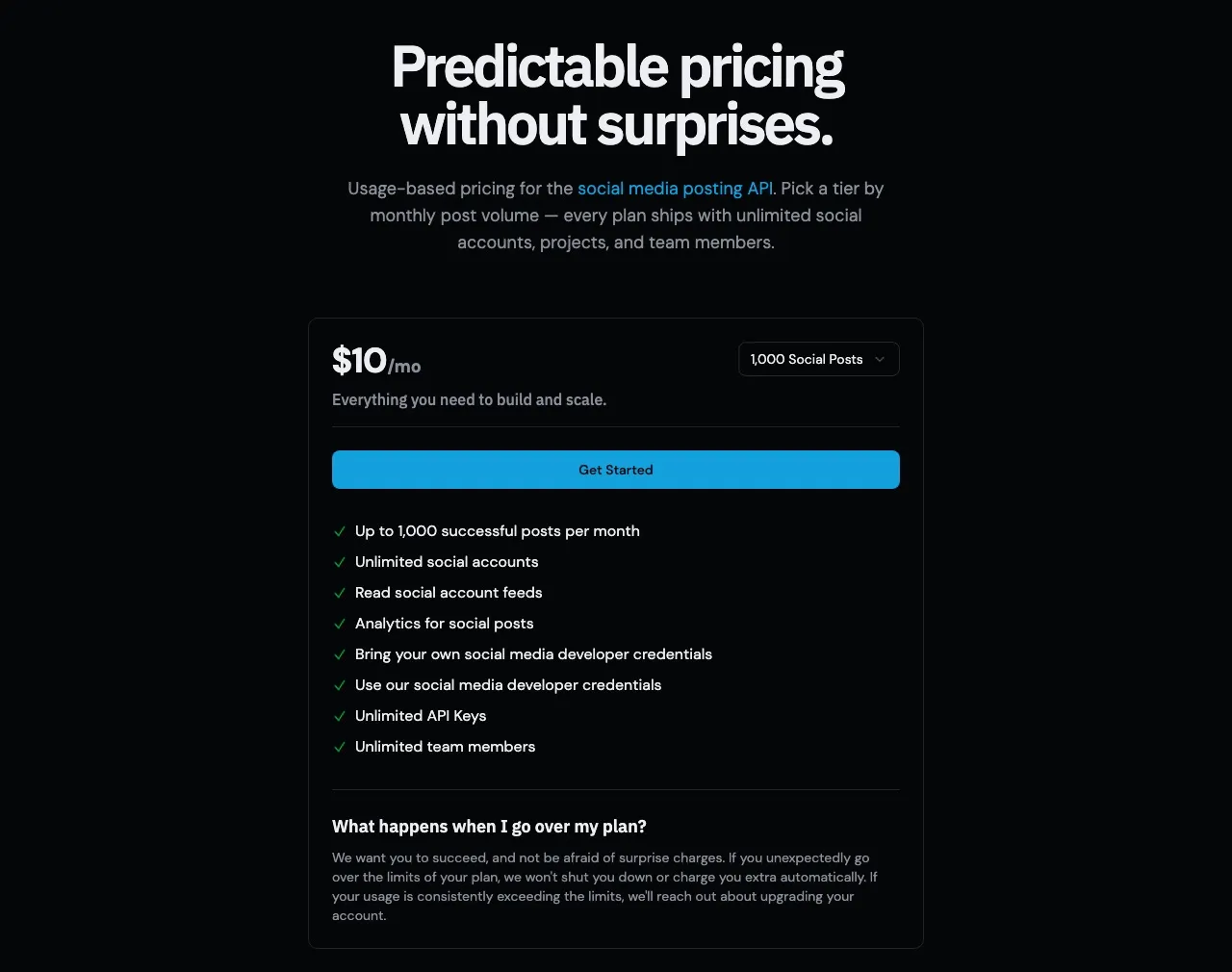
Post for Me’s pricing: one tier at $10/mo, scaled by monthly post volume rather than by account count.
It covers the same nine platforms Blotato does: TikTok, Instagram, Facebook, X, LinkedIn, YouTube, Threads, Pinterest, and Bluesky. Beyond publishing and scheduling it offers feeds for reading historical posts back, per-post analytics, media transcoding, and webhooks on publish success or failure. The analytics depth varies by network: TikTok and Facebook return watch time, engagement rates, and impression sources, while their documentation notes that LinkedIn metrics cover Company Pages only and Bluesky does not expose view counts.
There is no free tier, and the API rate limits sit at 5 requests per second and 40 per minute by default, raisable on request. It is a young product built by a small team, so weigh that the way you would weigh any early-stage dependency you are putting a production pipeline on top of.
Operators Publishing Their Own Accounts
I founded Blotato and I still run it, so treat this section as the interested party’s account and check it against the tables above.
The clearest way to see the split is to look at what each API asks you for. Post for Me’s create-post call expects a caption and a media URL you already have. Blotato’s surface starts one call earlier, generating the caption, the image, and the faceless video with ElevenLabs voiceovers, then publishing all nine platforms through the same key.
That is a deliberate choice about where the product begins, not a feature gap on either side. If content arrives from somewhere upstream in your build, the generation half is dead weight.
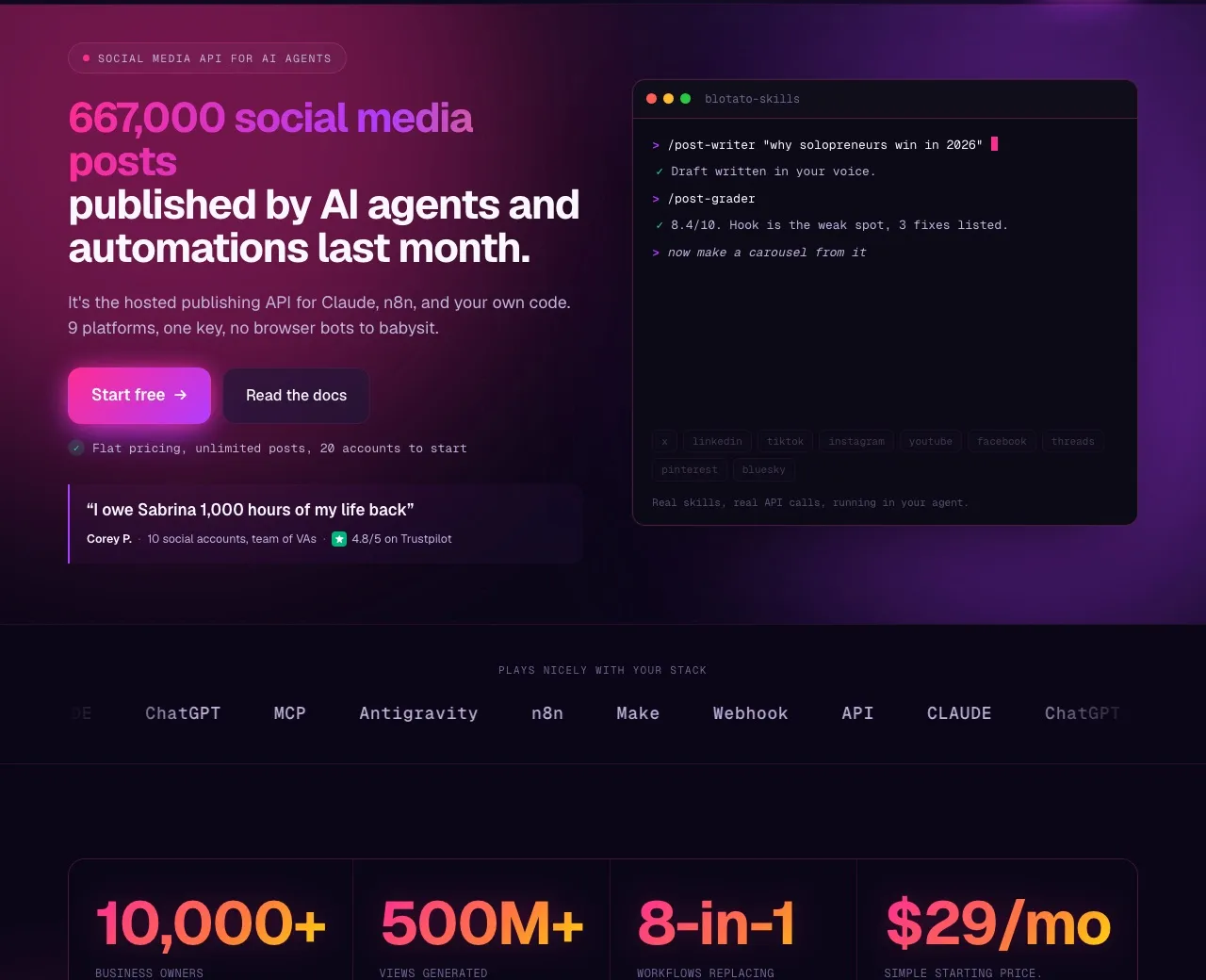
Blotato positions itself as agent infrastructure for social media marketing, covering creation through publishing.
The reader I build for now is mostly running this through an agent. Blotato’s MCP server is hosted at mcp.blotato.com/mcp, so there is no local process to babysit, and there are native n8n and Make nodes alongside the REST API. If you are weighing those three routes against each other, I compared n8n, Make, and MCP for social posting separately.
I should be precise about the engagement surface because it is narrower than the positioning implies. Analytics covers eight platforms. LinkedIn is the only one that returns no metrics yet. Comments and direct messages cover Instagram and Facebook.
If you need comment coverage across every network, that is a real gap and you should weigh it.
Post for Me vs Blotato: Side by Side
| Category | Post for Me | Blotato |
|---|---|---|
| Pricing model | Flat by monthly post volume | Flat by plan |
| Free plan | No | No (7-day trial, cancel anytime) |
| Cheapest paid tier | $10/mo (1,000 posts) | $29/mo (20 accounts) |
| Social accounts | Unlimited | 20 on Starter, 40 on Creator |
| Platforms | 9 | 9 |
| AI text writing | No | Yes (unlimited generation) |
| AI image generation | No | Yes (uses AI credits) |
| AI video generation | No | Yes (faceless video plus voiceovers) |
| Public REST API | Yes, on the $10 plan | Yes, on paid plans |
| MCP server | Yes, run locally via npx | Yes, hosted at mcp.blotato.com/mcp |
| n8n / Make nodes | Not documented | Native nodes for both |
| Post analytics | 9 platforms (LinkedIn limited to Company Pages) | 8 platforms (all but LinkedIn) |
| Comments | No | Instagram and Facebook |
| DMs / inbox | No | Instagram and Facebook |
| Open source | Yes, AGPL-3.0 | No |
The two rows that decide most builds are AI generation and analytics coverage. Post for Me reaches one more network than Blotato does, with the LinkedIn and Bluesky caveats above. Blotato creates the content, which Post for Me does not attempt. Those are the trades.
Unlimited Accounts at Ten Dollars
It is genuinely cheaper, and by a lot. $10 versus $29 is the headline, but the real gap is on accounts. Post for Me gives unlimited social accounts on that $10 plan. If you are building a product where hundreds of your users each connect their own accounts, Blotato’s 20-account Starter cap is simply the wrong shape and Post for Me is the correct tool.
The whole server is open source. The GitHub repository contains the NestJS API, the dashboard, and the background workers under AGPL-3.0, not just client SDKs. Very few vendors in this category publish their server. If auditability matters to your stack, or you want the option of running it yourself, that is a real advantage Blotato does not offer, and it is worth reading how open source and managed APIs actually trade off before you decide.
Analytics reaches one more network. Post for Me returns per-post metrics across all nine networks it publishes to, though LinkedIn is limited to Company Pages and Bluesky does not expose view counts. Blotato covers eight of the nine and has no LinkedIn analytics at all. If LinkedIn measurement matters to your product, Post for Me wins this row.
Unlimited team members and API keys. No seat math, at any volume. Several tools in this category charge per seat, and for an agency or a growing dev team that difference compounds.
Publishing to your users’ accounts without platform approval. Quickstart mode lets your users connect accounts through Post for Me’s platform credentials, so you skip the TikTok and Instagram developer review queues entirely. For getting a product in front of real users quickly, that is a genuine shortcut.
Breadth of Surface Behind One Credential
Breadth of surface behind one key. Generation, publishing to nine platforms, scheduling, Instagram comments and DMs, and eight-platform analytics all sit behind a single credential. The honest counterfactual is not “Post for Me plus one thing,” it is a posting API, an LLM provider, a media pipeline, and separately whatever handles the replies, each with its own bill and its own approval.
It writes the post. Unlimited AI text generation, AI image generation, and faceless video with voiceovers are included at $29/mo. With Post for Me you supply finished content, which means wiring an LLM provider and a media pipeline to the posting call. That stack costs money and maintenance that never shows up in the $10 line item.
The MCP server is hosted. Blotato’s sits at mcp.blotato.com/mcp and your agent points at a URL. Post for Me’s MCP runs locally via npx -y post-for-me-mcp@latest, and it exposes documentation search and a sandboxed code-execution tool rather than direct publishing tools. Both are legitimate designs, but a hosted endpoint is one less process to keep alive when the agent runs unattended at 3am.
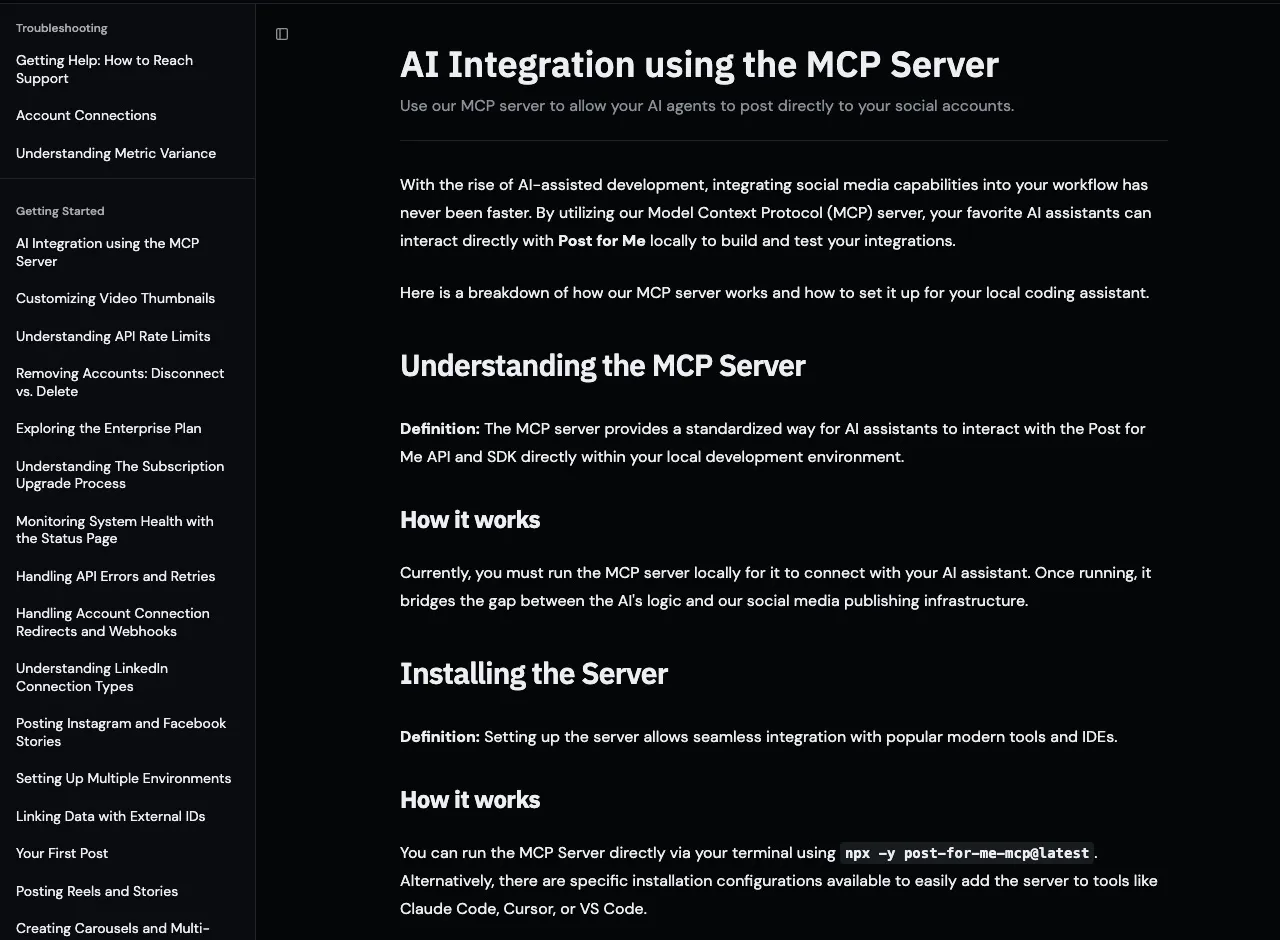
Post for Me’s MCP server runs locally through npx and exposes docs search plus sandboxed code execution.
No borrowed OAuth identity and no approval queue. As covered above, running your own content through Blotato means neither the third-party consent-screen branding nor the per-network review process enters the picture. This advantage disappears the moment your requirement is letting your own customers connect their accounts, which is Post for Me’s territory.
Native n8n and Make nodes. If your automation lives in either tool, the nodes are maintained against API changes. Calling any REST API from an HTTP node is trivial, so this is a maintenance difference rather than a capability one.
Post Volume Pricing Against Accounts and Credits
| Plan level | Post for Me | Blotato |
|---|---|---|
| Entry | $10/mo (1,000 posts, unlimited accounts) | $29/mo (20 accounts, 1,250 AI credits) |
| Mid | Steps up by post volume, 1,000 to 200,000/mo | $97/mo (40 accounts, 5,000 credits) |
| Top | Enterprise, contact sales | $499/mo (28,000 credits) |
| Trial | None | 7 days, excludes API |
Now the capability comparison at the entry tier, which is where the $19 difference actually resolves:
| Capability at the entry tier | Post for Me ($10/mo) | Blotato Starter ($29/mo) |
|---|---|---|
| Social accounts | Unlimited | 20 |
| Posts included | 1,000/mo | No per-post fee |
| AI text writing | No | Unlimited |
| AI image generation | No | Included (uses credits) |
| AI faceless video | No | Included (uses credits) |
| Post analytics | 9 platforms (with caveats) | 8 platforms (no LinkedIn) |
| MCP | Local via npx | Hosted endpoint |
| Open source | Yes (AGPL-3.0) | No |
Blotato’s Starter costs $19/mo more and includes three categories of content generation that Post for Me does not sell at any tier. Post for Me includes unlimited accounts and broader analytics that Blotato does not match at any tier. That is the trade stated plainly in one table, and the full tier breakdown shows where the credit allowances land.
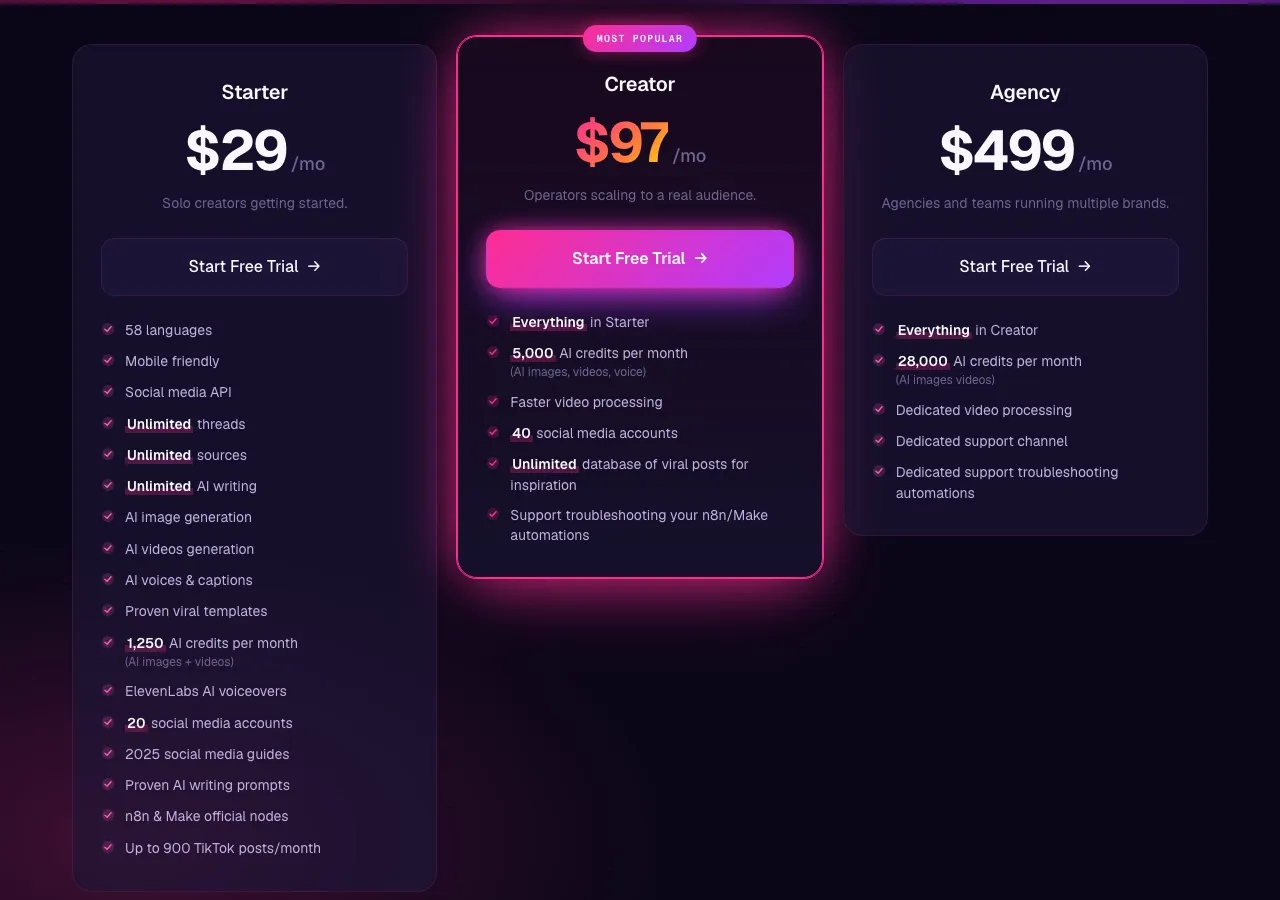
Blotato’s three tiers, all with a 7-day trial that excludes API access.
Four honest caveats before you decide:
If your users connect their own accounts, Post for Me is cheaper by an enormous margin. Unlimited accounts at $10 against 20 at $29 is not close, and a product with 200 connected users would still hit Blotato’s limits at Agency.
If you already have a content pipeline, Blotato’s AI surface is money you will not use. Paying for generation you have already solved makes no sense.
If you publish more than a thousand posts a month, compare the ladders directly. Post for Me scales by post volume where Blotato does not charge per post, so the crossover depends on your volume and account count.
If you need LinkedIn analytics, Blotato does not have them. Post for Me covers all nine networks it publishes to, subject to the Company Pages limit.
Post for Me Is Built for Your Users, Not for You
- You are building a product where your own users connect their social accounts
- You need unlimited connected accounts at a low fixed cost
- Your content already exists and you only need reliable delivery
- You want the option to audit or self-host the server
- You need per-post analytics across all nine platforms
You Are the End User, Not the Integrator
- You want the agent to write the caption and generate the image or video, not just publish
- You are running your own social presence rather than shipping a product for others
- You want a hosted MCP endpoint with nothing to keep running locally
- Your automations live in n8n or Make and you want maintained nodes
- You want your own brand on the OAuth screen without doing platform approvals yourself
Building for Others? Post for Me Is the Right Call.
If you are building software for other people to use, Post for Me is the right call. Unlimited accounts at $10 is very hard to beat, and the fact that the entire server sits on GitHub means you are never fully locked in.
If you are the one filling the blank page every morning, the $19 gap buys the AI writing, image, and video generation you would otherwise assemble from separate vendors. That was the problem I built Blotato to solve. The deciding question is whether you are shipping a product or running your own content, and those two answers point in opposite directions on this page. If it is the second, the plans page has the tier details, and API and MCP users should plan on starting the subscription rather than trialing it, since the 7-day trial excludes API access.
FAQs
Is Blotato cheaper than Post for Me?
No. Post for Me starts at $10/mo against Blotato’s $29/mo, and it includes unlimited social accounts where Blotato Starter includes 20. Blotato costs more because AI text, image, and video generation are included. If you already have a content pipeline, Post for Me is the cheaper and better-shaped tool.
Does Post for Me have AI content generation?
Not inside the API. Its documented endpoints cover media upload, social accounts, social posts, post results, and webhooks. The site markets an AI Content Generation use case page, but that describes products you might build on top of it rather than a generator within it.
Can I use Post for Me with n8n or Make?
Post for Me does not document native n8n or Make nodes, so you would call its REST API through a generic HTTP request node in either tool. Blotato ships maintained native nodes for both, plus a hosted MCP server at mcp.blotato.com/mcp for agent-driven publishing.
Does Blotato have a free plan?
No permanent free tier. There is a 7-day free trial on every plan, a card is collected, and you can cancel anytime. Note the trial excludes API access, and generating an API key ends the trial and starts the paid Starter plan, so API and MCP users should plan on subscribing rather than trialing.
Which tool supports more social platforms?
Both publish to the same nine: TikTok, Instagram, Facebook, X, LinkedIn, YouTube, Threads, Pinterest, and Bluesky. On analytics Post for Me covers all nine and Blotato covers eight, missing only LinkedIn.
Is Post for Me or Blotato better for agencies?
It depends on account count. Blotato runs 20 accounts on Starter, 40 on Creator, and 100 on Agency at $499/mo, so the account ceiling only becomes the deciding factor past 100 connected accounts, which is the point where Post for Me’s unlimited-account model is the better fit on count alone. An agency whose bottleneck is producing content rather than connecting accounts gets more from Blotato’s generation tools.