Manychat vs LinkDM: Two Meters, One Social Media Bill
Manychat vs LinkDM meter different things. One counts people, one counts messages, and that makes every social media price comparison of the two wrong.
Every Manychat vs LinkDM comparison I can find puts two dollar figures side by side and declares a winner. The figures are real. The comparison is not, because the two companies are not selling the same unit.
Manychat charges for people. LinkDM charges for messages. Until you know how many messages your funnel sends per person, you cannot convert one price into the other, and neither vendor publishes that ratio.
This post works out what each meter actually counts, what the honest cost range looks like on both, and where the published comparisons go wrong. Including the one on LinkDM’s own website.
Manychat vs LinkDM: The Short Answer
LinkDM is the better pick if: your funnel is comment-to-DM on Instagram and Facebook, you send a high volume of messages to a moderate number of people, and you want a bill that does not move when a post takes off.
Manychat is the better pick if: you need WhatsApp, SMS, Telegram, TikTok or email in the same flows, you want branching logic and a real flow builder, or your audience is small enough that per-person pricing is cheap.
Neither one publishes to your feed, so if you are also paying for a scheduler, Blotato’s plans start at $29 and cover both jobs behind one key. Blotato is an app I built, so weigh that mention accordingly and check my numbers rather than taking my word. I come back to it properly, with the caveats attached, once the two tools here have been compared on their own terms.
What the Ranking Pages Get Wrong
I read the six pages ranking for this comparison. Five of them price these two tools against each other as though the numbers were interchangeable, and one does not.
The one that gets it right is InstantDM’s write-up, which says Manychat “bills by ‘active contacts’” while LinkDM “meters messages rather than contacts,” and which discloses the assumption behind its own math. It sells a competing product to both and it is still the straightest page on the query.
The closest miss is CreatorFlow, which states each half correctly in separate sections and then prints a cost table rowing all three tools against an Active Contacts axis, which quietly puts the equivalence back. LinkDM’s own page, Litchfield Media and BooSend make no distinction at all, and BooSend quotes Manychat Pro at $15, which is neither its monthly $39 nor its annual $29 as the page reads today.
Here is the sentence that should open every one of them.
Manychat prices on Active Contacts. Its own pricing FAQ leaves no room to misread it: “An Active Contact is a real person you interact with during a monthly billing period.” It goes further in the next line. “It doesn’t matter how many messages you exchange. One person = one Active Contact for the month.”
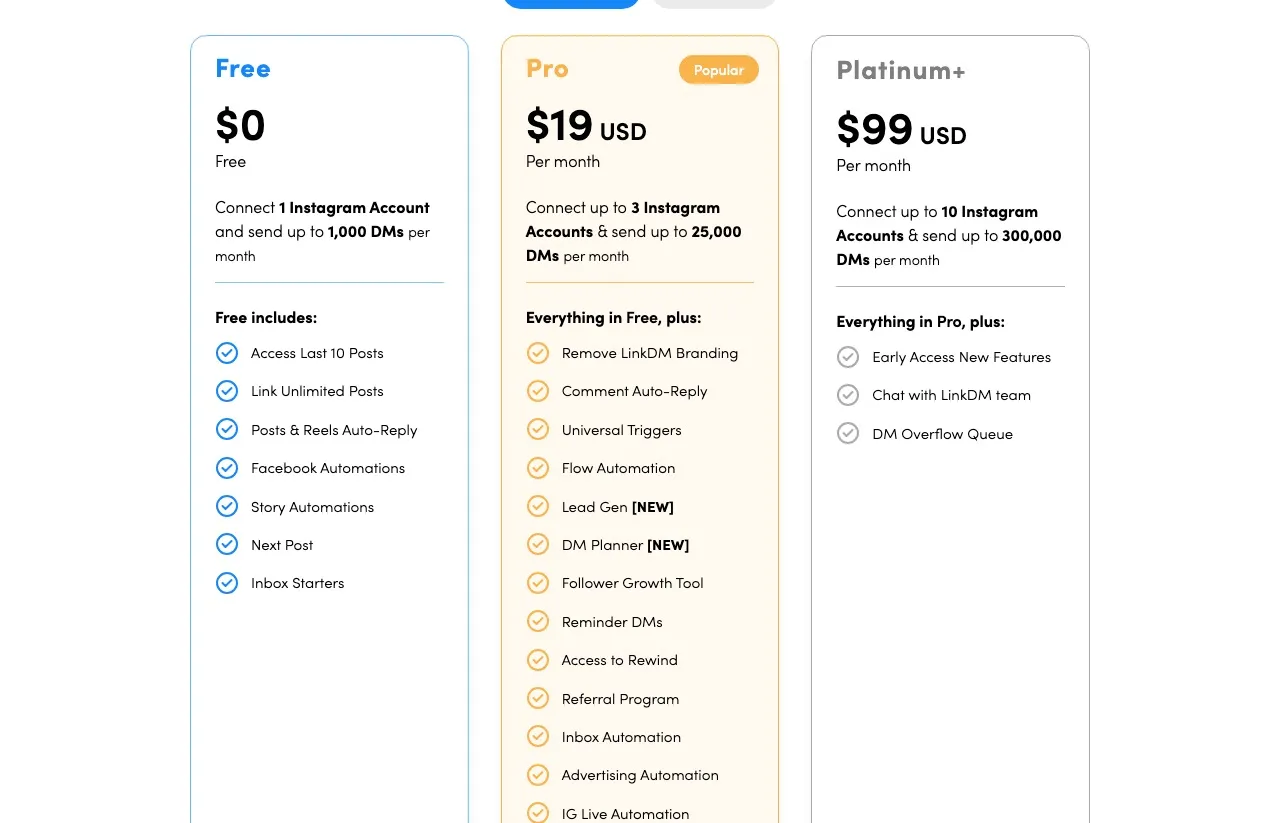
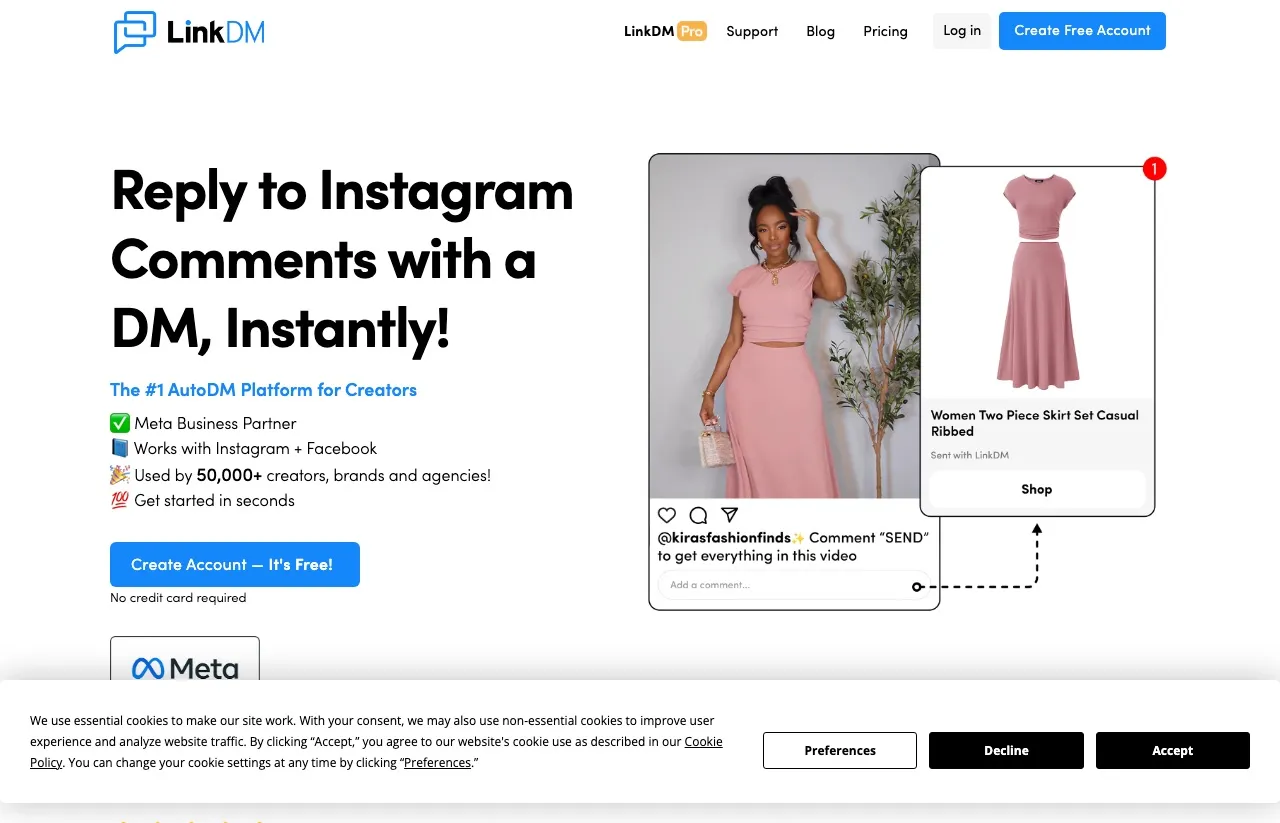
LinkDM prices on DMs sent. Its plan comparison table has one row for it, labelled DM Send Limit, and the numbers are 1,000 on Free, 25,000 on Pro, and 300,000 on Platinum+.
A funnel that replies to a comment, sends a reminder the next day, and follows up with a broadcast has sent three DMs to one person. On LinkDM that is three units. On Manychat it is one.
Manychat’s Meter: People, Not Messages
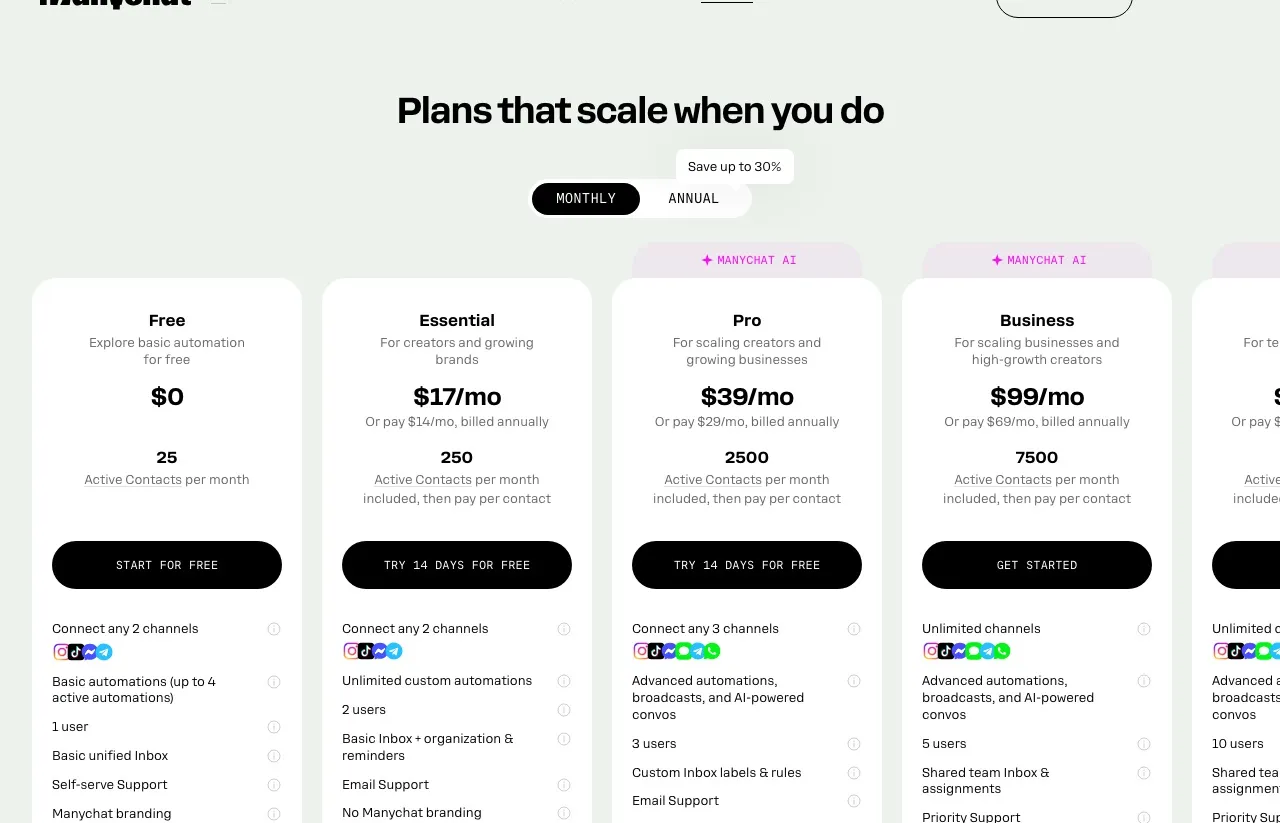
Manychat runs five tiers. Checked on the monthly toggle, because the page opens on annual and the annual figure carries a “/mo” suffix that reads like a monthly price.
Free is $0 for 25 Active Contacts. Essential is $17 a month for 250. Pro is $39 for 2,500.
Business is $99 for 7,500 and Advanced is $199 for 25,000. Annual billing takes those to $14, $29, $69 and $139.
Past your included pool you pay per additional contact, and the rate falls as the tier rises: $0.10 on Essential, $0.05 on Pro, $0.025 on Business, and $0.004 on Advanced. I put every tier through the same cost ladder separately if you want the full arithmetic.
A contact counts as active when messages move through Manychat by any route. Their words: “via automations, AI, Broadcasts, or the Inbox.” Someone who writes to you directly, with no automation involved, still counts.
One thing the scare stories about viral posts leave out. Manychat lets you cap this. Its pricing FAQ describes an overage threshold that “lets you control whether overages are allowed at all, and how many additional Active Contacts you’re comfortable paying for.” Upgrade mid-cycle and it forgives the overage you already ran up.
That is a real control, and any comparison that describes Manychat’s meter as an uncapped bill running away from you is describing a setting the user chose not to use.
LinkDM’s Meter: Messages, Not People
LinkDM’s pricing page runs three public tiers plus an Enterprise plan with no published price. Free is $0 for one Instagram account and 1,000 DMs a month. Pro is $19 for up to three accounts and 25,000 DMs. Platinum+ is $99 for up to ten accounts and 300,000 DMs.
Annual billing is $182 for Pro and $832 for Platinum+, a 20% and 30% discount respectively.
The free tier is more generous than most in this category, because comment-to-DM on posts and reels is included. Pro adds the follower check and Comment Auto-Reply, a public reply under the comment once the DM sends. Free also covers Facebook automations, story automations, Next Post and inbox starters, which is enough to see whether the format works for you.
There is one wrinkle worth knowing before you budget. LinkDM’s monthly Pro card and its plan comparison table both say 25,000 DMs per month. The yearly Pro card says 25,000 DMs “per account / per month.” Two of the three surfaces read as a shared pool and the third reads as a limit per connected account, which at three accounts is a threefold difference in what you are buying. Ask support which one governs your plan before you size a tier on it.
So What Does Manychat Actually Cost for 25,000 DMs?
Now the arithmetic, and it is the reason this post exists.
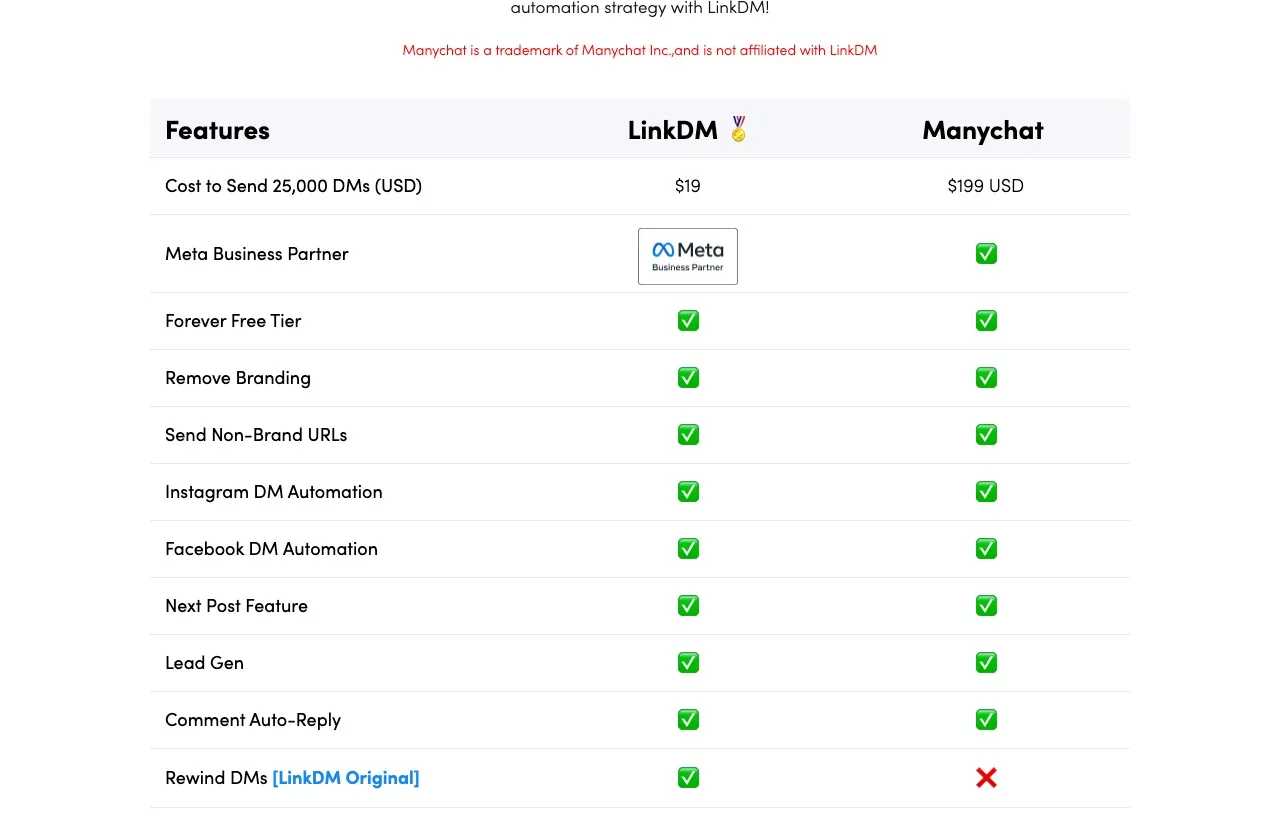
LinkDM’s own comparison page states the case for itself like this: “all for just $19 to send 25,000 DMs compared to $165 with Manychat.” Directly underneath, the feature table has a row labelled “Cost to Send 25,000 DMs (USD)” with $19 in the LinkDM column and $199 USD in the Manychat column.
Two different Manychat figures, on one page, a few hundred pixels apart. Neither is what Manychat charges to send 25,000 DMs, because Manychat does not sell DMs. The $199 is its Advanced tier, which is priced for 25,000 contacts.
Run the real numbers and the answer is a range, not a figure. It depends entirely on how many DMs your funnel sends each person.
| DMs per person | People behind 25,000 DMs | Cheapest Manychat monthly cost |
|---|---|---|
| 1 | 25,000 | $199 on Advanced |
| 2 | 12,500 | $199 on Advanced |
| 3 | 8,333 | $120 on Business |
Business at 8,333 people is the $99 base plus 833 contacts over the 7,500 allowance at $0.025 each, which is $119.83. Every row picks the cheapest tier for that contact count rather than assuming you stay on one plan.
The shape matters more than the endpoints. Manychat’s cheapest plan for that workload sits at $199 while your funnel sends one or two DMs per person, drops to about $120 at three, and keeps falling as the ratio climbs: $99 from four, then down through the Pro tier to $39 at ten DMs per person, because only 2,500 people are behind those messages by then.
So more DMs per person makes Manychat cheaper, not dearer, and at a heavy follow-up ratio it lands at twice LinkDM’s price rather than ten times it. That is the exact opposite of what a DM-count comparison implies, and it is why the single figure on LinkDM’s page cannot be right for everyone.
The $199 it quotes is the one-DM-per-person case, which is the most expensive point on that curve. Whether it is also a typical one depends on your funnel, and neither company publishes data on that. The conversion needs an assumption only you can supply, so treat any single number as somebody’s assumption rather than a price.
Manychat vs LinkDM: Side by Side
| Category | Manychat | LinkDM |
|---|---|---|
| Billing unit | Active Contacts (people) | DMs sent (messages) |
| Free plan | 25 Active Contacts | 1,000 DMs, 1 Instagram account |
| Cheapest paid tier | $17/mo Essential, 250 contacts | $19/mo Pro, 25,000 DMs |
| Top public tier | $199/mo Advanced, 25,000 contacts | $99/mo Platinum+, 300,000 DMs |
| Overage behaviour | Charges per extra contact, capped if you set a threshold | Non-expiring DM credit packs, $5 to $350 |
| Channels | Instagram, Facebook Messenger, TikTok, WhatsApp, Telegram, SMS, email | Instagram and Facebook |
| Channels at entry tier | Any 2, from Instagram, TikTok, Messenger or Telegram | Instagram and Facebook |
| Flow builder | Visual builder with branching logic | Click-to-setup, plus Flow Automation on Pro |
| Comment-to-DM | Yes | Yes, on every plan including Free |
| Meta Business Partner | Yes | Yes, since 2021 |
| Paid trial | 14 days on Essential and Pro | No trial, the free tier is the try-before-you-buy |
| Social media publishing | No | No |
Two rows carry most of the decision. The billing unit row is the one this whole post is about. The channels row is the one that ends the argument early if your funnel touches WhatsApp or SMS, because LinkDM does not go there at all.
Five Things LinkDM Does Better
1. A growing audience does not raise the bill. This is the real version of the argument the marketing makes badly. If your follower count doubles while your automation still sends the same number of DMs, LinkDM charges you the same and Manychat charges you more. That decoupling only pays off while your message volume stays flat, though, because volume is the axis LinkDM does bill you on.
2. The free tier is genuinely usable. A thousand DMs a month on one Instagram account, with Facebook and story automations included, is enough to test whether comment-to-DM works for you at all. Manychat’s 25 contacts runs out in an afternoon.
3. Volume is cheap at the top. Platinum+ is 300,000 DMs for $99, the same price as Manychat’s Business tier, which covers 7,500 people before overage starts. Those are different units again, but at high message volume the gap is wide enough that the unit conversion stops rescuing it. Cheaper still is topping up a Pro plan with credit packs, which the full LinkDM pricing breakdown works out.
4. Features built for the viral case. Slow Down Mode, a high volume rate limiter and a DM Overflow Queue are all aimed at the moment a post takes off, which is exactly when Meta’s own rate limits start rejecting sends. Note that the pricing card and the comparison table disagree about which tier Slow Down Mode sits on, so confirm it before buying on that basis.
5. It is a certified Meta Business Partner. It has been since 2021, and on a category where unofficial automation gets accounts restricted, appearing in Meta’s partner directory is worth more than a feature. Manychat is also a Meta partner, despite what LinkDM’s comparison table implies with a tick in its own column and a blank in Manychat’s.
Five Things Manychat Does Better
1. Five channels LinkDM does not have. WhatsApp, SMS, Telegram, TikTok and email all live inside Manychat flows. If your funnel runs on WhatsApp, nothing else in this post matters. Note the channel caps though: Free and Essential connect any two channels from a shorter menu that excludes WhatsApp, SMS and email, so WhatsApp in practice means Pro at $39 for three channels, or Business at $99 for all of them.
2. A real flow builder. Branching logic, conditional paths and segmentation are what you are paying for at the top tiers. LinkDM’s pitch is explicitly that this is overkill for straightforward DM automation, which is fair, and it is also an admission that the ceiling is lower.

3. Small audiences are cheap. At 250 contacts on Essential you pay $17. LinkDM’s equivalent entry is $19. If you talk to a few hundred people a month and send each of them several messages, per-person pricing is the cheaper unit and it is not close.
4. The bill is controllable, not just predictable. Between the overage threshold and mid-cycle upgrade forgiveness, you can bound the downside. Predictable and bounded are different properties, and Manychat gives you the second one on request.
5. Depth from a decade of edge cases. Manychat has been doing this far longer, and in a category where Meta changes the rules without warning, maturity is a feature you notice on the day something breaks, though its Trustpilot reviews are mixed enough that you should read a page of the critical ones first. Billing surprises are the most common theme in them, which is worth knowing given the meter this post is about.
The Job Neither One Does
Neither of these tools publishes to your feed. That is not a criticism, it is a category boundary: a DM automation runs after a post exists. So most people running comment-to-DM funnels are paying for two products, one that publishes and one that replies.
That is the gap Blotato fills, and it is the only reason I am in this post at all. It runs DM automation on Instagram and Facebook plus publishing to nine platforms and analytics on eight, behind one key, from $29 a month on Starter.
Against this pair specifically, that replaces two subscriptions with one, and only if you actually need both jobs done. If your publishing is already sorted and you just want the reply half, the verdict above stands and you should buy one of these two.
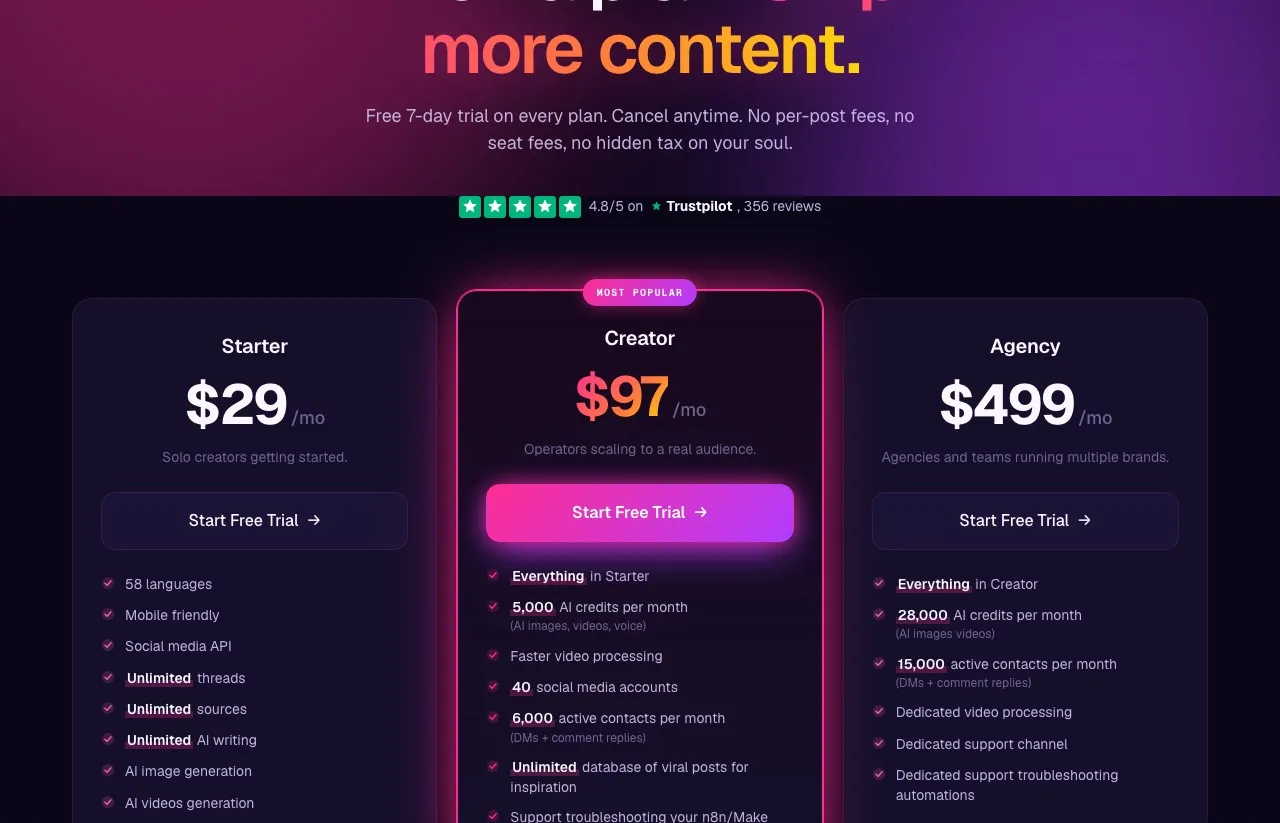
Our meter is worth stating plainly, because it is the same unit as Manychat’s rather than LinkDM’s. Blotato counts active contacts too, 1,000 a month on Starter, 6,000 on Creator and 15,000 on Agency. So on the axis this whole post is about we behave like Manychat, and a funnel sending many messages to few people will hit our contact ceiling long before it exhausts a message allowance.
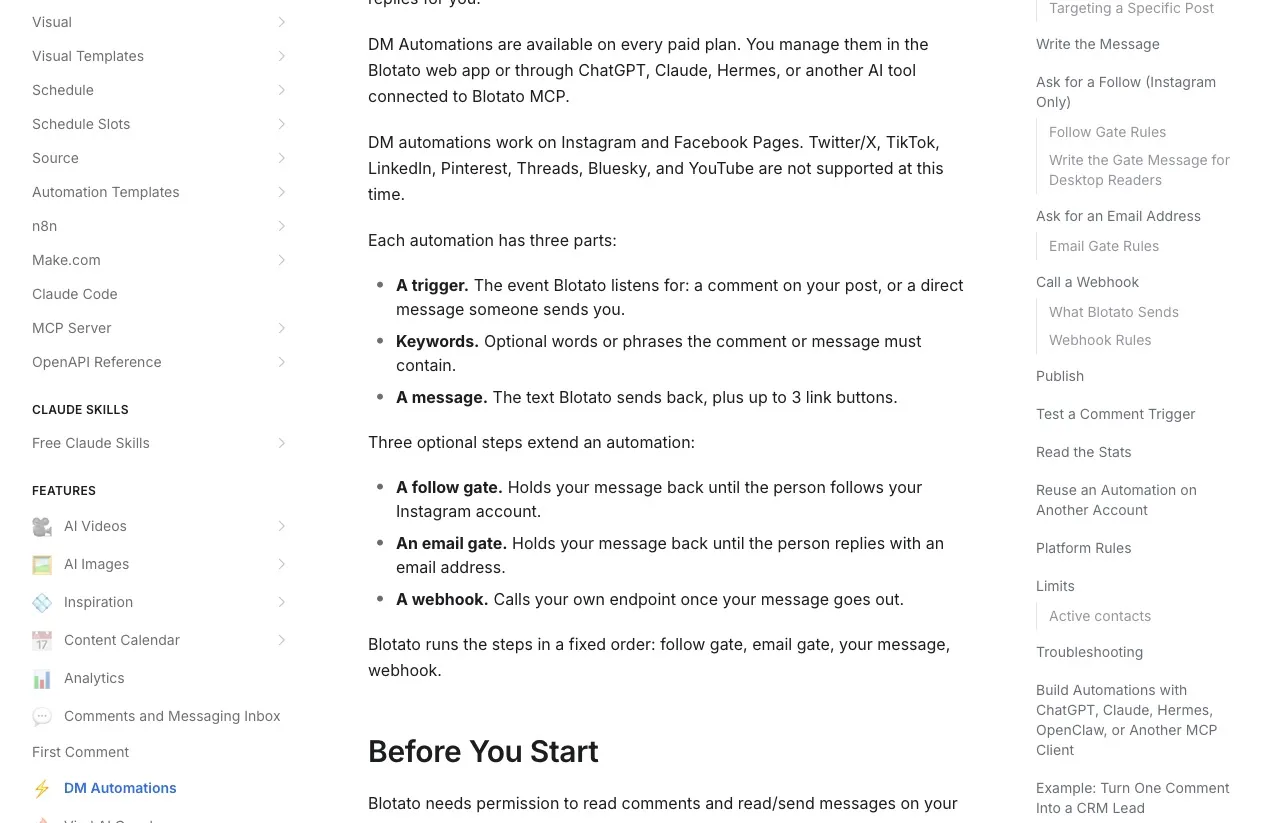
Here is the limitation I would want told to me before I bought. Our follow gate asks before it checks, because Instagram only grants follower status once someone opens a DM thread with your account.
Our own DM automation reference puts it bluntly: every run sends the gate message first and checks follower status second. So people who already follow you still get asked to follow on first contact. If they never answer, the run waits up to 30 days, expires, and nothing else sends. On a warm audience that is a real cost, and it is ours rather than something on a roadmap.
Our engagement surface also stops at Instagram and Facebook, same as LinkDM’s, so neither of us reaches a funnel that runs on WhatsApp, SMS or Telegram. That boundary is set by what each platform permits a comment-to-DM tool to do rather than by any of the three of us.
What $17, $19 and $29 Actually Buy
| Capability at the entry tier | Manychat Essential ($17/mo) | LinkDM Pro ($19/mo) | Blotato Starter ($29/mo) |
|---|---|---|---|
| Billing unit | 250 Active Contacts | 25,000 DMs sent | 1,000 active contacts |
| Instagram accounts | Any 2 channels | Up to 3 | 20 social accounts total |
| Comment-to-DM | Yes | Yes | Yes |
| Messaging channels | 2 of Instagram, TikTok, Messenger, Telegram | Instagram and Facebook | Instagram and Facebook |
| Social media publishing | No | No | 9 platforms |
| Analytics | No | No | 8 platforms |
| REST API and MCP | API on Pro and above | Enterprise only | Included |
The row that matters is the publishing one. Manychat and LinkDM are both cheaper than Blotato at the entry tier, and neither one puts a post on a feed, so a creator needing both is buying a scheduler as well. Only a handful of Instagram automation tools do both jobs. That is the price-to-value argument, and it only works if you need both. If the API row decides it for you instead, I sorted which DM tools let an agent build the automations in a separate roundup.
Pick LinkDM If
- Your funnel is Instagram and Facebook comment-to-DM, and nothing else
- You send many messages to a moderate number of people
- You want to test comment-to-DM properly before paying anything
- You are running up against Meta’s send limits on viral posts
- You want the cheapest path to high message volume
Pick Manychat If
- Your funnel touches WhatsApp, SMS, Telegram, TikTok or email
- You need branching logic rather than click-to-setup triggers
- Your audience is a few hundred people who each get several messages
- You want the ability to cap overage spend rather than just avoid it
- You value a decade of edge cases being already found
Measure Your Own Ratio First
Work out your own DMs-per-person number first. Everything else follows from it, and it takes one month of data to get.
If that number is high, meaning you send a lot of messages to relatively few people, LinkDM’s meter is built for you and $19 is very hard to argue with. If it is close to one, and especially if your channels reach past Meta, Manychat’s per-person pricing is the cheaper unit and the deeper product.
What I would not do is pick either one off a published price comparison, including the one on LinkDM’s site and including the table in this post. Those numbers all encode an assumption about your funnel that you can measure directly in a month. If neither meter suits you once you have the number, the wider field sorts by exactly that.
And if you find yourself paying for one of these plus a separate scheduler, that is worth pricing as one line rather than two. Our 7-day trial covers the web app and takes a card, though it excludes API access, so if you plan to drive this from an agent rather than the dashboard, budget for the Starter subscription instead of expecting to evaluate it free.
Manychat vs LinkDM FAQs
Is LinkDM cheaper than Manychat?
At the sticker price, yes: $19 against $17 for Essential or $39 for Pro looks close, and LinkDM’s 25,000 DMs dwarfs Manychat’s 250 or 2,500 contacts. But the units differ, so the honest answer depends on how many DMs your funnel sends each person. Send several messages per person and LinkDM is dramatically cheaper. Send one, and Manychat’s per-person pricing can win at small audience sizes.
What is a Manychat Active Contact?
A real person you interacted with through Manychat during the billing month. Manychat’s own wording is that the number of messages does not matter, so one person counts once no matter how many DMs you exchange. Contacts count whether they arrived through an automation, AI, a Broadcast, or simply wrote to your connected inbox, which is why totals run higher than people expect.
Does LinkDM have a free plan?
Yes, and it is more generous than most. Free covers one Instagram account and 1,000 DMs a month, including Facebook automations, story automations, Next Post and inbox starters. Comment-to-DM on posts and reels is included, and Pro at $19 a month adds the follower check and public comment replies. Manychat’s free tier is 25 Active Contacts.
Does Manychat or LinkDM support WhatsApp?
Manychat does, LinkDM does not. LinkDM covers Instagram and Facebook only. On Manychat, WhatsApp sits in the channel menu from Pro at $39 a month, which allows any three channels, and Business at $99 removes the channel cap entirely. Free and Essential connect two channels from a shorter list that excludes WhatsApp.
Can either tool publish posts to social media?
No. Both are DM automation platforms that run after a post exists, so most people using them pay separately for a scheduler. Blotato is the alternative worth pricing here because DM automation on Instagram and Facebook plus publishing to nine platforms sit behind one key from $29 a month. That only saves money if you genuinely need both jobs done.
Which one is safer for my Instagram account?
Both are certified Meta Business Partners, LinkDM since 2021, so both use official APIs rather than browser automation. LinkDM adds features aimed specifically at staying inside Meta’s send limits during a viral post, including a rate limiter and an overflow queue on its top tier. Neither exempts you from Instagram’s own limits.