8 Best LinkDM Alternatives With an API for Social Media DMs
LinkDM has no self-serve API. These 8 social media DM tools are ranked on whether your AI agent can build and edit the automations itself.
Ask Claude to swap the link behind every LinkDM keyword before a launch and it has no self-serve endpoint to call, which is the moment builders start shopping for LinkDM alternatives. LinkDM is cheap at volume and its free tier sends 1,000 DMs a month, but its only API sits on a quote-only Enterprise plan. I ranked eight replacements on one question, whether your agent can create and edit the automations or only fire ones you built by hand, and five pass: Blotato, Inrō, SetSmart, CommentKeyword and ReplyRush. Blotato comes first, and since I am its founder, check that entry harder than the rest.
Quick Comparison: 8 LinkDM Alternatives by Agent Access
| Tool | Best For | Starting Price | Key Strength |
|---|---|---|---|
| Blotato | Builders whose agent also publishes the posts that trigger the DMs | $29/mo | Instagram and Facebook DM automation plus publishing to 9 platforms, on one key |
| Inrō | Instagram sellers who want an agent editing multi-step scenarios | €12.99/mo | Conversational AI agent that qualifies leads in the DM |
| SetSmart | Coaches whose DMs end in a booked call | $25/mo | Books calls into Calendly or GoHighLevel, across WhatsApp, Instagram and Messenger |
| CommentKeyword | Developers who want a plain REST API for keyword automations | $12/mo | Metered on DMs sent, with per-DM overage on paid plans instead of a hard stop |
| ReplyRush | Senders who want LinkDM's DMs-sent meter from a $10 entry plan | $10/mo | 40,000 DMs a month for $25, across Instagram and Facebook |
| BooSend | Creators who want unlimited DMs, with WhatsApp and Telegram from the $29 plan | $15/mo | Unlimited DMs and contacts on every plan |
| InstantDM | Instagram creators who want an agent working the inbox | $12/mo | Publishes to Instagram from the same server that handles DMs |
| ManyChat | Teams that need WhatsApp or SMS and can start on the $39 Pro plan | $17/mo | Reaches WhatsApp, SMS, TikTok and Telegram as well as Instagram |
Every price is month-to-month. What each one lets an agent do is the table two sections down, because “has an API” covers three very different things in this category.
Why People Are Looking for LinkDM Alternatives
LinkDM is a Meta Business Partner that meters on DMs sent. Free covers 1,000 DMs a month on one Instagram account, Pro is $19 for up to three accounts and 25,000 DMs, and Platinum+ is $99 for up to ten accounts and 300,000. Its yearly cards say “per account / per month.” The monthly cards leave that out, so whether the allowance is pooled is ambiguous on its own page. Comment auto-reply starts on Pro.
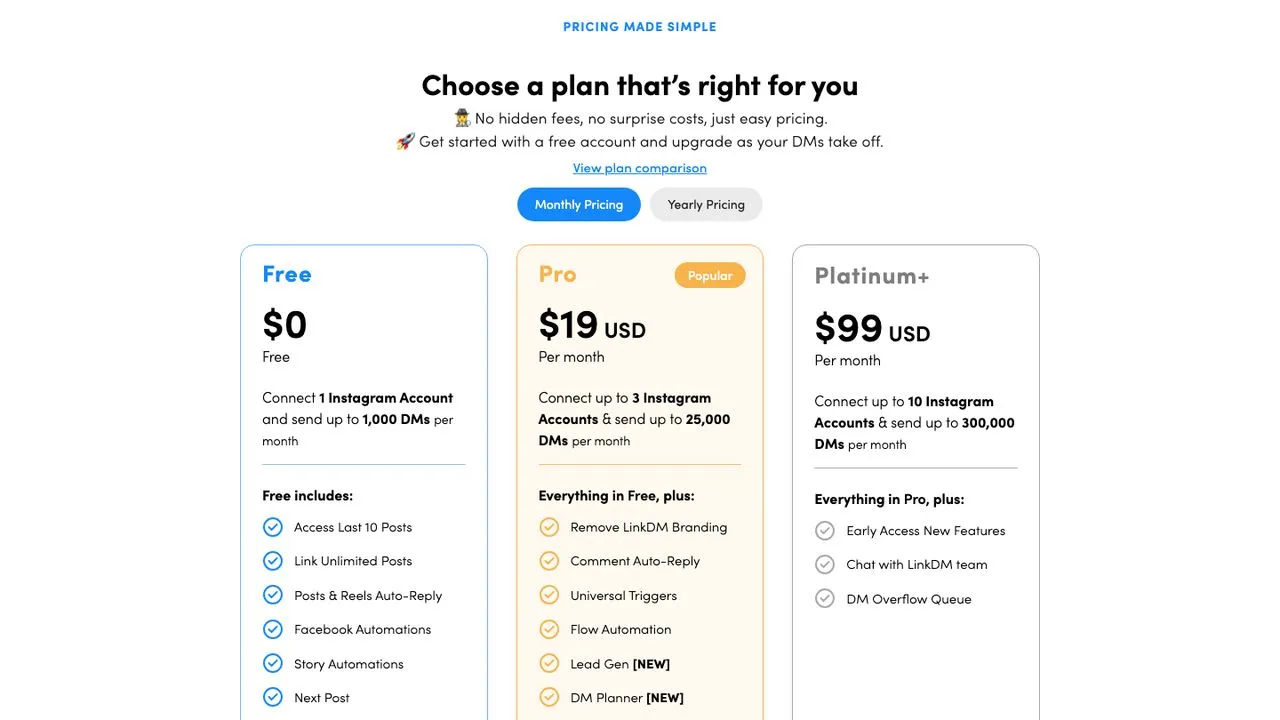
LinkDM’s three public plans. “API Integration” appears only on a fourth, Enterprise card, which has no public price.
All eight competitor pages ranking for this search list the DM caps or the price among the reasons people leave. That is fair, and I broke down the credit packs LinkDM sells past its caps separately, so I will not repeat the math here.
The reason that matters to an agent builder is different. LinkDM publishes no developer documentation. Its Enterprise card lists “API Integration available,” with a dedicated account manager and no public price. The only other integrations on its site are outbound ones, sending captured leads to Kit and Flodesk.
On the self-serve plans, the automations live in a dashboard that only a person can edit. If Claude already writes your posts and schedules them, the DM layer becomes the one step you still do by hand, and swapping an offer across twenty keywords is a round of dashboard edits and checks. Blotato puts DM automation and publishing on the same API key, and its entry below says where that stops being the right call.
Build, Trigger or Click: What an API Means for a DM Tool
Three levels of access hide behind the word “API” here, and the ranking below follows them.
- Build. The agent can create an automation with its keywords and reply message, change it later, and pause or delete it. This is what replaces the dashboard.
- Trigger. The agent can fire a flow a human already built, send a message, or tag a contact. Useful, but the automations themselves still get built by hand.
- Click. No self-serve API at all. LinkDM sits here unless you negotiate Enterprise.
ManyChat is the clearest trigger example. Its API lists flows with getFlows and starts one with sendFlow, and nothing in its 34 endpoints writes a flow. I mapped what the ManyChat API can and cannot touch endpoint by endpoint.
| Tool | What your agent can do | Surface | First plan with it |
|---|---|---|---|
| Blotato | Create, edit, pause and archive automations, read runs and logs | MCP and REST | Starter, $29/mo |
| Inrō | Create, update and delete scenarios, attach comment-to-DM to a post | MCP and REST | Pro, from €12.99/mo |
| SetSmart | Set and delete comment and DM keyword triggers | MCP | Light, $25/mo |
| CommentKeyword | Create, update and delete keyword automations | REST | Pro, $29/mo on the pricing table |
| ReplyRush | Create, update and delete keyword triggers | REST | Lite, $10/mo |
| BooSend | Build and toggle automations, per the vendor | MCP | Plan not stated |
| InstantDM | Trigger an existing flow, pause all automations | MCP and REST | Trendsetter, $29.99/mo |
| ManyChat | List flows and trigger one | REST, labeled beta | Pro, $39/mo |
| LinkDM | Nothing self-serve | Enterprise API | Custom quote |
Best LinkDM Alternatives for 2026
Tools where I confirmed an agent can build the automation come first. BooSend follows, since its build access is a claim I could not check, and the two tools where an agent can only trigger come last. Within each group I ordered them by how much of LinkDM’s job they cover, since most people leaving still need comment-to-DM at volume.
1. Blotato: Best for builders whose agent also publishes the posts
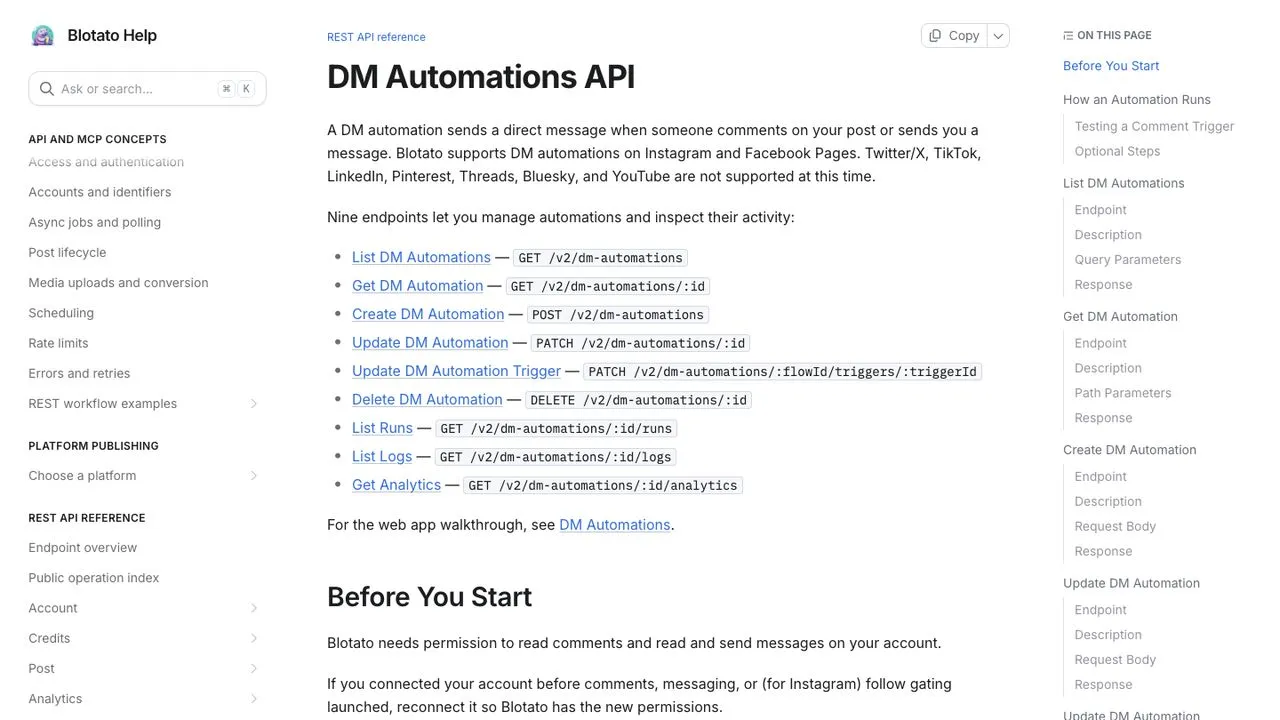
Blotato’s DM automation reference lists nine REST endpoints. The MCP server adds eight DM-automation tools covering the same jobs.
I built Blotato, so hold this entry to a higher standard than the others. Your agent creates, edits, pauses and archives Instagram and Facebook DM automations through our hosted MCP server, with tools like blotato_create_automation and blotato_update_automation, or the REST API, then reads each run’s logs to check the result. The same key publishes to 9 platforms, so one agent can post a reel and attach the keyword that answers its comments. Calvin Hia runs 46 of these flows his agents built from a template folder.
The honest disqualifier: we meter active contacts, 1,000 a month on Starter, not DMs sent. A LinkDM Pro account sending 25,000 DMs to thousands of people would need a bigger plan here, and each automation sends one message rather than a sequence.
Pros:
- An agent builds and edits automations over MCP or REST, with no dashboard step
- DM automation and publishing to 9 platforms on one key and one bill
- Run logs and per-automation analytics, so the agent can check its own work
Cons:
- Reply-only: it answers comments and DMs on Instagram and Facebook, with no WhatsApp and no cold outreach
- Contact limits of 1,000, 6,000 and 15,000 a month are a tighter meter than LinkDM’s
- The trial excludes the API, so an agent builder should budget for the Starter plan
Pricing: Starter $29/mo with 1,000 active contacts, Creator $97/mo with 6,000, Agency $499/mo with 15,000.
Ideal for: Operators running social media through Claude who want DM replies on the same key as publishing.
Bottom line: The pick when the agent should own the loop from post to reply. At pure DM volume, the tools below cost less.
2. Inrō: Best for Instagram sellers who want an agent editing scenarios
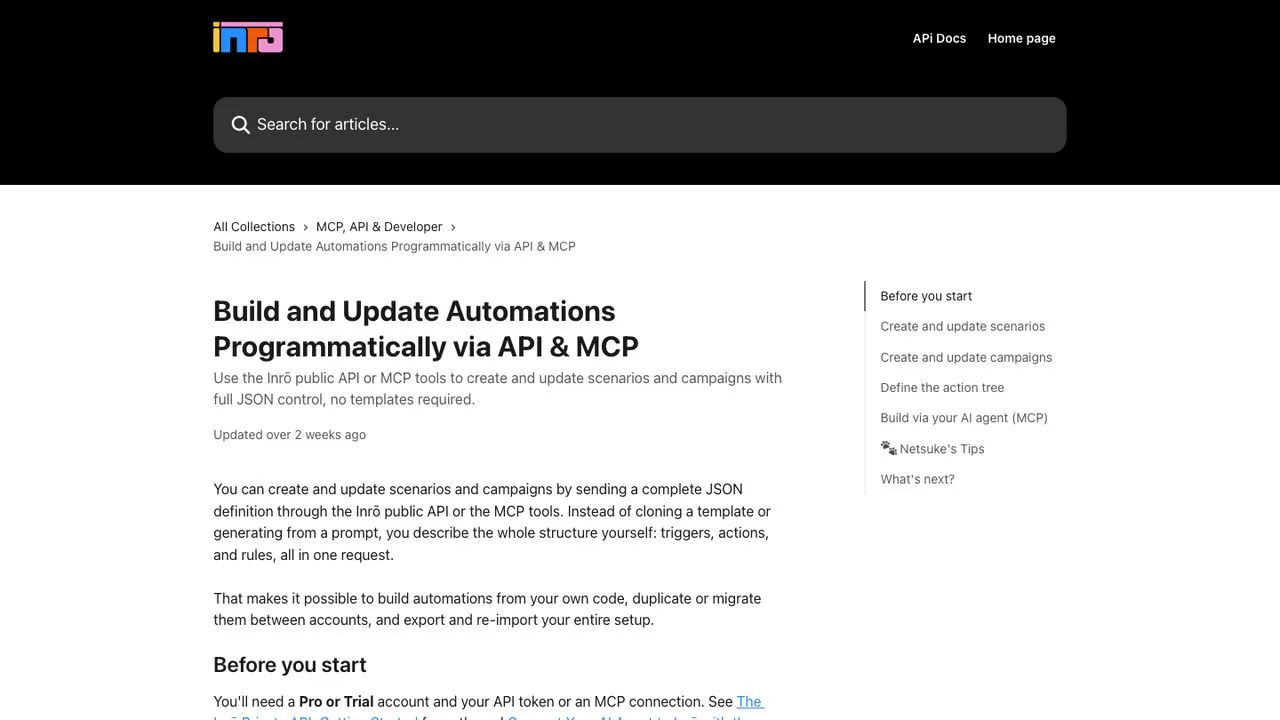
Inrō documents building and updating automations through its public API and MCP tools.
Inrō defines each automation as a scenario, a JSON document holding its triggers and actions. Its help centre says you can “create and update scenarios and campaigns by sending a complete JSON definition through the Inrō public API or the MCP tools,” so a whole scenario goes in one request. A separate endpoint attaches comment-to-DM to a post in a single call.
Scenarios go further than LinkDM’s keyword-to-link. Its AI agent qualifies leads inside the DM, a Calendly integration books calls without leaving the chat, and it can schedule Instagram posts too.
Pros:
- Create, update and delete full scenarios over REST or its live MCP server
- Conversational AI agent that qualifies leads, plus Calendly booking inside the chat
- Free tier with 100 active contacts and the comment trigger included
Cons:
- Instagram only, with no Facebook Pages
- The API needs Pro, and Free accounts get a 403
- Bills on active contacts in euros, so 10,000 contacts costs €149.99 a month
Pricing: Free €0, Pro from €12.99/mo scaling with contacts, Annual Pro €1,249/yr for 10,000 contacts.
Ideal for: Coaches and sellers on Instagram who want an agent maintaining multi-step scenarios.
Bottom line: Full scenario building over API and MCP, for an Instagram-only funnel whose volume suits a contact meter.
3. SetSmart: Best for coaches whose DMs end in a booked call
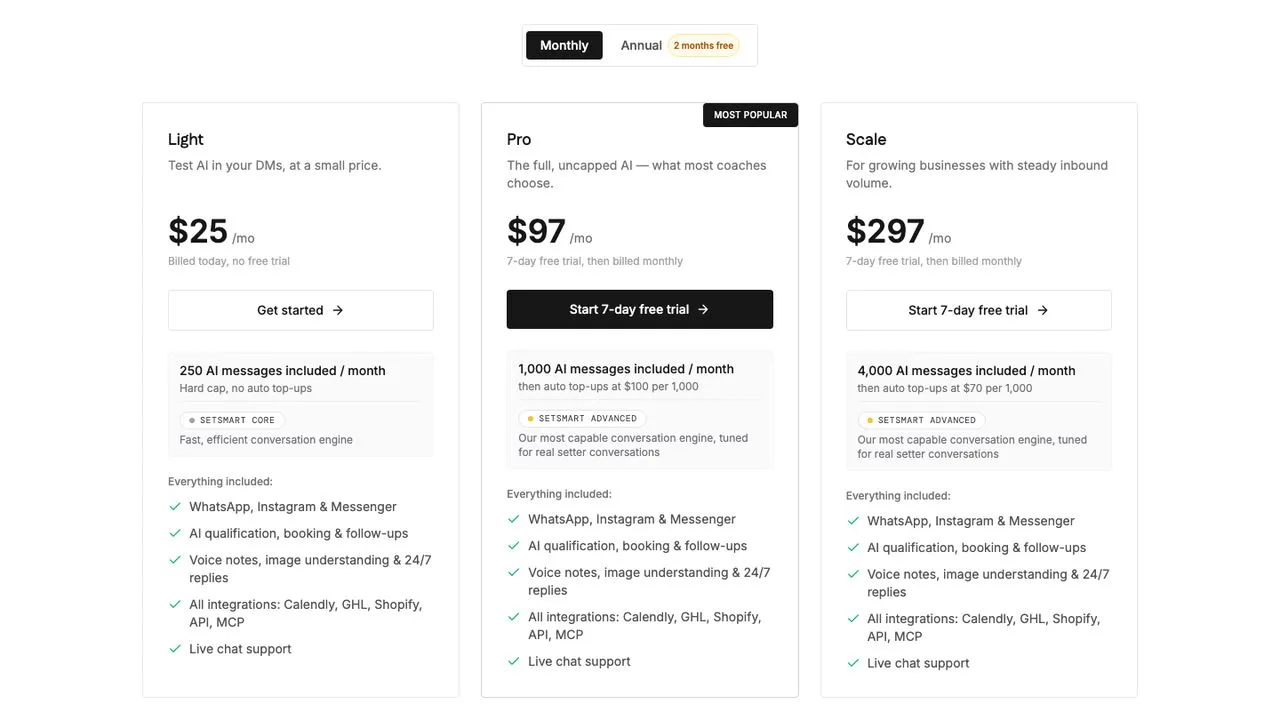
Each SetSmart plan card lists API and MCP among its integrations, from Light at $25.
SetSmart is an AI appointment setter that happens to have one of the widest agent surfaces here. Its MCP catalog runs to about 200 tools, including instagram_post_set_triggers and comment_reply_set_global_triggers. Each trigger carries its keywords, public comment replies and the private DM, so that is build access, on every plan.
The catch is the meter. You pay for AI messages, and Light caps at 250 with no top-up. Its REST API manages contacts and bookings but not triggers, so the MCP server is the route in.
Pros:
- MCP tools that set and delete comment and DM keyword triggers on every tier
- Covers WhatsApp and Messenger alongside Instagram
- Books calls into Calendly or GoHighLevel
Cons:
- Light caps at 250 AI messages with no top-up, a much smaller allowance than LinkDM’s DMs
- Trigger control lives in MCP only, not the REST API
- No publishing
Pricing: Light $25/mo, Pro $97/mo, Scale $297/mo, Enterprise $797/mo. Annual billing is ten times the monthly price.
Ideal for: Coaches and course sellers who close on a call and want an agent tuning the triggers.
Bottom line: Serious build access at a setter’s price, worth it only when a booked call beats a delivered link.
4. CommentKeyword: Best for developers who want a plain REST API
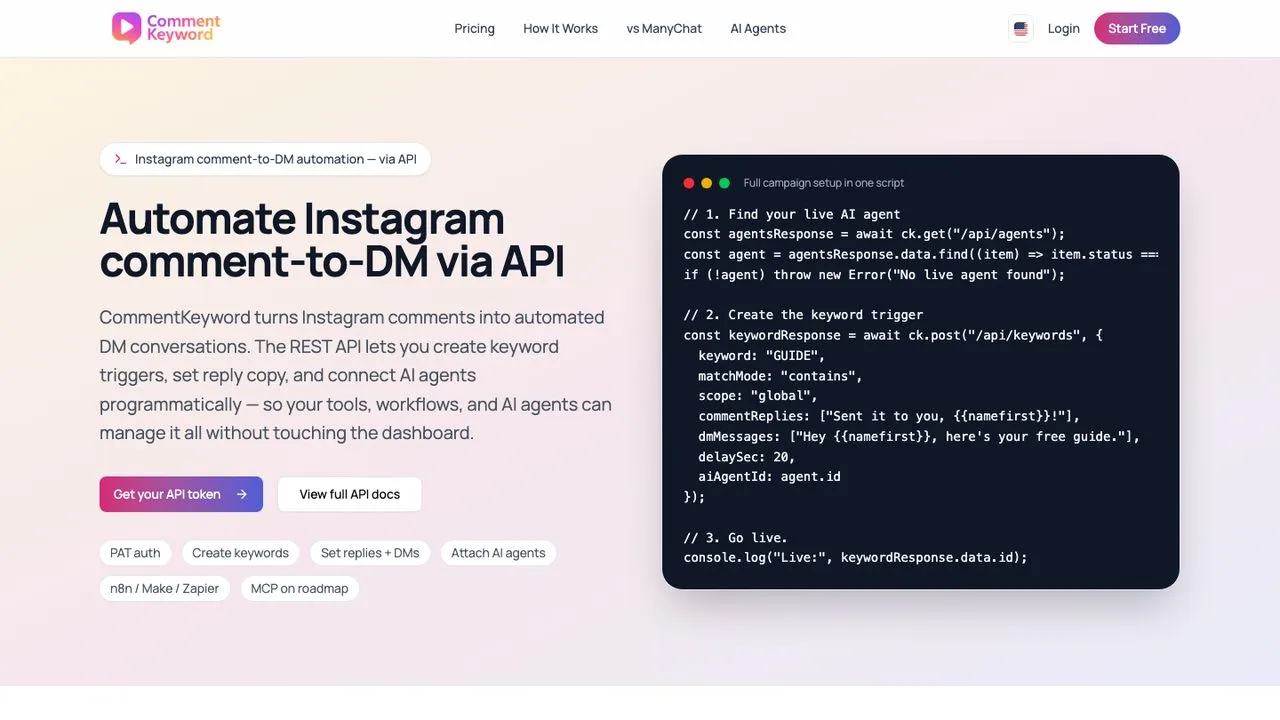
CommentKeyword publishes an OpenAPI spec for creating and editing keyword automations.
CommentKeyword publishes an OpenAPI spec with POST, PATCH and DELETE on /keywords, so an agent can create, change and remove keyword automations over plain REST. Each keyword carries its match mode, comment replies, DM copy and target posts.
It also meters the way LinkDM does, on automated DMs sent, with a per-DM overage instead of a hard stop. The trade is vendor maturity. The domain dates to mid-2025, there is no MCP server yet, and its own pages disagree on which plan includes the API.
Pros:
- Full create, update and delete on keyword automations over REST
- Metered on DMs sent, the same unit a LinkDM user already budgets in
- Paid plans bill overage from $0.005 down to $0.002 per DM instead of stopping
Cons:
- No MCP server, listed as on the roadmap
- The pricing table puts the API on Pro and up, while its API page says every plan
- Instagram only, from a vendor operating since 2025
Pricing: Free $0 (300 DMs), Starter $12/mo, Pro $29/mo, Growth $59/mo, Scale $99/mo.
Ideal for: Developers wiring comment-to-DM into their own code or agent tooling.
Bottom line: The cleanest REST build path on Instagram, if you can live with a young vendor.
5. ReplyRush: Best for high-volume senders on a budget
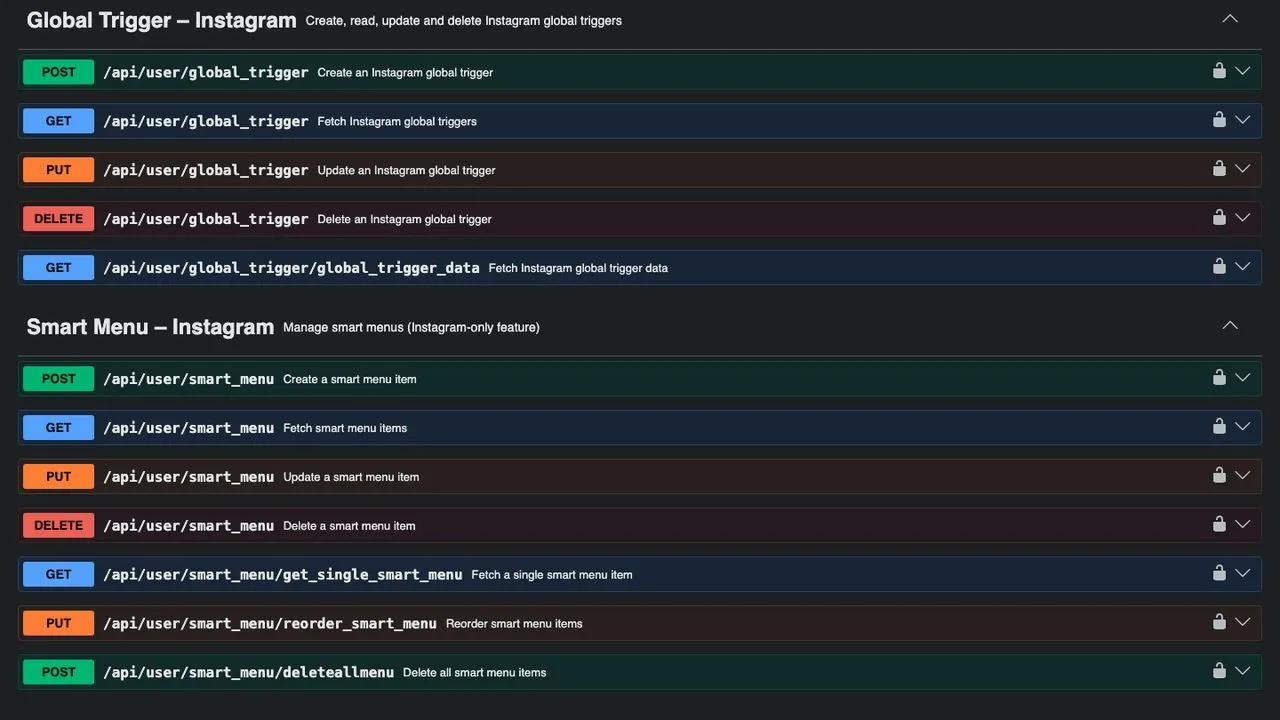
ReplyRush’s Swagger reference covers creating, updating and deleting keyword triggers.
ReplyRush is the closest like-for-like swap on the meter. It counts DMs sent, Lite starts at $10 for 7,500, and Boost at $25 buys 40,000 a month across three Instagram and three Facebook accounts.
The API is the surprise. Its marketing site never links to it, but the Swagger reference documents create, update and delete on Instagram and Facebook keyword triggers, each carrying its reply messages. Instagram triggers add a followers-only switch and email capture. API keys come with paid plans. Multi-step flows are the exception, since those attach by code after being built in the app, and it runs no MCP server for its automations.
Pros:
- Keyword trigger API for both Instagram and Facebook on paid plans
- 40,000 DMs a month for $25 on Boost
- Meta Business Partner, per its homepage
Cons:
- API docs are unlinked from the main site, and multi-step flows still get built in the app
- No MCP server for managing its automations
- The free plan switches off comment auto-reply
Pricing: Free $0 (1,500 DMs), Lite $10/mo, Boost $25/mo, MAX $100/mo.
Ideal for: Creators sending LinkDM-level volume who want an API without paying Enterprise prices.
Bottom line: LinkDM’s meter from a $10 entry plan, with build access for anyone willing to read Swagger.
6. BooSend: Best for unlimited DMs across Instagram, WhatsApp and Telegram
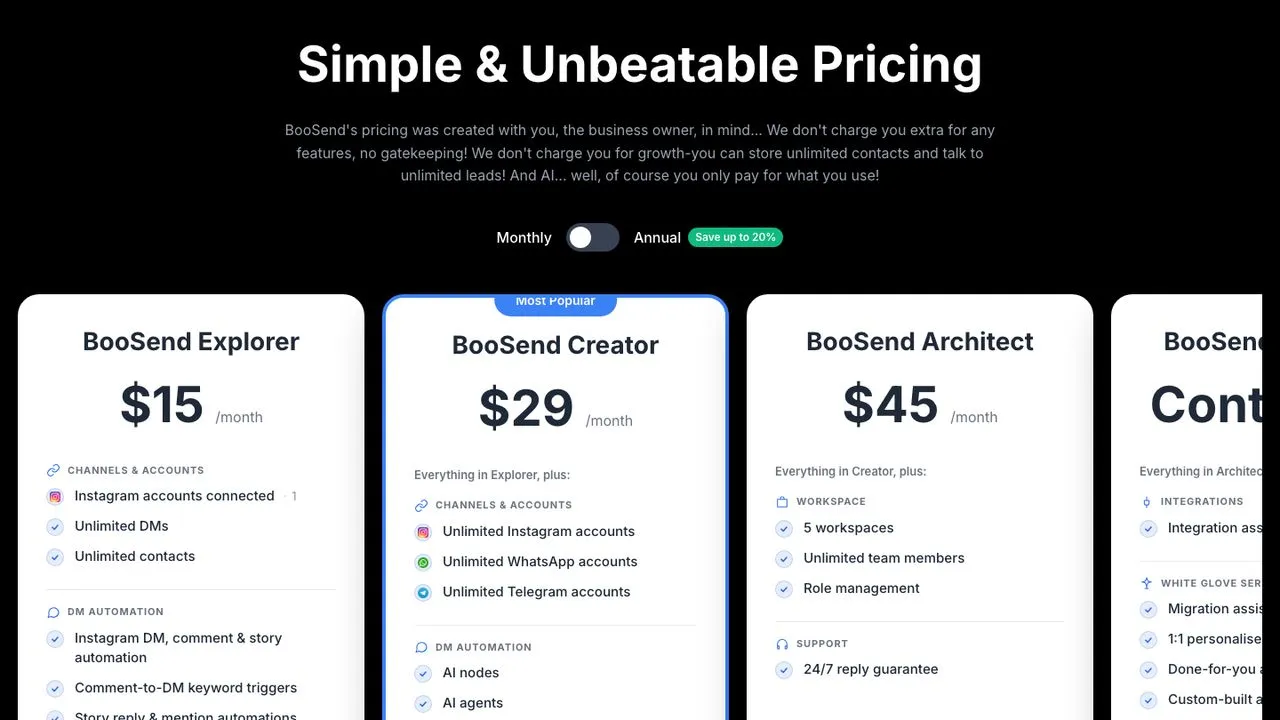
BooSend sells unlimited DMs and contacts on every plan from $15.
BooSend runs a live hosted MCP server that authenticates over OAuth with read and write scopes. Separately, its blog says you can build a new automation “by describing it in plain English” and turn automations on or off from Claude. I could not list the tools without an account, so treat build access as the vendor’s claim rather than something I confirmed.
The meter is the draw for a LinkDM user. Every plan includes unlimited DMs and contacts, so there is no cap to plan around.
Pros:
- Unlimited DMs and contacts from $15 a month
- Instagram, WhatsApp and Telegram on the Creator plan
- Live MCP server with write scope
Cons:
- Which plan includes MCP is not stated
- No free plan, only a 7-day trial
- The MCP endpoint moved in 2026, and older setup posts still show the old URL
Pricing: Explorer $15/mo, Creator $29/mo, Architect $45/mo. Annual billing runs $153, $261 and $351 a year.
Ideal for: Creators whose funnel reaches WhatsApp or Telegram and who hate counting DMs.
Bottom line: The most generous meter here, with an agent story that is promising but unconfirmed.
7. InstantDM: Best for creators who want an agent working the inbox
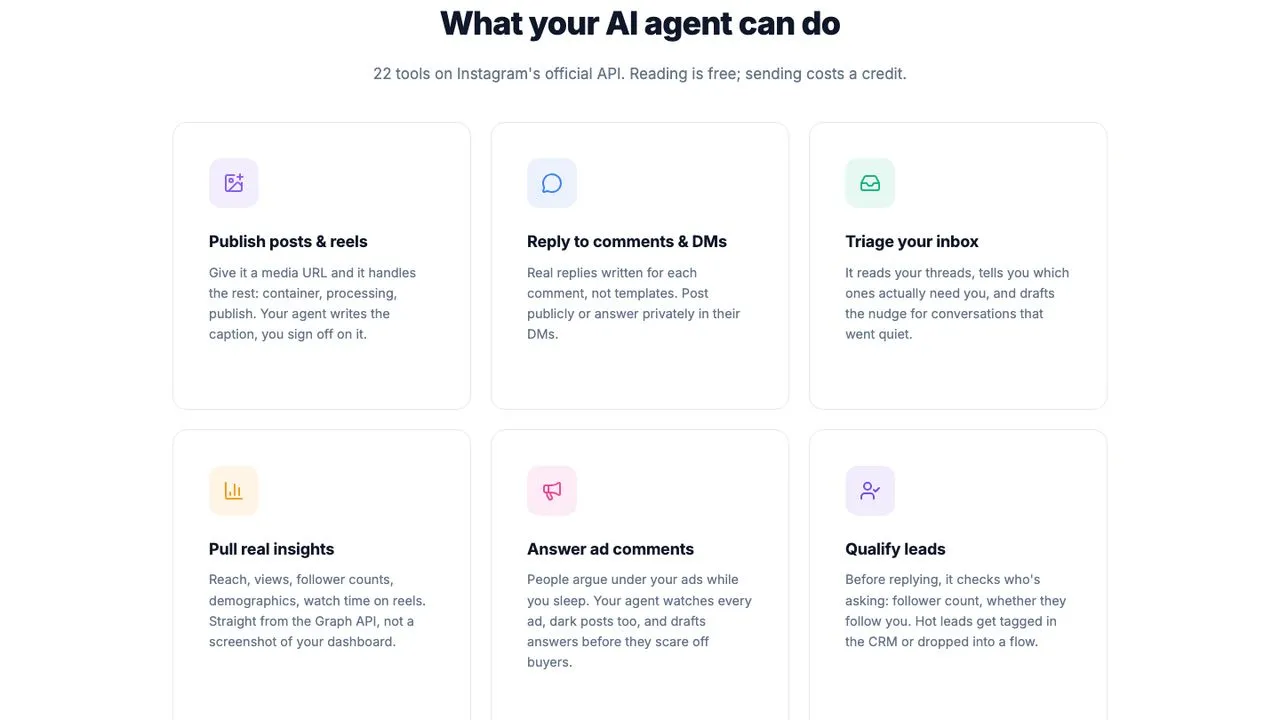
InstantDM’s MCP page says 22 tools, while its live server lists 23.
InstantDM has the more mature agent setup of the two trigger tools. Its live server lists 23 MCP tools, covering DMs, comments, Facebook messages and Instagram publishing. None of them creates or edits an automation, though. The closest are trigger_flow, which starts a pre-built flow, and disable_automation, which pauses everything.
So an agent can run the conversation, not the funnel. That still suits plenty of creators, and I priced every InstantDM plan and where the API starts separately.
Pros:
- 23 MCP tools, with a free trial that includes API access and no card
- Publishes to Instagram from the same server
- No per-contact billing on its main plans
Cons:
- No tool creates or edits an automation
- API and MCP start on Trendsetter at $29.99, not the $12 plan
- DMs cover Instagram and Facebook only
Pricing: Legend Pro $12/mo ($9.99 billed yearly), Trendsetter $29.99/mo ($24.99 billed yearly).
Ideal for: Creators who build flows in the dashboard and want Claude answering and posting.
Bottom line: A broad inbox and publishing tool surface that stops short of creating or editing flows.
8. ManyChat: Best for funnels that reach past Instagram and Facebook
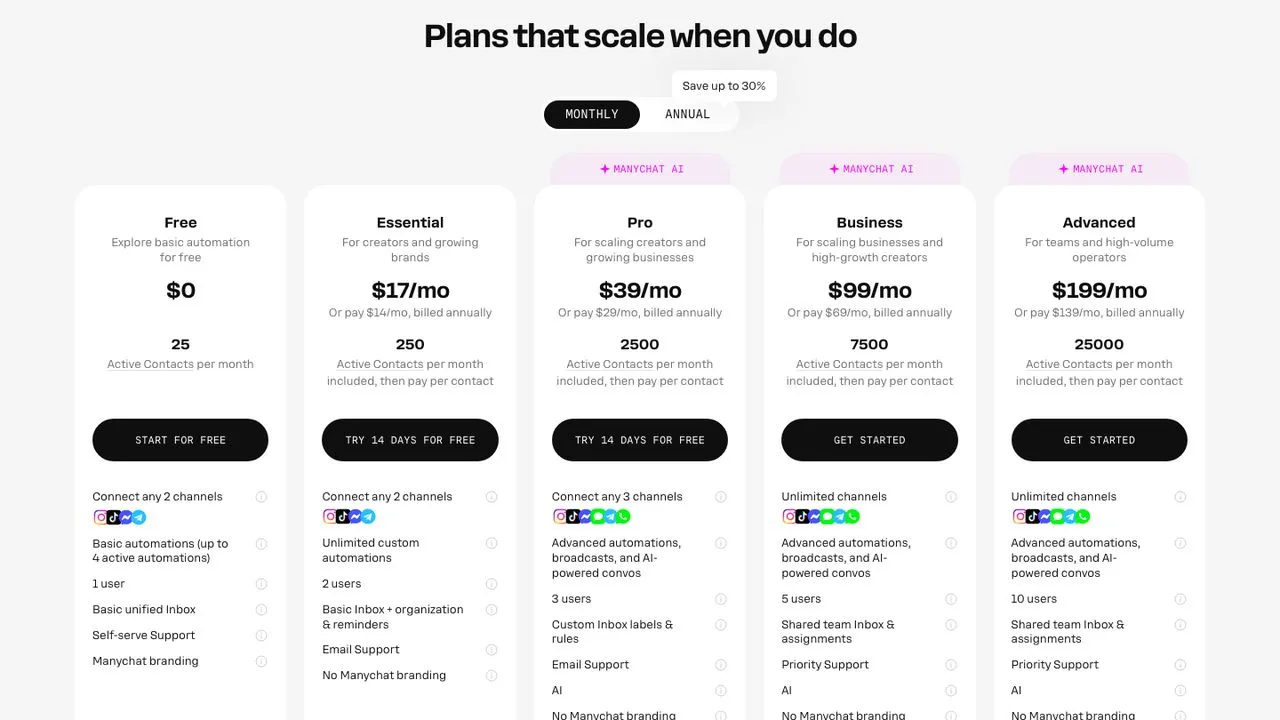
ManyChat’s monthly plans, from Essential at $17. The page opens on annual pricing.
ManyChat is the category incumbent, and for good reason. Its visual flow builder is the most established here, with branching and conditions, and it reaches Messenger, TikTok, Telegram, WhatsApp and SMS, where LinkDM stops at Instagram and Facebook.
For an agent it is trigger-level. The API starts on Pro, is labeled beta, and runs existing flows without writing new ones, and ManyChat documents no MCP server. It also bills on active contacts, which is the exact meter many LinkDM users chose to avoid. I compared the two meters head to head if that is your deciding question.
Pros:
- A mature visual flow builder with branching and conditions
- Reaches WhatsApp, SMS, TikTok and Telegram
- Comment-to-DM included on the free plan, up to four live automations
Cons:
- API triggers existing flows only and starts on Pro at $39
- No documented MCP server
- Active-contact billing grows with your audience
Pricing: Free $0 (25 contacts), Essential $17/mo, Pro $39/mo, Business $99/mo, Advanced $199/mo.
Ideal for: Teams whose funnel runs on WhatsApp, SMS or TikTok and who build flows by hand.
Bottom line: Strongest when people build the flows. An agent can list and trigger them on Pro, but creating or editing one is still a dashboard job.
How I Tested These LinkDM Alternatives
- Build access, checked at the source. I read each vendor’s API reference or OpenAPI spec for endpoints that create or edit an automation, instead of trusting a feature grid.
- Live MCP probes. I sent an initialize request to every documented MCP endpoint and ran a control against a made-up subdomain, since some of these domains answer on any subdomain at all.
- Month-to-month pricing. InstantDM and ManyChat both open their pricing pages on annual billing, so every price above is the monthly figure.
- Coverage of LinkDM’s own job. Comment-to-DM at volume, on Instagram and Facebook.
A tool made the list if it offers documented build or trigger access, or claims build access through a live MCP server. CreatorFlow, Kwikzy, FlowGent and ReplyFox were left off because none publishes an API that creates or edits comment-to-DM triggers, even though other roundups include them. Pricing and endpoints were verified on each vendor’s own site, and the switching reasons come from the eight competitor pages ranking for this search.
How to Choose the Right LinkDM Alternative
If your agent already publishes your content, Blotato puts the DM automations on the same key, as long as 1,000 active contacts a month on Starter covers your funnel.
If Instagram is the whole job and you want multi-step scenarios, Inrō builds full scenarios over its API and MCP, and the thing to price first is its contact-based meter in euros.
If you want LinkDM’s DMs-sent meter with an API attached, ReplyRush fits at $25 for 40,000 DMs when REST without MCP is enough. CommentKeyword fits on the same terms, once you confirm which plan includes its API.
If a booked call is the goal, SetSmart lets an agent write its triggers over MCP, though Light’s 250 AI messages will not stretch far.
If WhatsApp or SMS is part of the funnel, ManyChat covers the most channels, but you will build flows by hand and need Pro at $39 for WhatsApp, SMS or the API.
Final Recommendation
Plenty of people reading this should stay on LinkDM. It is cheap at volume, and five keywords that never change will run fine there for years.
The case for switching is the automation you keep editing. If an agent runs the rest of your social media, the DM layer should be something it can build and change too. Look first at the tools that let it build: Blotato, Inrō, SetSmart, CommentKeyword and ReplyRush. If that agent also publishes and a 1,000-contact month fits, Blotato’s Starter plan keeps posting and replies on one key.
LinkDM Alternatives FAQs
What is the best LinkDM alternative?
It depends on whether an agent needs to build the automations. Blotato fits when the same agent also publishes your posts, since it builds Instagram and Facebook DM automations over MCP on the key that publishes to 9 platforms, with one reply per automation rather than a sequence. If your funnel lives only on Instagram and runs multi-step scenarios, Inrō builds those over its API and MCP, priced on active contacts in euros.
Does LinkDM have an API?
Only on Enterprise. LinkDM’s pricing page lists “API Integration available” on its Enterprise plan, which has no public price and runs through a dedicated account manager. It publishes no developer documentation and no MCP server. Its other integrations send captured leads outward to Kit and Flodesk, so no self-serve plan lets an agent create or edit an automation.
Which Instagram DM automation tools can Claude build automations in?
Blotato and Inrō both let Claude create and edit automations over MCP, and SetSmart’s MCP tools set and delete keyword triggers along with the DM each one sends. CommentKeyword and ReplyRush offer keyword automation building through REST APIs, with no MCP server for their automations yet. BooSend claims automation building through MCP, which I could not verify without an account. InstantDM and ManyChat let an agent trigger flows, not build them.
What is the cheapest LinkDM alternative?
ReplyRush is the cheapest way onto a DMs-sent meter, with Lite at $10 for 7,500 DMs and Boost at $25 for 40,000, and its trigger API comes with any paid plan. CommentKeyword starts at $12 for 3,000 DMs. If you need no DM cap at all, BooSend’s $15 plan includes unlimited DMs on one Instagram account.
Is there a free LinkDM alternative?
Yes, with limits. ReplyRush’s free plan sends 1,500 DMs but switches comment auto-reply off. CommentKeyword gives 300 DMs and three keywords. Inrō covers 100 active contacts with the comment trigger included. ManyChat’s free plan is much smaller at 25 active contacts, though it runs up to four live comment-to-DM automations. Inrō’s free tier blocks the API and ReplyRush’s API is paid-only. CommentKeyword’s API page says every plan includes it while its pricing table starts it on Pro, so an agent builder should budget for a paid plan.