9 Best Manychat Alternatives for Instagram DM Automation
The best Manychat alternatives for Instagram in 2026, compared on what each bills you for: contacts, DMs sent, or a flat rate. Tested by Sabrina Ramonov.
If you are hunting for manychat alternatives in 2026, you probably did not go looking because the product broke. You went looking because your bill moved. On March 2, 2026, Manychat introduced contact-based billing for new accounts, and the free tier landed at 25 active contacts.
Nearly everyone searching this is running Instagram comment-to-DM, so that is the job I ranked these nine for, with Facebook noted where a tool covers it. Before you pick a replacement, ask the question most roundups skip: is this a second vendor, or a replacement for two? A DM tool is a separate subscription sitting alongside whatever already publishes your content. I ranked these on what each one bills you for, and I flag which ones add a line to your stack versus collapse one. Blotato is at number two and I founded it, so I have skin in that ranking, and I explain below exactly when it is the wrong choice.
Quick Comparison: 9 Best Manychat Alternatives for Instagram
| Tool | Starting Price | Free Tier | Agent Access (API / MCP) | Billed On |
|---|---|---|---|---|
| Manychat (for reference) | $17/mo | 25 active contacts | Read-and-trigger only, no MCP | Per active contact |
| InstantDM | $12/mo ($9.99 billed yearly) | 500/mo, unit varies by page | MCP server, 23 tools | Flat, no per-contact meter, paced per hour |
| Blotato | $29/mo | No (7-day trial, excludes API) | MCP server, 36 tools | Flat, per plan |
| LinkDM | $19/mo | 1,000 DMs/mo | Enterprise-only API, no MCP | Per DM sent |
| CreatorFlow | $15/mo | 500 DMs/mo | No documented API | Flat, any follower count |
| Inrō | €12.99/mo | 100 active contacts | MCP server | Per contact activated |
| Chatfuel | $20/mo | Not on the pricing page, docs list a comment-reply plan | No MCP | Plan fee returned as AI credit, usage on top |
| ReplyRush | $10/mo | 1,500 DMs, no comment auto-reply | No MCP | Per DM sent |
| SetSmart | $25/mo | No | API and MCP on every tier | Per AI message sent |
| Zernio | $0 (first 2 accounts) | First 2 accounts | MCP server | Per connected account |
Manychat sits in the table as the baseline you are comparing against. The last two columns are the ones worth reading together, because they answer different questions: what raises your bill as you grow, and whether anything other than you can build the automations.
Why People Are Looking for Manychat Alternatives
For most people the trigger is the March 2026 repricing. Manychat moved to billing on active contacts.
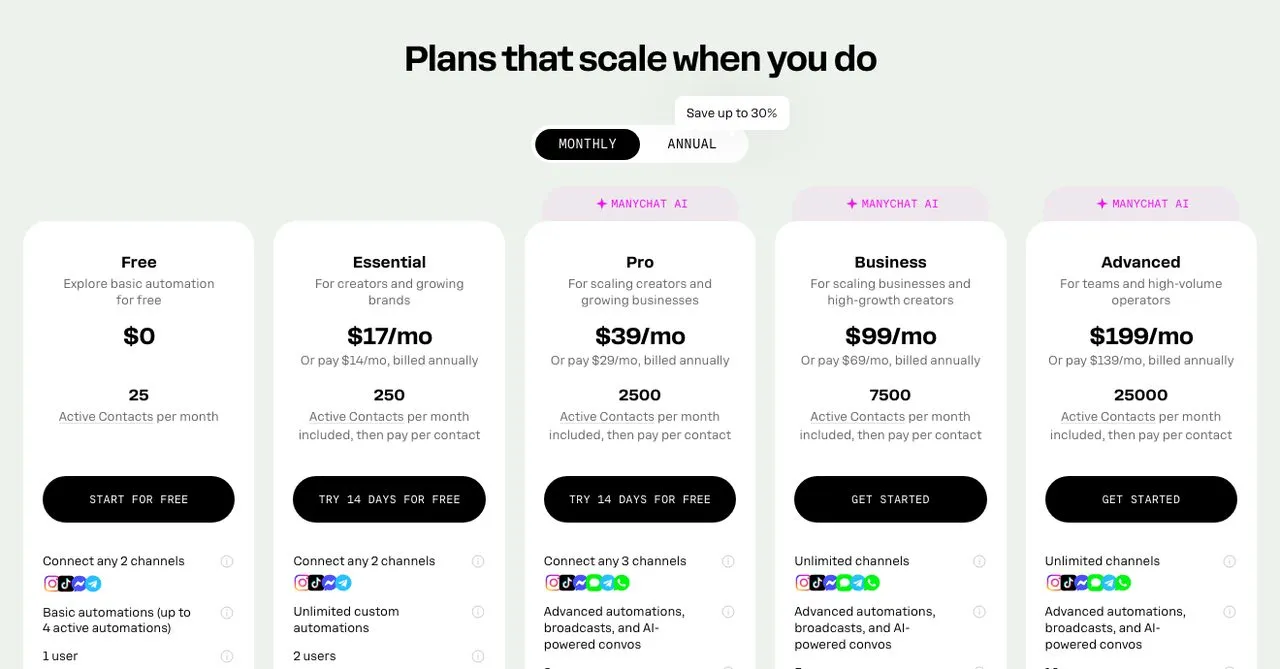
Manychat’s pricing page opens on annual billing. These are the month-to-month figures.
The ladder now runs Essential $17, Pro $39, Business $99, and Advanced $199 a month on month-to-month billing. Those tiers include 250, 2,500, 7,500, and 25,000 active contacts. Go past your allowance and you pay per contact, at $0.10 on Essential down to $0.004 on Advanced.
The number itself is not the complaint. The complaint is what counts as active. Reading through Manychat’s Trustpilot reviews, the sharpest one puts it plainly: a reviewer expected an active contact to mean someone reached through an automation they built, and found that organic conversations landing in the connected inbox counted too. Another describes a jump from $15 to $78 after thousands of contacts were imported from Meta Ads. When billing scales with your audience but the work you ask of the tool does not, growing hurts. Public sentiment reflects it, with a 2.1 out of 5 on Trustpilot that splits to the extremes rather than clustering in the middle.
That limit has a cost that compounds, and it is worth pricing before you compare monthly rates. Manychat gates its API to Pro and above, so reaching it costs $39 a month, and building each automation is still manual work in the editor. The cost lands at every offer change rather than only at setup: a launch that rewrites the destination behind a dozen keywords means opening those dozen flows, then opening them again to check.
Worth saying plainly: none of this makes Manychat a bad product, and if you want the full head-to-head I wrote a separate Blotato and Manychat comparison. The flow builder is the most mature in this category. It is an Official Meta Business Partner, it covers seven channels, and it has been at this since 2015. If your automations work and your contact count is stable, staying put is a perfectly rational choice.
What Switching Actually Costs You
Every roundup tells you which tool is cheaper. Few price the move itself, and that is the part worth knowing before you cancel anything. Your keywords and links live in a visual builder, and Manychat’s API does not create or update flows, so it documents no export that hands them to another tool in a usable shape. However you switch, you rebuild them.
So the question is what rebuilding costs. In this walkthrough I build a keyword automation in Blotato’s own editor, then build the same thing by describing it to Claude over MCP, then hand Claude a screenshot of the spreadsheet where I keep my keywords and links and let it create six at once.
The spreadsheet step is the one that matters when you are switching rather than starting, because a rebuild in a visual builder is one form per automation while the same list is a single table an agent works from. The rebuild is also not the last time you touch them. When a launch changes the offer behind every keyword, editing a row and asking the agent to apply it beats opening each flow, and you still read back what it changed before anything goes live.
One thing to get right while you are counting. A follow gate is Instagram only, so an Instagram-and-Facebook pair is two automations built two different ways rather than one flow duplicated, which means a replacement is costed in keyword-and-platform pairs rather than keywords. Gating in the right order is a separate decision from counting them.
One limit to price in, and it is ours rather than a competitor’s: per-post keyword targeting is built around posts published through Blotato. The web app’s picker lists only those, and for a reel you posted natively, an agent can attach a trigger only after that reel’s first comment arrives. Automations that fire on any post are unaffected, which is how most keyword funnels run anyway. If you want per-post triggers from the web app alone, your publishing has to move too.
Best Manychat Alternatives for 2026
I ranked these on what you actually get billed for, because that is the thing that sent you here. If you want the wider field rather than Manychat replacements, the Instagram DM automation tools roundup also covers the free Meta Business Suite and the scheduler SocialPilot. Tools that free you from a per-contact meter come first, tools that keep some version of one come later, and the two that reach well beyond Instagram land at the bottom on purpose. Blotato sits second with a contact allowance of its own, so it is here on the consolidation argument rather than on the meter.
1. InstantDM: Best for creators who want an AI agent running Instagram DMs
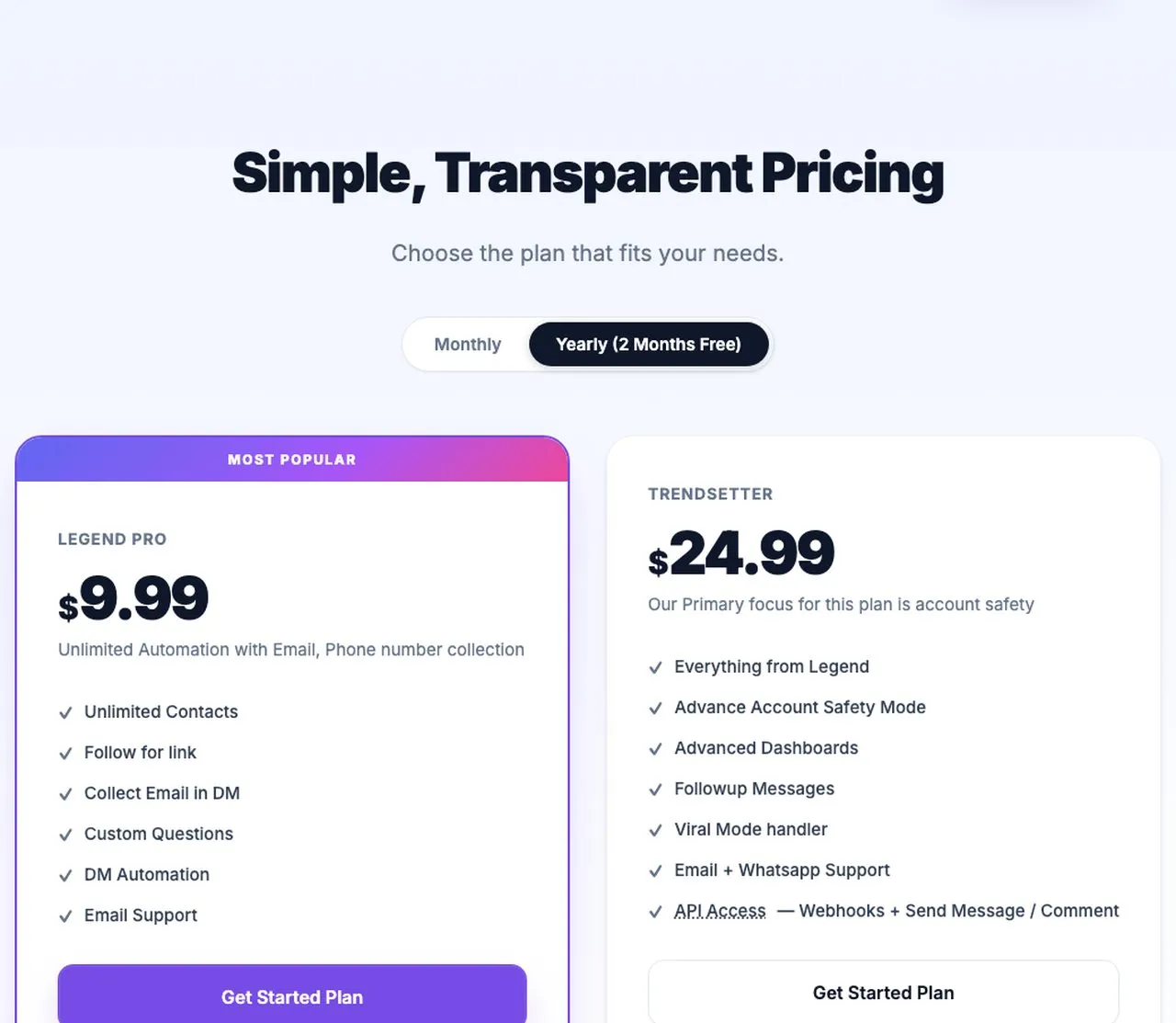
InstantDM’s pricing page opens on yearly billing, so Legend Pro shows $9.99 rather than its $12 monthly price.
InstantDM is the closest thing to a straight Manychat replacement if the contact meter is what sent you looking. Legend Pro is $12 a month, or $9.99 billed yearly, and it never bills per contact, though it paces sends by the hour (750 on its pricing page, 800 in its guide) and its own comparison table lists contact access on that plan as “Limited.” I price all six of its plans in what each InstantDM plan costs. It covers Instagram and Facebook, including posts, reels, stories, live comments, and ad comments.
What puts it first is that the agent path is real rather than announced. It runs a hosted MCP server at openapi.instantdm.com/mcp, and listing its tools on September 17, 2026 returned 23, covering DMs, comments, ad comments and Facebook Pages, plus create_post and publish_post. So it is not inbox-only: it publishes to Instagram as well, which is more than most of this list does. Every tool is also a plain REST endpoint, and it documents setup for Claude Code, Claude.ai and Codex. Inrō runs a live server too, so treat MCP itself as table stakes and pick on price and reach.
Pros:
- No per-contact meter from $12 a month ($9.99 billed yearly), so audience growth does not move the bill
- A hosted MCP server with 23 tools that publishes to Instagram as well as handling the inbox
- Free plan advertised at 500 a month, plus a 7-day trial with API and MCP access and no card
Cons:
- On the pricing page, API access starts on Trendsetter at $29.99 a month ($24.99 billed yearly), not on Legend Pro
- DMs cover Instagram and Facebook, and publishing covers Instagram only
- A smaller company than Manychat, with a shorter track record
Pricing: Legend Pro $12/mo ($9.99 billed yearly), Trendsetter $29.99/mo ($24.99 billed yearly). Free plan advertised at 500 a month.
Ideal for: Creators and coaches who want Claude to run their Instagram DMs and who are done paying per contact.
Bottom line: If Instagram and Facebook DMs are the whole job and you want an agent driving them, this is the cheapest way out of contact-based billing on this list.
2. Blotato: Best for running DM replies and publishing behind one key
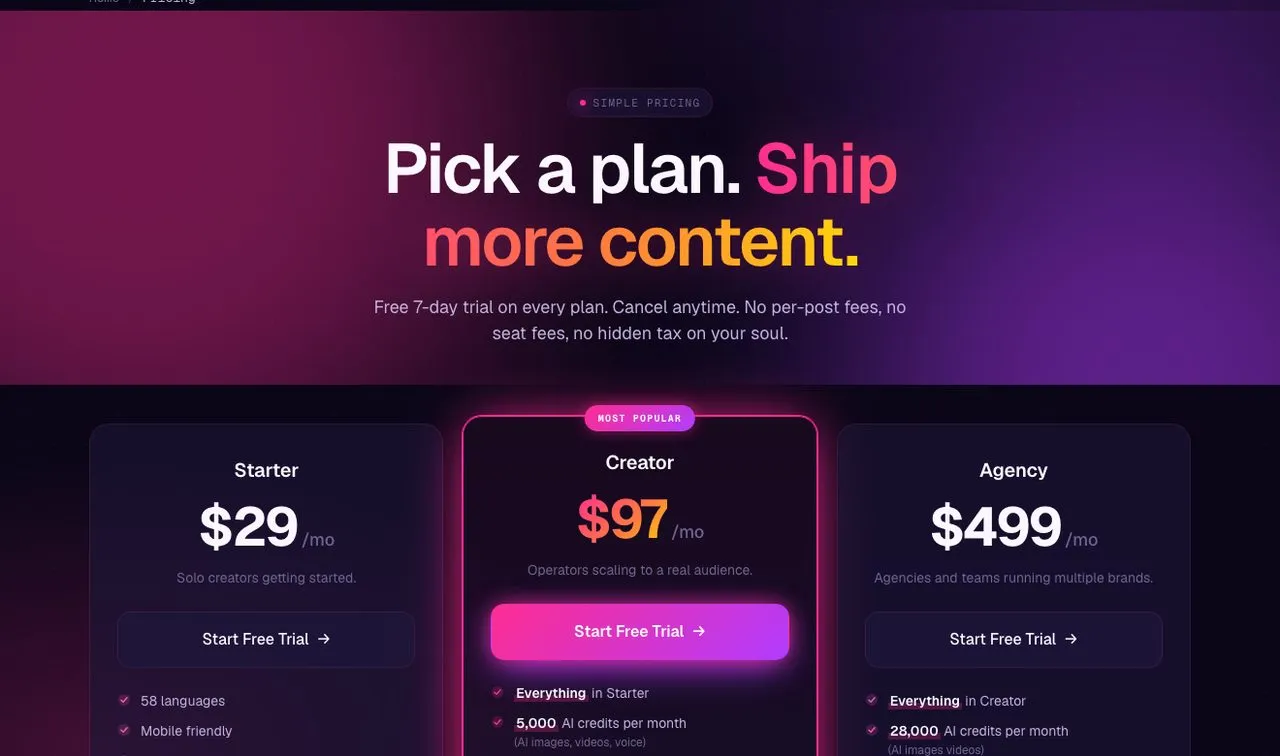
Blotato runs $29 a month for Starter with 1,000 active contacts included.
I founded Blotato, so judge this entry on the math rather than on my say-so. Blotato is the pick only if you also publish and want one key for both jobs, and if DM automation is the entire job then a dedicated DM tool is cheaper and more focused than this one. That is the only time I will say it.
Most tools here sit alongside whatever publishes your content, and the one that does publish, InstantDM, stops at Instagram. Blotato’s publishing half covers 9 platforms. DM automation shipped on August 6, 2026 behind the same API key that publishes, reads comments and returns analytics, so your agent can fire a keyword reply and schedule the post that generated those DMs on one key and one bill.
Eight of the 36 DM automation tools handle the reply side, and you build the flow from Claude rather than a visual builder. Because they are API calls, an agent can edit them in bulk, which is what matters before a launch when twenty automations need to point at a new offer. Calvin Hia let Codex build 46 flows that returned 3,000 leads in a month.
Pros:
- Handles DM replies plus social media publishing to 9 platforms behind one key, where the DM-first tools here reach Meta at most
- No per-contact overage inside a tier, so 1,000 active contacts on Starter cost the same whether you have 2,000 followers or 200,000
- 36 MCP tools and a REST API on every paid plan, no separate developer tier
Cons:
- More expensive than InstantDM, LinkDM, or CreatorFlow if DM automation is all you need
- DM automation covers Instagram and Facebook Pages only, reply-only, inside Meta’s 7-day comment and 24-hour DM windows
- The 7-day trial excludes API access, so an API reader should plan on the paid Starter plan instead
Pricing: Starter $29/mo with 1,000 active contacts, Creator $97/mo with 6,000, Agency $499/mo with 15,000.
Ideal for: Operators already running social media through an AI agent who want DM replies on the same key as publishing.
Bottom line: The consolidation play, not the budget play. Worth it when it removes a vendor, not when it just adds a DM tool.
3. LinkDM: Best for Instagram creators sending high DM volume
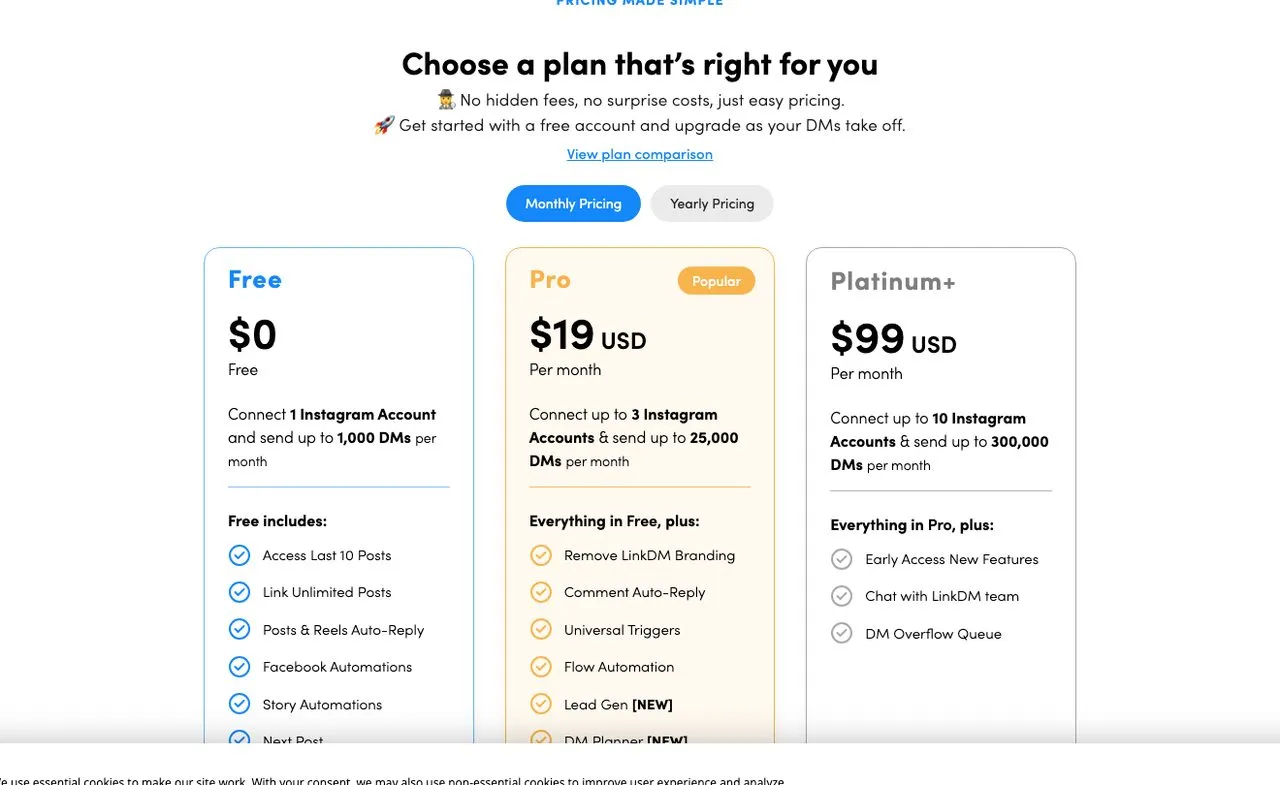
LinkDM meters on DMs sent per month rather than on contacts stored.
LinkDM bills on DMs sent and connected accounts, which is the cleanest answer to contact-based pricing on this list. Pro is $19 a month for 25,000 DMs across 3 Instagram accounts. The free tier gives you 1,000 DMs on one account with no card. Past that cap it sells non-expiring DM credit packs that its pricing page never shows, which I break down in LinkDM pricing.
It has been a Meta Business Partner since 2021 and leans heavily toward creators and affiliate marketers, with brands like Delta and Fandango on its customer wall. The meter matches the work: if you send more, you pay more, and a follower who never messages you costs nothing. Because the two tools count different units, the published price comparisons between them do not hold up, which I work through in Manychat vs LinkDM.
Pros:
- DM-based metering means a growing audience does not inflate the bill
- Generous free tier at 1,000 DMs a month with no credit card
- Handles stories, reels, live comments, and sponsored-post comments
Cons:
- Developer API is Enterprise-only, so there is no self-serve programmatic access. I ranked the LinkDM alternatives an agent can build in separately
- Instagram and Facebook only
- The $99 Platinum jump is steep if you outgrow 25,000 DMs
Pricing: Free $0, Pro $19/mo, Platinum+ $99/mo.
Ideal for: Creators running comment-to-DM funnels at volume who want the bill tied to sends.
Bottom line: The best pure swap if you liked what Manychat did and simply want a meter that does not punish audience growth.
4. CreatorFlow: Best for solo creators who want a predictable flat rate
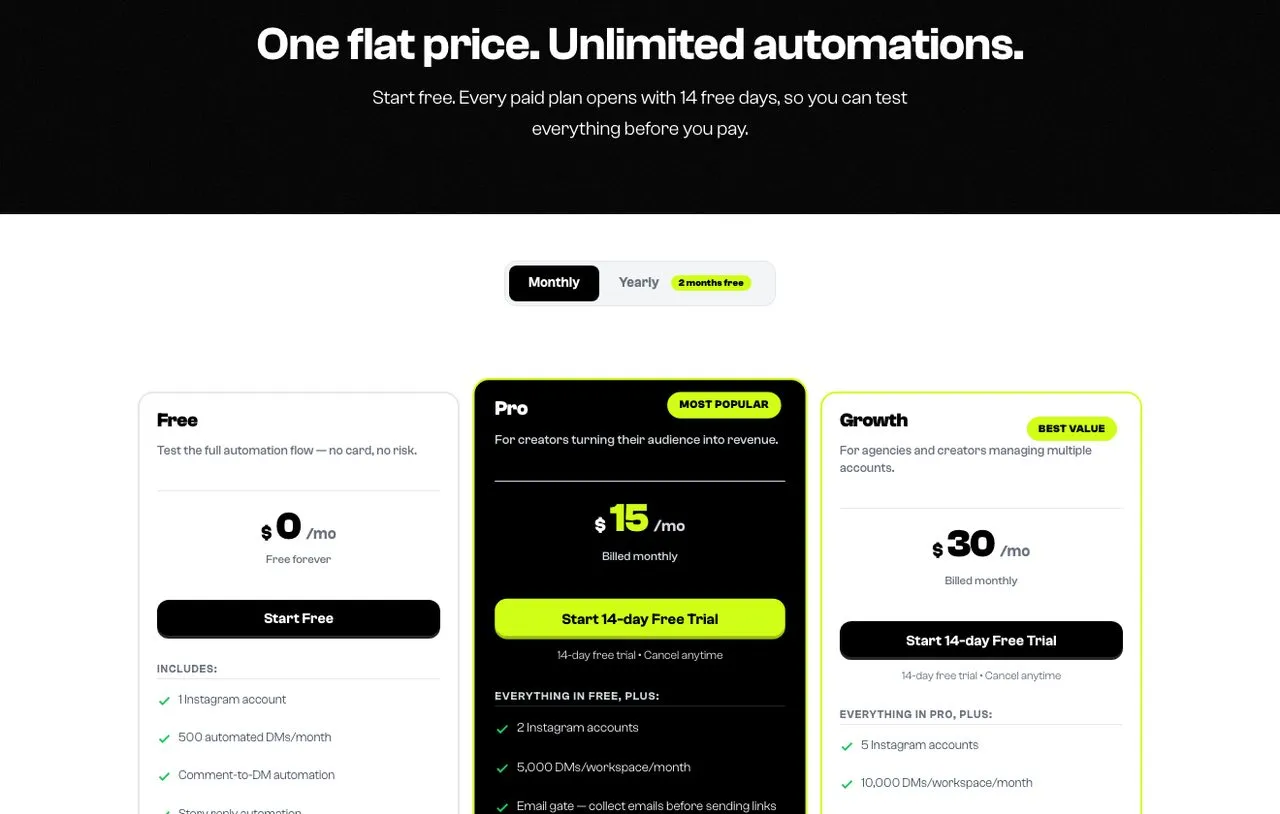
CreatorFlow charges $15 a month on month-to-month billing with no per-contact fees.
CreatorFlow makes the flat-rate promise the loudest, and its own FAQ states it directly: pricing stays the same whether you have 500 followers or 500,000. Pro is $15 a month for 5,000 DMs across 2 Instagram accounts, and there is a free tier at 500 DMs.
It is a Meta Tech Provider built for small businesses rather than enterprise teams, with a real ecommerce bent through Shopify and WooCommerce. DM top-up packs never expire, which is a nice touch if your volume is spiky.
Pros:
- Flat pricing with an explicit no-per-contact-fee guarantee
- Free forever tier, plus a 14-day trial on paid plans
- Top-up DM packs that do not expire
Cons:
- Instagram only, with no Facebook support at all
- No public developer API that I could find documented
- The 14-day trial requires a payment method up front
Pricing: Free $0, Pro $15/mo, Growth $30/mo.
Ideal for: Solo creators on Instagram who want one predictable number on the card each month.
Bottom line: The simplest flat-rate escape from contact billing, as long as Instagram is the whole job.
5. Inrō: Best for coaches selling in the DMs
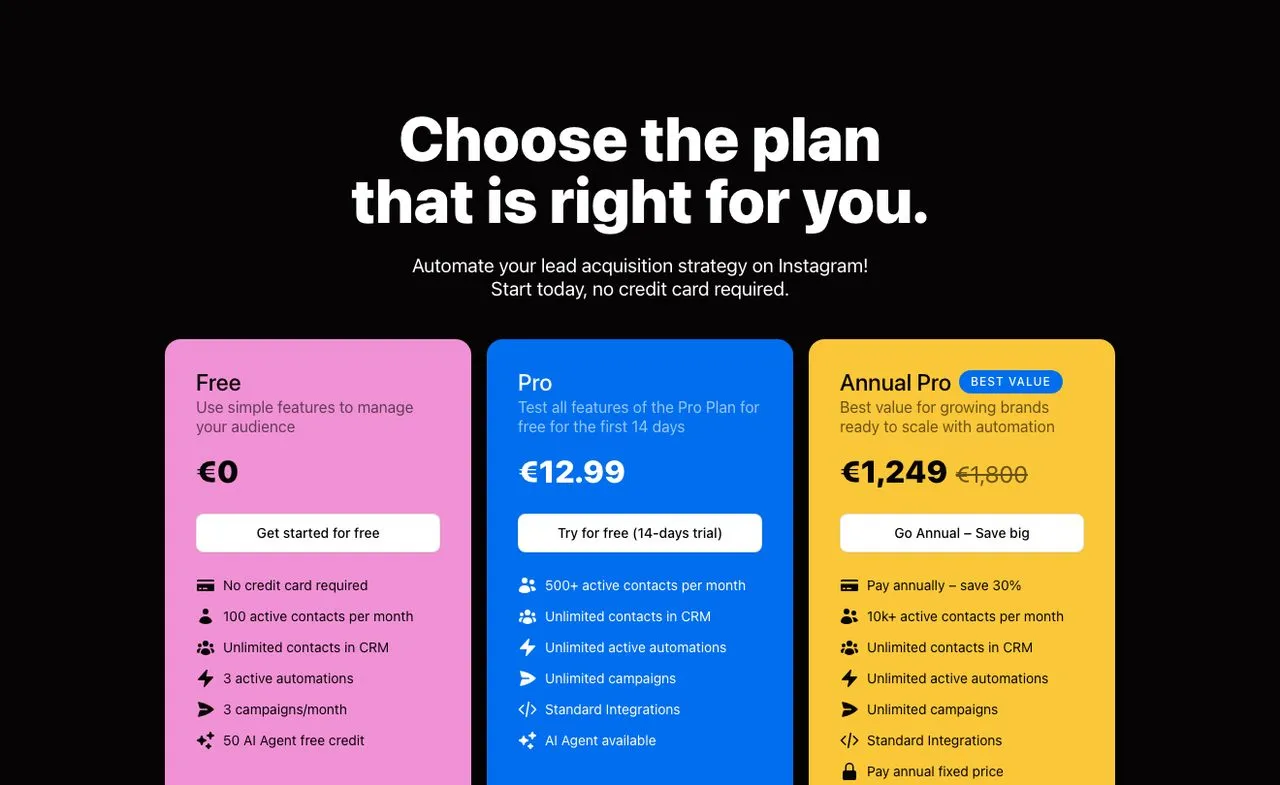
Inrō bills only for contacts activated during the month rather than the full list.
Inrō also bills on active contacts, so it does not escape Manychat’s model outright. It softens it in a way that matters though: you pay only for contacts you activate that month, and old inactive contacts stop costing you. Pro starts at €12.99 a month, priced in euros, and the free plan covers 100 active contacts.
Its real differentiator is the conversational AI agent, which qualifies leads, recommends products, and books calls inside the DM. It has the strongest sales-agent story of the Instagram-only tools here, and it serves an unusual spread of verticals including clinics.
Pros:
- Active-contact billing that drops dormant contacts from the bill
- The most capable conversational sales agent among the creator tools
- Free tier plus a 14-day Pro trial, and payments can happen in the DM
Cons:
- Still contact-based pricing, which is the model you may be leaving
- Instagram only
- Priced in euros, so your cost moves with the exchange rate
Pricing: Free €0, Pro from €12.99/mo, Managed Account custom.
Ideal for: Coaches and experts who close deals in the DMs and want an AI agent doing qualification.
Bottom line: Choose it for the sales agent, not to escape contact pricing, because it keeps that model.
6. Chatfuel: Best for ecommerce teams running WhatsApp
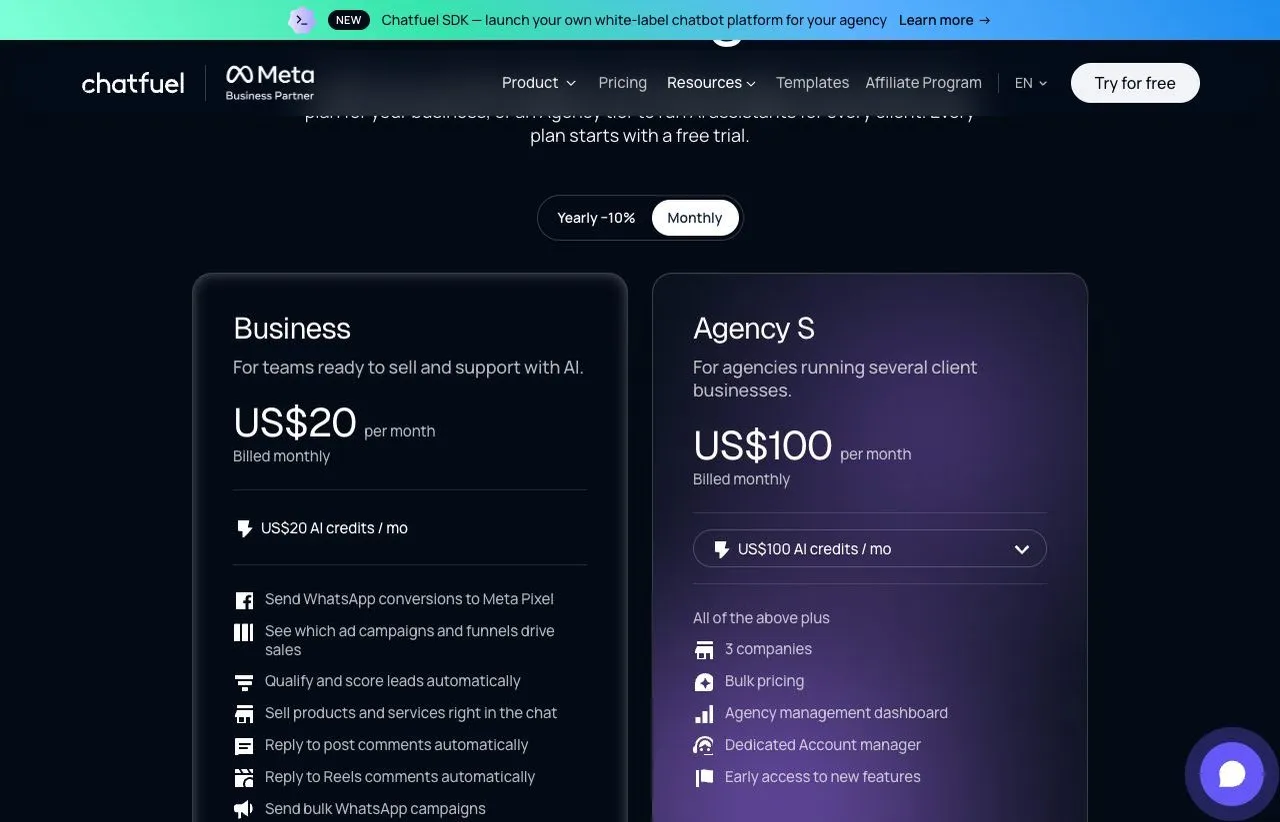
Chatfuel’s pricing page on monthly billing, with Business at $20 and Agency S at $100, each returned as AI credit.
Chatfuel is the one tool named on every competing roundup I checked, and it is the natural pick when WhatsApp is central. It is an Official Meta Partner and a WhatsApp Business Solution Provider, covering Instagram, Facebook, WhatsApp, TikTok and a website widget with official API access.
Watch the billing toggle. The page opens on yearly billing, so the $18 you see first is the yearly rate. Business is $20 a month billed monthly and Agency S is $100, and each fee comes back as AI credit that replies and WhatsApp fees draw down. The pricing page shows no free plan, only a 7-day trial, though the help center lists one limited to comment replies. The two tools meter completely different things, which I broke down in Manychat vs Chatfuel, and I price its credit wallet from 500 to 25,000 replies in this Chatfuel cost breakdown.
Pros:
- Official WhatsApp Business API through a Meta Partner
- Says it serves 150,000-plus businesses, so it is well established
- A WhatsApp-capable plan at $20 a month, with unlimited contacts
Cons:
- AI replies draw down the plan’s credit, and at a zero balance the bot stops unless auto-top-up refills it
- No free plan on the pricing page, only a 7-day trial
- Five channels, against Manychat’s seven
Pricing: Business $20/mo, or $18/mo billed yearly. Agency S $100/mo, or $90/mo yearly, with larger agency tiers up to $2,050/mo. Each fee returns as AI credit. 7-day free trial.
Ideal for: Ecommerce and agency teams whose customers live on WhatsApp.
Bottom line: If WhatsApp is where your customers already are, this is the strongest official route on this list. For a comment-to-DM funnel, each AI-written DM costs well under a cent on a short setup, so the included $20 covers a few thousand DMs before any top-up.
7. ReplyRush: Best for creators who want comment-to-DM metered on volume
ReplyRush is the pick if you want comment-to-DM on Instagram and Facebook without a contact meter, though only from the $10 Lite plan up, because the free tier switches comment auto-reply off. That is the catch worth knowing before you sign up for a plan marketed on being free.
What it does have is the meter most people leaving Manychat are looking for. ReplyRush counts DMs sent per month rather than contacts held, so an audience that grows does not raise your bill on its own. Lite is $10 for 7,500 DMs on one Instagram and one Facebook account, Boost is $25 for 40,000 DMs across three of each, and MAX is $100 for 400,000 DMs across five of each. It is a certified Meta Business Partner, which matters on a category where unofficial automation gets accounts restricted.
Pros:
- Metered on DMs sent, so audience growth alone does not move the invoice
- Meta Business Partner certification, plus follow-gated DMs and an email collector
- Story, Reel and post triggers, with an iOS app for managing conversations
Cons:
- The free plan excludes comment auto-reply, which is the feature most people come for. Meta’s own free Instagram auto reply options cover some of that gap
- Instagram and Facebook only, no WhatsApp and no publishing
- App branding stays on sent DMs until the $25 Boost plan
Pricing: Free $0 (1,500 DMs, no comment auto-reply), Lite $10/mo, Boost $25/mo, MAX $100/mo.
Ideal for: Creators running comment-to-DM funnels who want volume pricing instead of a contact meter.
Bottom line: The closest thing here to a like-for-like Manychat swap on the DM side, as long as you budget for Lite rather than the free tier.
8. SetSmart: Best for coaches booking calls out of the DMs
Where the other tools on this list send a link, SetSmart holds the conversation. It is an AI appointment setter: the agent replies in the DMs, qualifies the lead against your criteria, and books the sales call on your calendar. Choose it if your offer closes on a call and the bottleneck is qualifying people before that call, because if you only need a link delivered after a keyword, it is heavily overbuilt for the job and the cheaper DM tools do it better.
The meter is AI messages sent, not contacts. Light is $25 for 250 messages on a hard cap with no top-up, Pro is $97 for 1,000, Scale is $297 for 4,000, and Enterprise is $797 for 15,000, with overage top-ups from $40 to $100 per additional 1,000 depending on tier. It covers Instagram, WhatsApp and Messenger, and integrates with Calendly, GoHighLevel and Shopify.
Pros:
- Qualifies leads conversationally instead of firing one scripted reply
- Books directly into Calendly or GoHighLevel, closing the loop to a booked call
- WhatsApp and Messenger alongside Instagram
Cons:
- The most expensive entry per conversation on this list
- Light’s 250 messages are a hard cap with no top-up available
- Built around coaching and course offers, so a general ecommerce funnel is a poor fit
Pricing: Light $25/mo, Pro $97/mo, Scale $297/mo, Enterprise $797/mo.
Ideal for: Coaches and course sellers whose revenue depends on getting qualified people onto a call.
Bottom line: A setter, not a link-sender. Priced accordingly, and worth it only when a booked call is worth far more than the message that produced it.
9. Zernio: Best for teams whose inbox lives outside Meta
Zernio earns its place on channel reach: if your conversations happen anywhere beyond Instagram and Facebook, it reads and sends DMs on Instagram, Facebook, X, WhatsApp, Bluesky, Reddit, Telegram and Slack, and no other tool here comes close to that spread. If Instagram is genuinely the whole job, that reach is range you will pay to carry and not use.
Its billing shape is also the most unusual on this list. There are no plans. You pay per connected social account per month, the first 2 are free, then $6 each for accounts 3 to 10, $3 each for 11 to 100, and $1 each beyond that, with every feature included on every account. Messages you send are metered separately, with the first 10,000 a month free and $1 per 10,000 after. Ten accounts works out to $48 a month.
Pros:
- DMs on 8 platforms, plus comments and reviews on 9 including Google Business
- Every feature included on every account, with no plan gating
- Genuinely free at two accounts, no credit card
Cons:
- Per-account billing adds up for an agency holding many client accounts, even at the discounted tail rate
- Two meters to track, accounts and messages sent
- Broad rather than deep on comment-to-DM funnels specifically
Pricing: First 2 accounts free, then $6/mo each (3-10), $3/mo each (11-100), $1/mo each (101+).
Ideal for: Teams fielding conversations across more networks than Meta’s two.
Bottom line: The widest inbox here. Priced by how many accounts you connect, and the per-account rate falls as you add them, from $4.80 each at ten accounts to $3.18 at a hundred.
How I Chose These Manychat Alternatives
- What the meter counts. Contacts, DMs sent, conversations, or flat. This is the variable that pushed most readers to look, so it drove the ranking order.
- Month-to-month price, not the annual teaser. Four of these pricing pages default to an annual toggle. Every figure above is the month-to-month number.
- Whether an agent can drive it. I checked for a real hosted MCP server and a documented REST API, and I tested the endpoints rather than trusting a subdomain. The same test is how I ranked social media MCP servers more broadly.
- Honest channel coverage. Several of these are Instagram-only, which is fine if you are Instagram-only and a dealbreaker otherwise.
- Whether it is actually a replacement. Support platforms solve a different job, so they are labeled as such instead of padding the list.
Pricing was verified live on each tool’s own pricing page on the day this published, with the monthly toggle selected. Manychat’s review sentiment comes from reading individual Trustpilot reviews rather than a third-party summary. MCP claims were tested against the live endpoints, including a control check to rule out wildcard subdomains that resolve but serve nothing.
How to Choose the Right Manychat Alternative
If your bill jumped and a DM funnel is the whole job, take InstantDM from $12 a month with no per-contact meter, or LinkDM at $19 if you would rather meter on DMs sent.
If you want one predictable number and Instagram is the whole job, CreatorFlow at $15 flat is the simplest answer.
If you sell inside the DMs and want an AI agent qualifying leads, Inrō’s conversational agent is the strongest of the creator tools, provided you accept contact-based billing.
If WhatsApp is where your customers are, Chatfuel is the safest Meta-partner route, at $20 a month with $20 of wallet credit included.
If something already publishes your content, compare the two-vendor total against Blotato at $29, which puts DM replies behind the key you are already using. That is the comparison that decides this for most people, and the full head-to-head runs the numbers.
If your conversations happen outside Instagram and Facebook, Zernio reads and sends DMs on eight platforms and bills per connected account, which is free at two accounts and $318 a month at a hundred.
If a booked call is the goal rather than a delivered link, SetSmart at $25 qualifies the lead and books it, though you are overpaying if a keyword and a URL would have done.
Sabrina’s Final Thoughts
Most people leaving Manychat in 2026 are leaving because the meter changed, not because the product got worse. So pick on the meter first. If a per-contact bill is what pushed you out, no contact meter at InstantDM, DMs sent at LinkDM, or a flat rate at CreatorFlow each end per-contact billing for under $20 a month. LinkPlease does the same with flat paid plans per Instagram account, and LinkPlease checked against Manychat plan by plan shows where those flat plans stop.
Then count the subscriptions you are running to operate one account, because a cheap DM tool sitting next to a publishing tool is still two bills. That is the comparison most people do in their own favor, and it is the one worth doing properly before you pick anything above.
Manychat Alternatives FAQs
Does Manychat have an API for creating DM automations?
Not for creating them. Manychat’s API covers Pro plans and above, is still labeled beta, and treats flows as read-and-trigger: getFlows lists the flows you already built and sendFlow fires one. Its published endpoints include nothing that creates, updates or deletes a flow or a keyword trigger, and Manychat documents no MCP server in its help center or API reference. The practical consequence is that the automations get built by hand in the visual editor however much of the rest of your stack runs on agents, and that the work repeats every time an offer changes. Five tools on this list run hosted MCP servers, so an agent can at least reach them, but reaching a tool and building inside it are different things, and the endpoint list is what tells you which you are getting.
What is the cheapest Manychat alternative?
If DM automation is the only job you need done, InstantDM is the cheapest capable option at $12 a month, or $9.99 billed yearly, with no per-contact meter, followed by CreatorFlow at $15 and Inrō from €12.99. That comparison changes if you also pay for a publishing tool, because Blotato covers DM replies and posting to 9 platforms on one $29 plan, which is usually cheaper than two subscriptions. Free tiers exist at InstantDM, CreatorFlow, LinkDM and Zernio, and ReplyRush runs one too, though its free plan turns comment auto-reply off.
Why did Manychat get more expensive in 2026?
Manychat introduced contact-based billing on March 2, 2026, starting with accounts created on or after that date and opening it to older accounts country by country, and the free tier now includes 25 active contacts. Paid plans run $17, $39, $99, and $199 a month on month-to-month billing, including 250 to 25,000 active contacts, with per-contact overage beyond that. The common complaint is that organic conversations arriving in the connected inbox can count as active contacts, so bills rise with audience size rather than with usage. The full plan-by-plan cost breakdown runs the overage math at each volume level.
Which Manychat alternatives work with AI agents like Claude?
Five of them do, and MCP is now common enough in this category that it is not a reason to pick one. InstantDM runs a hosted MCP server with 23 tools, which answered a live handshake on September 17, 2026, and publishes setup steps for Claude Code and Claude.ai. Inrō runs one too, auth-gated at api.inro.social/mcp. Blotato exposes 36 MCP tools at mcp.blotato.com/mcp, of which 8 cover DM automations while the rest handle publishing to 9 platforms, comments, and analytics, so an agent can run the whole account rather than just the inbox. Zernio runs a live server at mcp.zernio.com/mcp, and SetSmart lists API and MCP access on every tier including $25 Light. Manychat has a REST API on Pro and above, still labeled beta, and documents no MCP server in its help center or API reference. The thing worth comparing is not whether a server exists but what sits behind it: a DM-only surface, or publishing and analytics on the same key.
Do I need a separate tool for DM automation and publishing?
Usually yes, and that is the hidden cost of replacing Manychat. Manychat and most DM-first tools on this list reply to comments and messages without publishing a post to a feed, so people end up paying for a DM tool plus whatever schedules their content. Two entries here do both: InstantDM exposes create_post and publish_post on its MCP server for Instagram, and Blotato runs DM automation behind the same key that publishes to 9 platforms. So the real question is how many platforms your publishing half has to reach, and if Instagram is your whole publishing stack then the cheaper tool wins that comparison.
Is there a free Manychat alternative?
Yes, if you are testing a DM funnel rather than running a business on it. LinkDM offers 1,000 DMs a month free on one Instagram account, InstantDM advertises 500 a month, and CreatorFlow gives 500 DMs, all without a credit card. Zernio is free on your first two connected accounts, and ReplyRush has a free plan worth reading twice, since it caps at 1,500 DMs and switches comment auto-reply off. All of them beat Manychat’s current 25 active contacts. None of those free tiers includes publishing beyond Meta, so unless Instagram and Facebook are your whole stack, a free DM tool still leaves you paying for whatever posts your content.
Can I export my Manychat flows to another tool?
Not into another tool. Manychat’s API lists flows with getFlows and fires one with sendFlow, and it has no endpoint that creates or updates a flow, so it publishes no export that recreates your automations on another platform. Cloning and templates move flows between Manychat accounts rather than out of Manychat. Whichever alternative you pick, you rebuild there, which is why the migration is worth scoping before you compare monthly prices. The practical prep is a list of what each automation does: the keyword, the destination link, the platform, and the message copy and gates you want to keep. Recording that yourself is what makes the rebuild quick, because the flow itself does not travel.
Can I run Manychat and Blotato on the same Instagram account while I switch?
Yes, for a short changeover, as long as every keyword and conversation has one tool answering it. Comments first: Meta allows one private reply per comment, so if both tools catch a keyword, the second fails. Move one keyword at a time, switching its Manychat trigger off before the Blotato version goes live. That order matters because Blotato only targets posts it published, so elsewhere it listens for the keyword across every post and reel. DMs need one owner too. Manychat’s setup makes it the default app in Meta’s conversation routing settings, which decide which app answers messages, and Meta lets only the default app message an idle conversation. Until you make Blotato the default and turn off Take control of conversations for Manychat, Blotato can only send the private reply to a comment, so leave out follow gates, email gates and message triggers. Move those together with the routing change, because Manychat flows lose that access when it flips. Blotato’s DM automation guide walks through those settings.