6 Best Post for Me Alternatives for Social Media APIs (2026)
The best Post for Me alternatives in 2026, compared on OAuth branding, engagement endpoints, and social media API scope. Tested by Sabrina Ramonov.
Nobody goes looking for Post for Me alternatives because of the price. Ten dollars a month for a thousand posts across nine platforms is hard to argue with, and Post for Me publishes its entire server on GitHub, which almost nobody else in this category does.
Two things send people looking anyway, and both show up after you have already built something. The first is the moment your agent publishes and a reply lands underneath it, because there is no endpoint to read that reply and none to answer it. The second is quieter: on the cheap setup path, your users see Post for Me’s logo on the consent screen when they connect their accounts, and your app inherits the permissions Post for Me was approved for.
Neither is a flaw. They are the shape of a $10 posting API, and the tools below trade against that shape in different directions. Blotato is my company and it sits at number one, so discount that entry as much as you like and judge the list on the endpoint columns instead. If you want the plans side by side, you can check the tiers yourself in a couple of minutes.
Quick Comparison: 6 Best Post for Me Alternatives
| Tool | Best For | Starting Price | Key Strength |
|---|---|---|---|
| Blotato | Builders whose agent needs to write the post, not just deliver it | $29/mo | Content generation and publishing behind one hosted MCP endpoint |
| Ayrshare | Platforms embedding social posting for many end customers | $149/mo | Comments, DMs, and ads endpoints across 14 networks |
| Zernio | Developers who want to start free and pay per connected account | Free, then $6/account/mo | Two accounts free with full API access, no feature gating |
| Upload-Post | Teams posting to destinations beyond the big nine networks | Free, then $24/mo | 22 destinations including Mastodon, Discord, and WordPress |
| Bundle.social | Products that treat comment volume as a core feature | Free, then $100/mo | Comments metered as a first-class quota alongside posts |
| PostPeer | Agencies connecting many accounts on modest posting volume | Free, then $25/mo | Unlimited connected accounts on every tier, including free |
Why People Are Looking for Post for Me Alternatives
The first reason is scope. Post for Me’s documented API covers media upload, social accounts, social posts, post results, and webhooks. That is publishing, scheduling, feeds, and post metrics, with no comments or messaging endpoints in the reference.
If your agent’s job ends at publish, none of that matters. If you wanted the agent to answer the comment it just earned, you are wiring a second vendor.
The second reason is quieter and it catches people late. Post for Me offers two ways to connect accounts. Quickstart uses their platform credentials, which is why you can skip the developer approval queue at TikTok and Instagram. The tradeoff is written plainly in their own documentation: your users “will see the ‘Post for Me’ brand and logo requesting permission to access their account,” and those connections “will be subject the permissions that our app has been approved for.” So you inherit somebody else’s scope ceiling and somebody else’s name on your OAuth screen.
The escape hatch is White Label mode with your own credentials, and it is a real option. But as the same page puts it, “your app must go through the approval and verification processes mandated by each specific social network.” That is the platform review gauntlet, which is the exact pain the product was bought to remove. Every tool below handles that tension differently, and it is worth knowing which one matches how you plan to ship.
Best Post for Me Alternatives for 2026
I ranked these on what the API actually returns, not on marketing pages. Pricing came off each vendor’s live pricing page this week.
1. Blotato: Best for builders whose agent needs to write the post, not just deliver it

Blotato’s homepage: one API and MCP surface covering nine platforms.
Full disclosure, Blotato is mine, so read this entry with that in mind. It sits at number one because it starts a step earlier in the pipeline than Post for Me does: the caption, the image, and the faceless video get generated first, then published through the same key. For an agent builder that replaces an LLM provider, a media pipeline, and a posting API with one endpoint at mcp.blotato.com/mcp.
The engagement surface is narrower than Ayrshare’s and you should know that before you build. Analytics covers every platform except LinkedIn, and comments and direct messages cover Instagram and Facebook.
The real argument is breadth behind one key. Generation, publishing to nine platforms, scheduling, and the Instagram and Facebook engagement surface all sit behind a single credential, where the honest alternative is several vendors and several approval processes.
Pros:
- AI writing, image generation, and faceless video generation included, not a separate vendor
- Hosted MCP endpoint, no local process to keep running
- Flat pricing that does not scale with post volume or connected accounts
- Native n8n and Make nodes alongside the REST API
Cons:
- Comments and DMs cover Instagram and Facebook, so engagement beyond those two needs another tool
- Nine platforms, fewer than Upload-Post’s 22 or Ayrshare’s 13
- The 7-day trial excludes API access, and generating a key ends the trial and starts paid Starter, so plan on subscribing rather than trialing
Pricing: Starter $29/mo (20 accounts, 1,250 AI credits), Creator $97/mo (40 accounts, 5,000 credits), Agency $499/mo (28,000 credits).
Ideal for: Builders running social through Claude or another agent who want the content created and published from one key.
Bottom line: Pick this when the blank page is the actual problem and delivery is just the last step.
2. Ayrshare: Best for platforms embedding social posting for many end customers
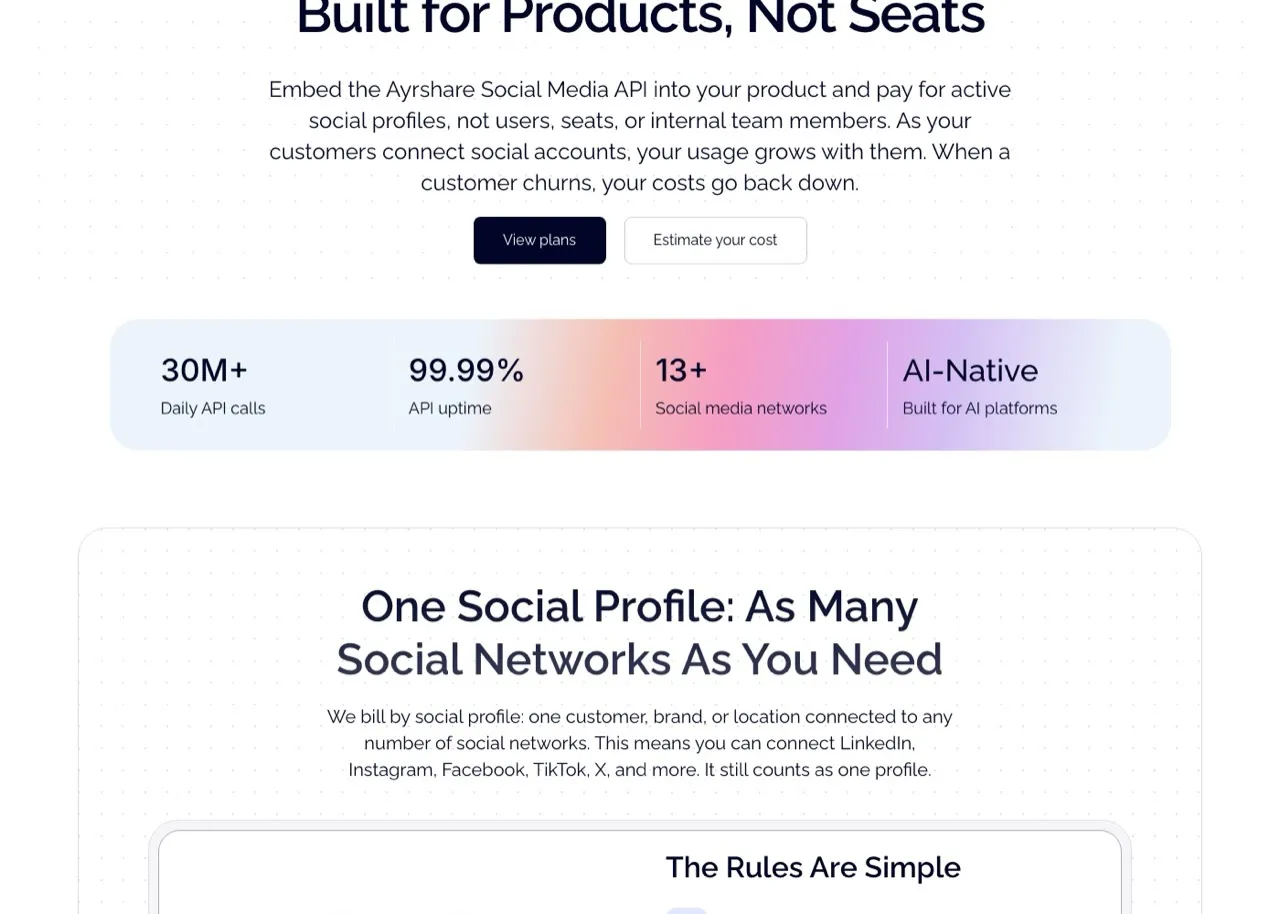
Ayrshare bills by active social profile rather than by seat, aimed at products embedding posting for their own customers.
Ayrshare is the benchmark most roundups measure against, and it earns that with the widest endpoint surface here. Comments, direct messages, and analytics sit behind one key across 14 networks, including Reddit, Telegram, Snapchat, and Google Business Profile that Post for Me does not reach. If the gap you hit was the missing engagement layer, this is the most complete answer available.
The cost is the entry price and the billing model. Premium starts at $149/mo billed per active social profile, so the bill tracks your customer count rather than your usage, and I ran that arithmetic in the Ayrshare alternatives roundup. Tools that bill per brand rather than per profile hit a different wall, which I worked through in the Postproxy alternatives comparison.
Pros:
- Comments API across 9 networks and a messaging API across 5
- 14 networks, the broadest mainstream coverage in this list
- Long operating history with maintained Node.js and Python SDKs
- 28-day free trial without a card
Cons:
- Entry tier is roughly fifteen times Post for Me’s price
- Per-profile billing scales directly with your customer count
- AI features and ads boosting are paid add-ons rather than included
Pricing: Premium $149/mo, Launch $299/mo, Business from $599/mo with per-profile tiering above the included profiles, Enterprise custom.
Ideal for: SaaS products embedding social posting for many isolated client profiles who need engagement endpoints.
Bottom line: Ayrshare is the most complete API in the category, but it is priced per active profile, so it only pencils out for products with revenue already behind them.
3. Zernio: Best for developers who want to start free and pay per connected account
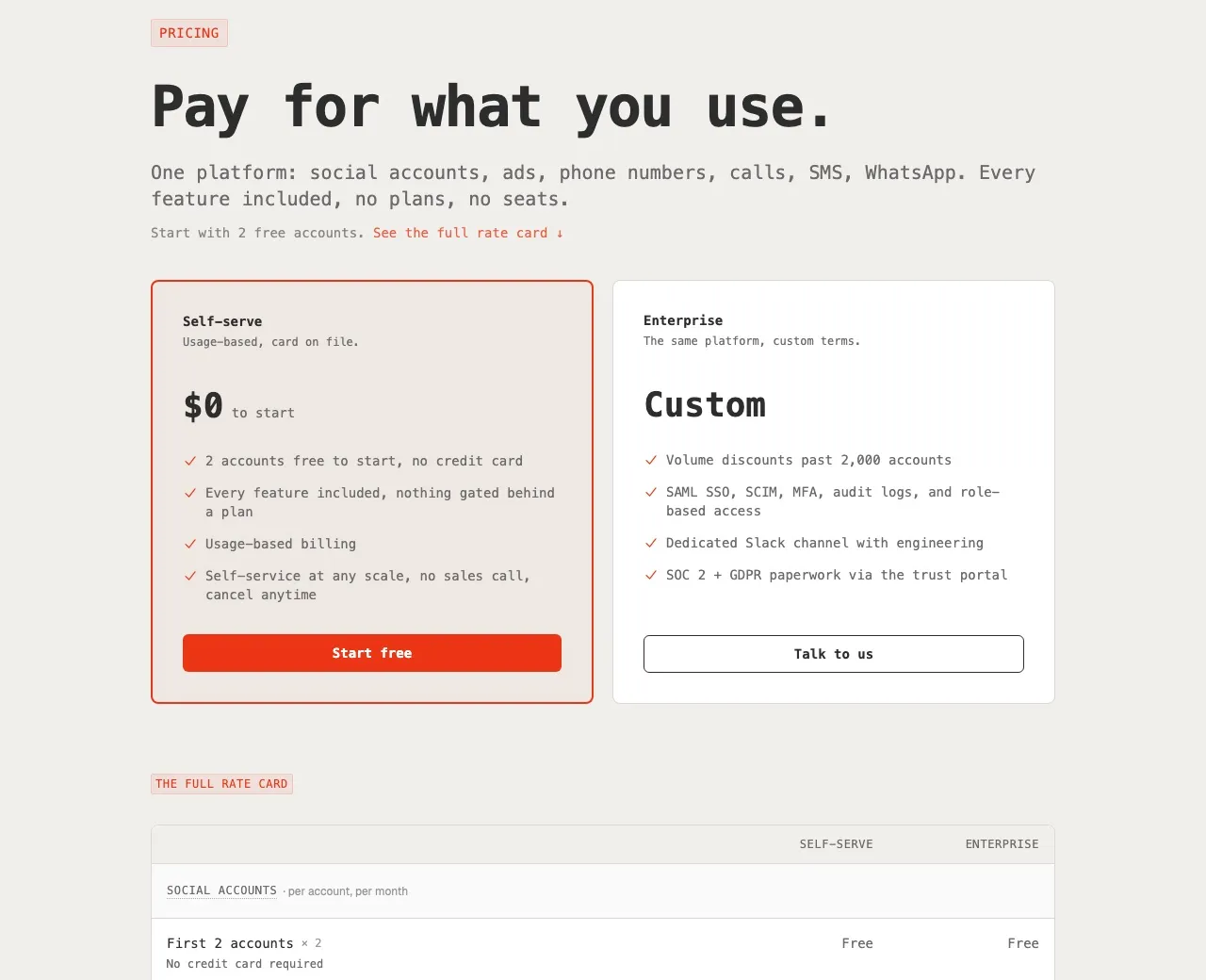
Zernio’s rate card: the first two accounts are free, then rates step down as you add more.
Zernio (formerly Late, at getlate.dev, which now redirects here) is the only tool here with a genuine free entry point that includes full API access. The first two accounts cost nothing with no card and no feature gating, then accounts three through ten run $6/mo each, eleven through one hundred drop to $3, and past that it is $1. A unified inbox spanning Instagram, Facebook, WhatsApp, X, Bluesky, Reddit, and Telegram closes the engagement gap too.
Watch the arithmetic. Paying per account rather than per post means Zernio undercuts Post for Me while you are small and passes its flat $10 at the fourth account.
Pros:
- Two accounts genuinely free with full API and MCP access
- Unified inbox covering comments and conversations
- 15 networks including WhatsApp, Telegram, and Google Business
- Hosted MCP endpoint at
mcp.zernio.com/mcp
Cons:
- Per-account billing passes Post for Me’s flat rate at four accounts
- Built-in AI content generation is not documented
- Usage-based billing makes the monthly bill harder to forecast
Pricing: Free for the first 2 accounts, then $6/account/mo for accounts 3-10, $3 for 11-100, and $1 for 101 and up.
Ideal for: Developers validating an agent workflow who want to start at zero and only pay as accounts prove out.
Bottom line: The cheapest way to start, as long as you model the account curve before you scale. For a CLI-first option that meters posts rather than accounts, SocialClaw and its alternatives cover that shape.
4. Upload-Post: Best for teams posting to destinations beyond the big nine networks
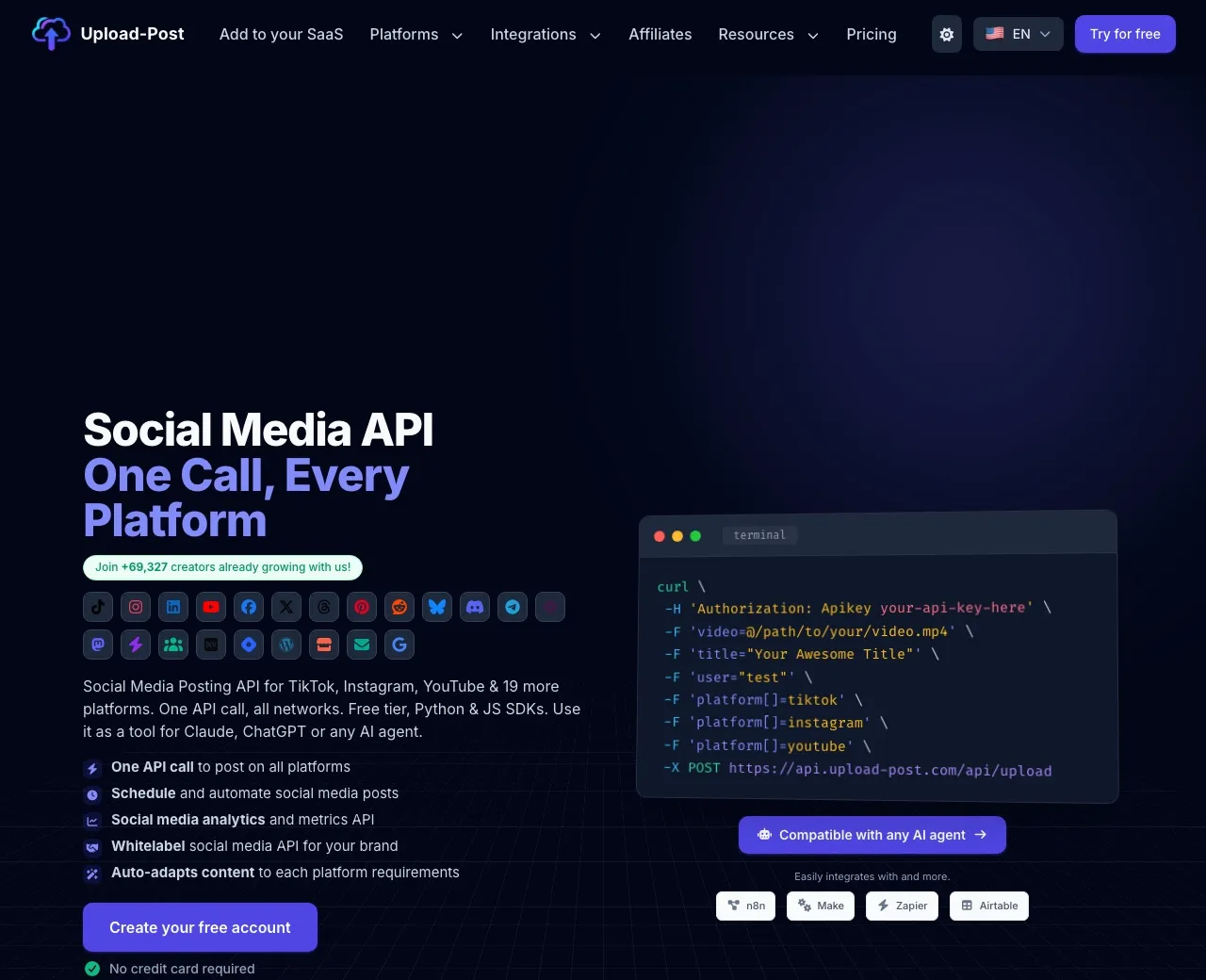
Upload-Post’s homepage: one API call, 22 destinations, with a curl example and a free tier.
If you are leaving because Post for Me’s nine platforms did not include the one you needed, Upload-Post is the direct fix. It reaches 22 destinations, and the long tail is the interesting part: Mastodon, Discord, Telegram, Slack, WordPress, Dev.to, and Hashnode sit alongside the usual networks. Its MIT-licensed MCP server exposes 50 tools spanning publishing, scheduling, analytics, comments, and DMs.
Pricing is tiered by profile count rather than post volume, which flips the math. The free tier covers two profiles and 10 uploads a month. Paid tiers unlock unlimited uploads but cap profiles at 5, 25, 75, and 225.
Pros:
- 22 destinations, the widest coverage here
- Real free tier with no card required
- MIT-licensed MCP server with 50 tools including comments and DMs
- Unlimited uploads on every paid tier
Cons:
- Profile caps mean agencies climb tiers quickly
- Only the MCP server is open source, not the core API
- Free tier excludes TikTok
Pricing: Free (2 profiles, 10 uploads/mo), Basic $24/mo, Professional $50/mo, Advanced $147/mo, Business $438/mo.
Ideal for: Teams whose publishing targets include developer blogs, Discord, or Mastodon rather than only the mainstream networks.
Bottom line: The right move when platform coverage, not scope, is what pushed you off Post for Me.
5. Bundle.social: Best for products that treat comment volume as a core feature
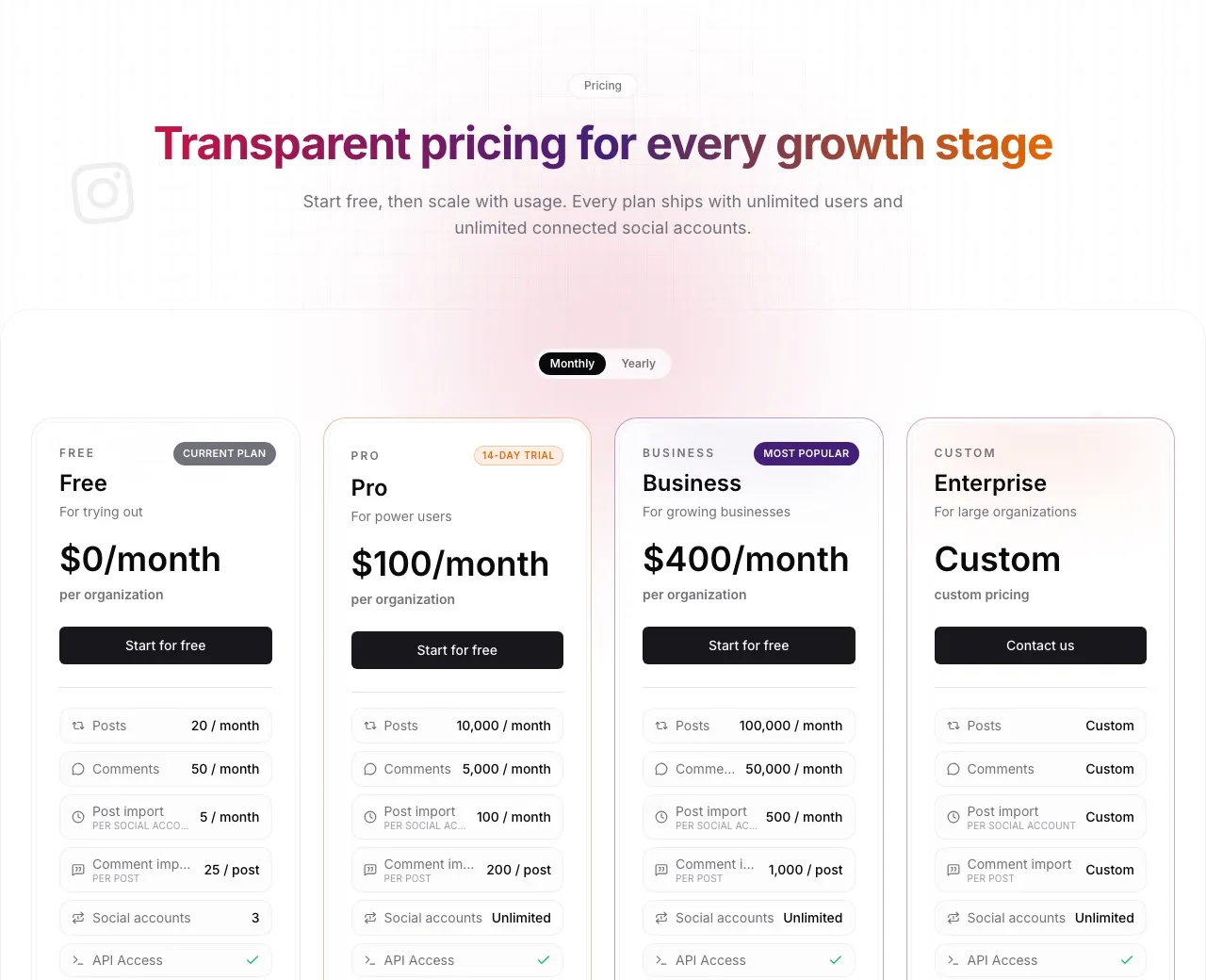
Bundle.social meters comments as their own quota, separate from posts.
Bundle.social is the only tool here that meters comments as a product line rather than a feature footnote. Free covers 20 posts and 50 comments a month, PRO gives 10,000 posts and 5,000 comments, BUSINESS scales to 100,000 and 50,000. That quota structure is how you tell an engagement layer is real rather than bolted on. The DM, private-reply, and Meta automation layer is marked “Coming soon” on its homepage, so buy this for the comment quota that exists today, not the messaging roadmap.
Price in two things. The jump from free to PRO is $100/mo, the steepest step here, and X posts bill separately at $0.015 each, rising to $0.20 with a link.
Pros:
- Comments metered as a first-class quota with real volume
- Unlimited social accounts on every paid tier
- 15 networks including Mastodon, Slack, and Discord
- Genuine free tier covering three accounts
Cons:
- $100/mo jump from the free tier is the steepest entry step here
- X posts carry per-post surcharges above the subscription
- Built-in AI content generation is not documented
Pricing: Free (3 accounts, 20 posts/mo), PRO $100/mo, BUSINESS $400/mo, plus custom. X posts bill from prepaid credits at $0.015 each, or $0.20 with a link.
Ideal for: Products where reading and replying to comments at volume is the feature customers pay for.
Bottom line: Buy this when the conversation is the product and posting is the setup.
6. PostPeer: Best for agencies connecting many accounts on modest posting volume
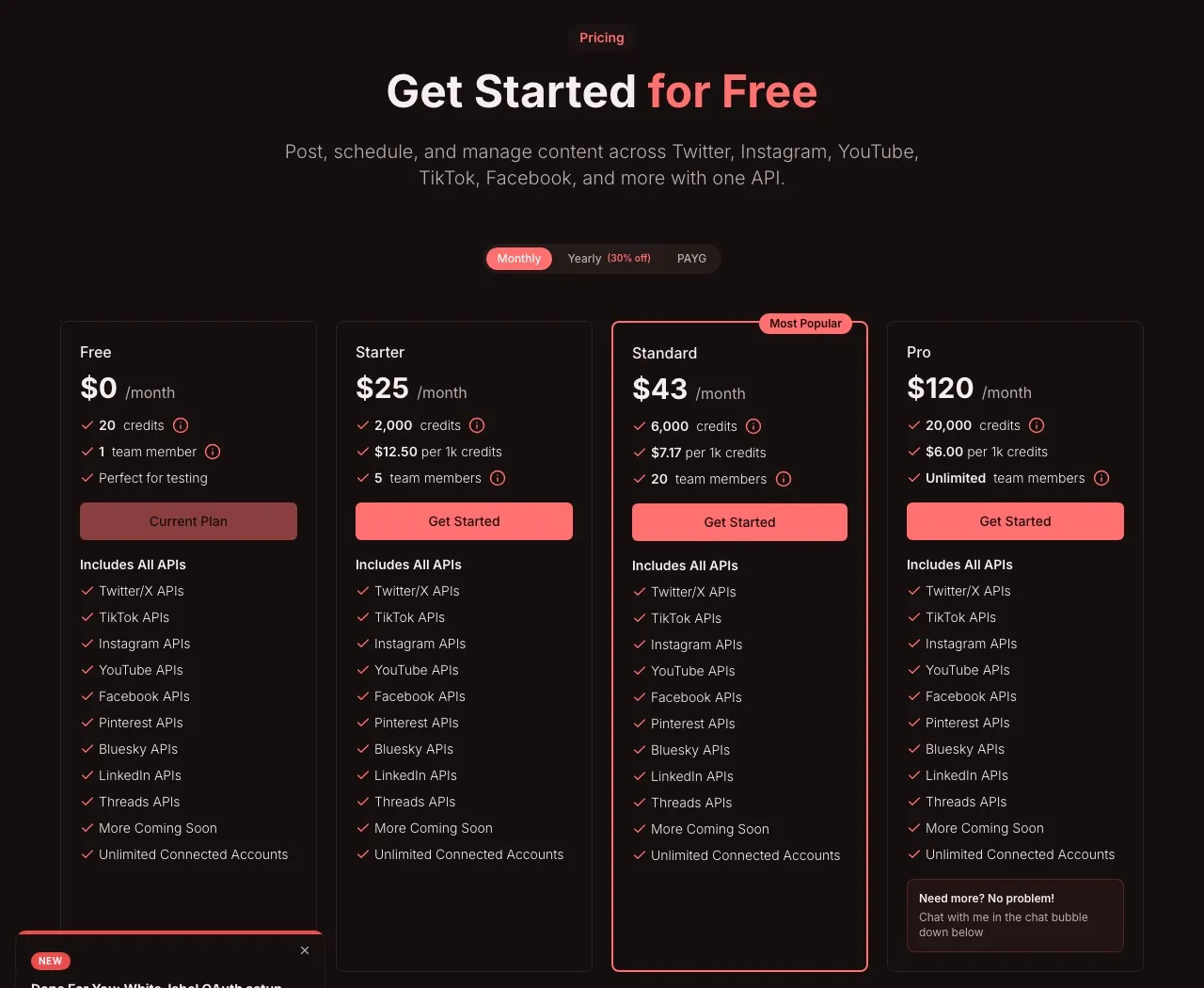
PostPeer sells credits rather than seats, with unlimited connected accounts on every tier.
PostPeer is the closest match to Post for Me’s shape: unlimited connected accounts on every tier including free, a hosted MCP endpoint, and a native Claude skill. It sells credits instead of posts, which suits agencies holding many accounts that each post occasionally.
The credit table deserves a careful read before you commit. Most platforms cost one credit per post, X costs five, and an X post containing a URL costs fifty. A Starter plan’s 2,000 credits sounds generous until a link-posting workflow on X burns through it in forty posts.
Pros:
- Unlimited connected accounts on every tier, including free
- Hosted MCP endpoint plus a native Claude skill
- Genuine free tier for testing
- 30% discount on annual billing
Cons:
- X posts with a URL cost 50 credits, which drains plans fast
- 10 platforms, the narrowest coverage here
- Credit accounting adds a forecasting step other flat plans do not
Pricing: Free (20 credits), Starter $25/mo (2,000 credits), Standard $43/mo (6,000 credits), Pro $120/mo (20,000 credits).
Ideal for: Agencies with many connected accounts posting at modest volume away from link-heavy X workflows.
Bottom line: Great account economics, provided the credit multipliers match your platform mix.
What About Open Source and Self-Hosting?
Post for Me’s strongest and least-discussed feature is that the entire server is on GitHub under AGPL-3.0, not just client SDKs. The monorepo carries the NestJS API, the dashboard, and the background job workers. That is more transparency than most vendors in this category offer, and it deserves credit rather than a footnote.
It is worth understanding what that does and does not buy you. There is no self-hosting guide, though Docker, Railway, and Render configs do ship in the repo, and running it expects Supabase, Trigger.dev, Stripe, and Unkey standing behind it. AGPL-3.0 is also strong copyleft, so network use triggers source disclosure obligations, which matters if you are embedding it in commercial software. It buys you auditability and an exit, not a weekend deploy.
If a documented self-host is the actual goal, Postiz is the more direct answer. It is AGPL-3.0 as well, but it is a complete scheduling product with deployment docs and AI image and video generation built in. Hosted plans run $29/mo to $99/mo with channel limits and AI quotas rising by tier, and self-hosting costs only your server. It sits outside the ranked list because it is a scheduling product with an API attached rather than an API-first peer, so it is a different purchase than anything above. Mixpost is worth a look too, though its pricing is a one-time license rather than monthly ($299 for Pro, $1,199 for Enterprise), so it does not compare cleanly on a monthly table.
How I Chose These Post for Me Alternatives
- Endpoint surface, verified against live docs. I checked what each API actually returns rather than what the marketing page implies, and where a capability was not documented I said that instead of asserting it does not exist.
- Real entry price. Every figure came off the vendor’s own live pricing page, including the usage multipliers that do not appear in the headline number.
- MCP as a check, not a differentiator. Nearly everything here ships one now, so I noted whether it is hosted or a local process instead of treating its existence as a feature. If you are still deciding between the two integration styles, the difference between a social media API and an MCP server matters more than which vendor you pick.
- Genuine category fit. Tools that are scheduling products rather than posting APIs went into the open-source section instead of the ranked list, and Late was excluded because it is now Zernio rather than a separate product.
- The switching reason. Each pick answers a specific reason someone leaves: scope, price shape, platform coverage, or OAuth branding.
Pricing was verified live on each vendor’s pricing page, platform and endpoint claims against their public API documentation, and MCP availability by probing each documented endpoint directly.
How to Choose the Right Post for Me Alternative
If your agent needs to create the content, not just ship it, the gap is upstream of the posting API, which is why Blotato sits at number one here.
If you need to read and reply to comments across several platforms, go to Ayrshare or Bundle.social. Both treat engagement as a real endpoint surface rather than a roadmap item.
If you are still validating and do not want to pay yet, Zernio’s two free accounts include full API access, and Upload-Post’s free tier proves a pipeline works without a card.
If the missing piece was a platform, Upload-Post’s 22 destinations cover the long tail the nine-network tools do not reach.
If you hold a lot of accounts that post occasionally, PostPeer’s unlimited-accounts model beats anything metered by post volume, provided you check the X credit multipliers first.
If you want to own the software outright, Postiz self-hosted is the cleanest path, and the tradeoffs between running your own stack and paying for a managed one are worth reading first.
Sabrina’s Final Thoughts
Most people leaving Post for Me are not leaving over the price, because there is nothing to beat at $10 a month. They leave because publishing turned out to be the easy half of the job, and the half that was missing was either the content going in or the conversation coming back out. Work out which half you are missing before you compare price tags, because those two problems have completely different answers on this list. If it is the content side, Blotato was built for exactly that handoff and you can see how the plans line up against what you are paying now.
Post for Me Alternatives FAQs
What is the best Post for Me alternative?
It depends on which limit you hit. For builders whose agent needs to generate content as well as publish it, Blotato covers both behind one key at $29/mo flat. For teams that need comments and DM endpoints across several platforms, Ayrshare is the most complete option at $149/mo. For developers who want to start free, Zernio includes full API access on its first two accounts.
Is there a free alternative to Post for Me?
Yes, several. Zernio is free for your first two accounts with no feature gating, Upload-Post’s free tier includes two profiles and 10 uploads a month, PostPeer gives 20 credits free, and Bundle.social’s free tier covers three accounts with 20 posts and 50 comments. Post for Me itself has no free tier, starting at $10/mo.
Does Post for Me support comments and direct messages?
Not in its published API reference. The documented endpoints cover media upload, social accounts, social posts, post results, and webhooks, which means publishing, scheduling, feeds, and post metrics rather than two-way engagement. Ayrshare, Zernio, Bundle.social, and Upload-Post all document some comment or DM coverage if that is what you need.
Can I self-host Post for Me?
The full server is on GitHub under AGPL-3.0, including the API, dashboard, and job workers, so legally and technically yes. In practice there is no self-hosting guide, and while Docker, Railway, and Render configs ship in the repo, it still expects Supabase, Trigger.dev, Stripe, and Unkey. If a documented self-host is the goal, Postiz is the more practical open-source option.
Why does my OAuth screen show the Post for Me brand?
That is Quickstart mode, which uses Post for Me’s platform credentials so you can skip developer approval at each network. Their documentation notes users see the “Post for Me” brand in the consent screen and that connections inherit the permissions their app was approved for. Switching to White Label mode puts your own brand in the flow but requires you to complete each network’s approval process yourself.