5 Best Postproxy Alternatives for AI Agents Posting to X (2026)
The best Postproxy alternatives in 2026, compared on X access for AI agents, profile-group billing, engagement coverage, and track record.
Most people hunting for Postproxy alternatives are not unhappy with the API. They read the docs page for X and found the sentence that changes the math: posting to X is capped at 20 per 24 hours per account, and past that you are either metered pay-as-you-go or bringing your own X credentials. That is a fine trade for some builds and a dealbreaker for others, and it is worth knowing which one you are before you shop. I’m the founder of Blotato, my pick below, so weigh that entry with the grain of salt it deserves and check the numbers yourself on the plans page.
Quick Comparison: 5 Best Postproxy Alternatives
| Tool | Best For | Starting Price | Key Strength |
|---|---|---|---|
| Blotato | Agent builders who want content generation behind the same key as publishing | $29/mo flat | Writes, designs, and publishes across 9 platforms with a hosted MCP server |
| Ayrshare | Platforms embedding social posting for many isolated end-user accounts | $149/mo | Per-profile token isolation proven across 14+ networks |
| Upload-Post | Builders who want the widest platform list on a real free tier | Free, then $24/mo | 22 platforms and 40 MCP tools with 10 free uploads a month |
| bundle.social | Teams that would rather pay per post than per connected brand | Free, then $100/mo | Usage-metered billing with unlimited connected accounts on paid plans |
| Zernio | Developers whose account count sits awkwardly between pricing bands | 2 accounts free, then $6/account | Per-account billing that drops to $1 at scale |
Ayrshare sits second at a price far above everything below it. That is deliberate. Multi-tenant token isolation is a genuinely hard problem, and if that is what you need, cheaper tools on this list will not solve it at any volume.
Why People Are Looking for Postproxy Alternatives
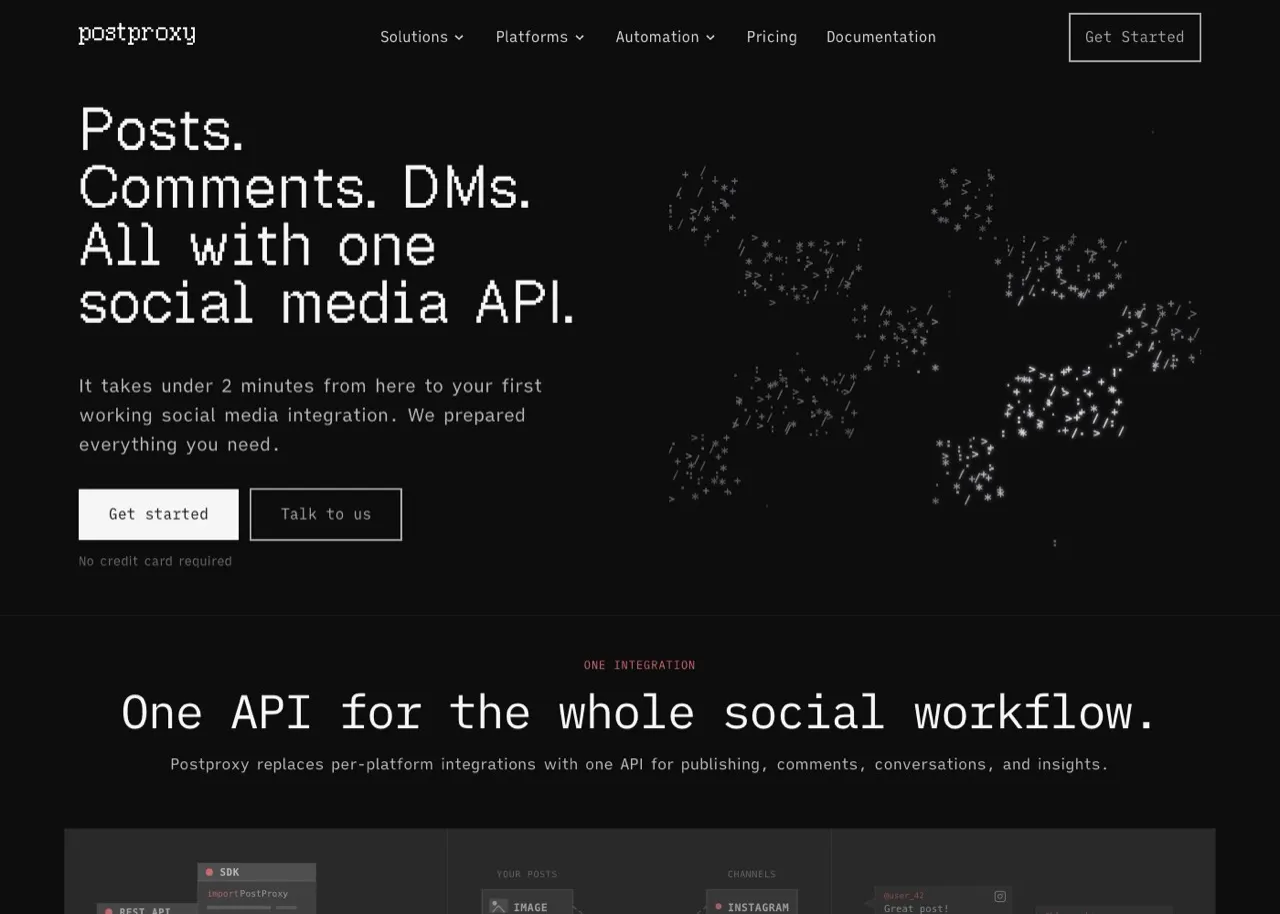
Postproxy’s homepage: one API covering publishing, comments, conversations, and insights.
Postproxy is a good product with an honest pitch. It is built by two Berlin founders who came from social platform integrations at scale, the API covers publishing plus comments, DMs, and Google Business review replies, and the free tier is permanent rather than a trial. For a lot of builds it is the right call, and this post is not an argument that it is broken.
The friction is concentrated in one place: X. Every Postproxy account includes 20 posts to X per 24 hours, and past that you either let Postproxy meter it pay-as-you-go or connect your own X credentials to keep direct control of the spend. Its platform reference also notes there is no comment or direct-message API for X. Nothing here is a trap, and the brokered path spares you the developer-app paperwork. It does mean X behaves differently from every other network in the product, with a throughput ceiling and a separate cost line, so if X is a primary channel the promise that one API replaces per-platform integrations holds less cleanly there.
The second reason is how profile groups bill. A group maps to one brand, client, or publishing setup and holds one account per network, so two Instagram accounts mean two profile groups. An agency running 20 clients on three networks each pays for 20 groups while touching only a fraction of the profile slots those groups entitle it to. If your accounts cluster on a few networks rather than spreading across the full platform list, you are buying headroom you cannot reach.
Third is track record, which cuts both ways. Postproxy launched publicly on Product Hunt in February 2026, and its own documentation lists SOC 2 Type II certification as in progress rather than complete. It also repriced in May 2026, moving Scale to $99/mo and Enterprise to $699/mo for new subscriptions roughly three months after launch, while explicitly grandfathering existing customers at their old rate. None of that makes it a bad tool, and the grandfathering is the honest way to do it. It does make it a real conversation if you are putting a product’s publishing path on it. The alternatives below solve the X problem, the billing-shape problem, or the maturity problem, depending on which one is actually blocking you.
Best Postproxy Alternatives for 2026
I ranked these by which Postproxy constraint they actually relieve, not by how close they are to Postproxy’s feature list.
1. Blotato: Best for agent builders who want content generation behind the same key as publishing

Blotato’s homepage: one API and MCP surface covering publishing, comments, DMs, and analytics.
I built Blotato because stitching a writing tool, an image generator, and a posting API together got old fast. Postproxy is a strong delivery layer, but it delivers content that something else had to create. Blotato writes the caption, generates the image or faceless video, and publishes across 9 platforms, with a hosted MCP server at mcp.blotato.com/mcp so Claude or an n8n agent drives the whole pipeline rather than just the final call. Analytics covers 8 platforms, and comments and DMs cover Instagram and Facebook, so the engagement surface is narrower than Postproxy’s on paper. What it buys you is one key and one flat bill instead of a content vendor plus a posting vendor.
One honest note for this audience: the 7-day trial excludes the API, and generating a key ends the trial and starts paid Starter. If you are here to test an API, plan on starting the subscription rather than trialing it.
Pricing: Compare this against what you would spend assembling the same coverage yourself. $29 a month covers 20 connected accounts with the API included, where the do-it-yourself route adds a writing tool and an image generator on top of the posting layer before anything publishes. Creator is $97, Agency $499. Cancel anytime.
Ideal for: Builders whose agent needs to produce the post, not just deliver it.
Bottom line: If Postproxy is the last step of your pipeline, Blotato covers the steps before it too, for one flat monthly price.
2. Ayrshare: Best for platforms embedding social posting for many isolated end-user accounts
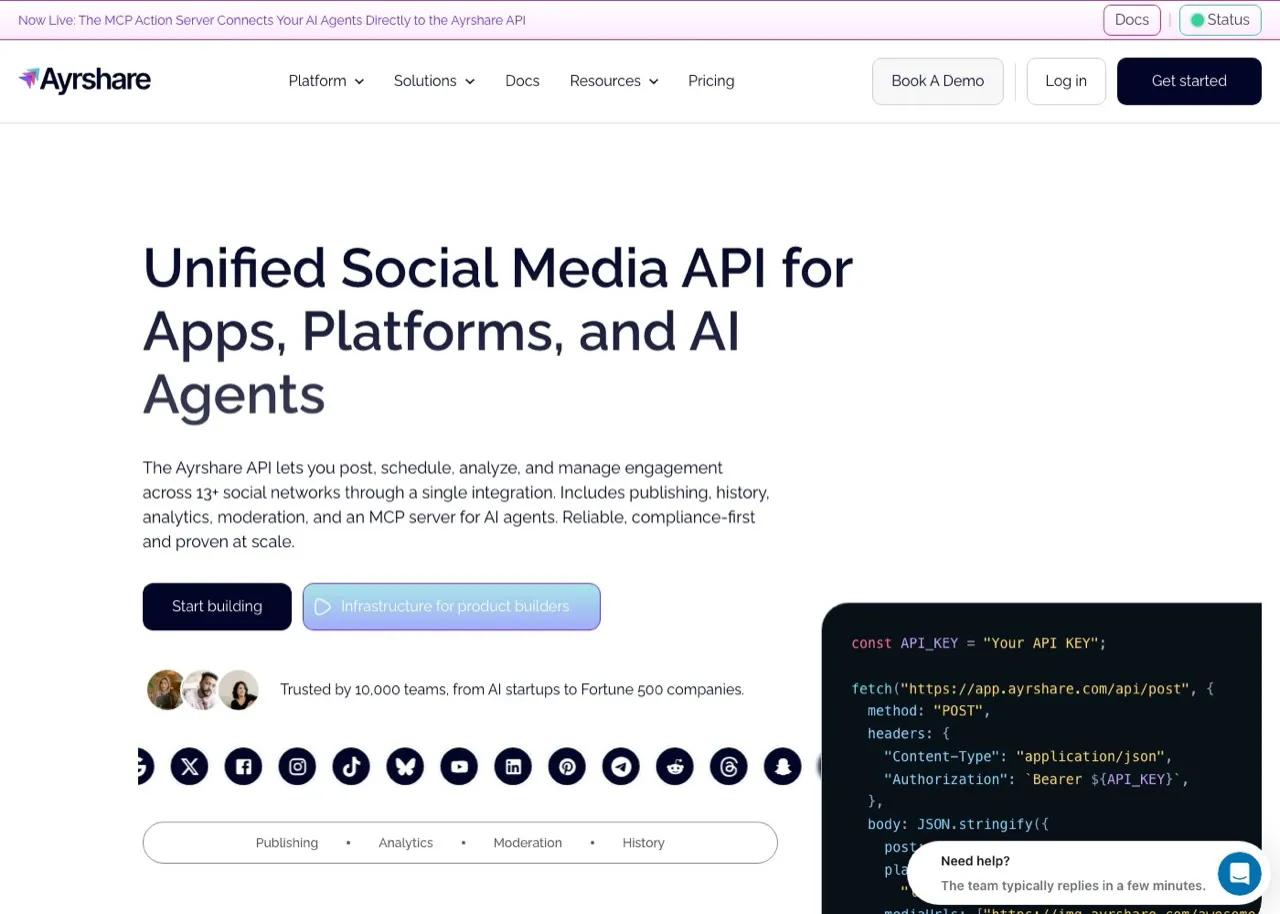
Ayrshare’s homepage: a unified API built around per-profile isolation across 14+ networks.
Ayrshare is the mature answer to a problem Postproxy’s profile groups only partly address. Each of your end users gets their own credential boundary, which is what you need when hundreds of separate customers connect their own accounts through your product. It also runs an Action MCP server at api.ayrshare.com/mcp with 27 tools, and note there is a separate read-only documentation server that is easy to confuse with it.
The premium is steep and the AI story is thin. Business starts at $599/mo for 30 profiles, and AI content generation is a Max Pack upgrade at an extra $300/mo on that tier. I ran the full price-to-value comparison in Blotato vs Ayrshare, and there is a dedicated Ayrshare alternatives roundup if it lands on your shortlist and then falls off it.
Pros:
- True per-profile token isolation for multi-tenant products
- Comment and DM moderation is part of the platform, not a separate product
- Long production track record across 14+ networks
Cons:
- Premium starts at $149/mo for a single profile
- AI generation costs an extra $300/mo on Business
Pricing: Premium $149/mo (1 profile), Launch $299/mo (up to 10), Business from $599/mo (30 profiles, then $8.99 per additional profile).
Ideal for: SaaS platforms whose customers connect their own accounts.
Bottom line: The right pick when isolation is the requirement and budget is not the constraint.
3. Upload-Post: Best for builders who want the widest platform list on a real free tier
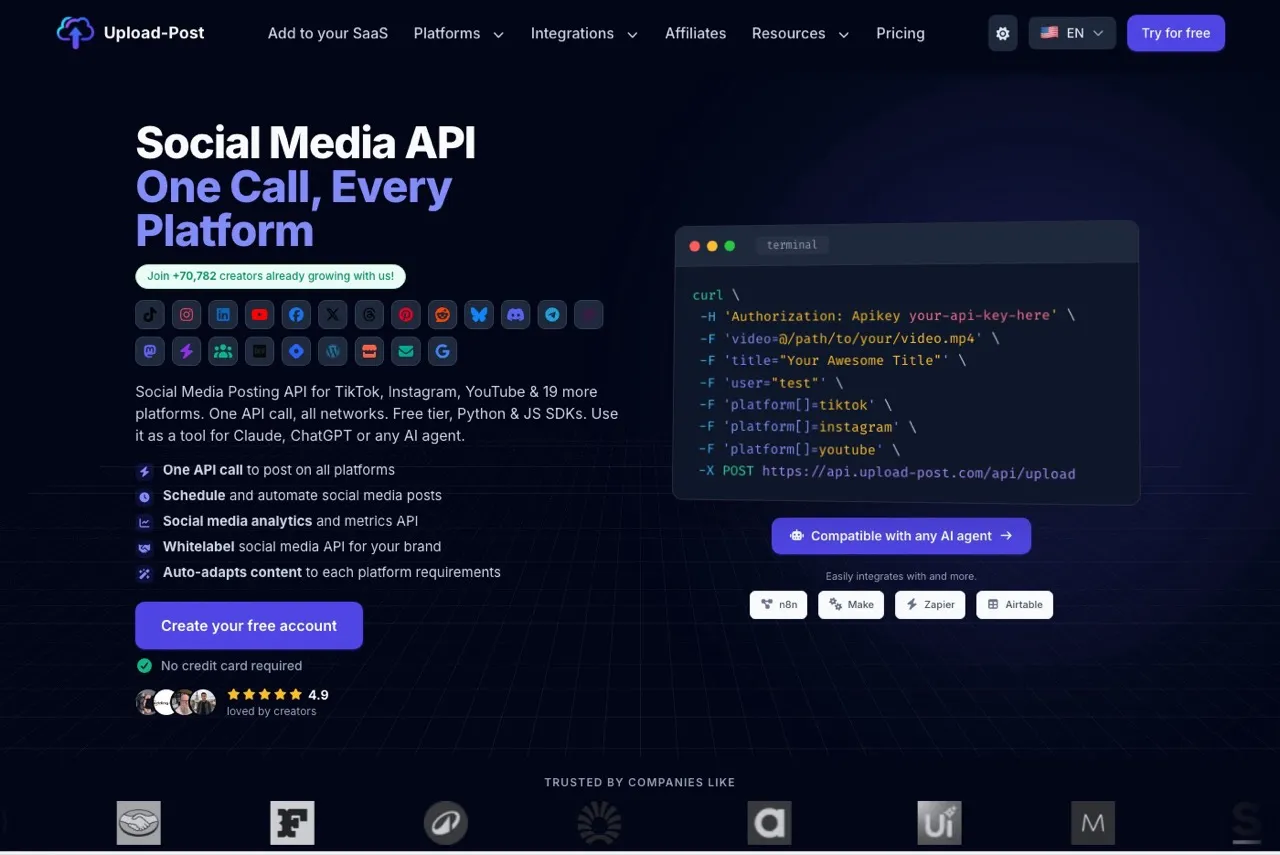
Upload-Post’s homepage: one API call across 22 platforms with a permanent free tier.
Upload-Post answers the platform-coverage complaint directly. Where Postproxy’s platforms page lists 11 live networks with Reddit still on the roadmap, Upload-Post covers 22, including Reddit and Mastodon. Its MCP server at mcp.upload-post.com/mcp is open source and exposes 40 tools spanning publishing, scheduling, analytics, comments, and DMs, which is a wider agent surface than most tools this cheap.
The gap is content. Its one AI feature writes titles, descriptions, and hashtags for short-form video you already made, so it formats and delivers rather than creates. The free tier also excludes TikTok. I compared the two models in Blotato vs Upload-Post, and there is a full Upload-Post alternatives list if you want the wider field.
Pros:
- 22 platforms, the widest list on this roundup
- Permanent free tier with 10 uploads a month, no card required
- 40 MCP tools covering analytics and engagement, not just publishing
Cons:
- No real AI content generation, only metadata for existing video
- TikTok is excluded from the free tier
Pricing: Free (2 profiles, 10 uploads/mo), Basic $24/mo ($16 annual), Professional $50/mo, Advanced $147/mo, Business $438/mo.
Ideal for: Builders who need reach across many niche networks on a small budget.
Bottom line: The best free tier here, as long as something else is writing your posts.
4. bundle.social: Best for teams that would rather pay per post than per connected brand
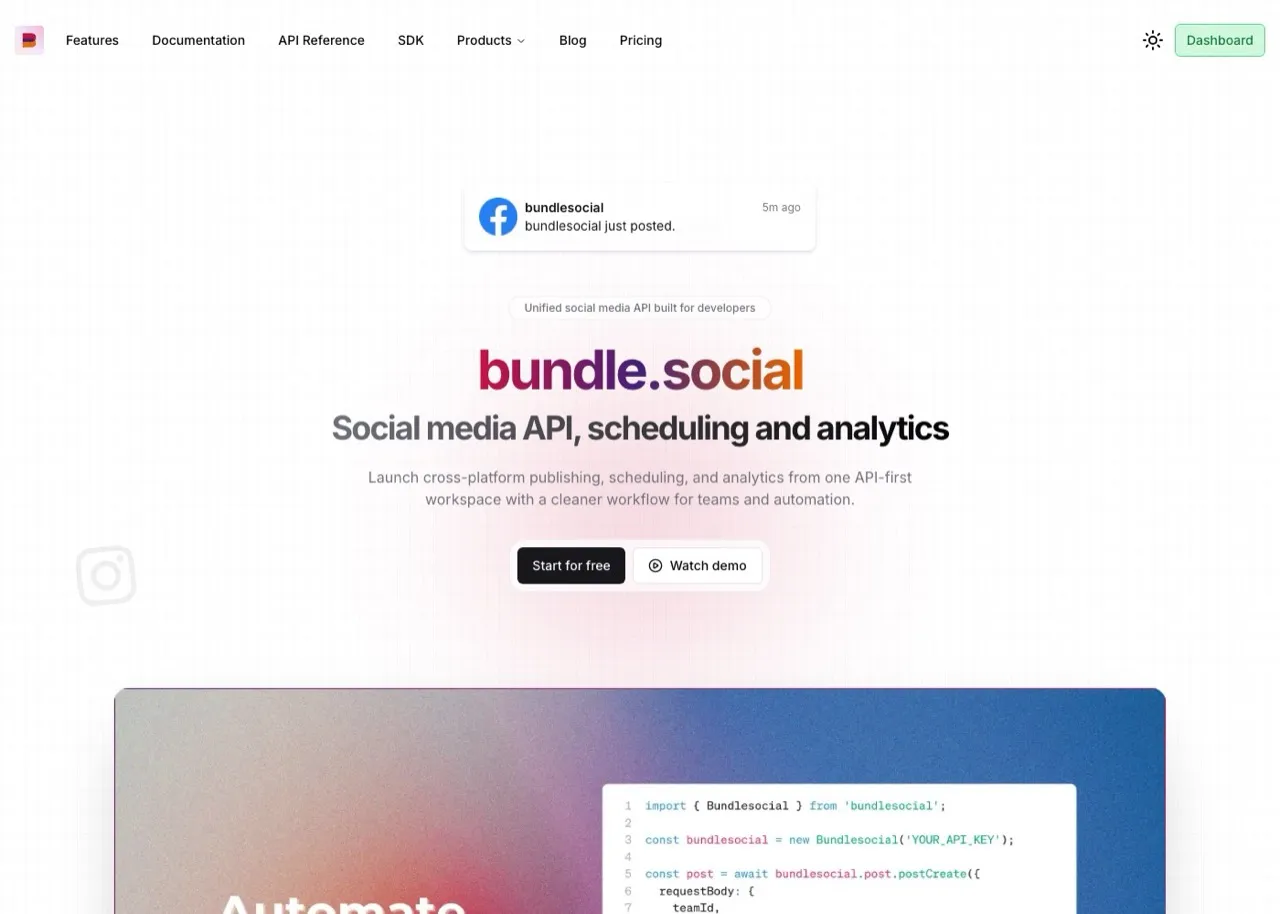
bundle.social’s homepage: an API-first workspace billed by usage rather than by connected account.
bundle.social inverts Postproxy’s billing shape, and that is the whole reason it belongs here. Paid plans include unlimited connected accounts and meter you on volume instead: Pro at $100/mo covers 10,000 posts and 5,000 comments a month. For an agency with many clients on few networks, the exact case where profile groups get expensive, that model is friendlier. Analytics and comment management are included on every tier, including the free one.
Two caveats worth stating plainly. X posts bill separately through prepaid credits at $0.015 per post and $0.20 for posts with a link, so X is metered here too, just differently. Those are X’s own published rates, not a markup this vendor invented. And its MCP is an npm package you run locally rather than a hosted endpoint, which matters if you wanted to point an agent at a URL and be done.
Pros:
- Unlimited connected accounts on paid plans
- Free tier includes API access, analytics, and comment management
- Usage billing suits many-accounts-few-networks setups
Cons:
- X posts cost extra through prepaid credits
- MCP runs locally via npm rather than as a hosted server
Pricing: Free (3 accounts, 20 posts/mo), Pro $100/mo, Business $400/mo, Custom on request.
Ideal for: Agencies whose account count outruns their platform count.
Bottom line: The clearest escape from per-brand billing, if you can live with metered X.
5. Zernio: Best for developers whose account count sits awkwardly between pricing bands
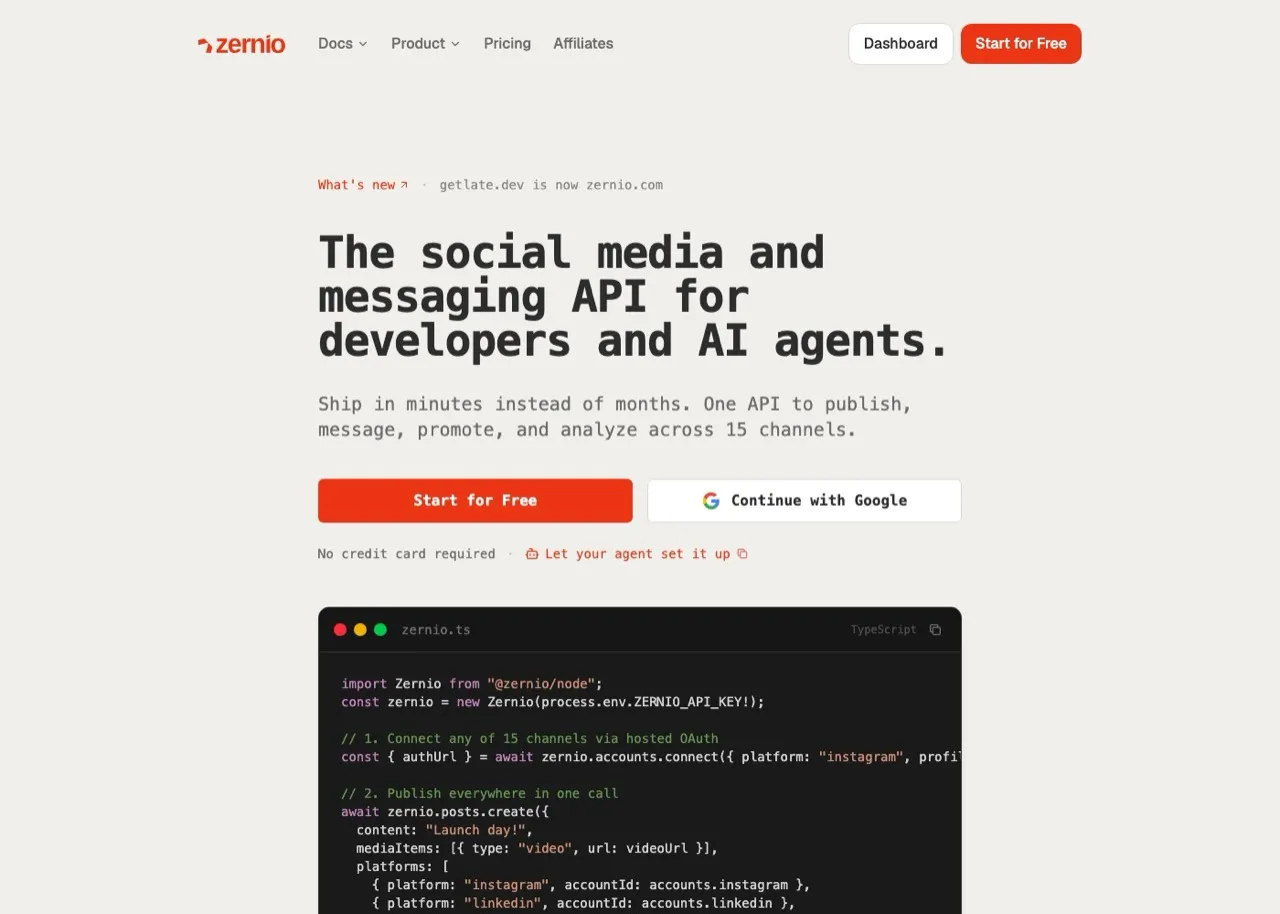
Zernio’s homepage: per-account billing across 15 channels with the first two accounts free.
Zernio (formerly Late) prices by the exact account rather than by the band, which fixes the specific irritation of paying for a profile group you have half-filled. Accounts three through ten run $6 each, eleven through a hundred drop to $3, and past that they fall to $1. The first two are free with full API access, so you can evaluate the integration properly before spending anything. Its MCP server at mcp.zernio.com/mcp is live and OAuth-gated.
Like Postproxy, it is a publishing and messaging layer rather than a content engine, so nothing here writes or designs the post. X also carries pass-through request pricing, which is the recurring theme of this entire roundup. I put the two account-count models side by side in Blotato vs Zernio.
Pros:
- Genuinely granular per-account pricing that falls at scale
- First 2 accounts free with full API access and no card
- Hosted MCP server plus messaging endpoints
Cons:
- No AI writing, image, or video generation
- X requests carry separate pass-through costs
Pricing: Free (2 accounts), $6/account for 3 to 10, $3/account for 11 to 100, $1/account past 100.
Ideal for: Developers who want the bill to track their real account count.
Bottom line: The most forgiving pricing curve here for an account count that keeps changing.
How I Chose These Postproxy Alternatives
I evaluated each tool on five things: whether X posting is brokered for you or handed back as your own developer app, what the bill actually tracks (accounts, brands, posts, or a flat fee), how much of the engagement surface the API covers beyond publishing, whether an agent can drive it through a hosted MCP server, and how much production history sits behind it. Pricing is current as of August 2026 and was read off each vendor’s own live pricing page. Platform and capability claims come from each vendor’s own documentation, and every MCP endpoint named here was probed directly rather than taken from a third-party directory.
How to Choose the Right Postproxy Alternative
- If X is a primary channel: none of these fully removes X’s cost, which is worth knowing up front. Blotato and Ayrshare broker the connection for you, bundle.social and Zernio meter it, and Postproxy gives you both, 20 posts a day included then pay-as-you-go, or your own key if you would rather hold the spend directly. Pick based on which of those you would rather manage.
- If the content itself is the gap: Blotato generates it behind the same key that publishes it.
- If you are embedding posting for hundreds of end users: Ayrshare’s isolation model is the reason it costs what it costs.
- If you need reach into niche networks: Upload-Post’s 22 platforms is the widest list here.
- If profile-group billing is what stings: bundle.social meters posts instead, and Zernio bills the exact account.
Sabrina’s Final Thoughts
Postproxy is a genuinely well-built API, and most people leaving it are not leaving because of quality. They are leaving because of a billing shape that does not match how their accounts are distributed, or because X turned out to be their problem to solve after all. Be honest with yourself about which one it is before you migrate, because the wrong swap costs you a week and fixes nothing. If the answer is that you also need the content created rather than just delivered, that is the specific gap Blotato was built for, and you can compare the plans in about ten minutes.
Postproxy Alternatives FAQs
What is the best free alternative to Postproxy?
Upload-Post and bundle.social both run permanent free tiers with real API access, which matters because Postproxy’s own free plan is one of its strongest features. Upload-Post covers 2 profiles and 10 uploads a month across 22 platforms, and bundle.social covers 3 accounts and 20 posts. Zernio’s first 2 accounts are free with full API access. Blotato has no permanent free tier, only a 7-day trial that excludes the API, so plan on starting a subscription if you are evaluating it as a builder.
Does Postproxy have an MCP server?
Yes. Postproxy runs a hosted MCP server at mcp.postproxy.dev/mcp with roughly 40 tools spanning publishing, queues, comments, and DMs, plus a local stdio option via the postproxy-mcp npm package. Authentication is by API key. MCP is table stakes across this category now rather than a differentiator, so compare tools on billing shape and capability breadth instead.
Why is Postproxy’s X/Twitter posting limited?
Every Postproxy account includes 20 posts to X per 24 hours. Above that you choose between two billing paths: let Postproxy meter it pay-as-you-go, which needs no developer account of your own, or connect your existing X credentials and keep direct control of the spend. Its platform reference also notes there is no comment or DM API for X. This is not unique to Postproxy: X’s own API pricing pushes most vendors toward metering, credits, or bring-your-own-keys, which is why several tools on this list handle X differently from their other platforms.
Which Postproxy alternative is cheapest for an agency with many clients?
It depends on whether your clients spread across many networks or cluster on a few. Postproxy’s profile groups charge per brand regardless of how many networks that brand uses, so an agency with 20 clients on three networks each pays for 20 groups. bundle.social’s paid plans include unlimited connected accounts and meter posts instead, and Zernio’s per-account rate drops to $3 above 10 accounts and $1 above 100. Run your real client and network counts through all three before deciding, because the point where per-brand overtakes per-account is a specific threshold rather than a matter of taste.
Is Postproxy safe to build a product on?
That is a judgment call rather than a fact. Postproxy uses official platform APIs and approved OAuth scopes rather than scraping, publishes SDKs across several languages, and maintains a public changelog with steady release activity. On the other side, it launched publicly in February 2026, its documentation lists SOC 2 Type II as in progress, and it repriced two tiers within three months of launch while grandfathering existing customers. If procurement requires a completed SOC 2 or a contractual SLA today, verify both directly with the vendor before committing.