7 Best Zernio Alternatives Compared by Account Count (2026)
Zernio bills per connected account, so the best alternative depends on how many you run. Seven options priced against real account bands for 2026.
Most people searching for Zernio alternatives in 2026 are not running from a bad product. They are running from a bill that grew a line every time they connected an account. Zernio starts free at two accounts, which is genuinely hard to beat, and then the meter starts.
Full disclosure before you read further: Blotato is mine, and it sits at number one. So I ran the account arithmetic for every tool here and published the bands where we lose. Zernio is cheaper below seven accounts, cheaper again between 21 and 26 where our plan steps up before its ladder catches it, and cheaper past forty. Blotato wins the two stretches in between, which happen to be where most creators sit.
Quick Comparison: 7 Best Zernio Alternatives
| Tool | Best For | Starting Price | Key Strength |
|---|---|---|---|
| Blotato | Creators and small agencies running 7 to 20 or 27 to 40 accounts who also need content made | $29/mo flat | Writing, image, and video generation in the same flat bill as publishing |
| PostPeer | Agencies with many accounts posting modest volume away from X | Free, then $25/mo | Priced in credits instead of per account, with unlimited accounts on every tier |
| Postproxy | Agencies and SaaS teams billing one client across many networks | Free, then $49/mo | Bills per profile group, so extra networks inside a client are free |
| Postiz | Teams who want to own the software and run it themselves | Free self-hosted, or $29/mo | AGPL open source you can deploy on your own server |
| Upload-Post | Builders prototyping an agent before committing budget | Free tier | A free on-ramp with no card required |
| Ayrshare | Platforms embedding posting for many isolated client profiles | $149/mo | Per-end-user token isolation built for multi-tenant apps |
| Mixpost | Anyone who would rather buy the software once than rent it | $299 one-time (Pro) | Pay once and self-host with no recurring fee |
I put Ayrshare and Mixpost near the bottom deliberately. Both are real Zernio alternatives, but Ayrshare keeps the same usage-linked shape you are trying to escape, and Mixpost asks you to run infrastructure. If your problem is that the bill moves, start at the top.
One number from the table deserves a warning label before you go further. PostPeer’s plans are quoted in credits, not posts, and a post to X costs 5 credits while a post to X carrying a link costs 50. That turns a 6,000-credit plan into roughly 120 posts for a link-sharing X workflow. It is the single easiest way to misprice a migration off Zernio, so check the credit table against your own posting mix rather than the headline number.
Why People Are Looking for Zernio Alternatives
Zernio, which was called Late until the rebrand, prices per connected social account. Your first two are free with no card. Accounts three through ten are $6 each per month, eleven through one hundred are $3 each, and past one hundred they are $1 each. Every feature is included at every level, with no tiers to decode.
The catch is arithmetic. Ten accounts costs $48 a month. Twenty costs $78. Fifty costs $168. If you are an agency adding a client every month, your infrastructure line grows every month too, and it grows fastest in the early bands where most creators actually live.
There is a second reason, and for the people I talk to it is the bigger one. Zernio moves content. It does not make any. That is the gap Blotato’s flat plan is built to close, and it is why the comparison is rarely just about the publishing line. The API publishes, schedules, reads analytics, and handles your DMs across a broad spread of channels, and it does all of that well. But the writing, the images, and the video still have to come from somewhere else, which means another subscription and another integration to maintain.
On top of the subscription, X API charges are passed through separately at X’s own rates with no markup. That is a reasonable way to bill for an expensive upstream API, and it is worth knowing before you model your costs.
Best Zernio Alternatives for 2026
I ranked these by what actually replaces Zernio for a specific kind of person, not by how close each one sits to my own product.
1. Blotato: Best for creators and small agencies who need content created, not just published

Blotato generates a week of posts, images, and video, then schedules them across nine platforms.
Blotato is a flat $29 a month for 20 social accounts, and the number on the invoice does not change when you connect the twentieth. That flat shape is the whole reason it belongs at the top of a Zernio list, because it is the one thing Zernio’s model cannot do by design.
The part that matters more is what happens before publishing. Blotato writes the posts, generates the images, and produces faceless video with voiceovers, all drawing on the same credit pool included in the plan. Zernio is publishing infrastructure and does not sell content generation at any tier, so if that second subscription is currently doing your writing or your images, Blotato can absorb it rather than sit beside it.
For the AI-agent crowd, there is a hosted MCP server at mcp.blotato.com/mcp that you point Claude Desktop or Claude Code at, which is the setup I walk through in posting to social media with Claude Code, plus a REST API and native nodes for n8n and Make. Worth knowing before you sign up: the 7-day trial covers everything except the API, and generating an API key ends the trial and starts the paid plan. If you came here for the API, plan on starting the subscription rather than trialing it.
Where Blotato loses: Zernio reaches more channels than Blotato’s nine, it has a real free tier and Blotato does not, and it costs less below seven accounts, between 21 and 26 where Blotato steps up to Creator early, and past forty.
Pricing: Starter $29/mo for 20 accounts, Creator $97/mo for 40 accounts, Agency $499/mo. 7-day trial on every plan, card required, cancel anytime.
Ideal for: Creators and small agencies running 7 to 20 or 27 to 40 accounts who are paying for a writing tool and a publishing tool separately.
Bottom line: The pick when you want generation and publishing on one flat bill without running a server yourself.
2. PostPeer: Best for agencies with many accounts and modest posting volume
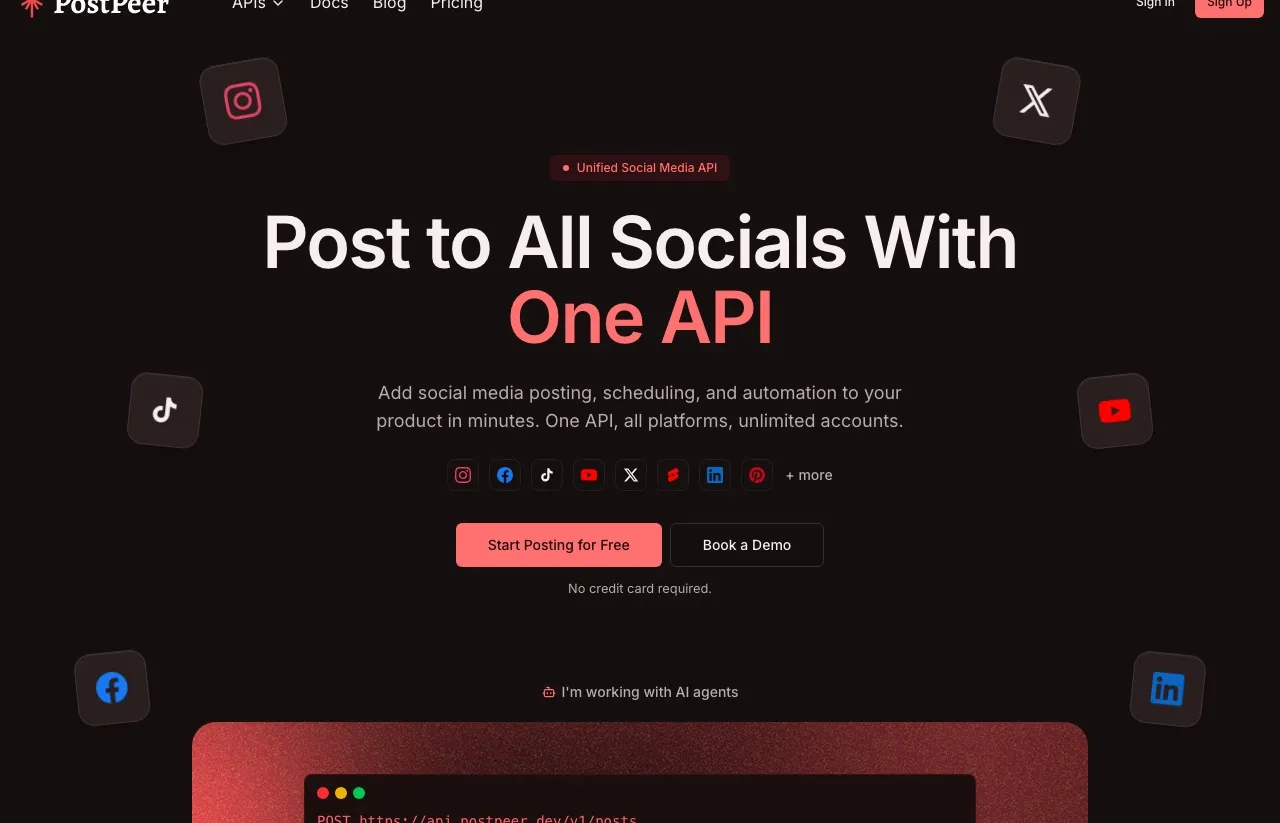
PostPeer prices in monthly credits and advertises unlimited connected accounts on every tier.
PostPeer inverts Zernio’s unit. Instead of charging for accounts and letting you post freely, it advertises unlimited connected accounts and charges for credits. Free gets you 20 credits a month, Starter is $33 for 2,000, Standard is $43 for 6,000, and Pro is $120 for 20,000, billed monthly. Annual billing takes about 30% off those three.
Starter moved from $25 to $33 since I first published this comparison, which is a 32% rise on the cheapest paid tier and worth knowing if you are working from an older write-up.
Read the credit table before you model this, because it is where the real cost hides. A post to most platforms costs 1 credit. A post to X costs 5. A post to X containing a link costs 50. So a Standard plan is 6,000 posts if you never touch X, and roughly 120 posts if your workflow is link-sharing on X.
For the right shape of workload the inversion still wins. If you manage 50 accounts that each post a few times a week to platforms other than X, Zernio bills you $168 a month and PostPeer bills you $43. Run that same volume through X with links and the comparison reverses completely.
Pros:
- Unlimited connected accounts on every paid tier
- A real free tier for testing, at 20 credits a month
- Credits carry across accounts, so adding a client costs nothing by itself
Cons:
- X posts cost 5 credits and X posts with links cost 50, which distorts the headline volume
- Ten platforms, with no Telegram or Snapchat
- No native AI content generation
Pricing: Free for 20 credits/mo. Starter $33/mo, Standard $43/mo, Pro $120/mo, billed monthly, with roughly 30% off on annual.
Ideal for: Agencies with many client accounts posting a modest volume away from X.
Bottom line: The best pick when your account count is high and your posting volume is not, provided X is not your main channel. Budget schedulers handle X differently again, compared in the Postoria alternatives roundup.
3. Postproxy: Best for agencies billing one client across many networks
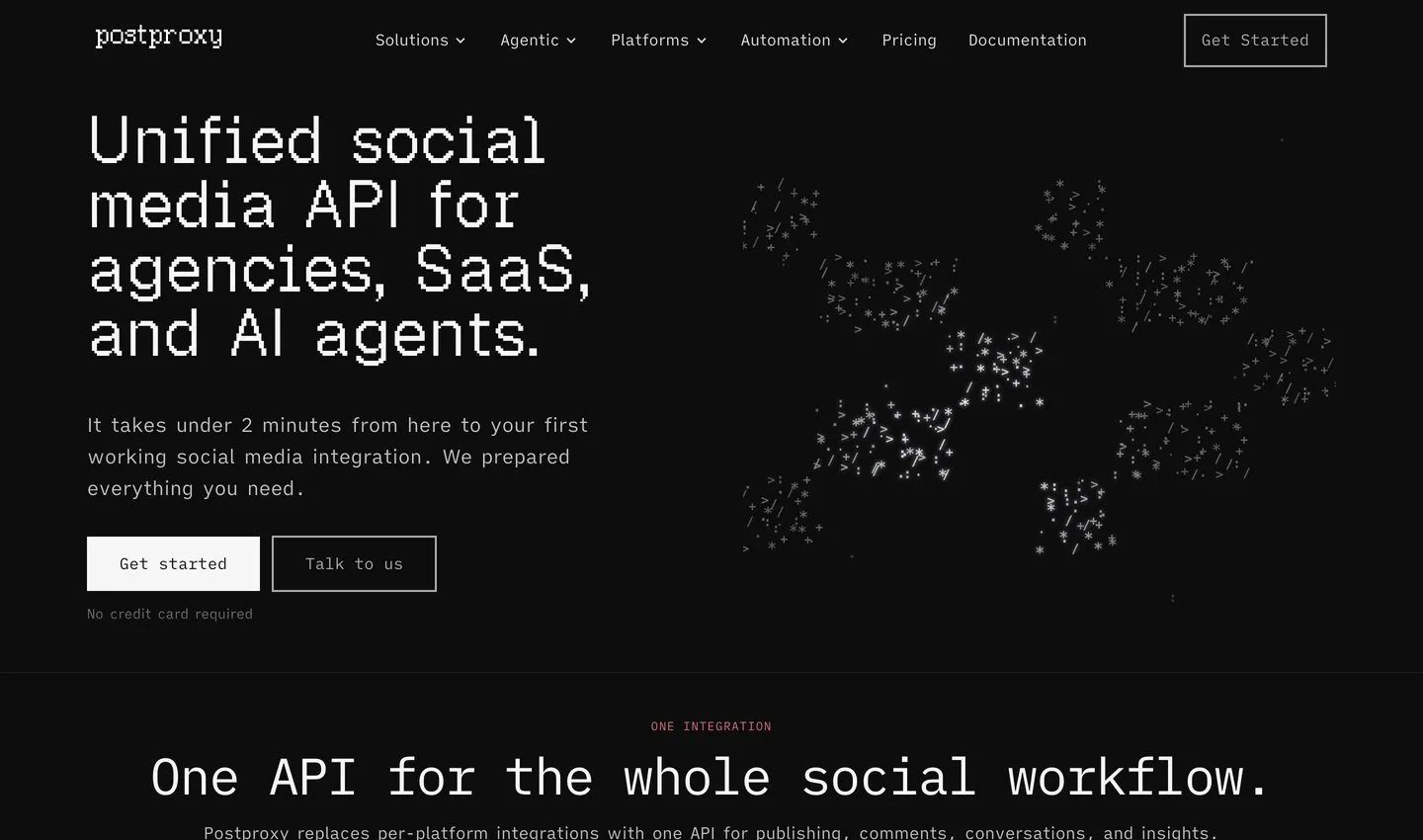
Postproxy bills agencies per profile group rather than per connected account.
Postproxy is the closest thing here to a direct answer to Zernio’s meter, and it is worth reading its rate card carefully because it runs two billing units on one page.
Its Business plan at $49 a month bills per profile group, where a group maps to one brand or client and can hold up to 11 connected platforms at no extra cost. Its own worked example is the whole pitch: nine connected accounts, two profile groups, so two units on the bill. Adding another network inside a client you already pay for is free.
Its Agentic plan at $17 a month is the one an AI-agent reader lands on first, and that tier bills per connected profile, which is the same shape as Zernio. If you are here to escape per-account billing, the $49 tier is the one that does it and the $17 tier is not.
The free tier is unusually generous for testing: 10 posts a month with no card, and cross-posting one piece of content to several platforms counts as a single post.
Pros:
- Profile-group billing means extra networks per client cost nothing
- Publishing MCP server that genuinely posts, plus a Claude connector listing
- Full REST API and sandbox mode on every tier, including free
Cons:
- The cheaper Agentic tier reverts to per-profile billing, the model you may be leaving
- Comments reach Instagram, Facebook, Threads and Bluesky only, with YouTube and LinkedIn listed as coming
- Founded in 2026, so it has the shortest track record on this list
Pricing: Free for 10 posts/mo. Agentic $17/mo for 5 profiles, Business $49/mo for 20 profile groups, Enterprise $399/mo for 300. Monthly billing only on Agentic and Business.
Ideal for: Agencies and SaaS teams whose clients each run several networks.
Bottom line: The best structural answer to Zernio’s per-account meter if your clients run several networks each, since that is what makes a group cheaper than a pile of accounts. If each client is a single Instagram account, the group model buys you nothing and Zernio’s own ladder is fine.
4. Postiz: Best for teams who want to own the software outright

Postiz is AGPL-licensed open source that you can self-host for free or use as a hosted plan.
Postiz is the answer when the objection is not the price but the arrangement. It is AGPL-licensed open source, so you can deploy it on your own server and pay nothing but hosting, keeping your tokens and your data on infrastructure you control. If you would rather not, the hosted plans start at $29 a month for 5 channels and run to $99 for 100.
The trade is real and worth stating plainly. Self-hosting means you own the upgrades, the OAuth token refreshes, and the 2 a.m. outage when a platform changes its API. I worked through that trade in more detail in open-source versus managed social APIs. Plenty of teams make that trade happily. Plenty of others discover a year later that the free tier cost them several weekends.
Pros:
- Genuinely free if you self-host, with no account ceiling
- Open source, so you can read and modify the code
- Ships a REST API and an MCP server
- Includes an AI copilot, a Smart Agent, and AI image and video generation on paid tiers
Cons:
- Self-hosting is real operational work, not a one-time setup
- The hosted tiers are priced per channel, so the scaling problem returns
Pricing: Free self-hosted. Hosted Standard $29/mo for 5 channels, Team $39/mo, Pro $49/mo, Ultimate $99/mo.
Ideal for: Technical teams with someone who already maintains servers.
Bottom line: The cheapest option here on paper, and the one whose real cost shows up on your calendar instead of your invoice.
5. Upload-Post: Best for builders testing an agent before spending anything
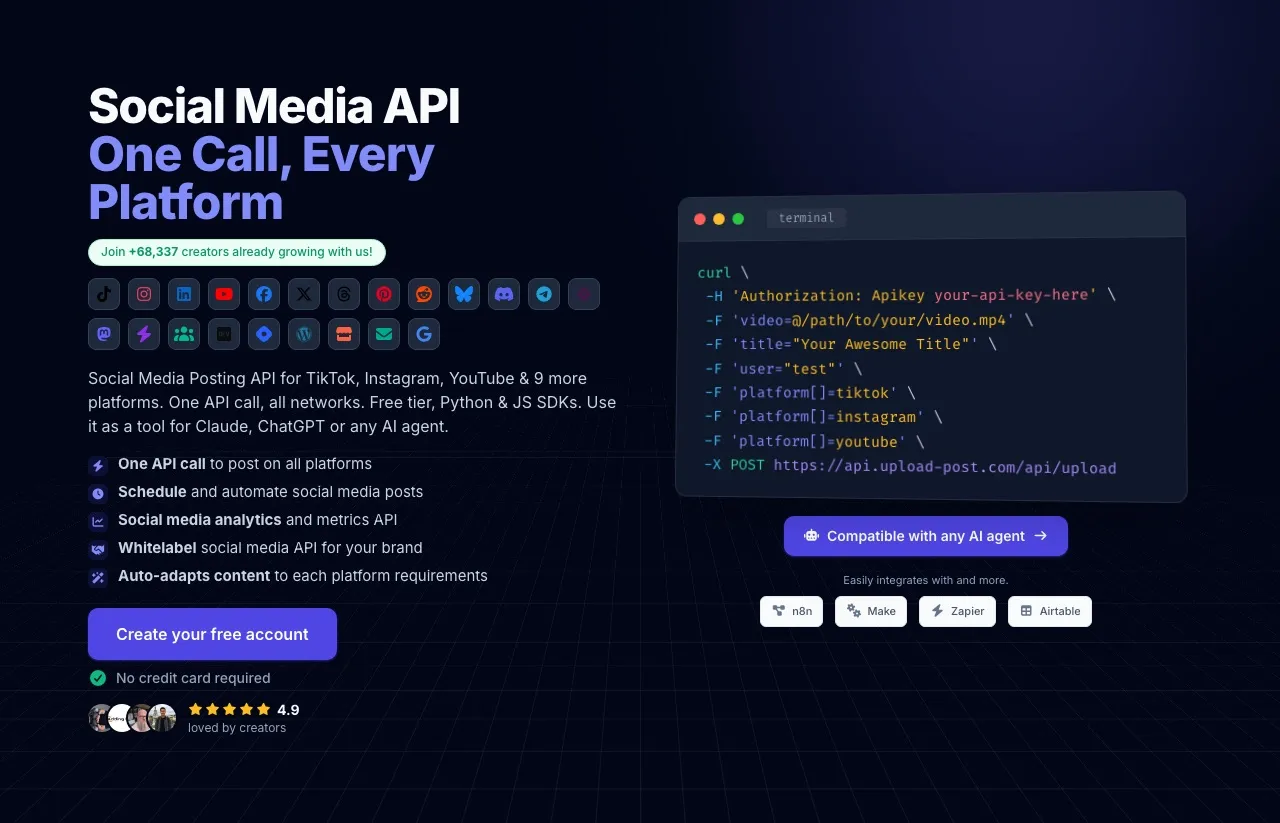
Upload-Post leads with a single API call and a free tier aimed at AI agents.
Upload-Post exists for the stage before you know whether the thing you are building works. It has a free tier with no card required and a hosted MCP server, which makes it the lowest-friction way to get an AI agent posting to a real account this afternoon.
It is not trying to be a full platform, and it should not be judged as one. Analytics are thin, the feature surface is narrow, and you will likely outgrow it. That is fine. It is a proving ground, and it is very good at being one.
Pros:
- Free tier with no card required
- Hosted MCP server, so an agent can publish with no glue code
- Fast to get running
Cons:
- Narrow feature set compared to everything else here
- Not built for managing a large account portfolio
Pricing: Free for 2 profiles and 10 uploads a month, no card. Basic $24/mo for 5 profiles, Professional $50 for 25, Advanced $147 for 75, Business $438 for 225, all billed monthly. Its own pricing page opens on the annual toggle and prints the annual rate with a monthly suffix, so the $16 you may see first is Basic billed yearly. I broke down its full ladder in 5 Best Upload-Post Alternatives.
Ideal for: Developers validating an agent workflow before committing to a platform.
Bottom line: Start here if you are not yet sure the project is real. The moment you pass a handful of accounts or need the posts written rather than just delivered, that is when the flat-rate options on this list start paying for themselves.
6. Ayrshare: Best for platforms embedding posting for isolated client profiles
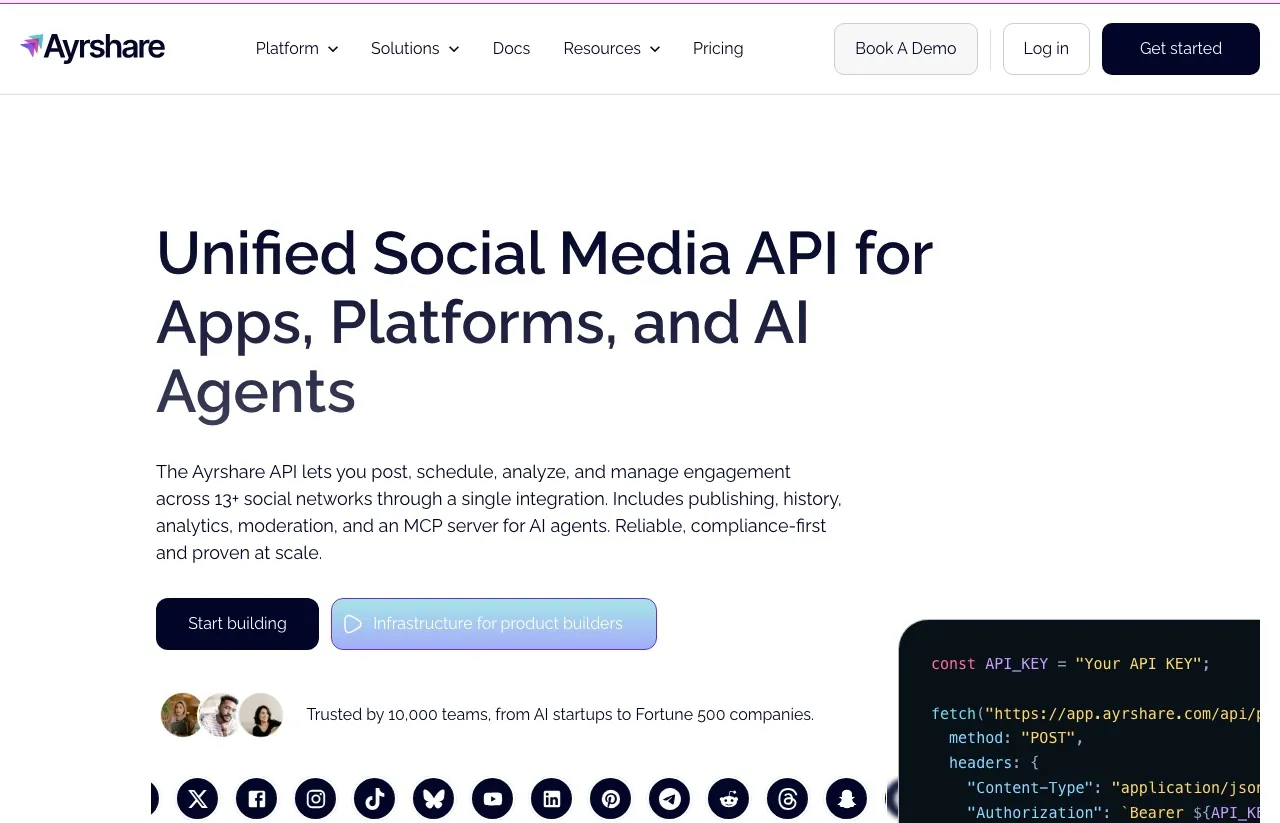
Ayrshare’s API is built around per-profile isolation for multi-tenant applications.
Ayrshare is the established choice when you are not managing accounts yourself but embedding posting inside your own product for hundreds of separate customers. Its per-profile token isolation is purpose-built for that, and it is the reason people pay its prices.
And they are prices. Premium is $149 a month, Launch is $299, and Business starts at $599. Read those cards carefully, because Ayrshare now markets them in accounts (up to 14, 140 and 420 respectively) while still billing by profile, and a profile is one client connecting up to 14 networks. Compare profiles to clients rather than to raw account counts.
One correction to something I wrote in an earlier version of this post: the multi-tenant piece people come to Ayrshare for, the profile endpoints and the JWT linking flow, is not on Premium. Ayrshare’s docs gate it to Launch and above, so the isolation model actually starts at $299 a month, not $149. Where the two models actually cross over comes down to how many networks each client uses. If you are one creator running your own channels, a single profile covers you and the question is whether $149 beats the alternatives. If you are a SaaS platform onboarding client accounts programmatically, the isolation model earns its cost. If Ayrshare is what you are actually weighing, I compared it against the field in the best Ayrshare alternatives.
Pros:
- Per-end-user token isolation designed for multi-tenant apps
- Long track record and thorough documentation
- Ships an MCP server
Cons:
- The most expensive entry point on this list by a wide margin
- Bills per profile, the same shape as the Zernio model you may be leaving
Pricing: Premium $149/mo, Launch $299/mo, Business from $599/mo. Per-profile rates fall from $7.99 to $1.99 on annual billing as you pass 500 profiles. The multi-tenant profile endpoints require Launch or above.
Ideal for: Companies embedding social posting inside their own product.
Bottom line: Correct for multi-tenant platforms, oversized for everyone else.
7. Mixpost: Best for buying software once instead of renting it
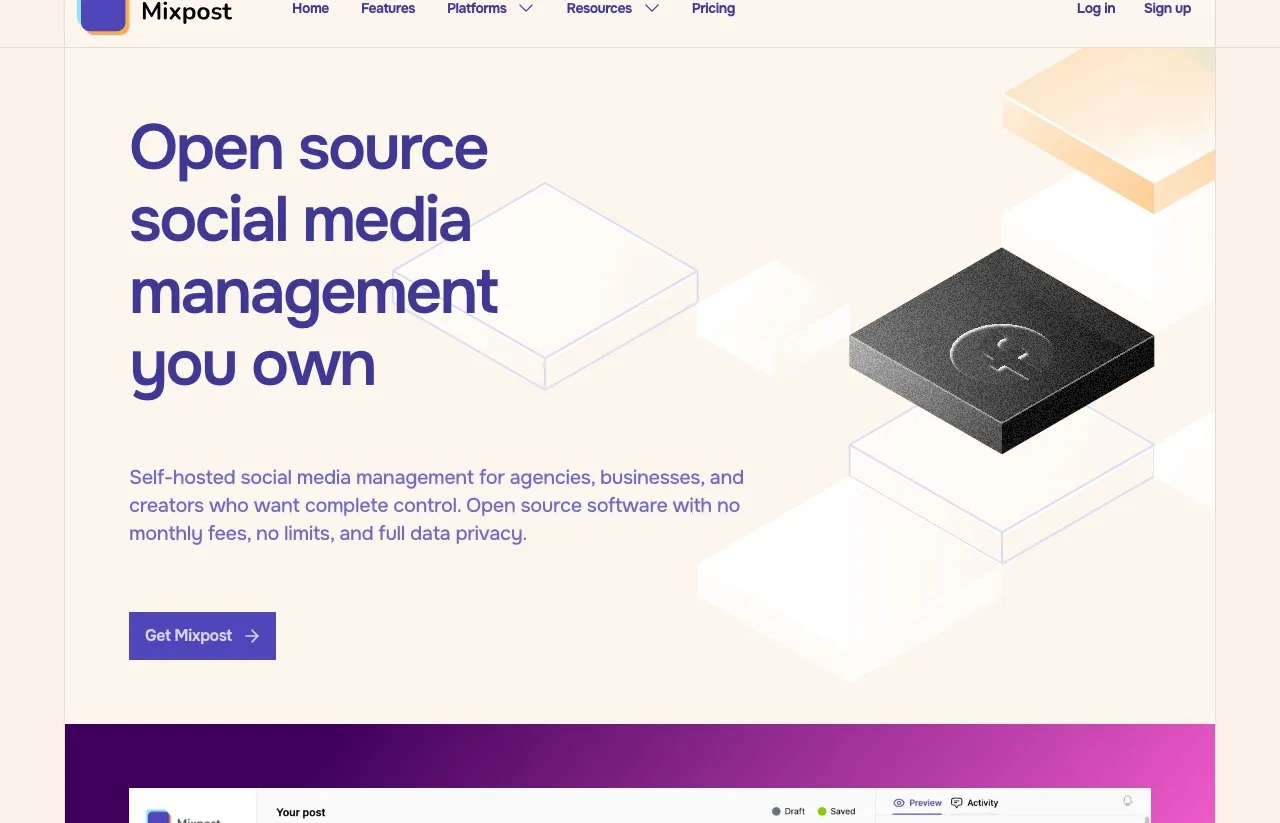
Mixpost sells a one-time license for self-hosted social media management.
Mixpost is the only option here with no subscription at all. Pro is $299 once, Enterprise is $1,199 once, and there is a free Lite edition limited to Facebook Pages, X, and Mastodon. You install it on your own server and the recurring cost goes to zero. For anyone who resents SaaS pricing on principle, that is a compelling structure.
The trade is the same one Postiz asks for, minus the open-source escape hatch. You run it, you patch it, and you handle every platform API change yourself. But there is no meter anywhere, which is the exact opposite of what sent you looking for Zernio alternatives.
Pros:
- One-time license, no recurring subscription
- Ships an MCP server on the Pro license
- Complete control over your data and tokens
Cons:
- Self-hosting work falls entirely on you
- No AI content generation
Pricing: Lite is free. Pro is $299 one-time, Enterprise is $1,199 one-time, both including a year of updates and a perpetual fallback license.
Ideal for: Technically comfortable operators who want to own their stack permanently.
Bottom line: The only genuinely meter-free option, if you will actually maintain it.
How I Chose These Zernio Alternatives
- The billing unit has to differ from Zernio’s. A tool that also charges per connected account is not an alternative, it is a rebrand of the same problem. That rule is why SocialAPI.ai is not on this list even though it shows up alongside these tools in search results. Its own FAQ says it “charges per connected social profile, not per request,” and its tiers are just profile-count buckets, so it is a cheaper instance of Zernio’s model rather than a different one. Its actual wedge is that reads are unlimited and free on every plan, which is a real advantage and a different article.
- It has to publish to a real spread of platforms, not two or three.
- Pricing has to be publicly verifiable, or I say so. I dropped one otherwise-strong candidate, bundle.social, because its pricing sits entirely behind a contact form. Upload-Post published its full paid ladder since I first ran this comparison, so the note that used to sit here about its unpublished rates is gone and the real numbers are in its entry.
- API or MCP access has to be genuine, since most people leaving Zernio are building something.
- I did the account math myself rather than repeating a competitor’s comparison chart.
Pricing was read off each tool’s own live pricing page on the day this published. I have not cited a star rating for any tool here, because the review pages I would source them from block automated checks and I will not quote a score I could not read myself.
How to Choose the Right Zernio Alternative
- If you run 7 to 20 or 27 to 40 social accounts and pay separately for a writing tool: Blotato, where the flat rate covers both. If those accounts belong to clients, running an AI social media agency covers the economics.
- If you have many accounts but low posting volume: PostPeer, which charges in credits rather than per account. To see exactly where Zernio’s own per-account curve peaks, see my Zernio pricing breakdown.
- If each of your clients runs several networks: Postproxy’s $49 Business tier, where a client is one billable group no matter how many platforms sit inside it. If each client is a single account, skip it, because the group model saves you nothing at that shape.
- If you would rather run the software yourself: Postiz for open source (how it stacks up against Zernio), or Mixpost to own a license outright.
- If you are still prototyping: Upload-Post’s free tier.
- If you are embedding posting for hundreds of client profiles: Ayrshare, and budget accordingly.
- If you have one to six accounts: stay on Zernio. At that size it is cheaper than everything on this list, and switching would cost you money. Revisit the question when you hit the seventh account, or sooner if you find yourself paying a second subscription to write the posts Zernio is publishing.
Sabrina’s Final Thoughts
The most useful thing I can tell you is where the lines actually cross, and there are more crossings than either of us would like. Zernio is cheaper below seven accounts, and I would not try to argue you out of it there. Blotato wins from seven to twenty. Zernio takes it back from 21 to 26, because our Creator plan starts before its ladder reaches $97. Blotato wins again from 27 to 40, and past forty Zernio pulls ahead for good.
Price is only half of it though. If you are also paying for something to write your posts and make your images, compare the combined bill rather than the publishing line alone, because that is the comparison that changed my own stack. Run your real account count through both quotes, and if the flat side wins, start with Blotato’s Starter plan.
Zernio Alternatives FAQs
What is the best Zernio alternative?
It depends on your account count. Blotato is the strongest pick for creators and small agencies in the 7 to 20 and 27 to 40 account bands, because $29/mo flat covers publishing plus AI writing, images, and video. PostPeer is better if you have many accounts but post infrequently, and Postiz is better if you want to self-host and are comfortable running a server.
Is Zernio free?
Yes, for your first two connected social accounts, with no credit card required. Beyond that it charges per account per month: $6 each for accounts 3 through 10, $3 each for 11 through 100, and $1 each above 100. X API charges are billed separately at X’s own rates.
Why did Late change its name to Zernio?
Late, which lived at getlate.dev, rebranded to Zernio. The company kept the same API, endpoints, and response schemas through the change, so existing integrations continued working. If you find older reviews or comparisons filed under Late, they describe the same product.
Does Zernio have an MCP server?
Yes. Zernio hosts an MCP server at mcp.zernio.com/mcp with a large tool library that works with Claude Desktop, Cursor, and other MCP clients. Blotato, Ayrshare, Postiz, Mixpost, and Upload-Post all ship MCP servers too, so this is no longer a feature that separates one from another. I catalogued which are hosted and which you run yourself in the best social media MCP servers.
How many platforms does Zernio support?
Zernio’s own surfaces no longer agree, so I will not print a single number. Its llms.txt file says 15 platforms in one line and 16 further down the same file, and its agent page says 16. The count has been drifting upward on the marketing pages, so if a specific channel is the reason you are switching, confirm that one channel in the API docs rather than trusting the headline. Either way the coverage is broader than most alternatives here, including Blotato’s nine platforms.
Does Zernio’s inbox really cover every platform?
No, and Zernio’s own two surfaces disagree on this. Its agent page says you can read the inbox and reply “on any platform that has one,” while its rate card lists messaging on 8 platforms and comments and reviews on 9. TikTok appears on neither list. If inbox coverage is why you are choosing a tool, price it against the rate card rather than the marketing line.
Which Zernio alternative is cheapest?
Postiz is cheapest if you self-host, since the software is free and you pay only for your server. Among hosted options, Upload-Post’s $24/mo Basic and Blotato’s $29/mo flat plan are the lowest paid entry points, and both Upload-Post and PostPeer have a free tier. Blotato’s $29/mo is the better value from seven to twenty accounts if you also need content generation.