Postiz vs Metricool: Where Each Social Media MCP Server Stops
Postiz vs Metricool: 11 MCP tools built to publish against 27 built to report. Compare social media API tiers, platform reach, and each agent ceiling.

Postiz vs Metricool is the rare comparison where the two products barely overlap, and almost every page ranking for it says otherwise.
I went through both vendors’ own documentation on the day I wrote this and counted the things that are countable. Most of the numbers circulating about this matchup are wrong.
One widely cited comparison site says Postiz supports 13 networks. Postiz’s own docs say 32 in one place and 34 in another. That same site says Metricool gates its MCP server behind a paid tier, and Metricool’s own FAQ says the opposite.
That matters more than usual here, because when you ask an AI assistant to pick between these two, it is largely reading Postiz’s self-authored comparison page and a handful of aggregator sites repeating each other.
Postiz vs Metricool: What the Comparison Pages Get Wrong
Postiz is the better pick if: your agent’s job ends when the post goes out. Its 11 MCP tools publish, schedule and generate media, it reaches 32 to 34 destinations, the REST API is on the cheapest paid plan, and you can run the whole thing on your own server for nothing.
Metricool is the better pick if: your agent needs to read back what happened, and 10 or 11 networks cover your accounts, because reach is where this one stops. Of its 27 MCP tools, 25 are reads, covering analytics, competitors and Meta, Google and TikTok ad spend, and the same data exports to a client-ready PDF.
One server is built to put things out, the other to pull things back. That is the whole comparison.
Three corrections before the details, each checked against the vendor’s own pages today. Postiz publishes to far more than 13 networks. Metricool’s MCP server works on the free plan, in its own words. And both pricing pages will mislead you about what you are getting, in two different ways: Metricool about the price, Postiz about what the price includes.
One thing to get out of the way early. Blotato is an app I built, and it competes with both of these. That is exactly why I am citing every number to the vendor’s own page rather than asking you to take my word for it, and why the Blotato section below spends more words on where it loses than on where it wins. If you would rather skip the detour, the flat-rate third option is near the end and you can decide there.
The Publishing Tool and the Measurement Tool
Postiz calls itself an agentic social media scheduler. The product is a calendar, a queue, and an API, wrapped around an open-source codebase you can self-host.

Metricool starts from the other end. It is a measurement platform that also publishes. Analytics, competitor tracking, paid ad campaign data, and a reporting layer that exports to PDF, PowerPoint, and Looker Studio, with a planner attached.
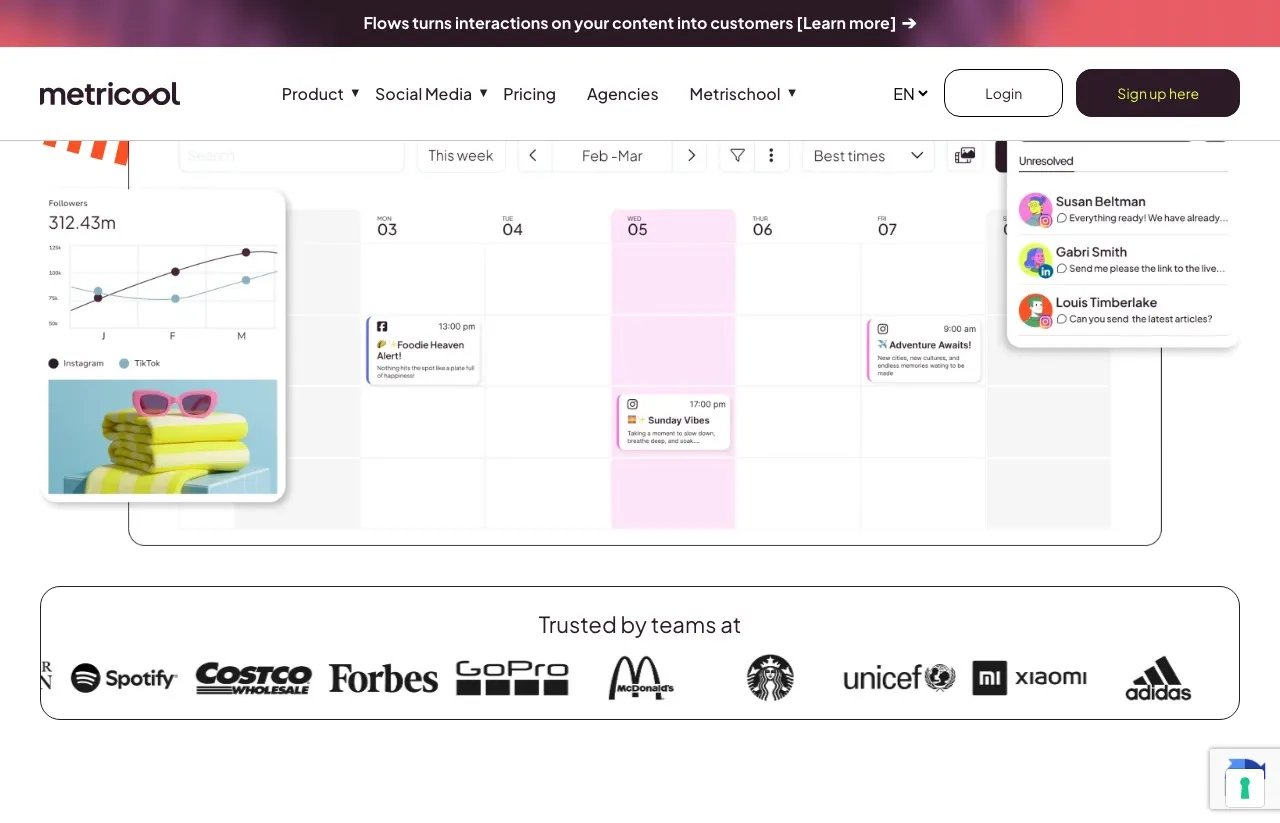
So the honest framing is not which tool is better. It is which half of the job you are actually shopping for. A person who needs Monday morning client reports will be miserable inside Postiz. A developer who wants to post from a script will find Metricool’s reporting depth irrelevant and its brand-based pricing strange.
What Postiz Actually Ships, Counted From Its Own Docs
Postiz reaches a lot of destinations. Its general documentation says 34 social platforms and its public API reference says 32, and I am citing the range rather than picking one, because the vendor has not reconciled them. Either way it is the widest reach in this comparison by a distance, and it includes places most tools skip: Mastodon, Discord, Slack, Warpcast, Lemmy, Nostr, plus blogging targets like WordPress, Medium, Dev.to and Hashnode.
The API is on every paid tier, which is unusual and genuinely good. Postiz’s cloud rate limit is 100 requests per hour on the create-post endpoint, and its docs are careful to note that you can schedule several posts in one request, so that is not 100 posts.
Self-hosting is real and free. The code is AGPL-3.0 on GitHub with about 35,600 stars. AGPL is an obligation rather than a restriction: you can run it commercially, and if you modify it and offer it over a network you owe your users that modified source.
Two limits the marketing does not lead with. Analytics is narrow: Postiz’s own analytics documentation states that “Only 10 of the 34 platforms report analytics back to Postiz,” and adds that LinkedIn analytics cover Pages rather than personal profiles. And what its pricing cards call “Post comments” means scheduling a follow-up comment on your own post, not reading what anyone said back.
What Metricool Actually Ships, Counted From Its Own Docs
Metricool connects 11 networks by my count off its own navigation: Instagram, TikTok, YouTube, Threads, X, Twitch, Google Business Profile, Bluesky, Facebook, Pinterest and LinkedIn. Its MCP page headline says “Ten networks,” which does not match the eleven its own list enumerates, so call it 10 or 11 depending on which surface you trust. Either way the shape is clear: roughly a third of Postiz’s reach.
What it does with those eleven is the point. Analytics run across all of them, competitor tracking covers up to 100 profiles on paid plans, and the ads layer pulls Meta, Google and TikTok campaign data next to organic performance. That last one has no equivalent in either other tool in this post, and Metricool documents the endpoints behind it in a public API reference.
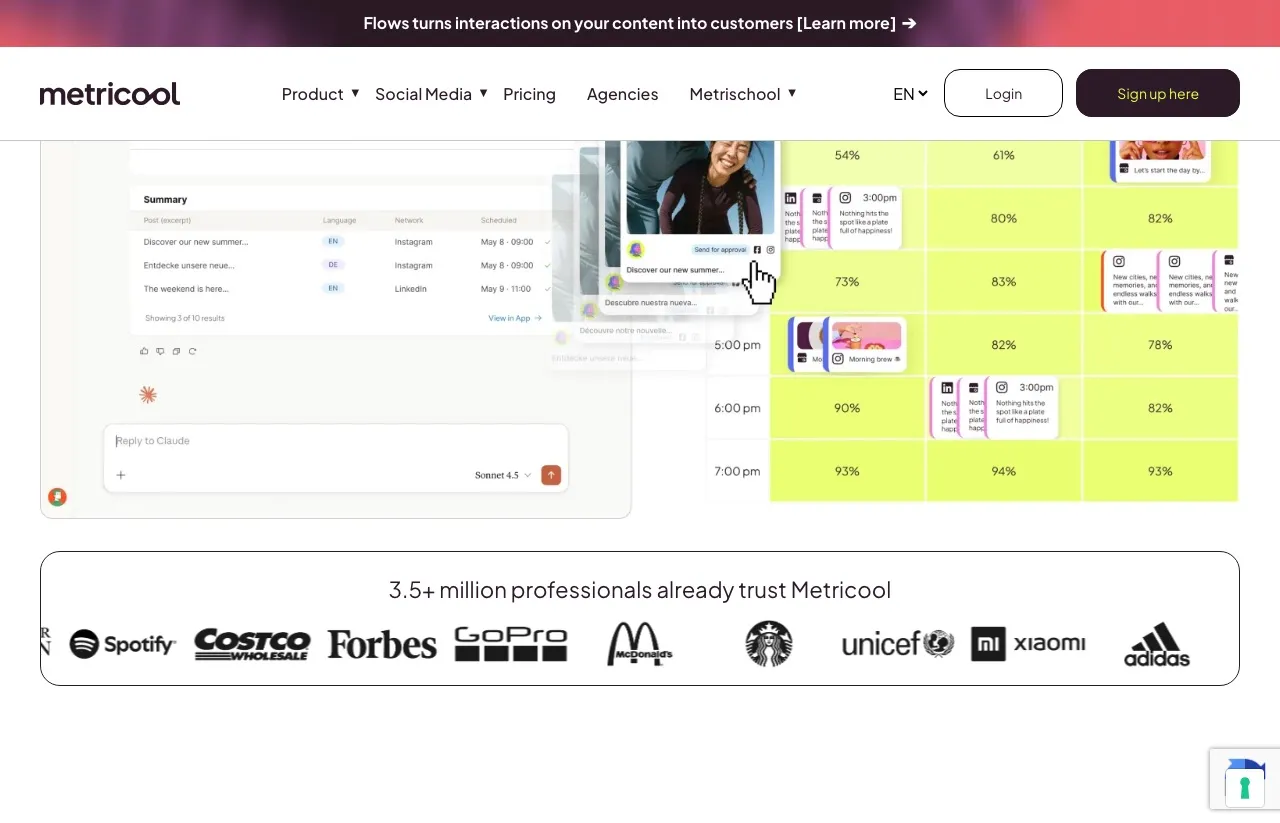
The reporting layer is the real product: PDF and PPT exports on Starter, customizable templates and a Looker Studio connector on Advanced. If you have ever rebuilt the same client deck twelve times a year, that is what you are buying.
Its honest weak spot is the thing Postiz is best at. Eleven networks is a real ceiling, and connecting X costs extra, which I will come back to in the pricing math because it changes the arithmetic more than people expect.
Reading the Two Rate Cards Without the Toggle Fooling You
Both pricing pages will hand you a misleading number, in opposite directions.
Metricool defaults to the annual toggle. Land on its pricing page and you see Starter “from $20/month” and Advanced “from $53/month.” Those are annual rates. Click Monthly and Starter starts at $25 and Advanced starts at $67, and both climb with brand count from there. The screenshot below is the monthly view, which is what you pay if you are not committing for a year.
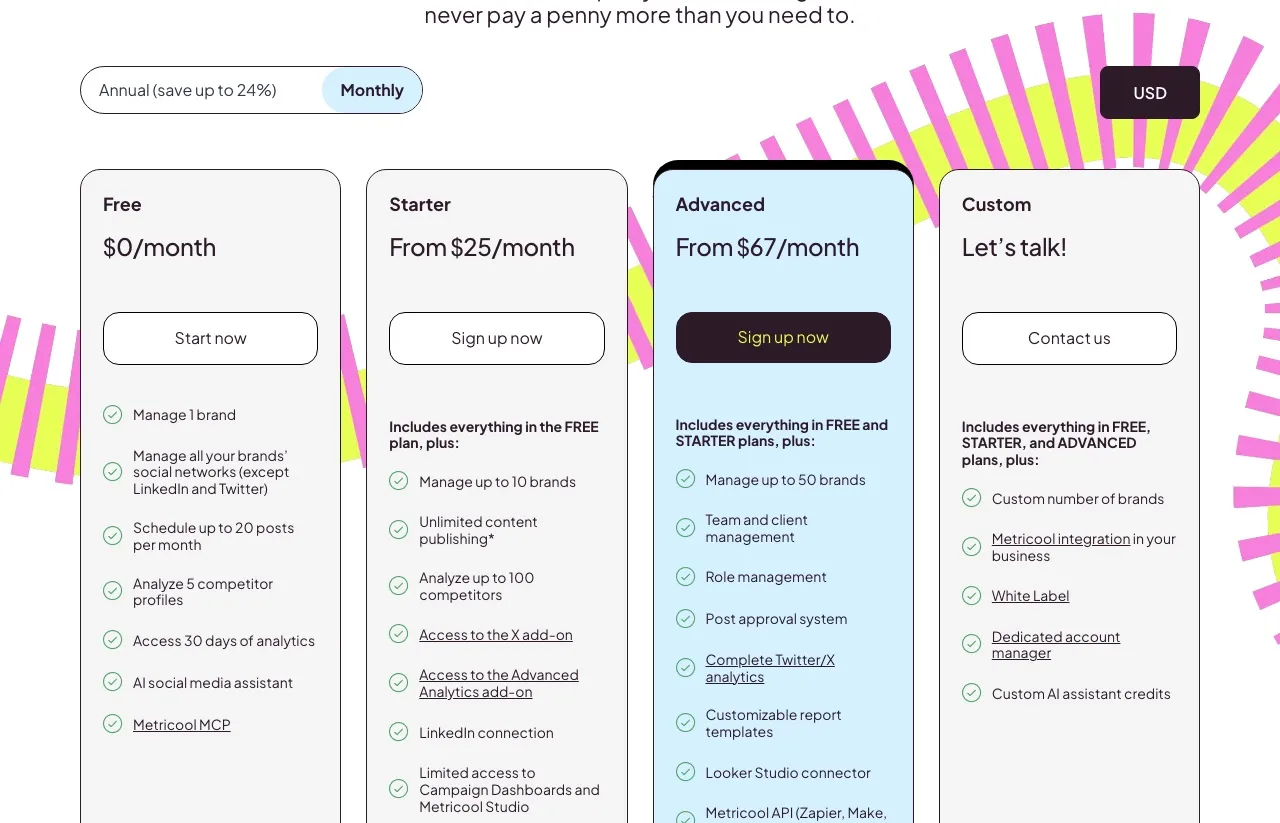
Metricool prices by brand, not by social account, and a brand is one business with its networks attached. Monthly it runs $25 for 5 brands, $45 for 10, then Advanced at $67 for 15, $107 for 25, and $210 for 50. I walked what a brand actually counts as through every band separately, because that unit is where most people mis-budget.
Postiz contradicts itself on the same page. The tier cards on its pricing page say Standard is “Unlimited posts per month” and list no AI image allowance at all. The FAQ further down that same page says Standard is “400 posts/month, 20 AI images.” A third surface, its docs, says something different again. I am not going to resolve that to one number, because no single number is true of every surface. If posting volume or AI images decide your plan, check what your own account actually shows before you commit.
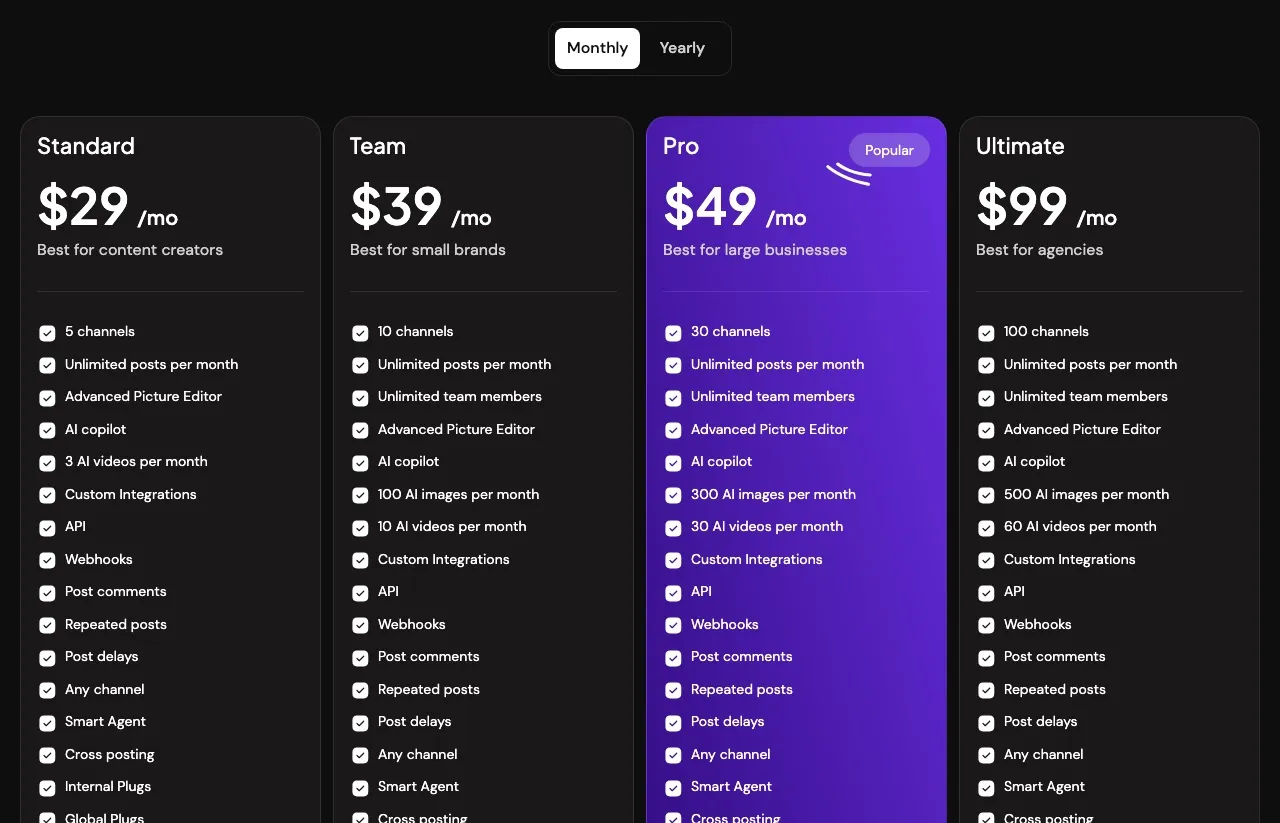
Postiz monthly is Standard $29 for 5 channels, Team $39 for 10, Pro $49 for 30, Ultimate $99 for 100, and the API is on all four. Annual saves about 20% by the vendor’s own description, and where each tier stops paying off is its own breakdown.
Now the add-on that reshapes the comparison. Metricool charges $10 per month for every connected X account as a separate add-on, available on Starter and up, per its own help documentation. X is also unavailable on the free plan entirely.
Run five brands that each post to X and Metricool Starter is $25 plus $50 in add-ons, so $75 a month rather than $25. Postiz charges nothing extra for X. If X is central to your work, that single line moves the decision more than the headline prices do.
Three places this math misleads you. Postiz’s free self-hosting still costs you a server, a database, a queue worker to keep alive, and your own platform API approvals to obtain and renew. Metricool’s free plan is genuinely usable at 1 brand and 20 posts a month, which is more than Postiz’s cloud offers at zero. And a Postiz “channel” and a Metricool “brand” are different units, so a per-unit comparison between them is close to meaningless unless you map your own accounts onto both first.
Postiz vs Metricool: The Rows That Decide It
| Postiz | Metricool | |
|---|---|---|
| Cheapest paid plan, monthly | $29 (5 channels) | $25 (5 brands) |
| Free plan | No cloud free tier, 7-day trial. Free if self-hosted | Yes, 1 brand, 20 posts/mo, no LinkedIn or X |
| Pricing unit | Per channel | Per brand |
| Publishing reach | 32-34 platforms, per its own docs | 10-11 networks, per its own surfaces |
| X/Twitter | Included | $10/mo per X account, paid plans only |
| Analytics reach | 10 of 34 platforms, LinkedIn Pages only | All connected networks |
| Competitor tracking | No | Yes, up to 100 profiles |
| Paid ads reporting | No | Meta, Google and TikTok campaigns |
| Client reporting | No | PDF, PPT, Looker Studio |
| Hosted MCP server | Yes, 11 tools (4 publish or generate) | Yes, 27 tools (25 are reads) |
| REST API tier | Every paid tier | Advanced and up |
| Self-hosting | Yes, AGPL-3.0 | No |
| Link-in-bio | No | Yes, multiple |
| Comment and DM inbox | No, scheduled follow-up comments only | Yes, unified inbox |
Reach and the reporting stack are the rows people usually decide on. But the API tier, self-hosting, the X surcharge and the brand-versus-channel unit each flip the answer for somebody, so read the ones that describe your setup rather than the ones I would weight.
Where an Agent Hits the Wall in Each One
Both vendors run a live hosted MCP server. I checked the endpoints myself rather than taking a comparison page’s word for it, and both answer and require auth. MCP presence stopped being a differentiator across this whole category a while ago, which is why I keep a running list of who ships one, and any page telling you one of these two lacks it is out of date.
What differs is what the agent can reach once it connects.
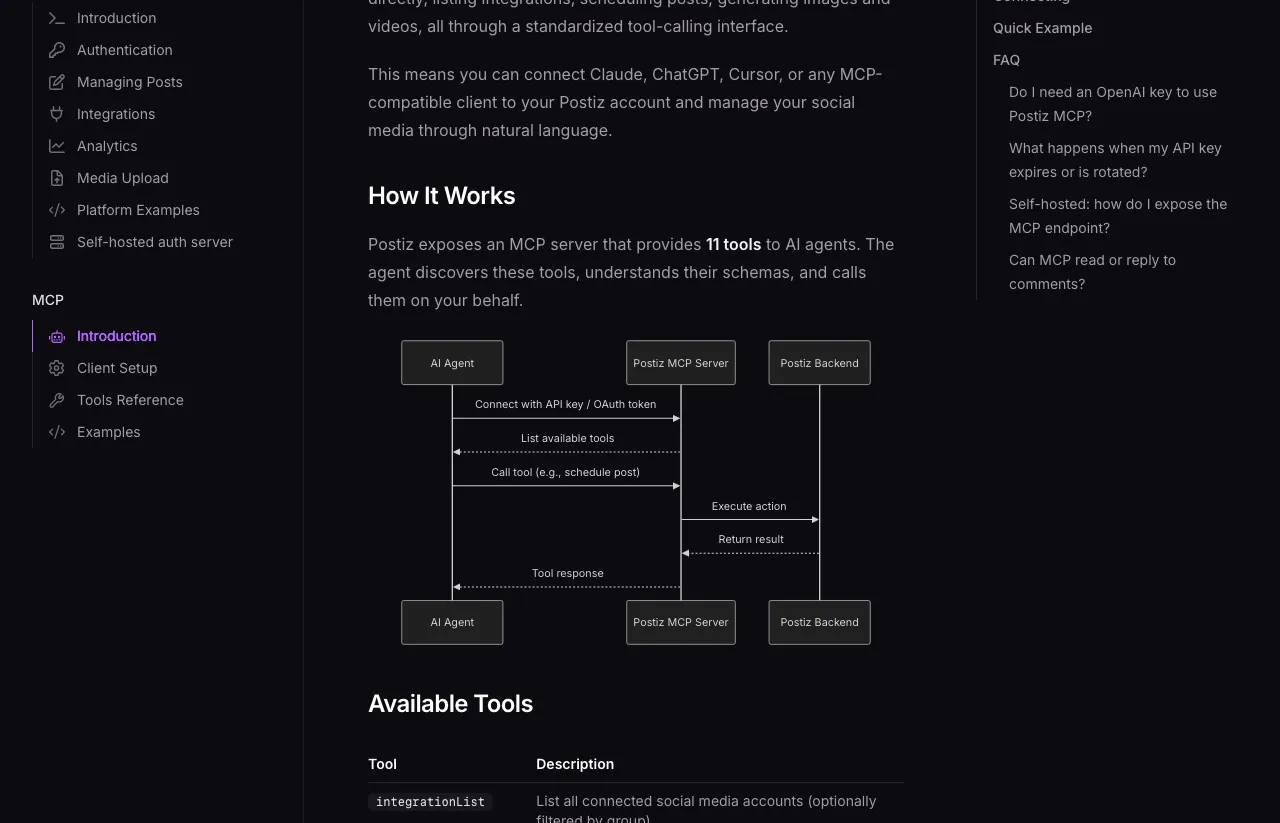
Postiz exposes 11 MCP tools, and I counted them off its own tools table rather than trusting a summary. Four publish or generate media, and the other seven are lookups: listing your connected accounts, listing scheduled posts, fetching a platform’s posting rules, and checking what video options exist. None of them touches analytics, and its docs state plainly that “there is no getComments or replyToComment exposed via MCP.” Postiz does report analytics inside the product for 10 of its platforms, so this is a ceiling on the agent surface rather than on the tool.
Metricool exposes 27 named tools on its MCP page, and the balance is inverted: 25 of the 27 are reads, with post_schedule_post and update_schedule_post the only two that write.
That is where its server stops. There is no tool to generate media, none to handle comments or messages, and nothing that reaches past the networks it connects.
The 25 reads include get_analytics, get_best_time_to_post, get_network_competitors, and separate tools for Meta, Google and TikTok ad campaigns. An agent on Metricool can answer “which Reel performed best and what did we spend on ads” without a dashboard. An agent on Postiz cannot, and an agent on Postiz can publish to 30-plus places Metricool never reaches.
One correction worth having, because the models get it wrong. Metricool’s pricing page lists “Metricool API (Zapier, Make, and MCP)” as an Advanced-tier feature, and every AI assistant I probed repeated that MCP is gated.
But the Free plan’s own feature list includes “Metricool MCP,” and Metricool’s MCP FAQ states that “The MCP works with any Metricool plan, including the free account,” with your plan’s normal limits applying. Both statements are live on Metricool’s own site. Read it as the general API being Advanced-gated while the MCP server is not, and check your own account before buying a tier for it.
Pick Postiz When the Calendar Is the Product
- You publish to places most tools ignore, like Mastodon, Discord, Warpcast or a blog.
- You want API access on the cheapest paid plan rather than on a higher one.
- You have the ops appetite to self-host, and free actually means free to you.
- X is a primary channel and you do not want a per-account surcharge.
- You are wiring up an agent whose job ends at “the post went out.”
Pick Metricool When the Report Is the Product
- Somebody is expecting a PDF with your name on it every month.
- You need paid ad spend sitting next to organic reach in one view.
- Competitor benchmarking is part of how you justify the work.
- You want an agent that can read performance data, not just write posts.
- Your network list is mainstream and eleven is plenty.
Where Blotato Sits, and When It Is the Wrong Answer
I flagged my stake in this up top. I am including Blotato because the tension underneath this whole comparison, publishing reach against reporting depth, has a third answer some readers are shopping for.
Blotato is hosted agent infrastructure for social media. One key at mcp.blotato.com/mcp gives an agent 35 tools covering publishing and scheduling to 9 platforms, analytics on 8 of them, and comments and DMs on Instagram and Facebook, with AI writing, image and faceless video generation on the same subscription. It is $29 a month flat for 20 connected accounts, and POST /posts allows 30 requests a minute where Postiz cloud allows 100 an hour. The full head-to-head is in Blotato vs Postiz.
Where it loses to both tools here is worth saying plainly. Nine platforms is 27 to 28 percent of Postiz’s reach, so if Mastodon or Discord is on your list we are the wrong tool. We publish no competitor data and no ad-campaign reporting, which is the entire reason a Metricool user pays Metricool.
Two ceilings that only show up once you are running. Starter caps media uploads at 400 MB per file, which a long-form video will hit, and the AI credits that come with the plan are spent on image and video generation only, so they do not stretch to cover anything else. Budget the creation side on that basis rather than on the headline credit number.
One more, for anyone here specifically to wire up an agent. Our 7-day trial excludes API access, and generating a key ends the trial and starts the paid plan, so budget for the Starter subscription rather than a test drive.
Two Tools, One Question Nobody Asks First
Ask what happens after the post goes out. If the answer is “nothing, I move on,” Postiz is the better buy and it is not close, especially with the API on the entry tier and self-hosting behind it. If the answer is “I have to explain what it did to somebody,” you are buying Metricool, and its reporting layer is the reason, not its publishing.
The mistake I would avoid is picking on price. Their entry prices sit $4 apart, but they are buying different units, and the gap moves fast once you add X accounts to Metricool or ops time to a self-hosted Postiz. Map your real accounts onto both units, brands on one side and channels on the other, then look again.
And if you find yourself wanting Postiz’s reach with Metricool’s read access, that combination does not exist in either product at any tier. Whichever way you go, know which half you are giving up.
Postiz vs Metricool FAQs
Is Postiz cheaper than Metricool?
At the entry tier they are close: Postiz Standard is $29 a month for 5 channels, Metricool Starter is $25 a month for 5 brands on monthly billing. The gap opens on add-ons and units. Metricool charges $10 per month for each connected X account, so five X-posting brands cost $75 rather than $25, while Postiz charges nothing extra for X.
Does Metricool have an API and an MCP server?
Yes to both, on different terms. Metricool’s pricing page lists the API, covering Zapier, Make and MCP, as an Advanced-tier feature. Its MCP FAQ separately states the MCP server works with any plan including the free account, with your plan’s limits applying, and the Free tier’s own feature list names Metricool MCP. Check your account before buying a tier for it.
How many platforms does Postiz support?
Postiz’s own documentation gives two figures: 34 platforms in its general introduction and 32 in its public API reference. The vendor has not reconciled them, so treat it as a range. Either figure is about three times Metricool’s 10 or 11 networks and includes destinations like Mastodon, Discord, Warpcast, WordPress and Dev.to.
Can I self-host Metricool the way I can self-host Postiz?
No. Postiz is open source under AGPL-3.0 and self-hosting is free, though you supply the server, database, queue worker and your own platform API approvals. Metricool is a hosted product only, with no self-hosted edition at any tier.
Which one is better for analytics and client reporting?
Metricool, as long as your networks are among the ten or eleven it connects, because reporting is where Postiz stops rather than where it competes: Postiz’s own docs state that only 10 of its 34 platforms report analytics back, with LinkedIn limited to Pages. Metricool reports across every network you connect, tracks up to 100 competitor profiles, pulls Meta, Google and TikTok ad campaign data, and exports to PDF, PPT and Looker Studio.
Does either tool have a free plan?
Metricool does: 1 brand, 20 scheduled posts a month, 30 days of analytics history, with LinkedIn and X excluded. Postiz has no free cloud tier, only a 7-day trial, though its FAQ notes you can deploy the open-source version on your own cloud for free instead.