Blotato vs Postiz: Better Option for Automating Social Media?
Blotato vs Postiz comes down to one thing: will you run the social media server yourself? Both ship MCP, so hosting, agent reach, and API caps decide.
Blotato vs Postiz is a rare comparison where the pricing pages agree and almost nothing else does. Both start at $29 a month. Both ship a REST API. Both run an MCP server so Claude can post for you.
On a spec sheet they look like the same product. They are not.
Postiz is AGPL-licensed open source you can download and run on your own server for nothing. Blotato is hosted software you rent. That single difference decides almost everything else, including who should ignore the rest of this post and go install Postiz right now.
In category terms: Postiz is an open-source social media management platform, run on Postiz Cloud or your own server, built for technical users and teams who want to own the stack. Blotato is hosted agent infrastructure for social media: one API and one MCP server that an AI agent uses to publish, schedule, read analytics, and answer comments and DMs, with AI creation on the same flat subscription.
One thing before we start, because a lot of comparison posts in this category quietly get it wrong. Postiz has a real API on its entry tier, an official MCP server, an n8n node, and a CLI. If you came here expecting me to argue that the open-source option is technically behind, that is not the honest read.
Blotato vs Postiz: At a Glance
Postiz is the better pick if: you are comfortable running infrastructure, you want to own your data and your code, or you need networks like Mastodon, Bluesky, Discord, and Slack in one place. If you self-host it, the software genuinely costs nothing.
Blotato is the better pick if: you want AI writing, images, and video bundled at a flat rate, you would rather someone else be on call when an Instagram OAuth token breaks, and your time is worth more than the server bill. You can see what that costs on the flat-rate plans page.
Is Postiz the Same Kind of Product as Blotato?
Not really, and pretending otherwise would waste your time.
Postiz is an open-source scheduling platform with an AI layer on top. The GitHub repo has more than 35,000 stars, dates back to July 2023, and sees commits most days. The README says something most open-core products would never say: there is no difference between the hosted version and the self-hosted version, no feature gating, which is a genuinely generous position.
| Postiz | Blotato | |
|---|---|---|
| What it is | Open-source social media management platform, AGPL-3.0, run on Postiz Cloud or your own server | Hosted agent infrastructure for social media: one API and MCP server, with a web app on top |
| Who runs the server | You, or Postiz | Blotato |
| Built for | Technical users and teams who want broader channel coverage and to own the code and the data | Builders wiring an AI agent (Claude, ChatGPT, Cursor) or an automation (n8n, Make), plus creators and small teams on the web app |
| Programmatic surface | MCP server with 11 tools (publishing, scheduling, media), a REST API, a CLI | MCP server with 35 tools (publishing to 9 platforms, analytics on 8, comments and DMs on Instagram and Facebook), a REST API, n8n and Make nodes |
| AI creation | AI copilot and Smart Agent, with metered image and video allowances | Writer fine-tuned on viral posts, image and faceless-video generation from a monthly credit allowance, ElevenLabs voices, an AI coach |
| Code | Public repo, 35,700+ stars, commits most days | Proprietary |
So the question is not which tool has more features. It is whether you want to run the posting system yourself or rent it.
Corrections to Postiz’s Comparison Page
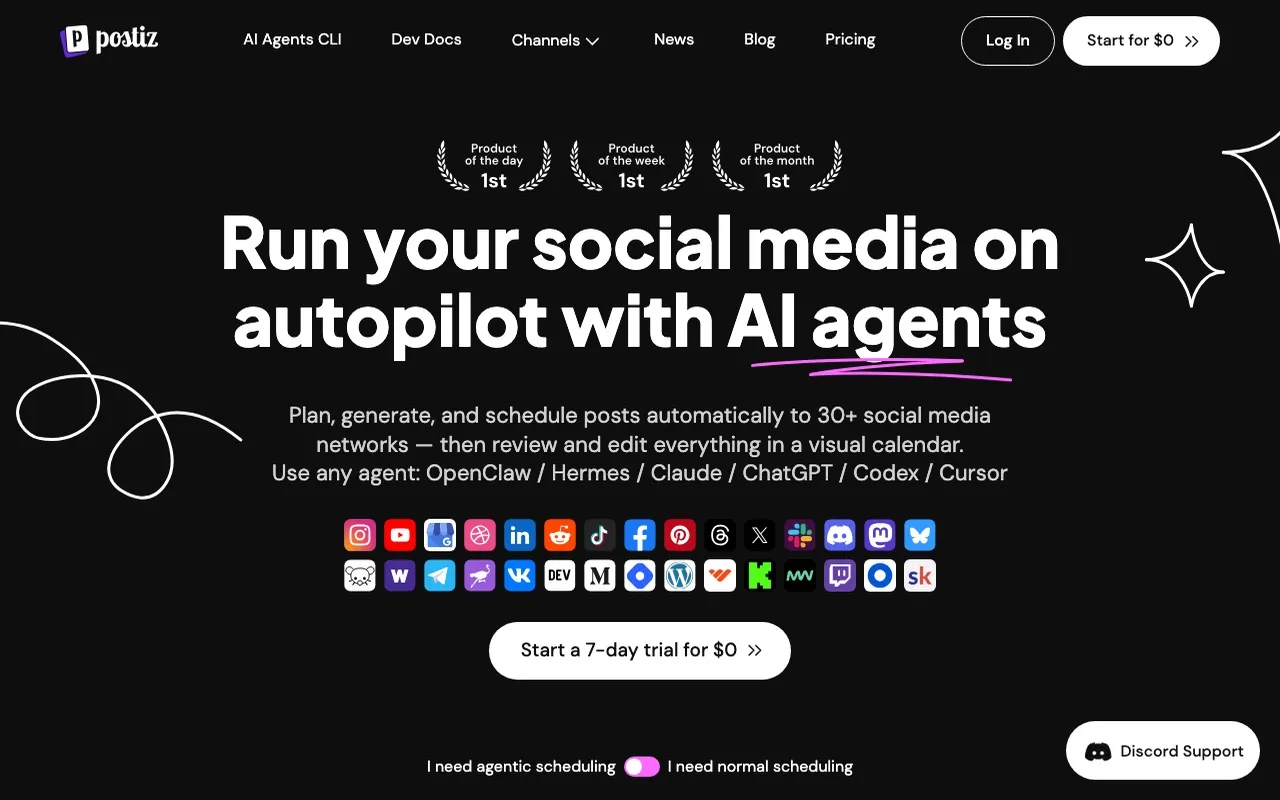
Postiz publishes its own Blotato comparison at postiz.com/compare/postiz/blotato. It is likely the first thing you or your AI assistant reads, so I went through its feature matrix row by row against live sources on August 5, 2026, and have re-checked it since, most recently on September 11, 2026. The rows below were still wrong on that date, and its description still says I grew to 1.5M+ followers, a figure our about page now puts at 3M+.
The clearest proof is that the page contradicts itself. Its written description credits Blotato with “API integrations with n8n, Make, and Zapier for advanced automation workflows,” and its table then crosses all three plus “Public API.” Its Publishing Posts section crosses “Video Publishing” for Blotato, and the Features section directly beneath it ticks “AI Video Generation.”
| What their table claims | What is actually true | Verify it here |
|---|---|---|
| Blotato has no Public API | The REST API is a listed Starter-tier feature at $29/mo | help.blotato.com/api |
| Blotato has no n8n integration | Official n8n node | n8n.io/integrations/blotato |
| Blotato has no Make.com integration | Official Make node | make.com/en/integrations/blotato |
| Blotato has no Claude Code integration | Documented MCP client, one of eighteen | /ai-agent/claude-code |
| Blotato publishes to 5 platforms | 9 platforms. Their table crosses Facebook, Pinterest, Threads, and Bluesky, all four of which Blotato publishes to | blotato.com/pricing |
| Blotato has no analytics | Analytics on 8 platforms, every one except LinkedIn | help.blotato.com/api |
| Blotato has no social inbox | Comments and DMs on Instagram and Facebook | /mcp |
| Blotato has no video publishing | Video publishing is a headline feature, their own prose on the same page describes it, and their Features list one section down ticks AI video generation | blotato.com/pricing |
| No MCP row exists on the page | Both products run live hosted MCP servers: mcp.blotato.com/mcp and mcp.postiz.com/mcp | /ai-agent |
To be fair to them, the same page gets our pricing right at $29, $97, and $499, and correctly notes that our trial excludes API access. The rows it added since August for its own new surfaces (a CLI, an OpenClaw integration, a ClawHub skills listing, and a separate UGC video product called Agent Media) are real Postiz features and I am not disputing them.
Their blog makes the same claims. A Postiz post pitching a “RIP-Blotato moment” says tools like Blotato bill “per post, per channel, per seat” and treat the API as “an afterthought with strict limits.” Blotato’s pricing is flat, publishing never draws down credits, and the publish limit is documented in the open, in the section below.
Technical Users Who Enjoy Running Their Own Stack
Postiz is built for developers, and it does not hide that. It is built by Gitroom, with Nevo David among its active maintainers, and the whole product assumes a reader who is comfortable with a terminal.
The platform coverage is the standout. Its own docs state it supports 34 platforms, including Mastodon, Bluesky, Discord, Slack, Telegram, Farcaster, and Nostr, plus blog and newsletter targets like WordPress, Medium, and Dev.to. If you live in the fediverse or you want to push the same update to Discord and a blog at once, there is not much competition.
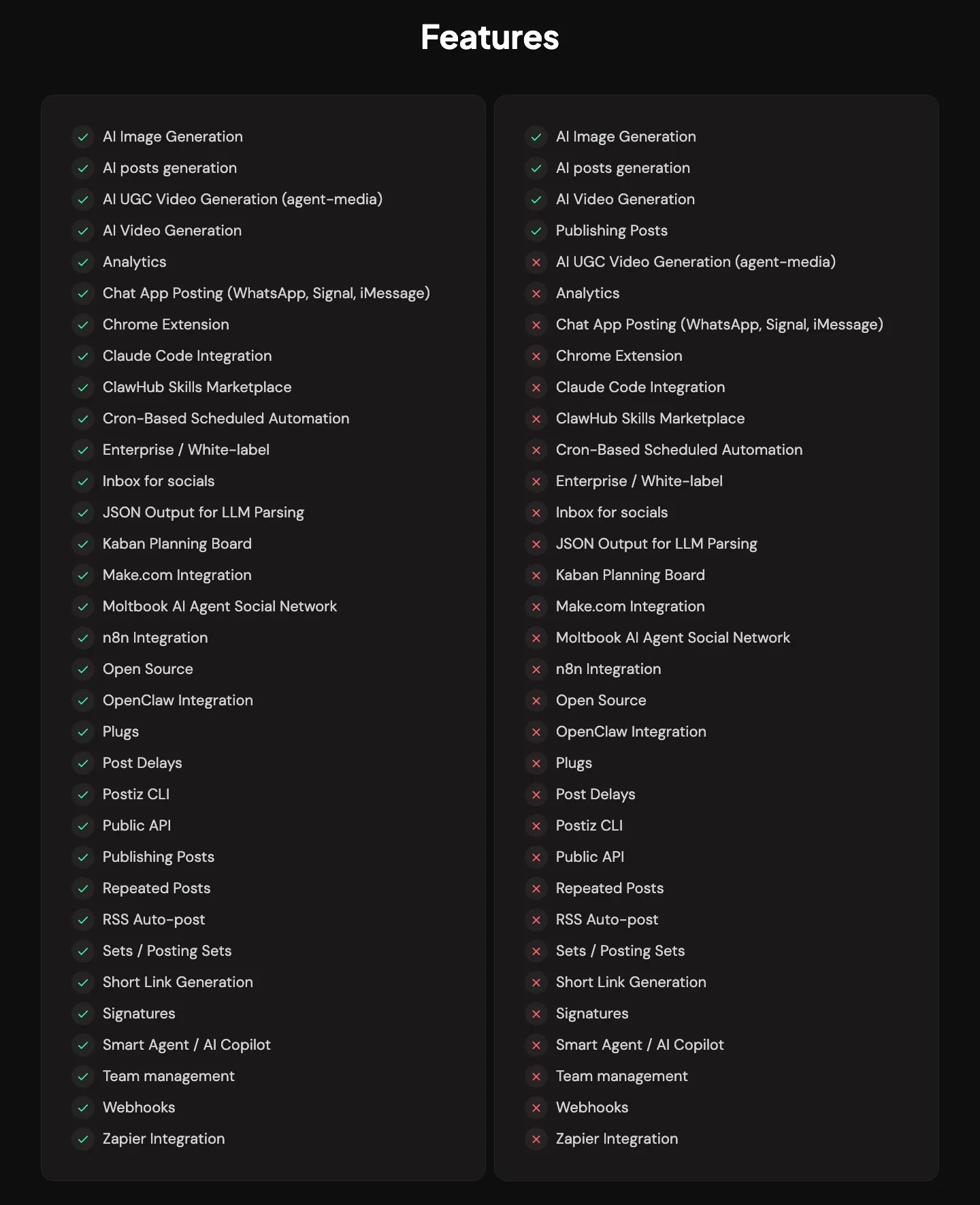
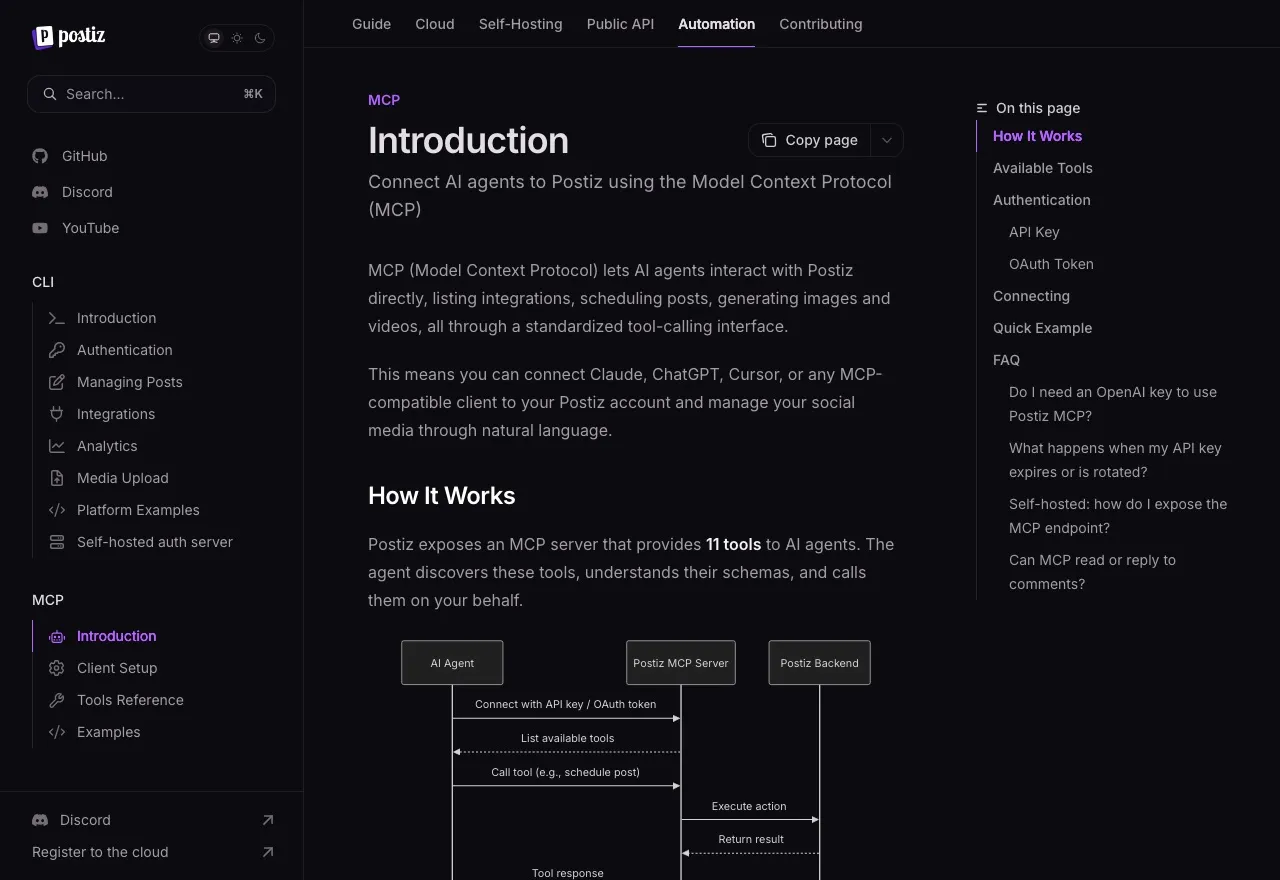
The AI-agent story is real too. The homepage now lists OpenClaw, Hermes, Grok Bot, Claude, ChatGPT, Codex, and Cursor as agents that can drive it. Its MCP server exposes eleven tools covering scheduling, image generation, and video generation, and the API is on the $29 Standard tier rather than gated behind an enterprise call.
There is also a CLI (npm install -g postiz) with an installable agent skill (npx skills add gitroomhq/postiz-agent), and every CLI command returns JSON, which is the right design for an agent. One line on their agent page is more candid than most vendors manage: “Please make sure there is always a human in the loop.”
Two more facts for a technical buyer. The trial and the self-hosted build both include the API and MCP, with nothing programmatic held back for a higher tier or a paid license the way Mixpost does it. And you own your data: the database is yours, which matters for anyone with a compliance requirement.
Builders Who Want the Whole Loop Behind One Key
I am involved with Blotato as a creator and tester, so I will keep every number in this section checkable.
Blotato is built for the person wiring an agent, not the person maintaining a posting server. Point Claude Code, Cursor, or any of eighteen documented clients at mcp.blotato.com/mcp and the agent gets 35 named tools: it lists your connected accounts, publishes or schedules to 9 platforms, polls the post’s status until it is live, pulls analytics on 8 of those platforms, and reads and answers comments and DMs on Instagram and Facebook, with reply-only DM automation on top. The same surface is a REST API with an agent-readable reference, plus official n8n and Make nodes, and the subscription costs the same whether the agent posts ten times a month or a thousand, inside the per-account caps I list below.
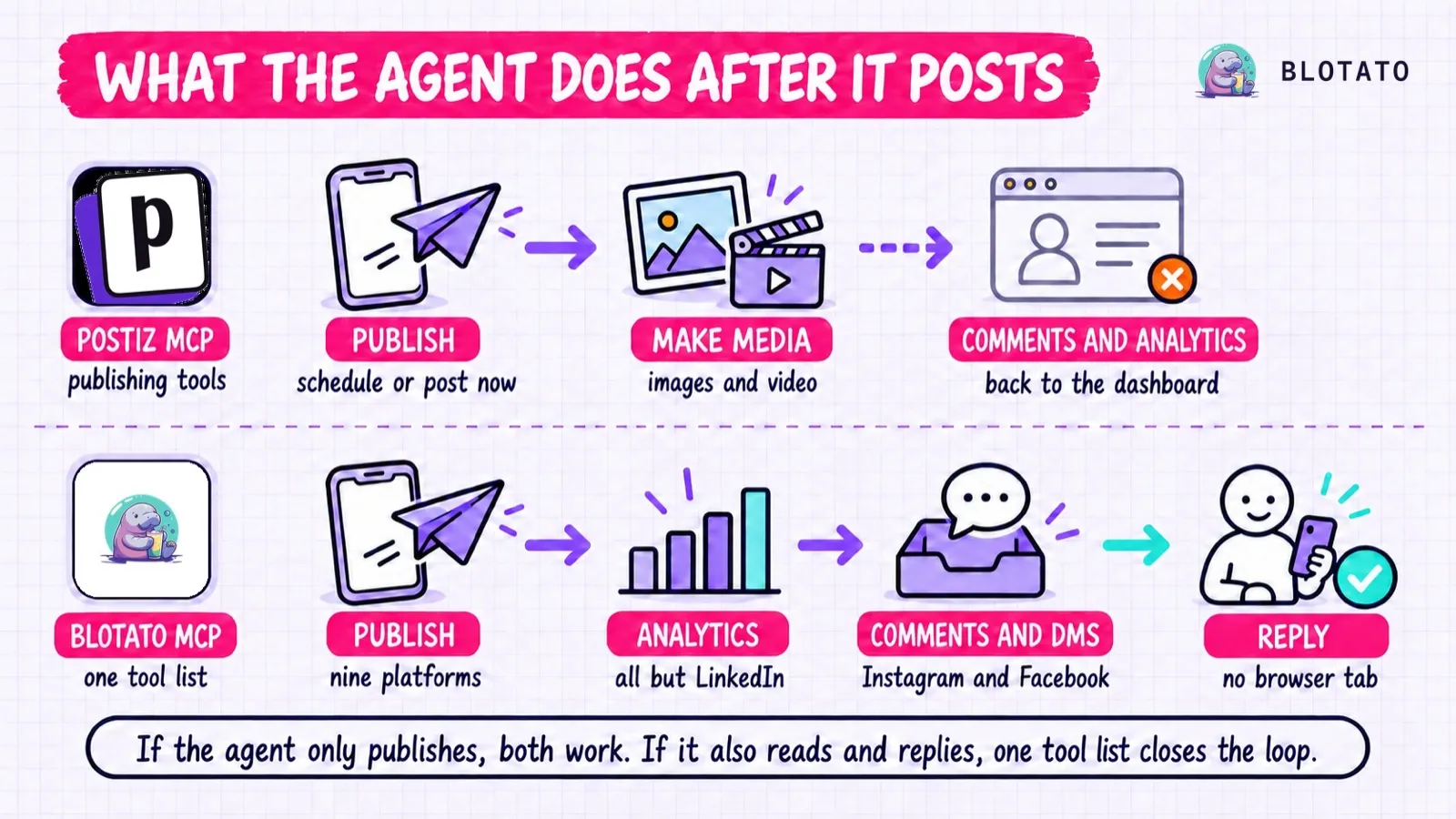
That last leg is the difference for a builder. Postiz’s own MCP documentation is blunt about it: there is no getComments or replyToComment tool, comment replies have to be triggered in the Postiz interface, and none of the eleven tools touches analytics, which Postiz reports for 10 of its 34 platforms through the other surfaces. Blotato is the pick if your agent needs to publish, check the numbers, and answer a reply inside one tool list, and the 9 platforms cover your stack. If your inbox lives on X or LinkedIn, that engagement surface is ours to widen and it is not there yet.

Postiz vs Blotato: Side by Side
| Category | Postiz | Blotato |
|---|---|---|
| Pricing model | Flat per plan, by channel count | Flat rate |
| License | AGPL-3.0 open source | Proprietary, hosted |
| Self-hosting | Yes, free | No |
| Free plan | No (7-day trial, self-host is free) | No (7-day trial, cancel anytime) |
| Cheapest paid tier | $29/mo (5 channels) | $29/mo (20 accounts) |
| Annual billing | $278 / $374 / $470 / $950 a year by tier | About 17% off the monthly rate |
| Posts per month | ”Unlimited” on the tier card and in its docs; its own pricing FAQ says 400/mo on Standard | No monthly cap; per-account daily caps apply |
| Platforms | 34 per its docs, including blog and newsletter targets | 9 |
| AI text writing | AI copilot and Smart Agent, all tiers | Unlimited |
| AI image generation | Metered. Its plans doc and pricing FAQ say 20/mo on Standard; the Standard tier card lists no image allowance at all | From the monthly credit allowance, 1,250 credits on Starter |
| AI video generation | Metered (3/mo on Standard) | Faceless video from the same credit allowance, plus ElevenLabs voiceovers |
| Public REST API | Yes, on every tier | Yes (full API on paid plans) |
| API rate limit | 100 create-post requests/hour on cloud, same on every tier | 30 requests/minute on the publish endpoint, plus per-account daily caps |
| MCP server | Official (mcp.postiz.com/mcp), 11 tools, included on every plan | Hosted (mcp.blotato.com/mcp), 35 tools, paid plans |
| What the MCP tools cover | Publishing, scheduling, media generation. No comment or analytics tools, per Postiz’s own docs | Publishing and scheduling on 9 platforms, analytics on 8, comments and DMs on Instagram and Facebook |
| Analytics | 10 of its 34 platforms report metrics, in the app, the REST API, and the CLI | 8 of 9 platforms (LinkedIn returns nothing yet), in the app, the REST API, and MCP |
| Comments and inbox | Schedules follow-up comments on your own posts; replies to incoming comments happen in the Postiz UI | Reads and replies to comments and DMs on Instagram and Facebook; reply-only DM automation, 1,000 active contacts a month on Starter |
| n8n / Make nodes | n8n node, partner-built and verified by n8n; no Make node listed | Official nodes for both |
| Mobile app | No | No |
| Trial | 7 days, API included | 7 days (excludes the API) |
Two notes on reading it. Postiz counts channels and Blotato counts connected accounts, so check each vendor’s rules for how Pages are counted before comparing the tiers. And on the platform row, Postiz’s docs say 34 on one page and 32 on another, its marketing says 30-plus, and the list includes blog targets, so 34 against 9 is not quite apples to apples.
The API Ceiling: 100 an Hour Against 1,800
The publish request ceiling is 18 times higher. If you are building an agent that posts on a schedule, read this one before the others, because it is the one item here a developer building for volume cannot shrug off. Postiz’s public API docs cap the create-post endpoint at 100 requests per hour on cloud. It is not an account-wide throttle, it lands on the exact call an agent makes most, and it does not scale with your plan. Paying $99 for Ultimate does not lift it. Self-hosted installs sit at 90 an hour, adjustable with the API_LIMIT variable, which means the fix for the ceiling is to go run the server yourself. Their docs do suggest batching several posts into one request to stretch it. Blotato’s publish endpoint is documented at 30 requests a minute on every paid plan, and I keep the published caps for the rest of the category in one rate-limit comparison.
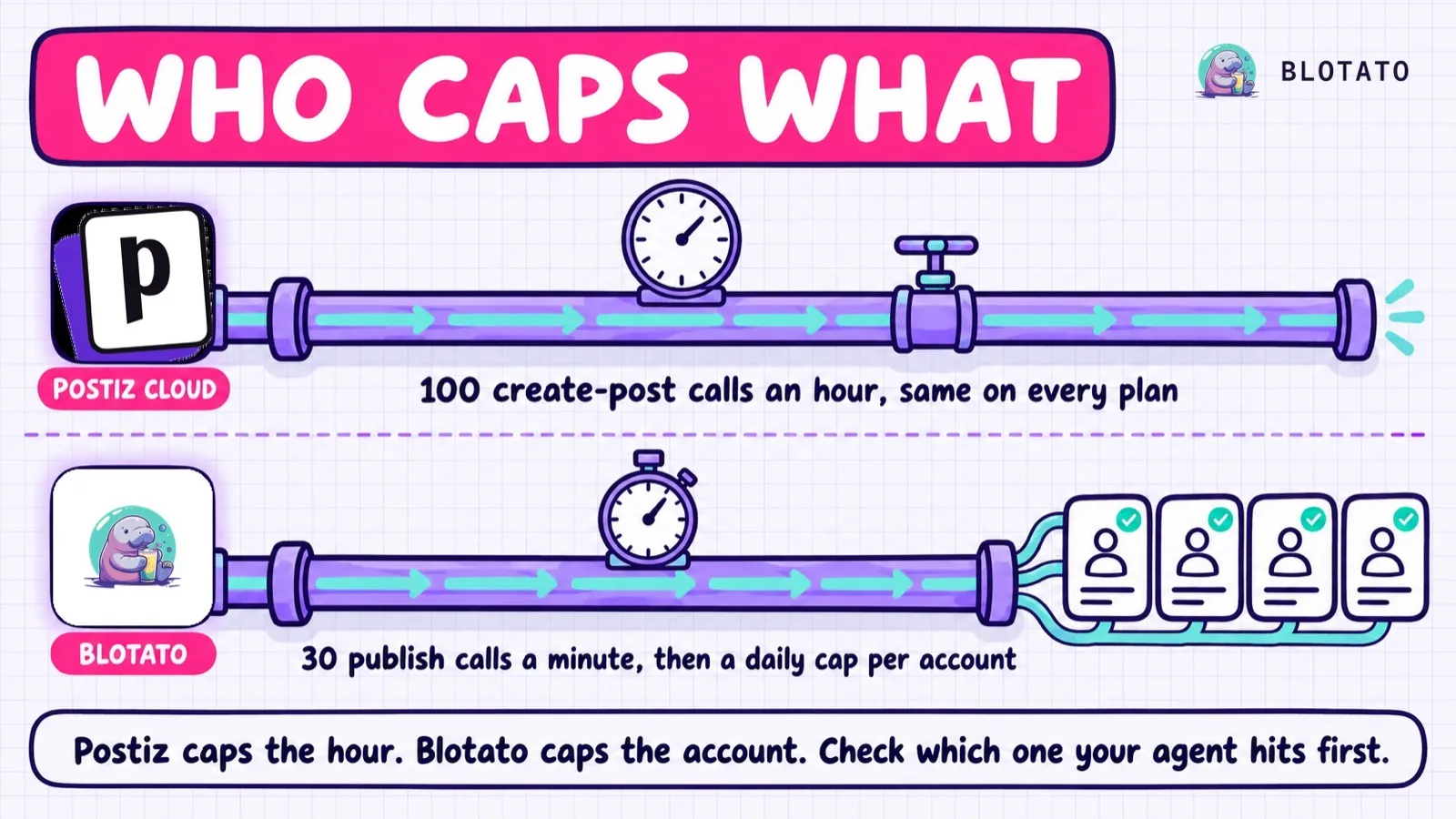
For a person posting a few times a day, this is invisible. For a Claude agent working a backlog, or an agency pushing scheduled content across 40 client accounts, an hourly wall you cannot buy your way past is an architectural constraint.
Blotato’s ceilings are per account, not per hour, and you should know them too. Beyond the API throttle, Blotato enforces its own anti-spam caps that are stricter than the platforms’ published limits: 50 posts per Instagram account per day, 50 per LinkedIn profile and per company Page, 25 per Facebook Page, 10 pins per Pinterest account, and on Starter 3 TikTok accounts at 10 posts each plus 10 YouTube uploads per channel per day. They exist to keep an agent from getting your accounts flagged. If your agent’s workload is a handful of accounts posting many times an hour, Postiz’s cap bites first. If it is many accounts posting a few times a day, ours is unlikely to.
The AI allowance is the clearest gap at the entry tier. Here is what each $29 plan actually includes for creation, from the two vendors’ pricing pages, Postiz’s plans doc and Blotato’s billing help page.
| At $29 a month | Postiz Standard | Blotato Starter |
|---|---|---|
| AI writing | AI copilot and Smart Agent | Unlimited, on a model fine-tuned on viral posts |
| AI images | 20 credits a month per its plans doc and pricing FAQ, though the same plans doc marks the image generator No on Standard and the tier card lists no image row | Drawn from 1,250 monthly credits, and the pricing page puts one credit at roughly one image or a few seconds of video |
| AI video | 3 a month | Faceless video, drawn from the same 1,250 credits |
| Voiceovers | None documented | ElevenLabs voices, which the billing help page states draw no credits |
| Design and templates | Canva-like editor | Template library for carousels, infographics and video |
If AI creation is why you are shopping, the two $29 plans are not comparable products.
Someone else owns the OAuth problem. When Instagram changes its API, that is my problem to solve, not yours. On Postiz Cloud it is Postiz’s problem too, which is fair to say. On a self-hosted install, every provider you enable is configured by hand in your .env file, and the docs are explicit that none are configured by default.
Channel Counts, Self-Hosting, and What Free Really Costs
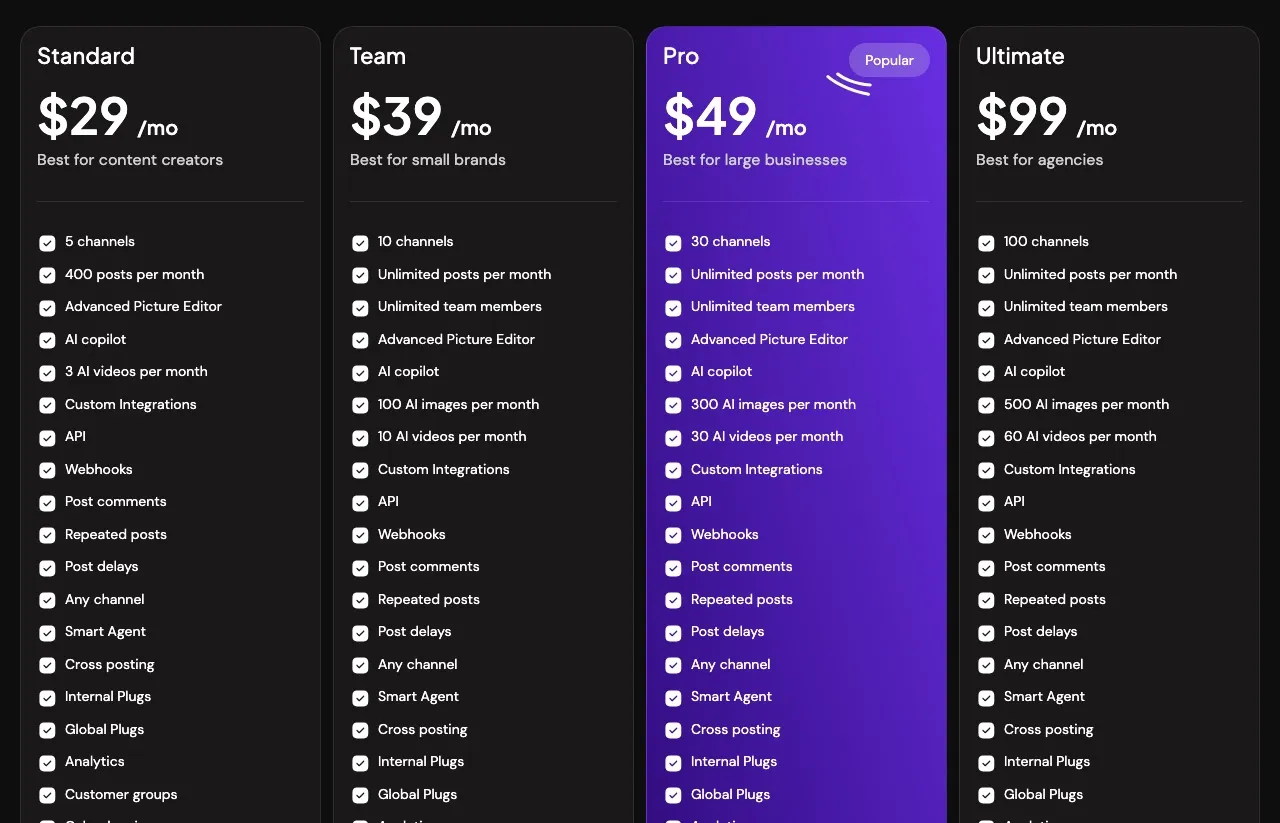
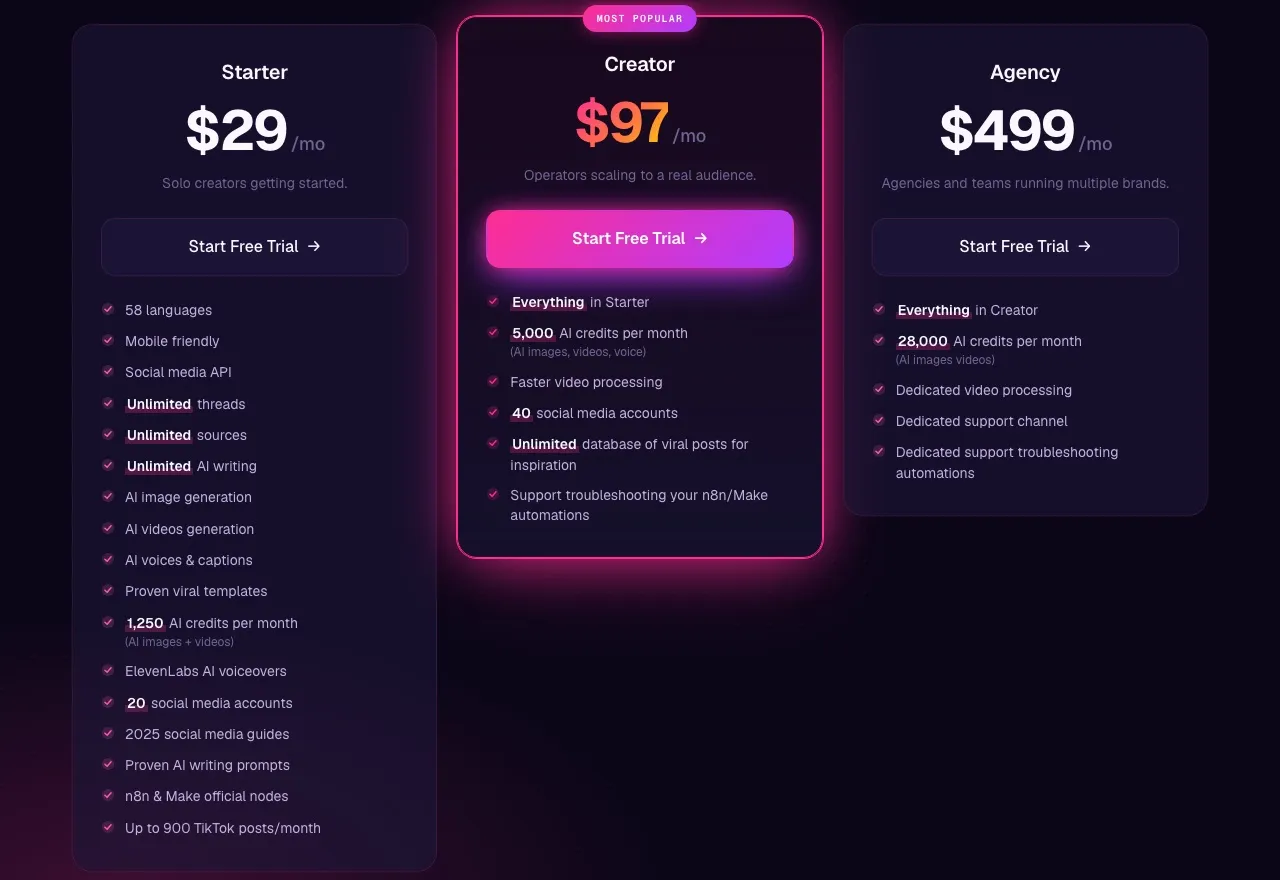
| Plan level | Postiz | Blotato |
|---|---|---|
| Entry | $29/mo, 5 channels | $29/mo, 20 accounts |
| Mid | $39/mo, 10 channels | $97/mo, 40 accounts |
| Higher | $49/mo, 30 channels | $499/mo, Agency, 100 accounts |
| Top | $99/mo, 100 channels | Not applicable |
| Self-hosted | Free (AGPL, your infrastructure) | Not offered |
Here is where the entry-tier argument stops working:
If you self-host, Postiz costs nothing in license fees and the comparison is over. On the software bill alone, a $5 VPS beats $29 a month. If you enjoy running your own infrastructure, that is your answer.
If you need more than 20 accounts, Postiz gets cheaper fast. Postiz Ultimate is $99 a month for 100 channels. Blotato’s answer at that scale is the $499 Agency plan. On raw account count, Postiz wins that matchup decisively.
If you barely touch AI, or you need Mastodon, Discord, or Slack, Blotato does not have an answer. No pricing table fixes a platform we do not support, and bundled AI you will not use is surface area you are paying for.
The Part Nobody Puts in the Comparison Table
Open source shifts the failure to you, and that is worth pricing honestly. I have written up the real cost of self-hosting versus a managed API at length, but the short version lives in the issue tracker, which is the one source competitors never read.
One thread titled “Could not add provider”, still open, has drawn 59 comments from people who cannot connect the accounts they installed the tool to reach. Connecting each platform is the step self-hosters configure by hand, and it is where a fair number of them get stuck.
The one worth reading is issue #832, closed now: Instagram posts were never marked as published, so the worker retried in a loop, and the user flagged the risk of Instagram disabling the account as a bot. One report, since resolved, not a verdict. But it is the honest shape of the trade: when you run the software, the retry loop is yours to catch, and the fix arrives when a maintainer gets to it. Every issue linked here is public because Postiz develops in the open, which is more transparency than most hosted vendors offer.
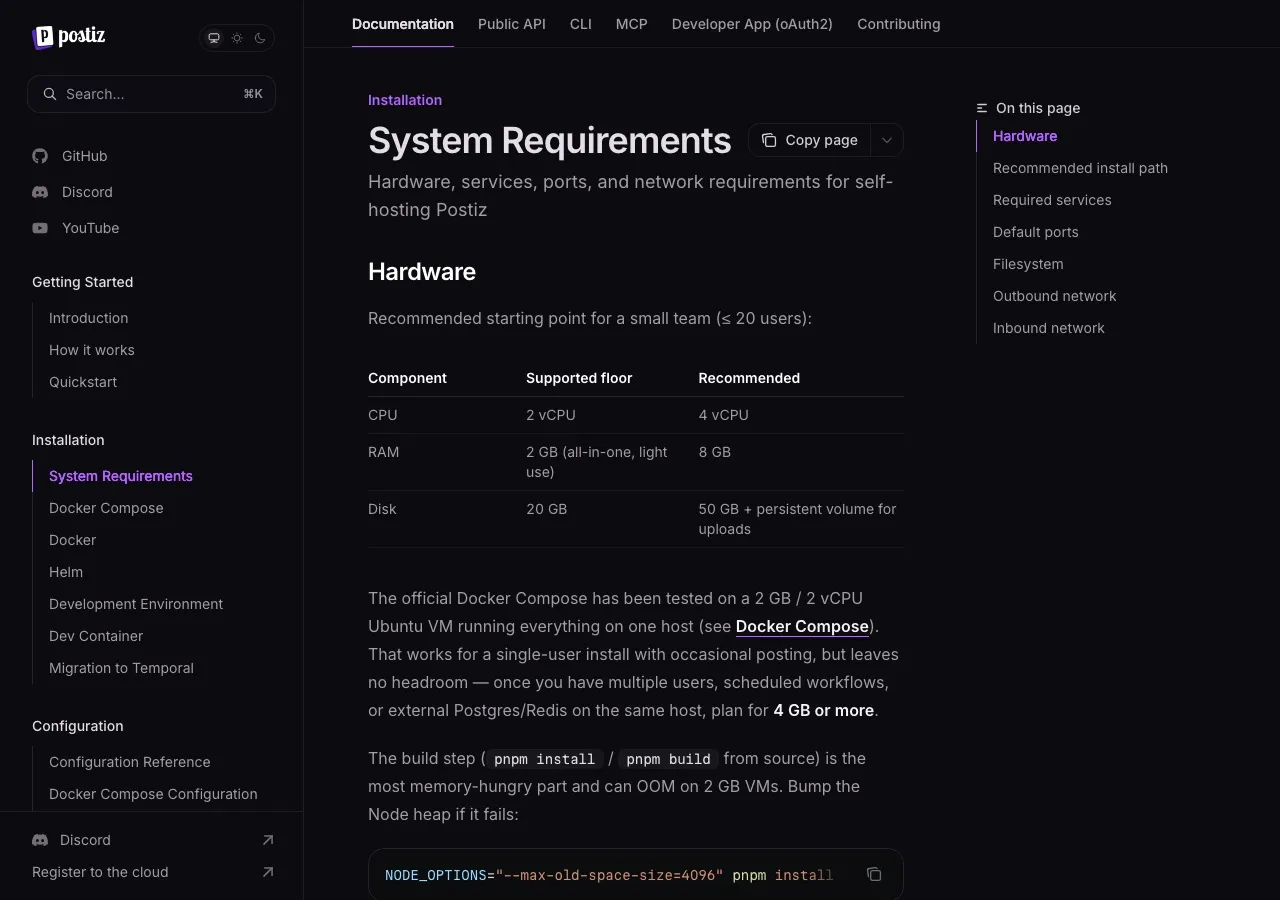
Postiz recommends 4 vCPU and 8 GB of RAM for a small team, plus PostgreSQL, Redis, and Temporal, though the official Docker setup is tested on a 2 GB VM. One more thing if you plan to self-host commercially: Postiz relicensed to AGPL-3.0 in January 2025. If you modify it and offer it as a service over a network, you have to offer the corresponding source of your modified version to the users who interact with it.
For personal use, an internal tool, or client accounts you manage yourself, it is unlikely to matter. If you were planning to fork it and resell it as a white-label product, talk to a lawyer first.
If You Like Running Things, Install Postiz
If you are technical and you like running things, install Postiz. I mean that. It is well-built, actively maintained, its platform coverage beats ours, and self-hosting it costs nothing in license fees. There is no version of this post where I pretend $29 beats free for someone who enjoys the work.
If neither of us is quite right, I ranked eight other Postiz alternatives including Mixpost for people who want to keep self-hosting on a lighter stack, and if your shortlist is Postiz against a hosted API, I put Zernio and Postiz head-to-head too.
Blotato is for the other reader, the one whose agent has to publish, read the numbers, and answer replies without becoming its own DevOps team. If that is you, the Starter plan is $29 flat for 20 accounts with the AI included. One honest caveat if you are here for the API or MCP: our 7-day trial excludes API access, so plan on starting the subscription rather than trialing that specific piece.
Blotato vs Postiz FAQs
Is Postiz really free?
The software is, under AGPL-3.0, if you self-host it. You still pay for the server, and Postiz recommends 4 vCPU and 8 GB of RAM for a small team, plus PostgreSQL, Redis, and Temporal. The hosted plans start at $29 a month. So free means free of license fees, not free of cost or effort.
Does Postiz have an MCP server?
Yes, an official one at mcp.postiz.com/mcp, exposing eleven tools including scheduling and image and video generation. It authenticates with the same API key as the REST API, API access is on the $29 Standard tier, and it works on self-hosted installs too. Blotato also runs a hosted MCP server at mcp.blotato.com/mcp. Both are genuine options for Claude users, so pick on how much of the job the tool list covers, publishing only or publishing plus analytics, comments, and DMs behind one key, rather than on which one has MCP.
Which is better for an AI agent, Blotato or Postiz?
Both connect to Claude, ChatGPT, Cursor, and other MCP clients, so the question is what your agent can do once connected. Blotato’s 35 MCP tools publish and schedule across nine platforms, add analytics on eight of them, and cover comments and direct messages on Instagram and Facebook. Postiz’s eleven MCP tools cover publishing, scheduling, and media generation, with no comment or analytics tool exposed, though its CLI does reach analytics.
If the agent needs to publish, read the results, and respond inside one tool list, Blotato keeps that whole loop behind one key. If it only needs to publish and you want to self-host, Postiz covers that and includes MCP on every plan.
Is Blotato a social media API or an AI content tool?
Both, and the order matters. Blotato is agent infrastructure for social media first: the API and the MCP server are the product, and the AI writer, image and video tools run on the same subscription. Postiz’s comparison page calls Blotato an all-in-one AI content engine designed for solopreneurs, content creators, and digital agencies, which describes the web app and leaves out the agent layer.
If you are choosing for an agent, compare the tool lists in the table above. If you are choosing for a person at a dashboard, Postiz’s channel list is broader and ours stops at nine.
Does Postiz’s API rate limit go up on a higher plan?
No. Postiz’s docs state the create-post limit is a single value for the whole instance, 100 requests an hour on cloud, and that plans tier on channels rather than API throughput, so Ultimate at $99 has the same cap as Standard at $29. One request can carry several posts, which is Postiz’s suggested workaround.
The only way to raise the number itself is to self-host and change the API_LIMIT variable. Blotato’s publish endpoint is documented at 30 requests a minute on every paid plan, with per-account daily caps on top.
Can Claude post to social media through Postiz or Blotato?
Yes, through either one. Connect the vendor’s MCP server to Claude, Claude Code, or Claude Desktop, then ask in plain language and the agent calls the right tool. Blotato’s endpoint is mcp.blotato.com/mcp, and Claude authenticates to it with OAuth rather than an API-key header.
The Claude Code social media setup page has the exact command. Scheduling runs on the server in both cases, so a queued post publishes whether or not Claude is running.
Is Blotato cheaper than Postiz?
At the entry tier they are both $29, but you get 20 accounts with Blotato against 5 with Postiz, plus the AI bundled in. I broke down every Postiz tier and the self-hosting break-even in my Postiz pricing guide. Above 20 accounts, Postiz gets cheaper quickly: its $99 Ultimate plan covers 100 channels.
And if you self-host Postiz, it costs nothing. The answer depends entirely on your account count and whether you run servers.
Which tool supports more social platforms?
Postiz, and it is not close: its docs put it at 34 platforms against Blotato’s 9, though that list includes blog and newsletter targets like WordPress, Medium, and Dev.to. If you need Mastodon, Discord, Slack, or Telegram, Postiz is your option. Bluesky, Threads, and Pinterest are on both.