6 Best Metricool Alternatives With Cheaper API Access (2026)
Metricool gates its API at Advanced while its MCP runs free. Six alternatives compared on what programmatic access costs and how brands are billed.

If you are looking for Metricool alternatives in 2026, you probably did not get angry at the product. You either counted your brands and landed one past a bracket, or you went to wire up an automation and found the API sitting behind the $67 plan. Blotato is my pick and I built it, so read my entry with that in mind and check my arithmetic against yours.
Both of those come down to pricing shape rather than product quality. Metricool sells brands in bands, so your eleventh costs nothing and your sixth costs a tier, and it splits programmatic access in a way almost nobody writes about: the MCP server is free on every plan while the HTTP API is not. If the tool you are weighing it against is Postiz, that split is what decides the two.
Quick Comparison: 6 Best Metricool Alternatives
| Tool | Best For | Starting Price | Key Strength |
|---|---|---|---|
| Blotato | Operators whose brand count keeps landing just past a bracket | $29/mo flat | Twenty accounts and the API on the cheapest paid plan, with no band to cross |
| Publer | Teams who want the bill to move one account at a time | Free, then $5/mo for the first account | Per-account billing, so adding one brand costs $4 rather than a tier |
| Zernio | Operators whose client roster changes every month | Free for 2, then $6 per account/mo | Every feature on every account with no plan to outgrow |
| Buffer | Solo creators running a handful of channels who still want an API key | Free, then $6 per channel/mo | API access starting on the free plan, with volume discounts past ten channels |
| SocialPilot | Agencies who need many seats more than they need many brands | $30/mo | Fifty accounts and unlimited users at $200/mo, the only plan here with free seats |
| Agorapulse | Teams whose real work is the inbox, not the calendar | $79 per user/mo | Moderation and inbox depth that publishing-led tools do not match |
Why People Are Looking for Metricool Alternatives
Metricool is an analytics-led platform that happens to publish, and its reporting genuinely is the best thing at its price. Competitor tracking on up to 100 competitors per network, organic and paid data in one dashboard, and ad campaigns across Meta, Google, and TikTok. Reviewers say so consistently, and rival roundups concede it. That is not the reason people leave.
They leave over the bands. A Metricool plan does not price a brand, it prices a bracket: 5 brands at $25 a month, 10 at $45, then Advanced at 15 for $67, 25 for $107, and 50 for $210, billed monthly. Land on 6 brands and you pay the 10-brand rate. Land on 16 and you pay for 25. Those are the monthly figures, and they matter because the pricing page opens on the annual toggle, where the same plans read $20, $36, $53, $85, and $159. I took both columns and the whole ladder apart if you want to work out which bracket you land in.
Two surcharges sit outside the bands. Connecting X costs $10 per month per connected account on Starter or higher, which several competing roundups still publish as $5, and the free plan cannot connect X or LinkedIn at all. Metricool also lists Metricool Studio and Campaign Dashboards as free “for a limited time,” and its own May 2026 changelog says they become a paid add-on afterwards, so the current bill is not necessarily next year’s bill. Metricool is not alone in this: ContentStudio’s add-on catalog runs the same headline-price-plus-extras structure at larger scale.
The gate that decides things for anyone automating is separate, and it is a deliberate design rather than vendor confusion. Metricool’s MCP server runs on every plan including Free, while the HTTP API that Zapier, Make, and Looker Studio call requires Advanced. Its help center states both plainly. So an agent talking to Metricool in natural language is free, and the same account driven by code costs $67 a month. Which one your stack actually calls decides your tier, and it is worth knowing before you pick. A hosted MCP server is table stakes now rather than a differentiator, so the question is never who has one, it is what it costs you to reach it.
If you want the head-to-head rather than the roundup, I wrote a longer Blotato vs Metricool breakdown that goes deeper on where its reporting genuinely wins.
Best Metricool Alternatives for 2026
I kept this to six tools that a Metricool leaver would genuinely weigh, priced on how each one counts a brand.
1. Blotato: Best for operators whose brand count keeps landing just past a bracket
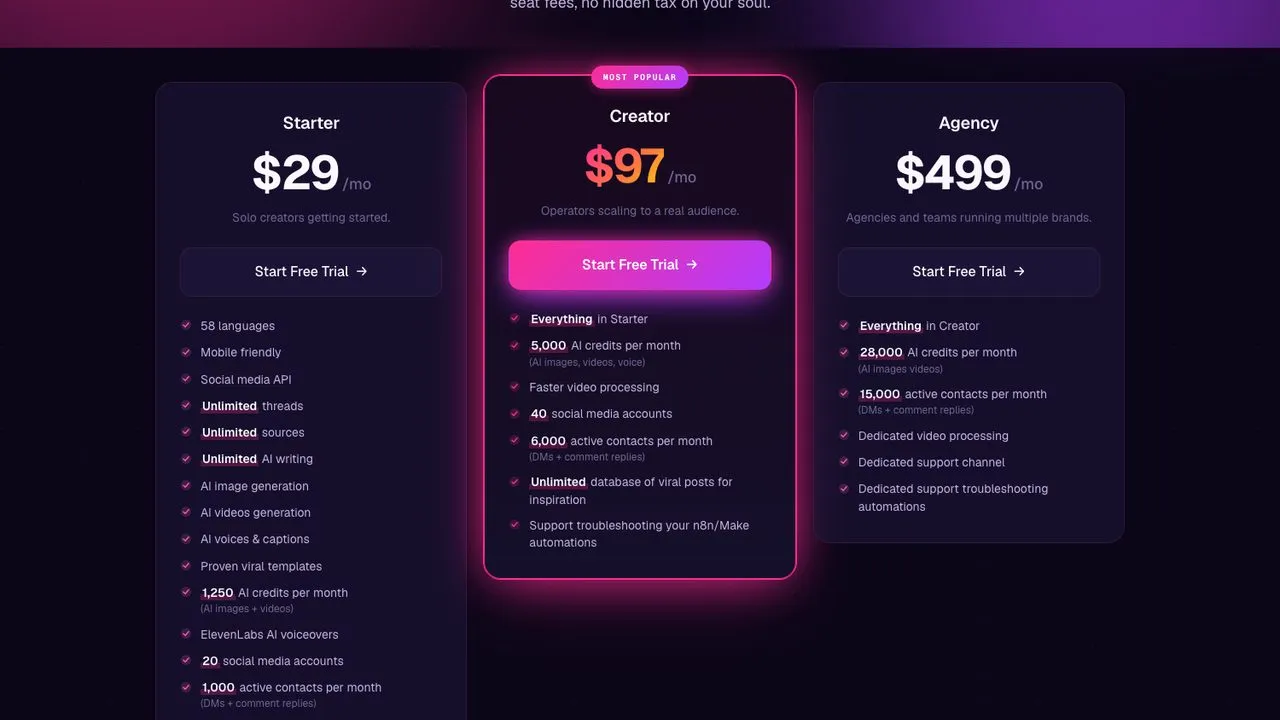
Blotato charges one flat rate per tier rather than pricing by brand band.
I built Blotato because I was managing my own accounts and kept paying for the next bracket instead of the next brand. It is flat: $29 a month covers 20 social accounts across 9 platforms, with AI writing, image, and video generation in the same bill, plus the REST API and hosted MCP on that lowest paid plan. There is no band to fall past, which is the specific pain that sends people here. If you want to check the arithmetic against your own count, you can compare the plans in a couple of minutes.
The honest limit is reporting, and it is the reason a lot of Metricool users should stay put. Analytics covers 8 of the 9 platforms with LinkedIn still missing, there is no ad-campaign data at all, and comments and DMs are Instagram and Facebook only. If your Monday morning is a client PDF that pulls Meta and Google Ads spend next to organic reach, Blotato cannot build it and Metricool can.
Pros:
- Flat $29 for 20 accounts, so adding a brand never crosses a pricing band
- API and hosted MCP included on the cheapest paid plan
- AI writing, images, and video generation bundled rather than sold as credits on top
Cons:
- Analytics reaches 8 of the 9 platforms, with no LinkedIn data and no ad-campaign reporting
- No permanent free plan, and the 7-day trial excludes the API
Pricing: Starter $29/mo, Creator $97/mo, Agency $499/mo. The 7-day trial covers everything except the API, so if you are here to wire an agent, plan on starting the Starter subscription rather than trialing it.
Ideal for: Creators and small agencies running up to 20 accounts who keep landing awkwardly between Metricool’s brackets.
Bottom line: Pick Blotato if your brand count moves month to month and you want the API on the plan you can already afford.
2. Publer: Best for teams who want the bill to move one account at a time
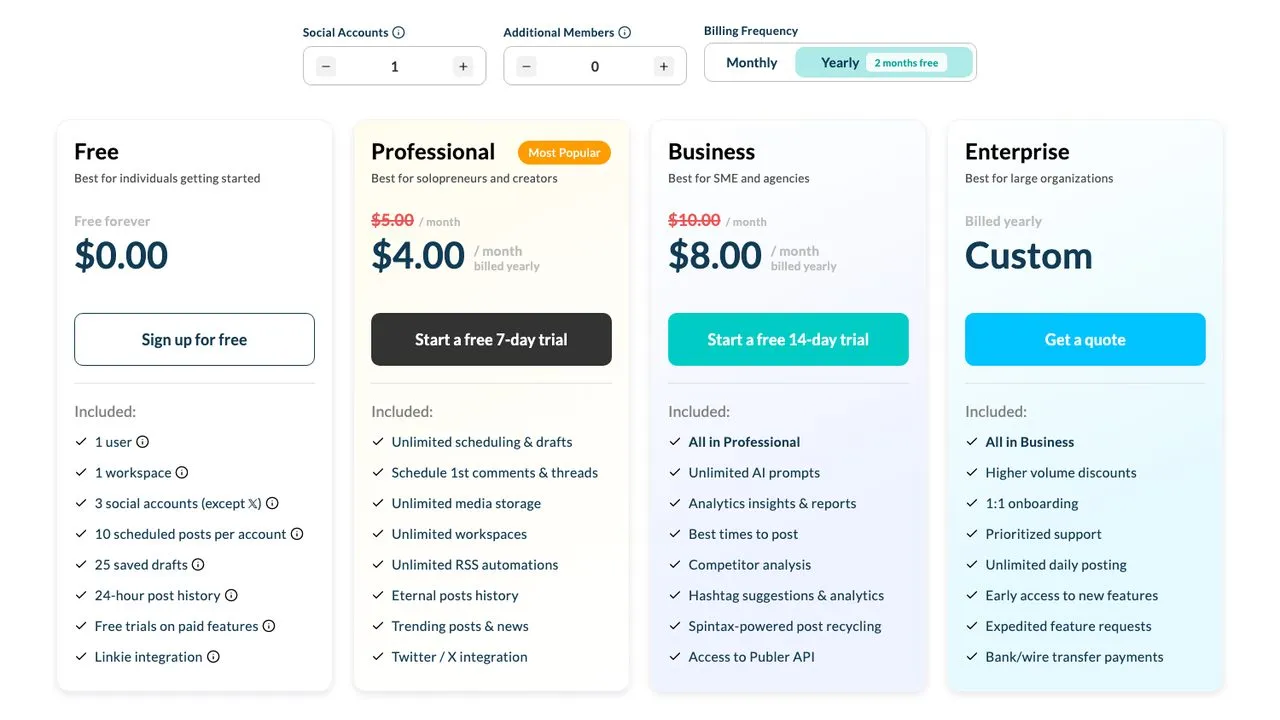
Publer prices per social account, so the bill grows in single steps.
Publer is the cleanest answer to the bracket problem, because it does not have brackets. You pay per social account, so brand eleven costs the same as brand ten, and nothing jumps. Bulk CSV scheduling, post recycling, and recurring posts are the features reviewers single out most, and every tenth account is free. If recycling is the feature you are really shopping for, the tools built around it are the ones I ranked in SocialBee alternatives.
Its weakness is the exact thing you liked about Metricool. Analytics is thin by comparison, with no competitor benchmarking and no audience demographics, so if reporting is why you log in, this is a downgrade dressed as a saving.
Pros:
- Per-account pricing with no tier to cross when you add a brand
- Bulk CSV scheduling, post recycling, and recurring posts at a low entry price
- Free plan covers 3 social accounts, and every tenth account is free
Cons:
- Analytics is much shallower than Metricool’s, with no competitor tracking
- API access requires the Business plan, not Professional
- The headline price is for one account, so read the additional-account rate before comparing
Pricing: Free for 3 accounts, excluding X. Professional starts at $5/mo for the first social account and $4/mo for each additional one. Business starts at $10/mo for the first and $7/mo for each additional. Extra members are $2/mo on Professional and $3/mo on Business.
Ideal for: Operators who add and drop brands often and want the invoice to track that exactly.
Bottom line: The right move if the bracket was the problem and reporting depth was not the reason you stayed.
3. Zernio: Best for operators whose client roster changes every month
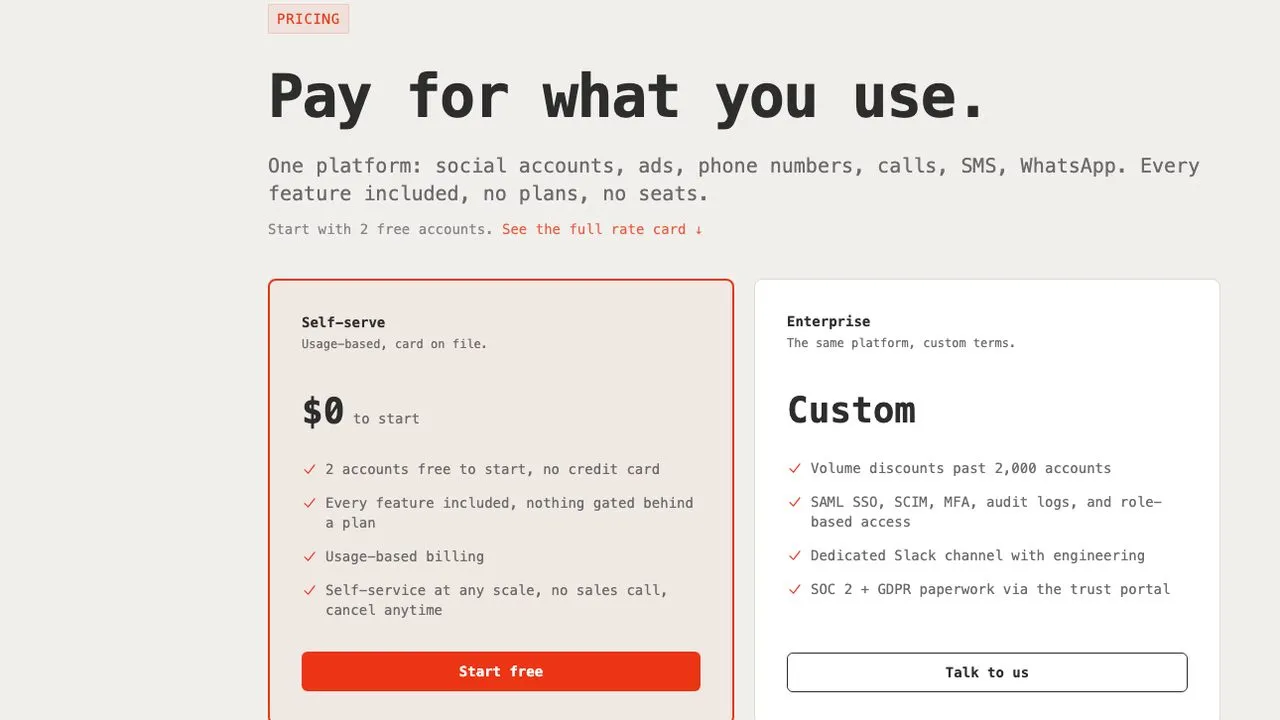
Zernio publishes a rate card by account band with every feature included.
Zernio takes the per-account idea further and removes plans entirely. The first two accounts are free, accounts 3 to 10 run $6 a month each, 11 to 100 drop to $3, and past 101 it is $1. Every feature is included on every account, which means no tier gates anything: scheduling, analytics, inbox, and API access all come with the account rather than the plan.
For a Metricool refugee that is the sharpest contrast available, because the thing you were paying a bracket for is simply not sold separately. The tradeoff is that it is a younger product with no meaningful third-party review base yet, so you are buying the rate card rather than a track record.
Pros:
- No plans and no feature gates, so nothing unlocks at a higher tier
- Two free accounts to start, with volume rates that fall as you grow
- Ads, inbox, and analytics on every connected account
Cons:
- Little independent review history compared with established tools
- Per-account billing costs more than a flat plan in the middle bands
Pricing: First 2 accounts free, then $6 per account/mo for accounts 3 to 10, $3 for 11 to 100, and $1 for 101 and up.
Ideal for: Agencies whose account count swings with client churn.
Bottom line: The clearest pricing model here, and worth a look if feature gating annoyed you as much as the bands did.
4. Buffer: Best for solo creators running a handful of channels who still want an API key
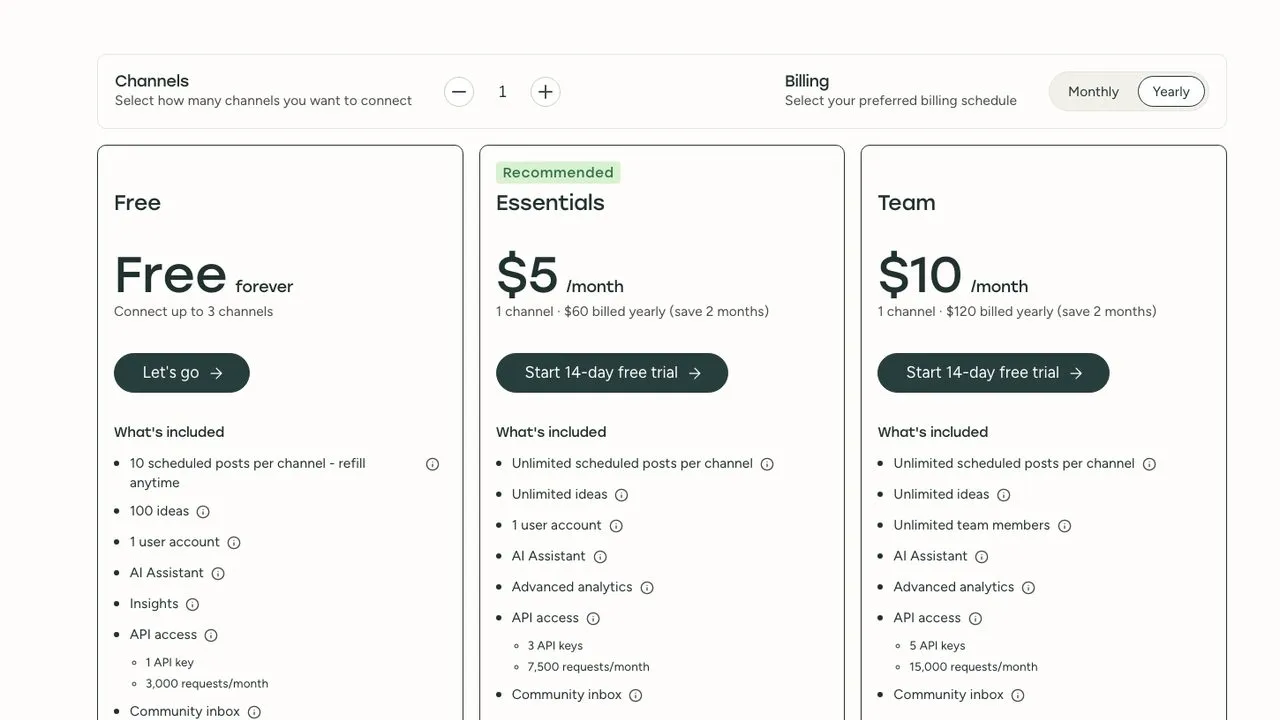
Buffer prices per connected channel and includes API access on the free plan.
Buffer is the simplest tool on this list and the fastest to set up. What makes it interesting next to Metricool is that API access starts on the free plan with one key and 3,000 requests a month, where Metricool asks $67 a month for programmatic access. If you are automating lightly, that gap is the story.
Note the toggle when you check the price. Buffer’s pricing page opens on Yearly and prints the annual rate with a monthly suffix, so the real month-to-month figure is $6 per channel, not the $5 shown by default.
Pros:
- API access included on the free plan, with volume discounts past ten channels
- Genuinely free tier for 3 channels with no time limit
- The fastest setup of anything on this list, with no brand or workspace concepts to learn
Cons:
- Analytics is shallow next to Metricool, with no ads reporting
- Per-channel pricing compounds quickly across many brands
Pricing: Free for 3 channels. Essentials $6 per channel/mo and Team $12 per channel/mo billed monthly, or $5 and $10 on annual billing. Essentials rates fall to $4 per channel for channels 11 to 25, $3 for 26 to 50, and $1 past 51.
Ideal for: Solo creators on a few channels who want light automation without a $67 gate.
Bottom line: Best fit for small footprints, and a poor one the moment your channel count climbs.
5. SocialPilot: Best for agencies who need many seats more than they need many brands
SocialPilot prices by plan with extra accounts sold at a flat rate on top.
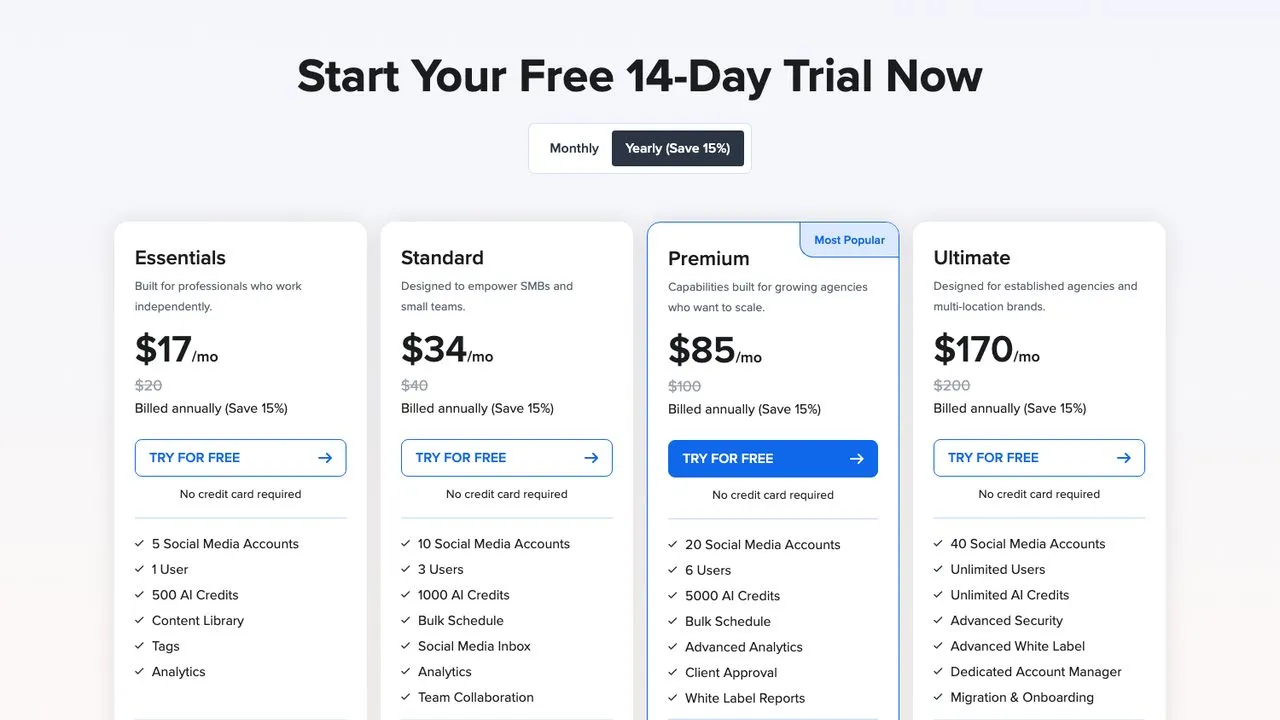
SocialPilot is the cheapest way to buy seats here. Ultimate runs $200 a month billed monthly for 50 social accounts and unlimited users, and no other tool on this list stops charging per user at all. On accounts alone Zernio is cheaper at that size, around $168 a month for the same 50, so pick SocialPilot when the team is the constraint rather than the account count. The per-account math across its whole ladder shows where each tier stops being efficient.
The catch is the one a builder cares about: API access is Enterprise only and quoted rather than listed, so no published plan buys it. It also now sells separate Reviews and Listings products, so comparing it purely as a scheduler misses half of what it is.
Pros:
- Unlimited users on the top plan, with extra accounts at a flat $4 each
- White-label reports and client approval below enterprise pricing
- Strong bulk scheduling for high-volume calendars
Cons:
- API access is Enterprise only, so no listed plan includes it
- Analytics is shallower than Metricool’s and there is no listening
Pricing: Essentials $30/mo, Standard $50/mo, Premium $100/mo, Ultimate $200/mo billed monthly, each about 15% less on annual billing. Extra accounts $4/mo and extra users $5/mo.
Ideal for: Agencies whose constraint is head count rather than brand count.
Bottom line: The cheapest option here once your team outgrows the accounts, provided nothing in your stack needs to call an API.
6. Agorapulse: Best for teams whose real work is the inbox, not the calendar
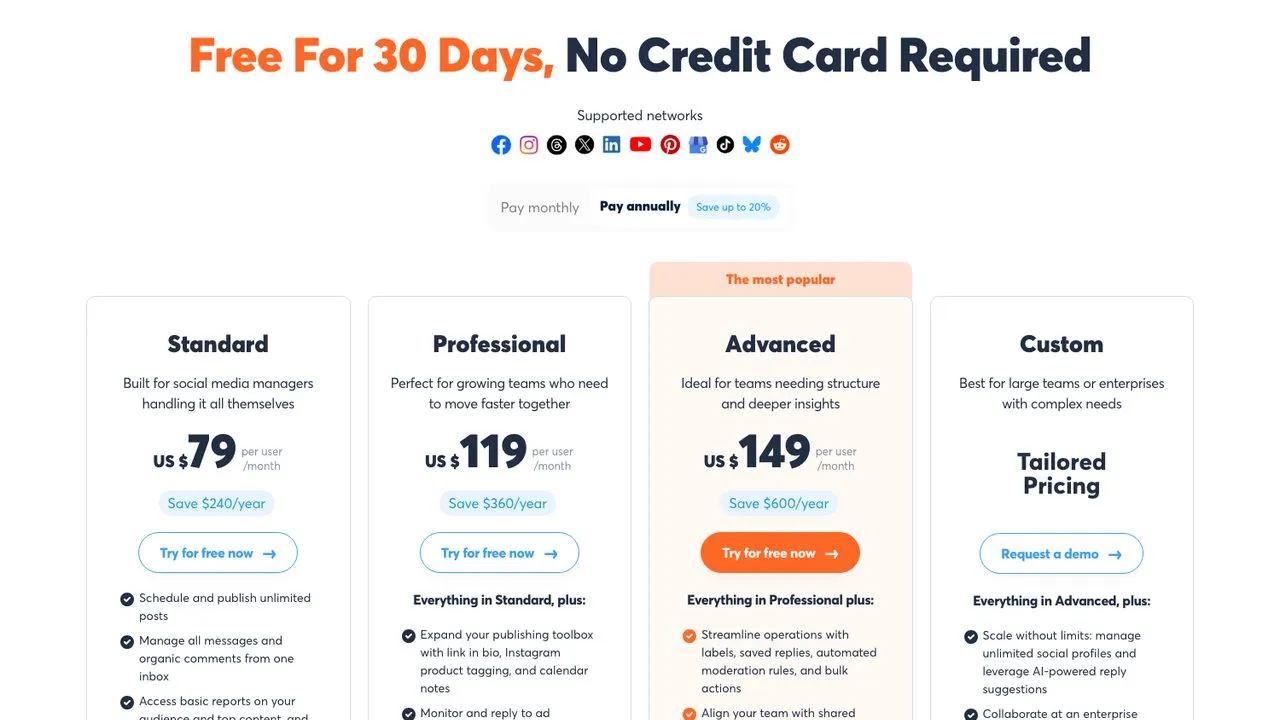
Agorapulse prices per user per month, which inverts Metricool’s per-brand model.
Agorapulse is the one tool here that beats Metricool at something other than price. Its unified inbox, moderation rules, and saved replies go deeper than anything else on this list, and support is the item reviewers praise most often. If your team spends more time replying than scheduling, it is the honest upgrade.
It is also the most expensive way to solve a bracket problem, because it charges per user. Three people on Standard is $237 a month before anyone counts brands, and API access sits on Custom. Those three seats still share one pool of ten profiles rather than getting ten each, which is the part Agorapulse’s own pricing page gets wrong in its structured data.
Pros:
- Inbox, moderation rules, and saved replies go deeper than the publishing-led tools here
- Ad comment monitoring on Professional and up
- Support is the most consistently praised part of the product in reviews
Cons:
- Per-user pricing escalates fast for teams
- Advanced reports and API access are gated to the highest tiers
Pricing: Standard $79, Professional $119, and Advanced $149 per user/mo on annual billing, with Custom quoted. A 30-day free trial with no card required.
Ideal for: Small teams doing real community management, not just publishing.
Bottom line: Worth the money if engagement is the job, and hard to justify if you only needed one more brand.
How I Chose These Metricool Alternatives
- Brand math first. I priced each tool at the point where Metricool’s bands bite, not at its headline rate.
- Automation access by tier. I checked which plan actually unlocks an API or MCP, not merely whether the feature exists.
- Monthly rates quoted, annual noted. Every pricing page here except Zernio’s opens on the annual toggle, so I rendered each one and read the monthly state.
- Genuine substitutes only. Six tools a Metricool user would really consider, rather than a padded list.
- A real gap named for each. Including mine.
Pricing was verified on each tool’s own pricing page and help documentation on August 13, 2026, and the strengths and weaknesses draw on Capterra and GetApp review data alongside my own testing.
How to Choose the Right Metricool Alternative
If you landed one brand past a bracket: Blotato or Publer. A flat plan has no cliff, and per-account billing makes the step small.
If your roster changes every month: Zernio, since nothing is gated behind a plan you might drop out of.
If you need programmatic access on a cheap plan: Buffer for light volume with its free-plan API key, or Blotato if you want the whole publishing surface behind one key.
If reporting is genuinely why you log in: staying on Metricool is the right call if client PDFs and ad-campaign data are the reason you open the tool, because switching to save $20 a month would cost you the one capability you use daily.
If your team lives in the inbox: Agorapulse, as long as you can absorb per-user pricing and the add-ons stacked on top of it.
If you are choosing for a client roster rather than your own brands, the trade-offs shift again, and I broke those down separately in my guide to social media tools for agencies.
Final Recommendation
Most people leaving Metricool are not leaving a bad tool, they are leaving a pricing shape that charges them for capacity they did not ask for. If that is you, a flat plan or a per-account meter fixes it, and Blotato is where I would start given it includes the API at $29. If your reason is reporting depth, no tool on this list will make you happier than the one you already have. You can start a trial whenever your brand count next lands somewhere awkward.
Metricool Alternatives FAQs
What is the cheapest Metricool alternative?
Publer and Buffer both start free, and Zernio gives you two accounts free with no card. For paid plans, Publer is the lowest entry point at $5 a month for the first social account and $4 for each additional one, while Blotato at $29 flat becomes cheaper once you are past roughly seven accounts, since it does not add per-account charges.
Does Metricool charge extra for X (Twitter)?
Yes. X is a separate add-on costing $10 per month per connected X account on Starter plans and above, or $120 per year, and each add-on covers one X account per brand. The free plan cannot connect X or LinkedIn at all. Several competing roundups still quote an outdated $5 figure.
Which Metricool alternatives include API access on a cheap plan?
Buffer includes API access on its free plan with one key and 3,000 requests per month, and Blotato includes both the REST API and a hosted MCP server on its $29 Starter plan. Metricool itself requires Advanced, which is $67 a month billed monthly, if you need the HTTP API for Zapier or Make.
Is Metricool’s MCP server available on the free plan?
Yes. Metricool’s help documentation states that its MCP server works on any plan including Free, while the HTTP API is limited to Advanced and Custom. Your plan limits still apply through MCP, so a free account cannot schedule more than 20 posts a month or read analytics older than 30 days no matter which client is calling it.
What counts as one brand in Metricool?
A brand is a container for one business or client, holding one profile per social network. So a single business with Instagram, TikTok, and LinkedIn is one brand, not three, which is why Metricool can be cheaper than per-account tools for companies with few brands and many networks each.