Zernio vs Ayrshare: The Social Media Break-Even Is 13
Zernio vs Ayrshare social media API pricing: Ayrshare only wins once every brand posts to 13 networks, which is the assumption doing all the work.
Zernio vs Ayrshare is the rare comparison where both companies publish their own version, both do the arithmetic correctly, and both arrive at opposite answers. Zernio’s page says an agency with 30 client profiles pays $108 a month against Ayrshare’s $599, which it calls 82% savings. Ayrshare’s page says that at 30 brands the same agency pays $599 against roughly $608 on Zernio, so Ayrshare wins.
Neither is lying. They are running the same 30 brands through opposite assumptions about how many networks each brand uses, and only one of them shows its working.
Disclosure, since it changes how you should read me: Blotato is a product I built and it sells against both of these. I have kept it out of the arithmetic entirely and given it one labelled section at the end. Everything before that section is about Zernio and Ayrshare.
Zernio vs Ayrshare: Both Vendors Are Right
Zernio is the better pick if: your brands each post to a handful of networks, because you pay per connected account, so every extra network a brand uses is another line on the bill. Two accounts are free with no card.
Ayrshare is the better pick if: your brands each post to nearly every network you support, because one profile covers unlimited networks at a flat rate. The break-even is higher than most people guess. You can see how a flat plan compares further down.
Run the Same 30 Brands Through Both Rate Cards
Here is the whole disagreement in one table. Thirty client brands, priced on both published rate cards, varying only the number of networks each brand posts to.
| Networks per brand | Connected accounts | Zernio | Ayrshare Business | Cheaper |
|---|---|---|---|---|
| 1 | 30 | $108/mo | $599/mo | Zernio |
| 2 | 60 | $198/mo | $599/mo | Zernio |
| 4 | 120 | $338/mo | $599/mo | Zernio |
| 5 | 150 | $368/mo | $599/mo | Zernio |
| 8 | 240 | $458/mo | $599/mo | Zernio |
| 12 | 360 | $578/mo | $599/mo | Zernio |
| 13 | 390 | $608/mo | $599/mo | Ayrshare |
The crossover sits at thirteen. Ayrshare becomes cheaper at exactly the point where every brand posts to every network Ayrshare supports, and not one network sooner.
Now look at where each vendor planted its flag. Zernio’s headline number, $108, is the first row: one network per brand. Ayrshare’s comparison table is the last row, and it says so openly, describing each plan “at full capacity” and labeling the row “30 brands × 13.” Both numbers are real. Both are also the extreme end of the range.
The Assumption Doing the Work
Everything in this comparison reduces to one variable that neither marketing page asks you for: how many networks does a typical brand of yours actually post to?
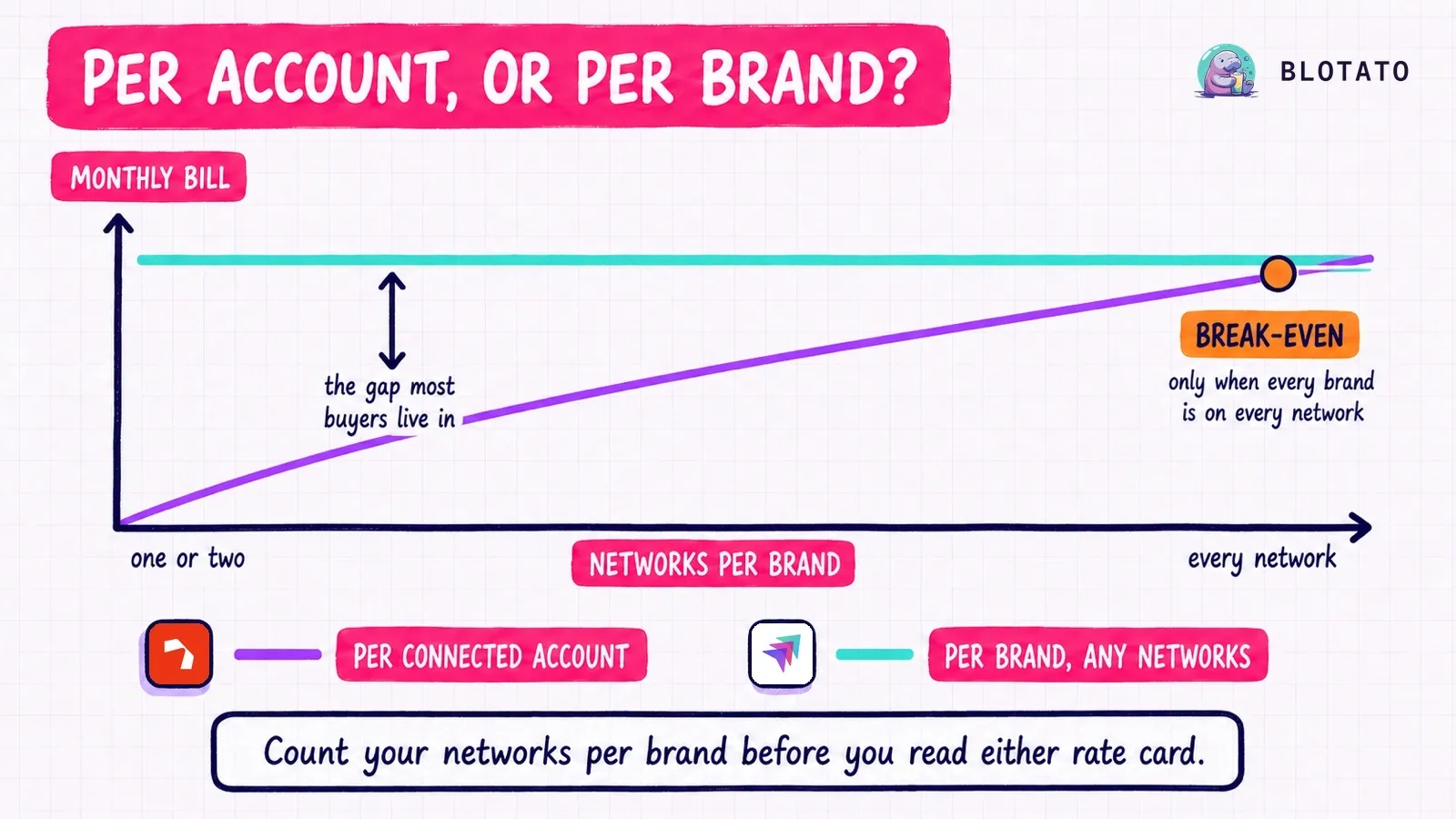
If the answer is one or two, Zernio is not slightly cheaper. At 30 brands it is $108 or $198 against $599, a gap wide enough that features would have to matter a great deal to overturn it. If the answer is thirteen, Ayrshare wins by about $9 a month at 30 brands, which is close enough that you should pick on features instead.
The interesting range is the middle, and neither vendor models it. Ayrshare’s published table jumps straight to thirteen networks per brand and Zernio’s headline sits at one, so if your real figure is four or five you will not find it on either page. That range is where Zernio is still meaningfully cheaper and where neither comparison helps you.
So compute it rather than assume it: total connected accounts divided by total brands. The number matters more than it looks, because a brand with an account on a network it posts to twice a year still costs a full line item on a per-account model and costs nothing extra on a per-brand one. If a chunk of your connected accounts are dormant, they are cheap on Ayrshare and not on Zernio.
The lesson is not that one vendor is dishonest. It is that a per-unit price and a per-bundle price cannot be compared without fixing the ratio between them, and the ratio is yours, not theirs. Count it before you read either page.
What Zernio Charges For, and What It Bundles
Zernio sells no plans and no seats at all. Billing is a monthly charge on each connected social account, stepped down as the count rises, on a published rate card: the first two accounts are free with no card, accounts three through ten are $6 each, eleven through one hundred are $3, and past one hundred it is $1. Its published examples are 10 accounts for $48, 20 for $78, 100 for $318, and 1,000 for $1,218. I have walked the whole ladder band by band separately.
One connected profile on one platform is one account. Connect a customer’s Instagram and TikTok and that is two. This is the mechanic that makes networks-per-brand the deciding variable rather than a detail.
The model suits a specific shape of buyer. If your account count moves up and down with real usage, you pay for what is actually connected and nothing else, and the first two accounts cost nothing at all, so a prototype runs free indefinitely. It suits you badly if your customers each connect a long list of networks, because every one of them is a line item.
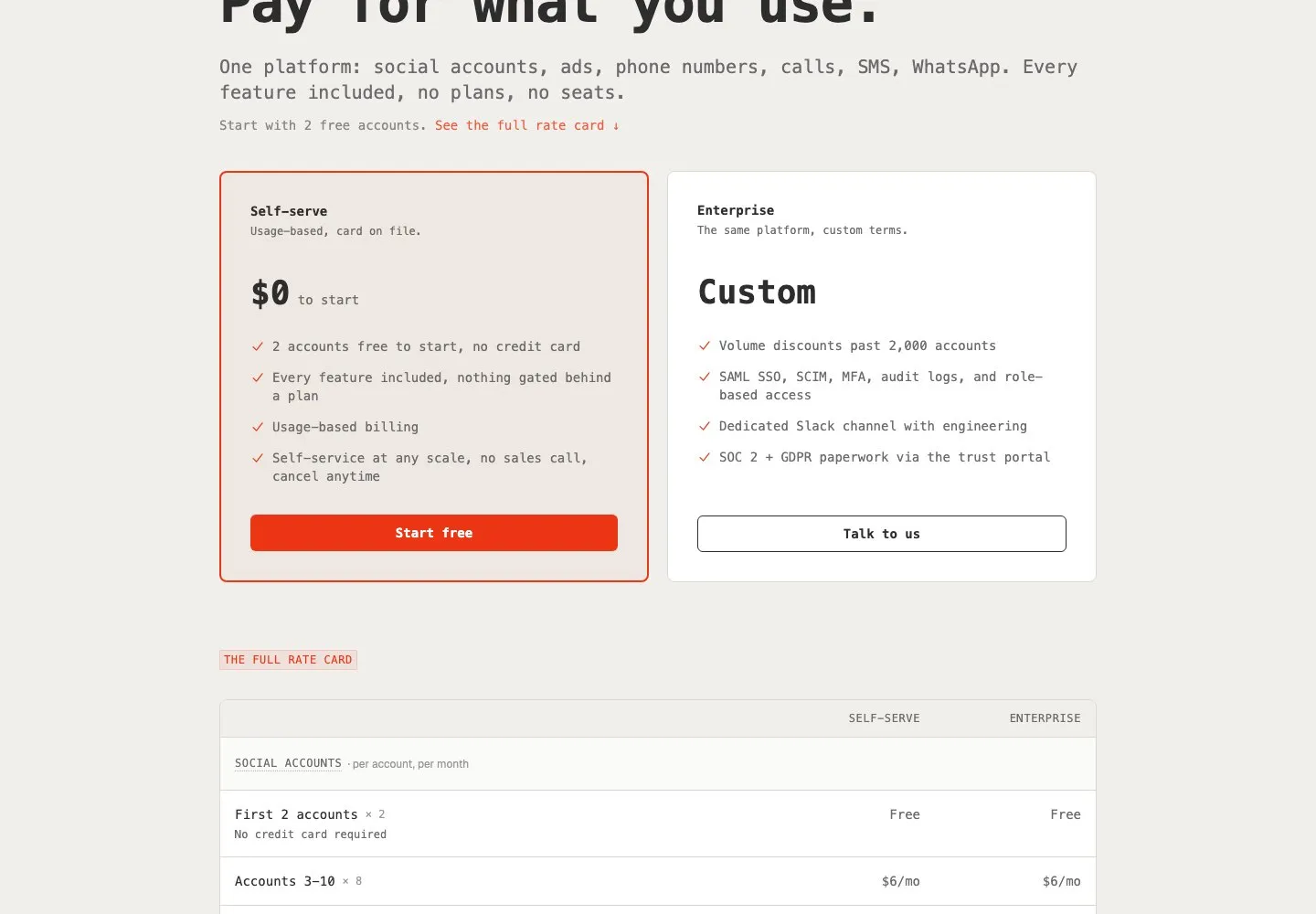
What comes bundled is broad for a metered product. Its rate card states that “every connected social account includes scheduling, analytics, inbox (comments + DMs), full API access, and unlimited posts. No add-ons, no feature tiers.” Two things meter on top: managed ads, and messages you send from the inbox, where the first 10,000 a month are free.
It publishes to sixteen destinations and exposes 496 MCP tools over one endpoint. Its rate-limit docs put the ceilings at 60, 600 and 1,200 requests a minute, keyed off your connected-account count rather than a plan name. Enterprise contracts exist for volume discounts and SSO from 2,000 accounts up, but they are optional rather than a tier you climb into.
What Ayrshare Charges For, and Where It Gates
Ayrshare sells profiles, not connections. A profile is a customer, a brand or a location, and it holds as many networks as you want to attach. Its rate card reduces that to six words: “We bill the customer, not the channels.” Premium is $149 a month for one profile, Launch is $299 for up to ten, and Business is $599 with thirty included and tiered rates to three hundred, which I break down in what a profile actually costs past thirty. Max Pack adds $300 a month and Facebook Boosted Ads $100.
The trial is worth naming because it is unusual here: 28 days on the Launch plan with no credit card required.
The design goal is embedding rather than operating. A profile is meant to be one of your customers, and Ayrshare’s own rate card frames the billing around that: your usage grows as customers connect accounts, and when a customer churns you delete the profile and the cost goes with them. That is a different promise from a metered account count, and it is the reason the per-brand model exists at all.
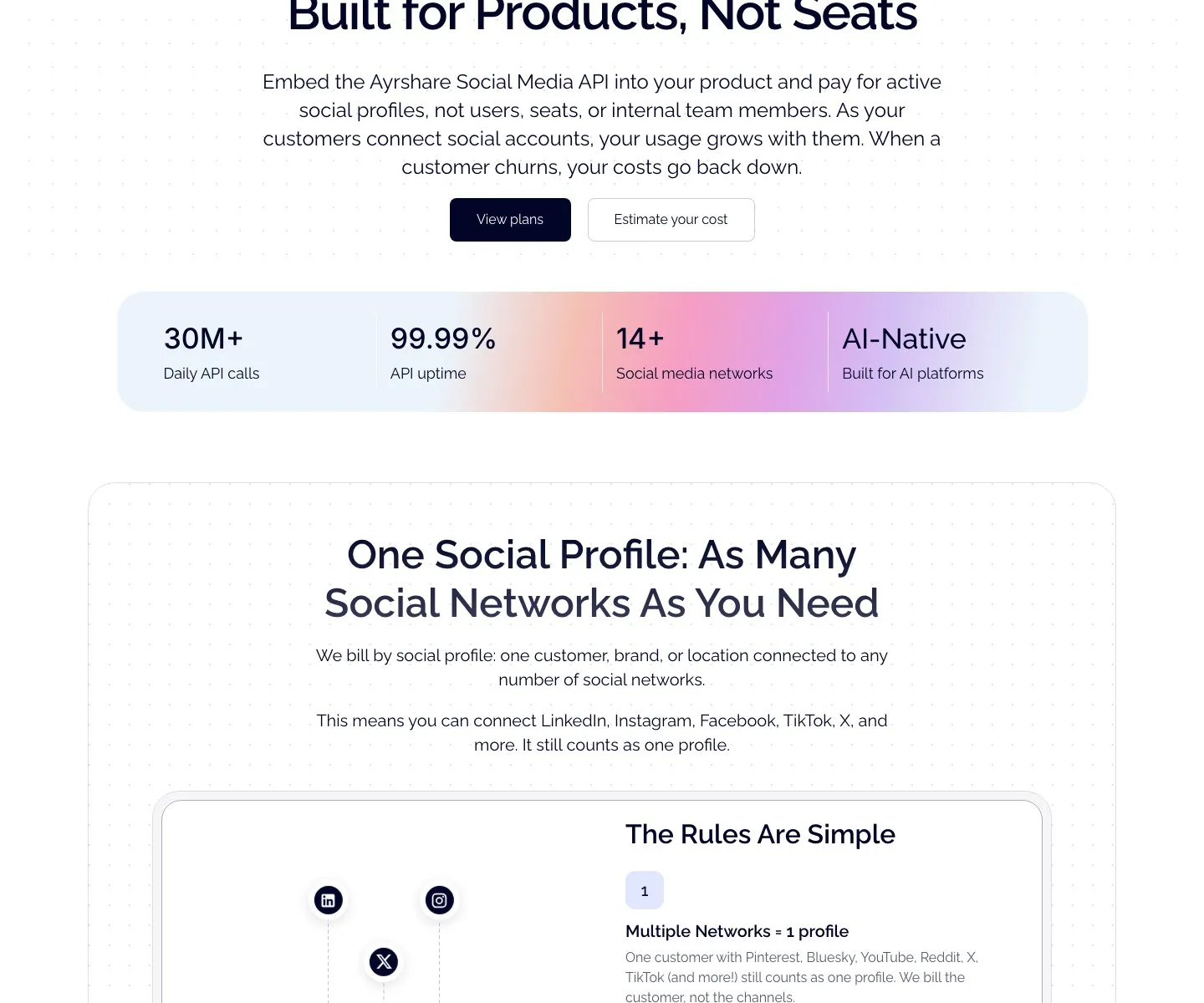
Two things to know before you model a year. Ayrshare publishes to thirteen platforms in its POST /post enum, not the “14+” its marketing says, because the fourteenth is WhatsApp and WhatsApp is messaging rather than publishing. Its own comparison arithmetic uses thirteen, which is why the crossover above lands there.
And the multi-profile machinery is gated. Premium includes one profile, which is your own, but the User Profile endpoints are marked “Available on the Launch, Business, and Enterprise plans,” so giving a second customer their own profile starts at the $299 Launch tier rather than $149. I walk through that gate in detail in my read of what the entry tier actually includes.
Where the Marketing Pages Overreach
Both pages are broadly fair on price and then stretch on features. Two of Zernio’s claims are worth correcting before you use them to decide.
Zernio’s page says Ayrshare has no paid-ad management. Ayrshare sells Facebook Boosted Ads as a $100 a month add-on. Zernio’s ads surface is wider, spanning several ad networks, so the comparative point survives. The absolute one does not.
Zernio’s own agents page advertises reading and replying “on any platform that has one,” which reads as all sixteen. Its rate card is narrower: messaging covers eight platforms, and comments and reviews cover nine. TikTok is on neither list. If your agent has to answer TikTok comments, neither tool in this post does it, and neither do we.
What the Sticker Price Leaves Out
Three line items sit outside both rate cards, and two of them land on Zernio.
X pass-through. On top of the per-account price, Zernio bills X API usage at cost, and the rate that matters is $0.200 for any post carrying a URL. Reads are $0.005 and ordinary posts or DM sends $0.015. Two hundred link posts a month therefore adds $40, larger than the gap between the two tools at several brand counts. Ayrshare folds X usage into the profile price instead.
Ad accounts count as accounts. Zernio’s ads coverage is broader, and its rate card is also explicit that ad accounts count toward your connected-account total. The feature that differentiates it also moves it up its own ladder.
Ayrshare ships a history endpoint Zernio does not. If you need to pull the history of a post or of every post on a network per profile, that is on Ayrshare’s side of the ledger and shows up in no pricing comparison.
Count Your Networks Before You Pick
- Work out your own figure first, then read it off the table above. Below the crossover Zernio is cheaper, and the gap widens the further below you sit.
- At twelve or more networks per brand, the two converge at 30 brands and you should decide on features. At one or two brands Zernio stays cheaper regardless.
- If your agent posts links to X at volume, add the pass-through before you compare anything.
- If your customers connect their own accounts inside your product, budget from $299 on Ayrshare, not $149.
- At one or two accounts Zernio is free and nothing else here is.
- If neither shape fits your ratio, the wider field of Zernio alternatives is priced by account band rather than head to head.
Where Blotato Lands on This Curve
The labelled section, as promised. Blotato is mine, so weigh what follows accordingly.
We are the third shape: a flat fee with an account allowance rather than a per-unit meter. $29 a month covers 20 connected accounts on Starter, $97 covers 40, and Agency is $499. Publishing covers 9 platforms, the MCP server is at mcp.blotato.com/mcp, analytics reaches 8 of the 9 with LinkedIn the exclusion, and comments and messaging cover Instagram and Facebook only.
On this post’s specific question, our shape has a hard edge worth stating: we cap at 100 connected accounts on Agency. Both tools here keep going past that. Zernio’s $1 band runs from account 101 with no cap, with enterprise contracts optional from 2,000, and Ayrshare tiers to 300 profiles, which at thirteen networks each is thousands of accounts. If your account count is heading past 100, we are not the answer and the flat model stops being the point.
Below that ceiling the flat rate is indifferent to shape in a way Zernio is not: twenty accounts cost the same whether they are twenty brands on one network or four brands on five. Ayrshare is indifferent in the other direction, since adding a network to an existing profile costs nothing there either. The three models are simply flat, per connection, and per brand, and only your own ratio says which is cheapest.
Worth knowing before you test us: the API is carved out of the 7-day trial, and the moment a key is generated the trial ends and Starter billing begins. Treat the subscription as the cost of evaluating, not the trial. The plan breakdown lists what each tier carries.
Zernio vs Ayrshare FAQs
Is Zernio cheaper than Ayrshare?
Below about twelve networks per brand, yes, usually by a wide margin. At 30 client brands posting to four networks each, Zernio is $338 a month against Ayrshare’s $599. The two converge at thirteen networks per brand, where Ayrshare’s $599 edges Zernio’s $608. Both vendors publish accurate numbers and pick opposite ends of that range, so the answer depends entirely on how many networks your brands actually use.
Does the answer change if my brands post to different numbers of networks?
Yes, and averaging hides it. The comparison runs on your total connected accounts, so ten brands on two networks and two brands on ten cost the same on Zernio and very different amounts on Ayrshare, where the first is ten profiles and the second is two. If your client list is lopsided, count profiles and accounts separately rather than working from an average.
What is the break-even between per-account and per-brand pricing?
At 30 brands it is thirteen networks each. At 10 brands, Ayrshare’s $299 Launch tier needs more than nine networks per brand before it beats Zernio. At a single brand, Ayrshare does not win within any realistic network count, because $149 buys one profile while the same accounts cost around $57 on Zernio.
How many platforms does each one support?
Zernio publishes to sixteen destinations, which its docs, its agents page and its API overview all agree on. Ayrshare publishes to thirteen, which is what its POST /post enum contains. Ayrshare’s “14+” marketing figure counts WhatsApp, which is messaging rather than publishing, and its own comparison math uses thirteen.
Does either one handle comments and DMs everywhere?
No, and Zernio’s marketing reads as though it does. Its rate card lists messaging on eight platforms and comments and reviews on nine, out of sixteen publishing destinations, with TikTok on neither. Ayrshare reaches nine platforms for comments, and for DMs it reaches four: Facebook, Instagram, X, and WhatsApp in private beta.
Which one is better for an agency?
Count networks per client first. An agency running 30 clients on four or five networks each pays roughly $338 to $368 on Zernio against $599 on Ayrshare. An agency whose clients each use nearly every network lands near the crossover and should decide on features, where Ayrshare’s customer-profile isolation and Zernio’s ads coverage pull in different directions.