Blotato vs Zernio: Two Social Media APIs Your AI Agent Can Run
Two social media APIs for AI agents on Claude and ChatGPT, compared on what the agent can do, the X per-request charges, and the rate-limit claims.
Both of these are social media APIs you point an AI agent at. Blotato and Zernio each run a hosted MCP server, so Claude, ChatGPT, or a Codex session connects to either one and starts publishing without you building a posting pipeline. The choice is about what the agent can do once it is connected, and what the bill does afterward.
The difference is where each one starts. Zernio is a developer-first publishing and messaging API: it reaches 16 channels, handles DMs and comments across a good share of them, runs ads, and expects the content to arrive finished. Blotato is agent infrastructure for social media marketing, which means the agent can make the post as well as send it, then read the analytics and answer the Instagram and Facebook replies from the same key.
So if your agent’s job starts at “here is a topic,” Zernio needs a second vendor to write and design the thing before it can publish it. If your job starts at “here is the finished post,” that second vendor is a cost you do not have, and Zernio’s pipe is the wider one.
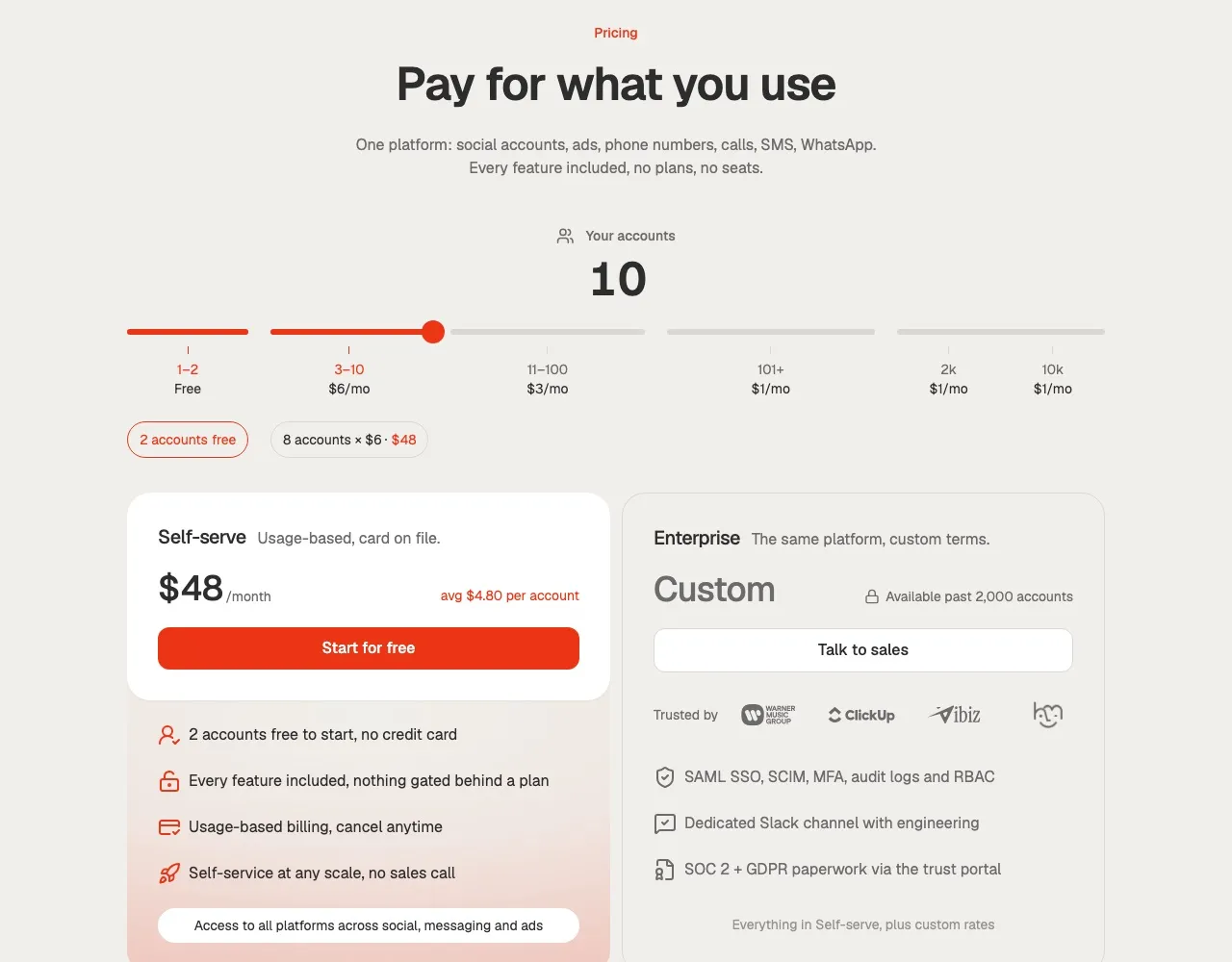
Then there is the bill. Zernio gives you two accounts free, with no card, which is a genuinely generous entry point, then charges per account. Blotato charges $29 a month flat and includes twenty. Because Blotato’s plans step at 20 and 40 accounts while Zernio’s ladder climbs smoothly, the cheaper tool changes hands more than once. Every band is below, including the three where we lose, and the metered extras on Zernio’s side that the sticker price does not show.
Blotato vs Zernio: At a Glance
Zernio is the better pick if: your agent receives finished content and only needs to publish it, you need to reach Snapchat, Telegram, Discord, Slack, or WhatsApp, your reply workflows live on X, LinkedIn, or Reddit, or you connect fewer than seven accounts or sit between 21 and 26.
Blotato is the better pick if: you want the agent to make the content as well as publish it, and you run 7 to 20 or 27 to 40 accounts. See what the flat plan includes.
Before you price either one: Zernio bills X (Twitter) API usage per request on top of its per-account rate, and a post carrying a link is $0.200 of that. A thousand link posts a month is $200 the account calculator never showed you. Blotato includes X publishing in the plan. That single line moves the total more than most of the pricing bands below do, so run it first if X is part of your mix.
Publishing Infrastructure Is Its Own Category
They sit in different categories, and pretending otherwise would make this comparison useless. Here is what each product is, on its own documentation, today.
| Zernio | Blotato | |
|---|---|---|
| What it is | A social media and messaging API for developers and AI agents, the category I mapped in this rundown of social media API tools | Agent infrastructure for social media marketing: a hosted REST API and MCP server, plus a web app on the same account |
| Built for | Developers and product teams wiring social into code or an agent | Builders running social through an AI agent, and the creators and small teams who work in the app |
| Programmatic surface | REST API, eight SDKs, a CLI, and a hosted MCP server with 496 tools | REST API, a hosted MCP server with 36 named tools, and native n8n and Make nodes |
| What the agent can do | Publish, schedule, message, comment, run ads, read analytics | Publish, schedule, read analytics, reply to Instagram and Facebook comments and DMs, run DM automations on those two, generate images and video |
| Engagement reach | DMs on 8 of its 16 channels, comments and reviews on 9 | Instagram and Facebook |
| Content creation | None. Its own comparison page marks AI content “No” for Zernio | Writing, images, and faceless video on the same plan |
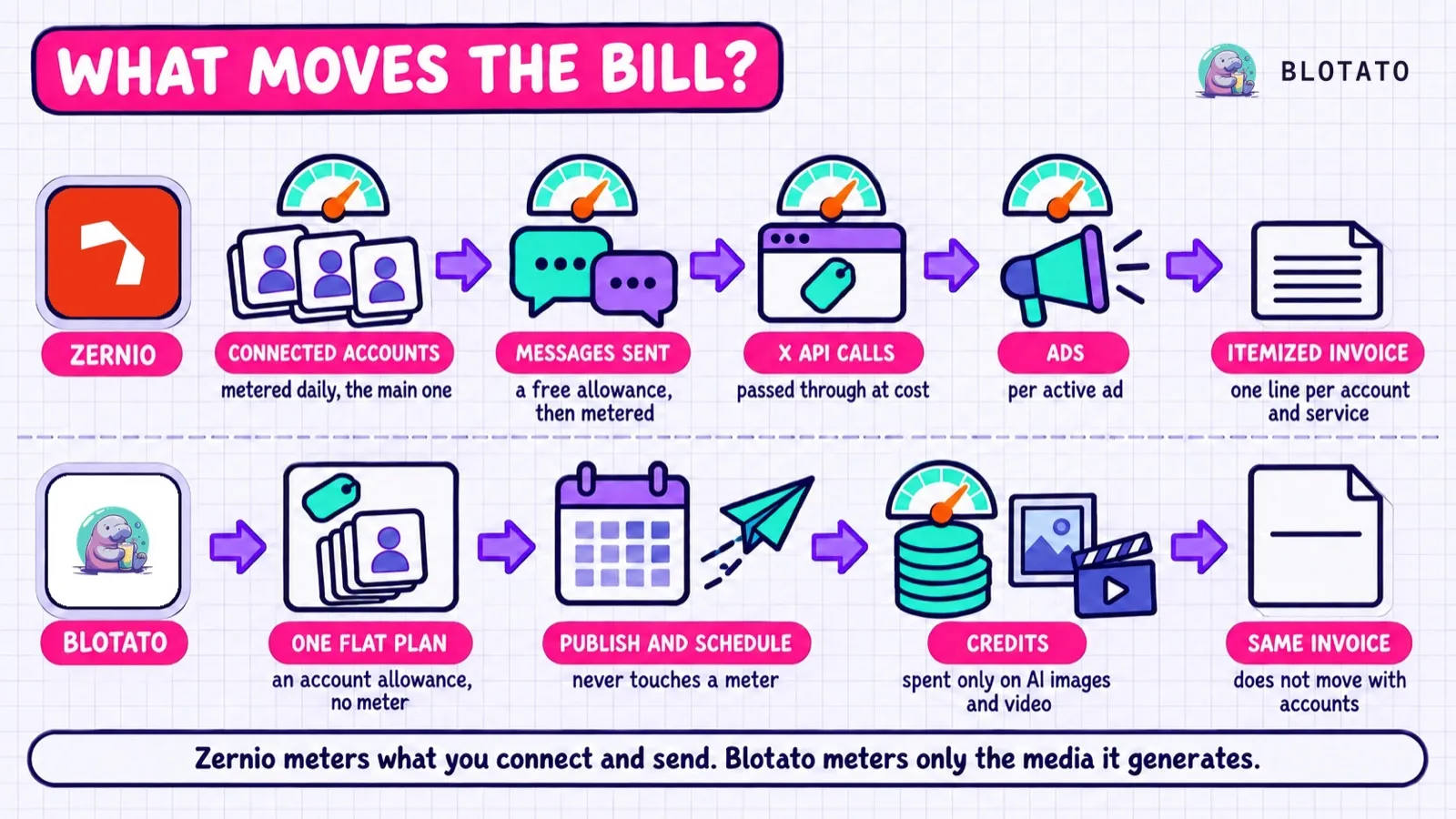
| What the bill tracks | Connected accounts, plus metered messages, X API calls, and ads | A flat plan with an account allowance. Credits move only for AI image and video |
Zernio’s page about us calls Blotato “an AI content studio with posting bolted on.” The table above is the shipped surface, and the content studio is one row of it.
The Developer Zernio’s Free Tier Is Aimed At
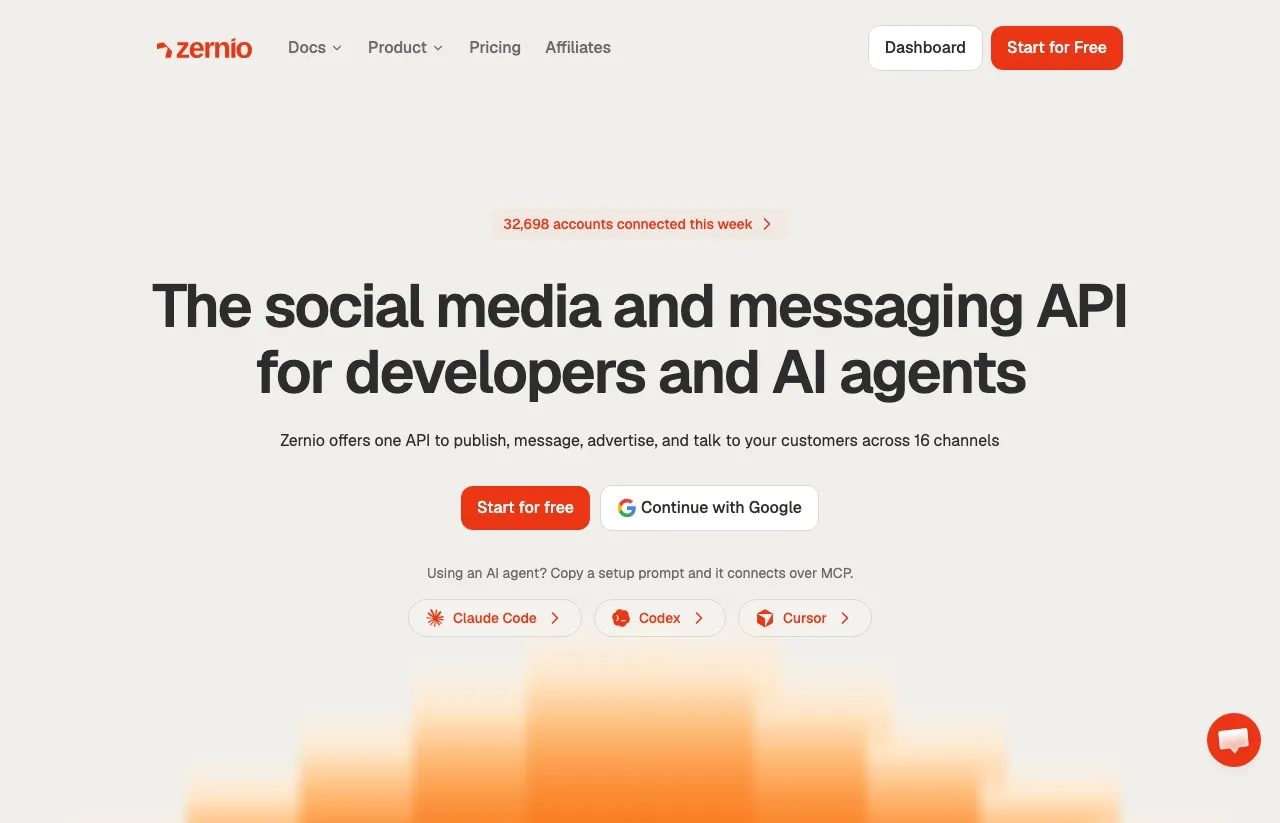
Zernio is built for developers, and it does not apologize for it. The onboarding assumes you want an API key, not a calendar view. It ships SDKs in Node, Python, Go, Ruby, Java, PHP, .NET, and Rust, plus a CLI, all documented per language, which is more official client coverage than Blotato or most of this category ships.
The product was called Late, at getlate.dev, until it rebranded to Zernio. The API, endpoints, and response schemas carried through the change, so integrations built against Late kept working. If you find older writeups under the Late name, they are describing the same thing.
Its reach is the widest here: sixteen channels on its homepage and API docs, spanning social networks plus WhatsApp, Telegram, Discord, Snapchat, Slack, and Google Business, with seven ad networks alongside them (Meta counts Facebook and Instagram as one). Its MCP server at mcp.zernio.com/mcp exposes 496 tools, 20 hand-built core tools plus one generated from the OpenAPI spec per endpoint, with about 50 visible by default and the rest found through a search tool. That puts it alongside most of the social media MCP servers worth knowing about. I would lean on the documentation when evaluating it, since the review sites that carry it block automated checks and I could not verify a score myself.
Where Blotato’s Reader Usually Comes From
Blotato is an app I built, so weigh what follows accordingly.
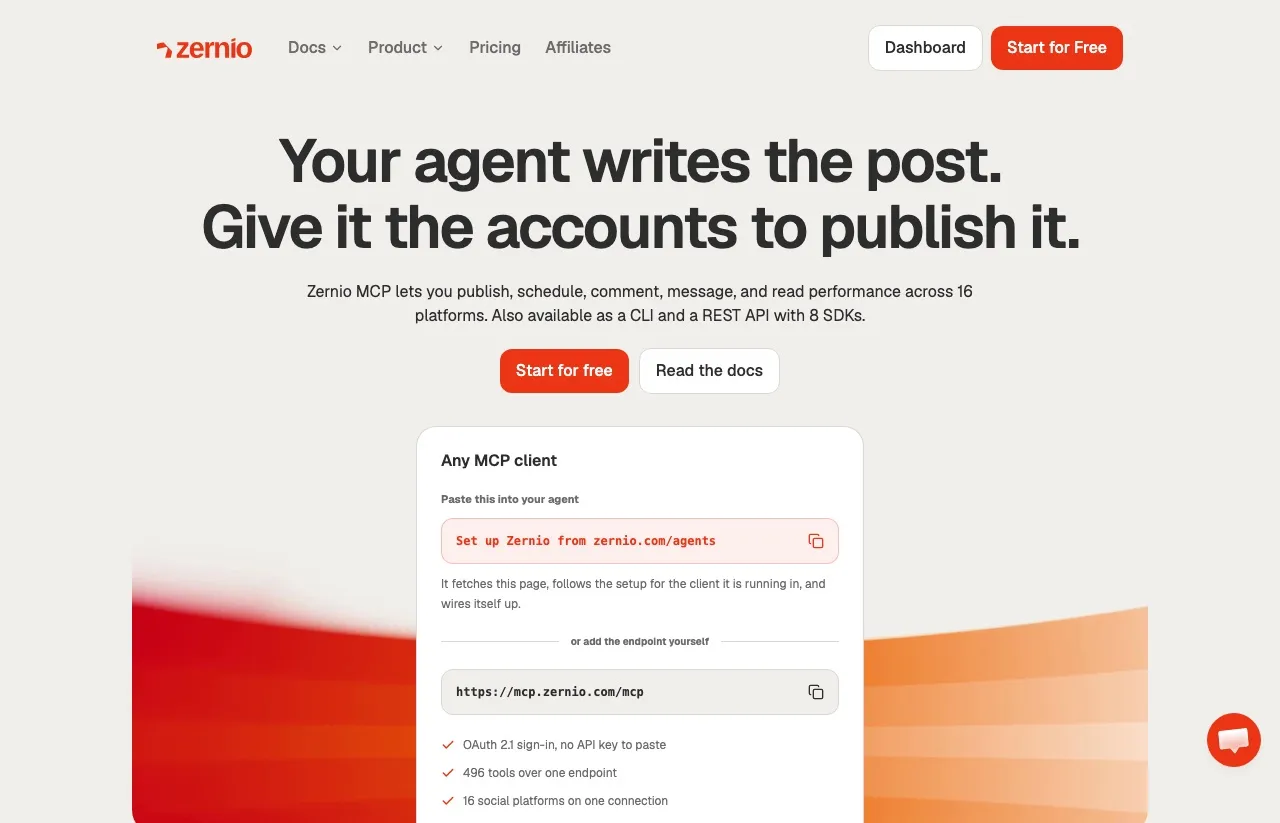
Blotato is for the person, or the agent, that has to run the whole loop rather than one leg of it: make the content, publish it, read the numbers, and answer what comes back. Most of our users run it from Claude Code, Claude Desktop, or an n8n or Make workflow rather than the dashboard, and the app is there for the ones who prefer it.
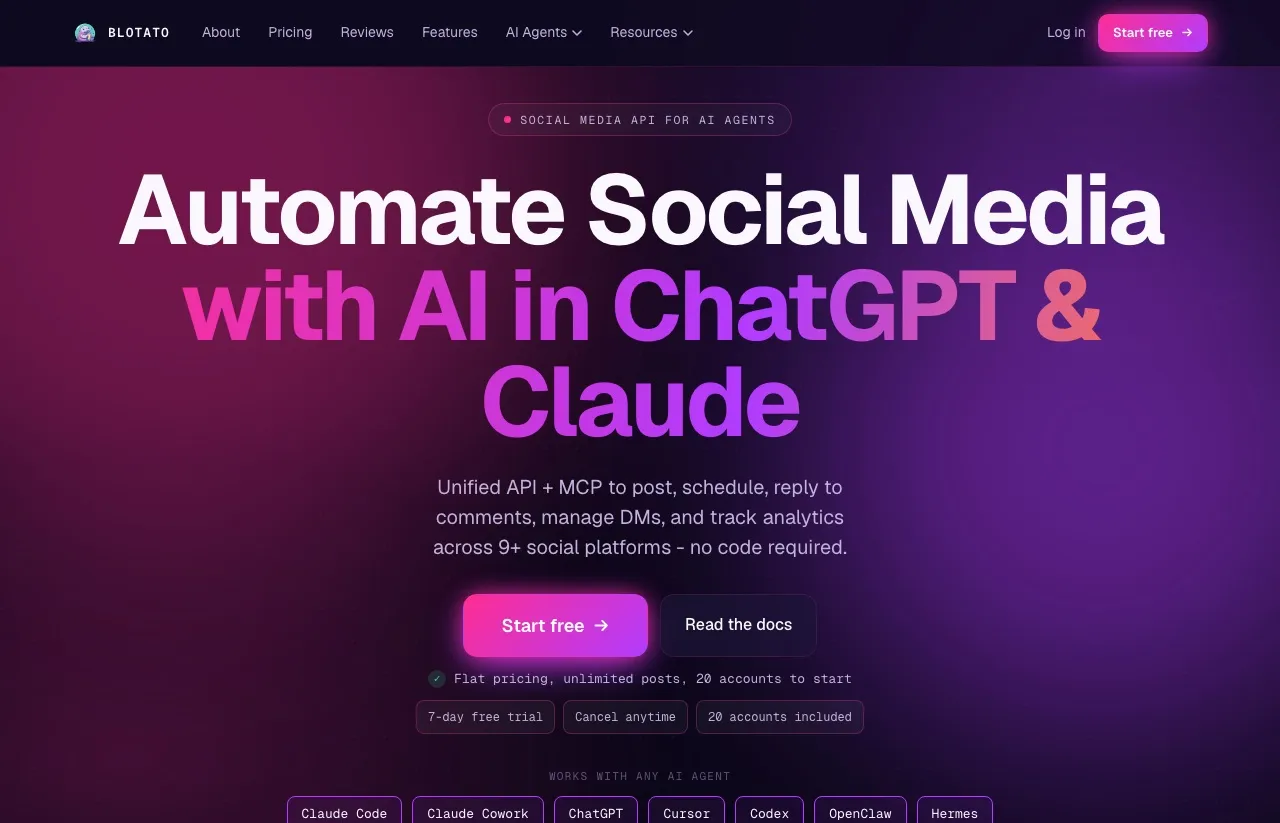
The flat plan covers publishing to nine platforms, analytics on eight of them (LinkedIn returns no metrics yet), comments and DMs on Instagram and Facebook, and DM automation on those two, where a comment or an inbound message triggers the reply and nothing goes out cold, with 1,000 active contacts a month on Starter. Writing is unlimited on every plan, and AI image and video generation draw on one credit pool in the same plan. The REST API and the hosted MCP server at mcp.blotato.com/mcp sit beside native n8n and Make nodes, and twenty accounts are included at $29 with no per-account meter.
One thing to know before you sign up, especially if you came for the API: the 7-day trial covers everything except the API, and generating an API key ends the trial and starts the paid Starter plan. If the API is the reason you are here, plan on starting the subscription rather than trialing it.
Zernio vs Blotato: Side by Side
| Category | Zernio | Blotato |
|---|---|---|
| Pricing model | Per connected account | Flat rate |
| Free plan | Yes, 2 accounts, no card | No (7-day trial, card required, cancel anytime) |
| Cheapest paid entry | $6 for a 3rd account | $29/mo flat (Starter, 20 accounts) |
| Channels supported | 16 on its homepage and API docs. Its own llms.txt says 15 in the header and 16 lower down | 9 |
| Messaging apps | Included (WhatsApp, Telegram, Discord, Slack) | Not offered |
| Ad networks | 7, through one ads endpoint | Not offered |
| AI text writing | Not offered | Yes, included |
| AI image generation | Not offered | Yes, uses AI credits |
| AI video generation | Not offered | Yes, faceless video with voiceovers |
| Public REST API | Yes, on the free tier | Yes, on paid plans |
| SDKs | 8 languages plus a CLI | REST API |
| n8n / Make nodes | Available | Native nodes for both |
| Hosted MCP server | Yes, 496 tools | Yes, 36 tools |
| Analytics | All platforms, per its rate card | 8 of 9, LinkedIn excluded |
| DMs and comments | DMs on 8 channels, comments and reviews on 9 | Instagram and Facebook |
| DM automation | Comment automations via the API | Instagram and Facebook, triggered by a comment or message, 1,000 active contacts a month on Starter |
| Outbound messages | 10,000 a month free, then $1 per 10,000 | Not metered |
| Published API rate limit | 60 req/min free, 600 on any paid account, 1,200 for high-volume by request | 30 req/min publish, 60 reads, 120 media uploads |
| Per-platform posting caps | 25 posts/hour per account, plus daily caps: Instagram 100, Facebook 100, Threads 250, X 50, Pinterest 25 | Instagram 50/day, LinkedIn 50 per profile and per Page, Facebook 25/Page, Pinterest 10/day |
| Public status page | Yes | No |
| X (Twitter) API charges | Billed on top: $0.015 a post, $0.200 for a post with a URL, $0.005 a read | Included in the plan, not billed per request |
The two rows that decide most cases sit at opposite ends. Zernio reaches more places and starts free. Blotato closes the loop and holds the price still.
What Each Side Actually Publishes on Reliability
Reliability is where Zernio makes its loudest case against us, so here is each claim on its comparison page, checked against what each side actually publishes. Some of it holds. Some of it does not.
| Zernio’s claim about Blotato | What the documentation says | Check it |
|---|---|---|
| ”30 posts/min global rate limit (undocumented)” and “buried in different contexts” | The publish endpoint’s limit is 30 requests a minute, stated in the open in the API reference | Blotato API reference |
| ”60-1200 req/min” set against Blotato “1.5 posts/min,” the figure its “40x faster” banner divides by | Two units in one row. The 1.5 appears nowhere in our docs, the FAQ on that same page says 30, and Zernio’s llms.txt says its own limit “applies only to API request throughput” | Zernio llms.txt |
| ”Designed for n8n/Make, not standalone REST” and “API requires paid automation platform” | The API is a standalone REST surface with its own base URL and an API key header, documented for direct HTTP. The n8n and Make nodes are optional | Blotato API quickstart |
| ”3 TikTok accounts per 24h” even with 20 connected | True on Starter: 3 unique TikTok accounts per 24 hours, 10 posts each. The cap does not apply on Creator or Agency, which the page leaves out | Blotato posting limits |
| ”No published uptime SLA or status page” | True. We publish neither | This post |
| ”99.97% uptime SLA, publicly documented” | Zernio’s own pricing FAQ says “We maintain 99.7%+ uptime.” I could not find an SLA document behind either figure | Zernio pricing |
| ”2.3 million posts delivered” | The same pricing FAQ says “over 2 million” | Same two pages |
The rate limit is the number the whole page is built on, and it measures two different things that the banner rolls into one. Zernio’s request limits run 60 a minute on the free tier and 600 on any paid account, with 1,200 reserved for high-volume and enterprise use and available only by contacting support. Ours is 30 a minute on the publish endpoint, with reads at 60 and media uploads at 120. On raw request throughput through a single key, Zernio is ahead at every tier, so if you are firing sustained bursts the gap is real and it favors them. Worth noting that the 40x in the banner divides by the 1,200 you have to ask for, not the 600 a paying customer actually gets.
What the banner then does is restate that throughput as “posts/min,” which its own rate-limit guide rules out: a velocity cap of 25 posts an hour per account, plus daily caps of Instagram 100, Facebook 100, Threads 250, X 50, and Pinterest 25. Neither tool posts 1,200 times a minute to a social network.
Per single account, Zernio’s published caps are the more generous ones, and I will say that plainly: Instagram 100 a day against our 50, Facebook 100 against our 25 per Page, Pinterest 25 against our 10. If you run one busy account per platform, Zernio lets you push more through it than we do.
The unit is where it turns, though, because those caps are per profile slot and a Zernio profile holds exactly one account per platform. Its own documentation is explicit: a profile connects “1 Instagram + 1 TikTok + 1 YouTube, but NOT 2 Instagram accounts,” and to run “20 GMB locations or 10 Instagram accounts, you need one profile for each.” Ours are per connected account with no profile layer, so ten Instagram accounts is ten times fifty on one login, where the same ten on Zernio is ten profiles to create and keep straight. Billing does not punish you for that (Zernio’s own example prices 20 Google Business locations as 20 accounts at $78), but the structure does, and one line in that doc is worth reading before you commit: connecting a different account of the same platform into an occupied slot “replaces it and deletes that slot’s analytics, inbox and DM history.”
One more piece of honesty on that comparison: Zernio’s own doc attributes those per-platform caps to “the social-network side,” so they largely mirror what the platforms allow, while ours are limits we add on top and keep stricter. So the honest version is narrower than either banner. Zernio is more generous on one account. We are simpler once the same platform repeats, which is the shape most multi-brand and multi-location work actually takes.
At 99.7% that works out to roughly 26 hours of downtime a year, at 99.97% about 2.6 hours, and those are not the same promise. On the status page itself the gap is ours to own: Zernio runs one and we do not, so if a public incident feed is something your team checks during an outage, that is a box we leave unticked.
The TikTok cap is ours and I will not argue with it. If you run TikTok at volume across many accounts on our entry plan it will bite, and Creator is the answer to that, which the comparison page leaves out.
Where Zernio Wins If You Bring Your Own Content
The free tier is real. Two accounts, full feature access, no credit card. Blotato has no equivalent. For anyone validating an idea before spending money, that decides it.
Platform reach is wider. Sixteen channels against Blotato’s nine, and that sixteen includes WhatsApp, Telegram, Discord, Snapchat, Slack, and Google Business alongside the major social networks. If your workflow needs any of those, no Blotato plan reaches them, and the comparison ends at the platform list.
The inbox reaches further, if your replies happen outside Meta. Zernio’s rate card lists DMs on eight of its channels and comments and reviews on nine, against Instagram and Facebook on Blotato. Its marketing says “any platform that has an inbox,” which the rate card does not support. Its two surfaces also disagree on TikTok: the rate card lists it on neither the DM nor the comments list, while its llms.txt says comments work on accounts connected through the TikTok for Business app. If reply workflows on X, LinkedIn, or Reddit are part of the job, Zernio covers them.
Developer tooling is deeper. Eight SDKs and a CLI is more language coverage than Blotato ships. If your team writes Rust or .NET, that difference is concrete.
There are no feature tiers to decode. Every feature is included on every account, so nothing you need sits behind an upgrade. The bands table below covers where that lands cheaper than we do.
Content Generation Zernio Doesn’t Sell at Any Tier
The content gets made. Blotato writes posts, generates images, and produces faceless video with voiceovers inside the plan. Zernio’s own comparison table marks AI content “No,” so if you need that part solved too, it comes from somewhere else in your stack.
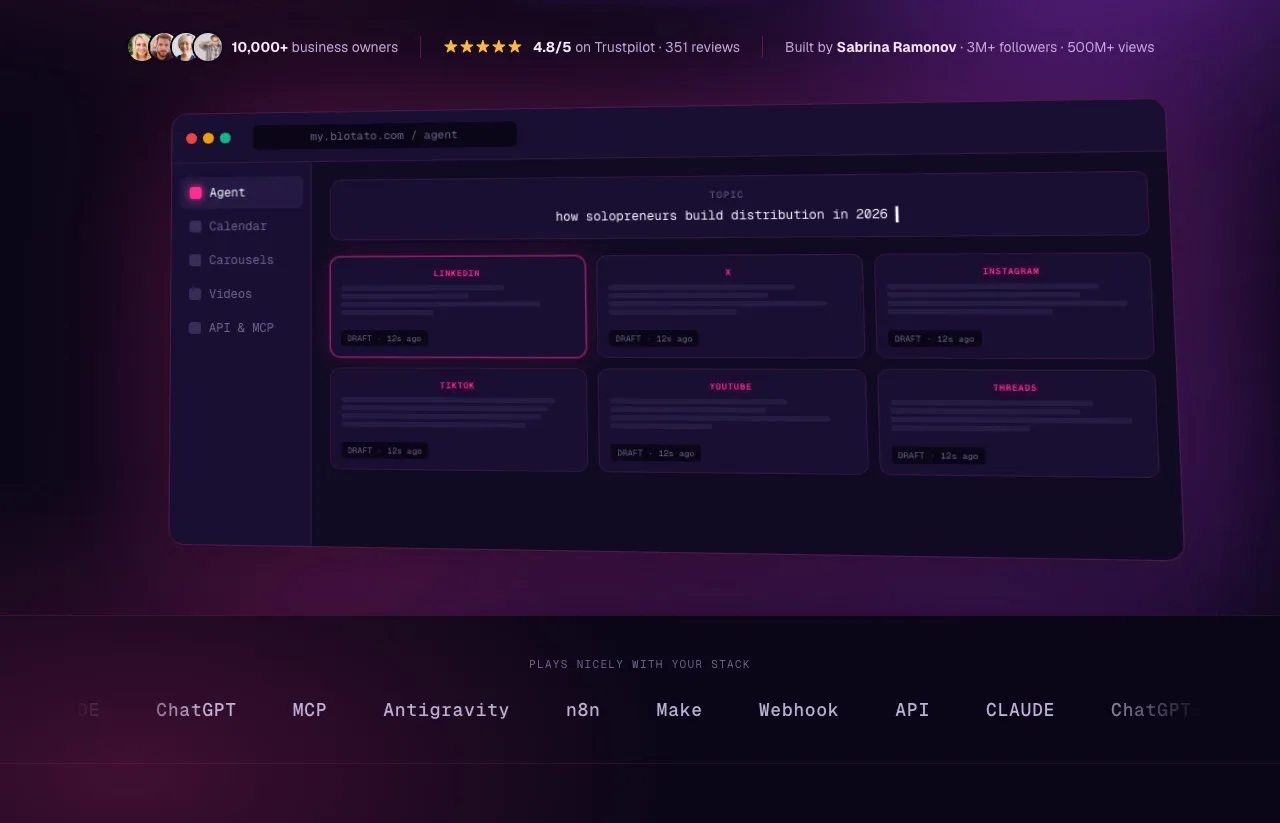
The loop closes behind one key. The same MCP server that publishes also reads analytics on eight platforms, reads and answers Instagram and Facebook comments and DMs, and runs comment-to-DM automations on those two. An agent on Zernio publishes and replies across more channels, but the draft, the image, and the video arrive from a second vendor.
Posting to X costs extra on one side and not the other. Zernio passes X (Twitter) API charges through per request on top of the per-account price. Its own rate card publishes the rates plainly: $0.015 for a post or DM send, $0.005 for a read, and $0.200 for a post that contains a URL. The rates are disclosed, but they sit outside the per-account calculator, so the number you price the tool on is not the number you pay. If a thousand of your X posts a month carry a link, that is $200 on top. On Blotato, X publishing is in the plan and is not billed per request.
Only the media meter moves. Zernio meters connected accounts daily and adds meters for outbound messages past 10,000 a month, for X API calls, and for active ads. Blotato’s invoice is the plan. The credit pool is the one meter, it spends on AI image and video, and Blotato’s billing documentation states that publishing, scheduling, and API calls never consume credits.
You do not have to be a developer to use it. Zernio’s entry point is an API key and an SDK. Blotato has a working app for the person running the accounts, with the API and MCP server there when you want to automate on top of it. Where one person handles the accounts and nobody handles infrastructure, that decides the tool.
Per-Account Curve vs Flat Rate: Where They Cross
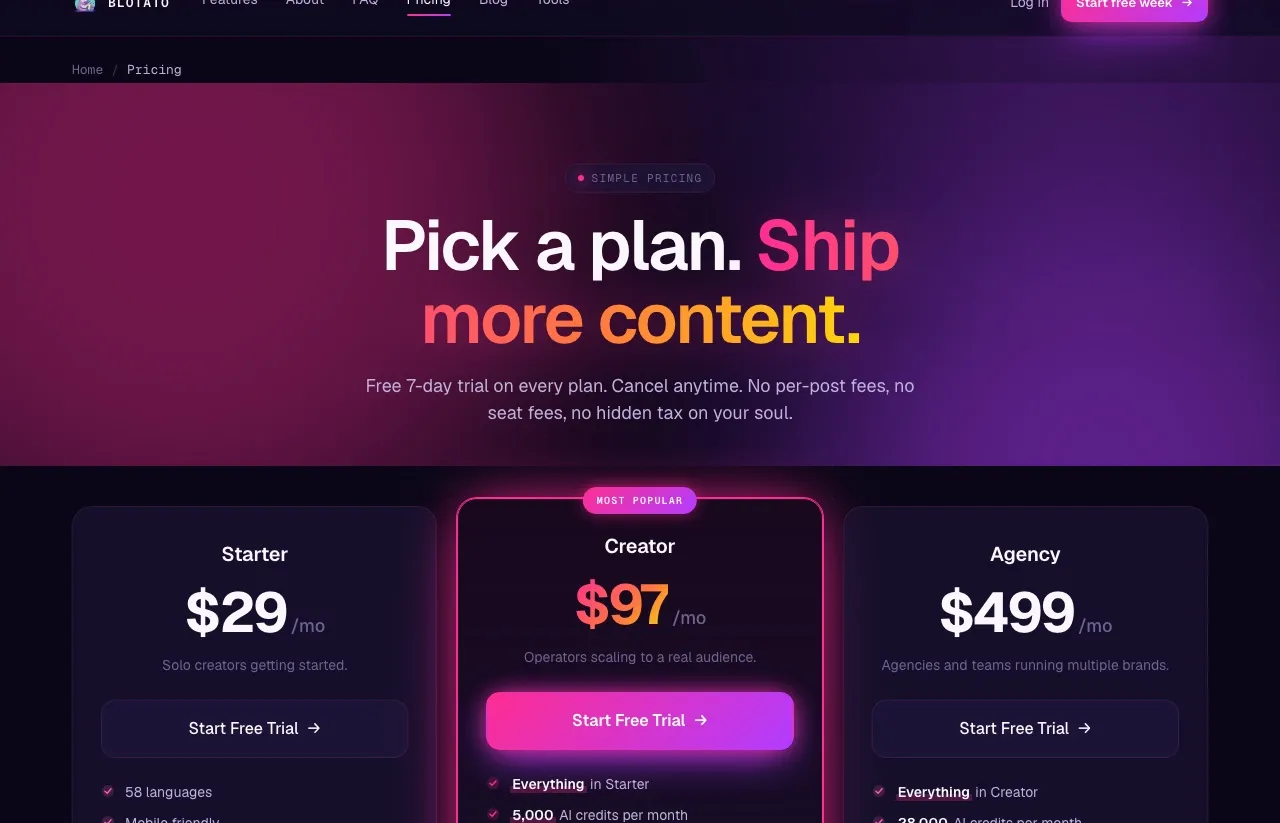
Zernio’s ladder is graduated, so each band’s rate applies only to the accounts inside it: the first two are free, accounts 3 to 10 are $6 each, 11 to 100 are $3, and anything past 100 is $1. Blotato steps instead of climbing, at $29 for 20 accounts, $97 for 40, and $499 for 100. Here is what that produces as actual monthly totals, which is the only version that helps you decide:
| Connected accounts | Zernio | Blotato |
|---|---|---|
| 2 | $0 | $29 |
| 5 | $18 | $29 |
| 10 | $48 | $29 |
| 20 | $78 | $29 |
| 40 | $138 | $97 |
| 50 | $168 | $499 |
| 100 | $318 | $499 |
Because Blotato’s plans step and Zernio’s ladder climbs, the cheaper tool changes hands four times across five bands. Here is every band, with the condition that makes each row true:
| Connected accounts | Cheaper on publishing price | Why, and when it holds |
|---|---|---|
| 1 to 6 | Zernio | Two accounts are free and $6 each stays under $29, if you bring your own content |
| 7 to 20 | Blotato | Starter’s flat $29 covers all twenty, and it includes the writing, images, and video Zernio does not sell |
| 21 to 26 | Zernio | Blotato steps up to Creator at $97 before Zernio’s ladder reaches it, if publishing is all you need that month |
| 27 to 40 | Blotato | Zernio passes $97 at the twenty-seventh account, and Creator’s 40 accounts cover the band |
| 41 to 100 | Zernio | Blotato steps up to Agency at $499, so past forty you pay for content generation whether you use it or not. Agency tops out at 100 accounts, and above that we quote a custom arrangement |
That 21 to 26 band is a real gap and I would rather name it than round it away. If you sit inside it and only need publishing, Zernio is the cheaper tool that month, and if you already have a content workflow you like, every Zernio row in that table gets stronger.
Three Accounts and No Budget? Zernio, Honestly.
- You connect two accounts and want to pay nothing, or up to six where Zernio is still cheaper, or sit between 21 and 26
- You need Snapchat, Telegram, Discord, Slack, or WhatsApp
- Your inbox lives outside Instagram and Facebook, on X, LinkedIn, Reddit, or WhatsApp
- Your team writes in Rust, .NET, Go, or another language where an official SDK matters
- You already produce your content elsewhere and only need it published
The Two Conditions That Flip the Answer
- You run 7 to 20 or 27 to 40 social accounts
- You are paying for a separate AI writing or image tool alongside your scheduler
- You want a bill that stays put as you fill your plan’s account allowance
- You want the same key to publish, read analytics, and answer Instagram and Facebook DMs
- You would rather point Claude at a hosted MCP server than build a posting pipeline
Where I’d Argue, and Where I Wouldn’t
Blotato is mine, so weigh this accordingly: I would still not try to talk a developer with three accounts off Zernio’s free tier. It is a good product with a clear pricing page, and at that size it costs less than we do.
The Blotato vs Zernio comparison changes when two things are true at once: your account count sits in one of Blotato’s two winning bands, and you are paying somebody else for writing, images, or video. Blotato is already cheaper on the publishing line inside those bands. The second condition is where the flat rate and the built-in generation start compounding instead of just competing on that line.
Outside those bands, run your own number through the table above and Zernio may well win. And if neither of these two fits, I ranked six Zernio alternatives through the same account-count lens.
If you land in one of Blotato’s bands, add up your current publishing bill and your content tool together, then compare that total against Blotato’s $29 Starter plan. If the API is what you came for, remember it sits outside the trial.
FAQs
Is Blotato cheaper than Zernio?
It depends on your account count, and on whether X is part of your mix. On the publishing line alone Blotato is cheaper from 7 to 20 accounts and again from 27 to 40 (ten accounts is $48 against $29, forty is $138 against $97), while Zernio is cheaper below seven, between 21 and 26, and past forty. My Zernio pricing breakdown maps the whole curve.
Two meters sit outside that math and both fall on Zernio’s side: X API usage bills per request on top of the account price, at $0.200 for a post carrying a link, and content generation is a second vendor, since Zernio sells none at any tier.
Does Zernio have AI content generation?
No. Zernio is publishing and messaging infrastructure: it publishes and reads analytics across sixteen channels and handles DMs on eight of them, and its own comparison page against Blotato marks AI content “No.” If you need writing, images, or video, you will run a second tool alongside it. Blotato includes all three in its plans.
Who are Blotato’s main competitors?
Zernio and Postiz are the two closest. Zernio competes as a per-account social media and messaging API with a wider channel list, and Postiz as an open-source scheduler you can self-host. Ayrshare and Upload-Post sit in the same API category. Blotato’s difference is one flat plan that also generates the content, and its limits are nine platforms and an engagement surface that stops at Instagram and Facebook.
How many MCP tools do Zernio and Blotato expose?
Zernio’s server at mcp.zernio.com/mcp exposes 496 tools, 20 hand-built core tools plus one generated per API endpoint, with about 50 visible by default and the rest found through a search tool. Blotato’s at mcp.blotato.com/mcp exposes 36 named tools covering publishing, scheduling, analytics, comments, DMs, and DM automations. More tools means more of the API is reachable, not that any single job is easier.
Can I use Zernio or Blotato with Claude?
Both ship hosted MCP servers, so either works with Claude Desktop, Claude Code, and other MCP clients. Zernio’s is at mcp.zernio.com/mcp and Blotato’s is at mcp.blotato.com/mcp. Neither has an exclusive here, and most serious tools in this category now ship one.
Does Blotato have a free plan?
No. Blotato runs a 7-day trial on every plan, a card is collected at signup, and you can cancel anytime. The trial also excludes API access, and generating an API key ends the trial and starts the paid Starter plan. Zernio does have a permanent free tier at two accounts.
Which tool supports more social platforms?
Zernio, at sixteen channels against Blotato’s nine, though Zernio’s own llms.txt says fifteen in its header and sixteen lower down. That sixteen already includes WhatsApp, Telegram, Discord, Snapchat, Slack, and Google Business, so it is sixteen channels in total rather than sixteen social networks plus extras. If a specific platform is a hard requirement, check Zernio’s list first.
Does Zernio charge extra for posting to X (Twitter)?
Yes. Zernio bills X API usage per request on top of its per-account price: $0.200 for a post containing a URL, $0.015 for a plain post or a DM send, $0.005 for a read, and $0.010 for “user reads, follows and Article actions.” Those are X’s own rates passed through with no markup, so the charge is Zernio reporting a cost rather than adding one, but it still lands outside the account price you budgeted. The URL rate is the one worth modelling, because a link post costs more than thirteen plain ones: a thousand link posts a month adds $200 to the bill. Blotato includes X publishing in the plan and does not bill it per request. If a meaningful share of your posting goes to X with links attached, run that line before the account-count math, because it can move the total more than a pricing band does.
Does Blotato publish an uptime SLA or a status page?
No to both, and Zernio’s page is right about that. What Blotato does publish is the API rate limit, 30 requests a minute on the publish endpoint, which is what makes the “undocumented” claim wrong. Zernio’s own uptime figure changes by page, 99.97% on its comparison page and 99.7%+ in its pricing FAQ, with no SLA document behind either.
Is Zernio or Blotato better for agencies?
It depends on your client count. An agency in the 7 to 20 or 27 to 40 account bands pays less on Blotato and gets content generation included, which is the model I broke down in how to start an AI social media agency. An agency above forty accounts pays less on Zernio for publishing, though it will need a separate content tool. Work out your account count first, then compare the combined bill rather than the publishing line alone.