Should You Remove the AI Label on Social Media Posts?
What each platform's rules say about removing an AI label, which ones let you, and what happens to your account if you strip the signal instead.
People are not searching for what an AI label is anymore. They are searching for how to get rid of one.
The demand is small but the curve is steep. “How to remove AI label on Instagram” sat at 10 to 20 Google searches a month through most of 2025 and reached 320 in June 2026, with “turn off,” “avoid,” and “bypass” variants climbing right behind it. Tiny numbers, unmistakable shape.
Every one of those searches rests on the same assumption, which is that the label is costing the creator reach and that getting rid of it is the fix.
I went through the labeling documentation on five platforms looking for the answer to the narrower question those searchers are actually asking. Not whether the label hurts reach, but whether you can take it off, what the platform does when you try, and what it costs you if the platform decides you were trying to hide something.
The answer is more specific than either side of the argument suggests. One platform documents a real correction path and publishes exactly where it closes. One offers an appeal that may or may not succeed. One tells you flatly that you cannot. And on the platform where correction is possible, the move most often recommended for getting rid of labels is the one thing that permanently forecloses it.
The Removal Answer, Platform by Platform
Here is what each platform documents about taking a label off after the fact.
| Platform | Can you remove it? | What the documentation says |
|---|---|---|
| TikTok | No | ”No, you cannot edit or remove the label after posting your video at this time” |
| YouTube | Sometimes | Change the disclosure survey in Studio, except in three blocked cases |
| Appeal available | Contact support to appeal a label on your Pin | |
| Not documented | No published removal or appeal path found | |
| Not applicable | No AI label to remove, and disclosure is a recommendation |
Three of those rows carry a condition that decides the answer, so it is worth taking them one at a time.
TikTok Closes the Door, and Says So Plainly
TikTok’s Creator Academy article on the AI-generated content label carries an FAQ that settles it in one line.
The question is “Can I edit or remove the label after posting my content?” The answer is “No, you cannot edit or remove the label after posting your video at this time.”
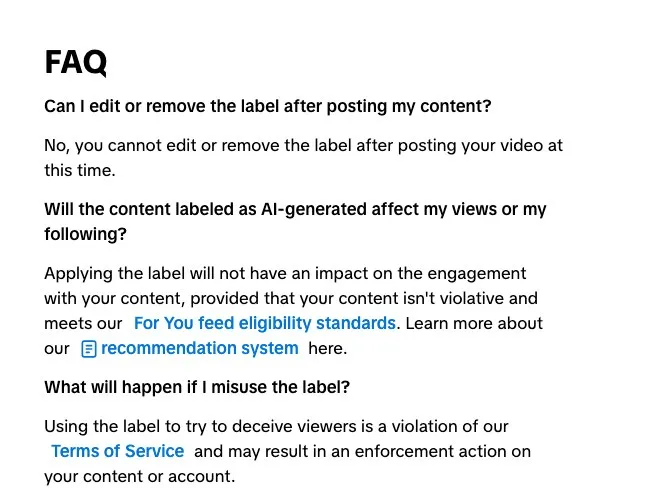
Once the label is on a published video, it stays on, and editing the source file afterward does not reach it.
The same article answers the reach question with a conditional that most people citing it drop. Applying the label “will not have an impact on the engagement with your content, provided that your content isn’t violative and meets our For You feed eligibility standards.” That second half is doing real work. The label is neutral, and the eligibility standards underneath it are where content actually gets held back.
There is a penalty in the other direction too, which is worth knowing before anyone gets creative with the toggle. Using the label “to try to deceive viewers is a violation of our Terms of Service and may result in an enforcement action on your content or account.”
Free 7-day trial · Cancel anytime
YouTube Lets You Fix It, With Three Exceptions That Matter
YouTube is the one platform that documents a real removal path, and then documents exactly where that path closes.
If the system labels your video and it got it wrong, YouTube’s disclosure documentation says creators “will have the ability to change AI disclosure in most cases by selecting No in the AI disclosure survey under ‘Attributes’ in YouTube Studio.”
Then comes the sentence that changes what you should do upstream. Content made with YouTube’s own AI tools, content labeled after manual review, and content containing C2PA metadata “can not be adjusted.”
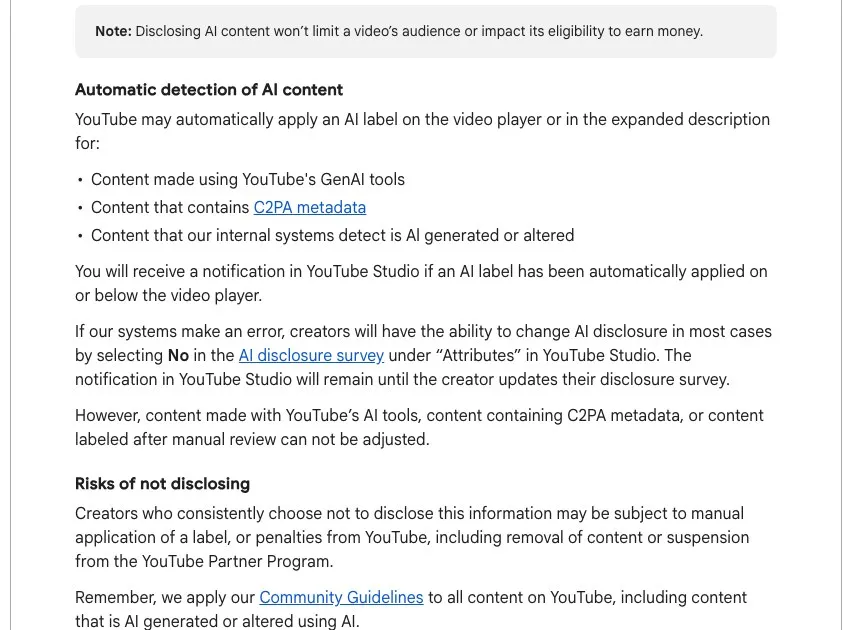
Read that third case against what people are told to do about AI labels. Stripping provenance metadata before upload is the advice you will see everywhere, and on YouTube it is the one move that permanently forfeits your correction path, because C2PA metadata in the upload does not merely trigger the label, it locks the disclosure setting. Stripping it afterward changes nothing, since the flag is already set on the video.
So the sequencing is the opposite of the intuition. Metadata decisions are made before the upload, and the correction path is the thing you lose.
YouTube also publishes the cost of not disclosing when you should have. Creators “who consistently choose not to disclose this information may be subject to manual application of a label, or penalties from YouTube, including removal of content or suspension from the YouTube Partner Program.” That is the clearest documented consequence I found for a pattern of non-disclosure, and it lands on the account rather than on the post.
For completeness, the reassurance is on the same page: “Disclosing AI content won’t limit a video’s audience or impact its eligibility to earn money.”
The Disclosure You Never Owed in the First Place
The more useful move on YouTube is not removing a label. It is knowing which content never required one.
YouTube requires disclosure for content that “makes a real person appear to say or do something they didn’t do,” alters “footage of a real event or place,” or generates “a realistic scene that didn’t actually occur.” The common thread is photorealism plus a claim about reality.
The documentation then lists what does not need disclosure at all. Creators “don’t need to disclose non-realistic content that’s made with AI, or edits to realistic content that are minor,” and it defines minor edits as ones that are “primarily aesthetic, and don’t alter the content in a way that could mislead the viewer about what actually happened.” Their own examples include beauty filters, color and lighting adjustment, background blur, and someone riding a unicorn through a fantastical world.
An AI-assisted color grade on real footage is not a disclosure event. A photorealistic synthetic scene presented as something that happened is. That line is worth locating your own work against before assuming a label was inevitable.
Pinterest Has an Appeal Process Almost Nobody Uses
Pinterest labels Pins by reading metadata, and it reads a different standard than everyone else. Its Gen AI labels documentation says the system analyzes “a Pin’s metadata following the IPTC Metadata Standard,” not C2PA, and separately runs classifiers “that automatically detect Gen AI content, even if the content doesn’t have obvious markers.”
That second clause is the part that defeats the metadata-stripping approach. A clean file still gets classified.
But Pinterest publishes something the others do not, in a section titled “Appeal your label”: if you find an AI label on one of your Pins and want to appeal it, contact support. That is a documented, sanctioned route for a wrongly applied label, and it is the correct answer for anyone whose Pin got labeled by a classifier that made a mistake.
Instagram Is Where the Demand Is and the Documentation Is Not
The removal queries cluster on Instagram, which is also the platform with the least published on the question.
I could not find a Meta help page documenting a removal or appeal path for the AI info label on a post. I also could not find the thing that circulates most widely about it. The claim that Meta confirmed AI labels do not affect reach is repeated across marketing blogs, and none of them link a primary source. The closest thing to one is a post from Instagram’s official creators account announcing an account-level “AI creator” label, where the reassurance about distribution appears inside a carousel graphic rather than in any documentation you can cite or search. I am not going to treat text baked into a promotional image as platform policy, and neither should anyone planning around it.
What Meta does document is what gets held back from recommendations, and it is not AI use. The guidelines describe avoiding recommendations that are “low-quality, objectionable, or particularly sensitive,” held to “a higher standard than our Community Standards” precisely because recommended content comes from accounts a viewer did not choose to follow.
Two separate things are worth keeping apart here. The account-level AI creator label is a creator opt-in. The per-post AI info label is applied by detection. Advice written about one gets applied to the other constantly, and they do not behave the same way.
What LinkedIn Penalizes Instead
LinkedIn does not attach an AI label to your post, so there is nothing to remove. Its guidance on AI-assisted content recommends rather than requires disclosure: “we recommend that you let others know (if it isn’t obvious from the context) if you’ve relied heavily on AI.”
What LinkedIn does define is the thing that costs you distribution, and it is defined in unusually direct language. “AI slop” refers to “low-effort, likely AI-generated content that may sound polished on the surface but lacks a clear point of view, unique perspective, or substance.” The platform scopes the harm to a specific combination, saying that “when content is generic, low-value, lacks substance, and over-uses AI, it dilutes the conversations that real, human conversations spark.”
Nothing in that definition turns on whether AI touched the post. It turns on whether the post has a point of view. A disclosed post carrying a real argument is not what that definition targets. An undisclosed one assembled from nothing is.
Automating Your Way Around a Label Is Its Own Violation
For anyone running an agent that generates and publishes, there is a rule that applies to the pipeline rather than to the post.
TikTok’s community guidelines on integrity and authenticity, effective September 13, 2025, state: “We strictly prohibit automation tools, scripts, or other tricks designed to bypass our systems. These can result in content removal, account bans, or other enforcement.”
Read that alongside the labeling requirement on the same page. TikTok requires creators “to label AI-generated or significantly edited content that shows realistic-looking scenes or people,” and unlabeled content “may be removed, restricted, or labeled by our team, depending on the harm it could cause.”
Publishing realistic AI content unlabeled is a clear breach of the first rule. Whether a metadata-stripping step also counts as an automated attempt to bypass TikTok’s systems is my reading rather than something TikTok spells out, and it is a reading I would not want to test on a monetized account.
This is the part that changes with scale, and it is where I stopped treating this as a per-post question in my own workflow. I publish around 250 pieces of content a week across nine platforms, so a labeling decision I make once in a pipeline gets executed hundreds of times before I look at it again. A person deciding not to tick a box is making one judgment call. An agent applying a stripping step to every asset is running a systematic bypass, unattended, across every post you publish. If you are wiring publishing rules into an agent, the guardrails that keep it from acting on its own are the place that decision belongs.
There is a design consequence for anyone building the pipeline. Disclosure is a per-platform field, not a file property, so it belongs in the publish call rather than in an image-processing step. In Blotato’s publish API the TikTok target treats isAiGenerated as a required boolean, sitting alongside privacyLevel and the branded-content flags, so an agent publishing to TikTok has to state a value for it on every post. That is the correct place for the decision, because it is a declaration about the post rather than a property of the file, and it is made once per destination at publish time instead of being inferred from whatever metadata happened to survive an export.
Why the Label Gets Blamed for Something Else
Every platform here documents real reasons content gets held back, and the label is not among them. That much I have worked through against the ranking documentation elsewhere, along with the parallel question of whether the API that published your post costs you anything.
What that analysis does not cover is the confound sitting underneath this particular complaint, and it is the reason the label takes the blame so reliably.
A label appears because something changed in how the content was made. That same change almost always altered the content itself, whether that is a synthetic scene replacing real footage, a faster production pipeline producing more posts, or one asset going out to five destinations. The label is the visible part of a change whose other effects are not visible at all. It shows up in the interface on the exact day the numbers move, which makes it the most available explanation and the worst place to stop looking.
Removing it, where that is even possible, changes the one variable that was never doing the work.
The Decision, Stated Plainly
If a label is wrongly applied, use the route the platform publishes. Change the disclosure survey on YouTube, appeal to support on Pinterest. Those exist for exactly this and they carry no risk.
If the label is correct, leave it. On TikTok you have no choice after posting anyway. On YouTube disclosure is explicitly free of audience or monetization cost. And on TikTok, labeling is what keeps realistic AI content eligible in the first place, so removing the signal works against you rather than for you.
If you are tempted to strip metadata to prevent a label, understand what that trade actually is. You are not buying reach, because no platform documents a reach penalty on the label. On YouTube you are giving up your ability to correct a mistaken label later. On Pinterest the classifiers catch it regardless of the file. On TikTok, automating it is a separate prohibited act. The mechanics of what actually lives in a file and what survives an upload are worth understanding before you decide any of this, because the advice circulating about metadata rarely distinguishes between the layers it is talking about.
The reason this question keeps getting answered badly is that it has been treated as one question. It is four. Can you remove it, should you, what happens if you try, and what were you actually losing reach to. The first three have documented answers that differ by platform. The fourth is the one worth your afternoon.