Does Posting to Social Media With an API or MCP Hurt Your Reach?
Does publishing through a social media API or MCP suppress reach? What every platform's ranking docs say, and what really costs distribution.
Does posting with an API hurt reach on social media? It is the question every builder asks right before wiring up an agent, and the honest answer is not the one either side of the argument gives you.
Almost every article on this repeats the same three sources, and I went and read all of them. One of them is a quote nobody can link to. One is an experiment with five posts in it. One does not say what people claim it says.
So here is what I actually found after reading the ranking documentation for all five major platforms. No platform names posting source as a ranking signal. But three real mechanisms do cost you reach, they show up more often in automated workflows, and every one of them is something you control.
And if it is TikTok you are worried about, skip ahead, because TikTok is a special case with a documented cause. If the tool publishing your videos has not passed TikTok’s audit, every post it makes is private by rule. The API returns success, the video goes up, and nobody can see it.
Does API Posting Hurt Reach? What Each Platform Documents
I checked the primary ranking and demotion documentation for every platform, looking for any mention of posting source, API, third-party tools, or schedulers as a distribution factor.
| Platform | Posting source in its ranking docs? | What the documentation covers | The real constraint |
|---|---|---|---|
| Absent | Content attributes and viewer behavior | Repurposed content with immaterial edits is ineligible for recommendation | |
| TikTok | Absent | User interactions, content information, user information | Unaudited API clients post privately, plus a shared per-creator daily cap |
| X | Absent | Retrieval signals in the open-sourced algorithm are user behaviors | Abuse labels target bot behavior, not API use |
| Absent | Profile data, engagement history, post metadata, recency | The user agreement bans unauthorized automation, which is not the publishing API | |
| YouTube | Absent | Viewing behavior, satisfaction surveys, channel quality | Nothing published either way |
Read that table carefully, because the distinction matters. All five describe what their ranking systems weigh, and posting source is absent from every one of those descriptions. LinkedIn’s engineering team even enumerates post metadata as an input and lists format, author, company and industry, with no mention of what published it.
That is weaker than “the platforms confirmed there is no penalty,” which is what most articles tell you. What I can show you is an absence across every list that exists, not a denial anyone has issued. I would rather hand you the weaker true version than the stronger false one, and I could not find a single platform rule anywhere stating that publishing through an API costs you distribution.
Free 7-day trial · Cancel anytime
Why the Evidence Everyone Cites Is Thinner Than It Looks
Every page ranking for this question rests on the same citation stack. It does not hold up well.
The Mosseri quote. Instagram’s head is quoted everywhere saying scheduling does not affect reach. It is attributed to an Instagram Stories AMA, and Stories expire after 24 hours. Not one of the pages citing it links a primary source, the wording drifts between versions, and several different dates circulate for it. It may well be accurate. I am simply not going to build an answer on a quote nobody can produce.
The Hootsuite experiment. Hootsuite ran a controlled test and scheduled posts actually won, 8.19% engagement against 6.44%. The sample was five posts per method on a single account over two weeks. Their own authors wrote that “with only five posts per method, this difference may not be statistically significant.” Everyone who cites it drops that sentence.
The Buffer study. Buffer tested more than 200 posts across 35 profiles and found no significant difference. It ran on data collected in late 2017. It predates Reels and the short-video rewrite of every feed on the internet, and it covered Facebook, Twitter and LinkedIn only, never Instagram or TikTok, which are the two platforms people actually worry about.
Both of those studies were run by companies that sell scheduling tools, which is the same category I am in, so weigh them accordingly. Meanwhile the loudest claim on the other side, that native posting gets 20 to 50 percent more reach, is published with no study, no sample size and no methodology behind it at all.
The evidence base on both sides of this argument is genuinely thin. That is the real state of it.
The Three Things That Actually Cost You Distribution
Here is where the reach complaints come from. None of these is a tax on the API. All three are decisions inside your workflow.
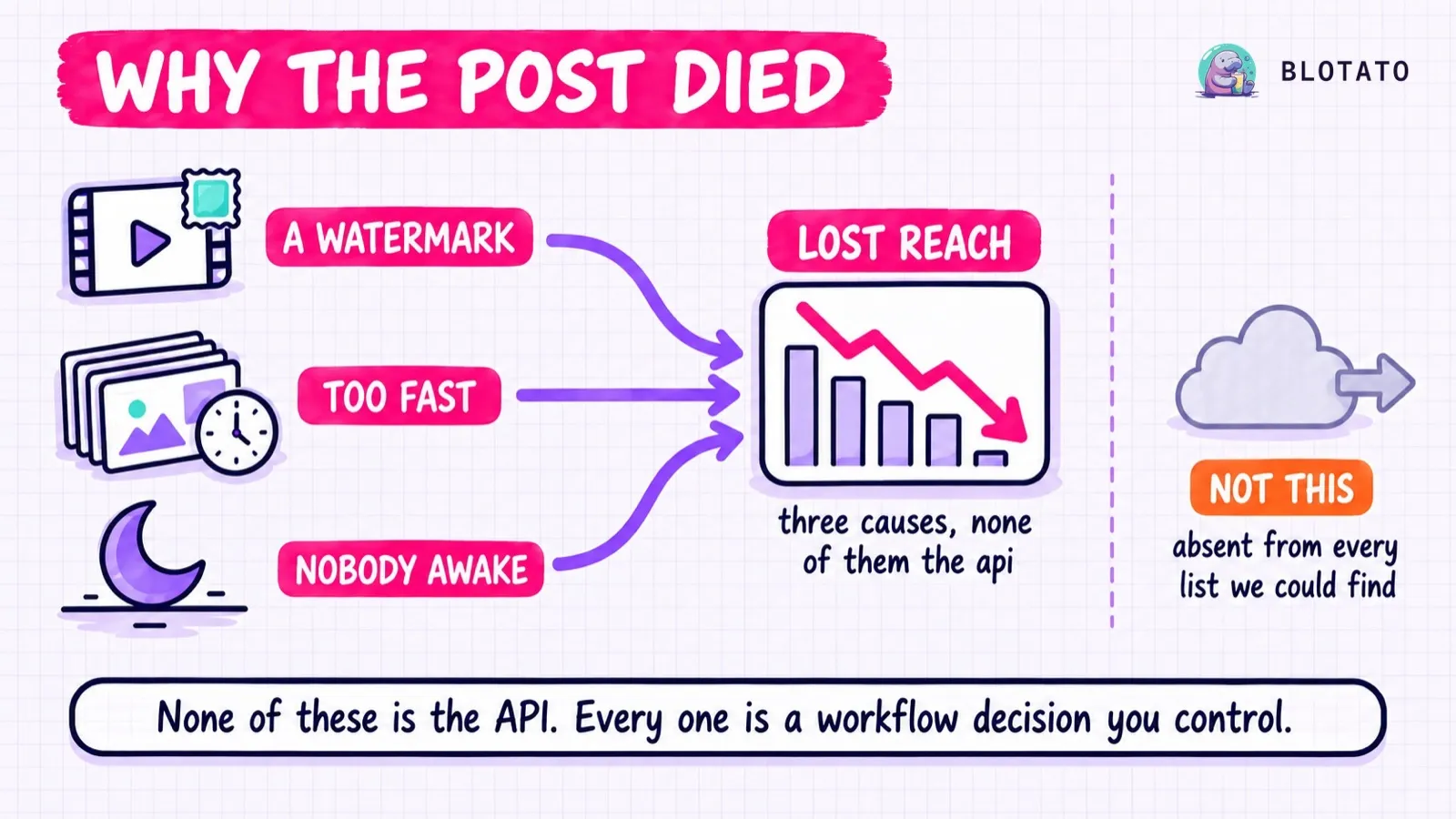
Unoriginal and watermarked content
This is the big one, and it is documented in plain language. TikTok’s Originality Policy says unoriginal content “may be removed from the For You feed, making it harder to discover,” and calls out content carrying someone else’s visible watermark or superimposed logo as generally not original. Instagram’s recommendation guidelines run the same way, making content that is largely repurposed from another source with only immaterial edits ineligible for recommendation.
That rule punishes what you posted, not how you transmitted it. It hits automated pipelines hard because automated pipelines are what people use to push one video to six platforms, watermark and all. The penalty tracks the content and correlates with the workflow, which is exactly why it gets misread as an API penalty.
Export clean and build a native variant per platform, and this one disappears.
Posting frequency and spam thresholds
Platforms cap automated publishing, and where the cap is published it is worth reading before you design a queue. I keep every platform’s cap next to the one Blotato enforces in one place. Instagram allows 100 API-published posts per 24 hours and exposes a content_publishing_limit endpoint so you can check your own usage. TikTok’s Direct Post API returns spam_risk_too_many_posts and spam_risk_user_banned_from_posting when frequency or duplicate checks fire. Caps are only half the picture, though. What each platform’s developer terms actually permit an agent to do is a separate question, and I read all six documents in what gets AI agents banned.
An agent has no instinct for pacing. It will happily flush a queue of thirty posts at 3am, and that is the behavior these thresholds exist to catch.
Publishing into a window nobody is awake for
Short-video ranking leans on early engagement, and early engagement depends on somebody being awake to supply it. Schedule everything for 4am and you are not being throttled, you are just posting to an empty room. Unlike the two above, this one is not a published rule, it is arithmetic about your audience, and it is a scheduling decision rather than an API one.
Why TikTok Is Genuinely Stricter Than the Rest
TikTok deserves its own section, because builders consistently report worse results there and they are not imagining it. The cause is documented, and it is not the recommendation algorithm.
TikTok’s content sharing guidelines state that unaudited API clients “can only post contents in SELF_ONLY viewership,” and that “all user accounts using the API client to post must be set to private at the time of posting.”
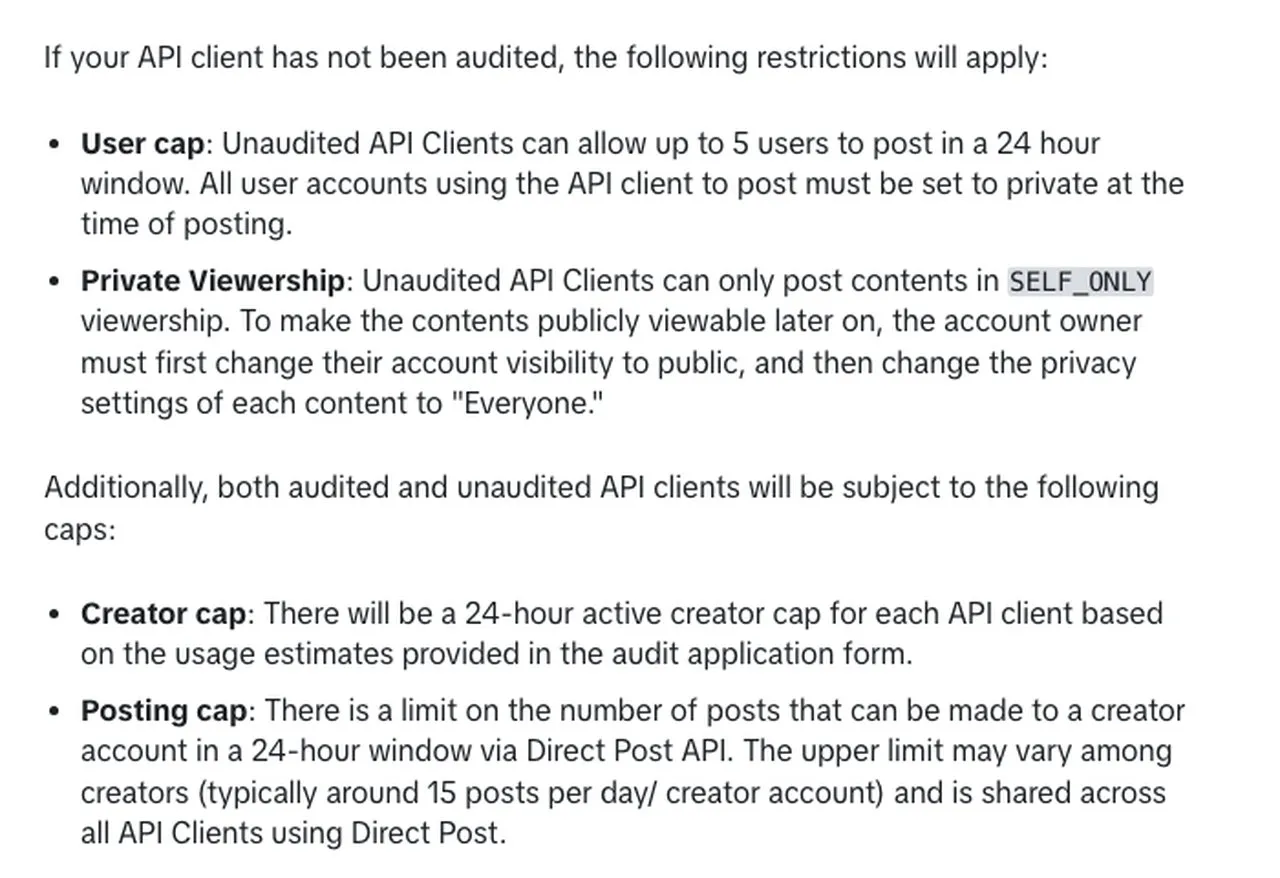
Read what that does to you. If the tool you are using has not passed TikTok’s audit, your post publishes successfully, the API returns a clean response, and the video is private. It got zero reach because nobody could see it, and passing the audit later does not go back and publish it. This alone explains a large share of “TikTok killed my API post” reports.
TikTok also imposes a posting cap on audited and unaudited clients alike, typically around 15 posts per day per creator account, and that cap is shared across every API client touching the account. No other platform does that.
There is a second TikTok-specific factor that has nothing to do with the API. A brand new account that suddenly connects a third-party tool and starts publishing looks like a bot to TikTok’s safety systems. Our own documentation tells people to warm up a TikTok account for four weeks before connecting it, against one to two weeks everywhere else, and to keep third-party posting to three per day after that. We tell customers to post by hand first because on TikTok it genuinely matters.
What I could not verify is whether TikTok treats audited-client posts identically to in-app posts once you clear the audit. Their documentation is silent on it. I am not going to assert parity that nobody has published, and I would treat anyone who does assert it with suspicion.
What This Means If You Are Building an Agent
The reach question turns out to be the wrong thing to argue about. Nobody is losing distribution because a POST request published their video. They are losing it to a watermark, a duplicate, a queue dumped at 3am, or a tool that never passed an audit.
All four of those are engineering decisions. That is good news, because it means the fix is in your workflow rather than in a platform’s mood.
Space your posts instead of flushing a queue. Export clean files with no platform watermark. Build a real variant per platform rather than shipping one asset six times. Schedule into hours when your audience is actually awake. Confirm your publishing layer is an audited TikTok client before you trust a single TikTok number.
Do that and the API stops being a variable in your reach at all, which leaves you arguing about the content instead of the plumbing.
The Honest Pitch: One Social Media API, Nine Platforms
I am biased here and you should factor that in. I built Blotato, and it is a social media API and MCP server that publishes to nine platforms.
One API. Every social platform.
The reason I would point a builder at a hosted publishing layer rather than direct platform APIs is not reach, because reach is not the differentiator. It is that the alternative is nine approval processes, nine auth flows, nine rate-limit regimes and nine sets of docs to keep up with, and TikTok’s audit is one of them. Blotato publishes to TikTok at full public visibility, so you set privacyLevel to PUBLIC_TO_EVERYONE and the video goes out public rather than landing in the private-only state an unaudited client is restricted to.
Publishing is one HTTP call:
curl -X POST https://backend.blotato.com/v2/posts \
  -H "blotato-api-key: YOUR_API_KEY" \
  -H "Content-Type: application/json" \
  -d '{
    "post": {
      "accountId": "YOUR_ACCOUNT_ID",
      "content": {
        "text": "Posted through the Blotato API.",
        "mediaUrls": [],
        "platform": "tiktok"
      },
      "target": { "targetType": "tiktok" }
    }
  }'
You get accountId from GET /v2/users/me/accounts, and for Facebook and LinkedIn you also fetch subaccounts for pageId. If you are driving this from an agent you never touch any of that, because the agent calls a tool that lists your accounts and passes the right ID itself.
There is an MCP server at https://mcp.blotato.com/mcp, so Claude Code, Claude Desktop, Cowork or any MCP client can publish and schedule directly. The workflow I see most often is an agent that drafts, generates the media, spaces the schedule sensibly and ships, with a human approving the queue rather than assembling it. Setup is documented at help.blotato.com/api/start.
One thing I would be a bad founder not to tell you: the 7-day trial excludes the API. Generating an API key ends the trial and starts the paid Starter plan at $29 a month, so plan on starting the subscription rather than trialing it.
If you want the per-platform detail behind any of this, I go deeper in Social Media APIs in 2026 and in the TikTok API pricing breakdown. The watermark and duplicate rules have their own post in 5 content repurposing mistakes.
Where I Land On This
You will notice I have not offered you my own numbers anywhere in this post. That is deliberate. A founder’s anecdote about her own product is the weakest possible evidence on this question, and this topic is already drowning in exactly that.
What I trust is the documentation. No platform lists posting source among its ranking signals, and no platform publishes a rule penalizing it, which is not the same as any of them promising you parity. What the documentation does state outright, and in TikTok’s case brutally, is that unoriginal content, watermarks, spam thresholds and unaudited clients all cost you real distribution.
If your API posts are underperforming, the API is the least likely culprit. Check the audit status first, then the watermark, then the schedule.
API and MCP Posting Reach FAQs
Does posting with an API hurt reach on social media?
No platform documents posting source as a ranking signal, so there is no evidence of a penalty on the transport itself. Note the precise shape of that answer, because it is weaker than the confident “no penalty” most articles give you. Every major platform describes what its ranking system weighs, posting method appears in none of those descriptions, and not one of them has issued an actual denial you could quote.
Why do my TikTok posts get no views when published through the API?
Check your tool’s TikTok audit status before you investigate anything else, because an unaudited client publishes every post privately while still returning a success response. If that is the cause, the videos are not underperforming, they were never visible, and no amount of caption or timing tuning will change it.
Do scheduled posts get less reach than posting manually?
The controlled tests do not show a penalty, though they are thin. Hootsuite’s experiment found scheduled posts slightly ahead at five posts per method, a sample its own authors called possibly not significant, and Buffer’s larger study found no significant difference on 2017 data. Timing matters more than method, because a post scheduled into a dead hour misses the early engagement window.
If the API is not the problem, why did my reach drop when I automated?
Because automating changes three things at once, and none of them is the transport. Most pipelines start reusing one asset across platforms, start publishing at whatever hour the job runs, and start pushing more volume than a person would. Two of those, reuse and volume, are governed by published platform rules, and the third is a plain audience-timing problem. The drop is real even though the API did not cause it, so change one variable at a time and you can usually find which of the three it was.
Do watermarks reduce reach?
Yes, and unlike the API question this one is documented rather than rumored. Both TikTok and Instagram publish originality rules that exclude watermarked or lightly-edited repurposed content from recommendations. Export a clean file per platform and the problem does not arise. Note these rules cover visible watermarks burned into the file. The platform’s own AI label is a different mechanism, and whether you can remove an AI label at all depends on the platform.
How many posts a day can I publish through an API?
Every platform publishes a cap, and they differ enough that one pacing rule will not cover all nine. The practical risk is not the ceiling itself but the shape of agent behavior, because an unattended job flushes a queue in seconds where a person would spread it over days. Add deliberate spacing to the scheduler rather than discovering the limits through failed posts.