9 Best Niches for Faceless AI YouTube Channels in 2026
The best niches for faceless AI YouTube channels, ranked by what you own beyond AdSense and by what survives YouTube's inauthentic content policy.
Every list of the best niches for faceless AI YouTube channels ranks them by ad RPM. I went looking for where those RPM numbers come from and the answer is nowhere. The “finance pays $15 to $50 CPM” figure is repeated across a dozen blogs and not one of them cites a source, because YouTube doesn’t publish CPM by niche. One site I found lists psychology at “$7.13 RPM,” precise to the cent, sourced to nothing. So the entire category ranks niches by a number nobody can trace, for the one revenue stream YouTube can switch off across your whole channel overnight.
Here’s the list re-ranked by what you actually own: affiliate, products, sponsorships, and clients. I’ve built an audience to millions of followers and sold an AI company, and almost none of that came from ad revenue.
Why Ranking Niches by RPM Is Backwards
Two problems, and they compound.
The numbers aren’t real. Ask any of these lists where the RPM data comes from and you get “industry benchmarks” or “creator reports.” Translated: they read each other’s blogs. A made-up range gets repeated until it reads as fact. I’m not going to add to that pile, so you won’t find a single niche CPM figure below.
Ad revenue is the weakest thing you can own. It’s rented. YouTube sets the rate, YouTube decides eligibility, and YouTube can remove monetization from your entire channel at once. Per YouTube’s own monetization policies, “if you have videos that violate our guidelines … monetization may be removed from your entire channel.” Not the video. The channel.
This is where I use the same chart I use for every money decision: how easy is this thing to scale (to serve ten more customers, do I have to do a lot more work?) against time to first dollar (how fast does money actually arrive?). AdSense is the worst square on that chart. It doesn’t scale, because more money strictly requires more views, forever. And it’s slow, because you need 1,000 subscribers and 4,000 watch hours before you earn a cent. An affiliate link earns on video one. A product you own earns while you sleep, and nobody can switch it off.
So the question isn’t “which niche has the highest RPM.” It’s “which niche puts me next to a buyer.”
Fair warning before the list: I built Blotato to publish this kind of content across 9 platforms, so I have a stake in you posting more. That’s also why I’d rather you pick a niche you can actually monetize than one that just racks up views.
What YouTube Actually Banned (It Isn’t AI)
The panic content has this wrong, and getting it right is most of the game.
On July 15, 2025, YouTube renamed its “repetitious content” policy to “inauthentic content.” Nearly every video titled “RIP AI CHANNELS” misreported it as a new ban on AI. It wasn’t a new rule at all. YouTube’s own language is that this content “has always been ineligible for monetization.” They renamed and clarified an existing policy.
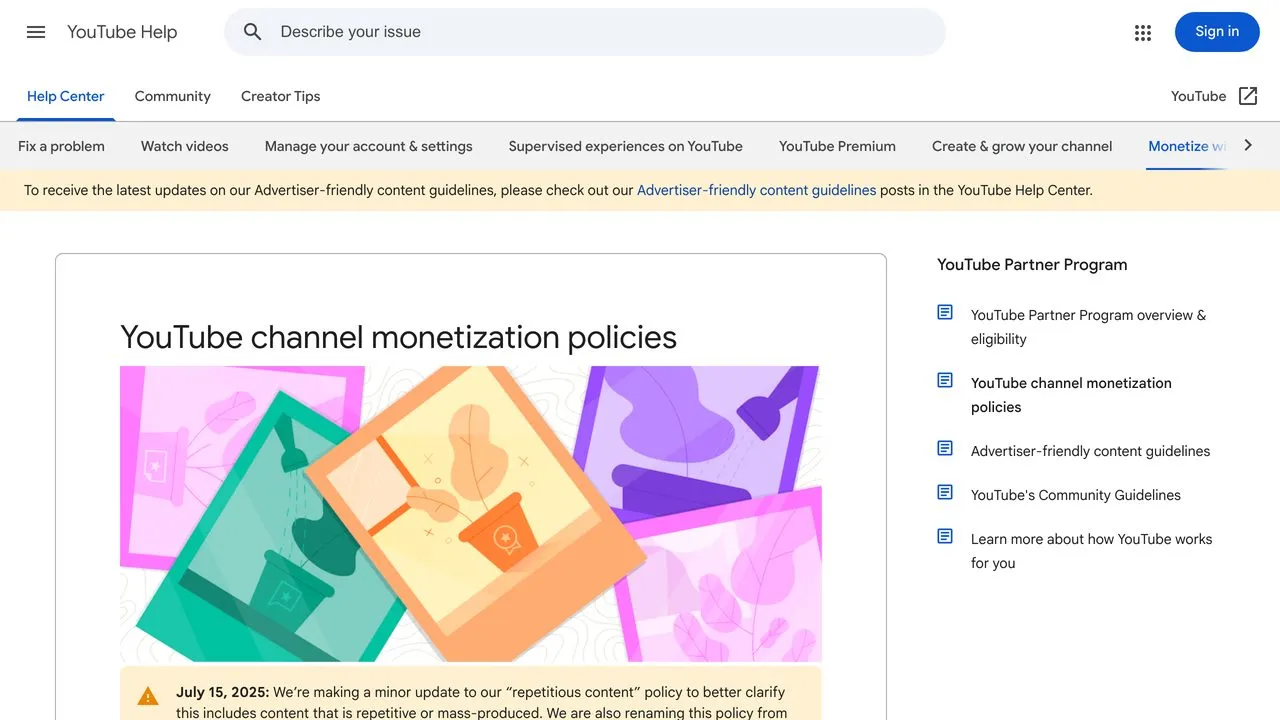
That’s the notice on YouTube’s own policy page, in their words: a “minor update” to clarify that the rule “includes content that is repetitive or mass-produced.” Minor update, not a ban.
What’s actually prohibited is content that is “repetitive or mass-produced.” On AI specifically, the policy targets “AI-generated content made with generic or unoriginal templates giving the impression of mass production” without the creator’s “original, authentic insights or perspective.” And it explicitly permits AI used with creative intent, naming things like “using AI to visualize a unique character and narrative you invented.”
Read that twice. The line is not AI. The line is templates. You can generate every frame with AI and stay monetized if the work carries your point of view. You can film with a real camera and get demonetized if every video is the same shape with a different noun.
This matters more than any RPM number, so it’s the second axis I score every niche on below: can this niche be made with genuine originality, or does it only work as a template farm?
For reference, YouTube Partner Program eligibility is 1,000 subscribers plus 4,000 valid public watch hours in the last 12 months, or 1,000 subscribers plus 10 million valid public Shorts views in the last 90 days.
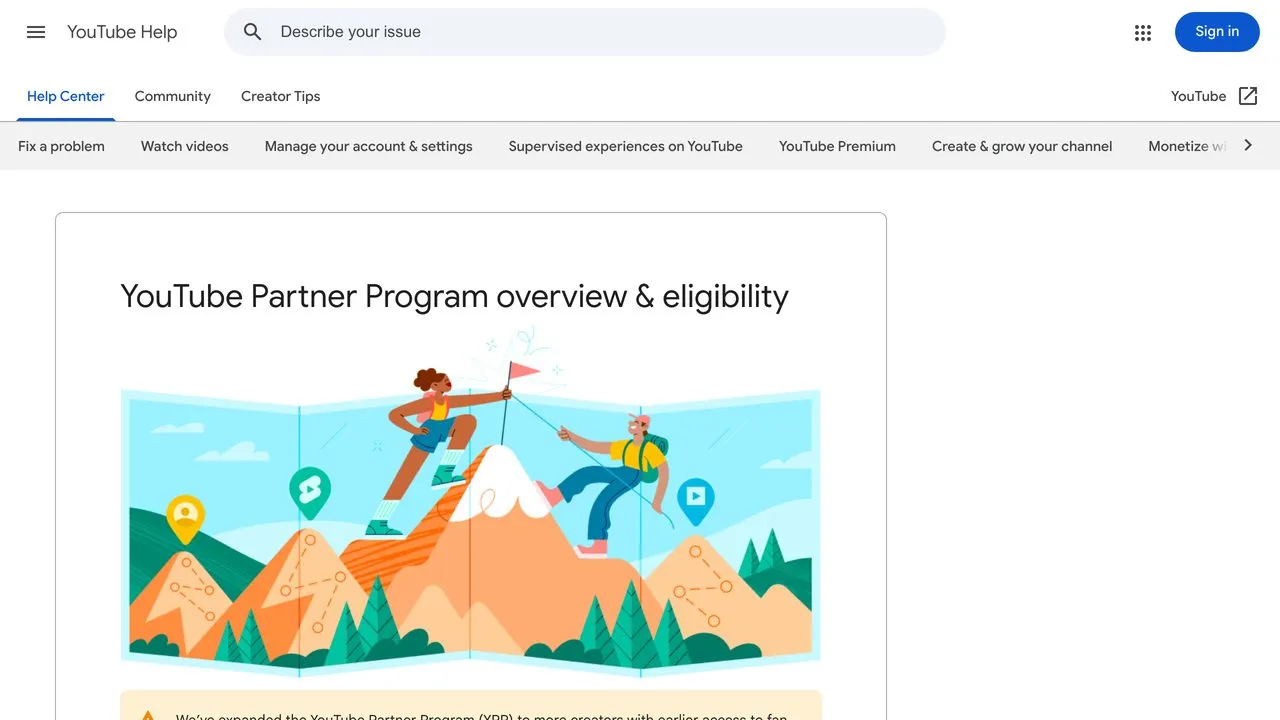
That’s the earliest AdSense can pay you anything. An affiliate link has no threshold at all.
How I Scored These Niches
Two axes, neither of which is RPM:
- Monetization surface: how many ways can you get paid besides ads. Affiliate, digital products, sponsorships, lead gen, services.
- Policy survivability: can this niche be made with a real point of view, or is it structurally a template farm?
| Niche | Best Money Beyond Ads | Policy Survivability | Why It Ranks Here |
|---|---|---|---|
| AI tools and workflows | Affiliate, products, consulting | High | Every tool has an affiliate program and buyers are already spending |
| B2B software and ops | Lead gen, consulting, sponsorships | High | Smallest audience needed per dollar of anything on this list |
| Personal finance | Affiliate, courses, newsletter | Medium | Real buyer intent, but the most crowded and most template-farmed |
| Language learning | Products, apps, memberships | High | Learners buy the next lesson, and the format is inherently varied |
| History recreation | Sponsors, products, licensing | High | Research and narrative are yours, AI only renders them |
| Health and fitness | Affiliate, coaching, products | Medium | Strong buyer intent, real accuracy and trust burden |
| Motivational and self-improvement | Products, memberships, sponsors | Medium | Huge reach, but only escapes template farming with a real voice |
| Faith and spirituality | Memberships, products, community | Medium | The most loyal audience on YouTube, memberships over ads |
| Meditation and focus audio | Products, licensing, memberships | Low | Terrible ads, decent products, hardest policy problem |
Best Niches for Faceless AI YouTube Channels
Ranked by what you own when AdSense goes away.
1. B2B Software and Operations - Best for the fewest viewers per dollar
The most underrated niche in faceless YouTube, and it’s not close. Nobody puts this at number one because the view counts look unimpressive. That’s exactly why it belongs there.
A video explaining how a dental practice automates scheduling might get 4,000 views. If one of those viewers becomes a $3,000/month client, that video outearned a million-view motivational compilation by a wide margin. Businesses already have money, and they only care about two things: making more money and saving time. The closer you sit to those, the more you can charge.
Faceless is an advantage here rather than a compromise. Nobody needs to see your face to trust a screen recording that solves their problem. This is the same logic behind starting an AI social media agency: the buyer wants the outcome, not your personality.
Money beyond ads: Lead gen for services, consulting retainers, high-CPM sponsorships, software affiliate deals.
Policy survivability: High. Specific business problems resist templating.
Bottom line: The lowest view counts and the highest revenue per view of anything here.
2. AI Tools and Workflows - Best for affiliate income from day one
This is the double win and almost nobody frames it correctly. Every list puts “AI tools” high because they claim it has a strong RPM. That’s not the reason. It’s here because every AI tool on earth has an affiliate program, your viewer is already holding a credit card looking for something to buy, and you can earn on your first video with zero subscribers.
The scaling math is what sells me. A tutorial that sends 20 people to a tool you’re an affiliate for pays recurring commission for as long as they stay subscribed. That’s income that compounds while the video keeps ranking, with no view threshold. Sponsorships arrive early here too, because tool companies want tutorials specifically.
Originality is easy in this niche, which is the point: you’re showing a real workflow you actually ran. That’s firsthand experience an AI can’t template. If you need somewhere to start, the AI tools I actually use for faceless content is the stack I’d demo first.
Money beyond ads: Affiliate commissions, sponsored tutorials, your own templates or courses, consulting.
Policy survivability: High. A real workflow demo is inherently original.
Bottom line: The niche where you can earn before you’re monetized and the audience actively wants to be sold to.
3. Personal Finance - Best for buyer intent, worst for competition
Every list has finance at number one on the strength of an RPM figure none of them can source. I’ve put it third, and the reason is honest: the buyer intent is genuinely excellent, and the competition is brutal precisely because everyone read the same unsourced list.
What’s real is that finance viewers buy. Brokerage and fintech affiliate programs pay well, courses sell, and newsletters convert. What’s also real is that finance is the most template-farmed niche on YouTube, which puts it squarely in the inauthentic content crosshairs. “Top 10 dividend stocks” with a stock-photo slideshow and an AI voice is the exact thing YouTube described.
If you enter finance, enter with a point of view. Generic finance is a demonetization candidate.
Money beyond ads: Brokerage and fintech affiliate, courses, paid newsletter, sponsorships.
Policy survivability: Medium. Only survives with genuine analysis.
Bottom line: Great buyers, terrible odds, and a policy problem if you template it.
4. Language Learning - Best for product economics
The slow-English story format is quietly one of the best businesses on YouTube and nobody talks about it, because the ad rates are unremarkable so the RPM lists ignore it.
Look at the actual economics. Language learners always have a next lesson to buy. That means memberships, workbooks, apps, and structured courses, all of which you own outright. The audience is global, which the RPM crowd counts as a negative because international ad rates are lower. It’s a huge positive when you’re selling a $15/month membership, because a subscriber in Jakarta pays the same as one in Ohio.
The format also happens to be naturally varied, which keeps you clear of the template problem.
Money beyond ads: Memberships, courses, workbooks, app partnerships.
Policy survivability: High. Teaching requires real structure and progression.
Bottom line: Bad ad rates, excellent product economics, and the RPM lists can’t see it.
5. History Recreation - Best for sponsorships and durability
This one’s genuinely working right now, and it earns its place on the beyond-ads test rather than on views.
The reason it survives the policy question so well: the research and the narrative are yours. AI renders the visuals, but the script, the sourcing, and the interpretation are human work with a point of view. That’s the definition of AI used with creative intent, and it’s the opposite of a template farm. If you want that to survive at volume, you need a system that varies output per platform rather than one that repeats it.
It also attracts real sponsors. History audiences skew toward exactly the education and documentary advertisers who pay properly, and the content doesn’t expire. A well-made recreation earns for years.
Money beyond ads: Sponsorships, print or digital products, licensing, memberships.
Policy survivability: High. Original research is the product.
Bottom line: Slow to make, hard to copy, and it doesn’t decay.
6. Health and Fitness - Best for affiliate depth, with a real burden
Strong buyer intent and deep affiliate options: supplements, equipment, apps, programs. The RPM lists mention it and then only talk about ad rates, which misses that a single supplement affiliate relationship can outearn AdSense entirely.
The caveat is serious and I won’t soften it. Health is a YMYL topic, meaning accuracy carries real consequences for real people. An AI-scripted health channel that hallucinates a claim isn’t a policy problem, it’s a harm problem. If you can’t verify what you publish, pick another niche.
Money beyond ads: Supplement and equipment affiliate, coaching, programs, app deals.
Policy survivability: Medium. Depends entirely on your accuracy standard.
Bottom line: Excellent economics if you take the accuracy burden seriously, and a bad idea if you won’t.
7. Motivational and Self-Improvement - Best for reach, hardest to make yours
The reach is enormous and the format is cheap, which is why it’s on every list and why it’s saturated with identical AI-voiced stoicism slideshows.
I’m ranking it seventh rather than cutting it because the product economics are real when there’s a person behind it. Memberships, courses, and books all sell well to this audience. But that’s the catch: those things sell because someone trusts a specific voice. A faceless channel with no perspective is the most template-farmed category on YouTube, and it’s the one most likely to get caught.
Do this only if you have something to say that isn’t a rephrased Marcus Aurelius quote.
Money beyond ads: Courses, memberships, books, sponsorships.
Policy survivability: Medium, and low if you do what most people do.
Bottom line: Massive reach, brutal sameness, and it only works with a real voice attached.
8. Faith and Spirituality - Best for community loyalty
Faith audiences are the most loyal on YouTube. The RPM lists rank this niche low or skip it because advertisers don’t pay much for it. That’s precisely why it’s a good beyond-ads bet.
Loyalty converts to memberships and community in a way general entertainment never does. These viewers show up daily, and daily attention is what supports recurring revenue. The visualization format now working, recreating scenes from religious texts, is legitimate original interpretive work when done with care.
Do it with genuine respect for the audience or don’t do it. This is not a niche to farm.
Money beyond ads: Channel memberships, community, books and study products, events.
Policy survivability: Medium. Depends on interpretation versus repetition.
Bottom line: Bad ad rates, exceptional loyalty, and loyalty is what you actually monetize.
9. Meditation and Focus Audio - Best for products, worst for policy
I almost cut this one and I want to explain why it stayed.
Ad rates are poor and the RPM lists rightly rank it near the bottom. But the product economics are genuinely good: sleep and focus apps, licensed audio, and memberships all sell to this audience, and long-session watch time is real.
The problem is that it’s the hardest policy case on this list. Hour-long ambient loops are close to the definition of repetitive and mass-produced. If you build here, the originality has to be deliberate and visible: original compositions, a distinct visual identity, a reason this is yours. Otherwise you’re the example in YouTube’s policy doc.
Money beyond ads: App partnerships, audio licensing, memberships, sleep or focus products.
Policy survivability: Low. Requires deliberate originality to survive.
Bottom line: The products are good, the policy risk is the highest here, and both facts are true at once.
The Niches I Left Off, and Why
Three formats are currently pulling huge view counts, and I still didn’t include them, because they fail the only test that matters here.
Impossible ASMR (the glass-cutting, unusual-texture clips) gets tens of millions of views. There is nothing to sell. No affiliate fits, no product follows, no sponsor wants it. It’s pure AdSense, which means it’s pure rented income, and the templated nature makes it a policy risk on top.
AI music compilations have the same shape. Real views, real watch time, and a monetization surface of almost zero beyond ads, with a copyright question sitting underneath.
Cozy anime loops are lovely and viral and lead nowhere. No buyer, no next step, maximum template exposure.
If your plan is a viral clip farm, those three work until they don’t. If your plan is a business, they’re all downside. I’d rather have 4,000 views in B2B software than 4 million views of impossible ASMR, and I mean that literally.
If you want the version of this argument aimed at income models rather than niches, I wrote about faceless passive income ideas separately.
How to Choose Your Niche
- If you want money before you hit 1,000 subscribers, pick AI tools. Affiliate income needs no threshold.
- If you want the most revenue per viewer, pick B2B software and accept small view counts.
- If you want to own the asset outright, pick language learning and sell the next lesson.
- If you want something durable that compounds, pick history recreation and do the research.
- If you already have expertise, use it. Any niche where you know something real beats every niche on this list, because that knowledge is the one thing that can’t be templated.
Whatever you pick, one thing decides your outcome more than the niche: whether you actually post. Three videos a month isn’t a channel. The people who succeed pick one niche and run it hard for 90 days, and most people quit at week three to chase a different list like this one.
That’s the honest reason Blotato exists. I generate faceless video and publish it across 9 platforms from one place, because posting daily stops happening the moment it takes a stack of separate tools. Pick the niche you’ll stick with, then remove the friction between making and publishing.
Faceless AI YouTube Niche FAQs
Can faceless AI YouTube channels get monetized in 2026?
Yes. YouTube’s inauthentic content policy targets “repetitive or mass-produced” content and AI made with “generic or unoriginal templates,” not AI itself. YouTube explicitly permits AI used with creative intent, like visualizing a character and narrative you invented. Faceless AI channels with a genuine point of view are monetizable. Template farms are not, and never were.
What is the highest-paying faceless niche?
Nobody can honestly answer that with an RPM number, because YouTube doesn’t publish CPM by niche and every figure you see quoted is unsourced. Ranked by total income rather than ads, AI tools and B2B software win, because both pay through affiliate commissions, sponsorships, and clients without needing a view threshold.
Do I need 1,000 subscribers to make money from a faceless channel?
Only for AdSense. YouTube Partner Program eligibility is 1,000 subscribers plus 4,000 valid public watch hours in 12 months, or 1,000 subscribers plus 10 million valid public Shorts views in 90 days. Affiliate links, digital products, and client work have no threshold and can earn on your very first video.
Which faceless niches should I avoid?
Any niche where nothing follows the view. Impossible ASMR, AI music compilations, and cozy anime loops all rack up millions of views with no buyer attached, which leaves you renting income from AdSense while carrying maximum template risk. Avoid any niche you can’t make with a real perspective.