How Much Do Content Creators Make in 2026? (Most Are Broke)
Salary sites say content creators earn $116,000. Social media creator surveys say most full-time creators earn below a living wage. Why both are real.
Ask how much do content creators make and you get two answers that cannot both describe the same person. ZipRecruiter puts the average content creator salary near $116,000 a year. Survey data on independent creators puts more than half of them under $15,000. Scroll the same results page and you find creators posting their real monthly numbers in double and triple digits, one with more than 100,000 followers reporting $172.81 for August across every platform, with nothing from brand deals.
Those figures are all real. They describe different populations, and nobody on page one says so.
I have spent years building an audience and a company around it, and the gap between those figures is the most misunderstood thing in this industry. It explains why views convert to so little, and what the creators who do make money are doing differently.
Why the Salary Numbers Are Wrong for You
Those six-figure numbers come from job boards. ZipRecruiter, Coursera, and Glassdoor report what companies pay a salaried employee whose job title is “content creator.” That person has a manager, a benefits package, and a marketing budget. They are not building an audience of their own.
If you are building your own social media audience and hoping it turns into income, the job-board number tells you nothing. The survey data on independent creators tells a very different story.
Influencer Marketing Hub’s 2025 Creator Earnings Report, which surveyed more than 3,000 creators, found that more than half earn under $15,000 a year. That figure got worse, not better: it was 48% in 2023 and crossed 50% in 2025.
The sharpest number in that report is about full-time creators specifically. The report puts the US living wage at $44,000, then finds that nearly 57% of surveyed full-time creators earn less than that from content creation alone.
Not hobbyists. Not people posting on the side. Most people doing this as their actual job earn less than a living wage doing it.
Here is every credible recent figure side by side, with the population each one actually measures, because the population is what makes these numbers look like they disagree.
| What it measures | The figure | Who is in the sample | Source |
|---|---|---|---|
| Salaried “content creator” job | $116,615 average per year | US job postings and reported salaries, not independent creators | ZipRecruiter |
| Independent creators earning under $15,000 | More than half, up from 48% in 2023 | 3,000+ surveyed creators of all sizes | Influencer Marketing Hub, 2025 |
| Full-time creators below a living wage | Nearly 57%, against a $44,000 baseline | Full-time creators only | Influencer Marketing Hub, 2025 |
| Creators classed as professional | 3.0% in 2025, projected to fall to 2.5% by 2030 | Global creator population, self-defined full-time | Goldman Sachs, March 2025 |
| Six-figure earners on a course platform | 1,000 to 10,000 followers, 309 customers | Kajabi’s own paying customers, vendor-reported | Kajabi, August 2025 |
The first two rows are the numbers people argue about, and they are not describing the same job. The last row is the one almost nobody quotes.
The Odds Are Getting Worse, Not Better
The common assumption is that the creator economy is maturing, so making a living from it should get easier over time. Goldman Sachs projects the opposite for any individual entrant.
Its March 2025 report, Creator Economy: Framing Market Opportunity, models the global creator population growing from 66.6 million in 2025 to 107.2 million by 2030. The number it classifies as professional does grow over that stretch, from 2.0 million to 2.7 million. The pool they are competing inside grows much faster, so the professional share falls from 3.0% to 2.5%. In 2022 it was 4.0%. Goldman bases that split on self-definition, full-time versus part-time, not on an income threshold.
So the professional tier is not shrinking. The crowd you have to get through to reach it is growing much faster. Goldman describes the result as “a barbell-like distribution of creator earnings where a small % of creators capture a significant % of overall earnings.”
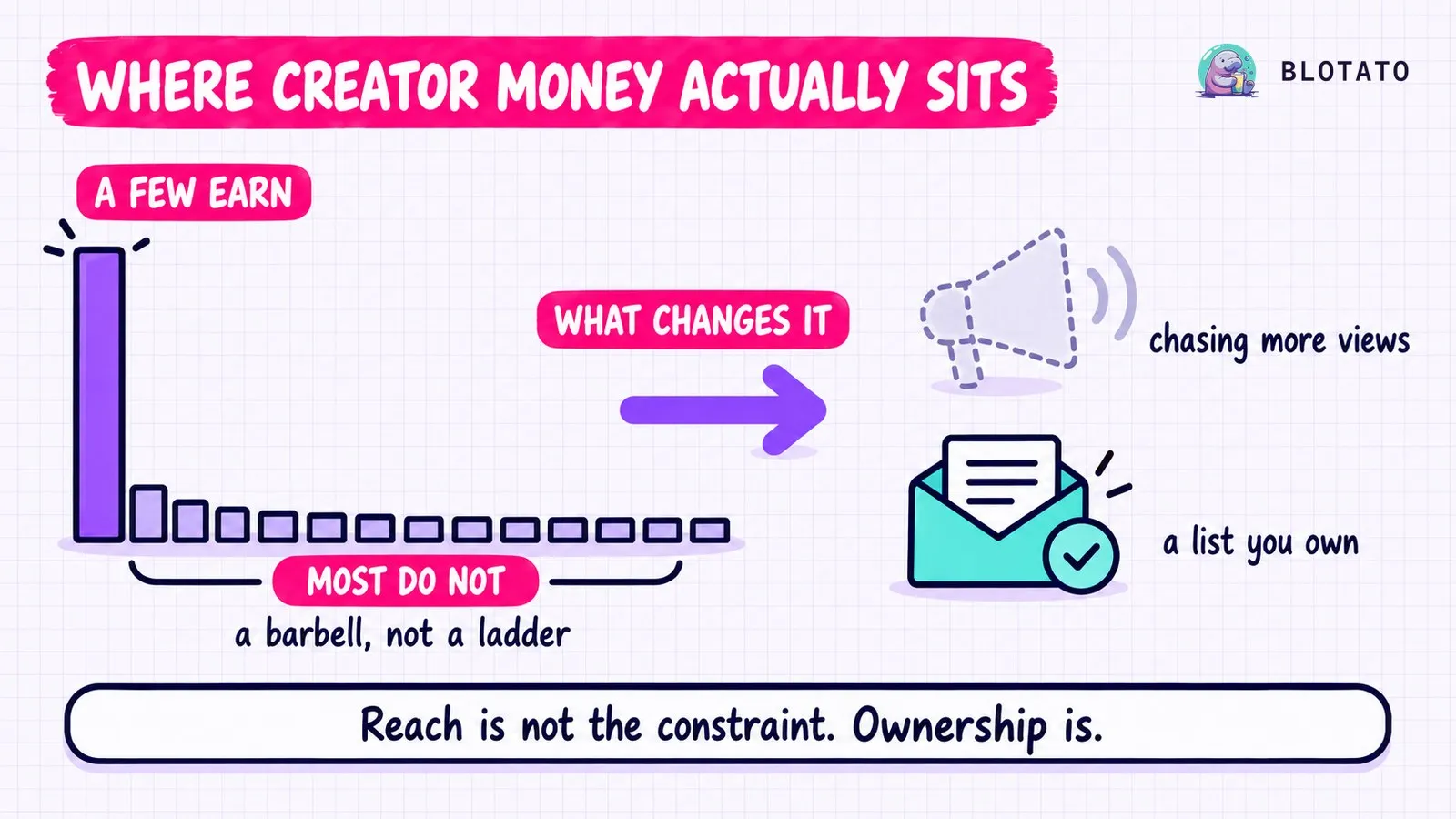
The money in this industry is real and growing. Your odds of catching a share of it by posting more are not.
Why 10 Million Views Can Pay Almost Nothing
No major platform publishes a fixed rate per view. The “$0.40 per 1,000 views” figures you have seen come from marketing blogs and calculator tools rather than from YouTube, TikTok, or Instagram, so I am not going to repeat one.
What the platforms do publish is more useful than a rate would be, because it shows you which of your views count at all.
YouTube offers a Shorts route into the Partner Program at 1,000 subscribers plus 10 million qualified Shorts views in the last 90 days. There are other routes in, including 4,000 watch hours on long-form and a lower threshold for some features in eligible countries. Once you are in, Shorts creators keep 45% of their allocated revenue pool.
TikTok pays on what it calls qualified views. Its own documentation states these “exclude fraudulent views, paid views, disliked views, views with less than 5 seconds watched, promoted views, and artificial views.” TikTok does not publish how many views that removes, but on a feed built for scrolling it is not a rounding error. The number on your video is not the number you get paid on.
Instagram lists no per-view payout for creators. Its creator monetization page covers gifts, subscriptions, badges, invite-only bonuses, partnership ads, and the Creator Marketplace. Nothing there pays you by the view.
So a viral video that made nothing is not a glitch. Views are not a currency. They are an input that most creators never convert. If that pushes you toward building on something other than ad revenue, the faceless niches that pay through offers rather than views are the more durable place to start.
Brand Deal Income Is Getting Less Reliable
The standard answer to “how do creators make money” is brand deals and sponsorships. In its 2023 creator economy report, Goldman Sachs wrote that “brand deals are the main source of revenue at about 70%, according to survey data.” That was the model.
The creator-side numbers have moved since. Kajabi’s 2025 State of Creator Commerce report found brand deal revenue down 52% year over year, affiliate income down 36%, and platform payouts down 33%.
In the same survey, over the same year, the owned-audience side went the other way. Podcast revenue rose 47%. Digital downloads rose 20%. Memberships rose 10%.
One caveat: that is a survey of one platform’s users, and total money flowing into creator marketing is still growing at the industry level. The category is not shrinking. The sponsorship share of an individual creator’s income is just getting less dependable while the product share gets more so.
The Influencer Marketing Hub data shows the same drift from another angle. Just over 49% of creators now earn most of their revenue from brand deals, which the report calls a 10% decrease from the previous year, and 64% still say they would prefer brand deals as their primary income. The preference is lagging the reality.
The deal flow is also thinner than the highlight reel suggests. In that same report, 53% of creators made between zero and ten sponsored posts in all of 2025. That is a sponsored post every five weeks at the top of that band, and none at all at the bottom.
What the Volatility Does to People
The instability has a measurable human cost. Billion Dollar Boy’s July 2025 study, which surveyed 1,000 creators alongside 1,000 senior marketers in the US and UK, found 52% of creators had experienced burnout, and 37% had actively considered leaving the profession. Among those experiencing burnout, 55% ranked financial instability as the single biggest contributing factor.
A good month, then three dry months, then a scramble. That cycle is hard to make good work inside of, and harder to plan a life around.
One Myth Worth Killing
You will read that taking sponsorships destroys your audience’s trust. The best data available does not support that.
BBB National Programs’ 2025 Influencer Trust Index surveyed more than 3,720 US consumers. It found 70% say a brand partnership does not make an influencer less trustworthy. It also found 57% say adding #ad or #sponsored does not make them more trustworthy either.
What does damage trust is concealment. 70% reported feeling negative, deceived, or worse when they later discovered a paid relationship had not been disclosed.
So for most people surveyed, disclosure buys little and partnering costs little. The problem with brand deals is not that your audience turns on you. The problem is that the income is unpredictable, it is falling as a share of what creators earn, and somebody else decides whether you get it next month.
What the Creators Who Make Money Actually Own
Here is the number that reframed this whole question for me.
Kajabi published data in August 2025 on its six-figure earners. The average creator on its platform earning six figures has between 1,000 and 10,000 followers, an email list of around 4,000 people, and just 309 paying customers.
An audience most people would call small. Three hundred and nine customers.
The source deserves a caveat: Kajabi sells the platform those creators use, so this is vendor data about its own self-selected paying customers rather than a random sample. It does not prove that small audiences beat large ones, and plenty of people do earn well from views, brand deals, and services.
What it does show is that a six-figure creator business does not require a huge audience. Reach is not the binding constraint most creators think it is. One of our users published an itemized breakdown of six income streams built on exactly that shape, which is the concrete version of what the Kajabi averages describe.
A follower is a person a platform lets you reach today. An email subscriber is a person you can reach tomorrow. Moving people across that line is the part most creators skip.
The Step Almost Nobody Builds
If you are already getting views, the audience side is working. What is usually missing is the handoff, the specific moment where someone watching becomes someone you can contact.
That handoff is usually manual, which means it does not happen. Someone comments “link please” on a reel and you either reply to 300 comments by hand or you let the interest die.
Automating that one step is the cheapest fix I know of for a creator who already has attention. Someone comments a keyword on your post, and they get a DM with the thing you promised, whether you are awake or not.
That video is me building the handoff end to end, including the reel that turned into $120,000 in annual recurring revenue. Watch it for the mechanics. The rest of this section is the short version.
That is what DM automation does, and it is why I built it into Blotato. You set a keyword trigger, and a comment on your Instagram or Facebook post fires an automatic reply with your link, your lead magnet, or your offer.
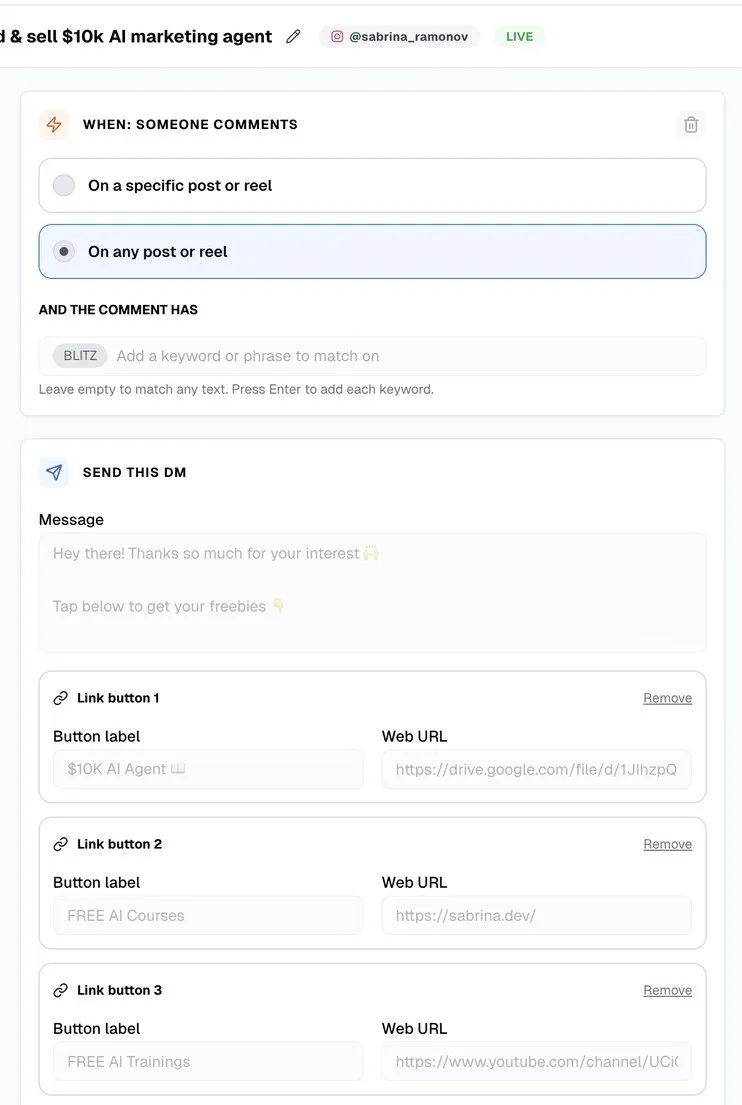
Because the automations are exposed through the API, your agent can create and update them for you rather than making you click through that builder one flow at a time. That matters when a launch changes your offer and twenty automations still point at the old link.
If you want the email rather than just the click, there is an optional email gate that asks for an address before the DM goes out and saves it to the contact. Reading those addresses back into your own list takes a webhook, so plan that piece rather than assuming the DM builds your list for you.
Two limits worth knowing up front. Blotato’s DM automations run on Instagram and Facebook only, and they are reply-only, so someone has to engage with you first. There is no cold outreach here and there should not be.
The bigger limit is the one that costs me customers to say: this only works if you already have attention. DM automation converts engagement into contacts, and someone has to comment or message you first. It does not create views. If you are not getting any yet, ignore all of this and go post consistently for a few months first. That is the better use of your time, and no tool changes it.
If you want the whole path from a reel to revenue rather than just the automation piece, I walked HubSpot’s CMO through my own comment-to-DM system and built one live on his show, and one of our users documented his own results from Instagram DM automations.
So How Much Do Content Creators Make?
If you want the honest short answer: most make very little, and the ones who make a lot usually are not making it from views.
More than half of creators earn under $15,000 a year. Nearly 57% of full-time creators earn below a $44,000 living wage. Goldman counts 3.0% as professional and expects that share to keep falling. On Kajabi’s numbers, meanwhile, a six-figure creator business can run on an audience in the low thousands and 309 customers.
Those are different datasets measuring different groups, so do not read them as one clean before-and-after. Read them as a direction. The people earning well are rarely the ones with the most views, and the ones with the most views are frequently not earning.
What separates them most often is whether the attention ended up somewhere they control. Most creators stay broke because they built an audience on rented land and never built a door out of it.
Build the door. Everything else gets easier after that.
Content Creator Income FAQs
How many views do you need to make money on YouTube?
Views alone do not qualify you. YouTube’s Shorts route into the Partner Program needs 1,000 subscribers plus 10 million qualified Shorts views in 90 days, and the long-form route needs 1,000 subscribers plus 4,000 watch hours in 12 months. Once you are in, Shorts creators keep 45% of their allocated revenue pool. YouTube publishes no fixed rate per view, so anyone quoting you a dollar figure per 1,000 views is estimating.
How much do content creators make per view?
No major platform publishes a per-view rate, and the payout rules matter more than any rate would. TikTok pays only on qualified views, which its documentation says exclude paid views, disliked views, and views with less than 5 seconds watched. Instagram lists no per-view payout at all. The view count on your video is not the number you are paid on.
Is being a content creator actually profitable?
For most people, not yet. More than half of creators earn under $15,000 a year, and nearly 57% of full-time creators earn less than a $44,000 living wage from content alone. Goldman Sachs classes 3.0% of global creators as professional and expects that share to fall to 2.5% by 2030. The creators who do earn well usually sell something to an audience they own rather than living on views.
Why do creators with millions of views make no money?
Because reach and revenue are separate problems. Views generate ad or bonus income only if they meet a platform’s eligibility rules, and even then the rates are small and outside your control. A creator converts attention into income at the handoff, the moment a viewer becomes a contact you can reach again, usually through an email list or a DM. Without that step, a viral video is an audience you rented for a day.
How do content creators get paid?
Through four broad channels: platform payouts, brand deals and sponsorships, affiliate commissions, and their own products or services. The mix is shifting. Kajabi’s 2025 data shows brand deal revenue down 52% year over year while digital downloads rose 20% and memberships rose 10%, which points creators toward the revenue they own rather than the revenue a platform or sponsor decides to send them.