Blotato vs Metricool: Which Tool Does More for Less?
Blotato vs Metricool: an honest look at where each tool wins on AI, analytics, pricing, and which one actually fits your workflow in 2026.
Blotato vs Metricool is a strange comparison once you actually use both tools. On paper they look like rivals. In practice they solve different halves of the same problem. One is built to measure and report on what you post. The other is built to create and publish what you post in the first place.
So the real question is not “which tool is better.” It is “which job are you trying to do.” If you pick based on a feature checklist alone, you can end up paying for analytics depth you never open, or an AI engine you do not need.
Let me break down where each one earns its price, and who should pick which.
Blotato vs Metricool: At a Glance
Metricool is the better pick if: You manage multiple client brands and your day revolves around analytics, ad performance tracking, and reporting. You want one dashboard that pulls social and paid data together, and you do not need the tool to write or generate content for you.
Blotato is the better pick if: Your bottleneck is making content, not measuring it. You want AI to write posts, generate images, and produce faceless video, then publish everything across platforms from one flat-rate plan.
Different Starting Points: Measurement vs Making
It is worth being honest up front. These tools are built around a different starting point.
Metricool is an analytics and scheduling platform with a strong paid-ads tracking layer on top. Its center of gravity is data: what performed, on which network, against which competitor, for how much ad spend. Scheduling is part of the package, but reporting is the reason people stay.
Blotato is a creation engine that also schedules. Its center of gravity is the AI that writes posts, generates images, and produces short video, so a solo creator can fill a content calendar without a team. Analytics exists, but it is not the headline.
That difference shapes everything else, including who each tool is priced for.
Analysts Who Report on Performance Weekly
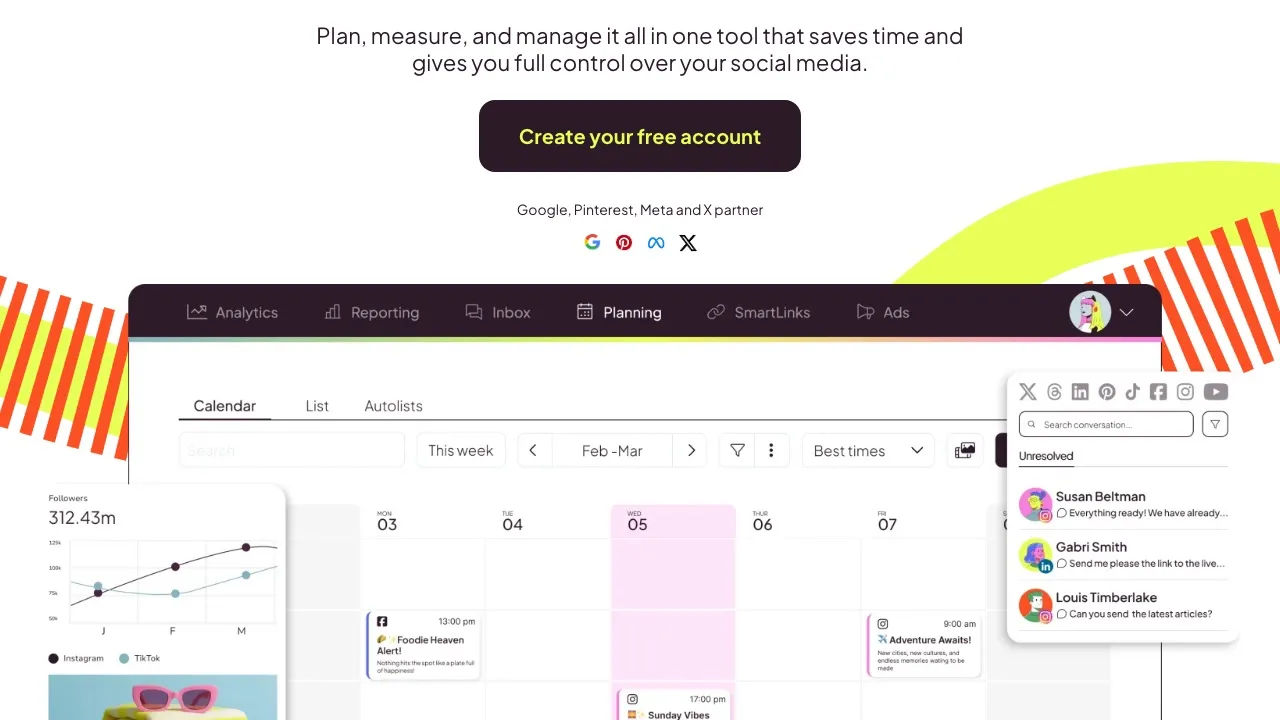
Metricool is built for social media managers and agencies who live in the numbers. It launched in 2015 out of Madrid, joined the team.blue group in 2024, and has grown into one of the most popular analytics-first tools for people juggling many brands. You can read more on the Metricool homepage.
The standout is breadth. Metricool tracks performance across a wide set of networks, and it folds in paid-ads data from Google, Facebook, and TikTok through its Unified Ads view. For an agency that has to show a client both organic and paid results in one report, that is genuinely useful and hard to replicate by stitching free tools together.
Reviews on platforms like Capterra lean positive, with users repeatedly praising the analytics depth and the value for money relative to enterprise suites. The common complaints are familiar for a deep tool: some areas take time to learn, and a few of the best features sit behind the higher tiers.
Creators Whose Bottleneck Is Output, Not Insight
I am involved with Blotato as a creator and tester, so take this with whatever grain of salt feels right. I have tested just about every social media tool that exists, and the gap I kept running into was creation, not measurement.
Blotato is built for solopreneurs, creators, and small teams whose real constraint is producing enough content to stay consistent. The AI writes posts trained on viral examples, generates images and carousels, and produces faceless video, so one person can do the work that used to need a small content team. Then it publishes natively across nine platforms: X, Instagram, LinkedIn, TikTok, YouTube, Threads, Facebook, Pinterest, and Bluesky.
If your problem is “I never have time to make the posts,” that is the problem Blotato is shaped around.

Metricool vs Blotato: Side by Side
| Category | Metricool | Blotato |
|---|---|---|
| Pricing model | Per brand (tiered) | Flat rate |
| Free plan | Yes (1 brand, 20 posts/mo) | No (7-day free trial) |
| Cheapest paid tier | From around $20/mo annual (Starter) | $29/mo flat (Starter, 20 accounts) |
| Social networks | 11 networks plus ad-platform tracking | 9 |
| AI text writing | Yes (writing assistant only) | Yes (unlimited generation, trained on viral posts) |
| AI image generation | No (native) | Yes (built in, uses AI credits) |
| AI video generation | No | Yes (faceless video, AI voiceover) |
| Public REST API | Yes (Advanced and Custom tiers) | Yes (full API on paid plans) |
| n8n / Make.com nodes | Make and Zapier integrations | Native nodes for both |
| MCP / Claude integration | Yes (works on any plan) | Yes |
| Ad performance tracking | Yes (Google, Facebook, TikTok) | No |
| Analytics depth | Deep, cross-platform | Basic |
| Trial on paid plans | Forever-free tier | 7 days |
The table makes the split obvious. Metricool wins the data and ads rows. Blotato wins the AI creation rows. Almost nobody needs to win both, which is exactly why this should be a fit decision, not a scoreboard.
Cross-Platform Analytics Depth and Paid Ads Tracking
Metricool is a strong tool, and pretending otherwise would not help you choose. Here is where it clearly leads.
1. Cross-platform analytics depth. Metricool reports across more networks than most tools, and the data goes deeper than a basic post-count summary. For anyone whose job is to explain performance to a client or a boss, this is the core value.
2. Unified ad tracking. This is the real differentiator. Metricool pulls Google, Facebook, and TikTok ad campaign data into the same dashboard as your organic results. Very few tools at this price connect paid and organic in one place.

3. A genuinely usable free plan. Metricool’s free tier covers one brand with up to 20 posts per month, basic analytics, and competitor tracking. It is a real workflow for a single account, not a 7-day clock. You can see the breakdown in Metricool’s own free-vs-premium guide.
4. Competitor benchmarking. You can track competitor accounts and compare your performance against them, which is built for the agency pitch-and-report cycle.
5. Link-in-bio and unified inbox. Metricool includes SmartLinks for a trackable link-in-bio and a unified inbox for comments and messages. Blotato has no link-in-bio and its inbox covers Instagram and Facebook only, so if those are part of your daily flow, that is a real point for Metricool.
Creation and Flat Pricing, Not Better Analytics
Blotato earns its edge on creation and on flat pricing, not by being a better analytics tool.
1. AI that actually makes the content. Metricool’s AI is a writing assistant: it can draft captions, fix grammar, change tone, and suggest hashtags. Blotato’s AI writes full posts trained on a large library of viral content, and it goes further into image generation, carousels, and faceless video. One assists your writing. The other produces the asset.
2. Built-in image and video generation. This is the cleanest gap. Metricool does not natively generate images or video, and points to third-party tools for that. Blotato includes AI image generation and faceless video inside the same plan. Its AI text writing is unlimited and does not draw from credits, while the image and video generation runs on a shared pool of AI credits.
3. Flat-rate pricing that does not punish you per platform. Metricool prices by brand, and two specifics matter: connecting X/Twitter is a paid add-on of $10 per account per month on every premium tier, and X and LinkedIn are not available on the free plan at all. Blotato’s $29 Starter includes all nine platforms with no per-network surcharge.
4. Deeper automation hooks for builders. Both tools integrate with automation platforms, but Blotato ships native nodes for both n8n and Make.com, a full REST API on paid plans, and MCP integration for Claude. If you want to wire publishing into a custom workflow, that surface area is wider.
Per-Brand Ranges Against a Fixed Number
Here is where the two models diverge most. Metricool prices by brand and adjusts as you add brands, so its plans are a range rather than a fixed number. Blotato charges one flat rate per tier.
| Tier | Metricool | Blotato |
|---|---|---|
| Free | Free: 1 brand, 20 posts/mo | None (7-day trial instead) |
| Entry paid | Starter from around $20/mo annual | Starter $29/mo (20 accounts, 1,250 credits) |
| Mid paid | Advanced from around $53/mo annual | Creator $97/mo (40 accounts, 5,000 credits) |
| Top paid | Custom (contact sales) | Agency $499/mo (28,000 credits) |
Now the part that actually clarifies the decision. Look at what you get at the cheapest paid tier of each tool:
| Capability at the entry tier | Metricool Starter (~$20/mo annual) | Blotato Starter ($29/mo) |
|---|---|---|
| Social accounts | Up to 10 brands (X is a +$10 per account add-on) | 20 total, all platforms included |
| AI text writing | Assistant only | Unlimited generation |
| AI image generation | No | Included (uses credits) |
| AI faceless video | No | Included (uses credits) |
| REST API + n8n/Make/MCP | API on higher tier | Included |
| Cross-platform analytics + ad tracking | Yes | Basic analytics, no ad tracking |
That last table is the whole Blotato vs Metricool comparison in one frame. Metricool’s entry tier buys you analytics and ad tracking that Blotato does not match. Blotato’s entry tier buys you AI creation and full publishing that Metricool does not sell at any tier. You are not really comparing prices. You are comparing which capability you need.
A few honest caveats before you decide:
- If you mostly need reporting, Metricool is the better spend, full stop. Blotato’s basic analytics will not replace it.
- If you run paid ads and need them tracked next to organic, Metricool has no equivalent on the Blotato side.
- If you only want occasional caption help and never touch image or video generation, Metricool’s writing assistant is plenty, and you avoid paying for AI creation you would not use.
- If you connect many brands but few platforms each, Metricool’s per-brand model can come out cheaper than it first looks. Run your own count.

You can see the current Blotato tiers on the Blotato pricing page.
Metricool Fits a Reporting-First Job
- Your core job is analytics and reporting across many networks.
- You run or manage paid ad campaigns and want them tracked beside organic.
- You need a forever-free plan for a single brand.
- You want competitor benchmarking baked in.
- A trackable link-in-bio and a unified inbox are part of your daily flow.
If Producing Is Slower Than Measuring, Start There
- Your bottleneck is creating content, not measuring it.
- You want AI to write posts, generate images, and produce faceless video.
- You want one flat price with every platform included, no per-network fees.
- You publish across X, Instagram, LinkedIn, TikTok, YouTube, Threads, Facebook, Pinterest, and Bluesky.
- You want to automate publishing through n8n, Make, an API, or Claude.
If you want a wider view of where both tools sit among their peers, our roundup of the best social media automation tools maps the whole field, Metricool included. For Blotato specifically, every major competitor sits in one table if you want the full field at a glance. And if you have already decided to leave, the best Metricool alternatives are priced side by side there, including what each one charges for API access.
One Comparison Where I Won’t Push Everyone One Way
Honestly, Blotato vs Metricool is one of the few comparisons where I would not push everyone to the same answer. The two tools are good at genuinely different things, and the right pick comes down to which problem is actually slowing you down. If you spend your days reporting on performance and tracking ad spend, Metricool is the better home for that work, and its free plan makes it easy to try. If you spend your days struggling to make enough content, that is the gap Blotato is built to close.
If you are still unsure, my honest advice is to start on Metricool’s free plan if analytics is your real need, and try the Blotato 7-day trial if creation is the part you keep getting stuck on.
FAQs
Is Blotato cheaper than Metricool?
It depends on what you count. Metricool’s entry plan can start lower than Blotato’s $29, but its price climbs in steps as you add brands, and X connections cost extra. I mapped every step of that brand-count ladder separately, because the bracket you land in matters more than the headline rate. Blotato is a flat $29 for 20 accounts across all platforms. For creation features, Blotato includes things Metricool does not sell at any price.
Does Metricool have AI video generation?
No. Metricool’s AI is a text writing assistant that drafts captions, adjusts tone, fixes grammar, and suggests hashtags. It does not natively generate images or video. Blotato includes AI image generation and faceless video with AI voiceover inside its plans.
Can I use Metricool or Blotato with n8n or Make.com?
Both connect to automation tools. Metricool supports Make and Zapier and offers an API on its higher tiers. Blotato ships native nodes for both n8n and Make.com, plus a full REST API on paid plans and MCP integration for Claude, so its automation surface is wider.
Does Blotato have a free plan?
No permanent free tier. Blotato offers a 7-day free trial on every plan. Metricool is the opposite: it has a forever-free plan for one brand with up to 20 posts per month, but no free creation tools.
Which tool supports more social platforms?
Metricool tracks more networks overall, around 11 social platforms plus paid-ad integrations, because its job is measurement across everything. Blotato publishes natively to 9 platforms. The difference is breadth of tracking versus depth of AI-assisted publishing.
Is Metricool or Blotato better for agencies?
For a reporting-heavy agency that manages many client brands and ad accounts, Metricool fits the workflow better. For an agency whose real cost is producing content at volume, Blotato’s AI creation can replace several tools at a flat rate. Many agencies end up using one for measurement and the other for creation.
Does Blotato report analytics on every platform it publishes to?
No, and on an analytics comparison that gap is worth stating plainly. Blotato collects published-post metrics on 8 of its 9 platforms, and LinkedIn is the exclusion because it returns no metrics yet. So if LinkedIn reporting is the number your client asks for every month, Metricool covers a surface Blotato currently leaves blank. Blotato also has no paid-ads tracking, so social and ad spend never land in one view the way they do in Metricool.