How Ikjot Juneja Runs 23.6M Views of Faceless Reels on a Grok Loop
Five Reels carried half his 23.6M views. Here is the social media automation loop behind them, the tools it actually runs on, and the part he still does by hand.
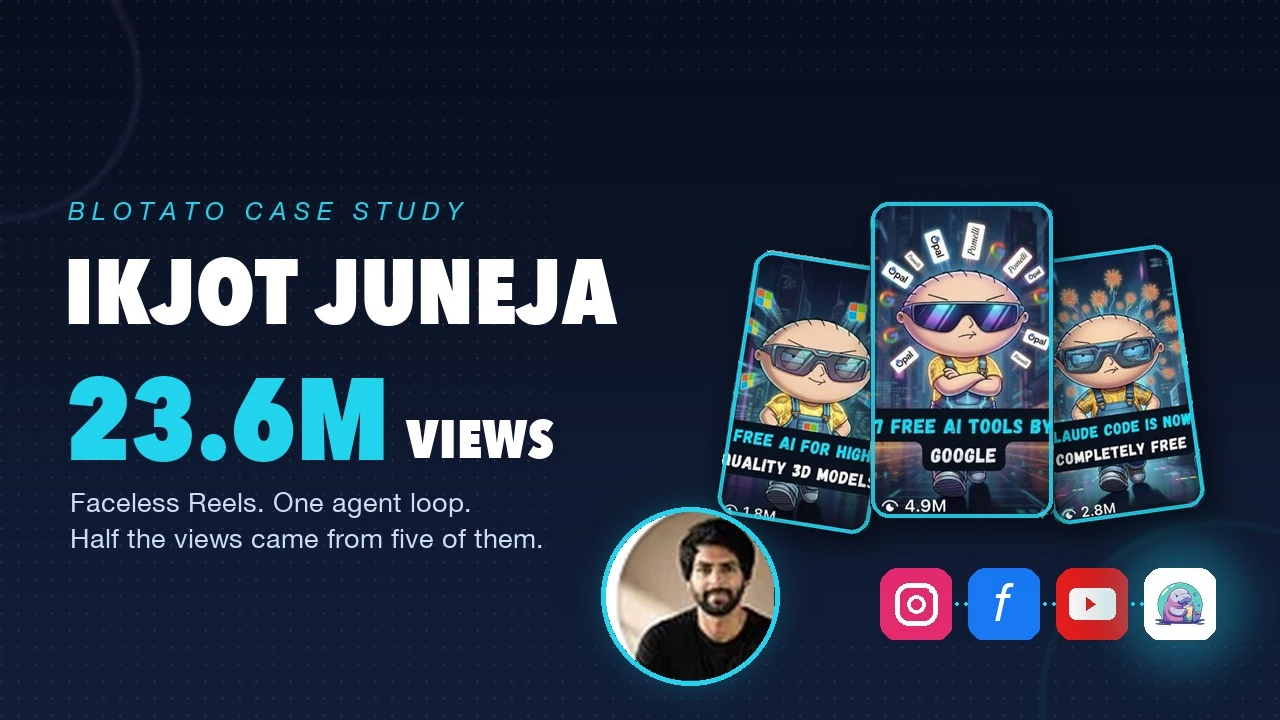
On August 26, Ikjot Juneja posted a note that opened with a number: 23.6M views, with a Grok bot behind every faceless Reel. Then he listed the top five. 4.9M, 2.8M, 1.8M, 1.2M, 988K.
He listed all of that himself. Add the five up, though, and you get 11.7M views, almost exactly half of his stated 23.6M total, from five videos. The ratio is the part worth building on, and it is not what the note is about.
He says he used to spend four hours a day finding the topic, writing the hook, making the visual, editing the Reel, posting it, and answering comments. An agent loop now runs most of that circuit, and he reviews four things: the first frame, the claim, the final animation, and the caption.
Fair warning that this is a Blotato user’s account of a stack that includes Blotato, published on Blotato’s blog. His view counts are his own and visible on his profile. Everything I say about the tools underneath comes from those vendors’ own repos and docs, and where his description and a repo disagree, I say so.
The Ratio Inside His Numbers
He also shared two screens of his profile grid, captured the same day. Seventeen Reels carry a legible view count across them, and those seventeen sum to 16.9M, so roughly 72% of his stated 23.6M sits in the videos you can actually see. More Reels continue below both crops, so seventeen is what is legible here, not his full catalog.
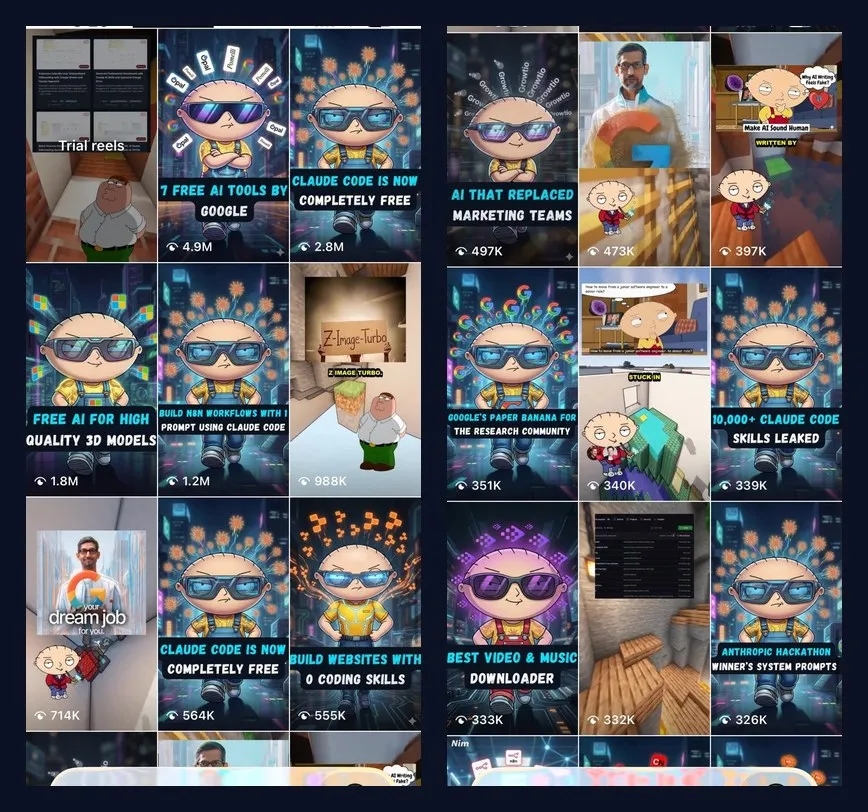
The curve is steep. 4.9M at the top, then a drop to 2.8M, then 1.8M, and by the seventeenth legible tile you are at 326K. Look at what the top tiles have in common. Most are the same faceless template, cartoon characters over game footage, and the claim burned into the first frame is doing the work: “Claude Code is now completely free,” “7 free AI tools by Google.” About a third use a photo or a product screenshot instead, so the format is looser than a single template.
That shape is the argument for automating this kind of content. If half your views come from five videos, you cannot pick the winners in advance, so the only variable you control is the cost of an attempt. At four hours per Reel a miss is an expensive day. When an agent runs the loop, a miss costs a review pass. That is the trade he actually made, and it is a better reason to build one of these than any single view count.
Lowering that cost means the publishing step has to be something an agent can call, not a dashboard someone logs into. That is what Blotato’s API and MCP server are for: one key covers 9 platforms, an agent calls it the same way whether it is posting to Instagram or YouTube, and the plan price is flat rather than metered per post.
The Loop, In His Own Words
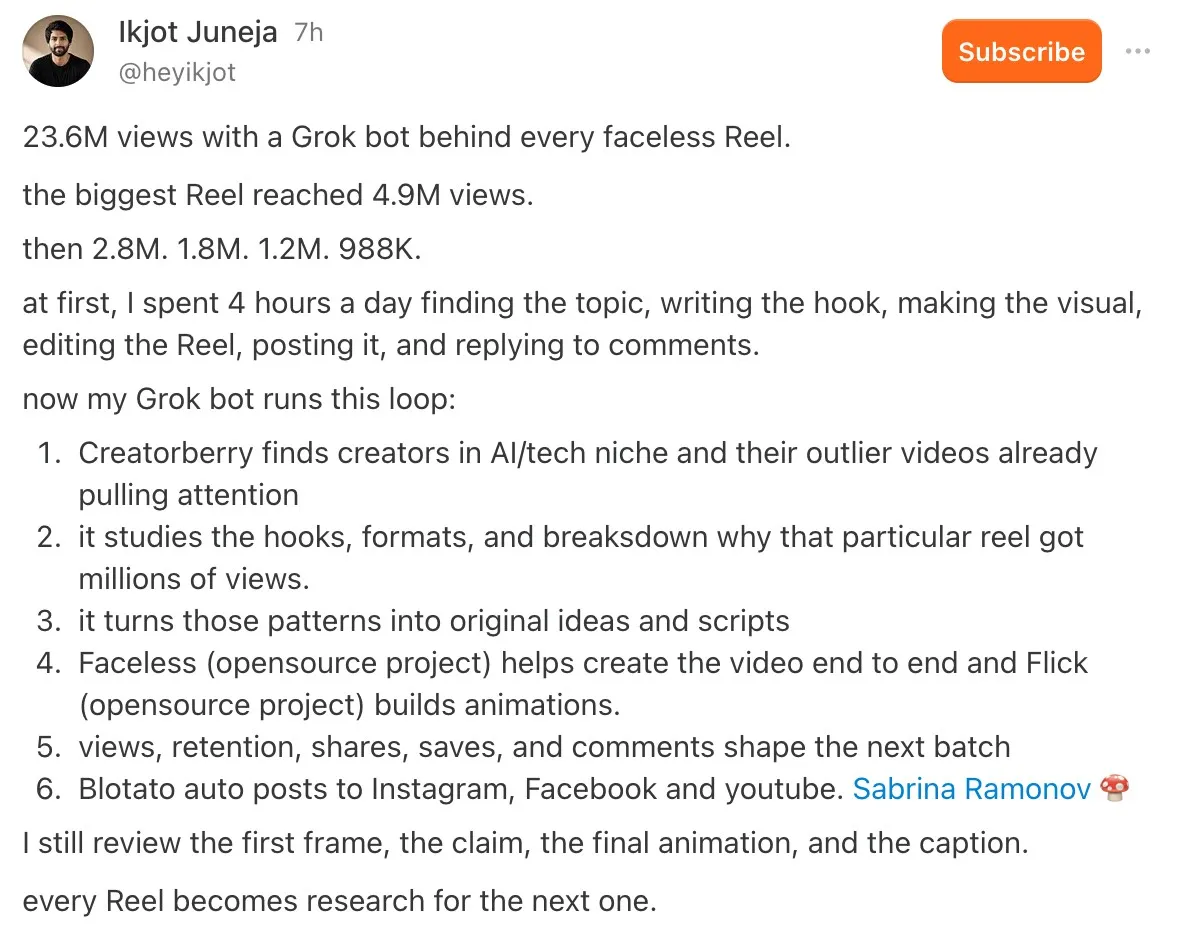
Here is the circuit he described, in his own order:
- Creatorberry finds creators in the AI and tech niche and surfaces their outlier videos, the ones already pulling attention
- It studies the hooks and formats, and breaks down why a given Reel got millions of views
- It turns those patterns into original ideas and scripts
- Faceless builds the video, and Flick builds the animations
- Views, retention, shares, saves and comments shape the next batch
- Blotato auto posts to Instagram, Facebook and YouTube, called as an API rather than a dashboard, so the agent finishes the job without a human opening a scheduler
Running this on a schedule rather than by hand is the whole difference between a loop and a hobby, and it is the same shape as automating Instagram Reels end to end. Step five is the one most people skip. Plenty of creators automate production and then judge the output by eye. Feeding the performance data back in as the input to the next batch is what makes it a loop instead of a conveyor belt, and it is the reason his own phrasing lands: every Reel becomes research for the next one.
The Part About His Stack That He Left Out
The named tools do not come from four different vendors.
Creatorberry is a paid product that tracks creators in a niche and flags outlier videos. Faceless and Flick are both MIT-licensed open source repos published by Creatorberry, positioned as companions to the paid product. So the shape of it is one vendor’s ecosystem, plus the agent running the loop, plus a publishing layer.
It works, so this is not a knock on the build. But if you read his note as a shopping list of four best-in-class picks, you would be misreading what he assembled.
One correction on the same point. He describes Faceless as creating the video “end to end,” and the repo’s README explicitly says otherwise: “Faceless starts from a script you provide. It does not research a product, find viral videos, create thumbnails, send Telegram messages, or use n8n.” What it actually does is narrower and more specific than that, which is turn a script into a character-dialogue reel with a Fish Audio voiceover over Minecraft footage. That is exactly what his Reels look like, so the tool is doing its job. The phrase just oversells its scope, and the Faceless repo was published on August 23, 2026, so treat it as new rather than battle-tested. It also locks you into one look, and if that is not yours, the faceless video generators worth testing differ mostly in how much of the edit they own. Flick, published a week earlier, has picked up real traction. Faceless has none yet.
Worth a footnote if you go looking: Flick is a common product name. The one in his stack is Creatorberry’s animation repo, not flick.social, the unrelated social media management platform.
Where He Keeps a Human
He named four checkpoints:
- The first frame, because on a feed that autoplays it is most of the pitch
- The claim, because an agent generating hooks from other people’s viral videos will happily produce something confident and wrong
- The final animation, because rendering breaks in ways a script does not catch
- The caption, because it is the part written in his voice rather than the agent’s
Notice what is not on that list. He does not review the topic selection, the script drafting, or the scheduling. He reviews the things that are expensive to get wrong and cheap to check, and he lets the agent own everything else.
That distinction is the transferable part of this whole setup. “Keep a human in the loop” is advice everyone repeats and almost nobody specifies. Naming the four exact checkpoints is what makes it a system instead of a sentiment.
What This Costs You in Practice
“Open source” here means the code is free, not the pipeline. Creatorberry, the piece doing the research and scripting, starts at $29 a month. Faceless needs a paid Fish Audio API key and a local asset download of roughly 2.4 GB. Grok Bot is bundled into xAI’s higher subscription tiers rather than sold standalone. The MIT-licensed repos are the only genuinely free part.
Our engagement surface, comments and DMs, is Instagram and Facebook only. That touches his step five directly: he publishes to three platforms and reads performance data back into the next batch, so on YouTube those metrics come back through Blotato while the comment replies he mentioned do not.
Faceless Reels Automation FAQs
Can an AI agent post Reels to Instagram automatically?
Yes. Blotato exposes publishing through a REST API and a hosted MCP server at mcp.blotato.com/mcp, so an agent authenticates once and posts to Instagram, Facebook, YouTube and six other platforms through the same key. The publish call returns a postSubmissionId, which is a receipt rather than proof, so poll blotato_get_post_status until it reports published or failed.
Do you need Grok specifically to run this?
No. Grok Bot is xAI’s always-on agent product, launched in August 2026, and it is a reasonable fit for this kind of loop: each bot gets its own cloud computer, signs into your tools, and works through multi-step jobs unsupervised, surfacing only when it needs approval. That maps onto what Ikjot describes. But nothing in the circuit is Grok-specific. The same loop runs on a Claude agent against the same MCP server, which is the setup in posting to Instagram with Claude.
Is this stack free?
Partly. Faceless and Flick are MIT licensed. Creatorberry, the Fish Audio voice key, and publishing are all paid. If you are wiring it into an agent, note that the 7-day trial excludes the API, and generating an API key ends the trial and starts the paid Starter plan, so plan on subscribing rather than trialing it.
What I Would Actually Copy
The headline on this one is 23.6M views. The finding is that five videos carried half of it.
Once you have seen that, the four-hours-to-a-review-pass story stops being about saved time and starts being about attempts. He did not find a way to make better Reels. He found a way to make being wrong cheap enough that one 4.9M outlier is worth the misses around it, and then he pointed the performance data back at the next batch.
What I would copy is not his tool list, which is mostly one vendor’s ecosystem and a repo published days ago. It is the four checkpoints. First frame, claim, animation, caption. Everything else runs unattended, and the things he kept are the ones where an agent’s confident mistake would cost him the account. Marc’s Claude setup draws the line in the same place, with an approval gate that stops the agent before it publishes rather than after.
Thanks to Ikjot for writing the loop up publicly, including the steps most people leave out.