6 Best Post Bridge Alternatives for Agent Builders in 2026
The best Post Bridge alternatives in 2026, compared on billing model, engagement coverage, and agent access. Tested by Sabrina Ramonov.

If you are searching for Post Bridge alternatives in 2026, you have probably just hit the ceiling rather than the price. Post Bridge is cheap and it publishes well, but the surface stops at posting and scheduling, so the moment your agent needs to reply to a comment you are shopping for a second vendor.
I build Blotato, which sits at number one here, so take that with the grain of salt it deserves and judge it on the numbers. I have included the account bands where Blotato is the more expensive choice, because a roundup that never loses is not worth reading.
Quick Comparison: 6 Best Post Bridge Alternatives
| Tool | Best For | Starting Price | Key Strength |
|---|---|---|---|
| Blotato | Builders whose agent writes and designs the post before publishing it | $29/mo | AI image and video generation behind the same key as publishing, on a flat bill |
| Zernio | Builders who need an agent to reply everywhere, not just publish | Free for 2 accounts, then $6/mo per account | DMs on 8 of its 16 platforms, comments and reviews on 9, per its rate card |
| Post Bridge | Solo operators publishing to many accounts on the smallest possible bill | $29/mo Starter, or $39/mo plus a $5 API add-on | Unlimited connected accounts at $99/mo |
| Postiz | Technical teams who want to own the software and self-host it | $29/mo hosted, free self-hosted | Open source, with AI image and video generation on paid plans |
| Upload-Post | Builders validating an agent before committing budget | Free tier available | A wide publishing surface with a genuinely usable free tier |
| Ayrshare | Products whose own customers connect their social accounts | API plans from $149/mo | Per-user account isolation built for multi-tenant products |
Every tool here runs a hosted MCP server, so “works with Claude” separates none of them. Ranking the servers by whether the agent finishes the job is the sharper test, and it is a different exercise from this one. What actually differs here is the billing model, how much of the stack sits behind one key, and whether the agent can create content or only ship it.
Why People Are Looking for Post Bridge Alternatives
The first reason is scope. Post Bridge publishes and schedules, and that is the product. Analytics is labelled beta on its pricing page, and there is no inbox or comment replying, so an agent that needs to respond to anything has to reach a second vendor to do it.
The second reason is that the details depend on which page you land on. The main pricing page lists Starter at $29 for 5 connected accounts, Creator at $39 for 15, Growth at $59 for 50, and Pro at $99 for unlimited, with the $5 API add-on offered on Creator and above. The agent page instead markets Starter plus the add-on at $34, which the pricing page does not support. Both pages are live at once, so check the pricing page before you budget. I have broken down all four price points and what each tier covers at real account counts in Post Bridge pricing.
The third is content. Post Bridge expects the post to arrive already written and already designed. If your agent generates captions and visuals, that is one more service, one more key, and one more bill sitting in front of the publish step. That split is really the whole question of whether your agent needs to make the asset or just ship it.
Best Post Bridge Alternatives for 2026
I ranked these on what an agent builder actually hits in production: the bill at the account count you will reach, what the agent can do besides publish, and whether the platform access is real.
1. Blotato: Best for builders whose agent creates the content it publishes

Blotato’s pricing, with connected accounts and AI credits listed per tier.
I built Blotato because publishing was never the part that cost me time. Writing the post, making the visual, and then getting it live across nine platforms was, and every tool I tried solved exactly one of those. Blotato puts AI image and video generation behind the same key as publishing and scheduling, so an agent goes from idea to live post without a second vendor in the middle.
Publishing and scheduling reach nine platforms. Comments and direct messages work on Instagram and Facebook. Analytics covers eight platforms, every one except LinkedIn. Credits are spent only on AI generation, never on publishing, scheduling, or API calls, and they roll over month to month.
One thing to know before signing up: the 7-day trial excludes the API, and generating a key ends the trial and starts the paid plan. If you are building an agent, plan on starting the subscription rather than trialing it.
Pros:
- AI image and video generation behind the same key as publishing
- Flat pricing that does not move with posting volume
- Real platform APIs, so there are no browser bots to babysit
Cons:
- Comments and DMs cover Instagram and Facebook only, where Zernio’s rate card lists DMs on 8 of its channels and comments on 9
- More expensive than Zernio below roughly seven accounts and again past forty
Pricing: Starter $29/mo for 20 accounts and 1,250 credits. Creator $97/mo for 40 accounts and 5,000 credits. Agency $499/mo for 100 accounts and 28,000 credits.
Ideal for: builders running an agent that writes and designs the post, not just one that ships it.
Bottom line: the strongest pick when creation and publishing belong behind one key on a predictable bill.
2. Zernio: Best for agents that need to reply beyond Instagram and Facebook
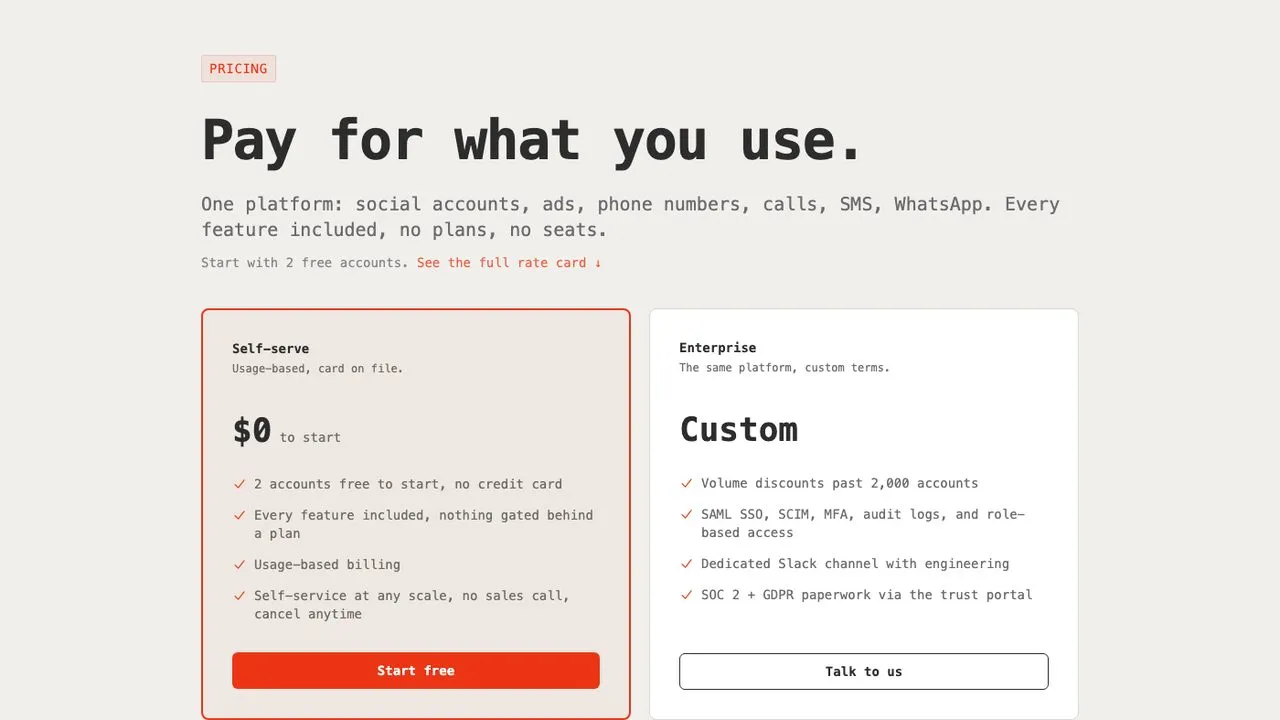
Zernio’s rate card, priced per connected account rather than per plan.
Zernio is the tool most likely to be underrated on a list like this, so here is the honest version. It exposes 496 MCP tools over one endpoint, publishes to 16 platforms including Google Business, reads and replies to comments and DMs on any platform that has an inbox, and runs ad campaigns across seven networks. If your agent needs to read and reply beyond Instagram and Facebook, where our own inbox stops, Zernio’s every-platform inbox beats Blotato.
The trade-off is the invoice. Pricing runs per connected account, so it starts near zero and climbs with every account you add rather than stepping at plan boundaries. I worked through where that per-account curve crosses our flat rate if you want the account bands.
Pros:
- DMs on 8 of its 16 platforms and comments on 9, the widest coverage here
- Two connected accounts free, so an agent can be validated at no cost
- Analytics and ads behind the same key as publishing
Cons:
- Per-account billing means cost grows with every account rather than staying flat
- No AI image or video generation, so content creation is a separate vendor
Pricing: first 2 accounts free, accounts 3 to 10 at $6/mo each, accounts 11 to 100 at $3/mo each, and $1/mo each past 101.
Ideal for: builders whose agent monitors and responds across many platforms.
Bottom line: the widest surface here, worth its per-account bill only when your agent actually replies across it.
3. Post Bridge: Best for solo operators publishing to many accounts cheaply
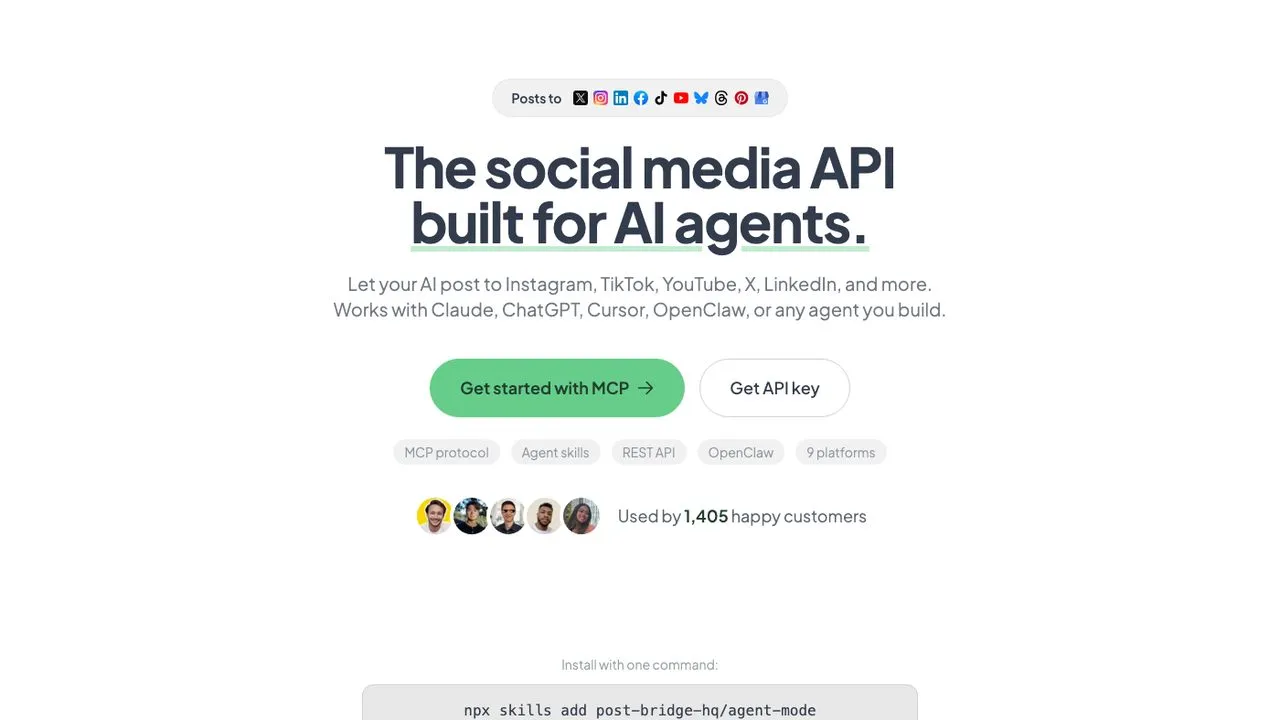
Post Bridge’s agent page, showing MCP, agent skills, REST API, and 9 platforms.
Worth being clear about what Post Bridge does well, because it does the core job properly and undercuts most of this list doing it. It ships a hosted MCP server, a REST API, a CLI, and an installable agent skill, and its platform list includes Google Business alongside the usual nine.
The unlimited-accounts tier at $99/mo is the most aggressive number in this comparison. If you connect dozens of accounts and only publish to them, nothing here beats that price.
Pros:
- Unlimited connected accounts at $99/mo
- Hosted MCP server, REST API, CLI, and an installable agent skill
- A $29/mo entry plan with MCP access included
Cons:
- No inbox or comment replying, so responding needs a second tool
- Analytics is labelled beta on its pricing page
Pricing: $29/mo for 5 accounts, $39/mo for 15, $59/mo for 50, $99/mo for unlimited. The $5 REST API add-on is listed on Creator and above.
Ideal for: solo operators whose agent publishes and nothing more.
Bottom line: the cheapest way to publish at scale, as long as publishing is genuinely all you need.
4. Postiz: Best for technical teams who want to own the software
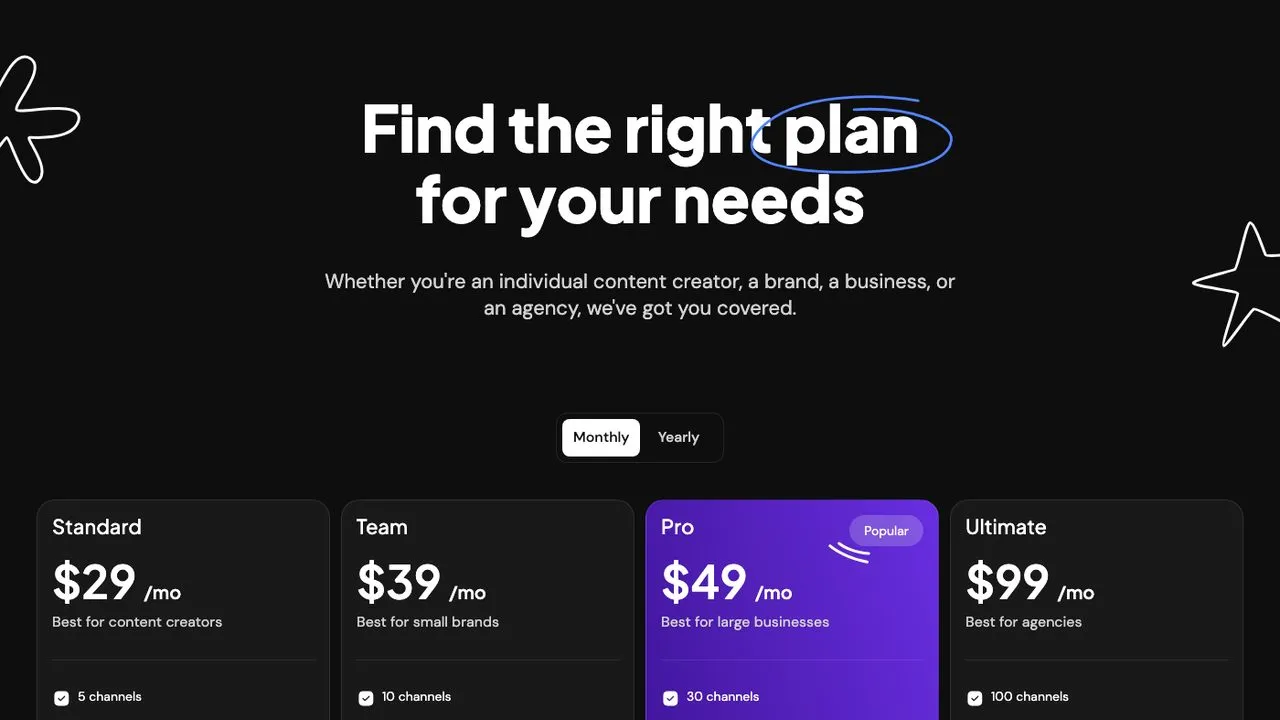
Postiz pricing, with a free self-hosted option beside the hosted tiers.
Postiz is open source, ships an MCP server, and is the only other tool here that generates images and video alongside publishing. Generation is metered as a monthly allowance that varies by plan rather than as credits that roll over.
Self-hosting is free, which is genuinely attractive if you would rather own the stack. It is also real operational work, and the platform approvals do not disappear because the software is yours. The hosted-versus-own-the-stack tradeoff is its own comparison.
Pros:
- Free to self-host, with no per-seat pricing
- AI text, image, and video generation included on paid plans
- Open source, so the roadmap is not somebody else’s decision
Cons:
- Self-hosting means maintaining the infrastructure and the platform tokens yourself
- AI generation is capped by a plan allowance rather than rolling credits
Pricing: $29/mo hosted on the Standard plan. Free if you self-host.
Ideal for: technical teams who want control of the deployment.
Bottom line: the right call when owning the software matters more than having somebody else run it.
5. Upload-Post: Best for builders validating an agent before paying
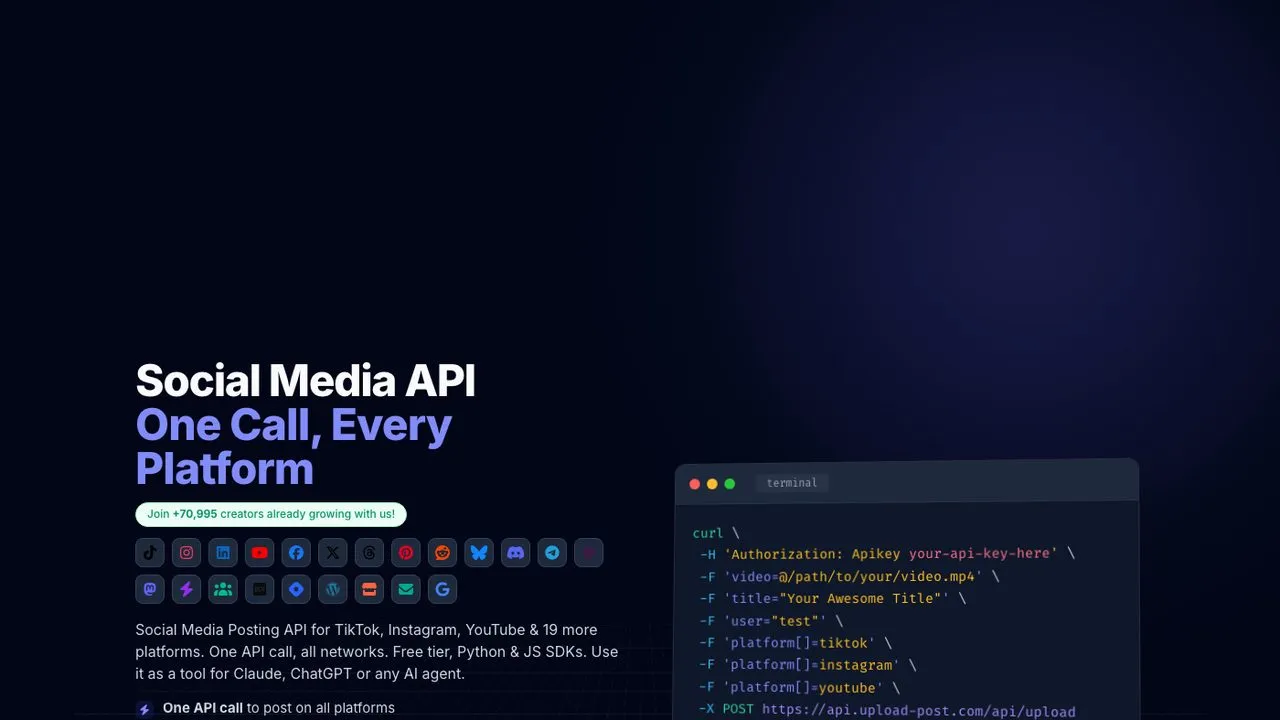
Upload-Post’s publishing API, with a free tier for testing an agent build.
Upload-Post is the low-commitment way onto this list. It ships an MCP server with a broad tool surface and a free tier that is actually usable, which makes it a sensible place to prove an agent works before any money changes hands.
It is a publishing layer, so the same second-vendor question applies once the agent needs to reply or generate content.
Pros:
- A free tier that is genuinely usable for testing
- Wide publishing surface behind one MCP server
Cons:
- Publishing focused, so engagement and creation live elsewhere
- Smaller and less established than the other tools here
Pricing: free tier available, with paid plans above it.
Ideal for: builders who want to validate the publish step before committing budget.
Bottom line: the cheapest way to find out whether your agent workflow holds up.
6. Ayrshare: Best for products whose own users connect accounts
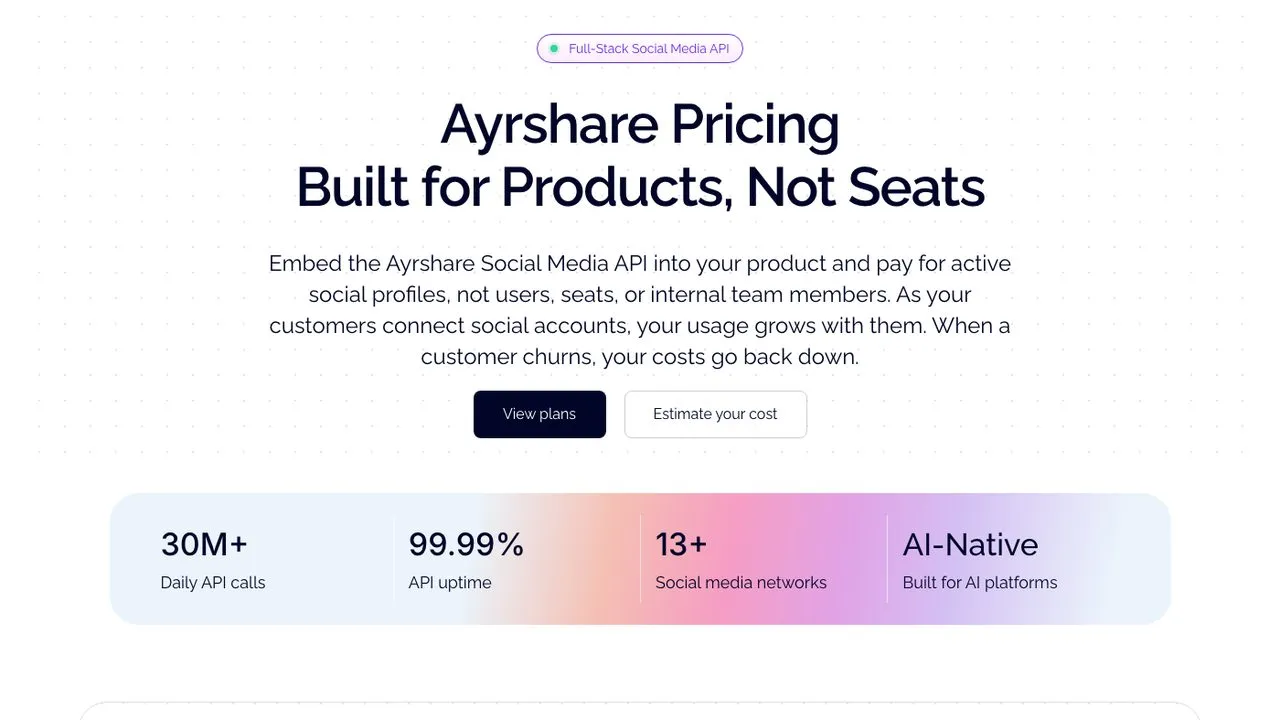
Ayrshare’s API pricing, built around isolated user profiles.
Ayrshare solves a different problem from everything else here. If you are building a product where your own customers connect their social accounts, you need per-user isolation, and that is what its architecture is designed around. Its Action MCP server handles publishing and engagement for those embedded builds.
The entry price reflects that. It is priced for a product with users, not for an operator running their own accounts.
Pros:
- Per-user account isolation designed for multi-tenant products
- Mature API with an MCP server for agent access
Cons:
- API plans start around $149/mo, steep for a single operator
- Overkill when the accounts being posted to are your own
Pricing: API plans from $149/mo.
Ideal for: SaaS products embedding social posting for their customers.
Bottom line: the right architecture when the accounts belong to your users rather than to you.
How I Chose These Post Bridge Alternatives
I evaluated every tool on five things: the billing model and what it costs at the account count you will actually reach, whether the agent can do anything beyond publishing, whether platform access runs on real APIs rather than browser automation, how much of the stack sits behind a single key, and how fast a builder can get an agent posting.
Pricing was verified live on each tool’s own pricing page on the day this published, and every capability claim was checked against the vendor’s own product and documentation pages rather than third-party summaries.
How to Choose the Right Post Bridge Alternative
If you connect dozens of accounts and only publish, Post Bridge at $99/mo for unlimited accounts is very hard to beat.
If your agent needs to reply to comments and DMs across many platforms, Zernio has the widest coverage here, including platforms Blotato does not reach.
If your agent generates the image or video it is about to post, Blotato and Postiz are the two that do creation and publishing behind one key, with Blotato hosted on rolling credits and Postiz self-hostable on a plan allowance.
If your own customers connect their accounts, Ayrshare is the only one built for that job.
If you are still testing whether the workflow holds up, start on Upload-Post’s or Zernio’s free tier and pay nothing until it does.
Sabrina’s Final Thoughts
Most people leaving Post Bridge are not leaving over price, because there is not much to beat there. They leave because publishing turned out to be the first step rather than the whole job, and the second step needed a vendor Post Bridge does not have. If your shortlist has narrowed to just these two, I put both tools side by side on price and scope separately.
Work out what your agent will need six months from now, then pick the tool that covers it behind one key. If that list includes writing and designing the post as well as shipping it, start with Blotato and skip the vendor sprawl.
Post Bridge Alternatives FAQs
What is the best Post Bridge alternative?
It depends on what your agent does beyond publishing. Blotato is the strongest pick when the agent also generates the image or video, since creation and publishing sit behind one key on a flat bill. Zernio is better when the agent needs to reply across many platforms, and Ayrshare is the right architecture when your own customers connect their accounts.
Is there a cheaper alternative to Post Bridge?
Zernio starts free for two connected accounts, Upload-Post has a free tier, and Postiz costs nothing if you self-host. Post Bridge is already inexpensive, with an entry plan at $29/mo and MCP included, so beating it on price alone usually means giving something up elsewhere.
Does Post Bridge have an MCP server?
Yes. Post Bridge runs a hosted MCP server alongside a REST API, a CLI, and an installable agent skill. Its endpoint sits under its main domain rather than an mcp subdomain. Every tool in this comparison ships MCP, so it does not separate them.
Which Post Bridge alternative handles comments and DMs?
Zernio’s rate card lists DMs on 8 of its 16 channels and comments and reviews on 9, the widest coverage on this list, though its own marketing says “any platform that has an inbox” and the rate card does not support that. Blotato handles comments and direct messages on Instagram and Facebook. Post Bridge, Postiz, and Upload-Post are publishing and scheduling layers without an inbox.
How many platforms does Post Bridge support?
Its platform list enumerates ten including Google Business, while its homepage headline says nine. Zernio covers 16 platforms, and Blotato publishes to nine and does not cover Google Business. Check the live list if one specific destination is the reason you are buying.