8 Best RobinReach Alternatives for Managing Brands (2026)
The best RobinReach alternatives for social media management in 2026, compared on brand limits, API tiers, and X caps. Tested by Sabrina Ramonov.

Most people hunting for RobinReach alternatives in 2026 hit one of two walls. Either you counted your brands and found the next tier costs double, or you went to connect Claude and discovered the API does not exist until $24. Blotato is my top pick and I founded it, so weigh that accordingly. RobinReach is a competent multi-brand dashboard, and its tier structure is what sends people looking.
This list leans toward tools built for running several brands at once, because that is what RobinReach is for.
Quick Comparison: 8 Best RobinReach Alternatives
| Tool | Best For | Starting Price | Key Strength |
|---|---|---|---|
| Blotato | Operators who want the API on the plan they can afford | $29/mo | API and hosted MCP included at the lowest paid tier |
| Metricool | Reporting-led managers juggling client brands | Free, then $20/mo | Five brands at $20 with analytics as the core product |
| Publer | Teams who want to pay per account, not per plan | Free, then $5/mo | Every tenth social account is free |
| Vista Social | Agencies running 15+ client profiles | $79/mo | 15 profiles included before any per-seat math starts |
| Zernio | Operators whose client roster changes month to month | Free, then $6 per account/mo | No plan to outgrow and no feature gates |
| SocialBee | Solopreneurs recycling evergreen content | $29/mo | Category-based queues that refill themselves |
| Postiz | Teams who want unlimited posts per month | $29/mo | No post ceiling on any paid tier, hosted or self-hosted |
| Buffer | Creators who post to X more than five times a day | Free, then $6 per channel/mo ($5 annual) | Treats X as an ordinary channel with no daily cap |
Why People Are Looking for RobinReach Alternatives
The API gate is the headline. RobinReach sells five tiers, and the two cheapest have no API and no MCP access at all. Seed is free with 2 profiles and 20 posts, Sprout is $9 with 5 profiles, and neither can talk to an agent. API and MCP begin at Bloom, $24/mo, so the real entry price for anyone automating is nearly triple the advertised one.
The second gate is X, and it surprises people. X is also Bloom-and-above, and it carries hard daily caps: 1 X account and 5 tweets per day on Bloom, 3 accounts and 12 per day on Thrive, 10 accounts and 15 per day on Scale. Those limits are per plan, not per account. If posting to X more than a handful of times a day matters, no RobinReach tier solves it, and the $99 Scale plan still tops out at 15.
The third reason is brand math. Bloom covers 5 brands, Thrive 15, Scale unlimited. The jump from 5 to 15 brands doubles your bill from $24 to $49, and agencies tend to cross that line one client at a time. Tools priced per connected account rather than per brand tier behave very differently as you grow.
It is worth seeing that difference in numbers, because it is the whole argument for switching. Take an agency at six brands, one client past the Bloom ceiling. On RobinReach that is $49/mo on Thrive, and you are paying for nine brand slots you are not using. On Publer at roughly three accounts per brand, eighteen accounts runs about $73 on Professional, more expensive but with no wasted capacity. On Zernio those same eighteen accounts cost $72, and on Metricool six brands sits inside the $36 tier.
There is no universally cheaper answer, which is the point. Tier pricing wastes money in the gaps and saves it at the top of each band. Per-account pricing tracks reality but never gives you a bargain. Work out which side of your next band you actually sit on before you switch, because the tool that looks cheaper at your current size may not be at the size you will be in six months.
Worth saying plainly: RobinReach’s user sentiment is genuinely decent. It holds 4.1 out of 5 on Trustpilot, and reviewers repeatedly praise the interface and a founder who answers publicly. There is also a Trustpilot account of a customer auto-upgraded eight days into a subscription and charged more than $7,000, refunded in full once raised. Read the billing terms before you scale a plan.
Best RobinReach Alternatives for 2026
I weighted these for someone managing multiple brands who wants either a cheaper path to the API or a pricing model that grows more gently.
1. Blotato: Best for the API on the plan you can afford
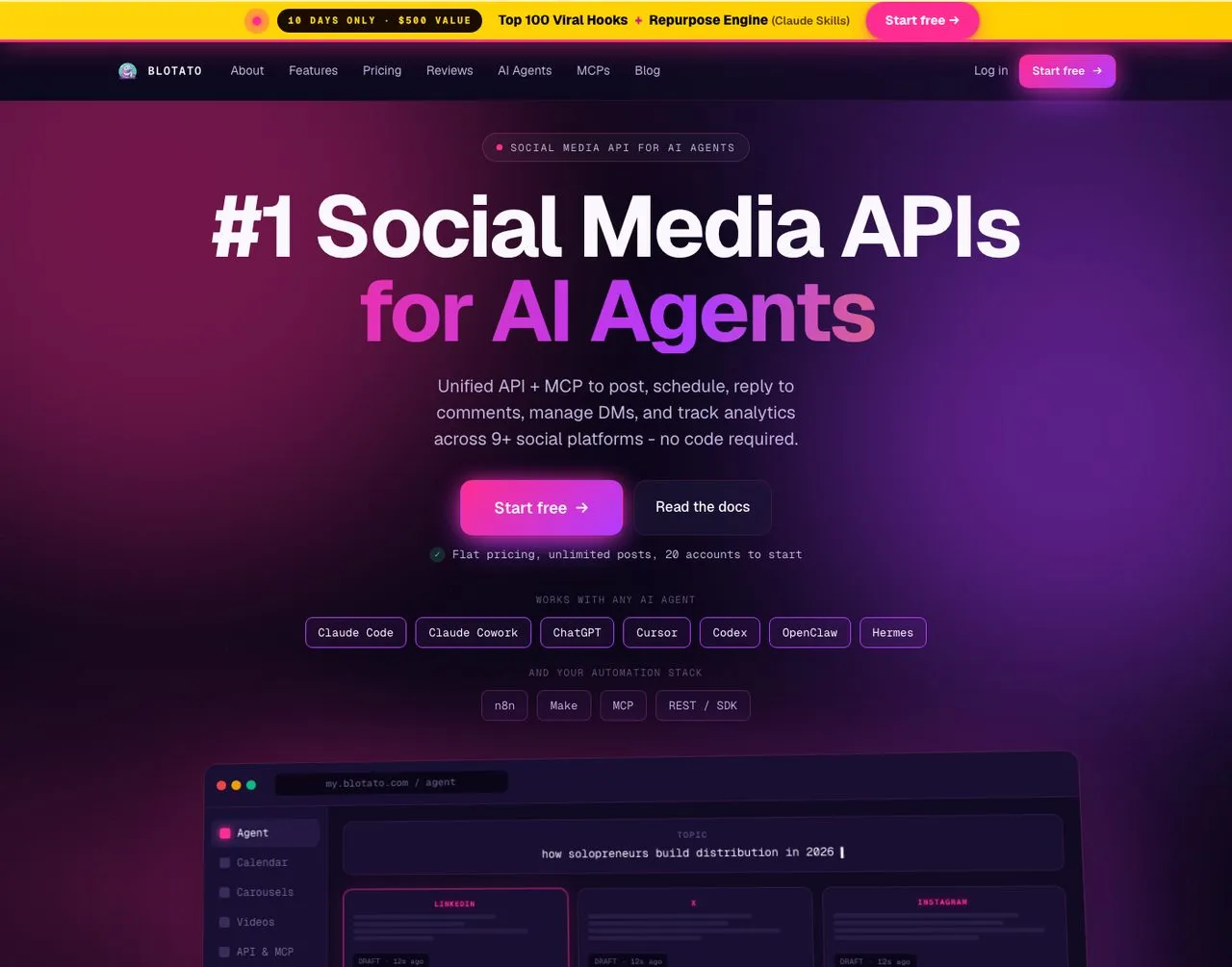
Blotato includes API and hosted MCP access on its lowest paid tier.
The reason Blotato leads a RobinReach comparison is narrow and specific: there is no API tier. Starter at $29/mo includes the API, the hosted MCP server at mcp.blotato.com/mcp, and 20 connected accounts, and we impose no daily posting cap on X beyond what the platform itself allows.
Beyond publishing to 9 platforms, one key also reads and posts comments on Instagram and Facebook, handles direct messages on those same two networks, and pulls analytics from eight. I built it that way because the alternative was three vendors and three approval processes.
Where it falls short of RobinReach: there is no free tier and no $9 entry point. If your budget genuinely is under $29 a month, RobinReach’s Sprout plan does more for the money as long as you never need the API.
Pricing: Starter $29/mo (20 accounts), Creator $97/mo (40 accounts), Agency $499/mo. The 7-day trial excludes the API, so an API or MCP user should plan on starting the Starter subscription instead of trialing.
Ideal for: Solo builders and small teams wiring social publishing into Claude, n8n, or Make.
Bottom line: The API is on the first paid plan, which is the entire complaint people bring here. The Starter plan is where that starts, and I go through the head-to-head against RobinReach separately.
2. Metricool: Best for reporting-led brand management
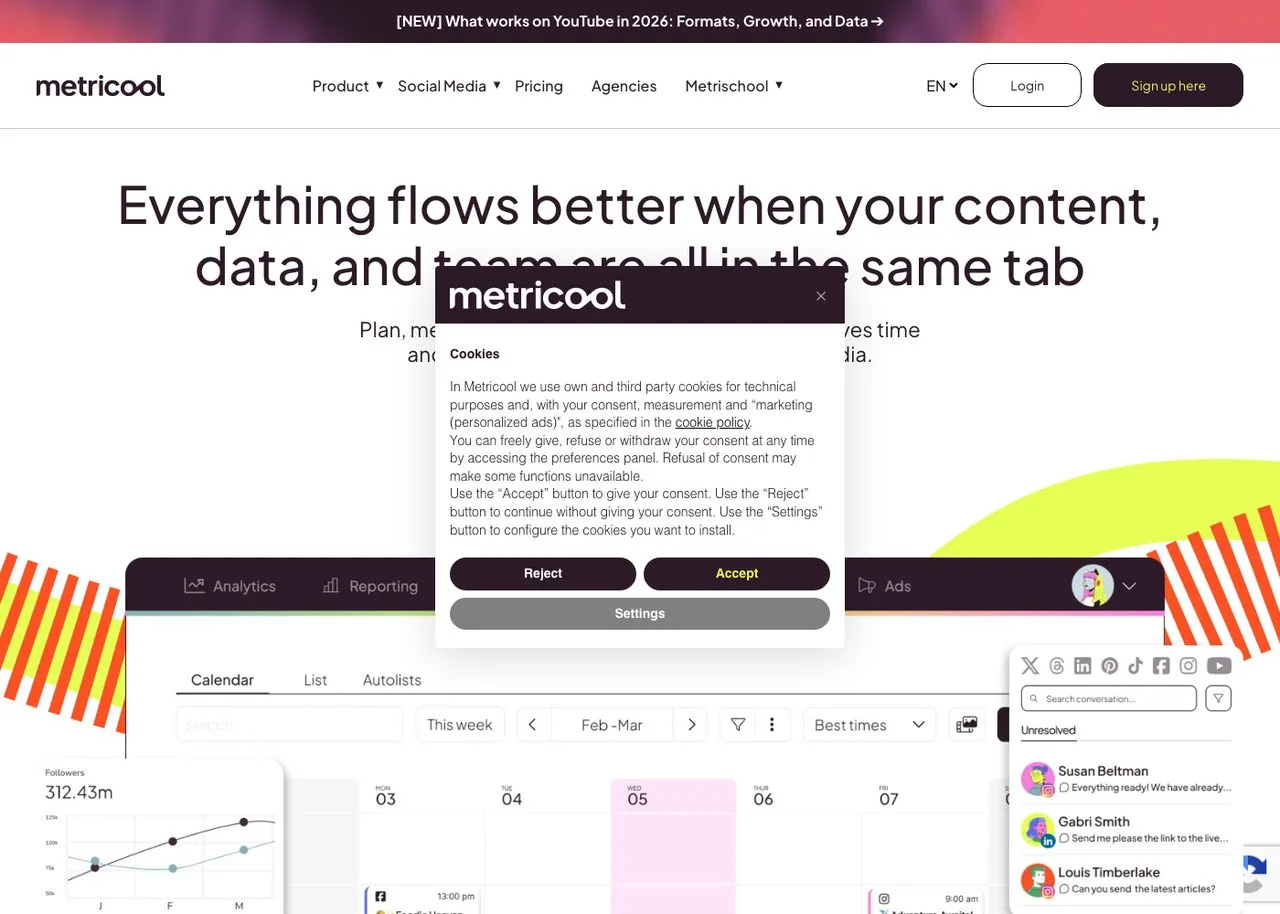
Metricool organizes work by brand and leads with analytics rather than publishing.
Metricool is the closest structural match to RobinReach’s brand model, and it is cheaper at the same brand count: $20/mo covers 5 brands where RobinReach charges $24, and $36 covers 10. There is a real free plan for a single brand.
Its strength is reporting depth rather than publishing. If the reason you manage brands is to send clients monthly performance decks, this is a better-shaped product. Note how it splits programmatic access: the MCP server works on every plan including Free, while the HTTP API used by Zapier and Make requires Advanced at $53. For an agent-driven reader that is unusually generous at the bottom of the range.
Pros:
- Five brands for $20, cheaper than RobinReach’s equivalent
- MCP works on every plan, including Free
- Analytics and reporting are the core product
Cons:
- The HTTP API needs the $53 Advanced plan
- Publishing feels secondary to measurement
Pricing: Free (1 brand), Starter from $20/mo (5 brands, $36 for 10), Advanced from $53/mo (15 brands, $85 for 25, $159 for 50), Custom on request.
Ideal for: Freelancers and agencies whose deliverable is a report, not just a post.
Bottom line: Better value than RobinReach at the same brand count if reporting is the job.
3. Publer: Best for paying per account instead of per plan
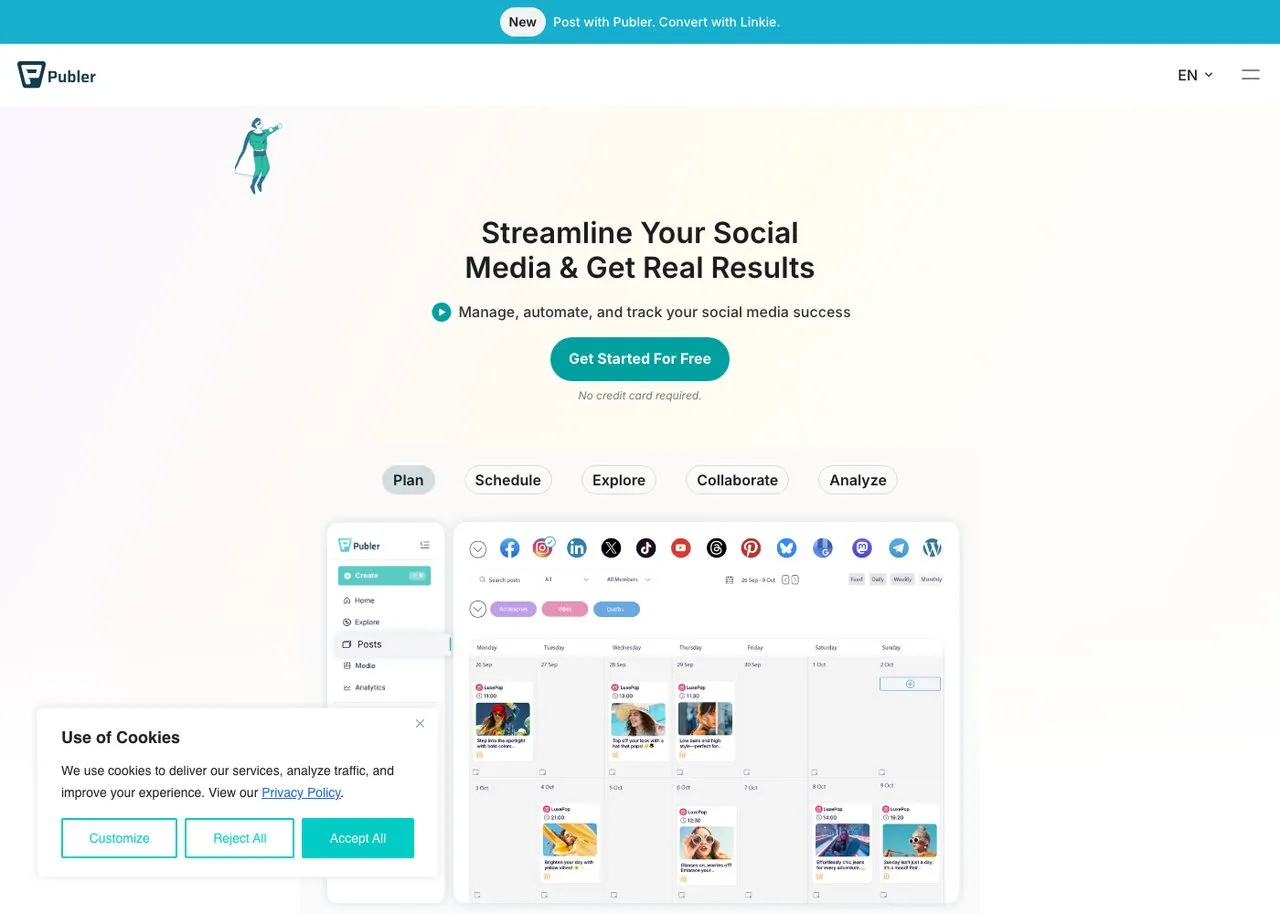
Publer prices per connected social account rather than by plan tier.
Publer sidesteps the brand-tier jump entirely by charging per social account. Professional starts at $5 for the first account and $4 for each additional one, Business at $10 then $7 each, and every tenth account is free. There is no moment where adding one client doubles your bill.
Two things to check. The API is limited to Business and Enterprise plans in good standing, so it is not an entry-tier feature. And Publer’s own MCP server is in beta for top ambassadors and Enterprise customers, set up from inside the dashboard rather than at a public endpoint, so there is nothing to point a URL at unless you are in that group. If driving it from an agent matters, confirm the current state with Publer before committing, and see which tier actually opens the door.
Pros:
- Per-account pricing with no tier cliffs
- Every tenth social account is free
- Free plan covers 3 accounts
Cons:
- API restricted to Business and Enterprise plans
- No first-party MCP server, only a community build
Pricing: Free (3 accounts, X excluded), Professional from $5/mo (first account, $4 each additional), Business from $10/mo (first account, $7 each additional), Enterprise custom.
Ideal for: Teams whose account count grows steadily rather than in jumps.
Bottom line: The gentlest growth curve here, provided you do not need the API early. More options in our Publer alternatives guide.
4. Vista Social: Best for agencies running many client profiles
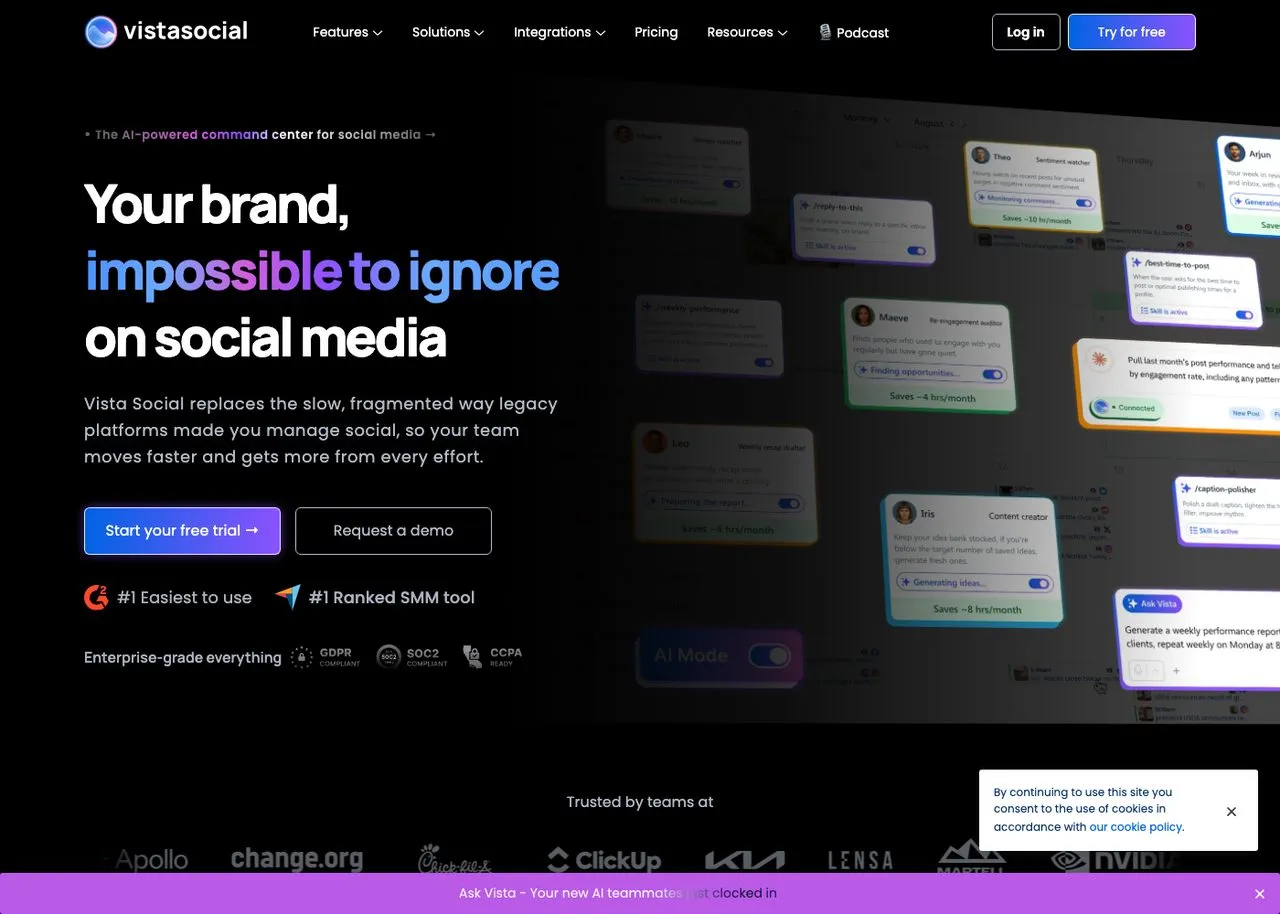
Vista Social bundles 15 client profiles into its entry agency plan.
Vista Social is built for the agency case RobinReach’s Thrive tier addresses, and it includes more at the same rough price point: $79/mo covers 15 profiles and 2 users, against RobinReach’s $49 for 15 brands with a 12-tweet daily X cap.
It also ships an unusually deep MCP server, included from the Advanced plan at $149, spanning scheduling, analytics, inbox, tasks and listening. The connection is a per-user link from account settings rather than a public endpoint you paste into a config file, which is worth knowing before you plan an integration around it.
The tradeoff against RobinReach is straightforward. You pay more at the entry point, $79 against $24, and you get profile headroom plus a genuinely broad agent surface once you reach Advanced. If you are at five brands and staying there, that is a bad trade. If you are at twelve and adding, it stops looking expensive quickly.
Pros:
- 15 profiles included at the entry plan
- Deep MCP coverage beyond publishing on Advanced
- Strong multi-profile workflows for client work
Cons:
- Entry price is higher than most tools here
- MCP requires the $149 Advanced plan
Pricing: Professional $79/mo (15 profiles, 2 users), Advanced $149/mo (30 profiles, 4 users), Scale $349/mo (70 profiles, 8 users), Enterprise custom. 14-day trial, no card.
Ideal for: Established agencies whose profile count is already past ten.
Bottom line: More capable than RobinReach at the agency tier, and priced like it.
5. Zernio: Best when your client roster keeps changing
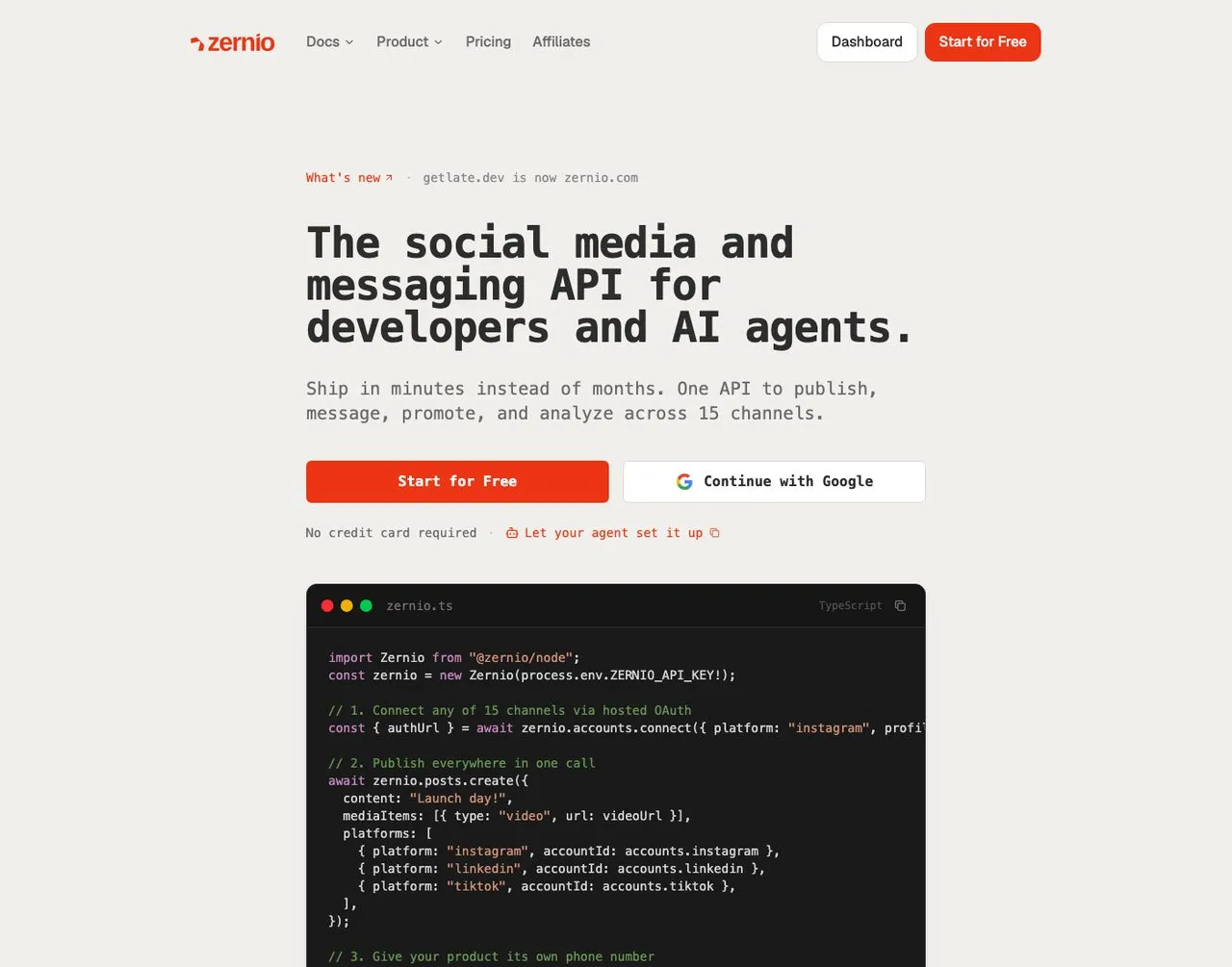
Zernio charges per connected account with graduated rates and no plan tiers.
Zernio has no plans to outgrow, which is a genuinely different shape from RobinReach’s five tiers. The first two accounts are free, accounts 3 to 10 cost $6 each, 11 to 100 cost $3, and past 100 the rate falls to $1. Scheduling, analytics, inbox and full API access come with every account.
For an agency onboarding and offboarding clients, the bill tracks reality instead of forcing a tier jump. Below about 15 accounts it costs more than a flat plan, which is the honest tradeoff.
Pros:
- No tiers and no feature gates at any level
- API included on every account, including the free two
- Rate drops to $1 per account at scale
Cons:
- More expensive than flat pricing at small counts
- Costs rise with every account you connect
Pricing: Free for 1-2 accounts, $6/account (3-10), $3/account (11-100), $1/account (101+).
Ideal for: Agencies with a churning roster where fixed tiers waste money.
Bottom line: Elastic pricing that suits variable client lists. Full detail in our Zernio alternatives guide.
6. SocialBee: Best for evergreen content recycling
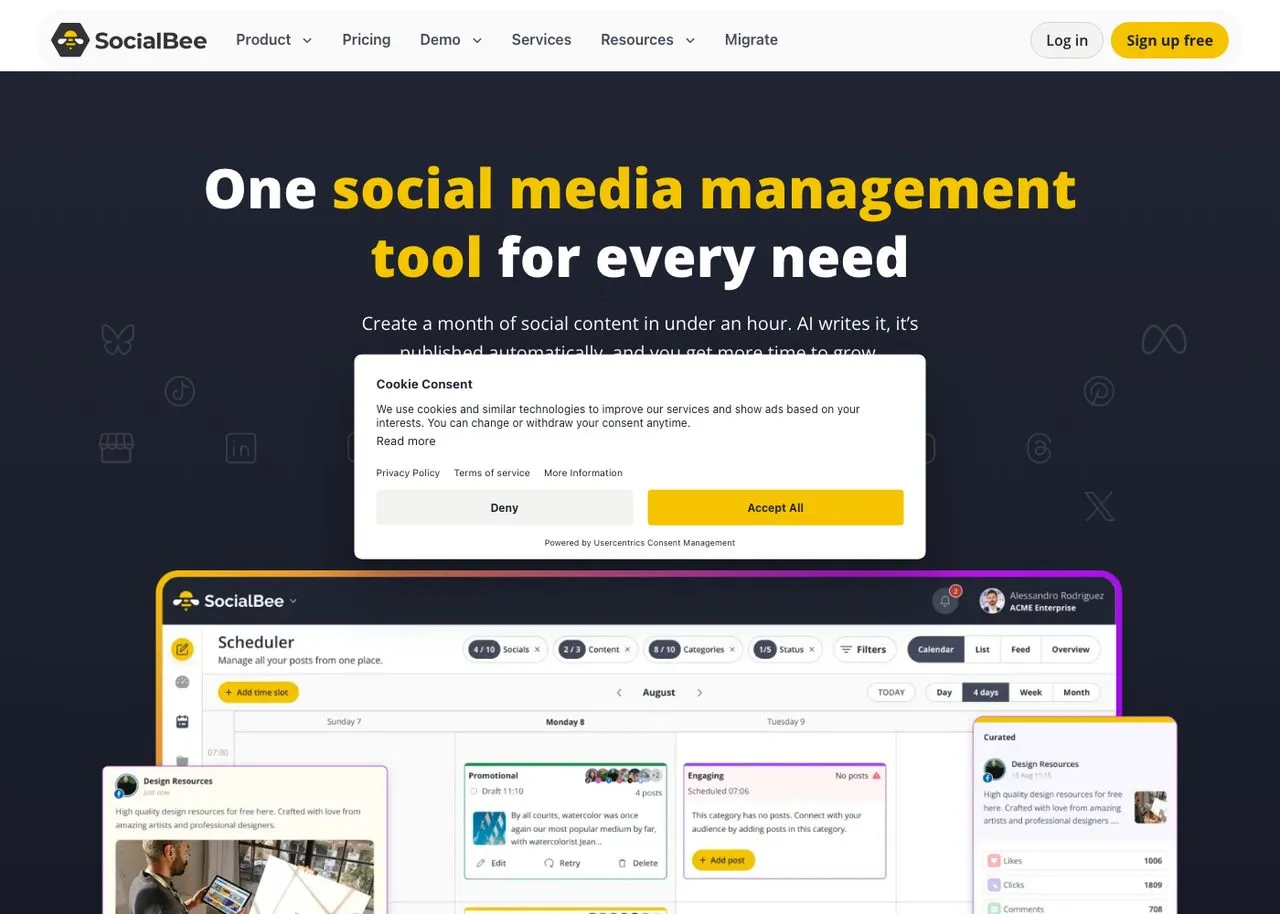
SocialBee organizes posts into categories that recycle on a schedule.
SocialBee solves a different problem from everything else here: keeping a queue full without writing new posts every week. Content goes into categories, and categories recycle on a schedule, which suits solopreneurs more than agencies.
Be clear-eyed about the limits. SocialBee has no public API, and their own help documentation directs anyone asking to email them, so integrations run through Zapier or Make. If automating from code matters at all, this is the wrong tool.
It earns its place on this list anyway, because a real slice of RobinReach users are not automating anything. They are one person keeping several brands alive, and the actual bottleneck is producing enough posts to fill the week. Category recycling solves that specific problem better than any API would.
Pros:
- Category-based evergreen recycling is genuinely distinctive
- Straightforward flat tiers by profile count
- 14-day trial with no card
Cons:
- No public API at all
- No MCP server
Pricing: Bootstrap $29/mo (5 profiles, 1 user), Accelerate $49/mo (10 profiles), Pro $99/mo (25 profiles, 3 users), agency tiers from $179/mo.
Ideal for: Solopreneurs whose bottleneck is content volume, not integration.
Bottom line: Great at recycling, unsuitable if you came here for an API.
7. Postiz: Best for unlimited monthly posts

Postiz includes unlimited monthly posts on every paid tier.
Postiz removes the volume ceiling that RobinReach’s Seed and Sprout tiers impose. Posts are unlimited on all four paid tiers, the API is included on every one, and the same product can be self-hosted for free if you would rather own it.
Pricing is channel-based: $29 covers 5 channels, $39 covers 10, $49 covers 30, $99 covers 100. A single brand posting to five networks fills the entry tier by itself.
Pros:
- Unlimited posts per month on every paid plan
- API on all tiers with a self-hosting option
- Simple upgrade path by channel count
Cons:
- Entry tier covers only 5 channels
- Self-hosting shifts maintenance onto you
Pricing: Standard $29/mo (5 channels), Team $39/mo (10), Pro $49/mo (30), Ultimate $99/mo (100). Self-hosting free.
Ideal for: Teams with high posting volume across a modest channel count.
Bottom line: The right pick if RobinReach’s post caps rather than its price pushed you out.
8. Buffer: Best for posting to X without a daily cap
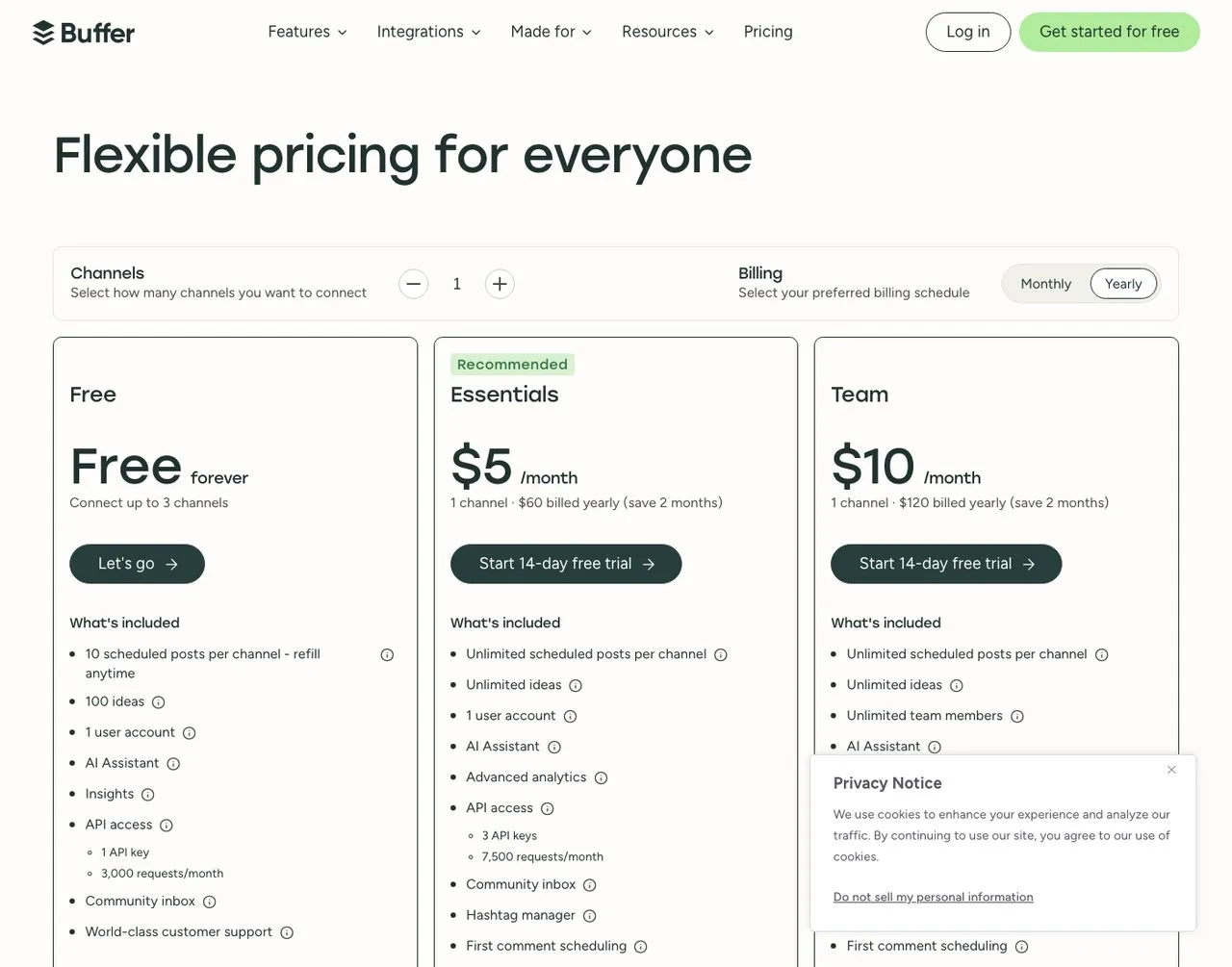
Buffer’s free plan includes an API key with 3,000 monthly requests.
If RobinReach’s X caps are your blocker, Buffer is the most direct answer here. It treats X as an ordinary channel at $5/mo with no vendor-imposed daily tweet limit, and its free plan ships a real API key with 3,000 requests a month, which is more API access than RobinReach gives at $9.
Per-channel pricing is the catch. Ten channels on Essentials runs about $50/mo, and Buffer remains a scheduling product rather than an agent platform, though it does operate an MCP server.
Pros:
- Free plan includes genuine API access
- No daily posting cap on X
- Mature and reliable
Cons:
- Per-channel cost adds up past a few channels
- Built for scheduling rather than agent workflows
Pricing: Free plan available, Essentials $6 per channel/mo ($5 annual), Team $12 per channel/mo ($10 annual). Volume discounts kick in at channel 11, where the rate falls to $4, then to $3 past 25.
Ideal for: Creators running a few channels who post to X frequently.
Bottom line: The cheapest uncapped route to X. More in our Buffer alternatives roundup.
How I Chose These RobinReach Alternatives
- What does the API actually cost? Not the headline price, but the cheapest plan that includes API access.
- How does the bill behave when you add a client? Brand tiers jump, per-account pricing slopes.
- Are there per-platform caps? Daily ceilings on a specific network are easy to miss and hard to work around later.
- Is there a free or genuinely cheap entry point? RobinReach’s free tier is real, and dropping it is a cost worth naming.
- Does it suit multi-brand work? A tool built for one brand rarely stretches to ten.
Tier details come straight from each vendor’s pricing page, which matters here because the gating differences are the whole comparison and directories rarely record which tier a feature sits on. MCP availability was checked at the endpoint or in the docs, and sentiment comes from G2, Capterra, Trustpilot, AppSumo and Reddit.
How to Choose the Right RobinReach Alternative
If the $24 API gate is the problem: Blotato includes it at $29 with 20 accounts, and Zernio includes it on its free two accounts.
If the X daily cap is the problem: Buffer treats X as a normal channel. Postiz and Blotato impose no vendor-side daily tweet limit.
If you manage 15+ brands: Vista Social bundles 15 profiles at $79, and Zernio charges $3 per account in that range.
If you want to keep a free tier: Metricool, Publer, Buffer and Zernio all have one. Buffer and Zernio include API access on theirs, and Metricool lets the MCP server run on Free even though its HTTP API does not.
If reporting is your deliverable: Metricool is built around analytics in a way none of the others are, though its brand bands and its Advanced-only API catch people out later, which is what the Metricool alternatives comparison digs into.
If you mostly want a dashboard: Stay on RobinReach. If you are not using the API, the $9 Sprout plan is hard to beat on price.
Final Recommendation
The pattern in almost every RobinReach complaint I read was the same shape: someone bought a plan for a price and then found the feature they came for one tier up. That is a pricing-design problem rather than a product problem, and whether it matters depends entirely on whether you are building or posting.
If you are building and you want the API on the first paid plan with the caps documented before you subscribe, Blotato’s entry plan was designed against exactly that complaint. If your deliverable is a monthly client report rather than a published post, Blotato is the wrong shape for you: there is no white-label reporting here and analytics skip LinkedIn entirely, so a brand-reporting workflow will hit that wall on day one.
RobinReach Alternatives FAQs
What is the best RobinReach alternative for AI agents?
Blotato, for a specific reason: the API and hosted MCP server are on the $29 entry plan, so there is no tier to climb before your agent can post. The tier-by-tier comparison works through where each one unlocks programmatic access. Zernio is the cheaper route if your account count is tiny, since its first two accounts are free and include full API access.
Does RobinReach have a free plan?
Yes. The Seed tier is free forever and includes 1 brand, 2 social profiles, and 20 posts, with 10 AI-generated posts a month. It does not include API or MCP access, and it excludes X. For a free plan that does include API access, Buffer ships a key with 3,000 requests a month and Zernio gives full API access on two accounts.
Why is X limited on RobinReach?
X sits on the Bloom tier and above, with daily posting caps of 5 tweets on Bloom, 12 on Thrive, and 15 on Scale. The limits are per plan rather than per connected account, so adding profiles does not raise the ceiling. Verify those numbers against your posting schedule before subscribing.
Which RobinReach alternative is cheapest for managing multiple brands?
Metricool at $20/mo for 5 brands undercuts RobinReach’s $24 Bloom tier at the same brand count, and $36 covers 10. If your accounts grow one at a time rather than in blocks, Publer starts at $5 and charges $4 for each additional account, with every tenth free, which avoids tier jumps entirely.
Do all these alternatives have an API?
No, and it is worth checking before you switch. Blotato, Zernio, Postiz, Buffer and Vista Social all expose one. Publer restricts its API to Business and Enterprise plans, Metricool gates its HTTP API to Advanced at $53 while letting MCP run on any plan, and SocialBee has no public API at all.